
Paper Pulp Market Share, Growth & Demand by 2034
Coverage: By Material (Virgin, Recycled); Grade (Writing Paper Grade, Packaging Grade); End Use Industry (Packaging, Commercial Printing, Building and Construction, Hygiene); and Geography (North America, Europe, Asia Pacific, and South and Central America)
- Status : Data Released
- Report Code : TIPRE00023254
- Category : Chemicals and Materials
- No. of Pages : 150
- Available Report Formats :


- Last update date : October 22, 2026


2025 Market Size
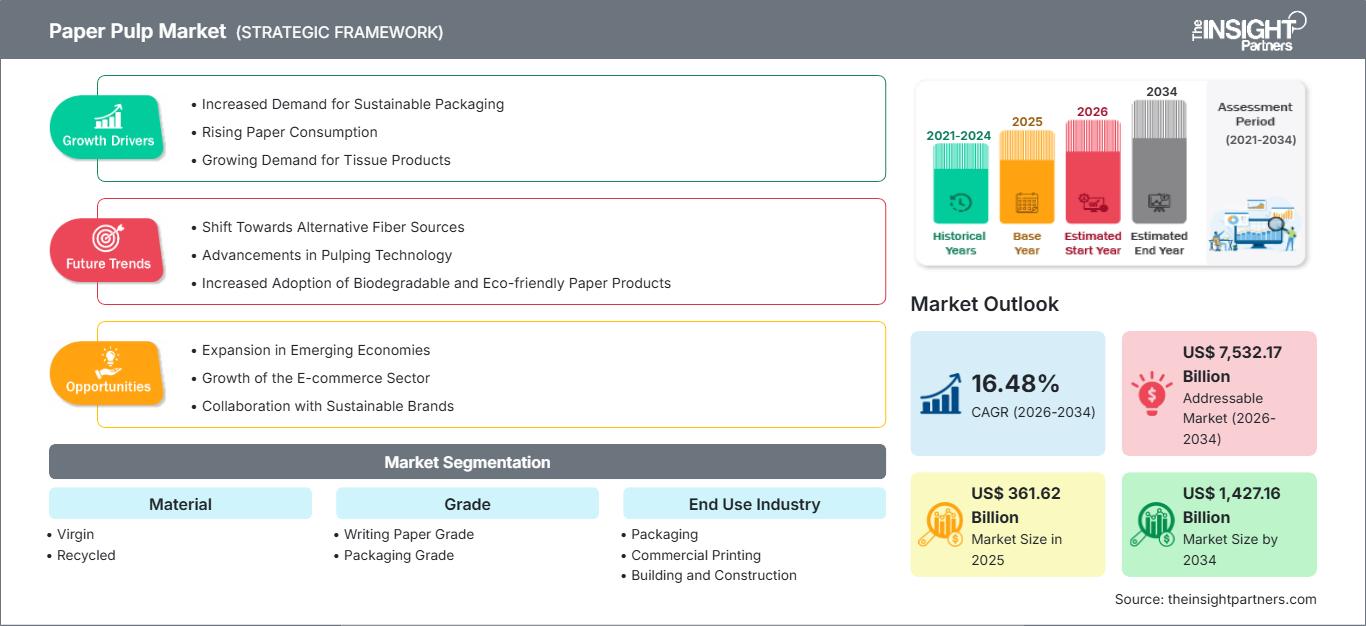
US$ 361.62 Bn
Base year value
2034 Forecast
US$ 1,427.16 Bn
Projected by 2034
CAGR 2026-2034
16.48 %
Growth rate
Addressable Market
US$ 7,532.17 Bn
(2026-2034)
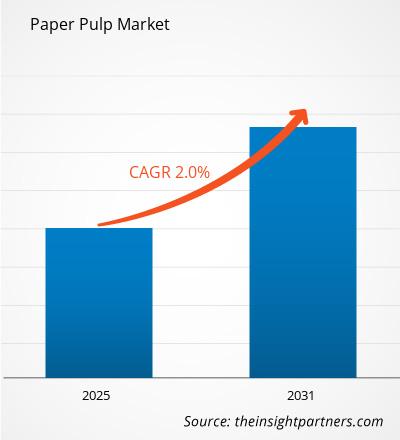
The Paper Pulp Market size is undergoing a structural transition as packaging demand, recovered-fiber utilization, hygiene applications, and investment in efficient pulp assets reshape the global value chain. The market is valued at US$ 361.62 Billion in 2025 and is projected to reach US$ 1,427.16 billion by 2034, registering a CAGR of 16.48% during 2026–2034. Expansion of fiber-based packaging, rising tissue consumption, and capacity additions are strengthening long-term demand across major producing and consuming economies.
North America remains an important production and consumption base for Paper Pulp, supported by established forestry resources, integrated mills, recycling infrastructure, and strong packaging conversion capacity. The region is expected to expand at approximately 12–15% CAGR during 2026–2034, with e-commerce packaging, lightweight containerboard, hygiene products, and recovered-fiber utilization providing structural support. The region also benefits from established logistics and customer qualification networks.
Paper Pulp Market Assessment and Insights
- North America: North America represented approximately a 20–24% Paper Pulp Market share in 2025 and is projected to grow at a 12–15% CAGR between 2026 and 2034, supported by packaging conversion, recycling infrastructure, integrated fiber supply chains, and established pulp production.
- U.S.: The U.S. accounted for approximately 72–76% of North America's 2025 market and is expected to register a 12–15% CAGR between 2026–2034, led by packaging, hygiene, recycling, and high-performance containerboard applications.
- Europe: Europe held approximately 20–24% share in 2025 and is anticipated to expand at a 13–16% CAGR between 2026–2034, with Germany, Italy, France, Spain, and the UK supporting packaging, recycled fiber, and renewable-material demand.
- Asia Pacific: Asia Pacific commanded approximately 42–46% share in 2025 and is forecast to grow at an 18–21% CAGR between 2026 and 2034, led by China, India, Japan, South Korea, and Australia through packaging and industrial expansion.
- Largest Segment: Packaging Grade represented approximately 55–60% market share in 2025 and is expected to grow at a 17–19% CAGR during 2026–2034, supported by corrugated packaging and cartonboard demand.
- High Growth Segment: Recycled material represented approximately 28–32% market share in 2025 and is projected to expand at an 18–21% CAGR during 2026–2034, reflecting circularity requirements and improved recovery infrastructure.
- Key companies analyzed in detail: International Paper Company, Georgia-Pacific LLC, Nine Dragons Paper (Holdings) Limited, Stora Enso Oyj, Suzano S.A., UPM-Kymmene Oyj, Svenska Cellulosa Aktiebolaget SCA, Oji Holdings Corporation, Nippon Paper Industries Co., Ltd., Mercer International Inc.
Source: The Insight Partners' analysis based on proprietary research, government publications, company annual reports, investor presentations, industry databases, and expert interviews.
The Paper Pulp market has shifted from its historical orientation of commodity-based fibers into a more diverse materials ecosystem whereby grade performance, mill efficiency, fiber origination, and conversion economics drive competitiveness. The strategic significance of packaging grades is increasing in line with declining demand for graphic papers, whereas recycling fiber, lightweighting, specialty pulp, and hygiene products drive technology upgrades. Global chemical market pulp demand grew 2.3% in 2025, and hardwood pulp demand expanded 3.2%, showing that there remains demand for market pulp notwithstanding weak paper demand.
Favorable conditions ahead will reward efficient assets, recovered-fiber systems, low-carbon processes, and high-performance packaging grades. Upcoming demand in Asia will be pivotal, while Latin American companies will have an edge due to productivity of their plantations and export of pulp. Regulations will shape investment decisions in connection with recycling, renewables, and resource efficiencies in those situations where compliance can be used as an opportunity for achieving lower material intensity, fiber recovery, and customer loyalty. In other words, Paper Pulp Market growth forecast hinges on mix more and more.
Paper Pulp Market Report Scope
| Report Attribute | Details |
|---|---|
| Market size in 2025 | US$ 361.62 Billion |
| Market Size by 2034 | US$ 1,427.16 Billion |
| Global CAGR (2026 - 2034) | 16.48% |
| Historical Data | 2021-2024 |
| Forecast period | 2026-2034 |
Paper Pulp Market Analysis
Demand becomes increasingly dependent upon plastic substitution through fiber-based packaging, increasing e-commerce deliveries, tissue usage, and demand for light but mechanically-strong paperboard. The Paper Pulp Market research includes analysis of a system ranging from plantation forestry, collection of recovered fiber, pulping, bleaching, drying, paper and board manufacture, converting, distribution, and recycling. Demand visibility thus requires downstream consumption as well as fiber availability.
Supply situation in the Paper Pulp Market varies significantly geographically. Brazil and other plantation producers enjoy rapid growth of eucalyptus feedstock, while North American and European producers use mature forest estate and recovered fiber infrastructure. Economics of mills depend upon the cost of wood, energy, chemicals, transport, and recovered fiber. Expansion of capacity may lead to oversupply locally, making logistics, product mix, and mill run-rate important factors of profitability. Global pulp capacity was generally steady in 2025, while hardwood market pulp capacity grew due to capacity addition in South America.
The competitive environment in the Paper Pulp Market comprises vertically integrated forest products companies, large packaging players, specialized recycled fiber manufacturers, and diversified papermakers. The International Paper Company has been moving towards packaging, whereas Georgia-Pacific LLC continues to have its pulp business for hygiene, specialty, and papermaking uses. Nine Dragons Paper (Holdings) Limited is an integrated company producing packaging paperboards, pulp, and printing & writing papers. This gives them an advantage in size and customers reach.
Renewable material and portfolio focus characterizes Stora Enso Oyj and UPM-Kymmene Oyj, while Suzano S.A. has a plantation-based pulp platform. Other companies in the group include Svenska Cellulosa Aktiebolaget SCA, Oji Holdings Corporation, Nippon Paper Industries Co., Ltd., and Mercer International Inc. The capital allocation is now moving towards highly efficient mills, debottlenecking, packaging conversion, recycling, and facilities that can survive volatile pulp cycles.
● REPORT CUSTOMIZATION
Tailor This Report To Align With Your Specific Business Requirements
This report can be customized to align precisely with your business objectives, scope, and target markets. Customization options include tailored segmentation, geography, competitive analysis, and strategic insights to support informed decision-making.
Customize This Report →WHAT YOU CAN ADJUST
- ● Segmentations
- ● Geography
- ● Competitive Analysis
- ● Language Preferences
Paper Pulp Market: Strategic Insights
Regional Insights
North America
North America accounted for approximately a 20–24% Paper Pulp Market share in 2025 and is expected to expand at a 12–15% CAGR through 2034. Forestry assets, kraft-pulp facilities, converting networks, and recovered fiber collection rates are some of the features which define this region. There is the demand for packaging driven by e-commerce, food delivery, retail transportation, and lightweighting needs. Hygiene products serve as another reliable avenue for consumption.
The United States plays the largest role in the activities of this region because of the packaging facilities, recycling operations, integrated mills, and customer relations. Canada also helps because of the forest assets, pulp production, and specialty grades. The international Paper Company and Georgia Pacific LLC play important roles in the region in both packaging and pulp applications. Through mill rationalization, energy efficiency initiatives, and investment in lightweight grades, there is expected to be greater asset productivity.
U.S. Paper Pulp Market
The U.S. represented approximately 72–76% of North America's 2025 market and is projected to register a 12–15% CAGR during 2026–2034. Drivers of demand consist of corrugated containers, food service applications, tissue products, commercial distribution and fiber recovery. There has been an increase in emphasis on light weight packaging grades and flexible manufacturing by the U.S. based manufacturers. Digital technology is restraining certain printing applications.
The biggest players have vertical integration in fiber, pulp, paperboard and converting operations, enabling them to be more effective in managing supply risk. The packaging application segment is expected to gain importance since digital communications are restraining the structural demand for certain graphic grade papers. Modernizing of mills, recycling and containerboard production would help increase productivity. International Paper Company and Georgia-Pacific LLC both have manufacturing and customer presence in the U.S., as well as recovered fiber operations.
Europe Paper Pulp Market
Europe held approximately 20–24% share in 2025 and is expected to grow at a 13–16% CAGR through 2034. Germany is still a leading industrial market, while the UK, France, Italy, and Spain offer significant demand for packaging and converting. The packaging grades have proved to be more resilient, while graphic paper is facing structural challenges. Producers in Europe are dealing with the cost of energy, labor, environment, and logistics.
The UK is enjoying a combination of retail, food, and e-commerce packaging consumption and recovered fiber collection. Germany enjoys industrial packaging and recycling. France, Italy, and Spain have food, beverages, consumer goods, and logistics usage. Producers in the region are focusing on renewable fiber, circularity, and efficiency. Paper and board production in Europe decreased in 2025, while demand for market pulp was comparatively resilient.
APAC Paper Pulp Market
APAC accounted for approximately 42–46% share in 2025 and is projected to grow at an 18–21% CAGR through 2034, making it the leading regional market. China is still the biggest market with its packaging production and converting abilities. Japan and South Korea focus on efficient and premium qualities, whereas India and Australia present extra growth potentials.
Recycling, manufacturing, packaging, and industrial investment policies add value to regional growth potential. China's big converting infrastructure drives strong usage of containerboards and cartonboards, India's growing consumer economy favors packaging and hygiene needs, and Japan and South Korea prioritize high-end uses and efficiency. The regional Paper Pulp market share will be the biggest in the world until 2034.
Middle East & Africa Paper Pulp Market
The Middle East and Africa are expected to expand at approximately 14–17% CAGR through 2034. Both Saudi Arabia and the UAE are developing their packaging logistics ecosystem along with the industrial diversification strategy, while South Africa is well-established in terms of its pulp, paper, forestry, and recycled fiber base. The country also has investments in infrastructure and manufacturing of consumer goods adding to the demand.
The region is smaller in size compared to APAC, Europe, and North America but presents opportunities for localized converting operations, recycled fiber system, and import substitution. Saudi Arabia and the UAE have a well-developed logistics system along with industrial diversification, while South Africa can bring in forestry and paper manufacturing facilities.
Segmentation Analysis
Material
Material composition influences product performance, sustainability positioning, mill economics, and customer specifications. The segment is expected to expand at a 15–18% CAGR during 2026–2034. Producers are balancing virgin fiber quality with recycled content requirements as packaging converters seek reliable strength, printability, and environmental performance. Material selection increasingly depends on application specifications, customer sustainability targets, and local fiber availability.
- Virgin: Virgin fiber remains strategically important for high-strength packaging, hygiene products, specialty grades, and applications requiring controlled fiber properties. Integrated forestry resources and plantation productivity support a reliable long-term supply.
- Recycled: Recycled fiber is gaining importance as converters pursue circularity, waste reduction, and lower reliance on virgin resources. Improved sorting, de-inking, cleaning, and fiber-quality management are expanding usable recovered-fiber applications.
Grade
The Paper Pulp Market forecasts show that Grade differentiation determines end-use suitability and pricing power across packaging, writing, and industrial applications. The segment is projected to register a 16–19% CAGR during 2026–2034, with packaging grades benefiting from stronger structural demand than traditional graphic applications. Product specifications increasingly emphasize strength, lightweighting, printability, barrier performance, and recyclability.
- Writing Paper Grade: Writing paper grades serve office, educational, publishing, and commercial communication applications. Demand remains selective as digitalization limits conventional consumption, although premium, specialty, and institutional applications retain relevance.
- Packaging Grade: Packaging grades benefit from e-commerce, food distribution, consumer goods logistics, and substitution toward fiber-based formats. Lightweighting and improved barrier technologies are increasing the functional value of packaging paper and board.
End Use Industry
End Use Industry determines demand concentration and influences grade specifications, conversion economics, and procurement strategies. The segment is expected to grow at a 17–20% CAGR during 2026–2034, supported primarily by packaging and hygiene consumption. Differences in regional manufacturing activity and consumer behavior will influence the pace of adoption across applications.
- Packaging: Packaging is the central demand channel, supported by corrugated boxes, folding cartons, food packaging, beverage applications, and retail logistics. E-commerce and lightweighting continue to encourage higher-performance fiber solutions.
- Commercial Printing: Commercial printing remains a mature application with selective demand in advertising, publishing, direct mail, and institutional materials. Premium grades and specialized print requirements provide targeted opportunities despite digital substitution.
- Building and Construction: Construction applications use paper-based materials in insulation, gypsum board, protective packaging, and related products. Building activity and renovation cycles influence demand, while lightweight construction materials create additional fiber consumption.
- Hygiene: Hygiene applications require absorbent and high-purity pulp for diapers, feminine care, adult incontinence products, and related products. Population growth, healthcare awareness, and improving disposable-product penetration support long-term consumption.
Opportunity Snapshot
| End Use Industry | Revenue Contribution | Trend Tag | Adoption Stage |
| Packaging | High | E-commerce Boxes | Scaling |
| Commercial Printing | Medium | Premium Print | Mature |
| Building and Construction | Medium | Fiber Materials | Scaling |
| Hygiene | High | Absorbent Pulp | Scaling |
Paper Pulp Market Growth Drivers and Impact Analysis
Expansion of Fiber-Based Packaging Applications
The Paper Pulp Market report shows that substitution of certain plastic packages by paperboard and corrugated solutions is driving the need for structural fiber in food, beverages, retail, consumer goods, and logistics. E-commerce adds to the need for more packages passing through the distribution chain, which results in higher needs for boxes, protection, and transport. Manufacturers are adapting to the challenge by manufacturing lighter packages that have compression strength but require less material per unit. The challenge affects the business of mills in terms of the fact that clients are valuing performance per unit of fiber rather than sheer volume of fiber. Growth in packaging requires investments into integrated pulp and paper facilities close to conversion centers. With the growing trend towards recycling, producers who are able to source quality fiber consistently will be important for clients.
Rising Demand for Hygiene and Absorbent Fiber Products
Hygiene applications represent a fundamentally different source of demand, since consumption depends less on production cycles and more on demographics, medical practice, income levels, and penetration rates than on industrial production cycles. Fluff pulp and other absorbent grades are employed in applications like diapers, feminine hygiene, adult incontinence and certain medical applications. Demographic trends in developed countries favor the demand for adult-care applications, while increasing disposable hygiene penetration in developing countries expands the market opportunity. Manufacturers place emphasis on absorbency, softness, fiber quality and efficiency. The application also favors the development of unique pulps and qualification process as converters need consistency in performance over high speed manufacturing processes. Growing concerns about sustainability are fueling the interest in responsible fiber and process efficiency.
Expansion of Recovered-Fiber Collection and Circular Manufacturing
Improving the collection, sorting, processing, and utilization of recovered paper is changing the economics of fiber procurement. Recycled-content requirements, corporate sustainability commitments, landfill diversion objectives, and packaging circularity programs are encouraging converters to increase recovered-fiber use. Modern mills are focusing on technology that will help screen, clean, de-ink, and eliminate contaminants from recycled fiber to make the recycled fiber more consistent. This technology increases the scope of products which may use recycled material without sacrificing strength or appearance requirements. Higher amounts of recycling can help increase the stability of regional ecosystem through reduced reliance on virgin fiber transportation over longer distances. There are still limitations due to quality of collection, degradation of fibers, contamination, and regional availability.
Paper Pulp Market Future Trends
Digitalized Mill Operations and Predictive Process Control
The Paper Pulp Market trends show that digital mill management is expected to become increasingly important as producers seek higher utilization, lower energy intensity, and tighter quality control. Advanced sensors, machine-learning models, predictive maintenance, and automated process optimization can identify operating deviations before they cause significant downtime or quality losses. Pulping, bleaching, drying, and paper-machine operations generate large volumes of process data that can support continuous optimization. The commercial value extends beyond productivity because stable production improves customer consistency and reduces waste. New installations are likely to integrate digital monitoring from the design stage, while older mills will increasingly adopt modular upgrades. Remote diagnostics can reduce maintenance response times and improve specialist support across geographically dispersed assets. As labor availability becomes more constrained in some producing regions, automation should gain additional importance. These capabilities will increasingly differentiate efficient mills from higher-cost facilities.
Low-Carbon Fiber Processing and Resource-Efficient Production
Decarbonization is expected to influence pulp and paper investment through energy efficiency, renewable power, process electrification, biomass utilization, water optimization, and improved chemical recovery. Producers are increasingly evaluating the carbon intensity of fiber from forestry through manufacturing and distribution rather than focusing solely on mill emissions. Integrated facilities can gain advantages by using residual biomass for energy generation and by improving heat recovery. Water reuse and closed-loop systems can reduce operating exposure where water availability becomes a strategic concern. Product development is likely to emphasize lightweight structures and grades that achieve equivalent functionality with less material. Customers will increasingly demand information on fiber origin and environmental performance. These changes could favor modern mills with efficient assets and sustainable forestry access while increasing pressure on older facilities requiring substantial capital expenditure.
Paper Pulp Market Opportunities
Localized Recycled-Fiber Infrastructure in Emerging Markets
Investment in regional collection and processing infrastructure represents an opportunity where packaging consumption is expanding faster than recycling capacity. Developing markets can improve fiber availability by establishing organized collection networks, sorting facilities, baling operations, and modern recycled-fiber mills near major consumption centers. Such infrastructure can reduce transportation costs while improving feedstock reliability for packaging producers. Investors can target integrated platforms combining collection, processing, pulp preparation, and paper manufacturing, thereby capturing value across several stages of the chain. Partnerships with municipalities, retailers, waste-management companies, and packaging converters can improve collection economics and supply visibility. The strongest opportunities are likely to occur in rapidly urbanizing markets where e-commerce and packaged consumer goods are expanding. Successful projects will require contamination controls, stable offtake arrangements, suitable technology selection, and disciplined management of recovered-fiber quality.
Specialty and High-Performance Fiber-Based Materials
Specialty pulp and advanced paper structures provide an opportunity to reduce dependence on mature commodity grades. Producers can develop higher-value materials for filtration, medical products, food-contact applications, technical packaging, absorbent products, and industrial uses where performance requirements support stronger margins. Innovation can focus on fiber morphology, purity, surface treatment, barrier performance, strength-to-weight ratios, and compatibility with converting equipment. These products often require closer collaboration with customers and longer qualification cycles, creating higher switching costs than conventional grades. Investment should prioritize applications where customers value functional performance sufficiently to offset additional development and processing costs. Specialty platforms can also make better use of existing mill assets by adapting pulp characteristics or paper-machine configurations. Over time, portfolio diversification into these niches could improve resilience against commodity pulp price cycles and conventional graphic-paper demand erosion.
Recent Developments
- August 2026: ITC Limited - ITC Limited completed the acquisition of Century Pulp and Paper from Aditya Birla Real Estate Limited for approximately INR 3,498 crore. The transaction adds Century Pulp and Paper's Lalkuan operations and increases ITC's installed paper and paperboard capacity by more than 50% to approximately 1.5 million tonnes. The acquisition strengthens ITC's integrated position across pulp, paper, paperboard, and specialty paper applications in India.
- August 2026: Yeni Paper Mill - Yeni Paper Mill in Myanmar's Bago Region initiated laboratory trials to produce paper pulp from different bamboo varieties. The trials are assessing bamboo's suitability as a locally available fiber source for paper manufacturing. Government officials also highlighted potential technology transfer to micro, small, and medium-sized enterprises if the trials demonstrate commercial viability, supporting greater domestic participation in Myanmar's pulp and paper value chain.
- June 2026: Suzano S.A. - Suzano's Cerrado pulp mill in Ribas do Rio Pardo, Brazil, is expected to exceed its nominal annual capacity and produce approximately 2.7 million tonnes of eucalyptus pulp from 2027. The mill is projected to produce about 2.57 million tonnes in 2026, already above its designed 2.55 million-tonne capacity. The development demonstrates strong ramp-up performance and reinforces Suzano's large-scale eucalyptus pulp position.
Frequently Asked Questions

- Comprehensive Market Sizing and Forecast Analysis
- Detailed Segmentation Analysis
- In-Depth Market Dynamics Assessment
- Regional and Country-Level Insights
- Competitive Landscape and Company Benchmarking
- Strategic Business Intelligence
Recent Reports
Testimonials

The Insight Partners provided valuable market intelligence that supported our global go-to-market strategy. Their team was professional, responsive, and attentive to our feedback, providing thoughtful analysis and helpful methodological clarifications throughout the project.
Junmo Kim Chief Financial Officer (CFO), Enertech Co., Ltd.
The Insight Partners' SCADA System Market report is comprehensive, with valuable insights on current trends and future forecasts. The team was highly professional, responsive, and supportive throughout. We are very satisfied and highly recommend their services.
RAN KEDEM Partner, Reali Technologies LTDs
I requested a report on a very specific software market and the team produced the report in a few days. The information was very relevant and well presented. I then requested some changes and additions to the report. The team was again very responsive and I got the final report in less than a week.
JEAN-HERVE JENN Chairman, Future Analytica
We worked with The Insight Partners for an important market study and forecast. They gave us clear insights into opportunities and risks, which helped shape our plans. Their research was easy to use and based on solid data. It helped us make smart, confident decisions. We highly recommend them.
PIYUSH NAGPAL Sr. Vice President, High Beam Global
The Insight Partners delivered insightful, well-structured market research with strong domain expertise. Their team was professional and responsive throughout. The user-friendly website made accessing industry reports seamless. We highly recommend them for reliable, high-quality research services
YUKIHIKO ADACHI CEO, Deep Blue, LLC.
This is the first time I have purchased a market report from The Insight Partners.While I was unsure at first, I visited their web site and felt more comfortable to take the risk and purchase a market report.I am completely satisfied with the quality of the report and customer service. I had several questions and comments with the initial report, but after a couple of dialogs over email with their analyst I believe I have a report that I can use as input to our strategic planning process.Thank you so much for taking the extra time and making this a positive experience.I will definitely recommend your service to others and you will be my first call when we need further market data.
JOHN SUZUKI President and Chief Executive Officer, Board Director, BK Technologies
I wish to appreciate your support and the professionalism you displayed in the course of attending to my request for information regarding to infectious disease IVD market in Nigeria. I appreciate your patience, your guidance, and the fact that you were willing to offer a discount, which eventually made it possible for us to close a deal. I look forward to engaging The Insight Partners in the future, all thanks to the impression you have created in me as a result of this first encounter.
DR CHIJIOKE ONYIA MANAGING DIRECTOR, PineCrest Healthcare Ltd.Reason to Buy
- Informed Decision-Making
- Understanding Market Dynamics
- Competitive Analysis
- Identifying Emerging Markets
- Customer Insights
- Market Forecasts
- Risk Mitigation
- Boosting Operational Efficiency
- Strategic Planning
- Investment Justification
- Tracking Industry Innovations
- Aligning with Regulatory Trends





 Get Free Sample for