
Security Papers Market Share & Growth Outlook 2034
Coverage: By Component (Substrates, Watermarks, Threads, Holograms, and Others) and By Application (Bank Notes, Passports and Visas, Identity Cards, Legal and Government Documents, Educational and Government Certificates, Cheques, Stamps, and Others)
- Status : Published
- Report Code : TIPRE00007409
- Category : Chemicals and Materials
- No. of Pages : 369
- Available Report Formats :


- Last update date : October 06, 2026


2025 Market Size
US$ 6.13 Bn
Base year value
2034 Forecast
US$ 9.26 Bn
Projected by 2034
CAGR 2026-2034
4.7 %
Growth rate
Addressable Market
US$ 69.90 Bn
(2026-2034)
The Security Papers Market is valued at US$ 6.13 Billion in 2025 and is projected to reach US$ 9.26 Billion by 2034, expanding at a CAGR of 4.7% during 2026–2034. Demand is supported by the continued issuance and replacement of banknotes, passports, visas, identity documents, certificates, cheques, stamps, and other authenticated records requiring physical anti-counterfeiting protection. The market encompasses specialized substrates and embedded authentication components designed for secure printing and verification.
Increasing requirements for authenticated government and financial documents are strengthening North American demand. The region benefits from established currency production systems, recurring banknote replacement programs, secure passport issuance, and federal documentation requirements. North America is estimated to expand at a 3.8–4.3% CAGR during 2026–2034, with demand increasingly shifting toward integrated substrates incorporating watermarks, threads, holograms, and other machine-verifiable security characteristics.
Security Papers Market Assessment and Insights
- North America: North America is estimated to hold 26.05% share in 2025 and grow at a 4.3% CAGR between 2026 and 2034, supported by currency replacement cycles, secure identity credentials, federal documentation, and established sovereign procurement systems.
- U.S.: The U.S. accounts for approximately 72.59% share of North America in 2025 and is projected to expand at a 4.2% CAGR between 2026–2034, supported by currency production and government-document requirements.
- Europe: Europe is estimated to represent 19.95% share in 2025 and expand at a 3.9% CAGR between 2026 and 2034, with Germany, the UK, France, Italy, and Spain supporting demand through banknotes, passports, identity documents, certificates, and government records.
- Asia Pacific: Asia Pacific represents approximately 33.14% share in 2025 and is projected to grow at a 5.4% CAGR between 2026–2034, led by China, Japan, South Korea, India, and Australia.
- Largest Segment: Bank Notes is estimated to account for 36.27% market share in 2025 and expand at a 3.7% CAGR between 2026 and 2034, supported by recurring issuance and replacement requirements.
- High Growth Segment: Holograms are estimated to represent 11.13% market share in 2025 and grow at a 4.8% CAGR between 2026 and 2034, driven by demand for layered optical authentication.
- Key companies analyzed in detail: CEPROHART SA, Blendpaper Security Papéis Especiais SA, China Banknote Printing and Minting Group Co., Ltd., Ciotola S.r.l., Crane NXT Co., De La Rue plc, Domtar Corporation, DREWSEN SPEZIALPAPIERE GmbH & Co. KG, Fedrigoni S.p.A., Giesecke+Devrient GmbH, Security Fibres Ltd, Security Paper Ltd, Security Paper Mill Inc., Security Printing and Minting Corporation of India Limited, and Simpson Security Papers.
Source: The Insight Partners' analysis based on proprietary research, government publications, company annual reports, investor presentations, industry databases, and expert interviews.
The industry has evolved from conventional fiber-based papers toward engineered substrates incorporating watermarks, security threads, fluorescent characteristics, optical elements, and specialized coatings. Manufacturers increasingly integrate several authentication features within one substrate while preserving strength, printability, dimensional stability, and compatibility with high-speed document production. These technology shifts have increased the importance of controlled manufacturing, secure raw-material sourcing, and automated quality inspection.
Future investment is expected to emphasize capacity modernization, advanced inspection, feature integration, and specialized substrates for passports and identity documents. Emerging Asian economies should provide incremental volume, while mature European and North American markets are likely to prioritize higher-value specifications. Regulatory requirements for secure travel documents, currency integrity, and government credentials should reinforce demand for substrates that support multiple authentication and verification mechanisms.
Security Papers Market Report Scope
| Report Attribute | Details |
|---|---|
| Market size in 2025 | US$ 6.13 Billion |
| Market Size by 2034 | US$ 9.26 Billion |
| Global CAGR (2026 - 2034) | 4.7% |
| Historical Data | 2021-2024 |
| Forecast period | 2026-2034 |
Security Papers Market Analysis
The Security Papers Market growth forecast is closely related to the activities of the issuance of sovereign currency, identity documentation programs, the production of passports, certificates, and other official documents. Specialty-fiber suppliers, paper makers, developers of security features, printers, central banks, government agencies, and document authorities are part of the value chain. The value of banknote substrates continues to be driven by volume, and the demand for passports and identity documents is driven by their specifications.
The Security Papers Market size opportunity is affected by both the re-issue of the currency and diversification into government document applications. While digital payments have affected payments in certain markets, physical banknotes still need to be replaced, redesigned, and improved for authentication. It makes continuous demand on the substrate instead of a transaction-oriented demand. Other applications, such as passports, identity cards, certificates, and legal-document programs, have different procurement cycles.
The competitive arena is based on technical ability, sovereign relations, production security, qualification experience, and the ability to incorporate multiple authentication elements. Competition is carried out by Giesecke+Devrient GmbH, De La Rue plc, Crane NXT Co., Fedrigoni S.p.A., and DREWSEN SPEZIALPAPIERE GmbH & Co. KG on the basis of their special substrates, authentication possibilities, and document-security solutions. Domestic supply resilience is boosted by regional producers.
Security Papers Market analysis reveals that supplier differentiation is more and more dependent on feature integration instead of feature security. Printing compatibility, embedded threads, watermarks, and optical features are some of the more stringent procurement requirements that can be met by producers able to integrate the substrate engineering with the embedded features. So strategic positioning is becoming more and more towards complete authentication platforms, and specialized manufacturers can continue to thrive by offering highly customized substrates and regional supply contracts.
● REPORT CUSTOMIZATION
Tailor This Report To Align With Your Specific Business Requirements
This report can be customized to align precisely with your business objectives, scope, and target markets. Customization options include tailored segmentation, geography, competitive analysis, and strategic insights to support informed decision-making.
Customize This Report →WHAT YOU CAN ADJUST
- ● Segmentations
- ● Geography
- ● Competitive Analysis
- ● Language Preferences
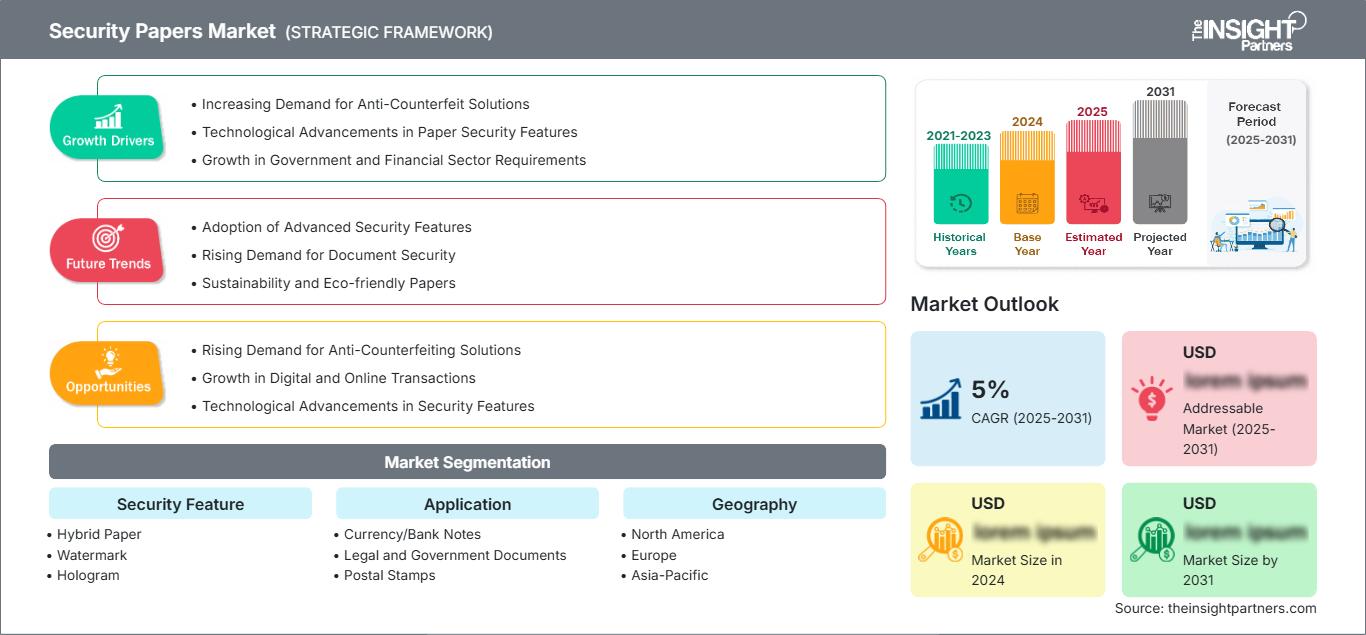
Security Papers Market: Strategic Insights
Regional Insights
North America Security Papers Market
North America is estimated to hold 26.05% share in 2025 and expand at a 4.3% CAGR through 2034. The U.S. represents the dominant national market because currency production, federal credentials, passports, certificates, and government documentation require secure substrates. Demand increasingly favors papers compatible with automated inspection and multiple authentication layers. Canada and Mexico provide additional applications through currency and identity programs.
The regional Security Papers Market share is supported by mature procurement systems and established supplier relationships. Currency replacement cycles create recurring requirements, while passport and identity-document programs emphasize durability, controlled printing, and feature compatibility. Manufacturers benefit from stringent qualification standards and long-standing production expertise. Advanced watermarks, embedded threads, and optical elements should receive stronger attention as document issuers seek authentication systems combining public recognition with machine verification.
U.S. Security Papers Market
The U.S. represents approximately 72.59% of the North American Security Papers Market share in 2025 and is projected to grow at a 4.2% CAGR through 2034. Currency applications remain central, with Crane NXT Co. maintaining an important position in supplying substrates and authentication technologies for U.S. currency requirements. Government documentation provides an additional demand base.
The U.S. market also benefits from established procurement processes favoring suppliers with secure facilities, proven quality systems, and long production histories. Higher-denomination banknotes can require sophisticated security features even when physical cash usage changes. Passports, identity credentials, certificates, and other government documents diversify demand. The country is therefore expected to remain a technically advanced market focused on reliability, authentication depth, and controlled supply.
Europe Security Papers Market
Europe is estimated to represent 19.95% share in 2025 and grow at a 3.9% CAGR through 2034. Germany is a leading country because of its specialty-paper manufacturing base and strong document-security ecosystem. The UK, France, Italy, and Spain contribute through currency, passports, identity documents, certificates, stamps, and government records.
The UK maintains an established demand for banknotes, passports, certificates, and official documentation. High-security paper expertise supports applications requiring watermarks, embedded threads, and specialized substrates. Germany has a strong manufacturing ecosystem, supported by DREWSEN SPEZIALPAPIERE GmbH & Co. KG and Giesecke+Devrient GmbH. France, Italy, and Spain contribute through sovereign documentation and currency-related applications, with procurement increasingly emphasizing durable substrates and integrated authentication features.
APAC Security Papers Market
APAC is estimated at 33.14% share in 2025 and projected to expand at a 5.4% CAGR, making it the fastest-growing major region. China is the leading country, supported by extensive banknote production and government-document requirements. India is another major market because of currency and sovereign-document production.
Japan and South Korea emphasize advanced authentication and document integrity, while Australia maintains demand for secure currency substrates. Regional industrial investment, modernization of sovereign printing facilities, stronger identity-document infrastructure, and anti-counterfeiting initiatives support expansion. Increasing domestic production capabilities should further strengthen regional demand for specialized substrates and authentication components.
Middle East & Africa Security Papers Market
The Middle East & Africa is projected to expand at a 4.6% CAGR through 2034. Saudi Arabia and the UAE are leading Gulf markets, supported by government-document modernization, passports, identity credentials, and secure administrative infrastructure. South Africa remains an important southern African market through currency and official document applications.
Infrastructure investment and administrative modernization provide longer-term opportunities across the rest of MEA. Saudi Arabia and the UAE benefit from international travel, border-management requirements, and government credential programs. South Africa contributes to established currency and documentation demand. As countries modernize sovereign printing capabilities and strengthen identity systems, demand should increasingly shift toward substrates incorporating multiple overt, covert, and machine-verifiable security characteristics.
Segmentation Analysis
Component
Substrates remain fundamental because paper composition determines strength, printability, durability, opacity, and compatibility with embedded security technologies. Watermarks and threads provide established authentication mechanisms, while holograms are gaining strategic relevance as issuers seek more complex optical protection. Component selection increasingly reflects the need to combine several authentication layers within one document without affecting production efficiency.
- Substrates: Substrates form the physical foundation of secure documents, requiring controlled fiber composition, strength, opacity, and dimensional stability. Their importance remains high because embedded security elements depend on consistent substrate performance.
- Watermarks: Watermarks provide recognizable authentication while supporting visual and machine-assisted verification. Their integration directly into paper construction makes them important for banknotes and official documents requiring durable protection against reproduction.
- Threads: Security threads provide visible and concealed authentication characteristics and can incorporate metallic, magnetic, optical, or customized effects. Their versatility supports banknotes and selected government documents requiring layered verification.
- Holograms: Holograms create dynamic optical effects that strengthen visual authentication. Their use is increasing where issuers require distinctive features that are difficult to reproduce through conventional printing and scanning processes.
- Others: Other components support specialized authentication requirements and enable manufacturers to configure substrates according to document specifications, printing environments, inspection procedures, and government procurement requirements.
Application
Bank Notes remain the largest application because currencies require recurring production and replacement. Passports, identity cards, legal documents, certificates, cheques, and stamps diversify demand. The Security Papers Market scope, therefore, extends across financial, governmental, educational, travel, and fiscal-document applications, each having different security requirements and replacement cycles.
- Bank Notes: Banknotes remain the core application because central banks require secure substrates capable of supporting multiple authentication layers. Continuous circulation, replacement cycles, and periodic redesigns sustain recurring procurement.
- Passports and Visas: Passport and visa documents require durable substrates compatible with personalization, lamination, optical inspection, and authentication systems. International travel and government identity programs support demand for controlled document materials.
- Identity Cards: Identity cards increasingly combine physical and digital verification. Secure paper components remain relevant for credentials requiring tamper resistance, durable printing, and standardized authentication characteristics.
- Legal and Government Documents: Government documents require reliable protection against alteration, duplication, and unauthorized reproduction. Secure substrates are particularly relevant for certificates, permits, licenses, and official records.
- Educational and Government Certificates: Certificates require long-term durability and credible authentication. Security papers help institutions protect qualifications and official awards against forgery while supporting physical verification procedures.
- Cheques: Cheques remain a specialized application where security features help mitigate alteration, duplication, and fraudulent issuance. Demand is concentrated in markets where paper-based payment instruments retain institutional use.
- Stamps: Stamps use secure substrates where governments require controlled issuance and protection against substitution or unauthorized reproduction. Specialized paper characteristics can support denomination recognition and authentication.
- Others: Other applications provide niche opportunities for customized papers used in documents requiring controlled production, physical authenticity, specialized printing, and defined anti-counterfeiting characteristics.
Opportunity Snapshot
| Application | Revenue Contribution | Trend Tag | Adoption Stage |
| Bank Notes | High | Currency Security | Mature |
| Passports and Visas | High | Travel Credentials | Scaling |
| Identity Cards | Medium | Credential Security | Scaling |
| Legal and Government Documents | Medium | Document Authentication | Scaling |
| Educational and Government Certificates | Medium | Credential Protection | Scaling |
| Cheques | Low | Payment Security | Mature |
| Stamps | Low | Fiscal Authentication | Mature |
| Others | Low | Custom Documents | Emerging |
Security Papers Market Growth Drivers and Impact Analysis
Growth in sophisticated counterfeiting and document fraud practices
High resolution, modified substrates, digital imaging, personalization without authorization, and the sophistication of scanning equipment are among the many techniques used to counterfeit increasingly. This creates an incentive for the issuers of documents to rely on a variety of physical authentication elements, rather than a single security element. Different levels of authentication can be realized with the use of optical components, special fibers, embedded threads, and watermarks, which increase the complexity of the process of reproducing the image. This is most notable in passports, ID cards, and official certificates, as well as high-value banknotes. Suppliers that can offer multiple features without sacrificing paper strength, machinability, or print quality may find they're in a more advantageous spot for getting through qualification programs. Today, as fraud methods are getting more sophisticated, procurement teams can no longer only look for individual security pieces but must consider the whole authentication architecture, feature compatibility, and the lifespan and longevity of a solution.
Extension of secure ID and government document programs
The need for secure passports, identity cards, certificates, licenses, and other credentials has risen in the context of government modernization programs. International travel documentation is based on technical aspects, such as those specified in ICAO Doc 9303, which makes it possible to establish a common standard of expectations regarding the security, personalization, and machine readability of these documents. Secure paper manufacturers can thus meet demand by designing substrates that can be laminated, optically inspected, embedded, and printed through complex printing techniques. There are also opportunities for emerging economies, as traditional credentials are being phased out and as governments improve civil-registration systems. However, the effects are not limited to just paper volume, as each program might need to employ targeted substrates, custom manufacturing, and supply security. Existing currency/identity-document producers can bring their identity-document authentication experience to new and adjacent government-diplomatic applications that maintain strict traceability requirements.
Modernization of a sovereign print and security-paper capacity
Governments and sovereign printing organizations are investing in their own capacity to improve the resilience of their banknote and sensitive document supply. This could minimize exposure to international procurement disruptions and offer greater control over security specifications. New paper machine, automatic inspection system, fiber preparation, and integrated feature insertion can be used to boost capacity and production consistency. India is also a good example of such initiatives, with the Security Paper Mill Narmada Puram project offering a global tender for a currency machine line (CML) of 6,000 tons per year for security papers that was issued by SPMCIL in January 2026. This capacity upgrade will boost local suppliers and generate revenue for machine manufacturers, specialty-fiber makers, authentication-technology firms, and technical-service providers.
Security Papers Market Future Trends
Integration of multi-layer physical and machine-verifiable authentication
Going forward, Security Papers Market trends are projected to focus on the integration of traditional paper-based authentication with machine-verifiable aspects. The increasing use of watermarks, threads, fluorescent properties, optical effects, and special fibers can be linked to become a single barrier to security rather than individual security measures. This can not only enable issuers to mesh public authentication with machine-assisted inspection but also lessen reliance on any particular feature. There will be greater integration, requiring coordination between substrate engineering, embedded-feature insertion, printing, and inspection. Thinner embedded components, increased durability, more accurate feature placement, and automated document processing compatibility are key attributes that manufacturers will look for. Suppliers able to offer full authentication architectures on the substrate will have a strategic benefit over providers that offer isolated functions. The shift can slowly begin shaping up secure paper as an active authentication platform and not just as a protective printing material.
More focus on sustainable and resource-efficient production
Environmental factors are likely to play a bigger role in specialty-paper buying in the future. Water efficiency, energy use, and fiber use will be improved; process waste will be reduced; and raw materials will be assessed to be responsibly sourced without affecting security specifications, all likely to be improved by manufacturers. The challenge is important, as the secure substrate needs to satisfy many requirements, such as strength, dimensional stability, optical properties, durability, and printability. Alternative or recycled fibers could then be used selectively if they meet qualification criteria. Facility modernization is likely to be a factor to consider in resource efficiency reporting, and in other parts of the world, there will be growing pressure for environmental reporting. The economics of production and competitiveness can be enhanced through reductions in manufacturing intensity that do not degrade authentication performance. Sustainability should thus grow as an efficiency of production issue as well as an environmental issue.
Security Papers Market Opportunities
Growth of high security identity document substrates
Manufacturers can diversify from currency applications by leveraging the growing number of passports, visa, identity-card, certificate, and license programs. These documents need substrates that enable personalization, tamper-proofing, machine-readability, durability, and multi-layer authentication. The suppliers can take advantage of this opportunity by offering modular platforms; paper platforms that can be adapted in such a way that they can be used with various security features without having to change their manufacturing process. The opportunity to replace the old credentials in regions can be an attractive target for regional governments since procurement often includes multiyear supply contracts. Organizations that already have a currency business can share their skills on authentication, substrate technology, and the secure production of currency with adjacent identity-document programs. The feature compatibility, the possibility to inspect features automatically, secure finishing, and controlled raw-material sourcing are investment priorities. These can make customers stick with the service provider and expand the reach into government-document applications.
Regionalized production partnerships in emerging markets
Regional production also offers a big opportunity as governments attempt to tighten their grip on the production of sensitive security paper. International technology providers can partner with regional paper producers to leverage expertise in their processes and local infrastructure. For emerging markets in Asia, the Middle East, and Africa, production lines with high-end fiber preparation, watermarking systems, thread inserting machines, and automatic inspection systems may be required. Based on procurement needs, suppliers can enter into joint ventures, technology licensing, equipment modernization, or long-term technical-service agreements. Localization can make the supply chain more efficient, make the enterprise more responsive to currency and document redesign changes, and generate regular demand for specialized parts and maintenance services. The opportunity is especially important in countries where the sovereign printing organization is looking to add capacity while not having to replace the entire infrastructure, thus enabling existing technology vendors to bid for the opportunity of modernization instead of greenfield projects.
Recent Developments
- June 2026: The Central Bank of Solomon Islands (CBSI) has introduced a new commemorative $50 banknote to mark its 50th Anniversary. The banknote, designed by De La Rue, is printed on SAFEGUARD® polymer substrate.
- May 2026: De La Rue has officially opened its new banknote manufacturing 'supersite' in Malta on 26th May 2026, marking the completion of a five-year construction project. This facility is part of a US$ 203.15 million (£150 million) investment program, celebrated in the presence of Prime Minister Robert Abela and Hon. Minister Silvio Schembri.
- March 2026: G+D Netcetera, the financial software subsidiary of Giesecke+Devrient (G+D), successfully completed the acquisition of Bank-Verlag's Payments & Banking Services business. The infrastructure handles one in four card and internet-based payments in Germany. With this move, G+D Netcetera becomes an end-to-end digitalization partner for the German financial industry.
Frequently Asked Questions

- Comprehensive Market Sizing and Forecast Analysis
- Detailed Segmentation Analysis
- In-Depth Market Dynamics Assessment
- Regional and Country-Level Insights
- Competitive Landscape and Company Benchmarking
- Strategic Business Intelligence
Recent Reports
Testimonials

The Insight Partners provided valuable market intelligence that supported our global go-to-market strategy. Their team was professional, responsive, and attentive to our feedback, providing thoughtful analysis and helpful methodological clarifications throughout the project.
Junmo Kim Chief Financial Officer (CFO), Enertech Co., Ltd.
The Insight Partners' SCADA System Market report is comprehensive, with valuable insights on current trends and future forecasts. The team was highly professional, responsive, and supportive throughout. We are very satisfied and highly recommend their services.
RAN KEDEM Partner, Reali Technologies LTDs
I requested a report on a very specific software market and the team produced the report in a few days. The information was very relevant and well presented. I then requested some changes and additions to the report. The team was again very responsive and I got the final report in less than a week.
JEAN-HERVE JENN Chairman, Future Analytica
We worked with The Insight Partners for an important market study and forecast. They gave us clear insights into opportunities and risks, which helped shape our plans. Their research was easy to use and based on solid data. It helped us make smart, confident decisions. We highly recommend them.
PIYUSH NAGPAL Sr. Vice President, High Beam Global
The Insight Partners delivered insightful, well-structured market research with strong domain expertise. Their team was professional and responsive throughout. The user-friendly website made accessing industry reports seamless. We highly recommend them for reliable, high-quality research services
YUKIHIKO ADACHI CEO, Deep Blue, LLC.
This is the first time I have purchased a market report from The Insight Partners.While I was unsure at first, I visited their web site and felt more comfortable to take the risk and purchase a market report.I am completely satisfied with the quality of the report and customer service. I had several questions and comments with the initial report, but after a couple of dialogs over email with their analyst I believe I have a report that I can use as input to our strategic planning process.Thank you so much for taking the extra time and making this a positive experience.I will definitely recommend your service to others and you will be my first call when we need further market data.
JOHN SUZUKI President and Chief Executive Officer, Board Director, BK Technologies
I wish to appreciate your support and the professionalism you displayed in the course of attending to my request for information regarding to infectious disease IVD market in Nigeria. I appreciate your patience, your guidance, and the fact that you were willing to offer a discount, which eventually made it possible for us to close a deal. I look forward to engaging The Insight Partners in the future, all thanks to the impression you have created in me as a result of this first encounter.
DR CHIJIOKE ONYIA MANAGING DIRECTOR, PineCrest Healthcare Ltd.Reason to Buy
- Informed Decision-Making
- Understanding Market Dynamics
- Competitive Analysis
- Identifying Emerging Markets
- Customer Insights
- Market Forecasts
- Risk Mitigation
- Boosting Operational Efficiency
- Strategic Planning
- Investment Justification
- Tracking Industry Innovations
- Aligning with Regulatory Trends





 Get Free Sample for