
Interposer and Fan-Out WLP Market Growth, Share & Trends by 2034
Coverage: by Application (Logic, Imaging and Optoelectronics, Memory, MEMS/Sensors, LED, Power); Packaging Technology (TSV, Interposer, Fan-Out WLP); End user (Consumer Electronics Industry, Telecommunication Industry, Industrial Sector, Automotive Industry, Military and Aerospace Industry, Smart Technologies, Medical Devices Industry) , and Geography (North America, Europe, Asia Pacific, and South and Central America)
- Status : Data Released
- Report Code : TIPRE00008832
- Category : Electronics and Semiconductor
- No. of Pages : 150
- Available Report Formats :


- Last update date : October 16, 2026


2025 Market Size
US$ 36.07 Bn
Base year value
2034 Forecast
US$ 61.99 Bn
Projected by 2034
CAGR 2026-2034
6.20 %
Growth rate
Addressable Market
US$ 443.85 Bn
(2026-2034)
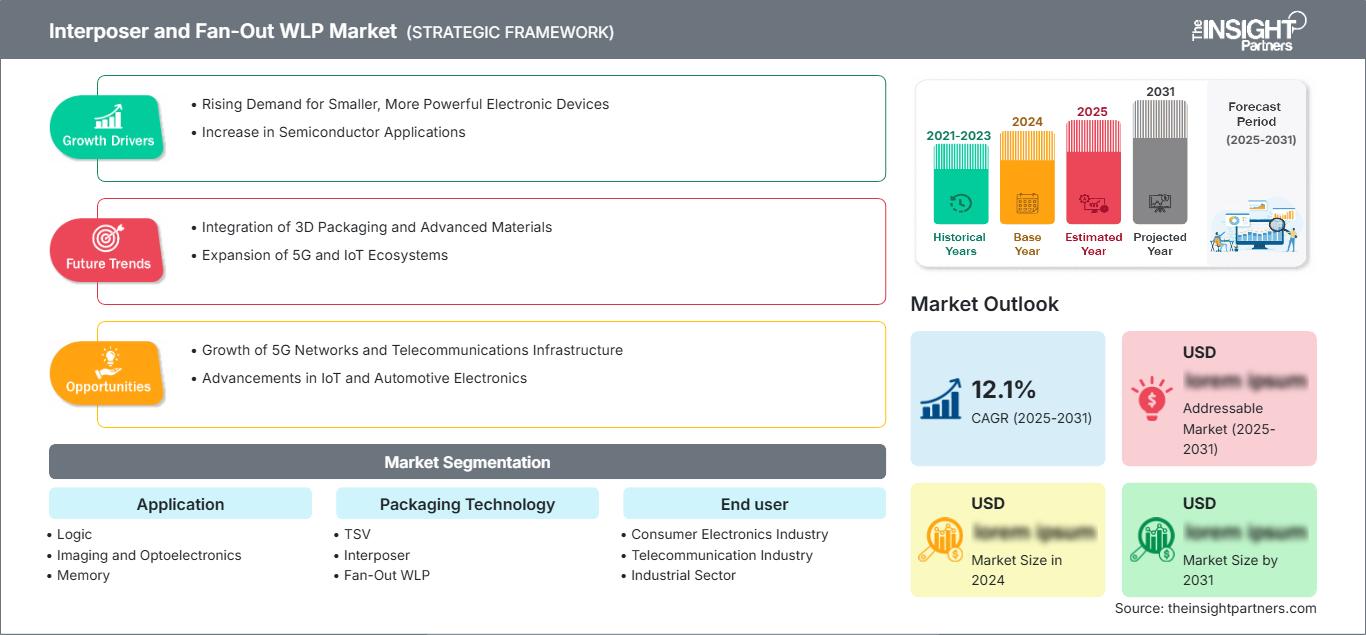
The Interposer and Fan-out WLP Market was valued at US$ 36.07 Billion in 2025 and is projected to reach US$ 61.99 Billion by 2034, registering a CAGR of 6.20% during 2026–2034. Expansion is being shaped by heterogeneous integration, higher interconnect density, compact form factors, and increasing semiconductor content across computing, communications, automotive, sensing, and intelligent devices, with wafer-level architectures gaining strategic importance as conventional scaling becomes progressively more complex.
North America presents a structurally attractive outlook, with the Interposer and Fan-out WLP Market size expected to expand at an estimated 6.8–7.6% CAGR through 2034. Growth is supported by domestic semiconductor manufacturing incentives, AI accelerator deployment, defense electronics requirements, and investment in localized advanced packaging capacity. The regional ecosystem is also benefiting from closer coordination among foundries, outsourced semiconductor assembly and test providers, chip designers, and hyperscale computing customers.
Interposer and Fan-Out WLP Market Assessment and Insights
- North America: The region is estimated to hold a 20–24% share in 2025 and expand at a 6.8–7.6% CAGR between 2026–2034, supported by AI, HPC, defense, and localization investments.
- US: The US represents approximately 18–22% of global demand in 2025 and is projected to grow at 7.0–7.8% during 2026–2034, led by AI infrastructure and domestic packaging capacity.
- Europe: Europe is estimated at 10–14% share in 2025 and 5.7–6.5% CAGR through 2034, with Germany, France, Italy, and the UK supporting automotive, industrial, and communications applications.
- Asia Pacific: Asia Pacific commands an estimated 56–62% share in 2025 and 6.3–7.2% CAGR through 2034, led by Taiwan, China, South Korea, Japan, and expanding Indian semiconductor manufacturing.
- Largest Segment: Logic applications are estimated at a 31–35% market share in 2025, with a 6.8–7.5% CAGR during 2026–2034, reflecting AI and processor integration requirements.
- High Growth Segment: Power applications represent approximately 9–12% in 2025 and are expected to grow at 8.2–9.0% CAGR through 2034 as electrification raises package-performance requirements.
- Key companies analyzed in detail: Amkor Technology, Inc.; ASE Technology Holding Co., Ltd.; Broadcom Inc.; QUALCOMM Incorporated; Samsung Electronics Co., Ltd.; STMicroelectronics N.V.; Taiwan Semiconductor Manufacturing Company Limited; Texas Instruments Incorporated; Toshiba Corporation; United Microelectronics Corporation.
Source: The Insight Partners' analysis based on proprietary research, government publications, company annual reports, investor presentations, industry databases, and expert interviews.
The Interposer and Fan-out WLP Market has evolved from the use of wafer level packaging mainly in small consumer electronics to designs for heterogeneous integration, chiplet, high bandwidth memory, and high performance computing. Fan out technology reduces package area whereas interposer technology allows dense connections between dies. As a result, development focus is on fine-line redistribution layer, thermal management, warpage control, yield enhancement, and compatibility of the processes. From industry disclosures, it can be noted that fan-out and interposer technologies are now being developed for AI and HPC packages which demand greater bandwidth and better energy efficiency.
Going forward, capacity localization is going to gain prominence alongside process capabilities. Semiconductor programs in the US, Europe, South Korea, Japan, and India are encouraging investments in fabrication, assembly, test, substrates, and packaging segments. Thus, share in the Interposer and Fan-out WLP Market is expected to increasingly include more geographic diversification even though Asia Pacific region will remain dominant in manufacturing.
Interposer and Fan-Out WLP Market Report Scope
| Report Attribute | Details |
|---|---|
| Market size in 2025 | US$ 36.07 Billion |
| Market Size by 2034 | US$ 61.99 Billion |
| Global CAGR (2026 - 2034) | 6.20% |
| Historical Data | 2021-2024 |
| Forecast period | 2026-2034 |
Interposer and Fan-Out WLP Market Analysis
Demand is becoming more related to performance metrics of a system rather than just miniaturization of packages. AI accelerators, networking processors, image processors, RF components, automotive control systems, and sensors are all going to need small interconnects which are able to handle bandwidth and power/thermal issues. The ecosystem includes semiconductor designers, foundries, OSATs, substrate and material suppliers, equipment suppliers, and end-device companies. Higher complexity of the package increases the importance of design for manufacturing cooperation because yield losses on advanced packaging steps can influence overall device economics substantially.
The supply environment is evolving due to investments in high density fan-outs, silicon interposers, TSV technology, and panel level solutions. Fan-out development was performed by ASE using 300 mm panel format, aiming at chiplet integration and HPC applications and solving issues of productivity, material efficiency, and warpage. Capacity commitment and lengthy qualification cycle can be limiting factors for flexibility, so process readiness, customer collaboration, and geographic diversification become critical.
The competitive positioning in the Interposer and Fan-out WLP Market Report is becoming ever more reliant on front-end, packaging, testing, and customer engineering integration capability. Taiwan Semiconductor Manufacturing Company Limited combines its foundry expertise with CoWoS, InFO, and SoIC packaging capabilities, whereas Samsung Electronics Co., Ltd. is working on combining memory, foundry, and packaging capabilities. Amkor Technology, Inc. and ASE Technology Holding Co., Ltd. deliver significant outsourced capacity, whereas Broadcom Inc. and QUALCOMM Incorporated drive packaging needs via networking, communication, and computing solutions.
Investment approaches are diverging according to the business models. The foundries are integrating packaging as part of their platforms, whereas OSATs are building their capacity for high density to capture the heterogenous integration opportunities. STMicroelectronics N.V. is developing panel-level packaging and advanced packaging business in Europe, whereas large semiconductor manufacturers are directing investments in infrastructure that supports AI initiatives. STMicroelectronics, Texas Instruments Incorporated, Toshiba Corporation, and United Microelectronics Corporation provide additional access to analog, power, automotive, specialty, and mature node applications where package performance is critical.
● REPORT CUSTOMIZATION
Tailor This Report To Align With Your Specific Business Requirements
This report can be customized to align precisely with your business objectives, scope, and target markets. Customization options include tailored segmentation, geography, competitive analysis, and strategic insights to support informed decision-making.
Customize This Report →WHAT YOU CAN ADJUST
- ● Segmentations
- ● Geography
- ● Competitive Analysis
- ● Language Preferences
Interposer and Fan-Out WLP Market: Strategic Insights
Regional Insights
North America Interposer and Fan-out WLP Market
North America is estimated to represent 20–24% of the Interposer and Fan-out WLP Market Share in 2025 and is projected to register a 6.8–7.6% CAGR through 2034. The region benefits from AI accelerator development, hyperscale data-center investment, defense electronics, automotive semiconductor localization, and government-backed manufacturing incentives. Advanced packaging is increasingly treated as a strategic complement to domestic wafer fabrication.
Demand is primarily sourced from the US, although Canada and Mexico also participate through their involvement in electronics, testing, and manufacturing operations. Amkor Technology, Inc. is planning an advanced packaging and test campus in Arizona, while working with Taiwan Semiconductor Manufacturing Company Limited is reinforcing the relationship between front-end manufacturing and back-end packaging processes. Such initiatives will enhance high-density packaging capability in the region.
U.S. Interposer and Fan-out WLP Market
The US is estimated to represent 88–92% of North American demand in 2025 and is projected to expand at a 7.0–7.8% CAGR through 2034. AI, HPC, aerospace, defense, automotive electronics, and communications are the primary structural demand centers. Domestic capacity expansion is reducing dependence on overseas packaging for selected advanced devices.
Advanced packaging capacity for Amkor Technology, Inc., is being built up in Arizona; production will follow after building and qualification. Advanced packaging capabilities for Taiwan Semiconductor Manufacturing Company Limited are also being developed in Arizona. The application demand is moving towards chiplets, high bandwidth interconnects, and heterogeneous integration; however, military applications impose demands on traceability and reliability.
Europe Interposer and Fan-out WLP Market
Europe will account for 10-14% market share in 2025 and will have a growth rate of 5.7-6.5% CAGR in 2034. Germany will continue to be the leading country driven by its automotive semiconductor consumption and industrial electronics hubs. France and Italy offer critical positions for power, automotive, sensors, and microelectronic segments, while the UK brings in design and research expertise. Europe investments are increasingly driven by concerns about semiconductor sovereignty and packaging capabilities.
The UK's market will have the support of semiconductor design expertise, compound semiconductor technology expertise, photonics, and research expertise from universities. The need for packaging will occur in automotive electronics, communications, industrial control systems, and customized computing systems and not the larger consumer device segment. Germany will benefit from the semiconductor ecosystem in Dresden and automotive ecosystem, while government funding leads to closer collaboration between fabs, packaging, equipment makers, and research organizations.
There is a higher degree of specialization observed in France, Italy, and Spain. France has expertise in aerospace, telecom, photonics, and automotive electronics segments; Italy enjoys the manufacturing presence of STMicroelectronics N.V. and power semiconductors; Spain is pursuing semiconductor and chip design initiatives related to automotive, communications, and research segments. STMicroelectronics N.V. is also making progress in panel-level packaging efforts in Europe.
APAC Interposer and Fan-out WLP Market
APAC is forecasted to hold a 56%-62% market share in 2025 and have a growth rate of 6.3%-7.2% CAGR during 2025-2034, retaining its leadership among regions. The Taiwan region leads in the advanced foundry-based packaging sector, and China, Japan, South Korea, India, and Australia contribute to regional demand.
The Taiwanese market is dominated by advanced foundries and OSATs; South Korea has the combination of memory, foundry, and packaging; Japan provides automotive and industrial sectors; China focuses on the self-reliance of semiconductors; and India is making an effort in semiconductor fabrication.
Middle East & Africa Interposer and Fan-out WLP Market
MEA remains a smaller regional market but is expected to expand at a 7.8–9.0% CAGR through 2034. Saudi Arabia and the UAE are developing technology and semiconductor diversification agendas, while South Africa provides established electronics, industrial, and research capabilities. Energy revenues and sovereign investment capacity create opportunities for long-term infrastructure development.
The key emerging economies include Saudi Arabia and UAE, while South Africa is the leading electronics economy in the area. Infrastructure updates, data center builds, renewable energy, and industrial digitization could stimulate semiconductor consumption in the area. Nevertheless, the package fabrication industry in the area is less developed compared to APAC, North America, and Europe.
Segmentation Analysis
Application
Application segment in the Interposer and Fan-out WLP Market is led by logic devices, supported by processors, AI accelerators, communications chips, and increasingly complex system architectures. The segment is estimated to grow at a 6.8–7.5% CAGR from 2026–2034. Imaging, memory, sensors, LEDs, and power devices broaden demand by applying wafer-level and interposer techniques to different performance and form-factor requirements.
- Logic: Logic devices hold the strongest application position because AI, networking, computing, and advanced processors require dense interconnects and increasingly heterogeneous architectures.
- Imaging and Optoelectronics: Imaging and optoelectronic devices favor compact wafer-level integration where optical alignment, electrical performance, and package dimensions directly influence system design.
- Memory: Memory applications benefit from high-density integration and short interconnect paths, particularly where advanced processing architectures require close proximity between memory and logic.
- MEMS/Sensors: MEMS and sensor packaging emphasizes miniaturization, environmental protection, electrical connectivity, and compatibility with automotive, industrial, medical, and consumer sensing systems.
- LED: LED packaging demand centers on optical efficiency, compact designs, thermal management, and manufacturing consistency across consumer, automotive, signaling, and specialty lighting applications.
- Power: Power applications increasingly require robust thermal performance and reliability under electrical and temperature stress, supporting adoption in electric mobility, industrial systems, renewable energy, and power management.
Packaging Technology
Packaging Technology segment in the Interposer and Fan-out WLP Market includes TSV, interposer, and fan-out WLP architectures serving different combinations of bandwidth, density, thermal performance, and cost. The segment is expected to grow at a 6.1–6.9% CAGR during 2026–2034. Technology selection increasingly depends on die count, package size, interconnect pitch, and targeted application economics.
- TSV: TSV supports vertical electrical connectivity and high-density integration, making it strategically important for stacked memory, 3D integration, and applications requiring short electrical paths.
- Interposer: Interposers enable high-density lateral communication between multiple dies and remain important for AI, HPC, networking, and other heterogeneous architectures requiring substantial bandwidth.
- Fan-Out WLP: Fan-out WLP provides compact integration without conventional package substrates in selected architectures, supporting mobile, RF, power, automotive, and increasingly sophisticated system-level designs.
End user
End user segment in the Interposer and Fan-out WLP Market demand is distributed across consumer, communications, industrial, automotive, defense, smart technology, and medical applications. The segment is estimated to expand at a 6.4–7.1% CAGR during 2026–2034. Different end markets prioritize different combinations of miniaturization, reliability, processing speed, thermal performance, and qualification requirements.
- Consumer Electronics Industry: Consumer electronics remains a high-volume user of compact packages, with smartphones, wearables, tablets, and connected devices emphasizing footprint reduction and power efficiency.
- Telecommunication Industry: Telecommunications applications require high-frequency performance, signal integrity, bandwidth, and thermal management for networking equipment, wireless infrastructure, and next-generation connectivity systems.
- Industrial Sector: Industrial demand is driven by automation, control systems, machine vision, robotics, and edge computing, where reliability and long operating lifetimes influence package selection.
- Automotive Industry: Automotive electronics increasingly require compact, thermally capable, and highly reliable packages for advanced driver assistance, electrification, infotainment, sensing, and vehicle computing.
- Military and Aerospace Industry: Defense and aerospace customers prioritize qualification, traceability, radiation tolerance, reliability, and secure supply chains, supporting demand for specialized advanced packaging solutions.
- Smart Technologies: Smart technologies use advanced packages across connected devices, edge processors, sensors, and intelligent infrastructure where integration density and low power consumption are central design objectives.
- Medical Devices Industry: Medical devices prioritize reliability, miniaturization, low power, and biocompatibility-related packaging considerations across imaging, monitoring, diagnostic, and wearable equipment.
Opportunity Snapshot
| End Users | Revenue Contribution (High/Medium/Low) | Trend Tag | Adoption Stage |
|---|---|---|---|
| Consumer Electronics Industry | High | Compact AI | Mature |
| Telecommunication Industry | High | Network Bandwidth | Scaling |
| Industrial Sector | Medium | Edge Automation | Scaling |
| Automotive Industry | High | Vehicle Compute | Scaling |
| Military and Aerospace Industry | Medium | Secure Supply | Scaling |
| Smart Technologies | Medium | Edge Intelligence | Scaling |
| Medical Devices Industry | Medium | Miniaturized Sensing | Scaling |
Interposer and Fan-Out WLP Market Growth Drivers and Impact Analysis
AI and high-performance computing increase package-level interconnect requirements
AI accelerators and HPC processors are increasing the amount of data that must move among logic, memory, networking, and accelerator dies. This shifts packaging from a supporting manufacturing step toward a system-performance determinant. Interposers provide dense lateral interconnection, while fan-out structures can integrate multiple dies and redistribution layers within constrained footprints. ASE's 2025 FOCoS-Bridge development illustrates the direction, combining fan-out and TSV approaches for higher bandwidth and improved power characteristics. The commercial impact is a larger addressable requirement for packaging engineering, advanced materials, process control, and testing. Suppliers capable of maintaining yield while increasing interconnect density can capture more value per package as AI system architectures become increasingly heterogeneous.
Semiconductor localization is broadening advanced packaging investment
Governments are increasingly supporting domestic semiconductor ecosystems that include packaging rather than focusing exclusively on wafer fabrication. The US is directing incentives toward domestic advanced packaging, while Europe and Asian economies are developing complementary programs. Amkor Technology, Inc.'s Arizona project demonstrates how public support, customer demand, and supply-chain resilience can converge around high-volume packaging infrastructure. The impact extends beyond direct capacity because regional packaging facilities require equipment, materials, engineering services, testing, utilities, and specialized labor. This creates localized ecosystems and can alter sourcing decisions for semiconductor companies. Over time, packaging qualification requirements may encourage multinational suppliers to maintain multiple qualified production locations, increasing the strategic value of geographic redundancy.
Automotive electrification raises thermal and reliability requirements
Vehicle electrification is increasing semiconductor content across power conversion, battery management, sensing, connectivity, and computing. These devices operate under demanding thermal and mechanical conditions, creating stronger requirements for package reliability and thermal pathways. Wafer-level and interposer approaches can help optimize electrical paths and system dimensions when appropriately engineered, while advanced testing becomes important for validating long service lives. The impact is particularly relevant for power and sensor applications, where package performance can influence overall system reliability. Automotive qualification cycles also create higher barriers to rapid supplier substitution, favoring manufacturers with demonstrated reliability data and established production controls. As vehicle architectures consolidate computing functions, packaging requirements are likely to become increasingly interconnected with vehicle-level thermal and electrical design.
Interposer and Fan-Out WLP Market Future Trends
Panel-level fan-out will move from development toward selective commercialization
Panel-level fan-out is likely to gain attention where package dimensions, throughput, and material utilization justify process changes. ASE's 2025 research demonstrated a 300 mm panel-level fan-out approach for chiplet-oriented HPC architectures, highlighting efforts to improve carrier utilization and manufacturing scalability. Future adoption will not be uniform because panel warpage, lithography accuracy, die placement, reliability, and equipment compatibility remain technical considerations. Instead, commercialization is likely to concentrate on applications where larger package formats can offset process complexity. As process control improves, panel-level techniques could complement rather than immediately replace wafer-level approaches, creating a more differentiated packaging landscape.
Packaging platforms will become increasingly integrated with chip design
Future semiconductor development is expected to treat package architecture as part of system design from the earliest engineering stages. Chiplets, high-bandwidth memory, optical interfaces, and heterogeneous integration require coordinated decisions concerning die partitioning, interconnect density, thermal paths, testing, and manufacturing yield. TSMC's continued development of CoWoS, InFO, SoIC, and related technologies illustrates the growing integration of packaging into semiconductor platform strategies. This Interposer and Fan-out WLP Market trend should increase demand for co-design tools, package-aware simulation, advanced inspection, and collaborative engineering. It also favors suppliers that can connect process development with customer-specific architectures rather than offering packaging as an isolated manufacturing service.
Interposer and Fan-Out WLP Market Opportunities
Regionalized packaging ecosystems can create new capacity partnerships
Investors and semiconductor manufacturers have an opportunity to build packaging ecosystems around existing wafer fabrication, electronics, and engineering clusters. Arizona illustrates the potential for co-located front-end and back-end operations, with Taiwan Semiconductor Manufacturing Company Limited and Amkor Technology, Inc. establishing complementary advanced manufacturing activities. Similar models can emerge in Europe and Asia where mature semiconductor infrastructure can reduce execution risks. Opportunity value is strongest where government incentives, anchor customers, skilled labor, utilities, and logistics infrastructure are available simultaneously. Strategic partnerships can also shorten qualification timelines by connecting packaging providers with established chip designers and foundries.
Advanced packaging partnerships can address AI infrastructure bottlenecks
AI infrastructure creates an opportunity for long-term capacity agreements that align packaging investment with predictable customer roadmaps. Amkor Technology, Inc. announced a multi-year partnership with NVIDIA in July 2026 that includes a US$1.5 billion advanced packaging and development agreement supporting expansion of US capacity. Such arrangements can reduce financing uncertainty for capital-intensive facilities while giving customers greater visibility into future packaging availability. Similar structures may develop around high-performance processors, networking devices, and specialized accelerators. The Interposer and Fan-out WLP Market Forecasts therefore point toward greater use of customer-backed investment, co-development, and capacity reservation as advanced packaging becomes more strategically critical.
Recent Developments
- February 2026: Amkor Technology’s high-density fan-out (HDFO) packaging ramp accelerated as demand for AI and chiplet-based computing increased, strengthening the company’s growth outlook across advanced packaging applications. The HDFO platform is being adopted for next-generation high-performance computing and AI processors, with multiple customer launches expected to contribute to revenue growth as production scales.
- July 2026: Samsung Electronics and Samsung Display joined forces to develop next-generation glass interposer technology for advanced semiconductor packaging, with the companies expected to pursue production of glass interposers for high-performance computing (HPC) and AI applications. The technology uses glass as an interposer material to enable finer interconnects, larger package sizes and improved dimensional stability compared with conventional organic substrates, supporting the integration of multiple high-performance chips and high-bandwidth memory (HBM).
Frequently Asked Questions

- Comprehensive Market Sizing and Forecast Analysis
- Detailed Segmentation Analysis
- In-Depth Market Dynamics Assessment
- Regional and Country-Level Insights
- Competitive Landscape and Company Benchmarking
- Strategic Business Intelligence
Recent Reports
Testimonials

The Insight Partners provided valuable market intelligence that supported our global go-to-market strategy. Their team was professional, responsive, and attentive to our feedback, providing thoughtful analysis and helpful methodological clarifications throughout the project.
Junmo Kim Chief Financial Officer (CFO), Enertech Co., Ltd.
The Insight Partners' SCADA System Market report is comprehensive, with valuable insights on current trends and future forecasts. The team was highly professional, responsive, and supportive throughout. We are very satisfied and highly recommend their services.
RAN KEDEM Partner, Reali Technologies LTDs
I requested a report on a very specific software market and the team produced the report in a few days. The information was very relevant and well presented. I then requested some changes and additions to the report. The team was again very responsive and I got the final report in less than a week.
JEAN-HERVE JENN Chairman, Future Analytica
We worked with The Insight Partners for an important market study and forecast. They gave us clear insights into opportunities and risks, which helped shape our plans. Their research was easy to use and based on solid data. It helped us make smart, confident decisions. We highly recommend them.
PIYUSH NAGPAL Sr. Vice President, High Beam Global
The Insight Partners delivered insightful, well-structured market research with strong domain expertise. Their team was professional and responsive throughout. The user-friendly website made accessing industry reports seamless. We highly recommend them for reliable, high-quality research services
YUKIHIKO ADACHI CEO, Deep Blue, LLC.
This is the first time I have purchased a market report from The Insight Partners.While I was unsure at first, I visited their web site and felt more comfortable to take the risk and purchase a market report.I am completely satisfied with the quality of the report and customer service. I had several questions and comments with the initial report, but after a couple of dialogs over email with their analyst I believe I have a report that I can use as input to our strategic planning process.Thank you so much for taking the extra time and making this a positive experience.I will definitely recommend your service to others and you will be my first call when we need further market data.
JOHN SUZUKI President and Chief Executive Officer, Board Director, BK Technologies
I wish to appreciate your support and the professionalism you displayed in the course of attending to my request for information regarding to infectious disease IVD market in Nigeria. I appreciate your patience, your guidance, and the fact that you were willing to offer a discount, which eventually made it possible for us to close a deal. I look forward to engaging The Insight Partners in the future, all thanks to the impression you have created in me as a result of this first encounter.
DR CHIJIOKE ONYIA MANAGING DIRECTOR, PineCrest Healthcare Ltd.Reason to Buy
- Informed Decision-Making
- Understanding Market Dynamics
- Competitive Analysis
- Identifying Emerging Markets
- Customer Insights
- Market Forecasts
- Risk Mitigation
- Boosting Operational Efficiency
- Strategic Planning
- Investment Justification
- Tracking Industry Innovations
- Aligning with Regulatory Trends





 Get Free Sample for