
Printed Circuit Board (PCB) Market Size, Growth & Trends by 2034
Coverage: By Type (Rigid PCB, Rigid-Flex PCB/RFPCB, HDI PCB, High Speed PCB, RF PCB, Others); Rigid PCB (Single Layer Board, Double Layer Board, Multilayer Board), HDI PCB (1+N+1 HDI, 2+N+2 HDI, 3+N+3 HDI, Any-layer HDI); Layer Count (1–16 Layers, 16–20 Layers, 20–30 Layers, 30+ Layers); Technology (Surface-Mount Technology (SMT) PCBs, Through Hole Technology PCBs, Mixed Technology PCBs); Material (FR-4 (Glass Epoxy), Metal-core, Polyimide, Ceramic-based, PTFE, Others); End-users (Original Equipment Manufacturers (OEMs), Electronic Manufacturing Services (EMS) Providers); Application (Consumer Electronics, Automotive, Telecommunications, Industrial Electronics, Medical Devices, Aerospace and Defense, IT and Data Centers, Others); and Geography (North America, Europe, Asia Pacific, Middle East and Africa, and South and Central America)
- Status : Published
- Report Code : TIPRE00016999
- Category : Electronics and Semiconductor
- No. of Pages : 306
- Available Report Formats :


- Last update date : October 07, 2026


2025 Market Size
US$ 82.34 Bn
Base year value
2034 Forecast
US$ 146.89 Bn
Projected by 2034
CAGR 2026-2034
6.6 %
Growth rate
Addressable Market
US$ 1,034.04 Bn
(2026-2034)
Printed Circuit Board (PCB) Market was valued at US$ 82.34 Billion in 2025 and is projected to reach US$ 146.89 Billion by 2034, expanding at a CAGR of 6.6% during 2026–2034. The market reflects rising electronic content across vehicles, mobile devices, network equipment, industrial automation, medical systems, aerospace platforms, and data centers where circuit density, signal integrity, thermal control, and reliability define product performance.
North America is still a demand centre with a strong focus on design and defence, the demand there is expected to grow at a compound annual growth rate (CAGR) of between 6.6% and 2034; the size of the printed circuit board (PCB) market in the region is due to aerospace electronics, automotive electrification, domestic semiconductor programmes, and reshoring efforts which stress the need for secure supplies of ultra-HDI, RF, rigid-flex, and high-layer-count boards.
Printed Circuit Board (PCB) Market Assessment and Insights
- North America held 23.32% share in 2025 and is growing at a CAGR range of 5.1% during 2026–2034, supported by defense electronics, advanced computing, EV platforms, and domestic high-reliability manufacturing.
- US represented 80.13% of North America in 2025 and is growing at a CAGR range of 5.5% during 2026–2034, led by aerospace, data centers, and defense microelectronics.
- Europe accounted for 19.56% share in 2025 and is growing at a CAGR range of 5.2–6.2% during 2026–2034, led by Germany, France, the UK, Italy, and Spain.
- Asia Pacific captured 48.67% share in 2025 and is growing at a CAGR range of 7.8% during 2026–2034, with China, Taiwan, South Korea, Japan, India, and Southeast Asia leading output.
- Largest Segment Rigid PCB held 53.41% market share in 2025 and is growing at a CAGR range of 6.8% during 2026–2034.
- High Growth Segment HDI PCB held 15.38% market share in 2025 and is growing at a CAGR range of 8.7% during 2026–2034.
- Key companies analyzed in detail: MEKTEC Corporation; Shennan Circuits Co., Ltd.; WUS Printed Circuit Co., Ltd.; Sanmina Corporation; Meiko Electronics Co., Ltd.; TTM Technologies, Inc.; Zhen Ding Technology Holding Limited; Tripod Technology Corporation; Ibiden Co., Ltd.; AT & S Austria Technologie & Systemtechnik Aktiengesellschaft; Jabil Inc.; Flex Ltd.; Samsung Electro-Mechanics Co., Ltd.; H.C.C. International Limited; and Fujikura Ltd.
Source: The Insight Partners' analysis based on proprietary research, government publications, company annual reports, investor presentations, industry databases, and expert interviews.
Manufacturing has moved away from a focus on capacity when producing circuit boards and is now concentrating on specific technological capabilities, particularly in the areas of high-density interconnect, RF, high-speed, rigid-flex, and high-layer-count products. In order to achieve this, board fabricators are making investments in laser drilling, sequential lamination, narrower line widths, automated optical inspection, and more stringent process control. Growth in the printed circuit board (PCB) market is becoming more and more linked to electronics miniaturization, AI server architectures, 5G radios, ADAS modules, medical devices, and power-dense industrial controls.
The level of demand will be influenced by regional diversification, secure sourcing, and government support for semiconductor ecosystems; the Asia Pacific region will continue to serve as the main centre for manufacturing, while in North America and Europe trusted production will be reinforced for use in defence, aerospace, medical applications, and critical infrastructure. Investment is anticipated to focus on ultra-HDI technologies, advanced substrates, high-frequency laminates, and low-loss materials since manufacturers need reliable boards to enable faster data transfer and to operate in more demanding environments.
Printed Circuit Board (PCB) Market Report Scope
| Report Attribute | Details |
|---|---|
| Market size in 2025 | US$ 82.34 Billion |
| Market Size by 2034 | US$ 146.89 Billion |
| Global CAGR (2026 - 2034) | 6.6% |
| Historical Data | 2021-2024 |
| Forecast period | 2026-2034 |
Printed Circuit Board (PCB) Market Analysis
The demand is growing since, with each new generation of electronic systems, more interconnect complexity is needed. The devices currently in use—such as smartphones, wearables, EV inverters, battery management systems, routers, AI servers, satellites, and industrial controllers—require circuit boards that have to carry a greater number of signals in smaller areas. The trend towards electrifying vehicles and the development of advanced driver-assistance systems is leading to increased use of multilayer and HDI boards, while the need for data centre acceleration is raising the demand for low-loss materials, a higher number of layers, controlled impedance, and thermal reliability on both server and networking platforms.
The value chain covers copper foil, glass cloth, resins, laminates, drilling chemistries, plating equipment, imaging tools, inspection systems, design services, EMS providers, and OEM qualification teams. Analysis of printed circuit boards reveals that supply strength is determined by yield, access to materials, engineering collaboration, and regional service capabilities. Since volatility in copper and laminate prices can squeeze margins, automation, long-term sourcing, and design-for-manufacturability support become essential to competitiveness.
Competitive positioning blends scale manufacturers and specialist interconnect suppliers. Zhen Ding Technology Holding Limited, Tripod Technology Corporation, Ibiden Co., Ltd., and Shennan Circuits Co., Ltd. benefit from Asian electronics clusters, while TTM Technologies, Inc., Sanmina Corporation, Jabil Inc., and Flex Ltd. have strong positions in defense, industrial, medical, and complex assembly-linked programs. MEKTEC Corporation, Fujikura Ltd., WUS Printed Circuit Co., Ltd., Meiko Electronics Co., Ltd., Samsung Electro-Mechanics Co., Ltd., AT & S Austria Technologie & Systemtechnik Aktiengesellschaft, and H.C.C. International Limited strengthen specialist coverage.
Funding is being directed towards ultra-HDI, substrate-type PCBs, RF components, high-speed backplanes, IC substrates, and local production. Suppliers are giving their priority to customers who need a high level of engineering expertise, complete program qualification, and long production life cycles. The way in which companies achieve a strategic advantage lies in their knowledge of advanced materials, their ability to reduce defects, their reliability testing, their traceability, and their capacity to co-develop boards with chip, module, and system architects.
● REPORT CUSTOMIZATION
Tailor This Report To Align With Your Specific Business Requirements
This report can be customized to align precisely with your business objectives, scope, and target markets. Customization options include tailored segmentation, geography, competitive analysis, and strategic insights to support informed decision-making.
Customize This Report →WHAT YOU CAN ADJUST
- ● Segmentations
- ● Geography
- ● Competitive Analysis
- ● Language Preferences
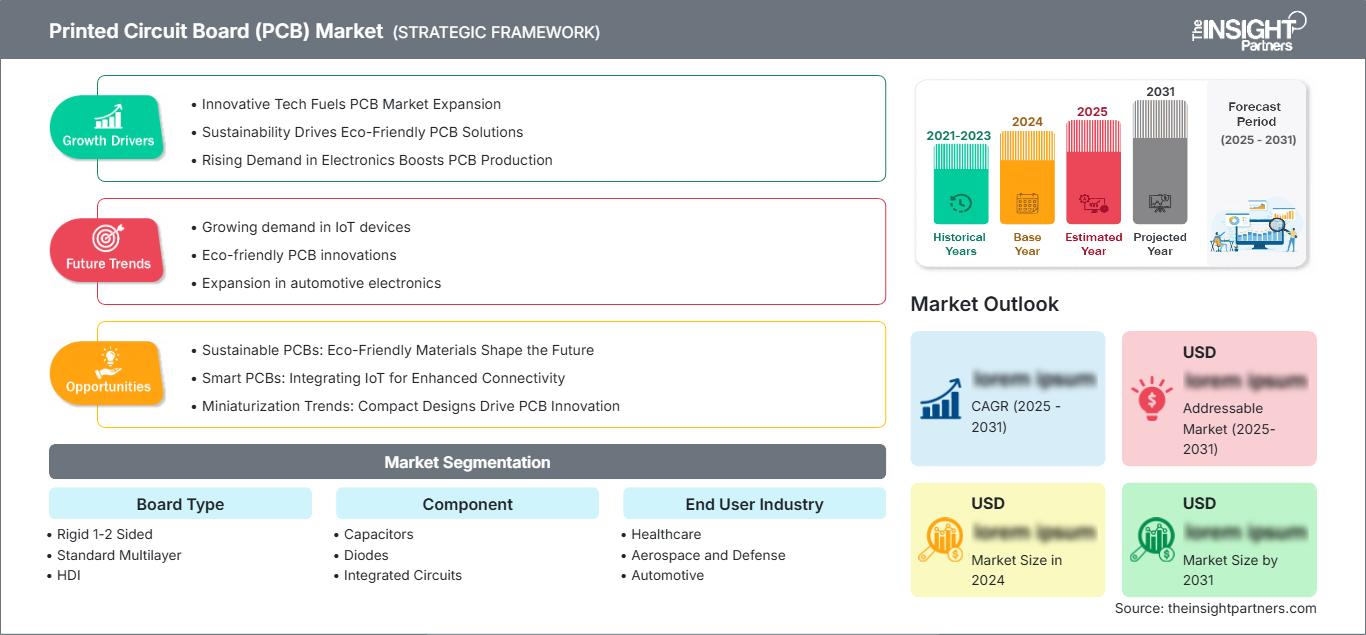
Printed Circuit Board (PCB) Market: Strategic Insights
Regional Insights
North America Printed Circuit Board (PCB) Market
North America held 23.32% share in 2025 and is expected to grow at a CAGR range of 5.1% during 2026–2034. Printed Circuit Board (PCB) Market share is supported by aerospace electronics, radar systems, data-center infrastructure, medical instruments, industrial automation, defense programs, and reshoring initiatives that prioritize secure domestic supply.
Although it is not as focused on volume as the Asia Pacific region, it does have a strong demand for the production of high-reliability, low-volume, and high-mix products. Companies such as TTM Technologies, Inc. and Sanmina Corporation focus on areas including defence, aerospace, RF, and complex systems, while the EMS providers assist with the industrialisation of products. Customers place great importance on engineering response, having ITAR-aligned capabilities, quality documentation, and continuity with regard to mission-critical platforms.
U.S. Printed Circuit Board (PCB) Market
The U.S. accounted for 80.13% of North America in 2025 and is projected to grow at a CAGR range of 5.5% from 2026–2034. Demand is concentrated in aerospace and defense, medical electronics, automotive power modules, high-performance computing, telecom hardware, and industrial controls that require qualification, traceability, and secure supply.
By opening a facility in Syracuse that covers 215,000 square feet, TTM Technologies, Inc. has extended its ability to produce ultra-HDI products in the United States, thus strengthening domestic manufacturing for use in radar, missile defense, space, and autonomous systems. Increasingly, domestic buyers of printed circuit boards are asking that suppliers demonstrate resilience, have on-site engineering capabilities, and provide reliable manufacturing processes for sensitive electronics. The greatest progress is being made in areas adjacent to advanced packaging, in RF systems, in AI infrastructure, and in high-reliability embedded controls.
Europe Printed Circuit Board (PCB) Market
Europe represented 19.56% share in 2025 and is forecast to grow at a CAGR range of 6.2% through 2034. Germany leads regional demand through automotive electronics, industrial automation, power electronics, and engineering-intensive production. The UK supports aerospace, defense, and instrumentation use cases where supply assurance and product qualification matter.
France, Italy and Spain make their contribution via the manufacture of aerospace products, rail systems, energy systems, telecom equipment and medical devices. The electronics strategy of Europe stresses resilience, sustainability and the depth of its semiconductor ecosystem, thereby meeting the demand for advanced boards and substrates. AT & S Austria Technologie & Systemtechnik Aktiengesellschaft and specialist EMS networks offer regional capabilities, while customers still balance European qualification against Asian volume supply.
APAC Printed Circuit Board (PCB) Market
APAC held 48.67% share in 2025 and is expected to grow at a CAGR range of 7.8% during 2026–2034. China remains the leading manufacturing country, supported by scale, component ecosystems, and strong downstream electronics demand. Taiwan, South Korea, and Japan add high-end capability in substrates, HDI, flexible circuits, and precision materials.
India, Vietnam, Thailand, Malaysia and Australia are enhancing regional diversification since the original equipment manufacturers are reducing their concentration risk and bringing electronics production in line with industrial policy. Capacity utilisation remains high for automotive electronics, 5G infrastructure, consumer devices, AI servers and data-centre hardware. Examples of this regional depth include Zhen Ding Technology Holding Limited, Tripod Technology Corporation, Samsung Electro-Mechanics Co., Ltd., Meiko Electronics Co., Ltd., Ibiden Co., Ltd. and Shennan Circuits Co., Ltd.
Middle East & Africa Printed Circuit Board (PCB) Market
Middle East & Africa is projected to grow at a CAGR of 4.7% during 2026–2034. Saudi Arabia leads demand through energy infrastructure, defense localization, telecom networks, industrial automation, and smart-city programs. UAE adoption is supported by aviation, logistics, electronics assembly, security systems, and data-center investment.
South Africa and the Rest of MEA add demand through mining automation, power infrastructure, medical devices, and communications equipment. The region remains import-dependent for complex boards, but local assembly and maintenance ecosystems are improving. Suppliers that can provide application support, reliable logistics, and qualification documentation will capture opportunities in industrial, defense, and infrastructure electronics.
Segmentation Analysis
Type
Printed Circuit Board (PCB) Market scope is broadening because OEMs select different PCB types for power electronics, antenna modules, compact consumer devices, data-center boards, vehicle control units, and mission-critical systems.
- Rigid PCB remains the largest type because it supports stable mechanical platforms for consumer electronics, automotive modules, industrial controls, servers, and medical devices requiring durable, cost-efficient, multilayer circuitry.
- Rigid-Flex PCB/RFPCB serves compact assemblies where space saving, bending reliability, and connector reduction matter, particularly in cameras, wearables, aerospace systems, medical instruments, and advanced vehicle sensors.
- HDI PCB is strategically important for miniaturized, high-function electronics using microvias, fine traces, and dense routing in smartphones, AI hardware, ADAS controllers, networking modules, and medical devices.
- High Speed PCB supports low-loss signal transmission for servers, switches, routers, AI accelerators, telecom equipment, and test systems where impedance control and material performance are essential.
- RF PCB addresses antenna, radar, satellite, radio, and wireless infrastructure applications where dielectric stability, frequency behavior, and thermal consistency determine product reliability.
Rigid PCB
Rigid PCB is expected to grow at a CAGR range of 6.8% during 2026–2034. It remains the volume backbone of the industry because standard and multilayer boards are used across mainstream electronics, appliances, industrial systems, computing platforms, and vehicle electronics. Demand is strongest where mechanical stability, scalable fabrication, and cost-efficient routing are more important than bending capability.
- Single Layer Board is used in simple electronics, appliances, LED lighting, power supplies, and low-cost controls where circuit complexity is limited and manufacturing efficiency remains the primary purchasing criterion.
- Double Layer Board supports moderate-density devices by enabling routing on both sides, making it useful for industrial controllers, consumer devices, automotive accessories, and power management assemblies.
- Multilayer Board is central to complex systems because multiple conductive layers support dense routing, signal separation, power distribution, and compact designs in servers, telecom hardware, vehicles, and instruments.
HDI PCB
HDI PCB is expected to grow at a CAGR range of 8.7% during 2026–2034, making it the high-growth type. Adoption is driven by smaller devices, higher pin-count components, faster signal paths, and advanced packaging adjacency. Smartphones, wearables, automotive compute modules, AI servers, aerospace electronics, and medical devices increasingly need microvias and fine-line routing.
- 1+N+1 HDI serves cost-sensitive designs needing improved density without excessive lamination complexity, making it suitable for mid-range consumer electronics, compact controllers, and selected automotive modules.
- 2+N+2 HDI supports higher routing density and component integration where devices require stronger miniaturization, better signal management, and more flexible layout options than entry HDI structures.
- 3+N+3 HDI is used in higher-end applications where multiple build-up layers are needed for dense chips, small form factors, and demanding reliability in mobile, medical, and industrial devices.
- Any-layer HDI provides the highest routing flexibility because microvias can connect across layers, supporting premium smartphones, advanced compute modules, aerospace electronics, and constrained high-performance designs.
Layer Count
is shifting toward higher layer counts as electronics consolidate more processing, memory, connectivity, sensing, and power functions on compact boards. However, 1–16 layer products remain broadly used because many cost-sensitive applications do not require extreme stack-up complexity.
- 1–16 Layers covers the broadest demand base across consumer devices, appliances, industrial controls, automotive electronics, and mainstream computing where manufacturability and cost efficiency guide selection.
- 16–20 Layers serves higher-performance computing, networking, and industrial devices that need additional routing, stronger signal separation, and better power integrity than standard multilayer platforms.
- 20–30 Layers is used in high-end servers, telecom infrastructure, defense electronics, and test systems where dense routing and controlled impedance support faster signal transmission.
- 30+ Layers addresses advanced backplanes, aerospace systems, AI infrastructure, and mission-critical electronics where high complexity, reliability, and thermal management justify premium fabrication costs.
Technology
Surface Mount Technology is expected to grow at a CAGR range of 7.2% during 2026–2034 as assembly methods evolve with component pitch, reliability needs, and automation. Surface-mount adoption dominates new high-density designs, but through-hole and mixed approaches remain important where mechanical strength, serviceability, and rugged connections matter.
- Surface-Mount Technology (SMT) PCBs dominate compact and automated assembly because small components, high placement speed, and dense routing support smartphones, servers, automotive modules, and industrial electronics.
- Through Hole Technology PCBs remain important for connectors, transformers, power components, and rugged assemblies where mechanical strength and field durability outweigh density advantages.
- Mixed Technology PCBs combine SMT density with through-hole robustness, serving power electronics, telecommunications, aerospace, industrial systems, and medical devices requiring both compactness and mechanical reliability.
Material
FR-4 (Glass Epoxy) Material is expected to grow at a CAGR range of 6.8% during 2026–2034 because substrates increasingly determine electrical performance, thermal behavior, mechanical durability, and regulatory compliance. FR-4 remains dominant, while metal-core, polyimide, ceramic-based, and PTFE materials gain relevance in power, flexible, high-frequency, and harsh-environment circuits.
- FR-4 (Glass Epoxy) remains the mainstream substrate because it balances cost, mechanical strength, process familiarity, and dielectric performance across consumer, industrial, automotive, and computing applications.
- Metal-core materials are selected for LED lighting, power electronics, EV modules, and industrial drives where heat dissipation and dimensional stability are critical to reliability.
- Polyimide supports flexible and rigid-flex boards where bending endurance, lightweight structures, and temperature resistance are required in wearables, aerospace systems, medical devices, and cameras.
- Ceramic-based materials support high-power and high-temperature electronics because they offer thermal conductivity, dimensional stability, and electrical insulation for demanding industrial and aerospace systems.
- PTFE is used in RF, microwave, radar, satellite, and high-frequency communication boards where low dielectric loss and stable signal behavior are essential.
End-users
Original Equipment Manufacturers (OEMs) segment is expected to grow at a CAGR range of 5.5% during 2026–2034. OEMs drive specifications, qualification, and platform roadmaps, while EMS providers influence sourcing, assembly integration, cost engineering, and volume ramp-up. The interaction between both groups determines board design choices, supplier qualification, and long-term production continuity.
- Original Equipment Manufacturers (OEMs) define performance, reliability, traceability, and lifecycle needs, especially in automotive, aerospace, medical, telecom, data-center, and industrial electronics programs.
- Electronic Manufacturing Services (EMS) Providers manage procurement, assembly, test, and supply integration, creating demand for qualified boards that fit high-volume and high-mix manufacturing programs.
Application
Consumer Electronics Application is expected to grow at a CAGR range of 5.7% during 2026–2034 as electronics penetration deepens across both high-volume and mission-critical systems. Consumer electronics remains central, but automotive, telecommunications, medical devices, aerospace and defense, and IT and data centers are raising requirements for signal integrity, miniaturization, and reliability.
- Consumer Electronics contributes high volumes through smartphones, tablets, wearables, laptops, gaming devices, and smart appliances that require compact, cost-efficient, and increasingly dense board designs.
- Automotive is gaining importance as EVs, ADAS, infotainment, body electronics, battery systems, sensors, and power modules require reliable multilayer, HDI, and thermal-management boards.
- Telecommunications demands RF, high-speed, and high-layer-count boards for 5G radios, optical transport, routers, switches, satellites, and network infrastructure upgrades.
- Industrial Electronics uses boards in automation, robotics, drives, smart meters, controls, and instrumentation where durability, serviceability, and long product life cycles are valued.
- Medical Devices require reliable, compact, and documented PCBs for imaging systems, diagnostics, monitoring devices, surgical equipment, implants, and portable healthcare electronics.
- Aerospace and Defense needs high-reliability boards for radar, avionics, satellites, missiles, communications, electronic warfare, and autonomous systems that operate under demanding conditions.
- IT and Data Centers increasingly require high-speed, high-layer-count, low-loss PCBs for AI servers, storage, networking, power distribution, and accelerator hardware.
Opportunity Snapshot
| Application | Revenue Contribution | Trend Tag | Adoption Stage |
| Consumer Electronics | High | Device Density | Mature |
| Automotive | High | EV Control | Scaling |
| Telecommunications | High | 5G Radios | Scaling |
| Industrial Electronics | Medium | Automation Boards | Mature |
| Medical Devices | Medium | Compact Diagnostics | Scaling |
| Aerospace and Defense | Medium | Trusted Supply | Scaling |
| IT and Data Centers | High | AI Servers | Scaling |
Printed Circuit Board (PCB) Market Growth Drivers and Impact Analysis
Vehicle electrification raises board complexity
Vehicles that are electric, hybrid, or software-defined need a greater number of electronic control units, power conversion boards, battery management systems, sensor modules, displays, and connectivity hardware. With each of these subsystems coming into play, the demand rises for multilayer, HDI, rigid-flex, and thermal-management boards which are capable of enduring vibration, heat, and long service lives. Due to the need for automotive qualification, the relationships with suppliers become more complicated since the designs have to meet reliability, traceability, and production consistency requirements before they can be adopted on a large scale. The result is a slow move in the way in which boards are purchased from a focus on cost to one based on application-specific engineering, particularly in the areas of ADAS, infotainment, battery packs, inverters, onboard chargers, and domain controllers.
AI infrastructure drives high-speed and high-layer demand
The boards needed for AI servers, accelerator cards, networking switches, and storage systems must support faster signalling, higher power density, and better thermal performance. In order to meet these requirements, designers are calling for low-loss laminates, controlled-impedance routing, thicker copper in appropriate places, and stack-up designs capable of managing dense memory and processor interfaces. As a result, the technical difficulty for manufacturers has increased and so too has the demand for accurate process control, high yield, and collaboration during the early stages of design. The most significant market impact is seen in high-speed printed circuit boards, high-layer-count boards, HDI products, and other advanced substrate-adjacent products that are used in AI computing clusters and in the upgrades to hyperscale data centres.
Supply-chain resilience changes sourcing strategy
OEMs are now reviewing their PCB sourcing due to the disruptions caused by the pandemic, the presence of geopolitical risks, material price volatility, and defence and security requirements having revealed weaknesses in their highly concentrated supply chains. Buyers are increasingly carrying out qualification of a number of different suppliers, separating sensitive programmes from high-volume commercial production, and asking for manufacturing options on a regional basis for mission-critical electronics. While this does not remove Asia Pacific's advantage in terms of scale, it does open up opportunities for high-reliability manufacturing capacity in North America and in Europe. The result is that there is a greater need for investment in trustworthy manufacturing, supplier audits, advanced traceability, inventory planning, and long-term agreements in order to ensure continuity for aerospace, medical, industrial and defence programmes.
Printed Circuit Board (PCB) Market Future Trends
Substrate-like boards move closer to advanced packaging
The trends in the Printed Circuit Board (PCB) market are going to show greater convergence between board fabrication and semiconductor packaging. PCBs that have the characteristics of a substrate, ultra-high-density interconnects, finer lines, microvias, and high-density build-up structures will assist in supporting AI processors, chiplet packages, high-bandwidth memory, and compact system modules. Manufacturers who have in the past specialised in conventional multilayer boards will now need to achieve tighter process capabilities, maintain cleaner production environments, and engage more closely with semiconductor and module designers. This trend will benefit those companies which are able to combine their expertise in PCB production, knowledge of IC substrates, and high-yield manufacturing for use in premium electronics platforms.
Material innovation supports higher frequency and heat loads
As systems are operated at higher frequencies and greater power densities, future boards will place greater reliance on advanced laminates, PTFE, ceramic-filled materials, metal-core designs, and low-loss resin systems. Applications such as telecom radios, radar, satellite links, AI servers, EV power modules, and industrial drives all demand reliable dielectric behaviour, thermal conductivity, and dimensional stability. The choice of materials will evolve into a strategic design decision rather than being made only at a later stage as a cost consideration. Suppliers who have a deep level of material qualification and established process windows will be able to secure stronger access to demanding applications.
Printed Circuit Board (PCB) Market Opportunities
Trusted ultra-HDI capacity for defense and aerospace
Defense and aerospace programs need secure, high-reliability interconnect supply for radar, missile defense, satellites, avionics, electronic warfare, and autonomous systems. Printed Circuit Board (PCB) suppliers can invest in domestic ultra-HDI, ITAR-compliant processes, advanced inspection, and engineering support to capture programs where sourcing assurance is as important as price. Opportunity is strongest where agencies and prime contractors require smaller, faster, and more reliable electronics with long qualification cycles. Vendors able to combine security, yield, documentation, and technical depth can build durable revenue streams.
Regional diversification for automotive and data-center customers
Automotive and data-center customers are expanding supplier qualification beyond traditional production clusters to reduce disruption risk and improve delivery resilience. PCB fabricators can use Southeast Asia, India, Mexico, Eastern Europe, and selective U.S. investments to serve customers seeking regional balance. The opportunity is action-oriented: qualify materials early, align process capabilities with customer roadmaps, add local engineering interfaces, and protect critical laminate supply. Suppliers that manage dual-region production without sacrificing yield or documentation will be better positioned for multi-year platform awards.
Recent Developments
- June 2025: the Government of India approved seven projects under the Electronics Components Manufacturing Scheme (ECMS) with an investment of ₹5,532 crore to strengthen domestic electronics manufacturing capabilities. The initiative focuses on producing key components including multi-layer PCBs, HDI PCBs, copper clad laminates, camera modules, and other electronic components within India. The approved projects are expected to enhance local PCB supply chains, reduce import dependency, and support industries such as consumer electronics, automotive, telecommunications, defense, EVs, and renewable energy. The projects are projected to generate significant production output and create over 5,000 direct employment opportunities, strengthening India’s position as an emerging electronics manufacturing hub.
- July 2025: OKI Circuit Technology (OTC), the PCB business unit of Japan's OKI Group, launched rigid-flex PCBs with embedded copper coins on July 28, 2025, targeting the New Space market (rockets and satellite equipment). The technology inserts high-thermal-conductivity copper coins into PCB through-holes to solve heat dissipation challenges in vacuum environments where no convective cooling occurs, while the connector-less rigid-flex design also saves space, weight, and mounting time. OTC, which holds certification across all seven JAXA PCB standard schedules, will begin sales in August 2025 with an FY2026 annual sales target of ¥20 million, and will showcase the product at the Small Satellite Conference in Utah.
- July 2026, Siemens Digital Industries Software and Arizona State University (ASU) launched a PCB Design Fundamentals microcredential program to address the growing demand for skilled PCB designers. The online program provides training in PCB design concepts, schematic creation, component selection, multilayer layout, routing, design for manufacturability (DFM), and production processes using Siemens’ PCB design software. The initiative aims to bridge the electronics industry skills gap by preparing students and professionals with practical PCB design expertise for applications across automotive, aerospace, medical devices, and advanced electronics sectors.
Frequently Asked Questions

- Comprehensive Market Sizing and Forecast Analysis
- Detailed Segmentation Analysis
- In-Depth Market Dynamics Assessment
- Regional and Country-Level Insights
- Competitive Landscape and Company Benchmarking
- Strategic Business Intelligence
Recent Reports
Testimonials

The Insight Partners provided valuable market intelligence that supported our global go-to-market strategy. Their team was professional, responsive, and attentive to our feedback, providing thoughtful analysis and helpful methodological clarifications throughout the project.
Junmo Kim Chief Financial Officer (CFO), Enertech Co., Ltd.
The Insight Partners' SCADA System Market report is comprehensive, with valuable insights on current trends and future forecasts. The team was highly professional, responsive, and supportive throughout. We are very satisfied and highly recommend their services.
RAN KEDEM Partner, Reali Technologies LTDs
I requested a report on a very specific software market and the team produced the report in a few days. The information was very relevant and well presented. I then requested some changes and additions to the report. The team was again very responsive and I got the final report in less than a week.
JEAN-HERVE JENN Chairman, Future Analytica
We worked with The Insight Partners for an important market study and forecast. They gave us clear insights into opportunities and risks, which helped shape our plans. Their research was easy to use and based on solid data. It helped us make smart, confident decisions. We highly recommend them.
PIYUSH NAGPAL Sr. Vice President, High Beam Global
The Insight Partners delivered insightful, well-structured market research with strong domain expertise. Their team was professional and responsive throughout. The user-friendly website made accessing industry reports seamless. We highly recommend them for reliable, high-quality research services
YUKIHIKO ADACHI CEO, Deep Blue, LLC.
This is the first time I have purchased a market report from The Insight Partners.While I was unsure at first, I visited their web site and felt more comfortable to take the risk and purchase a market report.I am completely satisfied with the quality of the report and customer service. I had several questions and comments with the initial report, but after a couple of dialogs over email with their analyst I believe I have a report that I can use as input to our strategic planning process.Thank you so much for taking the extra time and making this a positive experience.I will definitely recommend your service to others and you will be my first call when we need further market data.
JOHN SUZUKI President and Chief Executive Officer, Board Director, BK Technologies
I wish to appreciate your support and the professionalism you displayed in the course of attending to my request for information regarding to infectious disease IVD market in Nigeria. I appreciate your patience, your guidance, and the fact that you were willing to offer a discount, which eventually made it possible for us to close a deal. I look forward to engaging The Insight Partners in the future, all thanks to the impression you have created in me as a result of this first encounter.
DR CHIJIOKE ONYIA MANAGING DIRECTOR, PineCrest Healthcare Ltd.Reason to Buy
- Informed Decision-Making
- Understanding Market Dynamics
- Competitive Analysis
- Identifying Emerging Markets
- Customer Insights
- Market Forecasts
- Risk Mitigation
- Boosting Operational Efficiency
- Strategic Planning
- Investment Justification
- Tracking Industry Innovations
- Aligning with Regulatory Trends





 Get Free Sample for