
Forging Market Share, Trends & Demand Outlook 2034
Coverage: By Material Type (Nickel-based Alloys, Titanium Alloys, Steel Alloys, Aluminum Alloys, Others), Type (Closed Die Forging, Open Die Forging, Ring Forging), End-use Industry (Automotive, Aerospace, Heavy Equipment, Manufacturing, Oil and Gas, Construction Equipment, Agricultural Equipment, Energy and Power, Pharmaceutical, Others), and Geography
- Status : Published
- Report Code : TIPRE00017201
- Category : Manufacturing and Construction
- No. of Pages : 200
- Available Report Formats :


- Last update date : October 08, 2026


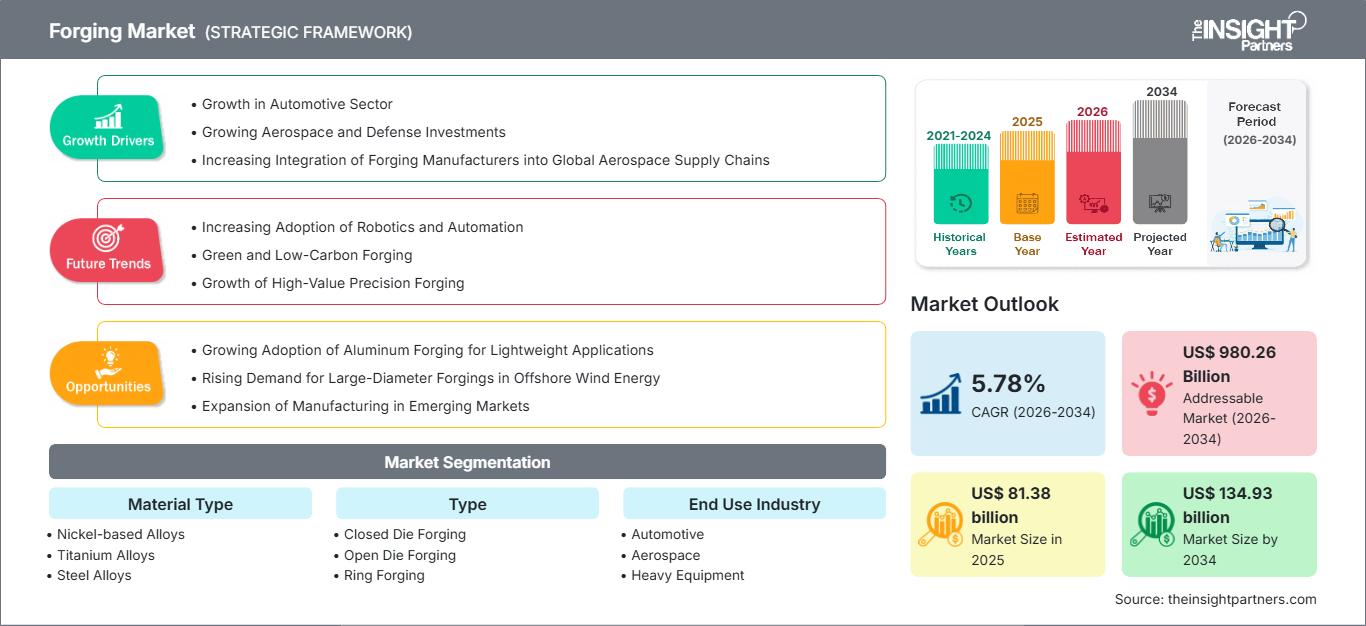
2025 Market Size
US$ 81.38 Bn
Base year value
2034 Forecast
US$ 134.93 Bn
Projected by 2034
CAGR 2026-2034
5.78 %
Growth rate
Addressable Market
US$ 980.26 Bn
(2026-2034)
Global Forging Market reached US$ 81.38 billion in 2025 and is projected to reach US$ 134.93 billion by 2034, expanding at a CAGR of 5.78% during 2026–2034. The market includes metal components shaped under compressive force across nickel-based, titanium, steel, and aluminum alloys, using closed die, open die, and ring forging for automotive, aerospace, heavy equipment, manufacturing, oil and gas, construction, agriculture, energy, pharmaceutical, and other applications.
North America is expected to expand at a modeled ~5% CAGR through 2034. The Global Forging Market size is supported by sustained aerospace build rates, replacement of aging energy equipment, and demand for high-integrity components in commercial vehicles and defense platforms. Regional suppliers are investing in automated presses, induction heating, simulation, and non-destructive inspection to improve traceability, shorten qualification cycles, and offset high labor and energy costs without compromising fatigue performance.
Forging Market Assessment and Insights
Regional Outlook
- North America: ~22% of the global market in 2025 | ~5% CAGR through 2034. Market position: The region ranks third, supported by aerospace, defense, energy, and heavy-truck demand, plus certified domestic capacity for safety-critical forgings.
- US: ~82% of North American market revenue in 2025 | ~5% CAGR through 2034. Market position: The US leads North America through its aerospace engine base, defense procurement, energy equipment replacement, and concentration of qualified alloy-forging suppliers.
- Europe: ~24% of the global market in 2025 | ~4% CAGR through 2034. Market position: A mature automotive and industrial base sustains demand; Germany leads, with Italy, France, the UK, and Spain maintaining specialized capacity.
- Asia Pacific: ~49% of the global market in 2025 | ~7% CAGR through 2034. Market position: The largest and fastest-growing region benefits from vehicle production, infrastructure investment, localization, and expanding aerospace and energy supply chains led by China, India, Japan, and South Korea.
Segment Outlook
- Material Type: ~100% Share in 2025 | ~6% CAGR through 2034. Market position: This main segment captures the complete materials pool, with steel dominating volume and aluminum, titanium, and nickel alloys gaining strategic relevance in lightweight and high-temperature systems.
- End-use Industry: ~100% Share in 2025 | ~6% CAGR through 2034. Market position: Demand broadens beyond automotive as aerospace, energy, heavy equipment, and manufacturing procure certified, near-net-shape components with greater reliability and lifecycle value.
Competitive Coverage
SIFCO Industries, Inc., ANDRITZ AG, RIGANTI SPA, Precision Castparts Corp, Scot Forge Co, Bharat Forge Ltd., Thyssenkrupps AG, Ramkrishna Forgings Ltd, M M Forgings Limited, Doosan Enerbility Co Ltd
Methodology
The Insight Partners follows Data Collection & Secondary Research, Primary Research, Data Analysis, and Data Triangulation & Final Review to validate market estimates and insights.
Source: The Insight Partners' analysis based on proprietary research, government publications, company annual reports, investor presentations, industry databases, and expert interviews.
Die production has evolved from manual hammer work into digital-controlled cells that integrate billet processing heating forming, heat treatment, machining, and inspection. The use of servo presses automation robotic handling, and finite-element simulation, plus in-line temperature monitoring, are boosting accuracy and die life. The economics of production are also changing: the basic-volume platform remains steel, for aluminum, titanium, and nickel-based alloys, where greater processing complexity pays dividends for weight savings, corrosion resistance, or high-temperature strength.
Possibly to 2034, capacity additions will be dominated by India China Southeast Asia, the Middle East and certain North American aerospace regions. Siting incentives, supply chain security requirements, military buys and clean-energy investment will build new ring mill and open-die capacity. Projects must live with lengthy accreditation intervals, secondary alloy input variability, electric-centric energy consumption and customer-specific authorizations. Operations that unify metallurgical engineering, machining, testing, and digital device audibility will win premium programs over mere commodity-only manufacturers.
Forging Market Report Scope
| Report Attribute | Details |
|---|---|
| Market size in 2025 | US$ 81.38 billion |
| Market Size by 2034 | US$ 134.93 billion |
| Global CAGR (2026 - 2034) | 5.78% |
| Historical Data | 2021-2024 |
| Forecast period | 2026-2034 |
Forging Market Analysis
The main factors propelling the market are requirement for parts having high strength under cyclic loadings impact heat and pressure. Automotive (powertrains axles steering systems), aircraft (landing gear), turbine (shafts) valves equipment large industrial gears require controlled grain flow and lower risk of defects. Customer demand flows from vehicle OEM schedules through tier-suppliers to forge shops steelmakers alloy suppliers, die makers, heat-treating facilities, machinists, and test labs. Qualification requirements lead to switching costs, while near-net-shape manufacturing helps reduce future material cutback.
Supply continues to be influenced by alloy pricing, gas, and electricity prices, lead-time availability, skilled-labor competitive disadvantage, and press bottlenecks. Closed-die lines benefit scale and repeating runs; open-die shops produce large low-volume parts; ring-rolling addresses bearings, turbines, engines, and pressure equipment. Customers look for total delivered cost, carbon footprint traceability lead-time, and machining yield, not just forging cost.
Global Forging industry Segmentation analysis the global forging industry has a competitive between generalist engineering groups and specialists who hold specific process approvals. Bharat Forge Limited (India), and Ramkrishna Forgings Limited (India) are venturing beyond the automotive and into aerospace, defense, rail, and industrial markets. Precision Castparts Corp. (United States) and SIFCO Industries, Inc. (United States) have a significant aerospace presence while Scot Forge Company (United States) caters to large forge components. Thyssenkrupp AG (Germany), Doosan Enerbility Co. Ltd. (South Korea), and ANDRITZ AG (Austria) connect forging capability with the broader industrial system.
Allocation of capital toward ring mills, automated transfer, induction heating, simulation, and integrated machining dominates. MM Forgings Limited, Righanti S.p.A. and local experts fight to the death on engineering response and proximity to customer. In the sense that mass production capacity is a driver of strategic location, this is determined based on brand certified alloy capability, program lifetime, energy consumption and tolerable qualification costs. OEM relationships can translate into multi-year ordering, but risk is in the concentrator's ability to spread among mobility, aerospace, energy, and capital equipment..
● REPORT CUSTOMIZATION
Tailor This Report To Align With Your Specific Business Requirements
This report can be customized to align precisely with your business objectives, scope, and target markets. Customization options include tailored segmentation, geography, competitive analysis, and strategic insights to support informed decision-making.
Customize This Report →WHAT YOU CAN ADJUST
- ● Segmentations
- ● Geography
- ● Competitive Analysis
- ● Language Preferences
Forging Market: Strategic Insights
Regional Insights
North America Global Forging Market
North America is modeled to grow at ~5% CAGR through 2034 as aerospace production, defense modernization, power-generation maintenance, and heavy-vehicle replacement sustain demand for high-integrity components. The region’s qualification infrastructure and installed press base favor complex steel, titanium, nickel-alloy, and aluminum products. Global Forging Market share in North America is estimated at ~22% in 2025, placing it behind Asia Pacific and Europe but ahead of smaller regional markets.
Investment considerations encompass automated billet handling, closed-loop temperature control, digital quality tracking, and machining cells adjacent to significant customer accounts. Reshoring and dual-sourcing support the viability of domestic capacity, but labor shortages, lengthy certification processes, and energy expenses limit the pace of growth. Forging suppliers integrating heat treatment, inspection, and finish machining are most likely to secure programs that demand delivery continuity while tolerating higher unit costs.
U.S. Global Forging Market
The U.S. represents ~82% of North American revenue in 2025 and is projected to expand at ~5% CAGR through 2034. It is the leading country in North America because commercial and military aerospace, industrial gas turbines, oilfield equipment, heavy trucks, and construction machinery create a diversified requirement for closed-die, open-die, and rolled-ring products. Modernization of domestic manufacturing capacity reinforces demand for qualified, traceable components.
Precision Castparts Corp. Scot Forge Company and SIFCO Industries, Inc. anchor niche capabilities in aircraft engines, airframe, and structural systems, defense, and energy. Application development trends toward near-net-shape forming, integrated machining and alloy-lightweighting. The best commercial opportunity occurs where suppliers can collaborate early on process qualification with OEM engineers, establish the genealogy of the material, and keep the delivery times on time despite limited supplies of titanium, nickel, or specialty steels.
Europe Global Forging Market
Europe accounts for a modeled ~24% share in 2025 and is expected to grow at ~4% CAGR through 2034. Germany is the leading country in Europe, supported by automotive engineering, industrial machinery, and a broad supplier network. EUROFORGE’s 2025 forecast indicates that Germany remains Europe’s largest forging producer by tonnage, while Italy retains substantial closed-die and open-die capability. Mature vehicle output tempers volume growth, but premium platforms, rail, aerospace, and energy equipment preserve demand for certified components.
France brings together aerospace and industrial outputs; British firms offer aerospace, defence, and energy capability; Spain gives manufacturing and automotive for export. European manufacturers face high cost of electricity and gas, carbon accounting obligations and foreign competitors. They are largely betting on induction-heating, waste-heat recovery, process simulation and modeling, use of recycled feedstock and rigorous yield control.
Thyssenkrupp AG; Riganti S.p.A.; and other experts in engineering strength and close OEM proximity win on regional position. The market's location becomes critical where high product quality and quality standards are to be achieved and where premiums can be realized relatively quick for higher value-adding products, even if tonnage growth is slow. Suppliers with the capability to tight control of emissions, metallurgical quality and more complex machined assemblies need to defend margins more effectively than a pure gross-formed weight player.
APAC Global Forging Market
Asia Pacific holds a modeled ~49% share in 2025 and is the fastest-growing region at ~7% CAGR through 2034. China is the leading country in Asia Pacific, supported by the world’s largest manufacturing ecosystem, vehicle production, machinery exports, and investment in energy equipment. India is gaining through auto components, defense localization, rail, and aerospace sourcing, while Japan and South Korea retain advanced automotive and industrial capabilities.
Demand from mining, energy, and maintenance-intensive assets is part of Australian sources. Regional policy encourages local production, digital manufacturing and lower emission profile, but quality uniformity and lack of spare capacity differ across submarkets. Bharat Forge Limited, Ramkrishna Forgings Limited, MM Forgings Limited, Doosan Enerbility Co. Ltd. and other equipment ecosystem linked to ANDRITZ AG exemplify the integration of component supply and production technology.
Middle East & Africa Global Forging Market
The Middle East & Africa market is modeled to expand at ~6% CAGR through 2034. Saudi Arabia is the leading country in the Middle East & Africa where energy investment, industrial localization, and large infrastructure programs create demand for valves, flanges, shafts, rings, and heavy-equipment components. The UAE adds oilfield services, aviation maintenance, and logistics-led demand.
The energy, power, and industry sectors (excluding mining) in South Africa provide a stable market for replacement forgings, whereas the rest of the Middle East & Africa (MEA) region continues to be project-led and import dependent. Regional opportunities are contingent on local machining, repair, and inventory positioning ahead of full scale forging localisation. Forging partnerships between international forge suppliers and locally based power generation or engineering players can shorten lead times and address procurement localisation criteria.
Segmentation Analysis
Material Type
- The material-type main segment is expected to grow at a CAGR of ~6% during 20262034. The scope of the Global Forging Market is divided from alloy selection for load, temperature, corrosion, weight, machinability, and certification mandates. Steel continues to act as the volume base, whereas aerospace, energy, and emerging premium mobility markets increase the strategic importance of titanium, nickel-based, and aluminum alloys.
- Nickel alloys: demand is concentrated in aero engines, IGT and high temperature equipment, where creep and oxidation performance allow for more complex machining, tighter temperature control and longer qualification.
- Titanium Alloys: titanium forgings are applied to high performance for aerospace structures, landing gears, engines, and certain industrial and medical applications for strength-to weight ratio, corrosion, and fatigue resistance, at a financial premium.
- Steel Alloys lead volume in automotive, heavy equipment, oil and gas construction, agriculture, and power applications due to scalable supply, mature design standards, a wide package of heat treatment solutions, and durability.
- Aluminum Alloys: Aluminum forging becomes increasingly popular for light-weight vehicle chassis, mainly served in aircraft structures, wheels, and mobility systems. Strategic advantages include weight saving, corrosion protection, recyclability, and ease of production through precision near-net-shape manufacturing..
Type
The type main segment is projected to grow at a Compound Annual Growth Rate (CAGR) of approximately 6% from 2018 through 2034. Selection among processes is based on geometry, lot size weight tolerance, grain-flow requirements, tooling economics, and down-stream machining. Closed-die is used for repeatable high-volume parts, open-die for large or engineered shapes, and ring forging brings circumferentially loaded equipment. Digital simulation, automated handling, and thermal protection are increasing yield for all three routes.
- Closed Die Forging: This process is the most dominant in production for automotive and aerospace as it produces advantageous grain flow, tight dimensions, and high volumes of complex components through specialized dies in long production runs.
- Open Die Forging: still the forging process of choice for large shafts, blocks, and cylinders; low production volume industrial parts. Many flexible geometry; very high workpiece capacity for energy marine defense, mining, and off-road equipment needs.
- Ring Forging: Rolled rings are critical components in aircraft engines bearings wind turbines, pressure equipment, and industrial machinery, because of the seamless circumferential grain flow that can provide better strength, fatigue performance, and material utilization.
End-use Industry
Automotive end-use industry dominates the main segment with an expected ~6% CAGR between 2026 and 2034 end use industry the automotive segment accounts for most volume but aerospace, power, and heavy industry demonstrate added value density in end part qualification programs. Buyers value fatigue resistance traceability lifecycle cost of investment, and ensured delivery. A range of forgers can leverage standard presses, heat treatment machining inspection, and other resources between industries to hedge cyclical risk.
- Automotive: Crankshafts, connecting rods gears axles, steering knuckles, wheel hubs and electric-drive shafts, which support the largest demand pool. Automotive production will see a combination of platform reuse and lightweighting but no reduction in the one-third forgings content.
- Aerospace: Aircraft powerplants, rotor systems, structural attachments, landing gear, and space hardware demand precision titanium, nickel, aluminum, and steel forgings with detailed process approval and complete traceability.
- Heavy Equipment: Mining, material handling and industrial equipment use heavy gears, shafts, pins, and undercarriage components. Fixed cycle times and aggressive environments make forged parts with controlled fatigue life the ideal solution.
- manufacturing: General industry takes forgings such as rolls, tooling, shafts, gears, couplings, and pressure fittings. Sales are estimated from total industry capital expenditures, factory utilization, and replacement needs of vital equipment.
- Oil and Gas: Valves flanges connectors, drilling, and well-drilling components, pressure-system parts need strength toughness corrosion resistance and certification for extreme working conditions and long operation.
- Construction Equipment: Excavators loaders crane, and road machinery for high-load drive train, hydraulic, and structural components. Pipeline replacement and other infrastructure pipelines influence timing of demand.
- Equipment for Agriculture: forgings are involved in tractors harvesters tillage equipment, and drive trains that require impact performance and field reliability. The need to mechanize and replace creates pervasively distributed opportunities.
- Energy and Power: long-cycle demands on turbine shaft, generator items, wind rings, nuclear items, and thermal-plant devices allow demanding metallurgy, inspection, and noting throughout each step.
- Pharmaceutics: corrosion-resistant forged valves fittings pressure components, and rotors in clean room process products in the areas of material verification, clean room procedure, and reliable volumes are the main purchase criteria.
Opportunity Snapshot
| End-use Industry | Revenue Contribution | Trend Tag | Adoption Stage |
| Automotive | High | EV Drivetrains | Mature |
| Aerospace | High | Fleet Ramp | Scaling |
| Heavy Equipment | Medium | Fleet Renewal | Mature |
| Manufacturing | Medium | Factory Automation | Mature |
| Oil and Gas | Medium | Pressure Integrity | Mature |
| Construction Equipment | Medium | Infrastructure Pipeline | Scaling |
| Agricultural Equipment | Low | Farm Mechanization | Scaling |
| Energy and Power | High | Turbine Renewal | Scaling |
| Pharmaceutical | Low | Clean Processing | Emerging |
| Others | Low | Niche Engineering | Emerging |
Forging Market Growth Drivers and Impact Analysis
Safety-Critical Demand Across Mobility and Aerospace
For forgings, our vehicle and aircraft customers are still specifying parts that must have a fatigue life, impact resistance, and well defined failure characteristics. Internal combustion architectures still require forged crankshafts, connecting rods, gears, and axles, while electric architectures drive demand for motor shafts, transmission parts, suspension members and structural nodes. Aerospace production also contributes landing gear, disks, rings, shafts, and fittings with strict certification requirements. The effects are felt beyond unit volume: minimized tolerances and better traceability increase value per component and favor a supplier who can offer the whole package of simulation, heat treatment, machining, and testing. Qualification challenges also lengthen program cycles, creating more predictable cash flows once a supplier is qualified.
Infrastructure, Energy, and Equipment Replacement
Large rings shafts flanges, gears, and pressure-boundaries are used for grid investment, wind farms, thermal, and nuclear plant and service, oil, and gas development, miner, and constructor. Many assets have life spans of decades, so replacement cycles are less correlated with consumer spending than auto demand. Forgings are chosen because controlled grain flow and toughness lower risk of failure when subjected torque, pressure, shock, and temperature. Commercially, open-die, and ring manufacturers that can lift heavyweights, perform ultrasonic inspection and machine fine assemblies have their greatest impact. Work is varied and project timing lumpy, but a mix of exposure can boost utilization for lengthy capital investment cycles.
Automation and Yield Economics
Robotic billet handling, servo-controlled presses, induction heating, finite-element simulation, and in-line inspection drive up consistency and lower scrap, rework, and operator exposure. These matters because alloy feedstock and energy can comprise a large fraction of the conversion cost, though this varies by titanium and nickel system. Refined die design and near-net-shape forming show an ability to reduce machining allowances and improve throughput. The productivity improvements can tilt the wage curve and help win bids on globally sourced programs. Use of data also changes the competition: plants with linked process histories can prove their case faster, participate in customer audits, and catch drift before the defect chain grows.
Forging Market Future Trends
Digital Process Twins and Closed-Loop Quality
Global Forging Market trends will increasingly center on digital process twins that connect billet chemistry, furnace history, die condition, press load, cooling, heat treatment, machining, and inspection. Rather than treating quality as an end-of-line activity, producers will use sensor data and simulation to predict grain flow, detect temperature deviations, and optimize die life. The transition should reduce qualification risk and enable more consistent near-net-shape production. Suppliers that can provide secure, auditable component histories will be better positioned for aerospace, defense, energy, and other regulated programs, while smaller plants may adopt modular monitoring platforms to avoid the cost of full factory replacement.
Lower-Carbon Forging and Circular Feedstock
Procurement more so between 2030-2034 will focus on electrical source, furnace efficiency, recycled content, yield, and documented product emissions. First, induction heating, regenerative burners, heat recovery, renewable power purchase agreements and segregation of scrap can reduce conversion intensity. This trend will not hold for all parts equally as safety qualifications restrict fast material-route changes. But suppliers who qualify a baseline and work with steel and alloy customers to reduce scope-three customer exposure will find markets. European demands may spur adoption, though import-oriented facilities in Asia and North America will adopt as OEM reporting requirements become standard practice in sourcing decisions.
Forging Market Opportunities
Aerospace Ring and Landing-Gear Localization
New ring mills and integrated machining lines in India and other emerging aerospace hubs create an opportunity to localize high-value engine and landing-gear components. Global Forging Market Forecasts support investment where capacity is paired with long-term customer agreements, approved alloy sources, non-destructive testing, and skilled metallurgical engineering. Investors should prioritize fungible equipment that can address aero engines, industrial turbines, and critical energy systems during program shifts. Early collaboration with OEMs is essential because certification can precede meaningful revenue by several years. The most defensible projects combine forging, machining, heat treatment, and digital traceability rather than relying on commodity conversion margins.
Lifecycle Services for Large Industrial Forgings
Market Opportunities for Forging Growth Opportunities include inspection, remanufacturing support, replacement engineering, and associated fast-turnaround manufacturing of aging turbines presses mining assets, and process plants. Often customers have long lead times and inadequate OEM tooling for large shafts, rings, and pressure parts. Forgers that can forge repeat relationships by establishing digital records, reverse engineering allowable parts, maintaining a supply of qualified feedstock, and orchestrating machining and heat treatment can shorten wait times and eliminate the need for a greenfield forge. Regional service centers can operate close to energy and other industrial geographies and minimize downtime without the infrastructure of an entire greenfield.
Recent Developments
- May 2026: Bharat Forge Limited – The company signed a long-term agreement with Embraer to manufacture and supply critical landing-gear forgings for commercial and defense aircraft, becoming the first Indian forged-component supplier in Embraer’s global aerospace supply chain. The award expands India’s role in safety-critical aerospace manufacturing and supports scale across structural and engine-related programs.
- December 2025: SIFCO Industries, Inc. – In its fiscal 2025 annual report, SIFCO reported a strong military and commercial backlog, continued work on electric-aircraft and drone applications, and awards covering 32 new products. The disclosure shows how aerospace and defense suppliers are broadening alloy and application portfolios while improving throughput and margins.
- March 2025: Ramkrishna Forgings Limited – The company commenced commercial production of two upsetters at its Dugni facility, adding 14,250 metric tonnes of annual hot and warm forging capacity. The approximately Rs. 40.85 crore investment was financed through equity and debt and was directed toward additional customer demand, lifting total hot and warm forging capacity to 243,400 metric tonnes.
Frequently Asked Questions

- Comprehensive Market Sizing and Forecast Analysis
- Detailed Segmentation Analysis
- In-Depth Market Dynamics Assessment
- Regional and Country-Level Insights
- Competitive Landscape and Company Benchmarking
- Strategic Business Intelligence
Recent Reports
Testimonials

The Insight Partners provided valuable market intelligence that supported our global go-to-market strategy. Their team was professional, responsive, and attentive to our feedback, providing thoughtful analysis and helpful methodological clarifications throughout the project.
Junmo Kim Chief Financial Officer (CFO), Enertech Co., Ltd.
The Insight Partners' SCADA System Market report is comprehensive, with valuable insights on current trends and future forecasts. The team was highly professional, responsive, and supportive throughout. We are very satisfied and highly recommend their services.
RAN KEDEM Partner, Reali Technologies LTDs
I requested a report on a very specific software market and the team produced the report in a few days. The information was very relevant and well presented. I then requested some changes and additions to the report. The team was again very responsive and I got the final report in less than a week.
JEAN-HERVE JENN Chairman, Future Analytica
We worked with The Insight Partners for an important market study and forecast. They gave us clear insights into opportunities and risks, which helped shape our plans. Their research was easy to use and based on solid data. It helped us make smart, confident decisions. We highly recommend them.
PIYUSH NAGPAL Sr. Vice President, High Beam Global
The Insight Partners delivered insightful, well-structured market research with strong domain expertise. Their team was professional and responsive throughout. The user-friendly website made accessing industry reports seamless. We highly recommend them for reliable, high-quality research services
YUKIHIKO ADACHI CEO, Deep Blue, LLC.
This is the first time I have purchased a market report from The Insight Partners.While I was unsure at first, I visited their web site and felt more comfortable to take the risk and purchase a market report.I am completely satisfied with the quality of the report and customer service. I had several questions and comments with the initial report, but after a couple of dialogs over email with their analyst I believe I have a report that I can use as input to our strategic planning process.Thank you so much for taking the extra time and making this a positive experience.I will definitely recommend your service to others and you will be my first call when we need further market data.
JOHN SUZUKI President and Chief Executive Officer, Board Director, BK Technologies
I wish to appreciate your support and the professionalism you displayed in the course of attending to my request for information regarding to infectious disease IVD market in Nigeria. I appreciate your patience, your guidance, and the fact that you were willing to offer a discount, which eventually made it possible for us to close a deal. I look forward to engaging The Insight Partners in the future, all thanks to the impression you have created in me as a result of this first encounter.
DR CHIJIOKE ONYIA MANAGING DIRECTOR, PineCrest Healthcare Ltd.Reason to Buy
- Informed Decision-Making
- Understanding Market Dynamics
- Competitive Analysis
- Identifying Emerging Markets
- Customer Insights
- Market Forecasts
- Risk Mitigation
- Boosting Operational Efficiency
- Strategic Planning
- Investment Justification
- Tracking Industry Innovations
- Aligning with Regulatory Trends






 Get Free Sample for