
Centrifugal Axial Flow Pump Market Growth, Demand & Forecast 2031
Coverage: By Stage (Single Stage and Multistage), Operation Type (Electric, Hydraulic, and Air Driven), Type (Vertically Suspended and Between Bearing), End User [Industrial (Water & Wastewater Treatment, Oil & Gas, Power Generation, Chemical, Food & Beverages, and Others), Residential, Commercial, and Agriculture], and Geography (North America, Europe, Asia Pacific, Middle East & Africa, and South America)
- Status : Published
- Report Code : TIPRE00041489
- Category : Manufacturing and Construction
- No. of Pages : 200
- Available Report Formats :


- Last update date : December 16, 2025


2024 Market Size
US$ 3.02 Bn
Base year value
2031 Forecast
US$ 4.20 Bn
Projected by 2031
CAGR 2025-2031
5.1 %
Growth rate
Addressable Market
US$ 25.92 Bn
(2025-2031)
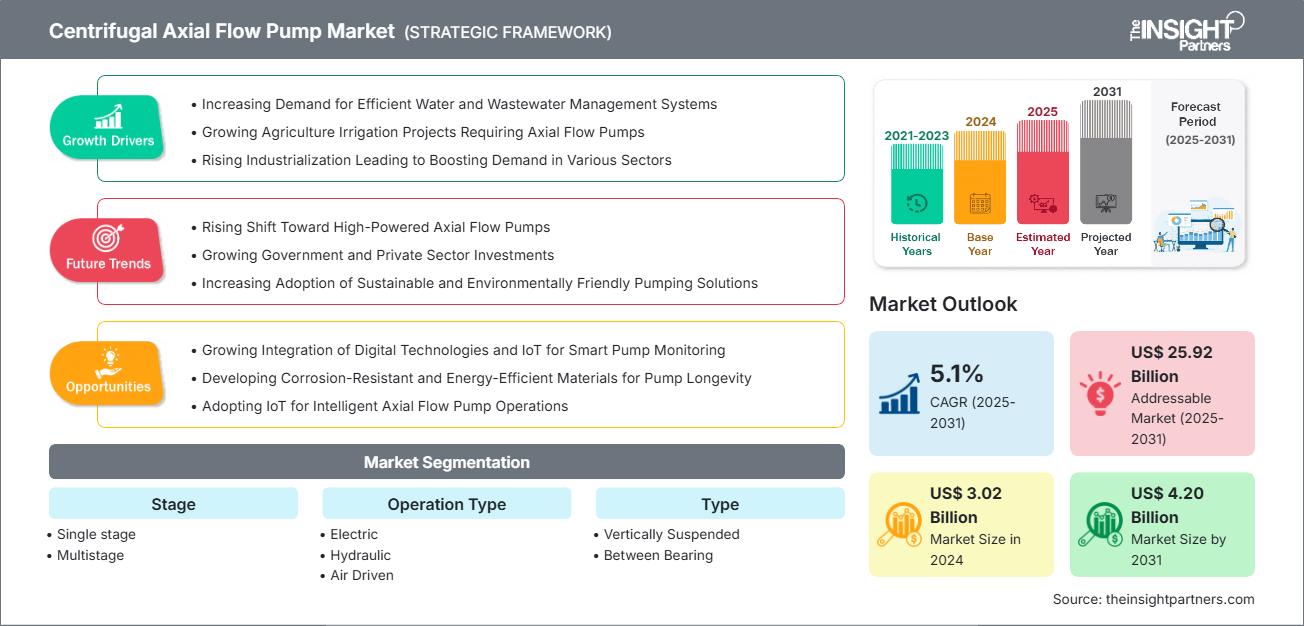
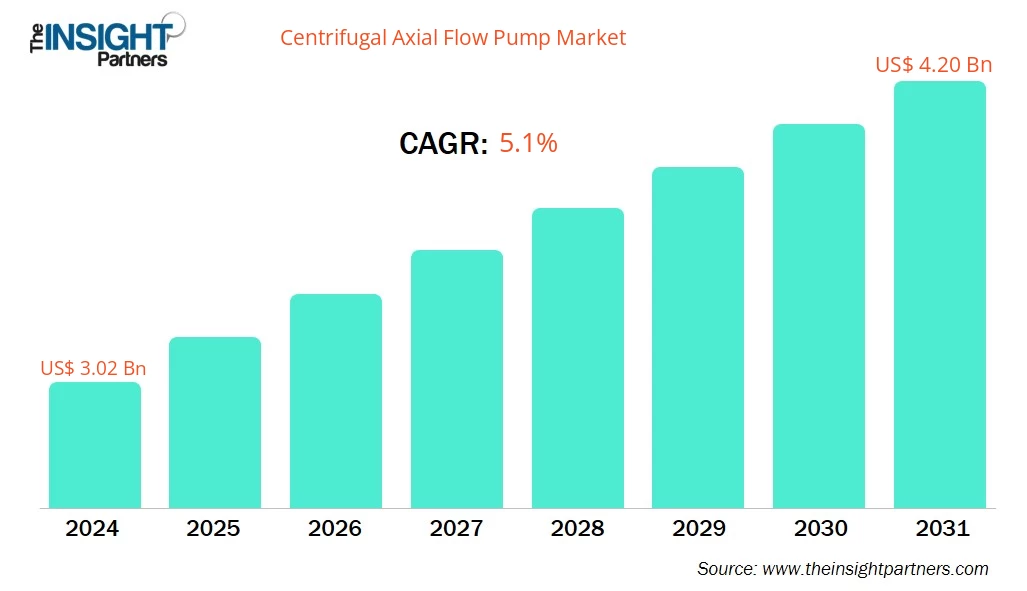
The centrifugal axial flow pump market size is projected to reach US$ 3.02 billion in 2024 and is expected to reach US$ 4.20 billion by 2031. The centrifugal axial flow pump market is estimated to register a CAGR of 5.05% during 2025–2031.
Centrifugal Axial Flow Pump Market Analysis
The market growth is driven by increasing demand for efficient fluid handling across industries such as water treatment, agriculture, and oil & gas. Rapid industrialization and infrastructure upgrades are boosting the need for reliable pump solutions that offer high flow rates and energy efficiency. Additionally, advancements in smart monitoring and automation reduce downtime and operational costs. Environmental regulations also push the adoption of energy-efficient axial flow pumps.
Centrifugal Axial Flow Pump Market Overview
The integration of Industry 4.0 and IIoT technologies enables real-time performance monitoring and predictive maintenance. Smart sensors and automation facilitate efficient flow control, reduced downtime, and enhanced operational reliability. These innovations support seamless data flow between pumps and control systems, optimizing fluid management in industrial, agricultural, and water treatment applications.
Market Assessment and Insights
- Asia Pacific dominated the market with 49.6% share in 2024.
- Asia Pacific is poised to grow at a CAGR of 6.1% over the forecast period.
- US market is projected to grow at a CAGR of 4.6% over the forecast period.
- By Stage, the Single Stage segment accounted for the largest market share of 59.5% in 2024.
- By Operation Type, the Electric segment is anticipated to witness the fastest growth, registering a CAGR of 5.3% over the forecast period
- By Type, the Vertically Suspended segment accounted for the largest market share of 62.4% in 2024.
- By End User, the Industrial segment is anticipated to witness the fastest growth, registering a CAGR of 5.5% over the forecast period
- By Industrial End User, the Oil and Gas segment accounted for the largest market share of 25.7% in 2024.
- The report profiles key industry players such as Parker Hannifin Corporation, Sulzer Ltd, Ebara Corp, KIRLOSKAR BROTHERS LIMITED, The Weir Group PLC, Xylem Inc., C.R.I. Pumps Private Limited, Denwell Fluid Controls, Grundfos Holding, Gorman-Rupp Company (Gorman-Rupp Pumps), while also analyzing key developments in novel ideas, disruptive products, and innovative services that could reshape the future market and reveal emerging themes across the industry.
Source: The Insight Partners' analysis based on proprietary research, government publications, company annual reports, investor presentations, industry databases, and expert interviews.
● REPORT CUSTOMIZATION
Tailor This Report To Align With Your Specific Business Requirements
This report can be customized to align precisely with your business objectives, scope, and target markets. Customization options include tailored segmentation, geography, competitive analysis, and strategic insights to support informed decision-making.
Customize This Report →WHAT YOU CAN ADJUST
- ● Segmentations
- ● Geography
- ● Competitive Analysis
- ● Language Preferences
Centrifugal Axial Flow Pump Market: Strategic Insights
-
Get Top Key Market Trends of this report.This FREE sample will include data analysis, ranging from market trends to estimates and forecasts.
Centrifugal Axial Flow Pump Market Drivers and Opportunities
Market Drivers:
- Adoption of Industrial Automation: Integration of smart sensors and automation enhances pump monitoring and control, leading to improved efficiency and reduced downtime in diverse industrial processes.
- Demand for Energy Efficiency: Innovations in pump design and materials reduce energy consumption, meeting stringent environmental regulations and lowering operational costs.
- Development of Infrastructure: Expansion of water supply, wastewater treatment, and agricultural projects boosts centrifugal axial flow pump installations.
Market Opportunities:
- Climate Resilience and Flood Management: The large-scale investments in flood control, stormwater management, and coastal protection projects have been driving the demand for centrifugal axial flow pumps that are capable of moving very large volumes of water at low heads for levees, pumping stations, and drainage schemes.
- Desalination and Large Water Transfer Projects: The extension of seawater desalination facilities along with the establishment of long-distance raw water transfer pipelines in regions suffering from water scarcity is leading to the demand for high-capacity axial and mixed-flow centrifugal pumps that are used in intake, brine discharge, and circulating systems.
- Power and Industrial Cooling Systems: The increase in thermal and nuclear generation, as well as energy-intensive process industries, has led to the need for efficient cooling-water and circulation systems in which centrifugal axial flow pumps are the best choice for dealing with high flows at moderate heads while at the same time minimizing energy consumption.
Centrifugal Axial Flow Pump Market Report Segmentation Analysis
The centrifugal axial flow pump market is divided into different segments to give a clearer view of how it works, its growth potential, and the latest trends. Below is the standard segmentation approach used in industry reports:
By Type:
- Single Stage: Single-stage centrifugal axial flow pumps are simple and effective for situations that need medium flow and pressure. Their small size and low-cost servicing make these products the best choice for water supply, irrigation, and heating and cooling systems.
- Multistage: Multistage pumps achieve higher pressure by arranging multiple impellers in series, which makes them suitable for specialized applications such as high-pressure industrial processes, boiler feedwater systems, and water treatment plants where increased head and precise flow control are essential.
By Application:
- Electric: Electric pumps are widely preferred for their energy efficiency and durability. They are commonly used in industrial, agricultural, and municipal water sectors, serving as the primary solution for accurate volume control and seamless integration with automation systems.
- Hydraulic: Hydraulic pumps are best suited for applications requiring high power and variable speed. They are commonly used in sectors like mining and heavy machinery, where efficient energy conversion from hydraulic systems to fluid flow ensures optimal performance.
- Air Driven: Air-driven pumps use compressed air as their power source, making them an excellent choice for hazardous or explosive environments where electric motors pose safety risks. They provide a safe and versatile pumping solution in such conditions.
By Type:
- Vertically Suspended
- Between Bearing
By End User:
- Industrial (Water & Wastewater Treatment, Oil & Gas, Power Generation, Chemical, Food & Beverages, Others)
- Residential
- Commercial
- Agriculture
By Geography:
- North America
- Europe
- Asia Pacific
- South America
- Middle East & Africa
Centrifugal Axial Flow Pump Market Report Scope
| Report Attribute | Details |
|---|---|
| Market size in 2024 | US$ 3.02 Billion |
| Market Size by 2031 | US$ 4.20 Billion |
| Global CAGR (2025 - 2031) | 5.1% |
| Historical Data | 2021-2023 |
| Forecast period | 2025-2031 |
| Segments Covered |
By Stage
|
| Regions and Countries Covered |
North America
|
| Market leaders and key company profiles |
|
Centrifugal Axial Flow Pump Market Players Density: Understanding Its Impact on Business Dynamics
The Centrifugal Axial Flow Pump Market is growing rapidly, driven by increasing end-user demand due to factors such as evolving consumer preferences, technological advancements, and greater awareness of the product's benefits. As demand rises, businesses are expanding their offerings, innovating to meet consumer needs, and capitalizing on emerging trends, which further fuels market growth.
Centrifugal Axial Flow Pump Market Share Analysis by Geography
Asia Pacific is the largest regional market for centrifugal axial flow pumps and also the fastest-growing. Growth in this region is primarily driven by industrialization, increasing population, and substantial investments in infrastructure by China, India, and Southeast Asia. There is a strong demand for large capacity axial pumps to carry out intake, transfer, and flood control operations because of the extensive investments being made in municipal water supply, sewage networks, and wastewater treatment plants. Besides that, the growing irrigation canals and water-conservancy projects for rice, sugarcane, and other water-intensive crops are significantly increasing the adoption, predominantly in China and India.
Below is a summary of market share and trends by region:
1. North America
- Market Share: The US contributes significantly to the market share.
- Key Drivers:
- Improvements in municipal water, wastewater, and flood-control systems.
- Well-developed process industries and reliable water and wastewater infrastructure.
- A robust oil & gas, chemical, and power sectors that need high-flow, energy‑efficient pumps.
- Trends: Gradual move to IIoT‑enabled pumps, predictive maintenance, and stricter efficiency standards to comply with more stringent environmental regulations.
2. Europe
- Market Share: Germany contributes significantly to the market share owing to the rise in demand for centrifugal pumps owing to heavy industrialization and spending on flood, desalination projects.
- Key Drivers:
- Regulatory compliance is the main driver for energy-efficient, low-emission pumping solutions in the water, chemical, and power sectors.
- Heavy industrialization and stringent environmental and efficiency regulations in countries such as Germany, France, Italy, and the UK.
- Spending on flood management, desalination, and heating networks.
- Trends: The replacement of the aged plants with advanced, variable-speed axial and centrifugal pumps, along with a strong focus on optimizing the lifecycle costs.
3. Asia Pacific
- Market Share: China, India, Japan, and Southeast Asia are the main investors, driving heavy industrialization and focusing on urban water infrastructure.
- Key Drivers:
- Large-scale expansion of municipal water supply, irrigation, and wastewater treatment projects.
- Development of power generation, chemicals, and mining sectors that require large‑capacity axial flow units.
- Trends: Expansion of local manufacturing, government infrastructure programs, and the growing use of smart control systems for large pumping stations.
4. Middle East & Africa
- Market Share: The region has a developing market, strongly supported by the GCC countries and major African economies that are investing in water management and energy projects.
- Key Drivers:
- Extensive desalination, district cooling, and flood-control projects.
- Oil & gas and petrochemical projects that require high‑volume circulation and cooling pumps.
- Trends: Developments in corrosion‑resistant, high-reliability pumps for harsh environments and PPP-backed water and wastewater infrastructure.
5. South America
- Market Share: A moderately sized but growing market primarily dominated by Brazil, Argentina, and Chile, which have robust agriculture, mining, and hydroelectric sectors.
- Key Drivers:
- Investments in irrigation networks, hydropower plants, and urban water projects.
- Industries consuming process materials such as pulp and paper, chemicals, and mining require efficient slurry and water handling.
- Trends: Replacement of outdated pumping stations with modern ones, greater emphasis on energy savings, and gradual implementation of automated monitoring and control systems.
Centrifugal Axial Flow Pump Market Players Density: Understanding Its Impact on Business Dynamics
Medium Market Density and Competition
Competition is strong due to the presence of established players such as Ebara Corp, Kirloskar Brothers Limited (KBL), Parker-Hannifin Corp, Grundfos Holding A/S, and Xylem Inc. Regional and niche players are also adding to the competitive landscape across different regions.
This high level of competition urges companies to stand out by offering:
- Advanced axial flow pump features.
- Value-added connectivity and integration services.
- Flexible and cost-effective pricing models.
- Comprehensive customer support and solution customization.
Opportunities and Strategic Moves
- Pump manufacturers are deepening relationships with automation suppliers, EPC contractors, and industrial OEMs to maintain compatibility with digital control systems and SCADA platforms, thus facilitating their use in water, power, and process industries.
- Leading vendors are introducing modular, skid-mounted, and configurable pump packages, combining pumps, drives, controls, and condition‑monitoring modules, which can be rapidly scaled or customized to different heads, flow rates, and site layouts, reducing engineering time and installation costs.
Disclaimer: The companies listed above are not ranked in any particular order.
Companies analyzed during the course of research:
- Xylem Inc.
- Sulzer Ltd
- The Weir Group PLC
- Gorman-Rupp Company (Gorman-Rupp Pumps)
- Grundfos Holding A/S
- C.R.I. Pumps Private Limited
- Parker Hannifin Corporation
- Denwell Fluid Controls
- Kirloskar Brothers Limited (KBL)
- Ebara Corporation
Centrifugal Axial Flow Pump Market News and Recent Developments
- Grundfos Holding A/S Announces Expansion of Facilities in Texas: In August 2025, Grundfos, a global leader in advanced water technology and pump solutions, announced an expansion of its facilities in Brookshire, Texas. Marking the culmination of years of planning, this new, state-of-the-art production facility represents a significant expansion of the current facility.
- Kirloskar Brothers Limited Launched Vertical Inline Long Coupled “KW-LC” Pumps: In October 2025, Kirloskar Brothers Limited (KBL) recently launched its latest product, the Vertical Inline Long Coupled “KW-LC” Pumps, expanding its ever-growing portfolio in the heating, ventilation, and air-conditioning (HVAC) segment. The KW-LC pump is a space-saving, vertical, long-coupled design that simplifies piping and has a compact structure. Moreover, the KW-LC pump is a vertical inline pump with axial flow characteristics
Centrifugal Axial Flow Pump Market Report Coverage and Deliverables
The "Centrifugal Axial Flow Pump Market Size and Forecast (2021–2031)" report provides a detailed analysis of the market covering below areas:
- Centrifugal axial flow pump market size and forecast at global, regional, and country levels for all the key market segments covered under the scope.
- Centrifugal axial flow pump market trends, as well as market dynamics such as drivers, restraints, and key opportunities.
- Detailed PEST and SWOT analysis.
- Centrifugal axial flow pump market analysis covering key market trends, global and regional framework, major players, regulations, and recent market developments.
- Industry landscape and competition analysis covering market concentration, heat map analysis, prominent players, and recent developments for the centrifugal axial flow pump market.
- Detailed company profiles.
Frequently Asked Questions
1. Rising Investments in Water and Wastewater Infrastructure
2. Growing Adoption in Irrigation, Flood Control, and Drainage Projects
3. Increasing Demand for Energy‑Efficient, High‑Flow Pumping Solutions
1. Water and Wastewater Treatment
2. Oil and Gas
3. Power Generation
4. Chemical
5. Food and Beverages
6. Others
7. Commercial
8. Residential
9. Agriculture
1. North America: North America shows strong uptake, supported by large-scale upgrades of municipal water and wastewater systems, flood-control projects, and process industries that prioritize high‑efficiency, large‑volume pumping solutions.
2. Europe: Europe is another key adopter, where stringent environmental rules, aging infrastructure replacement, and a focus on energy‑efficient water and wastewater management sustain steady demand for advanced centrifugal axial flow pumps.
3. Asia Pacific: Asia Pacific is the leading region for centrifugal axial flow pump adoption, driven by rapid urbanization, irrigation expansion, and massive investments in water, wastewater, and power infrastructure, particularly in China and India.
High Capital and Operating Costs for Large-Scale Installations:
The notable upfront investment, energy consumption, and the requirement for a maintenance that is quite specialized for a high‑capacity centrifugal axial flow pump will probably limit the expansion of the market, particularly in the case of municipalities with a tight budget and small industrial operators

- Comprehensive Market Sizing and Forecast Analysis
- Detailed Segmentation Analysis
- In-Depth Market Dynamics Assessment
- Regional and Country-Level Insights
- Competitive Landscape and Company Benchmarking
- Strategic Business Intelligence
Recent Reports
Testimonials

The Insight Partners provided valuable market intelligence that supported our global go-to-market strategy. Their team was professional, responsive, and attentive to our feedback, providing thoughtful analysis and helpful methodological clarifications throughout the project.
Junmo Kim Chief Financial Officer (CFO), Enertech Co., Ltd.
The Insight Partners' SCADA System Market report is comprehensive, with valuable insights on current trends and future forecasts. The team was highly professional, responsive, and supportive throughout. We are very satisfied and highly recommend their services.
RAN KEDEM Partner, Reali Technologies LTDs
I requested a report on a very specific software market and the team produced the report in a few days. The information was very relevant and well presented. I then requested some changes and additions to the report. The team was again very responsive and I got the final report in less than a week.
JEAN-HERVE JENN Chairman, Future Analytica
We worked with The Insight Partners for an important market study and forecast. They gave us clear insights into opportunities and risks, which helped shape our plans. Their research was easy to use and based on solid data. It helped us make smart, confident decisions. We highly recommend them.
PIYUSH NAGPAL Sr. Vice President, High Beam Global
The Insight Partners delivered insightful, well-structured market research with strong domain expertise. Their team was professional and responsive throughout. The user-friendly website made accessing industry reports seamless. We highly recommend them for reliable, high-quality research services
YUKIHIKO ADACHI CEO, Deep Blue, LLC.
This is the first time I have purchased a market report from The Insight Partners.While I was unsure at first, I visited their web site and felt more comfortable to take the risk and purchase a market report.I am completely satisfied with the quality of the report and customer service. I had several questions and comments with the initial report, but after a couple of dialogs over email with their analyst I believe I have a report that I can use as input to our strategic planning process.Thank you so much for taking the extra time and making this a positive experience.I will definitely recommend your service to others and you will be my first call when we need further market data.
JOHN SUZUKI President and Chief Executive Officer, Board Director, BK Technologies
I wish to appreciate your support and the professionalism you displayed in the course of attending to my request for information regarding to infectious disease IVD market in Nigeria. I appreciate your patience, your guidance, and the fact that you were willing to offer a discount, which eventually made it possible for us to close a deal. I look forward to engaging The Insight Partners in the future, all thanks to the impression you have created in me as a result of this first encounter.
DR CHIJIOKE ONYIA MANAGING DIRECTOR, PineCrest Healthcare Ltd.Reason to Buy
- Informed Decision-Making
- Understanding Market Dynamics
- Competitive Analysis
- Identifying Emerging Markets
- Customer Insights
- Market Forecasts
- Risk Mitigation
- Boosting Operational Efficiency
- Strategic Planning
- Investment Justification
- Tracking Industry Innovations
- Aligning with Regulatory Trends




 Get Free Sample for