
Dimethyl Terephthalate Market Trends, Share & Demand by 2034
Coverage: By Product Form (Flake (Solid) DMT, Liquid DMT); Application (Polyethylene Terephthalate (PET), Polybutylene Terephthalate (PBT), Others) , and Geography (North America, Europe, Asia Pacific, and South and Central America)
- Status : Data Released
- Report Code : TIPRE00005979
- Category : Chemicals and Materials
- No. of Pages : 150
- Available Report Formats :


- Last update date : October 22, 2026


2025 Market Size
US$ 1.25 Bn
Base year value
2034 Forecast
US$ 1.72 Bn
Projected by 2034
CAGR 2026-2034
3.61 %
Growth rate
Addressable Market
US$ 13.49 Bn
(2026-2034)
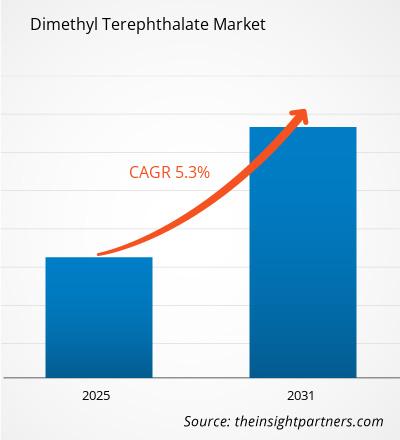
The Dimethyl Terephthalate market size was valued at US$ 1.25 Billion in 2025 and is projected to reach US$ 1.72 Billion by 2034, registering a CAGR of 3.61% from 2026 to 2034. The market is shaped by demand for polyester intermediates, engineering plastics, specialty films, and fibers. Its competitive structure reflects established production assets, downstream polyester integration, and increasing attention to circular feedstocks and process efficiency.
North America remains an important specialty market, supported by polymer manufacturing, engineering-plastics applications, and molecular recycling investments. The region is expected to expand at approximately 2.8–3.5% CAGR during 2026–2034. Demand is reinforced by domestic supply-chain resilience, advanced recycling infrastructure, and requirements for high-purity intermediates used in specialty polyester applications.
Dimethyl Terephthalate Market Assessment and Insights
- North America: North America represented approximately 18–22% Dimethyl Terephthalate market share in 2025 and is expected to grow at a 2.8–3.5% CAGR between 2026 and 2034, supported by specialty polymers, recycling, and domestic chemical production.
- U.S.: The U.S. accounted for approximately 75–82% of North American demand in 2025 and is projected to grow at a 2.9–3.6% CAGR during 2026–2034, led by specialty polyester applications.
- Europe: Europe held approximately 14–18% share in 2025 and is expected to expand at a 2.4–3.1% CAGR between 2026 and 2034, with Germany, France, Italy, and the UK supporting specialty polyester and engineering-plastic consumption.
- Asia Pacific: Asia Pacific held approximately 50–54% share in 2025 and is projected to register a 3.0–3.8% CAGR between 2026 and 2034, led by China, Japan, South Korea, and India through polyester manufacturing and industrial polymer demand.
- Largest Segment: Polyethylene Terephthalate represented approximately 64–69% market share in 2025 and is expected to expand at a 3.3–3.9% CAGR during 2026–2034.
- High Growth Segment: Polybutylene Terephthalate represented approximately 12–16% market share in 2025 and is projected to grow at a 4.0–4.8% CAGR through 2034, supported by engineering plastics.
- Key companies analyzed in detail: Fiber Intermediate Products Company, Eastman Chemical Company, SASA Polyester Sanayi A.Ş., Mogilevkhimvolokno JSC, Connect Chemicals GmbH, Sarna Chemicals Pvt. Ltd., SK Chemicals Co., Ltd., Yangzhou Juhechang Technology Co., Ltd., Antares Chem Private Limited, Mitsui Chemicals, Inc.
Source: The Insight Partners' analysis based on proprietary research, government publications, company annual reports, investor presentations, industry databases, and expert interviews.
Production economics in the Dimethyl Terephthalate market are now affected by the switch from dimethyl terephthalate to purified terephthalic acid in industrialized polyester plants. However, DMT is still relevant in instances where current transesterification infrastructure, the production of specialty polyesters, or the need for flexibility justifies its utilization. Eastman considers DMT as the intermediate material for producing PET fiber, film, container plastics, and specialty plastics, while SK Chemicals provides DMT for films, fibers, engineering plastics, and adhesives.
Expansions will probably not be driven by capacity, but rather, by selectivity. The Asia Pacific will continue to have the biggest consumption base owing to the already existing polyester manufacturing systems, while North America will get strategic significance through polyester intermediates from recycling. The infrastructure of molecular-recycling by Eastman illustrates the potential of using polyester waste to form molecular building blocks.
Dimethyl Terephthalate Market Report Scope
| Report Attribute | Details |
|---|---|
| Market size in 2025 | US$ 1.25 Billion |
| Market Size by 2034 | US$ 1.72 Billion |
| Global CAGR (2026 - 2034) | 3.61% |
| Historical Data | 2021-2024 |
| Forecast period | 2026-2034 |
Dimethyl Terephthalate Market Analysis
The Dimethyl Terephthalate market report shows that demand is tightly linked to the polyester value chain where dimethyl terephthalate functions as an reactive intermediate in the manufacturing of polyesters. The market for DMT, hence, depends upon fiber, film, packaging and engineering polymeric products production and not on chemical usage alone. Asia continues to remain the largest consumer of DMT, but the product finds itself more in a niche position as PTA based technology gains prevalence in high volume polyester production.
Starting from the aromatic raw materials and methanol, followed by esterification, purification, crystallization and or melting and distribution, the value chain is structured. While flake helps in easy storage and handling, the molten product may help in reducing remelting costs of integrated polymers producers. The selection of suppliers would be based on the purity, color, consistency, logistics and economics of conversion.
The competitive environment is influenced by the presence of integrated chemical producers as well as specialized suppliers. Analysis of the Dimethyl Terephthalate Market reveals that integrated companies have an opportunity to manage the use of raw materials, while specialized suppliers compete through quality, reliability of deliveries, support, and geographical distribution. Eastman supplies molten DMT for PET synthesis, whereas SK Chemicals provides both liquid and solid grades of DMT and specifies PBT, PET films, fibers, and adhesives as applications.
Innovation and investment in the Dimethyl Terephthalate market is getting more selective. Manufacturers are focusing on specialty polymer applications, circular feedstocks, and efficient production plants rather than general virgin DMT capacities. Eastman's methanolysis technology is one example of such approach, as Kingsport plant recycles polyester scrap into molecular blocks. SK Chemicals produces DMT as a part of its petrochemical range, and SASA incorporates DMT/PTA technology into PET synthesis.
● REPORT CUSTOMIZATION
Tailor This Report To Align With Your Specific Business Requirements
This report can be customized to align precisely with your business objectives, scope, and target markets. Customization options include tailored segmentation, geography, competitive analysis, and strategic insights to support informed decision-making.
Customize This Report →WHAT YOU CAN ADJUST
- ● Segmentations
- ● Geography
- ● Competitive Analysis
- ● Language Preferences
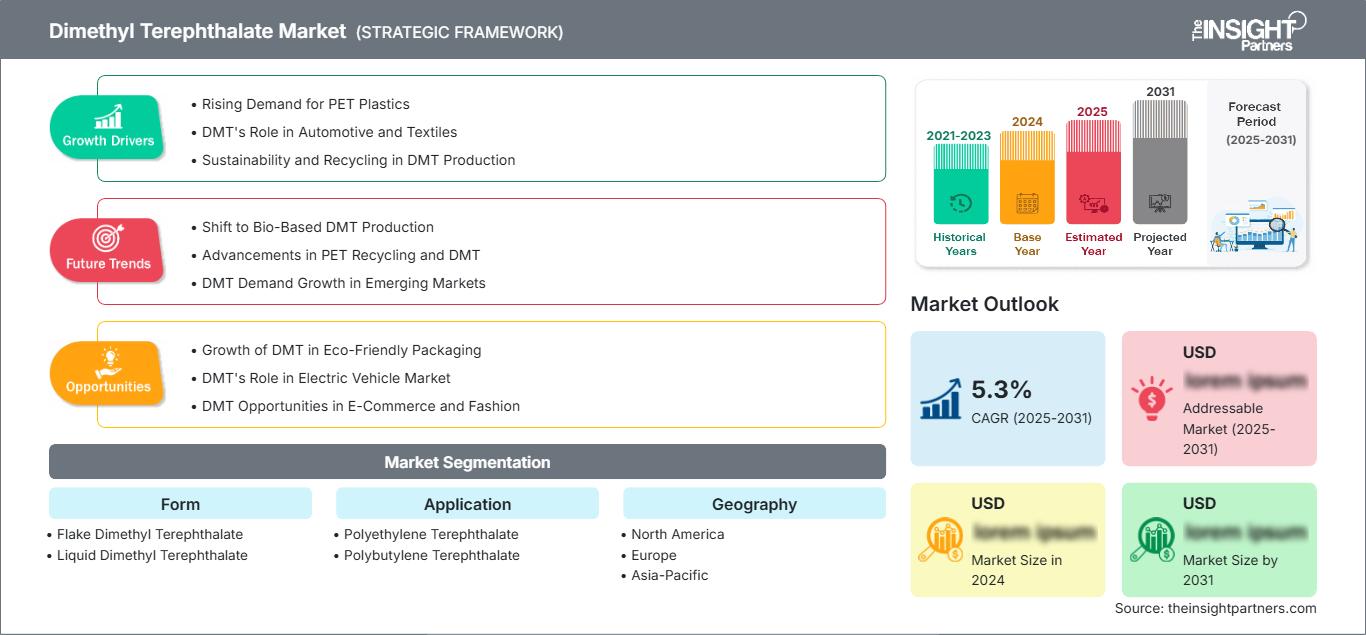
Dimethyl Terephthalate Market: Strategic Insights
Regional Insights
North America Dimethyl Terephthalate Market
North America accounted for approximately 18–22% Dimethyl Terephthalate market in 2025 and is expected to record a 2.8–3.5% CAGR through 2034. The United States acts as the key regional demand center, thanks to specialty polyester, engineering plastics, packaging, and chemical recycling. Unlike Asian textile clusters, the demand for DMT has more specific applications, hence making purity levels crucial and the need for a dependable local supply.
However, there are changes taking shape in terms of circular polymer technology. Eastman's plant located in Kingsport has commercialized molecular recycling and recycles polyester scrap into molecular building blocks. The creation of recycling infrastructure adds another way of obtaining polyester intermediates, ensuring a dependable feedstock source locally. There is a minor contribution from Canada, via specialty chemicals and polymer production, while Mexico's participation comes through packaging and plastics.
U.S. Dimethyl Terephthalate Market
The U.S. represented approximately 75–82% of North American demand in 2025 and is projected to grow at a 2.9–3.6% CAGR through 2034. The sources of demand include specialty polyester, packaging materials, engineering plastics, and polymers. It is worth mentioning that Eastman is a well-known domestic supplier of DMT, which is in liquid form used to manufacture polymers.
The molecular recycling is opening up another avenue. In addition, the Kingsport plant of Eastman has the capability to recycle 110,000 metric tons of polyester annually into new material. Moreover, it has announced plans for plants in France and Longview, Texas. This development will bolster the position of the United States in circular polyester chemistry.
Europe Dimethyl Terephthalate Market
Europe held approximately a 14–18% share in 2025 and is projected to grow at a 2.4–3.1% CAGR through 2034. The UK is an ally for specialty polymers and chemical distribution. Germany still plays an important role due to the developed plastics, auto, and engineering sectors. The strategic significance of France comes from the investment in circular polyester.
The demand in Germany is driven by engineering plastics, automotive parts, electric applications, and specialty polymer processing. Italy and Spain are important due to packaging, textile, and plastic converting industry segments. European producers are under the influence of high energy prices and competition from Asian manufacturing, which promotes specialization on specialty products, efficient logistics, and recyclates use.
APAC Dimethyl Terephthalate Market
APAC represented approximately 50–54% share in 2025 and is expected to grow at a 3.0–3.8% CAGR through 2034, making it the leading region. China has the biggest polyester ecosystem, whereas Japan and South Korea have sophisticated technologies for specialty polymer industry. Demand for downstream polymers and packaging comes from India and Australia.
China continues to be the leading market region, despite the fact that there is substitution pressure due to increased PTA capacity. Japan focuses on specialty products, South Korea has started manufacturing DMT via SK Chemicals, and India has an advantage due to growth in textiles and packaging sector. Australia is still small, but participates in the polymer industry via intermediates imports.
Middle East & Africa Dimethyl Terephthalate Market
The Middle East and Africa demand is expected to expand at approximately 2.6–3.4% CAGR through 2034. The dominant country in the region is Saudi Arabia due to petrochemical integration and diversification. The UAE serves as the main trading and distribution center, while South Africa is contributing its share through packaging, plastics and industrial applications.
The infrastructure of Saudi Arabia allows for the development of the downstream polyester business while logistics and re-exports benefit the UAE. South Africa is still relatively import-dependent. Rest of MEA refers to developing markets for packaging and textiles where DMT consumption is linked with imported polyester intermediates and polymer demand.
Segmentation Analysis
Form
Form is divided into Flake Dimethyl Terephthalate and Liquid Dimethyl Terephthalate. The segment is influenced by storage requirements, transportation economics, plant configuration, and downstream conversion practices. Overall form demand is expected to grow at a 2.8–3.5% CAGR during 2026–2034, with solid material retaining a strong position because of handling flexibility.
- Flake Dimethyl Terephthalate: Flake Dimethyl Terephthalate offers convenient storage and transportation at ambient conditions. Its physical stability supports distributors and polymer manufacturers that require inventory flexibility across multiple production locations.
- Liquid Dimethyl Terephthalate: Liquid Dimethyl Terephthalate is suited to integrated facilities where material can be transferred or consumed in molten form. Reduced remelting requirements can improve process efficiency for qualified downstream operations.
Application
The application comprises Polyethylene Terephthalate and Polybutylene Terephthalate. The application segment is expected to register approximately 3.2–3.8% CAGR during 2026–2034. PET remains the principal consumption route because of its broad use in fibers, films, packaging, and specialty plastics, while PBT provides a smaller but faster-growing engineering-plastics opportunity.
- Polyethylene Terephthalate: Polyethylene Terephthalate represents the principal application because polyester fibers, films, containers, and packaging products create a broad downstream customer base. Its scale provides consistent demand for qualified polyester intermediates.
- Polybutylene Terephthalate: Polybutylene Terephthalate provides a specialty route into engineering plastics used where thermal stability, dimensional performance, and electrical properties are important. Automotive, electronics, and industrial components support its strategic relevance.
Opportunity Snapshot
| Application | Revenue Contribution (High/Medium/Low) | Trend Tag | Adoption Stage |
|---|---|---|---|
| Polyethylene Terephthalate | High | PET Packaging | Mature |
| Polybutylene Terephthalate | Medium | EV Components | Scaling |
Dimethyl Terephthalate Market Growth Drivers and Impact Analysis
Expansion of Polyester Fiber and Packaging Manufacturing
Polyester will continue to drive demand downstream since DMT can be turned into polyester which finds applications in fibers, films, packaging, and specialty plastics. Growing production of textiles in Asia, steady packaging demand, and requirements for more robust industrial fibers will continue to define the addressable customer market. Nevertheless, this is limited by PTA's competitive pricing in making PET in large volumes. The effect of this is a divided demand picture wherein the demand for DMT is increasingly found in traditional transesterification units, specialty polyesters, and processes where DMT makes more sense. It follows that producers find value from having downstream polymer manufacturing capabilities or grades that meet strict purity specifications.
Engineering-Plastics Demand Broadens the Application Base
Engineering plastic demand acts as the second structure driver by increasing DMT demand outside of standard polyester fiber applications. The choice of PBT-based polymers is made for electrical, electronics, automobile, and industrial applications where dimensional stability and heat resistance are required. DMT is used for PBT and polyester elastomers based on thermoplastics according to SK Chemicals. This means that there is significance of DMT in the specialty polymer platform. One of the most important industries is automotive because the advent of electric mobility leads to higher demands for electrical and electronic components made of engineered polymers. Even though the demand of PBT is lower than PET, there might be high value-added applications which will enable manufacturers to earn decent profit margins.
Growth of Circular Polyester Feedstock Systems
Circularity provides a new pathway to demand of polyester intermediates by ensuring that the recovered waste can once again enter the polymer production process. The methanolysis technology developed by Eastman transforms difficult-to-recycle polyester waste into molecular building blocks that allow the creation of virgin-performance materials. This operation takes place on an industrial scale in Kingsport and includes other developments in France and Texas. For DMT manufacturers and users, this trend means that their procurement strategies will focus increasingly on traceable recycled feedstocks, mass balance, and reduced carbon footprint intermediates. Ultimately, circular sourcing may be seen as complementary rather than as a replacement of conventional sourcing. Strategic implications of this trend are most prominent in the markets where packaging regulations and commitment to using recycled content become important.
Dimethyl Terephthalate Market Future Trends
Integration of Molecular Recycling with Polyester Supply Chains
Dimethyl Terephthalate Market trends are increasingly connected with molecular recycling, particularly where polyester waste can be converted back into chemical building blocks. Unlike mechanical recycling, methanolysis can process selected colored, opaque, and difficult polyester materials while producing molecular inputs suitable for new polymers. Eastman’s Kingsport operation demonstrates industrial-scale implementation, and its planned French and Texas facilities indicate broader geographic deployment. Future supply chains are likely to combine virgin intermediates, recycled feedstocks, and certified circular materials. Buyers will increasingly evaluate traceability, carbon intensity, recycled content, and feedstock security alongside conventional specifications such as purity and color. This transition should favor suppliers capable of integrating chemical production with recycling infrastructure and downstream polymer qualification.
Greater Specialization of DMT Grades
The market is likely to move toward greater specialization as commodity-scale polyester production increasingly favors PTA. DMT suppliers can defend their position by targeting applications where high purity, controlled physical properties, molten delivery, or compatibility with specialty polymer systems provide measurable value. Eastman supplies molten DMT for PET fiber, film, containers, and specialty plastics, while SK Chemicals markets solid and molten grades for films, fibers, engineering plastics, and adhesives. Future product development should therefore focus on application-specific grades, consistent quality, and logistics optimization. Suppliers with strong technical service capabilities can support customers in formulation changes, process optimization, and recycled-content integration. This specialization should help maintain DMT relevance even where overall commodity demand faces substitution pressure from PTA.
Dimethyl Terephthalate Market Opportunities
Developing Specialty Polymer Supply in Asia
Dimethyl Terephthalate Market scope extends beyond conventional polyester fibers into specialty films, engineering plastics, adhesives, and copolyester systems. Asia Pacific provides the strongest opportunity because the region combines large polyester manufacturing clusters with rapidly expanding electronics, automotive, packaging, and industrial production. South Korea already maintains an established DMT supply base through SK Chemicals, while China and India offer extensive downstream polymer ecosystems. Investors can target specialty grades, technical services, and regional distribution rather than competing solely on commodity volume. Partnerships with polymer compounders and engineering-plastics producers can improve customer retention and qualification visibility. Localized inventories can further reduce lead times and improve resilience. The most attractive opportunities are therefore likely to emerge around technically demanding applications where customers prioritize performance consistency over the lowest intermediate price.
Building Verified Circular Intermediate Platforms
Dimethyl Terephthalate Market Forecasts increasingly depend on how effectively the polyester value chain incorporates recycled carbon. Molecular recycling provides a pathway for converting difficult polyester waste into reusable chemical building blocks while preserving material performance. Eastman’s Kingsport facility and planned projects in France and Longview illustrate the scale of investment directed toward this model. Producers can capture opportunities by developing traceable collection networks, purification systems, and partnerships with PET converters. Certification and chain-of-custody systems can strengthen customer confidence where recycled-content claims influence purchasing decisions. Investment should prioritize regions with large polyester waste streams and supportive recycling policies. Such platforms can diversify feedstock sources, reduce exposure to virgin raw-material volatility, and create differentiated products for packaging and specialty polymer customers.
Recent Developments
September 2025, Ester Industries and Loop Industries announced an initial investment of INR 1,600 crore to establish the first phase of their joint-venture facility in Dahej, Gujarat. The plant is planned to produce 70,000 tonnes of recycled dimethyl terephthalate (rDMT) annually, along with recycled MEG and PET resin, with commissioning targeted for 2027. The facility is expected to strengthen the supply of recycled DMT for textile, automotive, packaging, and specialty polymer applications.
September 2025, Loop Industries and Taro Plast entered into an offtake agreement under which Loop will supply 100% recycled-content Loop™ DMT from its planned Infinite Loop India facility. Taro Plast will use the recycled DMT in automotive and specialty polymer applications, supporting the commercialization of recycled DMT and increasing demand for sustainable alternatives to virgin DMT.
Frequently Asked Questions

- Comprehensive Market Sizing and Forecast Analysis
- Detailed Segmentation Analysis
- In-Depth Market Dynamics Assessment
- Regional and Country-Level Insights
- Competitive Landscape and Company Benchmarking
- Strategic Business Intelligence
Recent Reports
Testimonials

The Insight Partners provided valuable market intelligence that supported our global go-to-market strategy. Their team was professional, responsive, and attentive to our feedback, providing thoughtful analysis and helpful methodological clarifications throughout the project.
Junmo Kim Chief Financial Officer (CFO), Enertech Co., Ltd.
The Insight Partners' SCADA System Market report is comprehensive, with valuable insights on current trends and future forecasts. The team was highly professional, responsive, and supportive throughout. We are very satisfied and highly recommend their services.
RAN KEDEM Partner, Reali Technologies LTDs
I requested a report on a very specific software market and the team produced the report in a few days. The information was very relevant and well presented. I then requested some changes and additions to the report. The team was again very responsive and I got the final report in less than a week.
JEAN-HERVE JENN Chairman, Future Analytica
We worked with The Insight Partners for an important market study and forecast. They gave us clear insights into opportunities and risks, which helped shape our plans. Their research was easy to use and based on solid data. It helped us make smart, confident decisions. We highly recommend them.
PIYUSH NAGPAL Sr. Vice President, High Beam Global
The Insight Partners delivered insightful, well-structured market research with strong domain expertise. Their team was professional and responsive throughout. The user-friendly website made accessing industry reports seamless. We highly recommend them for reliable, high-quality research services
YUKIHIKO ADACHI CEO, Deep Blue, LLC.
This is the first time I have purchased a market report from The Insight Partners.While I was unsure at first, I visited their web site and felt more comfortable to take the risk and purchase a market report.I am completely satisfied with the quality of the report and customer service. I had several questions and comments with the initial report, but after a couple of dialogs over email with their analyst I believe I have a report that I can use as input to our strategic planning process.Thank you so much for taking the extra time and making this a positive experience.I will definitely recommend your service to others and you will be my first call when we need further market data.
JOHN SUZUKI President and Chief Executive Officer, Board Director, BK Technologies
I wish to appreciate your support and the professionalism you displayed in the course of attending to my request for information regarding to infectious disease IVD market in Nigeria. I appreciate your patience, your guidance, and the fact that you were willing to offer a discount, which eventually made it possible for us to close a deal. I look forward to engaging The Insight Partners in the future, all thanks to the impression you have created in me as a result of this first encounter.
DR CHIJIOKE ONYIA MANAGING DIRECTOR, PineCrest Healthcare Ltd.Reason to Buy
- Informed Decision-Making
- Understanding Market Dynamics
- Competitive Analysis
- Identifying Emerging Markets
- Customer Insights
- Market Forecasts
- Risk Mitigation
- Boosting Operational Efficiency
- Strategic Planning
- Investment Justification
- Tracking Industry Innovations
- Aligning with Regulatory Trends





 Get Free Sample for