
Refrigerant Market Forecast (2021-2031): Growth, Trends, and Opportunities
Coverage: By Type (Ammonia, Carbon Dioxide, Propane, Isobutane, HFCs, HFO, and Others), Application (Refrigeration Systems, Chillers, Air Conditioning Systems, MACs, and Others), and End Use (Industrial, Commercial, Residential, and Others)
- Status : Published
- Report Code : TIPRE00005348
- Category : Chemicals and Materials
- No. of Pages : 343
- Available Report Formats :


- Last update date : December 12, 2025


2024 Market Size
US$ 47.04 Bn
Base year value
2031 Forecast
US$ 75.62 Bn
Projected by 2031
CAGR 2025-2031
7.0 %
Growth rate
Addressable Market
US$ 435.58 Bn
(2025-2031)
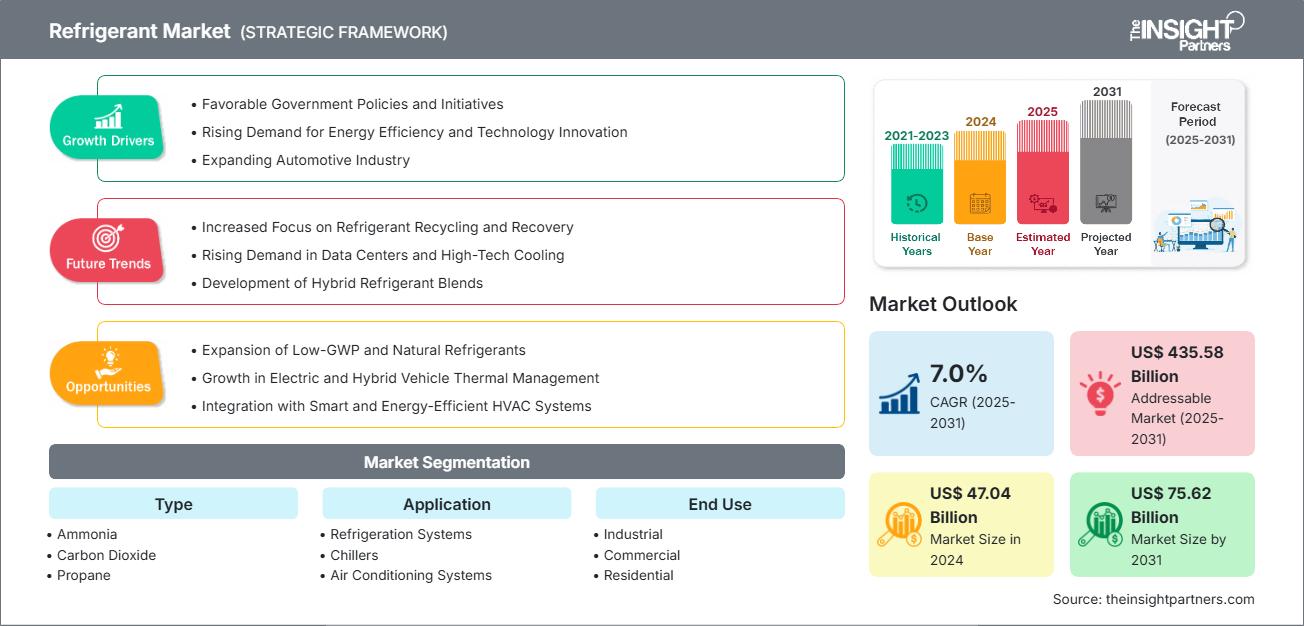
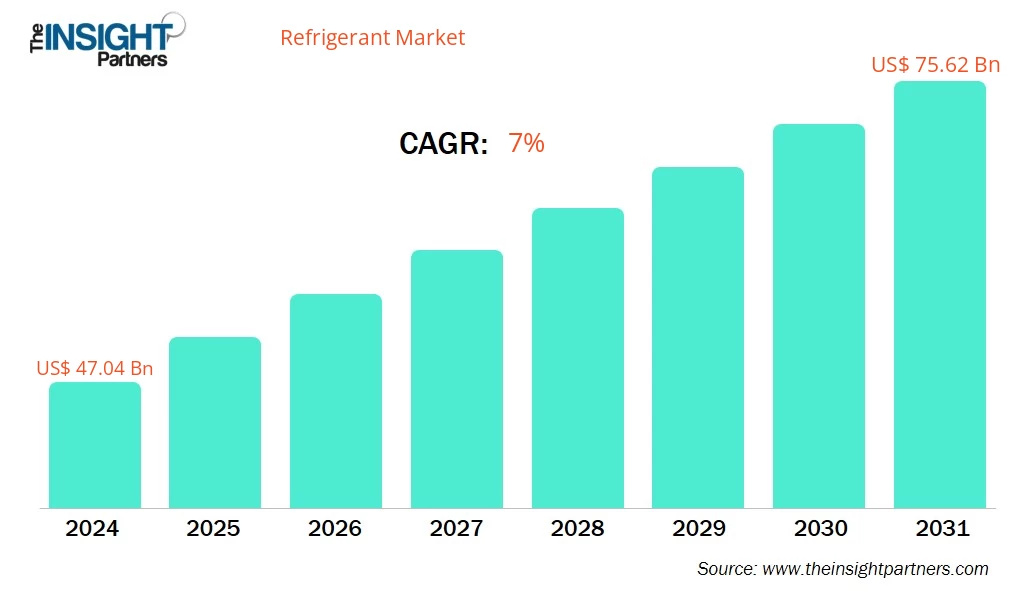
The refrigerant market size is projected to reach US$ 75.62 billion by 2031 from US$ 47.04 billion in 2024. The market is expected to register a CAGR of 7.0% during 2025–2031.
Refrigerant Market Analysis
Strict rules such as the Kigali Amendment and phasedowns of F-gas are hastening the process of replacing high-GWP HFCs with low-GWP HFOs, blends of HFOs and HFCs, and natural refrigerants, including CO2, ammonia, and hydrocarbons. Volume is increasing in APAC due to rapid urbanization, improved living standards, growth of cold-chain logistics, the explosion of data centers, and the adoption of electric-based vehicles. The new generation of leak detection, reclamation systems, and equipment that is compatible with A2L allows safer transitions without compromising the performance, cost, and reliability of its usage in residential, commercial, industrial, and automotive applications.
Refrigerant Market Overview
The universal requirement of refrigeration, air conditioning, and heat-pump systems that provide performance and fulfill the environmental requirements. The installed base is yet to be overcome by HFOs (R-1234yf, R-1234ze), R-32, and natural alternatives. Asia Pacific has been the most active in consumption and production based on the hot climates, urbanization, and industrialization in China and India. The best transitions are imposed in Europe and North America because of stringent laws, whereas developing countries compromise between costs and gradual compliance. By creating more eco-friendly refrigerants, improving how cooling systems are designed, and recycling old refrigerants properly, companies can keep improving their products and stay compliant with laws in the future.
Market Assessment and Insights
- Asia Pacific dominated the market with 64.7% share in 2024.
- Asia Pacific is poised to grow at a CAGR of 7.5% over the forecast period.
- United States market is projected to grow at a CAGR of 6.7% over the forecast period.
- By Type, the HFCs segment accounted for the largest market share of 50.2% in 2024.
- By Application, the MACS segment is anticipated to witness the fastest growth, registering a CAGR of 8.3% over the forecast period
- By End Use, the Commercial Refrigeration segment accounted for the largest market share of 42.4% in 2024.
- The report profiles key industry players such as Honeywell International Inc, Daikin Industries Ltd, Arkema SA, Air Liquide, Linde Plc, Eastman Chemical Co, The Chemours Co, Orbia Fluor & Energy Materials, A-Gas International Limited, Quimobasicos SA de CV, while also analyzing key developments in novel ideas, disruptive products, and innovative services that could reshape the future market and reveal emerging themes across the industry.
Source: The Insight Partners' analysis based on proprietary research, government publications, company annual reports, investor presentations, industry databases, and expert interviews.
● REPORT CUSTOMIZATION
Tailor This Report To Align With Your Specific Business Requirements
This report can be customized to align precisely with your business objectives, scope, and target markets. Customization options include tailored segmentation, geography, competitive analysis, and strategic insights to support informed decision-making.
Customize This Report →WHAT YOU CAN ADJUST
- ● Segmentations
- ● Geography
- ● Competitive Analysis
- ● Language Preferences
Refrigerant Market: Strategic Insights
-
Get Top Key Market Trends of this report.This FREE sample will include data analysis, ranging from market trends to estimates and forecasts.
Refrigerant Market Drivers and Opportunities
Market Drivers:
- Demand has been rising, especially in air conditioning and refrigeration: Urbanization and increasing incomes in the Asia Pacific and the Middle East drive intensive residential, commercial, and automotive cooling owing to the hot climate.
- Strict environmental standards: Kigali Amendment, EU F-Gas legislation, as well as national phasedowns of HFC require low-GWP substitutes.
- Boom in the use of electric vehicles and data centers: The use of heat pumps and precision cooling systems is growing rapidly, leading to greater use of refrigerant.
Market Opportunities:
- The next generation low-GWP solutions: HFOs (R-1234yf/ze), A2L blends, and natural refrigerants have high-growth replacement potential.
- Growing Asia-Pacific countries: Sluggish phasedown schedules and new plants propel demand for transitional and low-GWP refrigerants.
- Reclamation, recycling, and circular economy: Advanced recovery and reclaimed refrigerant markets help in ensuring sustainability and cost reduction.
Refrigerant Market Report Segmentation Analysis
The refrigerant market is divided into different segments to give a clearer view of its growth potential and the latest trends. Below is the standard segmentation approach used in industry reports:
By Type:
- Ammonia: It is a highly efficient natural refrigerant that has zero GWP; the most commonly used in large, industrial-based refrigeration systems, though it is toxic.
- Carbon Dioxide: Natural refrigerant (GWP 1) is eco-friendly and is rapidly replacing other refrigerants in supermarkets, heat pumps, and in trans critical commercial systems.
- Propane: Hydrocarbons with a high efficiency (GWP 3) will be used in small commercial units, vending machines, and plug-in cabinets.
- Isobutane: Extremely low GWP hydrocarbon; it is standardized in the domestic refrigerators and freezers worldwide because it conserves energy.
- HFCs: Large-volume, old refrigerants (R-410A, R-134a, R-404A) continue to prevail in existing systems but are being phased down worldwide.
- HFOs: HFC Replacements in automotive and commercial AC Next-generation low-GWP synthetics (R-1234yf, R-1234ze, A2L blends); the most rapidly growing ones to replace HFCs.
- Others: Transitional blends (R-448A/R-449A, R-407 series), niche naturals, and emerging which are primarily involved in retrofits and special use.
By Application:
- Refrigeration Systems
- Chillers
- Air Conditioning Systems
- MACs
- Others
By End Use:
- Industrial
- Commercial
- Residential
- Others
By Geography:
- North America
- Europe
- Asia Pacific
- Middle East & Africa
- South & Central America
Refrigerant Market Report Scope
| Report Attribute | Details |
|---|---|
| Market size in 2024 | US$ 47.04 Billion |
| Market Size by 2031 | US$ 75.62 Billion |
| Global CAGR (2025 - 2031) | 7.0% |
| Historical Data | 2021-2023 |
| Forecast period | 2025-2031 |
| Segments Covered |
By Type
|
| Regions and Countries Covered |
North America
|
| Market leaders and key company profiles |
|
Refrigerant Market Players Density: Understanding Its Impact on Business Dynamics
The Refrigerant Market is growing rapidly, driven by increasing end-user demand due to factors such as evolving consumer preferences, technological advancements, and greater awareness of the product's benefits. As demand rises, businesses are expanding their offerings, innovating to meet consumer needs, and capitalizing on emerging trends, which further fuels market growth.
Refrigerant Market Share Analysis by Geography
Rapid urbanization, increasing incomes, and hot climates create huge demand for air conditioning, cold-chain development, and refrigeration systems, which boosts the consumption of refrigerants. New markets in Latin America and MEA have a good future development potential due to food retail modernization, frozen exports, and a late HFC phasedown schedule.
The refrigerant market growth differs in each region due to the rate of economic development and consumer preferences. Below is a summary of market share and trends by region:
1. North America
- Market Share: Controls a considerable portion of the refrigerants market
- Key Drivers:
- Commercial refrigeration and residential AC penetration.
- No lenient EPA HFC phasedown and low-GWP requirements
- Trends: Rapid conversion to A2L HFO blends and CO2 cascade systems
2. Europe
- Market Share: Large share stimulated by early and aggressive regulation
- Key Drivers:
- Tough EU F-Gas quotas and 2030 HFC bans.
- Good supermarket and heat pump adoption
- Trends: The adoption of natural refrigerants (CO2, propane ) and HFO leadership
3. Asia Pacific
- Market Share: The fastest-growing region with a rapidly increasing market share
- Key Drivers:
- Massive AC power demands, urbanization, and cold-chain development.
- HFC production and consumption in China/India
- Trends: Ongoing HFC consumption and increasing use of R-32 and HFO/HFC mixture
4. Middle East and Africa
- Market Share: Expanding market with stable growth
- Key Drivers:
- AC and refrigeration demand due to extreme climate.
- Late Phase down in Art 5 countries.
- Trends: High demand for low-cost HFC and blends
5. South and Central America
- Market Share: Smaller and fast-growing market
- Key Drivers:
- Cold-chain development in food and retail export.
- Progress in AC intrusion and regulatory correlation with Kigali
- Trends: Replacement of R-404A/R-22 with lower-GWP HFO solutions and replacement of R-290/R-600a solutions with lower-GWP HFO solutions.
Refrigerant Market Players Density: Understanding Its Impact on Business Dynamics
High Market Density and Competition
Competition is intense due to the presence of established players such as Archer-Daniels-Midland Company, Didion Milling Inc, KRONER-STÃRKE GmbH, Tardella Flour Co Inc, and LifeLine Foods LLC.
This high level of competition urges companies to stand out by:
- Future innovation to create next-generation low-GWP HFOs, A2L blends, and natural refrigerant solutions with a higher level of efficiency and safety.
- Communicating cost-efficient, drop-in, and retrofit blends to prolong the use of the already in place HFC systems and conform to the phasedown schedules.
- The offer of advanced reclamation, recovery, and circular economy services to cut the virgin refrigerant demand and emissions.
Opportunities and Strategic Moves
- Introduce new equipment based on ultra-low GW PHFO and natural refrigerant portfolios.
- Increase the production of R-32 and R-454 mixtures and R-1234yf/ze to win out replacement market.
- Inventory leak detectors, IoT monitoring, and smart fridge systems.
- Collaborate with OEMs on A2L- and CO2 -CO2-compatible equipment.
- Co-operate with governments and industry in the training, safety standards, and the large-scale reclamation programs.
Major companies operating in the refrigerant market are:
- A-Gas International Limited
- Eastman Chemical Co
- Eastman Chemical Co
- Arkema SA
- Linde Plc
- Honeywell International Inc
- Daikin Industries Ltd
- Air Liquide
- Orbia
- Quimobasicos SA de CV
Disclaimer: The companies listed above are not ranked in any particular order.
Other companies analyzed during research:
- Didion Milling Inc
- KRONER-STÃRKE GmbH
- Tardella Flour Co Inc
- LifeLine Foods LLC
- Sage V Foods LLC
- Agrasys S.L.
- Caremoli Group
- BELOURTHE S.A
Refrigerant Market News and Recent Developments
- A-Gas Expands Operations in Canada: A-Gas International Limited established its first Canadian refrigerant recovery and reclamation facility in Hamilton, Ontario. The facility, operational by the fourth quarter of the year, processed and reclaimed refrigerants to AHRI-700 standards.
- Arkema strengthens its range of lower global warming: Arkema SA announced an expansion of its low-GWP refrigerant offerings through a commercial partnership with Honeywell. This collaboration aims to enhance global supply chains and meet the growing demand for HFO blends in the HVACR industry, aligning with the HFC phasedown.
Refrigerant Market Report Coverage and Deliverables
The " Refrigerant Market Size and Forecast (2021–2031)" report provides a detailed analysis of the market covering the following areas:
- Refrigerant market size and forecast at global, regional, and country levels for all market segments covered under the scope
- Refrigerant market trends, as well as market dynamics such as drivers, restraints, and key opportunities
- Detailed Porter's five forces analysis and SWOT analysis
- Refrigerant market analysis covering market trends, global and regional framework, major players, regulations, and recent market developments
- Industry landscape and competition analysis covering market concentration, heat map analysis, prominent players, and recent developments for the refrigerant market
- Detailed company profiles
Frequently Asked Questions

- Comprehensive Market Sizing and Forecast Analysis
- Detailed Segmentation Analysis
- In-Depth Market Dynamics Assessment
- Regional and Country-Level Insights
- Competitive Landscape and Company Benchmarking
- Strategic Business Intelligence
Recent Reports
Testimonials

The Insight Partners provided valuable market intelligence that supported our global go-to-market strategy. Their team was professional, responsive, and attentive to our feedback, providing thoughtful analysis and helpful methodological clarifications throughout the project.
Junmo Kim Chief Financial Officer (CFO), Enertech Co., Ltd.
The Insight Partners' SCADA System Market report is comprehensive, with valuable insights on current trends and future forecasts. The team was highly professional, responsive, and supportive throughout. We are very satisfied and highly recommend their services.
RAN KEDEM Partner, Reali Technologies LTDs
I requested a report on a very specific software market and the team produced the report in a few days. The information was very relevant and well presented. I then requested some changes and additions to the report. The team was again very responsive and I got the final report in less than a week.
JEAN-HERVE JENN Chairman, Future Analytica
We worked with The Insight Partners for an important market study and forecast. They gave us clear insights into opportunities and risks, which helped shape our plans. Their research was easy to use and based on solid data. It helped us make smart, confident decisions. We highly recommend them.
PIYUSH NAGPAL Sr. Vice President, High Beam Global
The Insight Partners delivered insightful, well-structured market research with strong domain expertise. Their team was professional and responsive throughout. The user-friendly website made accessing industry reports seamless. We highly recommend them for reliable, high-quality research services
YUKIHIKO ADACHI CEO, Deep Blue, LLC.
This is the first time I have purchased a market report from The Insight Partners.While I was unsure at first, I visited their web site and felt more comfortable to take the risk and purchase a market report.I am completely satisfied with the quality of the report and customer service. I had several questions and comments with the initial report, but after a couple of dialogs over email with their analyst I believe I have a report that I can use as input to our strategic planning process.Thank you so much for taking the extra time and making this a positive experience.I will definitely recommend your service to others and you will be my first call when we need further market data.
JOHN SUZUKI President and Chief Executive Officer, Board Director, BK Technologies
I wish to appreciate your support and the professionalism you displayed in the course of attending to my request for information regarding to infectious disease IVD market in Nigeria. I appreciate your patience, your guidance, and the fact that you were willing to offer a discount, which eventually made it possible for us to close a deal. I look forward to engaging The Insight Partners in the future, all thanks to the impression you have created in me as a result of this first encounter.
DR CHIJIOKE ONYIA MANAGING DIRECTOR, PineCrest Healthcare Ltd.Reason to Buy
- Informed Decision-Making
- Understanding Market Dynamics
- Competitive Analysis
- Identifying Emerging Markets
- Customer Insights
- Market Forecasts
- Risk Mitigation
- Boosting Operational Efficiency
- Strategic Planning
- Investment Justification
- Tracking Industry Innovations
- Aligning with Regulatory Trends





 Get Free Sample for