
Industrial Lubricants Market Size & Emerging Trends 2031
Coverage: By Type (Mineral Oil, Synthetic Oil, and Bio-Based Oil), Product Type (Hydraulic Fluid, Engine Oil, Driveline Lubricants, Metalworking Fluids, Grease, Process Oils, Coolants, and Others), By End Use Industry (Building and Construction, Power Generation, Mining and Metallurgy, Food Processing, Oil and Gas, Marine, Aviation, and Others), and Geography (North America, Europe, Asia Pacific, Middle East and Africa, and South and Central America)
- Status : Published
- Report Code : TIPRE00004232
- Category : Chemicals and Materials
- No. of Pages : 379
- Available Report Formats :


- Last update date : December 30, 2025


2024 Market Size
US$ 89.58 Bn
Base year value
2031 Forecast
US$ 113.78 Bn
Projected by 2031
CAGR 2025-2031
3.7 %
Growth rate
Addressable Market
US$ 727.06 Bn
(2025-2031)
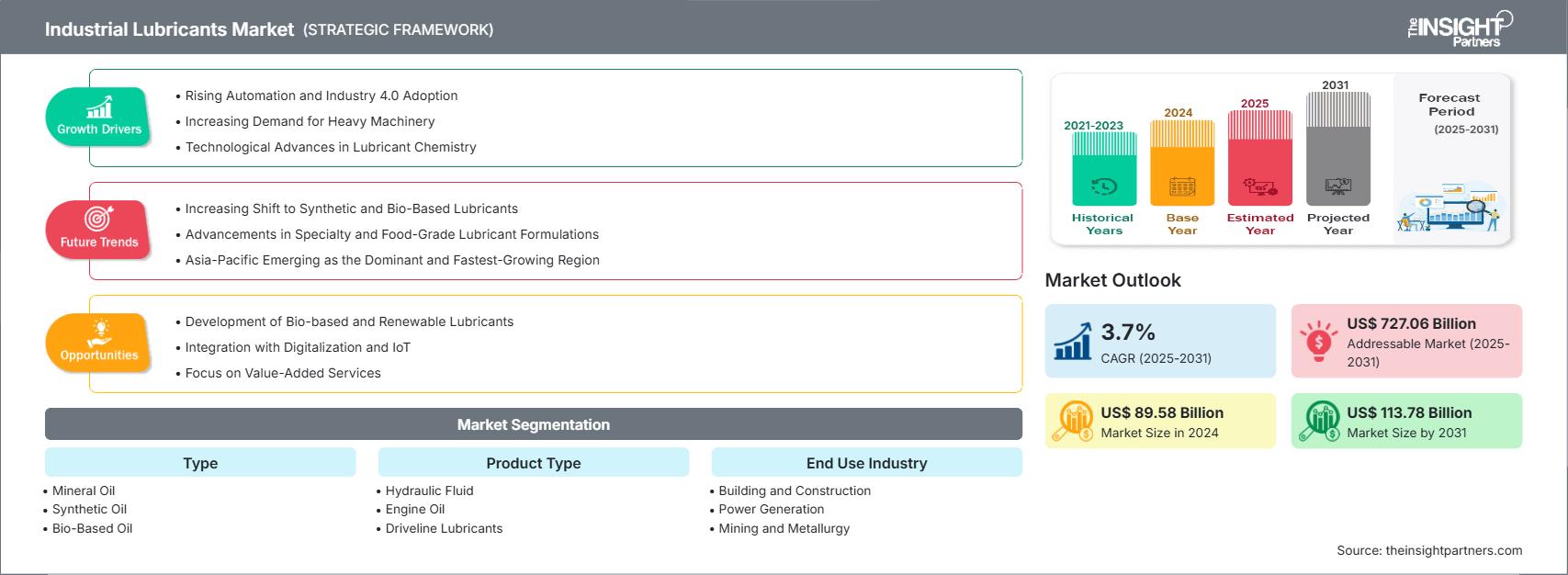
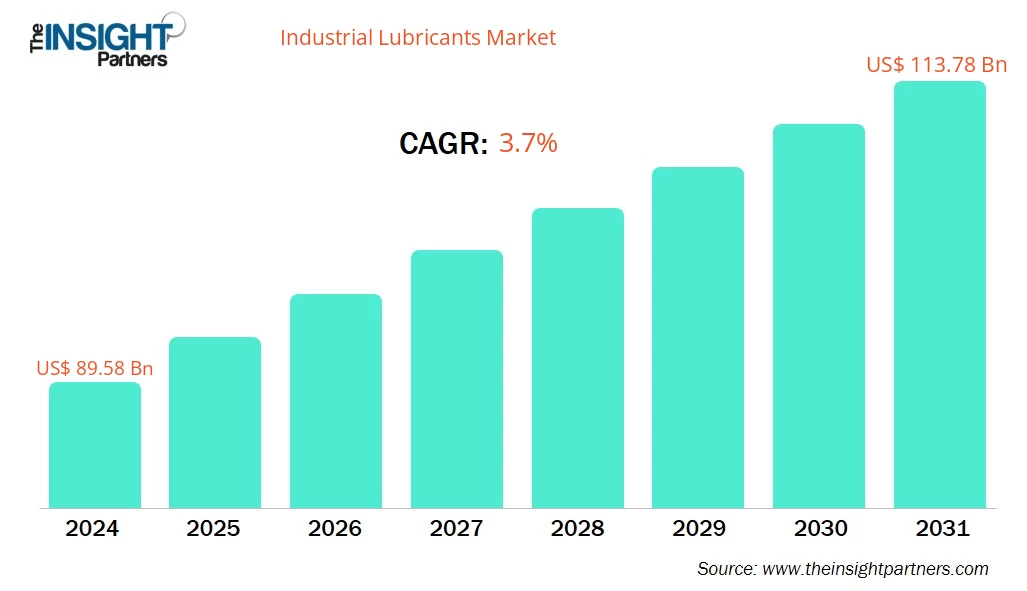
The industrial lubricants market size is projected to reach US$ 113.78 billion by 2031 from US$ 89.58 billion in 2024. The market is expected to register a CAGR of 3.7% from 2025 to 2031.
Industrial Lubricants Market Analysis
Mechanization and automation in industries have created a dependence on high-performance lubricants as a way of reducing friction, wear, and heat, and ensuring the smooth operation of high-endurance machinery in extreme conditions. The development of synthetic and biodegradable lubricants with high thermal stability and loads accelerates market growth. The shift to predictive maintenance and IoT-based monitoring systems opens up the prospects of special lubricants that guarantee long-lasting operation, increased efficiency, and low maintenance costs, placing the market on a stable rise in developed and developing markets.
Industrial Lubricants Market Overview
Industrial lubricants are fluids and greases that are used to minimize friction and wear, dissipate heat, and prevent corrosion of machinery in a broad scope of industrial equipment. They are applied in industries such as manufacturing, automotive, power generation, and mining. Industrial lubricants are essential to efficiency and cost control in operations by ensuring that there is a smooth running and equipment is not wasted due to its wear and tear. The growing popularity of synthetic and semi-synthetic lubricants with superior thermal stability and load-bearing properties, the increasing need for biodegradable and environmentally friendly formulations, and the incorporation of IoT-based monitoring and predictive maintenance systems help optimize the use of lubricants and their performance. Also, increasing mechanization, automation, and infrastructure growth of emerging economies are pushing the need for high-performance lubricants.
Market Assessment and Insights
- Asia Pacific dominated the market with 42.3% share in 2024.
- Asia Pacific is poised to grow at a CAGR of 4.6% over the forecast period.
- United States market is projected to grow at a CAGR of 4.4% over the forecast period.
- By Type, the Mineral Oil segment accounted for the largest market share of 70.7% in 2024.
- By Product Type, the Engine Oil segment is anticipated to witness the fastest growth, registering a CAGR of 4.3% over the forecast period
- By End-Use Industry, the Building and Construction segment accounted for the largest market share of 22.1% in 2024.
- The report profiles key industry players such as Exxon Mobil Corp, TotalEnergies SE, Shell Plc, Chevron Corp, BP Plc, China Petroleum & Chemical Corp (Sinopec), Fuchs SE, Valvoline Inc, Phillips 66, Kluber Lubrication GmbH & Co KG, while also analyzing key developments in novel ideas, disruptive products, and innovative services that could reshape the future market and reveal emerging themes across the industry.
Source: The Insight Partners' analysis based on proprietary research, government publications, company annual reports, investor presentations, industry databases, and expert interviews.
● REPORT CUSTOMIZATION
Tailor This Report To Align With Your Specific Business Requirements
This report can be customized to align precisely with your business objectives, scope, and target markets. Customization options include tailored segmentation, geography, competitive analysis, and strategic insights to support informed decision-making.
Customize This Report →WHAT YOU CAN ADJUST
- ● Segmentations
- ● Geography
- ● Competitive Analysis
- ● Language Preferences
Industrial Lubricants Market: Strategic Insights
-
Get Top Key Market Trends of this report.This FREE sample will include data analysis, ranging from market trends to estimates and forecasts.
Industrial Lubricants Market: Drivers and Opportunities
Market Drivers:
- Growing Industrialization and Infrastructure Development: The increased manufacturing, construction, and energy infrastructure creates the need for industrial lubricants, which will allow the effective functioning of the heavy machines and equipment under constant, high-load conditions.
- Increasing Mechanization and Automation: Lubricants that are industrially utilized are needed in machinery operating on automated production lines, robotics, and precision machinery, which aid in smooth operation, less wear, and less downtime.
- Need for High-Performance Fluids: High temperature, pressure, and heavy-duty industries in the steel, mining, and power generation sectors require lubricants that have a high level of thermal stability, oxidation resistance, and a high load-bearing capacity.
- Focus on the Duration and Cost-Efficiency of Equipment: Synthetic ester lubricants are used to provide efficient heat control of micro-data centers and high-load electronics and facilitate continuous operations in limited space.
- Focus on the Environmental Compliance: Low-toxicity, biodegradable, and environmentally-friendly lubricants are popular among industries that seek to comply with environmental laws, regulations, and sustainability.
Market Opportunities:
- Advanced Synthetic and Semi-Synthetic Lubricants: High-performance lubricants that are designed and engineered with better thermal stability, anti-wear ability, and oxidation stability offer opportunities in highly demanding industries.
- Predictive Maintenance and IoT-Enabled Lubrication: With the introduction of smart sensors and condition-monitoring systems, opportunities are created in terms of optimized use of lubricants, early predictive maintenance, and better management of equipment lifecycle.
- Adoption in Emerging Markets: High-rate infrastructure growth in APAC, Africa, and South and Central America offers high demand for quality lubricants of high reliability.
- Development of Advanced Eco-Friendly Formulations: Increasing interest in sustainability leads to the development of biodegradable and renewable lubricants, as it is in line with the global green agenda and the concept of a circular economy.
- Specialized Lubricants for Industry-Specific Applications: There are prospects in the development of lubricants to resist high-temperature, high-pressure, or chemically hostile environments in industries such as steel, mining, and construction, and improve the reliability and performance of the equipment.
Industrial Lubricants Market Report Segmentation Analysis
The industrial lubricants market is divided into different segments to give a clearer view of how they work, their growth potential, and the latest trends. Below is the standard segmentation approach used in industry reports:
By Type
- Mineral Oil: A popular base oil in industrial lubrication products, mineral oils offer good service in normal operating temperatures and economic lubrication.
- Synthetic Oil: Synthetic oils have high thermal stability, oxidation resistance, and performance under extreme conditions and heavy loads, and hence are best suited to high-demand industrial applications.
- Bio-Based Oils: Bio-based oils are biodegradable with low toxicity, are derived from renewable sources, and can contribute to sustainability in industrial lubrication.
By Product Type
- Hydraulic Fluids: Hydraulic fluids are used to transmit power in industrial machines and equipment, making hydraulic systems smooth and precise in construction, manufacturing, and mining.
- Engine Oil: Engine oils are used to lubricate and protect the internal combustion engines installed in heavy machinery, as well as vehicles, to improve durability and performance in extreme operating environments.
- Driveline Lubricants: Such lubricants minimize the friction and wear on gearboxes, differentials, and other parts of the drivetrain that are critical in the transmission of power in industrial automobiles and machinery.
- Metalworking Fluids: Metalworking fluids are used in machining and metal fabrication processes to cool, lubricate, and protect tools and workpieces to enhance precision and surface finish.
- Grease: Greases offer durable lubrication and protection to bearings, joints, and moving components in machines where liquid lubricant is ineffective.
- Process Oils: Process oils can be used as an additive or base oil in the manufacturing process, such as in the production of rubber and plastics, which helps to improve the material characteristics and processing effectiveness.
- Coolants: Coolants are used to maintain the temperature of industrial engines and equipment to avoid overheating and ensure steady operation at high temperatures.
- Others: This segment includes compressor oils, turbine oils, chain lubricants, slideway oils, and others.
By End-Use Industry
- Building and Construction: The use of lubricants in construction machines such as cranes, excavators, and loaders makes them efficient in their operation and minimizes wear in harsh working conditions.
- Power Generation: Power plants keep up turbo, generator, and auxiliary equipment performance and reliability through lubricants.
- Mining and Metallurgy: The heavy-duty lubricants help to maintain the equipment under severe mining conditions, guaranteeing defense against extreme loads, dust, and contamination.
- Food Processing: Food-grade lubricants are safe and hygienic and do not affect the operation of the machinery in food and beverage production.
- Marine: Marine lubricants make shipping and offshore equipment and machinery resistant to saltwater corrosion and excessive mechanical loads.
- Aviation: High-performance lubricants are used to provide safety and efficiency in the aircraft engine, landing gear, and hydraulic systems in severe conditions.
- Mining and Metallurgy: The heavy-duty lubricants help to maintain the equipment under severe mining conditions, guaranteeing defense against extreme loads, dust, and contamination.
- Others: This segment includes automotive manufacturing, textiles, and chemicals, among others, where industrial lubricants play a significant role.
By Geography:
- North America
- Europe
- Asia Pacific
- South and Central America
- Middle East & Africa
Industrial Lubricants Market Report Scope
| Report Attribute | Details |
|---|---|
| Market size in 2024 | US$ 89.58 Billion |
| Market Size by 2031 | US$ 113.78 Billion |
| Global CAGR (2025 - 2031) | 3.7% |
| Historical Data | 2021-2023 |
| Forecast period | 2025-2031 |
| Segments Covered |
By Type
|
| Regions and Countries Covered |
North America
|
| Market leaders and key company profiles |
|
Industrial Lubricants Market Players Density: Understanding Its Impact on Business Dynamics
The Industrial Lubricants Market is growing rapidly, driven by increasing end-user demand due to factors such as evolving consumer preferences, technological advancements, and greater awareness of the product's benefits. As demand rises, businesses are expanding their offerings, innovating to meet consumer needs, and capitalizing on emerging trends, which further fuels market growth.
Industrial Lubricants Market Share Analysis by Geography
Asia Pacific dominated the market. The expansion of edge computing infrastructure across the region powers this surge. Emerging markets in South and Central America, the Middle East, and Africa have untapped opportunities for industrial lubricants providers to expand.
The growth of the industrial lubricants market varies by region. The demand for high-performance lubricants continues to grow, positioning industrial lubricants in an evolving consumer landscape. Below is a summary of market share and trends by region:
1. North America
- Market Share: Holds a significant market share
- Key Drivers:
- Strong presence of manufacturing industries, including automotive, construction, and others.
- Trends: Rising adoption of smart lubricants.
2. Europe
- Market Share: Holds a significant market share
- Key Drivers:
- Stringent environmental regulations.
- Trends: Increasing preference for bio-based lubricants.
3. Asia Pacific
- Market Share: Dominating the market, with a rising market share every year
- Key Drivers:
- Rapid industrialization and infrastructure expansion.
- Trends: Adoption of high-performing lubricants from various sectors.
4. South and Central America
- Market Share: Although small, it is growing quickly
- Key Drivers:
- Increasing demand from the mining industry.
- Trends: Shift in consumer preference for maintenance-optimization lubricants.
5. Middle East and Africa
- Market Share: Rapidly growing market, with a surging market share every year
- Key Drivers:
- Expansion of oil & gas, mining, and heavy construction projects.
- Trends: Rising investments in specialized high-performance lubricants.
Industrial Lubricants Market Players: Density: Understanding Its Impact on Business Dynamics
High Market Density and Competition
Competition is intense due to the presence of established players such as China Petroleum & Chemical Corp (Sinopec), Exxon Mobil Corp, BP Plc, and others.
This high level of competition urges companies to stand out by offering:
- Diverse product offering
- Sustainable and ethical sourcing
- Competitive pricing models
- Strong customer support and easy integration
Opportunities and Strategic Moves
- Focusing on research and development activities to distinguish themselves in the market
- Expanding global footprint and capabilities through acquisitions of value-added lubricant companies.
- Expanding product portfolio with the launch of sustainable products
Other companies analyzed during the course of research:
- China Petroleum & Chemical Corp (Sinopec)
- Exxon Mobil Corp
- BP Plc
- Shell Plc
- Kluber Lubrication GmbH & Co KG
- Chevron Corp
- Phillips 66
- TotalEnergies SE
- Valvoline Inc
- Fuchs SE
Industrial Lubricants Market: News and Recent Developments
- Shell U.K. Limited – Mergers and Acquisitions In January 2024, Shell U.K. Limited completed the acquisition of MIDEL and MIVOLT from Manchester-based M&I Materials Ltd. Shell will manufacture, distribute, and market the MIDEL and MIVOLT product lines as part of Shell's global lubricants portfolio. The acquisition of MIDEL enables Shell to complement its differentiated position in transformer oils used for power distribution, offshore wind parks, utility companies, and traction power systems. By adding synthetic and natural ester-based transformer fluids and services to its portfolio, Shell Lubricants aims to deliver improved fire protection and biodegradability to its customers.
- TotalEnergies – Mergers and Acquisitions In January 2025, TotalEnergies announced the acquisition of fire-resistant hydraulic fluid product lines from a specialist German firm, Fluid Competence. The acquired fluids — classified under HFA (water-based) and HFC-E (water-glycol-based) categories — extend TotalEnergies' portfolio of mineral-oil-free, low-VOC, fire-resistant fluids suitable for safety-critical applications in steel, mining, tunnelling, and heavy-duty industrial environments.
Industrial Lubricants Market Report Coverage and Deliverables
The "Industrial Lubricants Market Size and Forecast (2021–2031)" report provides a detailed analysis of the market covering the following areas:
- Industrial lubricants market size and forecast at global, regional, and country levels for all the segments covered under the scope
- Industrial lubricants market trends, as well as market dynamics such as drivers, restraints, and key opportunities
- Detailed Porter's five forces and SWOT analysis
- Industrial lubricants market analysis covering key trends, global and regional framework, major players, regulations, and recent market developments
- Industry landscape and competition analysis covering market concentration, heat map analysis, prominent players, and recent developments for the industrial lubricants market
- Detailed company profiles
Frequently Asked Questions

- Comprehensive Market Sizing and Forecast Analysis
- Detailed Segmentation Analysis
- In-Depth Market Dynamics Assessment
- Regional and Country-Level Insights
- Competitive Landscape and Company Benchmarking
- Strategic Business Intelligence
Recent Reports
Testimonials

The Insight Partners provided valuable market intelligence that supported our global go-to-market strategy. Their team was professional, responsive, and attentive to our feedback, providing thoughtful analysis and helpful methodological clarifications throughout the project.
Junmo Kim Chief Financial Officer (CFO), Enertech Co., Ltd.
The Insight Partners' SCADA System Market report is comprehensive, with valuable insights on current trends and future forecasts. The team was highly professional, responsive, and supportive throughout. We are very satisfied and highly recommend their services.
RAN KEDEM Partner, Reali Technologies LTDs
I requested a report on a very specific software market and the team produced the report in a few days. The information was very relevant and well presented. I then requested some changes and additions to the report. The team was again very responsive and I got the final report in less than a week.
JEAN-HERVE JENN Chairman, Future Analytica
We worked with The Insight Partners for an important market study and forecast. They gave us clear insights into opportunities and risks, which helped shape our plans. Their research was easy to use and based on solid data. It helped us make smart, confident decisions. We highly recommend them.
PIYUSH NAGPAL Sr. Vice President, High Beam Global
The Insight Partners delivered insightful, well-structured market research with strong domain expertise. Their team was professional and responsive throughout. The user-friendly website made accessing industry reports seamless. We highly recommend them for reliable, high-quality research services
YUKIHIKO ADACHI CEO, Deep Blue, LLC.
This is the first time I have purchased a market report from The Insight Partners.While I was unsure at first, I visited their web site and felt more comfortable to take the risk and purchase a market report.I am completely satisfied with the quality of the report and customer service. I had several questions and comments with the initial report, but after a couple of dialogs over email with their analyst I believe I have a report that I can use as input to our strategic planning process.Thank you so much for taking the extra time and making this a positive experience.I will definitely recommend your service to others and you will be my first call when we need further market data.
JOHN SUZUKI President and Chief Executive Officer, Board Director, BK Technologies
I wish to appreciate your support and the professionalism you displayed in the course of attending to my request for information regarding to infectious disease IVD market in Nigeria. I appreciate your patience, your guidance, and the fact that you were willing to offer a discount, which eventually made it possible for us to close a deal. I look forward to engaging The Insight Partners in the future, all thanks to the impression you have created in me as a result of this first encounter.
DR CHIJIOKE ONYIA MANAGING DIRECTOR, PineCrest Healthcare Ltd.Reason to Buy
- Informed Decision-Making
- Understanding Market Dynamics
- Competitive Analysis
- Identifying Emerging Markets
- Customer Insights
- Market Forecasts
- Risk Mitigation
- Boosting Operational Efficiency
- Strategic Planning
- Investment Justification
- Tracking Industry Innovations
- Aligning with Regulatory Trends




 Get Free Sample for