
Compound Semiconductors Market Size, Trends & Demand by 2034
Coverage: by Type (III-V, II-VI, IV-IV, Sapphire); Deposition Technology (Chemical Vapor Deposition (CVD), Molecular Beam Epitaxy (MBE), Hydride Vapor Phase Epitaxy (HVPE), Ammonothermal, Liquid Phase Epitaxy (LPE), Atomic Layer Deposition (ALD), and Others); Product (Power Semiconductor, Transistors, Integrated Circuits (ICs), Diodes & Rectifiers, and Others); Application (IT & Telecom, Industrial and Energy & Power, Aerospace & Defense, Consumer Electronics, and Healthcare), and Geography (North America, Europe, Asia Pacific, and South and Central America)
- Status : Data Released
- Report Code : TIPEL00002128
- Category : Electronics and Semiconductor
- No. of Pages : 150
- Available Report Formats :


- Last update date : September 22, 2026


2025 Market Size
US$ 44.88 Bn
Base year value
2034 Forecast
US$ 111.25 Bn
Projected by 2034
CAGR 2026-2034
10.61 %
Growth rate
Addressable Market
US$ 691.65 Bn
(2026-2034)
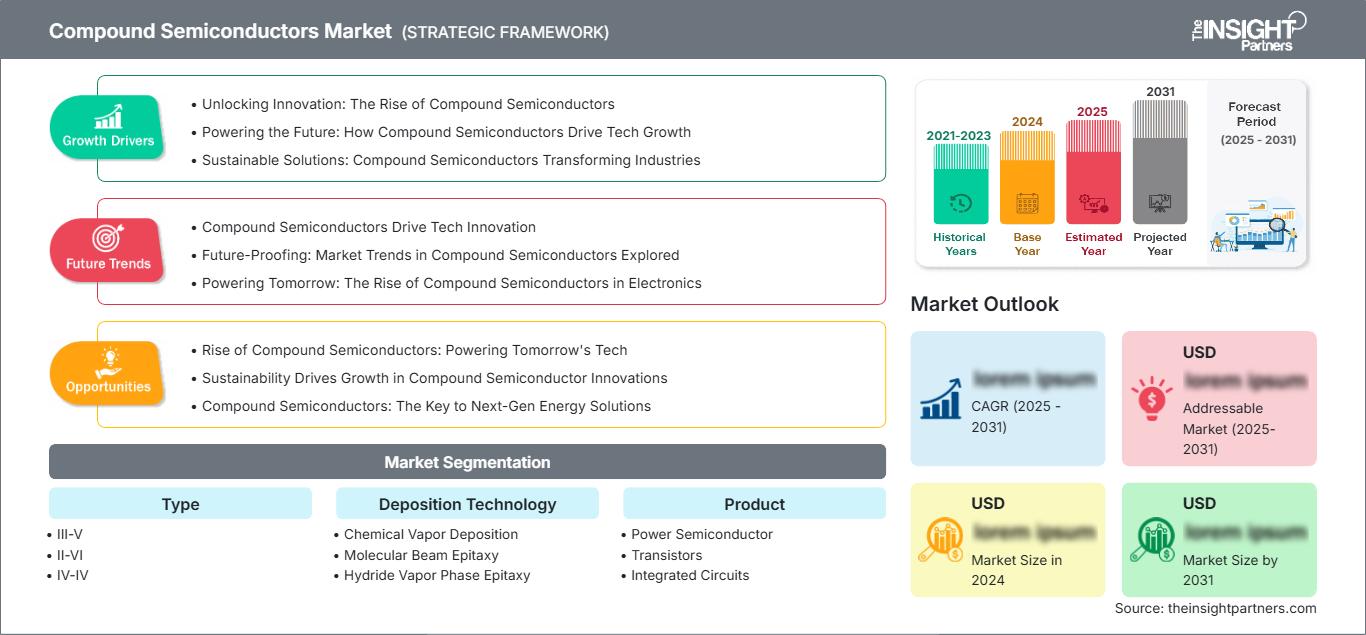
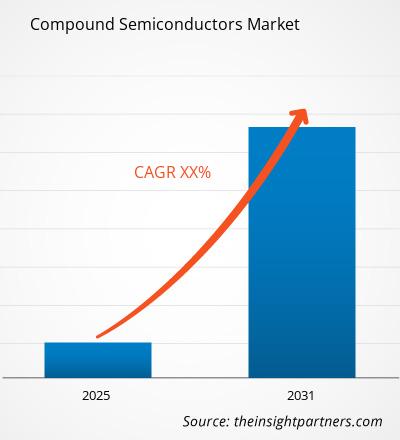
The Compound Semiconductors Market is expected to rise from US$ 44.88 Billion in 2025 to US$ 111.25 Billion by 2034, registering a CAGR of 10.61% during 2026-2034. Growth in demand is fueled by applications related to high-frequency communications, power conversions, optoelectronic devices, and defense electronics that require the use of compounds due to their superior thermal conductivity, breakdown voltages, and faster switching speeds than traditional silicon systems.
North America is still considered an important market for the Compound Semiconductors Market size as it grows with the support of its defense electronics sector, power systems in data centers, radio frequency infrastructure for 5G networks, and the electric mobility value chain. The market is estimated to grow at a 9.8–10.6% CAGR during 2026-2034.
Compound Semiconductors Market Assessment and Insights
- North America accounted for 27–30% Compound Semiconductors Market share in 2025 and is expected to grow at a CAGR of 9.8–10.6% during 2026–2034, supported by defense electronics, EV power modules, and domestic wafer investments.
- US represented 72–76% of North America in 2025 and is projected to grow at a 9.9–10.7% CAGR through defense, aerospace, and data center power conversion demand.
- Europe held 19–22% share in 2025 and is set to grow at 9.2–10.0% CAGR, led by Germany, the UK, France, Italy, and Spain across automotive and industrial power electronics.
- Asia Pacific contributed 43–46% share in 2025 and is forecast to expand at 11.2–12.0% CAGR, led by China, Japan, South Korea, India, and Australia across telecom, EV, and electronics manufacturing.
- Largest Segment Type held the leading market share of 36–40% in 2025 and is expected to grow at a CAGR of 10.0–10.8% during 2026–2034.
- High Growth Segment Application accounted for 24–28% share in 2025 and is expected to grow at a CAGR of 11.4–12.2% during 2026–2034.
- Key companies analyzed in detail: Wolfspeed, Inc.; IQE plc; Skyworks Solutions, Inc.; Digi-Key Electronics; Texas Instruments Incorporated; Qorvo, Inc.; Toshiba Corporation; Infineon Technologies AG; Broadcom Inc.; Renesas Electronics Corporation.
Source: The Insight Partners' analysis based on proprietary research, government publications, company annual reports, investor presentations, industry databases, and expert interviews.
The evolution of device architectures has been from performance substitution to system-level re-designing, resulting in increased dependency of the Compound Semiconductors Market on substrate quality, epitaxial growth, packaging, and thermal management. Increasingly, silicon carbide and gallium nitride are being designed into traction inverters, fast chargers, satellite payloads, radar modules, and telecom radios. The production landscape will see the evolution of 200 mm wafer fabrication, high yield deposition, and shorter qualification loops with lower conversion rates.
In the years to come, capacity build-out will be driven by regional industrial policy, long-term automotive supply strategy, and need for power efficient infrastructures. The investment activity seen in India, Southeast Asia, and the Middle East will add to the existing cluster of manufacturing bases in the US, Europe, Japan, South Korea, Taiwan, and China. The regulatory push towards electrification, grid efficiency, and communication infrastructure hardware will ensure structural robustness of the market.
Compound Semiconductors Market Report Scope
| Report Attribute | Details |
|---|---|
| Market size in 2025 | US$ 44.88 Billion |
| Market Size by 2034 | US$ 111.25 Billion |
| Global CAGR (2026 - 2034) | 10.61% |
| Historical Data | 2021-2024 |
| Forecast period | 2026-2034 |
Compound Semiconductors Market Analysis
Compound Semiconductors Market growth is being driven by electrified transport, renewable power conversion, 5G densification, satellite communications, and AI data center power needs. According to the International Energy Agency, electric mobility remains a major policy and infrastructure priority, which supports stronger demand for silicon carbide power devices in traction inverters, onboard chargers, and DC-DC converters.
The value chain consists of substrates, epitaxy, devices manufacturing, packaging, modules assembly, and distribution. Supplier dynamics prefer suppliers with skills in crystal growth, deposition process control, and pre-qualified product platforms. Therefore, wafer availability, qualification processes, and thermal packaging capacity impact the market’s pricing strategy and design wins within the automotive, telecommunication, aerospace, and industrial segments.
Competitive pressure continues to grow due to Wolfspeed, Inc., Infineon Technologies AG, Toshiba Corporation, Renesas Electronics Corporation, and Texas Instruments Incorporated growing their power semiconductor product lines, while Skyworks Solutions, Inc., Qorvo, Inc., Broadcom Inc., and IQE plc developing RF, analog, and wafer platforms. The expansion of market access through partnerships with Digi-Key Electronics includes engineering support and component sourcing.
According to Compound Semiconductors Market, strategic positioning becomes less dependent on product leadership and more focused on supply, process maturity, and specific application co-design. The industry is shifting its investment in 200 mm silicon carbide wafers, gallium nitride on silicon, packaging innovations, and geographic manufacturing resilience. Partnerships between device manufacturers, aerospace prime contractors, automotive manufacturers, and telecommunication original equipment manufacturers become crucial for qualification speed and margin protection.
● REPORT CUSTOMIZATION
Tailor This Report To Align With Your Specific Business Requirements
This report can be customized to align precisely with your business objectives, scope, and target markets. Customization options include tailored segmentation, geography, competitive analysis, and strategic insights to support informed decision-making.
Customize This Report →WHAT YOU CAN ADJUST
- ● Segmentations
- ● Geography
- ● Competitive Analysis
- ● Language Preferences
Compound Semiconductors Market: Strategic Insights
Regional Insights
North America Compound Semiconductors Market
In 2025, North America’s compound semiconductors market is projected to have a 27-30% share, with an anticipated growth rate of 9.8-10.6%. The market growth in North America is boosted by developments such as defense electronics, satellite payloads, AI data centers’ power conversion, and electric vehicle infrastructure. Government spending in semiconductor manufacturing and investments in silicon carbide production ensure localization of the supply chain and qualification of the customer.
The market share of compound semiconductors in North America is held by the US due to its advanced aerospace industry, RF design and power electronics implementation in grid and mobility segments. Contributions from Canada and Mexico in terms of their automotive industries, electronics production, and energy sector projects provide a balanced portfolio in North America.
U.S. Compound Semiconductors Market
The United States was responsible for 72-76% share of North America in 2025 and it will be expanding at CAGR rate between 9.9%-10.7%. There are several factors behind the demand in this industry, including defense radar, secure communication, aerospace electronic equipment, artificial intelligence data center, renewable energy conversion and high voltage EV platform.
In terms of local manufacturing, Wolfspeed, Inc., Skyworks Solutions, Inc., Qorvo, Inc., Texas Instruments Incorporated, Broadcom Inc., and Digi-Key Electronics offer wide domestic ecosystem that includes wafers, RF front-end, analog semiconductor, power devices and distribution. From application perspective, there is higher adoption of satellite communication link, 800 V EV system, industrial motor drive and small power supply for artificial intelligence infrastructure.
Europe Compound Semiconductors Market
The European share stood at 19-22% in 2025 and is expected to grow at 9.2-10.0% CAGR. Germany dominates because of the growth in automotive electrification, industrial automation, and power modules. The United Kingdom will benefit from compound semiconductor hubs and expertise in radio frequency, while France, Italy, and Spain will make contributions in the aerospace, energy, and electronic manufacturing industries.
Key players contributing to Europe's growth include Infineon Technologies AG as far as capacity and product developments are concerned, as well as IQE plc when it comes to epitaxial wafers for RF and photonics. EU policy, grid upgradation, and vehicle emissions will help sustain long-cycle adoption. France and Italy make contributions via aerospace and industrial power projects.
APAC Compound Semiconductors Market
APAC was the dominant region in 2025 with a market share of 43–46%, and is expected to witness growth at a CAGR of 11.2–12.0%. These regions benefit from their electronics manufacturing capabilities, their EV platforms, 5G technology, and their favorable policies to promote industry.
The dominance of China is due to its scale in electronics and EVs. The regions of Japan and South Korea support advanced materials, power devices, and optoelectronics, whereas the Indian region is gaining momentum in its semiconductor policies. The Australian region contributes to this market via defense and mining electrification.
Middle East & Africa Compound Semiconductors Market
Middle East & Africa is expected to grow at 8.4–9.2% CAGR through 2034. Saudi Arabia and the UAE lead demand through energy transition, data centers, defense modernization, and smart infrastructure programs, while South Africa contributes through industrial power and telecom modernization.
Regional adoption is still earlier than in APAC, North America, and Europe, but high-temperature power electronics and resilient communication hardware are increasingly relevant. Grid reliability, renewable integration, desalination, and oil and gas electrification provide practical use cases for robust diodes, rectifiers, transistors, and integrated circuits.
Segmentation Analysis
Type
The Type segment is expected to grow at a 10.0–10.8% CAGR during 2026–2034. Compound Semiconductors Market scope across III-V, II-VI, IV-IV, and sapphire materials reflects varied performance requirements in RF, photonics, power electronics, and substrates. Adoption depends on bandgap, electron mobility, thermal conductivity, wafer maturity, and compatibility with deposition and packaging processes.
- III-V materials dominate RF, photonics, and high-speed communication devices because gallium arsenide, gallium nitride, and indium phosphide offer strong electron mobility and frequency performance.
- II-VI compounds support optoelectronics, sensing, and specialized imaging applications, where optical response, wavelength control, and material stability influence device selection.
- IV-IV materials, especially silicon carbide, are strategically important for power conversion because they support high voltage, high temperature operation, and lower switching losses.
- Sapphire remains important as a substrate in LED, RF, and optoelectronic applications, valued for hardness, transparency, thermal stability, and manufacturing availability.
Deposition Technology
The Deposition Technology segment is forecast to grow at a 9.7–10.5% CAGR from 2026 to 2034. Process choice determines crystal quality, defect density, throughput, and cost per wafer. Manufacturers increasingly balance precision epitaxy with scalable production, especially as customers demand tighter reliability windows for automotive, aerospace, telecom, and industrial applications.
- Chemical Vapor Deposition is widely used for scalable epitaxial growth, supporting silicon carbide and gallium nitride production where uniformity, repeatability, and high-volume capability are critical.
- Molecular Beam Epitaxy supports highly controlled layer structures for RF, photonics, and research-grade devices, but throughput and cost limit broader commodity use.
- Hydride Vapor Phase Epitaxy is important for thick gallium nitride layers and substrate development, helping improve crystal quality for high-power and optoelectronic applications.
- Ammonothermal technology supports bulk gallium nitride crystal growth, addressing defect reduction and substrate availability for demanding power and RF use cases.
- Liquid Phase Epitaxy remains relevant for selected optoelectronic and legacy device structures where controlled growth and material quality outweigh throughput constraints.
- Atomic Layer Deposition enables ultra-thin film control for passivation, gate dielectrics, and interface engineering, improving reliability in advanced compound semiconductor devices.
Product
The Product segment is projected to grow at a 10.3–11.1% CAGR during 2026–2034. Demand is strongest where compound devices improve power density, switching efficiency, frequency response, and thermal performance. Product differentiation increasingly depends on reliability qualification, module design, packaging, and the ability to reduce total system cost rather than component cost alone.
- Power Semiconductor products are central to EVs, renewable energy, industrial drives, and data center power supplies, where efficiency gains reduce cooling and energy losses.
- Transistors serve RF amplification, high-speed switching, radar, and telecom systems, with gallium nitride and gallium arsenide improving frequency handling and output power.
- Integrated Circuits support compact RF, analog, and mixed-signal functions, enabling smaller modules in smartphones, defense electronics, satellites, and connected infrastructure.
- Diodes & Rectifiers improve conversion efficiency in chargers, adapters, industrial equipment, and renewable systems, benefiting from high breakdown voltage and fast recovery behavior.
Application
The Application segment is expected to grow at an 11.4–12.2% CAGR during 2026–2034. Growth reflects broader use across communications, industrial energy systems, aerospace electronics, consumer devices, and healthcare equipment. Buyers increasingly evaluate compound devices based on energy efficiency, signal integrity, rugged operation, and the ability to enable smaller, lighter, and more reliable systems.
- IT & Telecom uses compound semiconductors in RF front ends, base stations, optical networks, and data infrastructure, where bandwidth, linearity, and thermal efficiency are essential.
- Industrial and Energy & Power adoption is rising in motor drives, inverters, chargers, grid assets, and renewable integration, where lower losses improve operational economics.
- Aerospace & Defense applications require radiation tolerance, high-frequency operation, and reliability in harsh environments, supporting use in radar, satellite communications, and electronic warfare systems.
- Consumer Electronics demand is tied to compact chargers, RF modules, displays, sensors, and power management components that improve device performance and charging efficiency.
- Healthcare adoption is selective but valuable in imaging, sensing, laser systems, and compact diagnostic electronics requiring precision, stability, and efficient power handling.
Opportunity Snapshot
| Application | Revenue Contribution | Trend Tag | Adoption Stage |
| IT & Telecom | High | 5G Radios | Scaling |
| Industrial and Energy & Power | High | Grid Inverters | Scaling |
| Aerospace & Defense | Medium | Radar Modules | Mature |
| Consumer Electronics | Medium | Fast Charging | Scaling |
| Healthcare | Low | Imaging Sensors | Emerging |
Compound Semiconductors Market Growth Drivers and Impact Analysis
Electrification Raises Demand for Efficient Power Conversion
Electric vehicle platforms, charging infrastructure, renewable energy sources, and industrial drives are driving up the need for silicon carbide and gallium nitride components. Such semiconductor materials offer less switching loss and enhanced thermal properties, which make cooling solutions unnecessary and facilitate smaller inverters. The outlook of electric mobility from the International Energy Agency confirms the extent of vehicle electrification, while power utilities are equipping themselves with power electronics for grid flexibility. The effect of the market is reflected in extended qualification periods and long-term sourcing contracts.
High-Frequency Networks Expand RF Device Requirements
Compounding semiconductors are being employed by telecom operators and their partners, who supply equipment, to boost power amplification, performance, and energy efficiency within the context of 5G technology and beyond. These semiconductors made from gallium nitride and gallium arsenide allow for operating at higher frequencies and greater performance with regard to radio equipment. The impact on suppliers will be a trend toward application-oriented RF platforms, cooperation with network OEMs, and increasing use of epitaxial wafers.
Regional Manufacturing Policy Strengthens Supply Resilience
Governments are prioritizing semiconductor manufacturing because power electronics, RF devices, and photonics are linked to energy security, defense readiness, and digital infrastructure. Incentives in the US, Europe, China, India, Japan, and South Korea are encouraging wafer capacity, packaging capability, and materials development. The market impact is a gradual reduction in single-region dependency, although qualification requirements still slow supplier substitution. Companies with proven reliability data and scalable deposition technologies are better positioned to capture strategic sourcing opportunities.
Compound Semiconductors Market Future Trends
200 mm Silicon Carbide Manufacturing Becomes a Cost Pivot
Compound Semiconductors Market trends point toward larger wafer formats as suppliers pursue lower cost per die, better throughput, and higher automotive readiness. The transition from 150 mm to 200 mm silicon carbide will not be uniform because crystal quality, defect control, and equipment readiness remain demanding. However, successful scaling can improve device availability for EV inverters, grid assets, and industrial systems. Suppliers that combine wafer growth, epitaxy, and device fabrication will gain stronger control over yield learning and customer qualification.
GaN-on-Silicon Moves Toward Broader Power Applications
Gallium nitride on silicon is expected to expand beyond fast chargers and RF niches into higher-volume power conversion, provided reliability data and packaging maturity continue improving. Its compatibility with larger silicon wafer infrastructure creates a pathway for cost reduction, while high switching speed enables smaller passive components and compact system designs. Adoption will likely accelerate in consumer adapters, telecom power supplies, server power stages, and selected automotive auxiliary systems where efficiency and form factor carry measurable value.
Compound Semiconductors Market Opportunities
AI Data Center Power Architectures Create New Design Wins
AI infrastructure is increasing electricity density at rack, server, and facility levels, creating opportunities for high-efficiency power conversion. Compound Semiconductors Market Forecasts indicate that suppliers can target compact power modules, solid-state transformers, and high-voltage conversion stages where silicon carbide and gallium nitride reduce losses. The opportunity is strongest for vendors that can prove thermal performance, reliability, and manufacturability at scale. Partnerships with hyperscale infrastructure providers and power supply manufacturers can convert technical advantages into recurring platform demand.
Localized Supply Agreements Improve Automotive Penetration
Automakers are prioritizing supply certainty for high-voltage platforms, creating room for long-term agreements with qualified wafer, device, and module suppliers. Silicon carbide remains especially relevant for 800 V traction systems, onboard charging, and fast-charging infrastructure. The opportunity is not only device sales but also co-development, packaging optimization, and regional manufacturing support. Suppliers that align capacity ramps with model launch cycles can improve utilization, reduce customer risk, and secure higher-value positions in future EV architectures.
Recent Developments
- July 2025: The Government of India approved a ₹22,919 crore Electronics Component Manufacturing Scheme (ECMS) to strengthen the domestic electronics supply chain. The scheme aims to boost local manufacturing of passive components, display modules, camera modules, batteries, connectors and other critical electronic components, supporting India's semiconductor and electronics ecosystem.
- July 2025: Kaynes Semicon announced plans to expand beyond OSAT into the full semiconductor chip value chain, including chip design, wafer fabrication partnerships, packaging, testing and system solutions. The company is positioning itself as an integrated semiconductor player to support India's growing chip ecosystem.
- May 2026: Cyient Semiconductors launched India's first GaN (Gallium Nitride) Power IC family, developed using Navitas Semiconductor's technology. The seven-device portfolio targets AI data centres, telecom, fast chargers, industrial power systems and e-mobility applications, marking Cyient's first commercial GaN power product family.
Frequently Asked Questions

- Comprehensive Market Sizing and Forecast Analysis
- Detailed Segmentation Analysis
- In-Depth Market Dynamics Assessment
- Regional and Country-Level Insights
- Competitive Landscape and Company Benchmarking
- Strategic Business Intelligence
Recent Reports
Testimonials

The Insight Partners provided valuable market intelligence that supported our global go-to-market strategy. Their team was professional, responsive, and attentive to our feedback, providing thoughtful analysis and helpful methodological clarifications throughout the project.
Junmo Kim Chief Financial Officer (CFO), Enertech Co., Ltd.
The Insight Partners' SCADA System Market report is comprehensive, with valuable insights on current trends and future forecasts. The team was highly professional, responsive, and supportive throughout. We are very satisfied and highly recommend their services.
RAN KEDEM Partner, Reali Technologies LTDs
I requested a report on a very specific software market and the team produced the report in a few days. The information was very relevant and well presented. I then requested some changes and additions to the report. The team was again very responsive and I got the final report in less than a week.
JEAN-HERVE JENN Chairman, Future Analytica
We worked with The Insight Partners for an important market study and forecast. They gave us clear insights into opportunities and risks, which helped shape our plans. Their research was easy to use and based on solid data. It helped us make smart, confident decisions. We highly recommend them.
PIYUSH NAGPAL Sr. Vice President, High Beam Global
The Insight Partners delivered insightful, well-structured market research with strong domain expertise. Their team was professional and responsive throughout. The user-friendly website made accessing industry reports seamless. We highly recommend them for reliable, high-quality research services
YUKIHIKO ADACHI CEO, Deep Blue, LLC.
This is the first time I have purchased a market report from The Insight Partners.While I was unsure at first, I visited their web site and felt more comfortable to take the risk and purchase a market report.I am completely satisfied with the quality of the report and customer service. I had several questions and comments with the initial report, but after a couple of dialogs over email with their analyst I believe I have a report that I can use as input to our strategic planning process.Thank you so much for taking the extra time and making this a positive experience.I will definitely recommend your service to others and you will be my first call when we need further market data.
JOHN SUZUKI President and Chief Executive Officer, Board Director, BK Technologies
I wish to appreciate your support and the professionalism you displayed in the course of attending to my request for information regarding to infectious disease IVD market in Nigeria. I appreciate your patience, your guidance, and the fact that you were willing to offer a discount, which eventually made it possible for us to close a deal. I look forward to engaging The Insight Partners in the future, all thanks to the impression you have created in me as a result of this first encounter.
DR CHIJIOKE ONYIA MANAGING DIRECTOR, PineCrest Healthcare Ltd.Reason to Buy
- Informed Decision-Making
- Understanding Market Dynamics
- Competitive Analysis
- Identifying Emerging Markets
- Customer Insights
- Market Forecasts
- Risk Mitigation
- Boosting Operational Efficiency
- Strategic Planning
- Investment Justification
- Tracking Industry Innovations
- Aligning with Regulatory Trends





 Get Free Sample for