
Catalyst Market Size, Share & Growth by 2034
Coverage: by Type (Zeolites, Metals, Chemical Compounds, Enzymes, Organometallic Materials); Application (Petroleum Refining, Chemical Synthesis, Polymer Catalysis and Environmental), and Geography (North America, Europe, Asia Pacific, and South and Central America)
- Status : Data Released
- Report Code : TIPRE00003426
- Category : Chemicals and Materials
- No. of Pages : 150
- Available Report Formats :


- Last update date : September 22, 2026


2025 Market Size
US$ 44.52 Bn
Base year value
2034 Forecast
US$ 66.77 Bn
Projected by 2034
CAGR 2026-2034
4.61 %
Growth rate
Addressable Market
US$ 505.36 Bn
(2026-2034)
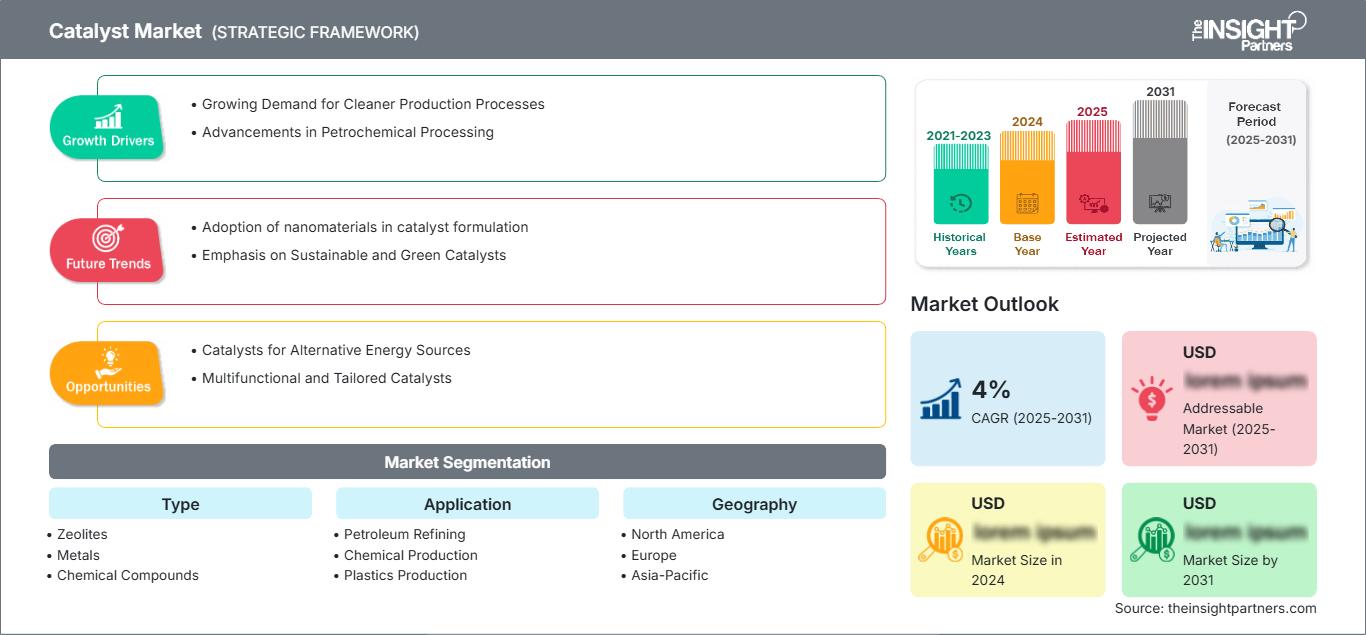
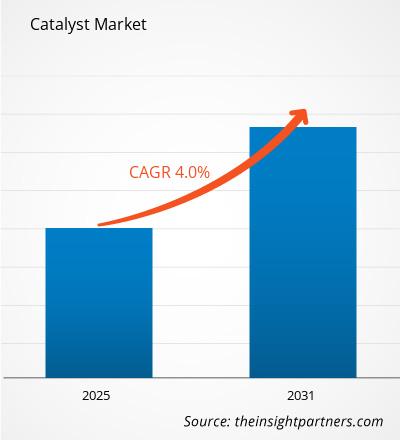
The Catalyst Market reached US$ 44.52 Billion in 2025 and is projected to attain US$ 66.77 Billion by 2034, registering a CAGR of 4.61% during 2026–2034. The industry continues to benefit from rising investments in refining, petrochemicals, specialty chemicals, and advanced manufacturing, where catalytic technologies improve process efficiency, product selectivity, and resource utilization. Increasing industrial emphasis on decarbonization, circular production systems, and energy optimization continues to strengthen long-term demand across diverse end-use sectors.
Across North America, the Catalyst Market size is supported by sustained refinery modernization, expansion of petrochemical capacity, and growing investments in low-carbon technologies. The region is expected to register a CAGR of 3.9–4.4% during 2026–2034, driven by technological innovation and stringent environmental regulations. Rising hydrogen production, renewable fuel projects, and increasing adoption of advanced catalyst formulations across chemical processing industries further reinforce regional competitiveness and manufacturing resilience.
Catalyst Market Assessment and Insights
- North America: Accounted for a 30–34% share in 2025 and is expected to expand at a CAGR between 3.9–4.4% during 2026–2034. Strong refinery infrastructure, chemical manufacturing investments, and continuous catalyst replacement cycles sustain regional demand while environmental regulations encourage adoption of high-performance catalytic materials.
- U.S.: Represented 74–78% of North America in 2025 and is anticipated to grow at a CAGR between 3.8–4.3% during 2026–2034. Advanced refining capacity, petrochemical integration, and hydrogen economy initiatives continue supporting technology adoption.
- Europe: Held 24–28% share in 2025 and is projected to grow at a CAGR between 3.8–4.2% during 2026–2034. Germany, the UK, France, Italy, and the Netherlands remain leading contributors due to established specialty chemical production, emission standards, and industrial decarbonization initiatives.
- Asia Pacific: Accounted for a 36–40% share in 2025 and is forecast to expand at a CAGR between 5.4–5.9% during 2026–2034. China, Japan, South Korea, and India continue expanding refining, electronics, and chemical manufacturing capacities, supporting sustained catalyst consumption.
- Largest Segment: Petroleum Refining accounted for 38–42% market share in 2025 and is expected to register a CAGR between 4.0–4.5% during 2026–2034, supported by refinery upgrades, fuel quality regulations, and continuous catalyst regeneration requirements.
- High Growth Segment: Electronics represented 11–15% Catalyst Market share in 2025 and is projected to grow at a CAGR between 6.2–6.8% during 2026–2034, driven by semiconductor manufacturing, advanced materials processing, and precision chemical applications.
- Key companies analyzed in detail: BASF SE, Johnson Matthey Plc, Clariant AG, Topsoe A/S, Albemarle Corporation, Evonik Industries AG, W. R. Grace & Co.-Conn., INEOS Group Holdings S.A., Honeywell International Inc., Exxon Mobil Corporation.
Source: The Insight Partners' analysis based on proprietary research, government publications, company annual reports, investor presentations, industry databases, and expert interviews.
Rapid industrial transformation has reshaped catalyst development toward higher activity, longer operational life, and improved selectivity across refining, petrochemical, and specialty manufacturing operations. Process industries increasingly deploy engineered catalytic materials that enhance conversion efficiency while reducing feedstock consumption and greenhouse gas emissions. Simultaneously, manufacturers continue investing in customized formulations, digital process monitoring, catalyst regeneration technologies, and recycling capabilities to improve lifecycle performance. These developments collectively reinforce the Catalyst Market growth across mature and emerging industrial economies while supporting operational efficiency and sustainability objectives.
Emerging economies continue expanding domestic refining and chemical production capacities, creating attractive investment opportunities for catalyst manufacturers seeking regional diversification. Strong policy support for hydrogen production, carbon capture, utilization, renewable fuels, and circular manufacturing encourages the commercialization of advanced catalyst technologies. Collaboration among chemical producers, technology developers, and research institutions is accelerating innovation in nanostructured materials, bio-based catalytic systems, and low-carbon industrial processes, positioning the market for sustained technological advancement throughout the forecast period.
Catalyst Market Report Scope
| Report Attribute | Details |
|---|---|
| Market size in 2025 | US$ 44.52 Billion |
| Market Size by 2034 | US$ 66.77 Billion |
| Global CAGR (2026 - 2034) | 4.61% |
| Historical Data | 2021-2024 |
| Forecast period | 2026-2034 |
Catalyst Market Analysis
Growing industrial demand for cleaner production technologies continues to reshape the global catalytic ecosystem. Environmental regulations targeting sulfur reduction, greenhouse gas emissions, and energy efficiency encourage industries to replace conventional process technologies with advanced catalytic solutions. Petroleum refining remains the largest demand center, while chemical manufacturing, plastics production, and electronics increasingly require specialized catalyst formulations that improve productivity and reduce waste generation. This evolving industrial landscape strengthens the long-term Catalyst Market analysis, particularly as manufacturers prioritize operational efficiency, feedstock optimization, and lower lifecycle costs.
The value chain spans raw material suppliers, catalyst manufacturers, technology licensors, equipment providers, industrial processors, and catalyst regeneration specialists. Secure access to metals, specialty chemicals, rare earth elements, and engineered support materials remains essential for maintaining consistent production quality. Increasing investments in catalyst recovery, recycling, and regeneration services improve resource efficiency while reducing dependence on virgin raw materials. Digital monitoring technologies further enable predictive maintenance and performance optimization across industrial processing facilities.
Competitive intensity continues to increase as established manufacturers invest in product innovation, strategic partnerships, and regional manufacturing expansion. BASF SE, Johnson Matthey Plc, Clariant AG, Topsoe A/S, Evonik Industries AG, and Honeywell International Inc. continue strengthening their portfolios through advanced refining technologies, sustainable chemistry solutions, and high-performance industrial catalysts. Meanwhile, Albemarle Corporation and W. R. Grace & Co.-Conn. Expand specialty catalyst offerings addressing petrochemical and polymer production requirements.
The future of strategic investment in catalysts lies in hydrogen generation, renewable fuel production, carbon capture systems, and more complex applications of catalysis in chemical processes. Catalyst development continues to be incorporated into energy transition plans at INEOS Group Holdings S.A. and Exxon Mobil Corporation, while increased research cooperation accelerates the process of making catalysts ready for industrial use with a minimized carbon footprint. The trend toward investing in digital manufacturing, aided by artificial intelligence and materials science, will improve catalyst effectiveness and shorten product development timelines.
● REPORT CUSTOMIZATION
Tailor This Report To Align With Your Specific Business Requirements
This report can be customized to align precisely with your business objectives, scope, and target markets. Customization options include tailored segmentation, geography, competitive analysis, and strategic insights to support informed decision-making.
Customize This Report →WHAT YOU CAN ADJUST
- ● Segmentations
- ● Geography
- ● Competitive Analysis
- ● Language Preferences
Catalyst Market: Strategic Insights
Regional Insights
North America Catalyst
North America accounted for 30–34% of the Catalyst Market share in 2025 and is projected to register a CAGR of 3.9–4.4% during 2026–2034. The region benefits from a mature refining sector, integrated petrochemical complexes, and continuous investments in process modernization. Environmental regulations established by the U.S. Environmental Protection Agency and Canada's industrial emission frameworks continue encouraging industries to adopt advanced catalytic technologies that improve operational efficiency while reducing emissions.
Increased investment in renewable diesel, sustainable aviation fuel, hydrogen, and carbon capture processes is expected to boost catalyst use across a wide range of industrial applications. High-efficiency catalysts are used in the chemical industry to maximize raw material utilization and minimize production costs. Research collaboration between industrial firms and technology providers will enhance regional competitiveness, and catalyst regeneration and recycling will help save on operational costs.
U.S. Catalyst Market
The United States represented 74–78% of the North American Catalyst Market in 2025 and is expected to expand at a CAGR of 3.8–4.3% through 2034. The country's extensive refining capacity, strong petrochemical industry, and advanced specialty chemical manufacturing continue driving catalyst consumption. Leading industrial producers actively invest in catalyst optimization to improve fuel quality, increase production yields, and comply with evolving environmental standards across refining and chemical processing operations.
The existence of companies like Honeywell International Inc., Exxon Mobil Corporation, Albemarle Corporation, and W.R. Grace & Co.-Conn. fosters innovation in catalyst production and industrial applications. The growing focus on the production of hydrogen, renewable fuels, and semiconductors provides further scope for innovative catalysts. There is an increased emphasis on digital process optimization and predictive maintenance, which helps reduce the catalyst turnover rate.
Europe Catalyst Market
Europe accounted for 24-28% market share in 2025 and is expected to see a 3.8-4.2% CAGR during the forecast period. Germany leads the region due to its advanced chemical manufacturing industry, long-established automotive supply chain, and ongoing investment in sustainable manufacturing practices. Decarbonization of industries and stringent environmental laws are aiding the development of catalyst technology for both refinery and specialty chemicals applications.
The UK continues to boost demand for catalysts due to its investments in hydrogen infrastructure, sustainable aviation fuel, and carbon capture technologies. Countries such as France, Italy, and Spain have been increasingly using high-tech catalytic solutions in petrochemical refining, medicines, and specialty chemicals, supported by the modernization of their manufacturing plants and efforts to switch to new energy. Local corporations such as BASF SE, Clariant AG, Evonik Industries AG, Johnson Matthey Plc, and Topsoe A/S remain focused on research and development of catalysts and low-carbon technologies.
APAC Catalyst Market
Asia Pacific region held 36%-40% of the market in 2025 and is expected to grow at a CAGR of 5.4%-5.9% between 2026 and 2034. The greatest demand in the region comes from China, driven by extensive refining, chemicals, and electronics manufacturing, whereas Japan and South Korea are developing advanced catalysts for specific industrial applications.
India is witnessing rapid expansion in refining and petrochemical investments, supported by favorable industrial policies and infrastructure development. Australia makes its contribution through mining, energy processing, and chemical industries, thus providing ample scope for catalyst manufacturers.
Middle East & Africa Catalyst Market
The Middle East & Africa region is anticipated to expand at a CAGR of 4.7%- 5.2% through 2034. The Middle East's largest regional market is Saudi Arabia, owing to its investments in refining and petrochemical plants. The UAE is continuously developing its downstream industries owing to its energy diversification initiatives.
South Africa helps sustain regional demand through its mining and chemical industry operations, while the rest of MEA continues its industrial development and refining process improvements. Energy diversification and advances in industrial technology are expected to drive demand for catalysts in the region.
Segmentation Analysis
Type
The Type segment is projected to experience a CAGR of 4.8-5.2% for 2026-2034. The Catalyst market scope is further widening as new catalyst chemistries are incorporated in response to increasing demands for greater selectivity, durability, and lower energy consumption. The technological innovations in materials science, nanotechnology, and catalyst regeneration help manufacturers meet their changing demands in the refining, chemicals, plastics, and electronics industries.
- Zeolites remain widely used in petroleum refining due to their excellent molecular sieving capability, thermal stability, and ability to improve hydrocracking and fluid catalytic cracking efficiency while supporting cleaner fuel production.
- Metals play an essential role in hydrogenation, oxidation, emission control, and specialty chemical synthesis, with platinum, palladium, nickel, and other engineered materials supporting high-performance industrial processing.
- Chemical Compounds continue expanding across bulk chemicals, polymers, and specialty manufacturing because they deliver cost-effective catalytic performance while enabling process optimization and improved reaction selectivity.
- Enzymes are gaining wider industrial acceptance for sustainable processing, biocatalysis, pharmaceutical production, and environmentally friendly manufacturing, supporting lower energy consumption and improved product specificity.
Application
The Application segment category is expected to witness a CAGR of 4.9%-5.3% during the forecast period. Increasing industrial output, strict environmental policies, and investments in sustainable manufacturing practices keep the demand for catalysts high within sectors such as refining, chemicals, plastics, and electronics. The development of new catalysts also enhances productivity while lowering costs.
- Petroleum Refining remains the dominant application because catalyst technologies improve fuel quality, maximize refinery conversion rates, reduce sulfur emissions, and enhance operational efficiency across modern refining complexes.
- Chemical Production increasingly relies on advanced catalytic systems for ammonia, methanol, hydrogen, and specialty chemical manufacturing, supporting higher yields and lower energy consumption during industrial processing.
- Plastics Production utilizes catalysts to improve polymerization efficiency, product consistency, and manufacturing productivity while supporting the development of advanced engineering plastics and sustainable polymer materials.
- Electronics continues expanding through semiconductor fabrication, electronic chemicals, and advanced materials manufacturing, where precision catalyst technologies enable high-purity production processes and superior product performance.
Opportunity Snapshot
| Application | Revenue Contribution | Trend Tag | Adoption Stage |
| Petroleum Refining | High | Clean Fuels | Mature |
| Chemical Production | High | Green Hydrogen | Scaling |
| Plastics Production | Medium | Circular Polymers | Scaling |
| Electronics | Medium | Chip Fabrication | Emerging |
Catalyst Market Growth Drivers and Impact Analysis
Stringent environmental regulations driving catalyst adoption
Regulators in the leading industrialized nations maintain an ongoing push for ever-more stringent emissions standards for fuels, industrial manufacturing, and chemical processes, thereby driving the adoption of catalytic technologies. Requirements regarding reduced sulfur content, nitrogen oxide emissions, volatile organic compounds, and greenhouse gas reductions call for upgrading plants with higher-efficiency catalytic solutions. Growing interest in sustainable diesel, sustainable jet fuels, hydrogen generation, and carbon capture technologies is creating additional needs for catalysts. The regulatory trend is also accelerating the pace of catalyst replacement while spurring new research to develop catalysts that improve conversion efficiency and minimize industrial waste. Given these trends, catalyst manufacturers are building more robust product lines aimed at sustainable manufacturing, emissions reductions, and more economical manufacturing processes.
Expansion of global refining and petrochemical capacity
Further investments in large refinery capacity improvements and petrochemical capacity enhancements in Asia-Pacific, the Middle East, and certain North American countries will ensure sustained catalyst market growth over the coming years. The increase in demand for transportation fuels, petrochemicals, specialty chemicals, and industrial materials prompts refinery operators to adopt modern catalytic solutions that deliver maximum efficiency at minimum operational costs. New refineries require more advanced catalysts for hydrocracking, catalytic reforming, fluid catalytic cracking, and desulfurization. Meanwhile, the integrated petrochemical units are adopting modern catalyst systems with enhanced feedstock flexibility and higher yields. The continuous expansion of downstream capacities and digital process optimization, together with catalyst regeneration, guarantees steady demand on the market.
Growing investment in sustainable industrial technologies
The global transition toward low-carbon manufacturing has accelerated investment in catalyst technologies that support renewable fuels, hydrogen generation, carbon capture, bio-based chemicals, and circular manufacturing systems. There is a growing demand for catalytic materials that conserve energy by enhancing process efficiency and selectivity. Government grants, industry involvement, and research partnerships continue to play an important role in the commercialization of innovative catalysts based on engineered materials and nanotechnology. Manufacturers are also focusing on recycling catalyst systems and techniques to regenerate catalysts, thereby minimizing the use of virgin raw materials. All this enhances the competitiveness of industries in the future and opens new areas for catalyst providers, including sustainable energy transition initiatives, chemical manufacturing, and materials production.
Catalyst Market Future Trends
Artificial intelligence accelerating catalyst discovery
AI, machine learning, and computational materials science have brought about a revolution in the field of catalysts by minimizing the time required for their development and improving the accuracy of their design. Digital simulations provide scientists with an opportunity to test the effectiveness of a catalyst without laboratory testing, thereby enabling faster production of effective catalysts. It is becoming common for companies to depend on data analysis and process optimization to check the condition of the catalyst. These innovations are expected to enhance production economics and facilitate the customization of catalysts for different industries such as refineries, chemicals, hydrogen, and electronics. The Catalyst Market trends are increasingly influenced by digital technologies in the development and application of future-generation catalysts.
Growing commercialization of low-carbon catalyst technologies
Industries are increasingly adopting catalyst technologies specifically designed for renewable fuels, carbon utilization, sustainable chemicals, and hydrogen production. Manufacturers will continue investing in catalysts that enable the use of bio-derived raw materials and in low-temperature processes to enhance energy efficiency. Moreover, the development of recyclable catalysts, along with improved regenerative technologies, will help achieve sustainability goals and minimize costs. Future investments will be geared towards catalytic systems that combine performance improvement, life cycle management, and monitoring.
Catalyst Market Opportunities
Expansion of hydrogen and clean energy infrastructure
The investment in global markets for hydrogen generation, fuel cell development, ammonia production, and carbon-free processes presents a significant opportunity for catalyst manufacturers. The government and private industries are constantly investing in hydrogen centers, electrolyzer projects, and clean-fuels projects that require specialized catalysts. Catalyst Market Forecasts demand for catalyst materials for electrolysis, fuel processing, and hydrogen purification will remain high over the next decade. Companies that invest in research, partnerships, and regional manufacturing will be well-positioned to capitalize on emerging trends in the energy transition.
Increasing demand from advanced electronics manufacturing
The accelerated growth of semiconductors, packaging, electronic chemicals, and materials processing offers promising prospects for catalyst manufacturers. The highly controlled environment demands specific catalysts that provide superior process control and product quality. Ongoing investments in artificial intelligence hardware, electric cars, data centers, and consumer electronics will drive up industrial demand for cutting-edge catalytic technologies. Companies specializing in custom-designed catalyst production and innovation, in cooperation with semiconductor companies, can gain significant competitive advantages by diversifying their revenue sources beyond refining and the petrochemical industries.
Recent Developments
- March 2026: BASF SE commissioned the world's first industrial-scale production plant for 3D-printed catalysts at its Ludwigshafen, Germany, site. Based on BASF's proprietary X3D® technology, the facility scales additive manufacturing of catalysts to industrial production, enabling optimized catalyst geometries that improve reaction efficiency, mechanical stability, and process performance across chemical manufacturing applications.
- September 2025: Technip Energies N.V. completed the acquisition of Ecovyst Inc.'s Advanced Materials & Catalysts business, expanding its technology portfolio in specialty catalysts and advanced materials. The transaction strengthens Technip Energies' Technology, Products & Services segment and enhances its capabilities in sustainable fuels, circular chemistry, carbon capture, and industrial catalyst solutions, supporting the global energy transition.
- May 2025: Honeywell International Inc. announced the acquisition of Johnson Matthey Plc's Catalyst Technologies business, expanding its portfolio in refining, petrochemicals, sustainable fuels, and low-carbon process technologies. The transaction strengthens Honeywell's Energy and Sustainability Solutions segment while broadening its global catalyst manufacturing capabilities.
Frequently Asked Questions

- Comprehensive Market Sizing and Forecast Analysis
- Detailed Segmentation Analysis
- In-Depth Market Dynamics Assessment
- Regional and Country-Level Insights
- Competitive Landscape and Company Benchmarking
- Strategic Business Intelligence
Recent Reports
Testimonials

The Insight Partners provided valuable market intelligence that supported our global go-to-market strategy. Their team was professional, responsive, and attentive to our feedback, providing thoughtful analysis and helpful methodological clarifications throughout the project.
Junmo Kim Chief Financial Officer (CFO), Enertech Co., Ltd.
The Insight Partners' SCADA System Market report is comprehensive, with valuable insights on current trends and future forecasts. The team was highly professional, responsive, and supportive throughout. We are very satisfied and highly recommend their services.
RAN KEDEM Partner, Reali Technologies LTDs
I requested a report on a very specific software market and the team produced the report in a few days. The information was very relevant and well presented. I then requested some changes and additions to the report. The team was again very responsive and I got the final report in less than a week.
JEAN-HERVE JENN Chairman, Future Analytica
We worked with The Insight Partners for an important market study and forecast. They gave us clear insights into opportunities and risks, which helped shape our plans. Their research was easy to use and based on solid data. It helped us make smart, confident decisions. We highly recommend them.
PIYUSH NAGPAL Sr. Vice President, High Beam Global
The Insight Partners delivered insightful, well-structured market research with strong domain expertise. Their team was professional and responsive throughout. The user-friendly website made accessing industry reports seamless. We highly recommend them for reliable, high-quality research services
YUKIHIKO ADACHI CEO, Deep Blue, LLC.
This is the first time I have purchased a market report from The Insight Partners.While I was unsure at first, I visited their web site and felt more comfortable to take the risk and purchase a market report.I am completely satisfied with the quality of the report and customer service. I had several questions and comments with the initial report, but after a couple of dialogs over email with their analyst I believe I have a report that I can use as input to our strategic planning process.Thank you so much for taking the extra time and making this a positive experience.I will definitely recommend your service to others and you will be my first call when we need further market data.
JOHN SUZUKI President and Chief Executive Officer, Board Director, BK Technologies
I wish to appreciate your support and the professionalism you displayed in the course of attending to my request for information regarding to infectious disease IVD market in Nigeria. I appreciate your patience, your guidance, and the fact that you were willing to offer a discount, which eventually made it possible for us to close a deal. I look forward to engaging The Insight Partners in the future, all thanks to the impression you have created in me as a result of this first encounter.
DR CHIJIOKE ONYIA MANAGING DIRECTOR, PineCrest Healthcare Ltd.Reason to Buy
- Informed Decision-Making
- Understanding Market Dynamics
- Competitive Analysis
- Identifying Emerging Markets
- Customer Insights
- Market Forecasts
- Risk Mitigation
- Boosting Operational Efficiency
- Strategic Planning
- Investment Justification
- Tracking Industry Innovations
- Aligning with Regulatory Trends





 Get Free Sample for