
Occupancy Sensor Market Growth, Share & Trends by 2034
Coverage: By Technology (Infrared, Ultrasonic, and Dual Technology), Connectivity Type (Wired and Wireless), Application (Lighting, HVAC, and Security & Surveillance), and End-User (Residential, and Commercial), and Geography
- Status : Data Released
- Report Code : TIPRE00006556
- Category : Electronics and Semiconductor
- No. of Pages : 150
- Available Report Formats :


- Last update date : October 13, 2026


2025 Market Size
US$ 2.75 Bn
Base year value
2034 Forecast
US$ 7.69 Bn
Projected by 2034
CAGR 2026-2034
13.71 %
Growth rate
Addressable Market
US$ 49.68 Bn
(2026-2034)
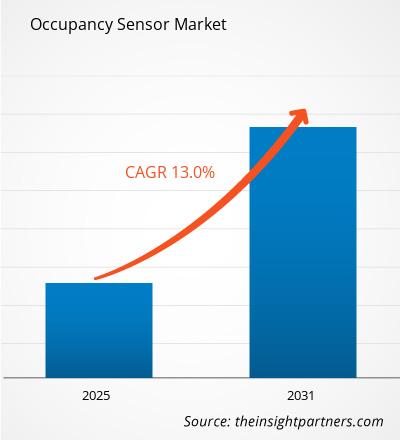
The occupancy Sensor Market growth is driven by rising building automation adoption and increasingly stringent energy efficiency mandates. The market, valued at US$ 2.75 Billion in 2025, is projected to reach US$ 7.69 Billion by 2034, expanding at a CAGR of 13.71% between 2026 and 2034. Growing integration of infrared, ultrasonic, and dual-technology sensors across lighting, HVAC, and security applications reinforces sustained global adoption momentum.
North America is estimated to grow at a CAGR of 13.0-13.5% through 2034, reflecting the occupancy sensor market size expansion driven by stringent building energy codes mandating automatic lighting controls and rising commercial retrofit activity. Growing smart building certification demand further reinforces sustained regional consumption across residential and commercial installation categories.
Occupancy Sensor Market Assessment and Insights
- North America: The region holds an estimated 32-35% share in 2025, growing at a CAGR of 13.0-13.5% between 2026-2034, driven by building energy codes, commercial retrofit activity, and smart building certification programs across regional markets.
- US: The United States represents the majority of regional demand in 2025, expanding at a CAGR of 12.9-13.4% through 2034, backed by strong commercial construction and energy efficiency mandate enforcement.
- Europe: Europe accounts for roughly 24-27% share in 2025 and is projected to grow at a CAGR of 13.2-13.7% through 2034, led by Germany, the UK, and France through building energy performance directives.
- Asia Pacific: Asia Pacific holds an estimated 26-30% share in 2025, expanding at a CAGR of 14.8-15.3% between 2026-2034, led by China, Japan, and India through rapid commercial construction and smart building adoption.
- Largest Segment: The Infrared technology segment holds the largest share at 42-46% in 2025, growing at a CAGR of 13.3-13.8% through 2034, favored for cost efficiency and reliable motion detection performance.
- High Growth Segment: The Wireless connectivity segment registers the fastest growth at a CAGR of 16.5-17.0% through 2034, propelled by simplified installation and expanding retrofit demand across existing building infrastructure.
- Key companies analyzed in detail: Schneider Electric SE, Eaton Corporation plc, Lutron Electronics Co., Inc., Leviton Manufacturing Co., Inc., Johnson Controls International plc, Honeywell International Inc., General Electric Company, Acuity Brands, Inc., Legrand SA, Hubbell Incorporated.
Source: The Insight Partners' analysis based on proprietary research, government publications, company annual reports, investor presentations, industry databases, and expert interviews.
The occupancy sensor market has evolved through successive technology transitions, moving from standalone infrared motion detectors toward dual technology sensors combining infrared and ultrasonic detection for improved accuracy and reduced false triggering. Manufacturers have continually improved wireless connectivity protocols, which have led to compatibility within larger building management systems. The manufacturing processes have increasingly gravitated towards smaller sensor types that allow for installation in different ceiling, wall, and fixture installations for lighting, heating, ventilation, air conditioning (HVAC), and security purposes.
In terms of future trends, manufacturers are forecasted to increase their production levels in newly developed Southeast Asian and Latin American countries, experiencing growth in commercial construction. The development of standards in energy building performance by international energy organizations will further propel the adoption of sensors. Investment in sensor fusion technology, which incorporates occupancy detection alongside air quality monitoring, provides sustainable prospects within building automation systems.
Occupancy Sensor Market Report Scope
| Report Attribute | Details |
|---|---|
| Market size in 2025 | US$ 2.75 Billion |
| Market Size by 2034 | US$ 7.69 Billion |
| Global CAGR (2026 - 2034) | 13.71% |
| Historical Data | 2021-2024 |
| Forecast period | 2026-2034 |
Occupancy Sensor Market Analysis
The drivers of market growth include stringent regulations concerning the use of energy-efficient building systems that compel the use of automatic lighting shut-off in commercial buildings, coupled with increasing HVAC optimization solutions to decrease energy expenditure in unoccupied areas. The value chain consists of sensor component manufacture, printed circuit boards assembly, integration, and distribution through electrical contractors and building automation systems integrators, where sensing efficiency and compatibility of protocols influence cost competitiveness among manufacturers of different tiers.
The supply dynamics are still determined by the sourcing of semiconductor components for PIR motion detectors and wireless communication units, along with the availability of manufacturing capabilities for contract manufacturing companies within various regions of production. Final assembly of the products is localized close to major demand areas to minimize logistics and shorten lead times of installation by electrical contractors.
The market analysis indicates that there is a competitive environment in which the leading lighting control and building automation companies dominate because of their wide distribution channels. Lutron Electronics Co., Inc. and Leviton Manufacturing Co., Inc. have extensive product ranges for lighting controls that include both wired and wireless sensor systems, whereas Schneider Electric SE and Johnson Controls International plc utilize integrated building management systems to incorporate occupancy sensors.
Honeywell International Inc. and Eaton Corporation plc develop integrated sensor solutions for commercial security and surveillance applications, and Acuity Brands, Inc. and Hubbell Incorporated engage in lighting control innovations and regional distribution partnerships. Finally, Legrand SA and General Electric Company increase their competencies in wireless integration to support global customers in smart building automation.
● REPORT CUSTOMIZATION
Tailor This Report To Align With Your Specific Business Requirements
This report can be customized to align precisely with your business objectives, scope, and target markets. Customization options include tailored segmentation, geography, competitive analysis, and strategic insights to support informed decision-making.
Customize This Report →WHAT YOU CAN ADJUST
- ● Segmentations
- ● Geography
- ● Competitive Analysis
- ● Language Preferences
Occupancy Sensor Market: Strategic Insights

Regional Insights
North America Occupancy Sensor Market
North America holds an estimated 32-35% share of the global market in 2025, expanding at a CAGR of 13.0-13.5% through 2034. Growth is anchored by stringent building energy codes mandating automatic lighting controls across commercial construction, alongside rising retrofit activity within aging office and educational facility infrastructure requiring energy efficiency modernization.
Structural drivers include expanding smart building certification program adoption, incentivizing occupancy-based automation investment, alongside growing HVAC optimization demand, and reducing conditioning costs in variable-occupancy commercial spaces. Canada contributes through provincial energy code alignment, while Mexico's expanding commercial construction base, supported by nearshoring trends, adds incremental regional consumption across lighting and security sensor applications.
U.S. Occupancy Sensor Market
The United States accounts for an estimated 80-84% share of the North American market in 2025, growing at a CAGR of 12.9-13.4% through 2034. Strong commercial construction activity, coupled with rigorous energy efficiency mandate enforcement, continues to anchor demand for infrared, ultrasonic, and dual technology sensors across lighting and HVAC applications nationwide.
Lutron Electronics Co., Inc. and Leviton Manufacturing Co., Inc. maintain substantial domestic manufacturing and distribution presence, supporting rapid deployment across commercial retrofit projects. Application trends indicate a rising preference for wireless sensors in retrofit installations, avoiding costly rewiring, while new commercial construction continues to favor wired configurations integrated within comprehensive building automation systems.
Europe Occupancy Sensor Market
Europe commands an estimated 24-27% share of the global occupancy sensor market in 2025, growing at a CAGR of 13.2-13.7% through 2034, with Germany identified as the leading contributor given its stringent building energy performance directive compliance requirements across commercial and residential construction.
Germany represents the region's largest market, driven by building energy performance regulation compliance requiring automated lighting and HVAC control adoption. The UK contributes through commercial retrofit and smart building certification demand, while France, Italy, and Spain register steady demand from energy efficiency renovation programs and new commercial construction projects across expanding regional infrastructure development initiatives.
APAC Occupancy Sensor Market
Asia Pacific leads the global occupancy sensor market with an estimated 26-30% share in 2025, expanding at the fastest regional CAGR of 14.8-15.3% through 2034. China leads, given its extensive commercial construction base, followed by Japan, India, South Korea, and Australia.
Industrial policy support for building energy efficiency, particularly across China and India, alongside Japan's established smart building automation ecosystem, continues driving capacity expansion and adoption of occupancy sensing technology across rapidly growing commercial and residential construction segments region-wide.
Middle East & Africa Occupancy Sensor Market
The Middle East & Africa market is projected to grow at a CAGR of 12.3-12.8% through 2034, with Saudi Arabia leading regional demand through smart infrastructure and energy efficiency initiatives tied to national diversification strategies.
The UAE contributes through commercial building automation and smart city infrastructure projects, while South Africa and the Rest of MEA register gradual uptake driven by expanding commercial construction and energy cost reduction priorities across growing regional business infrastructure investments.
Segmentation Analysis
Technology
The Technology segment of the occupancy sensor market scope encompasses Infrared, Ultrasonic, and Dual Technology categories, collectively growing at a CAGR of 13.6-14.1% between 2026 and 2034. Demand distribution reflects diverging detection accuracy requirements, with dual technology sensors gaining share as commercial customers prioritize reduced false triggering over cost savings associated with single-detection method alternatives.
- Infrared: Infrared sensors dominate cost-sensitive residential and small commercial applications, valued for reliable motion detection and straightforward installation suited to standard lighting control requirements.
- Ultrasonic: Ultrasonic sensors gain preference in spaces with obstructed sightlines, offering superior detection of minimal movement suited to restroom and enclosed office applications requiring sensitive occupancy monitoring.
- Dual Technology: Dual technology sensors combine infrared and ultrasonic detection for improved accuracy, increasingly favored across large open-plan commercial spaces requiring reduced false positive and false negative triggering rates.
Connectivity Type
The Connectivity Type segment records a combined CAGR of 14.5-15.0% between 2026 and 2034, led by wireless adoption across retrofit installations. Wired sensors maintain steady demand within new commercial construction projects, reflecting continued diversification between installation flexibility and integrated system reliability preferences among building owners and contractors.
- Wired: Wired sensors remain preferred for new commercial construction, offering reliable integration within comprehensive building management systems requiring a consistent power supply and centralized control architecture.
- Wireless: Wireless sensors gain rapid traction across retrofit applications, eliminating costly rewiring requirements while enabling flexible sensor placement within existing commercial and residential building infrastructure.
Application
The Application segment, covering Lighting, HVAC, and Security & Surveillance, expands at a CAGR of 13.9-14.4% between 2026 and 2034. Lighting applications maintain a dominant share given widespread energy code adoption, while HVAC and security integration grow steadily through expanding smart building automation investment and comprehensive facility management system adoption.
- Lighting: Lighting control represents the dominant application, driven by widespread energy code mandates requiring automatic shutoff in unoccupied commercial spaces across office, retail, and educational facilities.
- HVAC: HVAC applications leverage occupancy data to optimize conditioning schedules, reducing energy costs in variable-occupancy zones while maintaining comfort standards within commercial building management systems.
- Security & Surveillance: Security applications integrate occupancy sensors within broader surveillance systems, supporting intrusion detection and access monitoring across commercial facilities requiring comprehensive building security infrastructure.
Opportunity Snapshot
| Application | Revenue Contribution | Trend Tag | Adoption Stage |
| Lighting | High | Energy Code Compliance | Mature |
| HVAC | Medium | Zone Optimization | Scaling |
| Security & Surveillance | Medium | Access Monitoring | Scaling |
Occupancy Sensor Market Growth Drivers and Impact Analysis
Tightening Building Energy Codes Mandating Automatic Lighting Controls
More stringent building energy codes in both developed and developing nations are leading to mandatory installation of automatic lighting shutoff systems in commercial premises, driving the use of occupancy sensors. The regulations regarding the energy performance of commercial buildings call for automation systems that limit energy waste by minimizing the lighting usage in empty buildings. This trend is especially true for buildings such as offices, schools, and shopping centers, which are operational for long hours and hence have great potential for energy savings. Non-compliance with these regulations may lead to delays in certification and penalties, encouraging early adoption of occupancy sensors. With increasing compliance with energy codes in developed and developing nations, the requirement for infrared, ultrasonic, and dual technology occupancy sensors in commercial lighting will continue to drive the market growth over the forecast period.
Rising HVAC Energy Optimization Demand Across Commercial Facilities
There is an increasing emphasis on managing HVAC energy usage in commercial buildings with changing occupancy rates, which is driving the need for occupancy sensors incorporated into the automation systems that provide zoned conditioning control. Facility managers are using occupancy information more often to set temperature thresholds in conference rooms, office areas, and other spaces where occupancy is changing over the day. This scenario is especially advantageous for dual-sensor or wireless technologies that can be used effectively in building automation systems. Increased costs of energy in commercial property markets continue to increase the installation of occupancy sensors in support of cost savings efforts. Manufacturers of products that integrate lighting and HVAC control solutions can leverage the growing market potential.
Expanding Smart Building Certification Programs Driving Adoption
Increasing use of smart building certification programs, as well as sustainable building practices certification standards by various bodies involved, is pushing building owners towards full deployment of occupancy sensors to meet certification needs. Real estate developers are increasingly interested in gaining certifications to distinguish themselves with environmentally friendly tenants and investors who value sustainability metrics. Certification-related demand applies to all applications such as lighting, HVAC, and security systems, that need sensor technology as part of their certification. Building management companies are increasingly demanding occupancy sensors to be included in the basic infrastructure of new commercial buildings, trying to gain certifications. The growing trend of sustainability certifications in the commercial real estate sector will keep the demand for occupancy sensors strong for years to come.
Occupancy Sensor Market Future Trends
Integration of Occupancy Sensing with Indoor Air Quality Monitoring
Sensor manufacturers are increasingly combining occupancy detection with indoor air quality monitoring capabilities within unified device platforms, reflecting emerging occupancy sensor market trends toward comprehensive building health monitoring beyond conventional lighting and HVAC control functions. This convergence enables facility managers to correlate occupancy patterns with ventilation requirements, supporting improved indoor environmental quality management. As post-pandemic building health awareness continues influencing commercial real estate priorities, demand for multi-function sensors combining occupancy and air quality detection is expected to increase substantially. This trend is particularly relevant for healthcare and educational facilities requiring comprehensive environmental monitoring, positioning integrated sensors as a differentiated product category among manufacturers targeting health-conscious institutional customers globally.
Growing Adoption of Artificial Intelligence for Occupancy Pattern Analytics
Artificial Intelligence features that allow for predicting occupancy patterns have been introduced into many sensor platforms and extend further the capability of sensors just to detect the presence or absence of people in spaces. With the help of such an innovation, the building management system will be able to predict how the spaces will be used and schedule lighting and HVAC systems based on that prediction, instead of responding reactively to any changes. Many facility managers use occupancy analysis to make space planning decisions and optimize real estate use accordingly.
Occupancy Sensor Market Opportunities
Expansion of Wireless Sensor Retrofit Solutions Across Aging Infrastructure
Growing commercial building retrofit activity across aging office and educational infrastructure presents a significant opportunity for manufacturers developing wireless occupancy sensor solutions, eliminating costly rewiring requirements. Companies expanding wireless product portfolios compatible with diverse building management system protocols can capture growing demand from facility owners pursuing energy efficiency upgrades without extensive construction disruption. This opportunity extends to partnerships with electrical contractors specializing in commercial retrofit installations requiring minimal downtime solutions. Occupancy sensor market forecasts indicate sustained investment interest in wireless retrofit technology will continue strengthening through 2034 as aging commercial building stock across developed markets requires energy efficiency modernization without extensive capital construction investment requirements.
Strategic Investment in Sensor Fusion Technology for Comprehensive Building Automation
Increased utilization of smart building automation provides significant potential for manufacturers who are committed to developing sensor fusion technology that integrates occupant detection alongside other building monitoring tasks, such as lighting and temperature levels. Manufacturers who allocate specific R&D resources to multi-purpose sensor devices will be able to distinguish themselves through the ability to integrate into smart building automation systems. This represents an important area of opportunity for strategic collaboration between sensor manufacturers and building management systems providers looking for a single unit hardware solution. Manufacturers committed to expanding their sensor fusion capabilities with allocated engineering resources to meet the needs of smart buildings stand to grow disproportionately.
Frequently Asked Questions

- Comprehensive Market Sizing and Forecast Analysis
- Detailed Segmentation Analysis
- In-Depth Market Dynamics Assessment
- Regional and Country-Level Insights
- Competitive Landscape and Company Benchmarking
- Strategic Business Intelligence
Recent Reports
Testimonials

The Insight Partners provided valuable market intelligence that supported our global go-to-market strategy. Their team was professional, responsive, and attentive to our feedback, providing thoughtful analysis and helpful methodological clarifications throughout the project.
Junmo Kim Chief Financial Officer (CFO), Enertech Co., Ltd.
The Insight Partners' SCADA System Market report is comprehensive, with valuable insights on current trends and future forecasts. The team was highly professional, responsive, and supportive throughout. We are very satisfied and highly recommend their services.
RAN KEDEM Partner, Reali Technologies LTDs
I requested a report on a very specific software market and the team produced the report in a few days. The information was very relevant and well presented. I then requested some changes and additions to the report. The team was again very responsive and I got the final report in less than a week.
JEAN-HERVE JENN Chairman, Future Analytica
We worked with The Insight Partners for an important market study and forecast. They gave us clear insights into opportunities and risks, which helped shape our plans. Their research was easy to use and based on solid data. It helped us make smart, confident decisions. We highly recommend them.
PIYUSH NAGPAL Sr. Vice President, High Beam Global
The Insight Partners delivered insightful, well-structured market research with strong domain expertise. Their team was professional and responsive throughout. The user-friendly website made accessing industry reports seamless. We highly recommend them for reliable, high-quality research services
YUKIHIKO ADACHI CEO, Deep Blue, LLC.
This is the first time I have purchased a market report from The Insight Partners.While I was unsure at first, I visited their web site and felt more comfortable to take the risk and purchase a market report.I am completely satisfied with the quality of the report and customer service. I had several questions and comments with the initial report, but after a couple of dialogs over email with their analyst I believe I have a report that I can use as input to our strategic planning process.Thank you so much for taking the extra time and making this a positive experience.I will definitely recommend your service to others and you will be my first call when we need further market data.
JOHN SUZUKI President and Chief Executive Officer, Board Director, BK Technologies
I wish to appreciate your support and the professionalism you displayed in the course of attending to my request for information regarding to infectious disease IVD market in Nigeria. I appreciate your patience, your guidance, and the fact that you were willing to offer a discount, which eventually made it possible for us to close a deal. I look forward to engaging The Insight Partners in the future, all thanks to the impression you have created in me as a result of this first encounter.
DR CHIJIOKE ONYIA MANAGING DIRECTOR, PineCrest Healthcare Ltd.Reason to Buy
- Informed Decision-Making
- Understanding Market Dynamics
- Competitive Analysis
- Identifying Emerging Markets
- Customer Insights
- Market Forecasts
- Risk Mitigation
- Boosting Operational Efficiency
- Strategic Planning
- Investment Justification
- Tracking Industry Innovations
- Aligning with Regulatory Trends





 Get Free Sample for