
mmWave 5G Market Trends, Size & Growth by 2034
mmWave 5G Market Size and Forecasts (2021–2034), Global and Regional Share, Trends, and Growth Opportunity Analysis Report Coverage : By Component (Hardware, Solutions, Services), Use Case (eMBB, mMTC, URLLC, FWA), Bandwidth (24GHz to 57GHz, 57GHz to 95GHz, 95GHz to 300GHz), End User (Aerospace and Defense, Telecom, Automotive and Transportation, Public Safety, Media and Entertainment, Others)
- Status : Data Released
- Report Code : TIPRE00039530
- Category : Electronics and Semiconductor
- No. of Pages : 150
- Available Report Formats :


- Last update date : October 13, 2026


2025 Market Size
US$ 3.7 Bn
Base year value
2034 Forecast
US$ 12.16 Bn
Projected by 2034
CAGR 2026-2034
14.15 %
Growth rate
Addressable Market
US$ 68.37 Bn
(2026-2034)
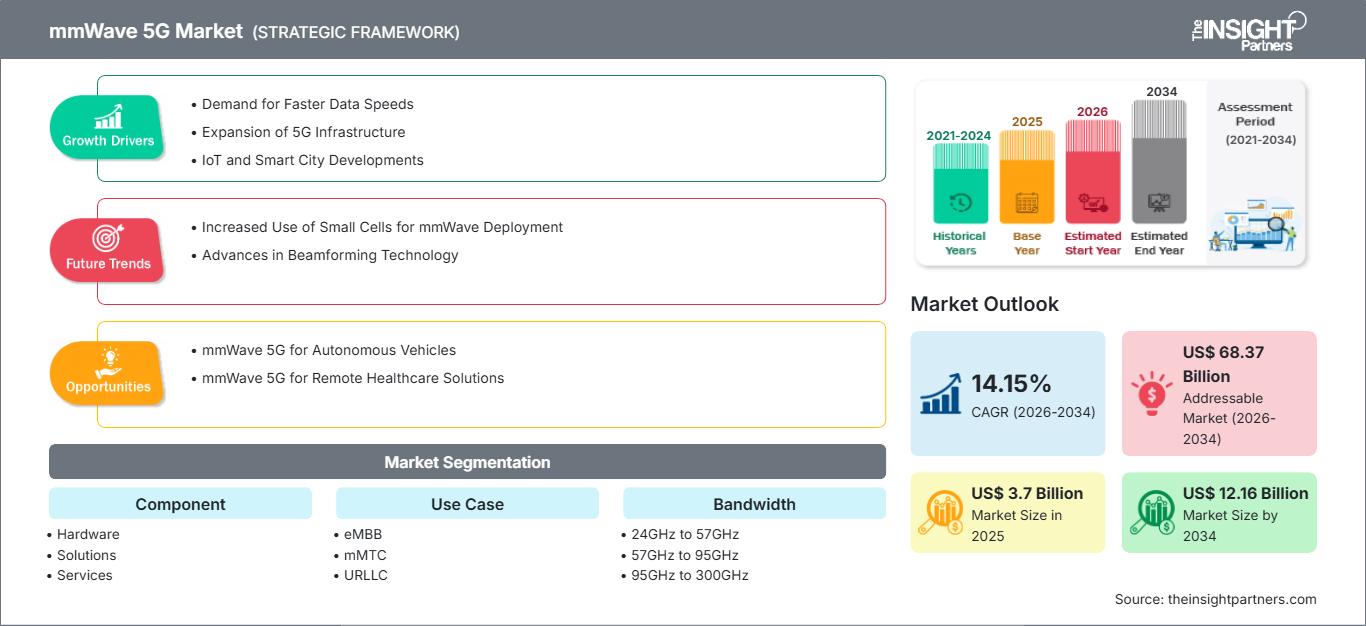
The mmwave 5g market is projected to expand steadily as next-generation wireless infrastructure investments accelerate across developed and emerging economies. The market was valued at US$ 3.7 Billion in 2025 and is projected to reach US$ 12.16 Billion by 2034, registering a CAGR of 14.15% during 2026–2034. Continued deployment of high-capacity spectrum, increasing enterprise digitalization, and expanding network densification are reinforcing long-term commercial opportunities across multiple industry verticals.
Across North America, telecom operators continue to prioritize dense urban deployments, private wireless networks, and advanced spectrum utilization to improve capacity and latency. The mmwave 5g market size in the region is supported by strong investments in Open RAN architecture, extensive fiber backhaul, and favorable spectrum policies. Regional demand is anticipated to advance at an estimated CAGR of 13.2–14.4% through 2034 as enterprise connectivity and fixed wireless access applications expand.
mmWave 5G Market Assessment and Insights
- North America: Accounted for 34–38% Share in 2025 and is expected to expand at a CAGR between 13.2–14.4% during 2026–2034. Mature telecommunications infrastructure, rapid enterprise adoption, and strong operator investments continue supporting regional leadership.
- US: Represented nearly 78–82% of the North American market in 2025 and is projected to record a CAGR between 13.4–14.6% during 2026–2034, supported by nationwide spectrum utilization, private 5G deployments, and advanced semiconductor innovation.
- Europe: Held approximately 24–28% Share in 2025 and is forecast to grow at a CAGR between 12.8–14.0% during 2026–2034. Germany, the UK, and France remain major contributors owing to industrial automation, smart mobility, and manufacturing digitization initiatives.
- Asia Pacific: Captured around 28–32% Share in 2025 and is expected to register a CAGR between 15.1–16.3% during 2026–2034. China, Japan, South Korea, and India continue investing heavily in nationwide 5G infrastructure and advanced wireless ecosystems.
- Largest Segment: Hardware accounted for approximately 56–60% market share in 2025 and is anticipated to expand at a CAGR between 13.4–14.6% during 2026–2034, supported by increasing deployment of antennas, chipsets, radios, and network equipment.
- High Growth Segment: Fixed Wireless Access (FWA) represented approximately 18–22% market share in 2025 and is expected to grow at a CAGR between 17.2–18.6% during 2026–2034, driven by broadband expansion and last-mile connectivity investments.
- Key companies analyzed in detail: NXP Semiconductors N.V., Airspan Networks Holdings LLC, AT&T Inc., Fastweb S.p.A., SoftBank Corp., Corning Incorporated, Nokia Corporation, Mavenir Systems, Inc., NTT DOCOMO, INC., Advanced Micro Devices, Inc. (AMD), Huawei Technologies Co., Ltd., Qualcomm Incorporated, Ericsson AB.
Source: The Insight Partners' analysis based on proprietary research, government publications, company annual reports, investor presentations, industry databases, and expert interviews.
The rapid commercialization of millimeter wave communication has caused the wireless ecosystem to move from pilot implementations to full-fledged network transformation initiatives. Constant advancements in beamforming techniques, sophisticated antenna systems, cloud native radio access networks, and semiconductor integration have increased the efficiency of the network, in terms of coverage, while making deployment simpler. Increasing collaboration between equipment providers and telecommunication companies is causing the ecosystem to become more interoperable, resulting in enterprise-grade connectivity for various industries, including manufacturing, healthcare, transport, and smart cities.
Future expansion of the mmWave 5G Market is expected to be supported by increasing spectrum harmonization, industrial digital transformation, and public-sector investments in intelligent infrastructure. Increasingly, developing nations are making use of high-frequency spectrum in favor of commercial players and promoting local production capacity for sophisticated communication devices. Regulatory measures that are designed to promote wireless facilities, together with growing expenditures on connected mobility, automated industry, and defense upgrading, will likely fuel future innovation within the worldwide wireless environment.
mmWave 5G Market Report Scope
| Report Attribute | Details |
|---|---|
| Market size in 2025 | US$ 3.7 Billion |
| Market Size by 2034 | US$ 12.16 Billion |
| Global CAGR (2026 - 2034) | 14.15% |
| Historical Data | 2021-2024 |
| Forecast period | 2026-2034 |
mmWave 5G Market Analysis
Growing enterprise demand for ultra-low latency communications, high-capacity mobile broadband, and industrial automation continues to accelerate mmwave 5g market growth worldwide. Telecom operators are now relying on dense small-cell systems to ensure effective use of spectrum in urban settings to enable the use of bandwidth-consuming services like augmented reality, autonomous vehicles, and robotics.
Continuing evolution of the value chain is ensured by close cooperation between semiconductor companies, infrastructure equipment providers, optical fiber suppliers, software developers, and telecom operators. Growing investments in advanced radio devices, edge computing technologies, and cloud-native core networks boost the resilience of the ecosystem and shorten the deployment process. With supply chains becoming more regionalized, manufacturers place a premium on diversification of supply sources and localization of production facilities.
Competitive differentiation within the mmwave 5g market analysis increasingly depends on technological innovation, strategic partnerships, and integrated portfolio capabilities rather than hardware performance alone. Nokia Corporation, Ericsson AB, Qualcomm Incorporated, Huawei Technologies Co., Ltd., and Mavenir Systems, Inc. continue expanding software-defined networking capabilities, while NXP Semiconductors N.V. and Advanced Micro Devices, Inc. strengthen semiconductor performance through higher integration and energy-efficient architectures. Telecom operators, including AT&T Inc., SoftBank Corp., Fastweb S.p.A., and NTT DOCOMO, INC. continue collaborating with equipment vendors to accelerate commercial deployments across enterprise and consumer applications.
Investment momentum stays high as governments and private institutions emphasize the need to modernize digital infrastructure. Investment funds are getting directed more towards Open RAN software, intelligent network orchestration, private wireless systems, and sophisticated radio technologies for the purposes of digitalizing industries. Corning Incorporated is moving ahead with its fiber solutions that enable network densification, and Airspan Networks Holdings LLC is concentrating on flexible radio access infrastructure.
● REPORT CUSTOMIZATION
Tailor This Report To Align With Your Specific Business Requirements
This report can be customized to align precisely with your business objectives, scope, and target markets. Customization options include tailored segmentation, geography, competitive analysis, and strategic insights to support informed decision-making.
Customize This Report →WHAT YOU CAN ADJUST
- ● Segmentations
- ● Geography
- ● Competitive Analysis
- ● Language Preferences
mmWave 5G Market: Strategic Insights
Regional Insights
North America mmwave 5g market
North America remained the leading regional marketplace in 2025, accounting for 34–38% of global revenue, supported by widespread spectrum commercialization, advanced telecommunications infrastructure, and continuous investment in next-generation wireless connectivity. The mmwave 5g market share in the region continues to benefit from dense urban deployments, rapid enterprise adoption, and increasing use of private wireless networks across manufacturing, logistics, healthcare, and defense. Regulatory agencies continue allocating additional high-frequency spectrum, enabling operators to improve network capacity and deliver ultra-low latency services for data-intensive applications.
Strong collaboration between network operators, semiconductor companies, cloud providers, and infrastructure vendors continues to strengthen regional competitiveness. Fixed wireless access, smart transportation, industrial automation, and immersive digital experiences remain major adoption areas, while ongoing Open RAN deployments improve infrastructure flexibility. Public investment in broadband modernization and increasing enterprise digital transformation initiatives is expected to support a regional CAGR of 13.2–14.4% during 2026–2034, ensuring sustained infrastructure expansion and technological innovation throughout the forecast period.
U.S. mmwave 5g Market
The United States represented approximately 78–82% of the North American mmwave 5g market in 2025, making it the dominant national market within the region. Commercial operators continue expanding millimeter-wave coverage across metropolitan areas while increasing deployment of private wireless networks supporting manufacturing, healthcare, airports, ports, and smart campuses. Extensive availability of high-frequency spectrum and strong collaboration between equipment manufacturers and network providers continue to accelerate infrastructure investments across both public and private sectors.
Growing enterprise demand for ultra-reliable low-latency communications, edge computing, and AI-enabled network management is creating new commercial opportunities across industries. Major technology developers continue investing in advanced chipsets, intelligent radio platforms, and cloud-native network architectures to improve operational efficiency. Supported by favorable regulatory initiatives and sustained telecommunications expenditure, the U.S. market is projected to expand at a CAGR of 13.4–14.6% during 2026–2034, maintaining its leadership position within North America.
Europe mmwave 5g Market
Europe accounted for approximately 24–28% of global mmwave 5g market revenue in 2025 and continues benefiting from coordinated digital infrastructure policies, industrial modernization programs, and increasing investments in intelligent manufacturing. With regard to regional leadership, Germany will stay ahead with its superior automotive production capacity, Industry 4.0 technologies, and private wireless implementations for advanced manufacturing facilities. The UK is also working on enhancing its commercial 5G rollout and is promoting innovation in healthcare, banking, and transport sectors.
Countries such as France, Italy, and Spain are ramping up their investments in national connectivity, intelligent mobility, and digital public infrastructure. Businesses operating in these countries are implementing private wireless networks to boost operational effectiveness and automation capabilities. The European market is expected to register a CAGR of 12.8–14.0% during 2026–2034, with Germany remaining the largest national contributor throughout the forecast period.
APAC mmwave 5g Market
Asia Pacific captured approximately 28–32% of the global mmwave 5g market in 2025, supported by aggressive telecommunications investments, expanding semiconductor manufacturing, and rapid urban digitalization. China leads regional deployments, while Japan, South Korea, India, and Australia continue strengthening commercial network infrastructure through public and private investment initiatives.
Government-backed digital transformation strategies, expanding industrial automation, and increasing consumer demand for high-speed connectivity are expected to drive a regional CAGR of 15.1–16.3% during 2026–2034. China is expected to remain the leading country due to large-scale infrastructure deployment and advanced manufacturing capabilities.
Middle East & Africa mmwave 5g Market
The Middle East & Africa mmwave 5g market is witnessing gradual commercialization as governments prioritize digital economies, smart city initiatives, and advanced telecommunications infrastructure. Saudi Arabia and the United Arab Emirates remain leading adopters, while South Africa continues expanding commercial wireless investments alongside broader digital infrastructure modernization efforts.
Energy sector digitalization, industrial diversification, and increasing public investments in intelligent transportation systems continue to create favorable conditions for next-generation connectivity. The regional market is anticipated to expand at a CAGR of 12.4–13.6% during 2026–2034, with Gulf Cooperation Council countries expected to remain the principal contributors.
Segmentation Analysis
Component
The Component segment of the mmwave 5g market forms the technological foundation of the industry by combining physical infrastructure, software capabilities, and lifecycle support services. Continuous deployment of advanced wireless infrastructure, increasing enterprise digital transformation, and ongoing operator investments are strengthening demand across all component categories. The market scope continues expanding as integrated hardware and software ecosystems improve network efficiency, scalability, and operational performance. The overall Component segment is projected to grow at a CAGR of 13.9–14.8% during 2026–2034.
- Hardware – Hardware represents the largest revenue contributor owing to widespread deployment of base stations, antennas, RF modules, chipsets, and network equipment supporting high-capacity wireless communications across commercial and industrial environments.
- Solutions – Solutions include network management platforms, Open RAN software, virtualization technologies, analytics platforms, and security applications that improve network optimization, automation, and operational intelligence for telecom operators and enterprises.
- Services – Services encompass consulting, deployment, integration, maintenance, optimization, and managed services that help operators accelerate commercialization while improving long-term operational efficiency and infrastructure reliability.
Use Case
The Use Case segment of the mmwave 5g market reflects the expanding application landscape for advanced wireless communications across consumer, enterprise, and industrial environments. Increasing demand for ultra-high bandwidth, low latency, and reliable connectivity continues to encourage adoption across multiple communication scenarios. Continuous innovation in spectrum utilization and network virtualization supports sustained market expansion. The overall Use Case segment is expected to register a CAGR of 14.5–15.4% during 2026–2034.
- eMBB – Enhanced Mobile Broadband remains the primary commercial application by enabling high-speed connectivity for video streaming, immersive reality, cloud gaming, enterprise collaboration, and bandwidth-intensive mobile applications.
- mMTC – Massive Machine Type Communications supports large-scale Internet of Things deployments across utilities, manufacturing, agriculture, logistics, and smart city infrastructure through efficient connectivity for millions of connected devices.
- URLLC – Ultra-Reliable Low-Latency Communications enables mission-critical industrial automation, autonomous mobility, healthcare systems, and defense applications where reliability and near real-time responsiveness remain essential operational requirements.
- FWA – Fixed Wireless Access is rapidly expanding broadband availability by delivering high-speed connectivity to residential, enterprise, and underserved locations without requiring extensive wired network deployment.
Bandwidth
Bandwidth segmentation of the mmwave 5g market reflects the industry's increasing emphasis on optimizing spectrum utilization according to application requirements, deployment density, and performance objectives. Higher-frequency bands continue supporting greater throughput and lower latency, while technological improvements enhance propagation efficiency and commercial viability. The Bandwidth segment is anticipated to grow at a CAGR of 14.2–15.1% during 2026–2034.
- 24GHz to 57GHz – This frequency range supports early commercial deployments because it provides an effective balance between network coverage, capacity, equipment maturity, and infrastructure economics across urban environments.
- 57GHz to 95GHz – Increasing adoption within enterprise networks, industrial campuses, and specialized communications applications is driving demand for this spectrum range as equipment ecosystems continue maturing globally.
- 95GHz to 300GHz – Higher-frequency deployments remain at an emerging commercialization stage, offering substantial long-term opportunities for future ultra-high-capacity communications, advanced sensing technologies, and research-driven innovation.
End User
End-user demand continues to diversify as digital transformation accelerates across public and private sectors. Telecommunications operators remain the primary adopters, while transportation, defense, media, and industrial organizations increasingly invest in advanced wireless infrastructure to improve operational efficiency, automation, and service delivery. The End User segment is projected to expand at a CAGR of 14.8–15.7% during 2026–2034.
- Aerospace and Defense – Defense modernization, secure communications, intelligent surveillance, and mission-critical connectivity continue to support adoption across military operations, aviation infrastructure, and aerospace applications.
- Telecom – Telecom operators remain the largest commercial users through nationwide infrastructure deployment, network modernization, and continuous expansion of consumer and enterprise wireless services.
- Automotive and Transportation – Connected vehicles, intelligent transportation systems, autonomous mobility, and smart logistics continue creating substantial opportunities for advanced wireless communications throughout transportation ecosystems.
- Public Safety – Emergency response agencies increasingly utilize resilient, low-latency wireless infrastructure to improve disaster management, incident coordination, and secure communications during critical operations.
- Media and Entertainment – Broadcasters, event organizers, immersive media providers, and digital content companies increasingly adopt high-capacity wireless connectivity to support ultra-high-definition content production and real-time media distribution.
Opportunity Snapshot
| End User | Revenue Contribution | Trend Tag | Adoption Stage |
|---|---|---|---|
| Aerospace and Defense | Medium | Secure Networks | Scaling |
| Telecom | High | Open RAN | Mature |
| Automotive and Transportation | High | Connected Mobility | Scaling |
| Public Safety | Medium | Mission Critical | Scaling |
| Media and Entertainment | Medium | Immersive Media | Emerging |
mmWave 5G Market Growth Drivers and Impact Analysis
Expansion of Fixed Wireless Access and High-Capacity Broadband Networks
The fast-growing adoption of fixed wireless access services is emerging as one of the most potent drivers of industry growth, with telecom companies opting for cost-efficient solutions to deploying fiber-optic networks in cities, suburban, and underserved locations. With high-frequency spectrum, there is an availability of higher bandwidths, which are ideal for providing gigabit broadband connections to both residences and businesses. Telecom companies are increasingly using millimeter wave spectrum along with beamforming technology, network slicing, and cloud-based networks to ensure reliable services while cutting down on deployment timeframes. Governments are, at the same time, supporting the growth of broadband by way of digital infrastructure initiatives that aim to provide universal broadband access. Radio and small cell equipment providers are continuously developing more efficient radio systems that minimize costs associated with the deployment of the network.
Growing Enterprise Digital Transformation and Industrial Automation
Further development of enterprise digital transformation continues to create substantial demand for ultra-low latency and highly capacity wireless connectivity, which would be able to facilitate mission-critical industrial operations. Industrial facilities, logistics operations, airports, energy utilities, and mines implement private wireless networks in order to increase operational visibility, automate processes, and ensure employees’ safety. Implementation of artificial intelligence, industrial IoT platforms, robots, and edge computing makes this demand stronger. Organizations start to replace their outdated wireless infrastructure with scalable solutions that could support thousands of connected devices and operate with a constant performance level. Growing use of digital twins, predictive maintenance platforms, autonomous guided vehicles, and machine vision opens up additional commercial perspectives. With industrial enterprises continuing to focus on productivity, resilience, and operational flexibility, advanced wireless infrastructure investments will keep driving market growth for many years.
Continuous Innovation in Semiconductor and Radio Access Technologies
Technological innovations in semiconductors, radio frequency technologies, and intelligent antennas have significantly boosted commercial deployment. The manufacturers of semiconductors are coming up with highly integrated radio frequency front-end modules, complex SoCs, and power-saving processors, which increase the efficiency and decrease the size of devices. At the same time, the companies dealing with infrastructure are advancing beamforming algorithms, massive MIMO, and software-defined networking platforms to increase efficiency and make efficient use of spectrum. The adoption of Open RAN is fostering collaboration among the vendors of equipment, making the ecosystem more competitive and innovative. Research and development investment leads to further advancements in network automation, intelligent traffic management, and cybersecurity. All this makes the deployment of scalable networks easier and allows for applications demanding reliable and high-bandwidth wireless communications.
mmWave 5G Market Future Trends
Artificial Intelligence Transforming Autonomous Network Operations
Artificial intelligence is expected to become a defining element of next-generation wireless infrastructure by enabling autonomous network optimization, predictive maintenance, intelligent spectrum allocation, and dynamic traffic management. The mmwave 5g market trends increasingly reflect the integration of AI-driven orchestration platforms capable of continuously monitoring network performance and automatically adjusting resources according to changing traffic patterns. Telecom operators are expected to expand investments in self-healing networks, AI-assisted security monitoring, and digital twin technologies to improve operational efficiency while reducing operating expenses. As enterprise applications become increasingly complex, intelligent automation will strengthen service reliability and accelerate commercial adoption across manufacturing, transportation, healthcare, and smart city ecosystems.
Convergence of Edge Computing with Advanced Wireless Infrastructure
The combination of edge computing and high-frequency wireless networking technology is anticipated to grow together as one entity, which allows real-time processing of data in latency-sensitive application cases. Distribution of computing power close to the consumers will allow increasing application response time while decreasing the reliance on cloud technology. Companies will start using localized edge computing to implement autonomous manufacturing, connected cars, virtual reality, telemedicine, and advanced surveillance systems. Cooperation between cloud computing suppliers, semiconductor firms, telecom companies, and infrastructure vendors will help develop a highly scalable ecosystem that can meet future requirements for digital transformations.
mmWave 5G Market Opportunities
Expansion of Private Wireless Networks Across Industrial Verticals
Growing enterprise investment in dedicated wireless infrastructure presents one of the most attractive long-term opportunities for technology providers, network operators, and infrastructure vendors. Manufacturing facilities, ports, airports, mining operations, healthcare campuses, and logistics centers increasingly require secure, low-latency, and high-capacity communications to support automation, robotics, and connected assets. The mmwave 5g market forecasts indicate that industrial digital transformation initiatives will continue accelerating demand for customized private network deployments. Vendors capable of integrating edge computing, artificial intelligence, cybersecurity, and cloud-native management platforms into comprehensive enterprise solutions are expected to strengthen their competitive positioning. Strategic partnerships between telecommunications operators, industrial equipment manufacturers, and software providers will further expand commercial opportunities while enabling customers to achieve higher productivity, improved operational resilience, and scalable digital infrastructure capable of supporting next-generation industrial applications.
Next-Generation Smart Cities and Connected Transportation Ecosystems
The increasing investment in intelligent transport systems, smart city infrastructure, and digital public services is generating significant opportunities for participants in the ecosystem. Municipal administrations are becoming more and more dependent on the availability of robust wireless connections to enable connected intersections, autonomous mobility, intelligent surveillance systems, emergency response systems, and public broadband services. Telecom operators, semiconductor companies, and infrastructure providers are well equipped to provide robust connectivity solutions for such complex urban environments. The expansion of advanced traffic management systems, environmental sensing systems, and public safety digital solutions will increase the need for wireless infrastructure to deal with large amounts of data. Companies that offer integrated platforms with robust communication, analytics, edge computing, and networking solutions are likely to benefit from infrastructure modernization initiatives of the public sector.
Frequently Asked Questions

- Comprehensive Market Sizing and Forecast Analysis
- Detailed Segmentation Analysis
- In-Depth Market Dynamics Assessment
- Regional and Country-Level Insights
- Competitive Landscape and Company Benchmarking
- Strategic Business Intelligence
Recent Reports
Testimonials

The Insight Partners provided valuable market intelligence that supported our global go-to-market strategy. Their team was professional, responsive, and attentive to our feedback, providing thoughtful analysis and helpful methodological clarifications throughout the project.
Junmo Kim Chief Financial Officer (CFO), Enertech Co., Ltd.
The Insight Partners' SCADA System Market report is comprehensive, with valuable insights on current trends and future forecasts. The team was highly professional, responsive, and supportive throughout. We are very satisfied and highly recommend their services.
RAN KEDEM Partner, Reali Technologies LTDs
I requested a report on a very specific software market and the team produced the report in a few days. The information was very relevant and well presented. I then requested some changes and additions to the report. The team was again very responsive and I got the final report in less than a week.
JEAN-HERVE JENN Chairman, Future Analytica
We worked with The Insight Partners for an important market study and forecast. They gave us clear insights into opportunities and risks, which helped shape our plans. Their research was easy to use and based on solid data. It helped us make smart, confident decisions. We highly recommend them.
PIYUSH NAGPAL Sr. Vice President, High Beam Global
The Insight Partners delivered insightful, well-structured market research with strong domain expertise. Their team was professional and responsive throughout. The user-friendly website made accessing industry reports seamless. We highly recommend them for reliable, high-quality research services
YUKIHIKO ADACHI CEO, Deep Blue, LLC.
This is the first time I have purchased a market report from The Insight Partners.While I was unsure at first, I visited their web site and felt more comfortable to take the risk and purchase a market report.I am completely satisfied with the quality of the report and customer service. I had several questions and comments with the initial report, but after a couple of dialogs over email with their analyst I believe I have a report that I can use as input to our strategic planning process.Thank you so much for taking the extra time and making this a positive experience.I will definitely recommend your service to others and you will be my first call when we need further market data.
JOHN SUZUKI President and Chief Executive Officer, Board Director, BK Technologies
I wish to appreciate your support and the professionalism you displayed in the course of attending to my request for information regarding to infectious disease IVD market in Nigeria. I appreciate your patience, your guidance, and the fact that you were willing to offer a discount, which eventually made it possible for us to close a deal. I look forward to engaging The Insight Partners in the future, all thanks to the impression you have created in me as a result of this first encounter.
DR CHIJIOKE ONYIA MANAGING DIRECTOR, PineCrest Healthcare Ltd.Reason to Buy
- Informed Decision-Making
- Understanding Market Dynamics
- Competitive Analysis
- Identifying Emerging Markets
- Customer Insights
- Market Forecasts
- Risk Mitigation
- Boosting Operational Efficiency
- Strategic Planning
- Investment Justification
- Tracking Industry Innovations
- Aligning with Regulatory Trends





 Get Free Sample for