
Laptop Market Size, Growth & Trends by 2034
Coverage: By Type (Traditional Laptop, 2-in-1 Laptop); RAM Size (Upto 8 GB, 8 GB - 16 GB, Above 16 GB); Price Range (Low, Mid, High); End-user (Personal, Business, Gaming), and Geography (North America, Europe, Asia Pacific, and South and Central America)
- Status : Data Released
- Report Code : TIPRE00014535
- Category : Electronics and Semiconductor
- No. of Pages : 150
- Available Report Formats :


- Last update date : October 22, 2026


2025 Market Size
US$ 113.41 Bn
Base year value
2034 Forecast
US$ 176.97 Bn
Projected by 2034
CAGR 2026-2034
5.07 %
Growth rate
Addressable Market
US$ 1,317.72 Bn
(2026-2034)
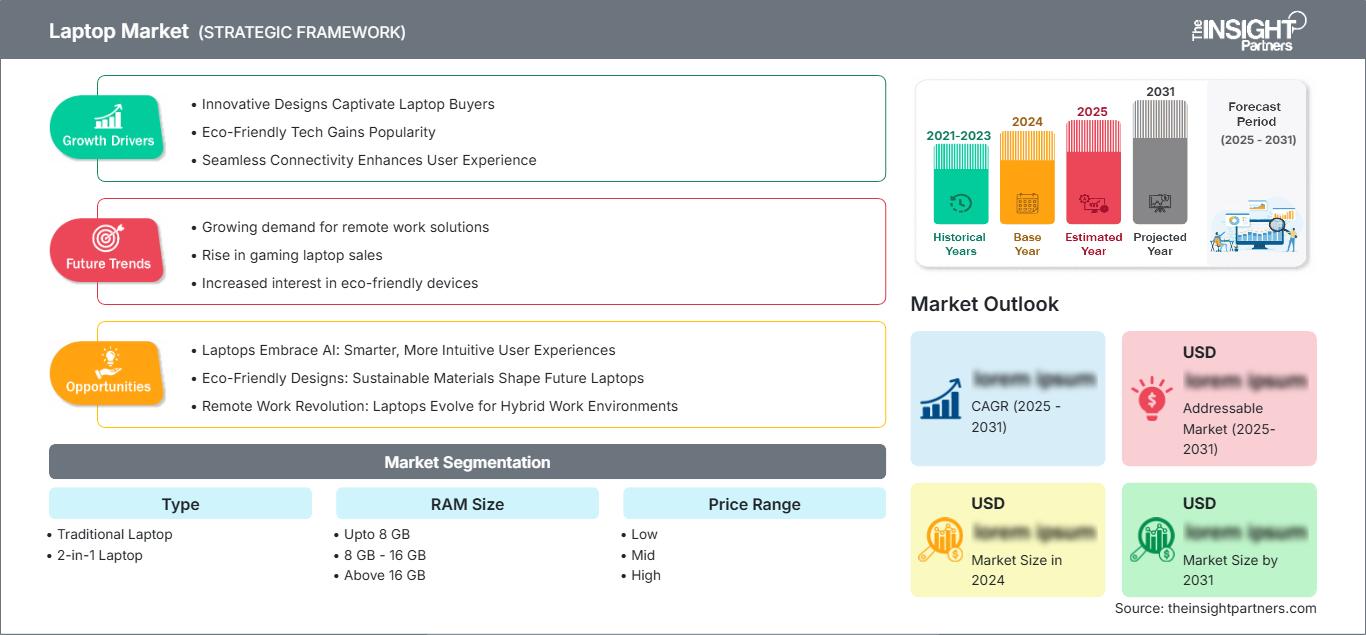
The Laptop Market stands at US$ 113.41 Billion in 2025 and is projected to reach US$ 176.97 Billion by 2034, registering a CAGR of 5.07% during 2026–2034. The demand covers conventional and convertible computing platforms, where factors such as memory, cost, mobility, speed, life cycles, and enterprise digitalization are critical in dictating the requirements for products.
North American demand for the product is estimated to grow at a forecast CAGR of 4.6–5.4% until 2034, driven by enterprise refresh cycles, hybrid work, high-performance computing, and replacement needs. The Laptop Market size for laptops is also dictated by AI-based workload applications, cloud collaboration, security considerations, and buying policies that require devices with extended lifespans and high energy efficiency.
Laptop Market Assessment and Insights
- North America: The region represented a 28–32% share in 2025 and is projected to expand at a CAGR of 4.6–5.4% between 2026–2034, supported by enterprise refresh cycles, premium devices, cloud workloads, and strong replacement demand.
- US: The US accounted for 65–70% of North American demand in 2025 and is expected to grow at a CAGR of 4.5–5.2% between 2026–2034, supported by business computing and consumer upgrades.
- Europe: Europe held a 22–26% share in 2025 and is forecast to grow at a CAGR of 4.2–5.0% between 2026–2034. Germany, the UK, France, Italy, and Spain support demand through enterprise modernization, education digitization, and sustainability-led procurement.
- Asia Pacific: Asia Pacific represented a 34–39% share in 2025 and is expected to register a CAGR of 5.8–6.8% between 2026–2034. China, Japan, South Korea, and India remain important production, technology, and consumption centers.
- Largest Segment: Traditional Laptop held a 72–76% market share in 2025 and is expected to expand at a CAGR of 4.4–5.0%, supported by established enterprise and personal computing requirements.
- High Growth Segment: 2-in-1 Laptop represented a 24–28% market share in 2025 and is projected to grow at a CAGR of 7.0–8.2%, driven by portability and flexible productivity.
- Key companies analyzed in detail: Acer Inc., Apple Inc., ASUSTeK Computer Inc., Dell Technologies Inc., HP Inc., Lenovo Group Limited, Microsoft Corporation, Micro-Star International Co., Ltd. (MSI), Razer Inc., Samsung Electronics Co., Ltd.
Source: The Insight Partners' analysis based on proprietary research, government publications, company annual reports, investor presentations, industry databases, and expert interviews.
Product development trends are becoming more defined by processor efficiency, artificial intelligence capabilities, thin frames, enhanced displays, and increased connectivity speeds. Companies are shifting their engineering focus to brain power, heat dissipation, increased battery life, and weight reduction while continuing to make compatible devices that work with existing operating systems. Manufacturing will continue to be based out of Asian electronics manufacturing ecosystems, even though the final manufacturing and logistics have become more diverse to cope with transportation, tariff issues, and component availability.
During the forecast period, developing countries are going to increase their significance as products become more affordable and educational uses, small business adoption, and collaboration become more prevalent. The focus of investments is predicted to be on AI capable architectures, efficient processors, increased memory speed, and designs that allow for repairability. Regulatory pressures towards energy usage, electronic waste, product durability, and supply chain transparency may increase in importance.
Laptop Market Report Scope
| Report Attribute | Details |
|---|---|
| Market size in 2025 | US$ 113.41 Billion |
| Market Size by 2034 | US$ 176.97 Billion |
| Global CAGR (2026 - 2034) | 5.07% |
| Historical Data | 2021-2024 |
| Forecast period | 2026-2034 |
Laptop Market Analysis
Demand is driven by replacement needs, expansion of digital workflows, hybrid working models, online education, gaming, content generation, and increased adoption of locally-run AI programs. The Laptop Market growth is thus driven by not only replacement of existing units but also higher average unit selling prices through premium processors, high-end memory, high quality screens and special graphics cards. The value chain involves semiconductors, memory and storage providers, screen-makers, original equipment manufacturers, OS suppliers, distribution partners and enterprise buying centers.
Supply factors are vulnerable to availability of semiconductors, display panels, memory pricing, battery components, logistics costs, and exchange rates fluctuations. Original equipment manufacturers are also increasingly using standard platforms for a number of products to simplify the development process and procurement leverage. Channel inventories are important as frequent releases of new processors may lead to shorter product life cycle.
Positioning is becoming increasingly important through differentiated processors, design, power management, ecosystems, services, and software. Analysis of the laptop market report reveals that Apple Inc. positions itself with vertically integrated hardware and software, whereas Lenovo Group Limited, HP Inc., Dell Technologies Inc., and Acer Inc. position themselves with diversified product lines that cater both for commercial and consumer categories. ASUS Tek Computer Inc., Micro-Star International Co., Ltd. (MSI), and Razer Inc. position their laptops for gaming, creators, and performance users.
These sectors of investment now include AI laptop computers, cooling solutions, processors, displays, and management of devices. Microsoft Corporation influences the ecosystem through its need for Windows operating systems and artificial intelligence, while Samsung Electronics Co., Ltd. comes into the ecosystem through portable computing, displays, components, and devices integration. This implies that competitive intensity will not just be affected by hardware specifications but also by the degree of distribution scale, compatibility of ecosystems, after sales support, channel management, and launch coordination with processor generations.
● REPORT CUSTOMIZATION
Tailor This Report To Align With Your Specific Business Requirements
This report can be customized to align precisely with your business objectives, scope, and target markets. Customization options include tailored segmentation, geography, competitive analysis, and strategic insights to support informed decision-making.
Customize This Report →WHAT YOU CAN ADJUST
- ● Segmentations
- ● Geography
- ● Competitive Analysis
- ● Language Preferences
Laptop Market: Strategic Insights
Regional Insights
North America Laptop Market
North America was 28-32% Laptop Market share in 2025 and is forecast to grow at a CAGR of 4.6-5.4% till 2034. Device refresh programs are critical since enterprises need secured devices that can run cloud applications, video collaboration solutions, security, and artificial intelligence solutions to help them improve their productivity. The purchasing power of households is also helping premium configurations gain traction.
North America enjoys its matured retail footprint, enterprise purchase programs, high gaming, and creation notebook demand. Canada helps the region with education, professional services, and SMBs, whereas the US continues to be the main consumer center. Total cost of ownership, warranty coverage, processor efficacy, and software ecosystem compatibility influence buying decisions more often these days.
U.S. Laptop Market
The US comprised 65–70% of North American demand in 2025 and is projected to exhibit a CAGR of 4.5–5.2% up to 2034. Enterprise spending is critical in areas of technology, finance, health care, education, professional services, and government-related establishments. The replacement programs consider factors such as security, manageability, battery life, and AI processing capacity.
Leading vendors include Apple Inc., Dell Technologies Inc., HP Inc., Lenovo Group Ltd., Acer Inc., Microsoft Corp. et al. Consumers look for slim and premium laptops, while companies require management throughout the lifecycle and management of their fleets. Gaming sub-segment makes for an additional premium market owing to graphics cards, high refresh rate, efficient cooling, and portability.
Europe Laptop Market
Europe had a market share of 22-26% in 2025 and is expected to register a growth rate of CAGR of 4.2-5.0% till 2034, with Germany having strong prospects as a market. The trend shows that procurement takes into account energy efficiency, longevity, data protection, and lifecycle issues.
The UK continues to be an important commercial as well as consumer market with demand driven by hybrid working model, education, professional services, and technology intensive industries. Enterprise buyers show preference for standardizing fleets, warranties and device management. Consumer purchases continue to vary from basic notebooks to premium ultralight systems and gaming systems.
Germany has its potential in the areas of industrial digitization, enterprise computing, education, and engineering uses. The buyer is concerned about reliability, service, security, and productivity performance. France enjoys potential because of its digital transformation efforts in public sector, education technologies, enterprise modernization, and consumer replacement cycle. Italy and Spain have their potential through SMEs, households, tourism, education, and creative uses, affordability still playing its part in basic models.
APAC Laptop Market
The Asia-Pacific region comprised the highest market share of 34-39% in 2025 and is expected to record a CAGR of 5.8-6.8% from 2025 to 2034, and will emerge as the dominant regional market. The region encompasses high consumption levels and well-established electronics manufacturing capacity in China, Japan, South Korea, India, and Australia.
China remains relevant in the production and consumption of electronics. On the other hand, Japan and South Korea create an environment for high-end electronics. Digital learning, modernization of firms and increased use of technology have resulted in growth in the Indian market. The market in Australia is boosted by learning institutions and consumer replacements.
Middle East & Africa Laptop Market
It is predicted that the demand from the Middle East and Africa will increase by 6.0% to 7.0% per annum until 2034. The Middle Eastern countries which lead in this region are Saudi Arabia and UAE as the use of notebooks is driven by digital transformation, education, business technologies and smart cities.
South Africa remains an important player in Africa for similar reasons including education, finance, business computerization and consumer demand. Other countries from MEA region are price sensitive, but better connectivity makes way for new opportunities. Saving energy, product reliability, financing and logistics become more important in replacement-driven regions.
Segmentation Analysis
Type
Type segmentation remains strategically important because traditional notebooks serve established productivity requirements while convertible formats address portability and multi-mode usage. Traditional Laptop is projected to grow at a CAGR of 4.4–5.0% between 2026–2034, while 2-in-1 Laptop is expected to register 7.0–8.2%. Laptop Market scope therefore increasingly includes both standardized business devices and flexible consumer-oriented designs.
- Traditional Laptop: Traditional models retain the largest installed-base opportunity because businesses and households continue to value conventional keyboards, established operating systems, broad software compatibility, and predictable productivity workflows.
- 2-in-1 Laptop: Convertible devices benefit from touchscreen interaction, tablet-like portability, pen support, and flexible positioning, making them relevant for students, mobile professionals, content users, and households seeking multifunctional hardware.
RAM Size
Memory configuration is becoming more closely linked with application complexity, multitasking, local AI workloads, gaming, and professional content creation. Upto 8 GB is projected to grow at a CAGR of 1.5–2.5%, 8 GB - 16 GB at 5.5–6.5%, and Above 16 GB at 8.0–9.5% through 2034.
- Upto 8 GB: This tier remains relevant in entry-level education, basic browsing, office productivity, and cost-sensitive purchasing, although increasing software requirements gradually encourage buyers toward higher-memory configurations.
- 8 GB - 16 GB: This range serves mainstream productivity, business applications, study, media consumption, and moderate creative workloads, providing a practical balance between system responsiveness, affordability, and expected device longevity.
- Above 16 GB: Higher-memory systems increasingly address gaming, engineering, professional creation, software development, AI-assisted workflows, and demanding multitasking, supporting premium pricing and longer performance relevance.
Price Range
Price segmentation reflects purchasing power, component specifications, brand positioning, and application requirements. Low is projected to grow at a CAGR of 2.0–3.0%, Mid at 5.0–6.0%, and High at 6.5–8.0% during 2026–2034. Pricing strategy increasingly combines processor capability, display quality, memory, storage, design, and service coverage.
- Low: Entry pricing supports education, household productivity, basic office use, and price-sensitive emerging markets where financing and replacement affordability remain central purchasing considerations.
- Mid: Mid-range products address the broadest combination of business, household, study, and professional requirements, making balanced specifications and dependable service important competitive factors.
- High: Premium systems compete through advanced processors, displays, materials, graphics, acoustics, connectivity, and industrial design, with demand concentrated among professionals, creators, executives, and enthusiasts.
End-user
End-user requirements differ materially by workload, procurement process, lifecycle expectations, and performance intensity. Personal use is projected to grow at a CAGR of 4.5–5.5%, Business at 5.0–6.0%, and Gaming at 7.0–8.5% during 2026–2034. Laptop Market trends increasingly reflect convergence between productivity, entertainment, and specialized computing.
- Personal: Household demand spans education, communication, entertainment, browsing, creative activity, and general productivity, with portability, battery life, affordability, and ecosystem compatibility influencing purchase decisions.
- Business: Business adoption emphasizes security, manageability, interoperability, lifecycle support, durability, and employee productivity, creating opportunities for standardized procurement and device-as-a-service models.
- Gaming: Gaming notebooks command specialized specifications including dedicated graphics, high-refresh displays, advanced thermal management, high-capacity storage, and performance processors, supporting premium positioning.
Opportunity Snapshot
| Application Segment | Revenue Contribution | Trend Tag | Adoption Stage |
| Personal | High | Mobile Work | Mature |
| Business | High | Fleet Refresh | Mature |
| Gaming | Medium | AI Gaming | Scaling |
Laptop Market Growth Drivers and Impact Analysis
AI-capable processors are reshaping notebook replacement decisions
With the inclusion of specialized neural processing capabilities, there have been changes in how purchasers assess the performance of notebooks. No longer will organizations or consumers concentrate only on CPU speed or graphics capabilities. The new emphasis will be on whether the system can run workloads such as productivity through AI, creating images, transcribing, securing, among others, at the local level. The process may also hasten the obsolescence of previous systems in the event that the previous devices do not have appropriate processing capabilities. It will affect the hardware requirements in terms of greater memory capacity, effective thermal design, bigger battery capacities, and optimized operating systems. With AI, it provides the manufacturer with a chance to make a difference with matured product categories through more advanced displays or CPUs.
Enterprise endpoint modernization supports recurring replacement demand
The computing needs of corporations are always evolving as companies implement hybrid working, cloud-based applications, security measures, and centralized endpoint management. As such, there is a constant need as older equipment might become less effective when applications, security measures, and requirements from the operating system change to be more stringent. Purchasing agents are looking at the total cost of ownership of notebook computers instead of just their buying costs, taking into consideration support, warranty, power use, downtime, security, and longevity of the device. Volume is predictable for providers of standardized notebooks in large numbers for different geographical regions. The replacement of computer equipment will become less influenced by the failure of the equipment itself.
Performance convergence is expanding premium computing applications
Modern notebooks are beginning to integrate functionalities that were once found only in desktop PCs, media devices, and gaming devices. With advances in graphics, processors, memory bandwidths, screens, and cooling technologies, it is possible for the thinner notebooks to be able to cope with rigorous professional programs. This means that more users who are involved in creative works, engineering tasks, programming, design, and gaming will need portability but do not have to make many sacrifices in terms of performance. The effect of premiumization is the increase in average sales price despite low total unit sales since consumers are paying for high memory, high-quality screens, graphics cards, noise management, and battery life.
Laptop Market Future Trends
AI-native personal computing will move from specification to experience
Laptop Market trends are likely to shift from advertising AI processing capability toward delivering measurable user experiences. Future systems may increasingly coordinate local neural processing, cloud services, operating-system assistants, and application-specific models according to workload, connectivity, privacy, and energy conditions. This architecture could reduce unnecessary cloud transfers while improving responsiveness for selected tasks. Vendors are likely to differentiate through software orchestration, privacy controls, battery-aware inference, and application partnerships rather than processor specifications alone. Device makers may also integrate AI into maintenance, accessibility, security, content creation, and communication features. As these capabilities mature, procurement teams could begin evaluating AI functionality through workload benchmarks, governance requirements, and software compatibility instead of treating neural processing as a standalone hardware feature.
Modular lifecycle design may gain strategic relevance
Longer product lifecycles are likely to influence notebook design as businesses and regulators place greater emphasis on repairability, resource efficiency, and electronic waste reduction. Manufacturers may respond with easier component access, replaceable batteries, standardized fasteners, longer software support, and expanded spare-parts availability. Such approaches can alter product economics by increasing service revenue while reducing premature replacement. Enterprise buyers could favor vendors that provide predictable component availability and transparent lifecycle documentation, particularly for large device fleets. Consumers may similarly consider repair costs when comparing premium products. Design changes will need to balance durability and serviceability against requirements for thinness, weight, thermal performance, and structural rigidity. The result may be a broader definition of product value centered on ownership period rather than launch specifications.
Laptop Market Opportunities
Localized AI computing for professional workloads
Manufacturers can target professional users by developing notebooks optimized for industry-specific local AI workloads. Engineering, architecture, media production, software development, healthcare administration, and financial analysis can require combinations of high memory capacity, strong graphics performance, secure processing, and sustained thermal capability. A focused product strategy could package hardware with validated applications, drivers, security controls, and support services rather than selling components independently. This approach may create higher switching costs and improve differentiation in crowded premium segments. Vendors can also develop channel partnerships with software providers and enterprise integrators to accelerate deployment. Investment should prioritize workload benchmarking, application compatibility, privacy-preserving inference, and serviceability. Products that demonstrate measurable productivity benefits are more likely to justify premium pricing than devices differentiated only by processor generation.
Emerging-market device ecosystems and financing models
Emerging economies in the Laptop Market Forecast provide opportunities where first-time buyers, students, small businesses, and public institutions require affordable computing with dependable support. Vendors can address this opportunity through localized configurations, flexible financing, trade-in programs, extended warranties, and partnerships with education and business channels. Instead of reducing specifications broadly, manufacturers can optimize component combinations for commonly used applications while maintaining upgrade paths where practical. Local assembly and regional distribution can also reduce logistics exposure and improve availability. Financing mechanisms may be particularly relevant where upfront device costs remain a barrier despite strong digitalization requirements. Strategic expansion should therefore combine product affordability with after-sales service, spare-parts access, software support, and channel training. Such ecosystem investments can improve adoption sustainability beyond one-time promotional pricing.
Recent Developments
- July 2026: Microsoft announced the upcoming availability of the next-generation Surface Pro and Surface Laptop in Malaysia. Powered by the groundbreaking Snapdragon X2 processors, these highly anticipated devices are engineered to deliver ultimate performance, flexibility, and sustained local AI computing.
- May 2026: Qualcomm Technologies, Inc. announced the Snapdragon C Platform, a new entry‑tier processor designed to make modern personal computing more accessible to students, families, and small businesses. Snapdragon C delivers responsive performance, cool, quiet designs and incredible all-day battery life1 in entry-tier laptops targeting $300 and up.
- March 2026: Apple announced the new MacBook Air with M5, bringing exceptional performance and expanded AI capabilities to the world’s most popular laptop. M5 features a faster CPU and next-generation GPU with a Neural Accelerator in each core, enabling MacBook Air to power through a variety of workflows, from creative projects to complex AI tasks. MacBook Air now comes standard with double the starting storage at 512GB with faster SSD technology, and is configurable up to 4TB, so customers can keep their most important work on hand.
Frequently Asked Questions

- Comprehensive Market Sizing and Forecast Analysis
- Detailed Segmentation Analysis
- In-Depth Market Dynamics Assessment
- Regional and Country-Level Insights
- Competitive Landscape and Company Benchmarking
- Strategic Business Intelligence
Recent Reports
Testimonials

The Insight Partners provided valuable market intelligence that supported our global go-to-market strategy. Their team was professional, responsive, and attentive to our feedback, providing thoughtful analysis and helpful methodological clarifications throughout the project.
Junmo Kim Chief Financial Officer (CFO), Enertech Co., Ltd.
The Insight Partners' SCADA System Market report is comprehensive, with valuable insights on current trends and future forecasts. The team was highly professional, responsive, and supportive throughout. We are very satisfied and highly recommend their services.
RAN KEDEM Partner, Reali Technologies LTDs
I requested a report on a very specific software market and the team produced the report in a few days. The information was very relevant and well presented. I then requested some changes and additions to the report. The team was again very responsive and I got the final report in less than a week.
JEAN-HERVE JENN Chairman, Future Analytica
We worked with The Insight Partners for an important market study and forecast. They gave us clear insights into opportunities and risks, which helped shape our plans. Their research was easy to use and based on solid data. It helped us make smart, confident decisions. We highly recommend them.
PIYUSH NAGPAL Sr. Vice President, High Beam Global
The Insight Partners delivered insightful, well-structured market research with strong domain expertise. Their team was professional and responsive throughout. The user-friendly website made accessing industry reports seamless. We highly recommend them for reliable, high-quality research services
YUKIHIKO ADACHI CEO, Deep Blue, LLC.
This is the first time I have purchased a market report from The Insight Partners.While I was unsure at first, I visited their web site and felt more comfortable to take the risk and purchase a market report.I am completely satisfied with the quality of the report and customer service. I had several questions and comments with the initial report, but after a couple of dialogs over email with their analyst I believe I have a report that I can use as input to our strategic planning process.Thank you so much for taking the extra time and making this a positive experience.I will definitely recommend your service to others and you will be my first call when we need further market data.
JOHN SUZUKI President and Chief Executive Officer, Board Director, BK Technologies
I wish to appreciate your support and the professionalism you displayed in the course of attending to my request for information regarding to infectious disease IVD market in Nigeria. I appreciate your patience, your guidance, and the fact that you were willing to offer a discount, which eventually made it possible for us to close a deal. I look forward to engaging The Insight Partners in the future, all thanks to the impression you have created in me as a result of this first encounter.
DR CHIJIOKE ONYIA MANAGING DIRECTOR, PineCrest Healthcare Ltd.Reason to Buy
- Informed Decision-Making
- Understanding Market Dynamics
- Competitive Analysis
- Identifying Emerging Markets
- Customer Insights
- Market Forecasts
- Risk Mitigation
- Boosting Operational Efficiency
- Strategic Planning
- Investment Justification
- Tracking Industry Innovations
- Aligning with Regulatory Trends





 Get Free Sample for