
Braking Resistor Market Growth, Size & Forecast by 2034
Coverage: By Resistor Element Type (Wire-Wound Braking Resistors, Edge-Wound Braking Resistors, Stamped Grid Braking Resistors, Others), Power Rating (High Power (Above 10 kW), Medium Power (1 to 10 kW), Low Power (Less Than 1 kW)), Braking Method (Dynamic Braking, Regenerative Braking), End Use Industry (Automobile and Railway, Energy, Oil and Gas, Marine, Mining, Others), and Geography
- Status : Published
- Report Code : TIPRE00013134
- Category : Electronics and Semiconductor
- No. of Pages : 309
- Available Report Formats :


- Last update date : October 08, 2026


2025 Market Size
US$ 8,620.22 Mn
Base year value
2034 Forecast
US$ 14,851.08 Mn
Projected by 2034
CAGR 2026-2034
6.2 %
Growth rate
Addressable Market
US$ 106,073.98 Mn
(2026-2034)
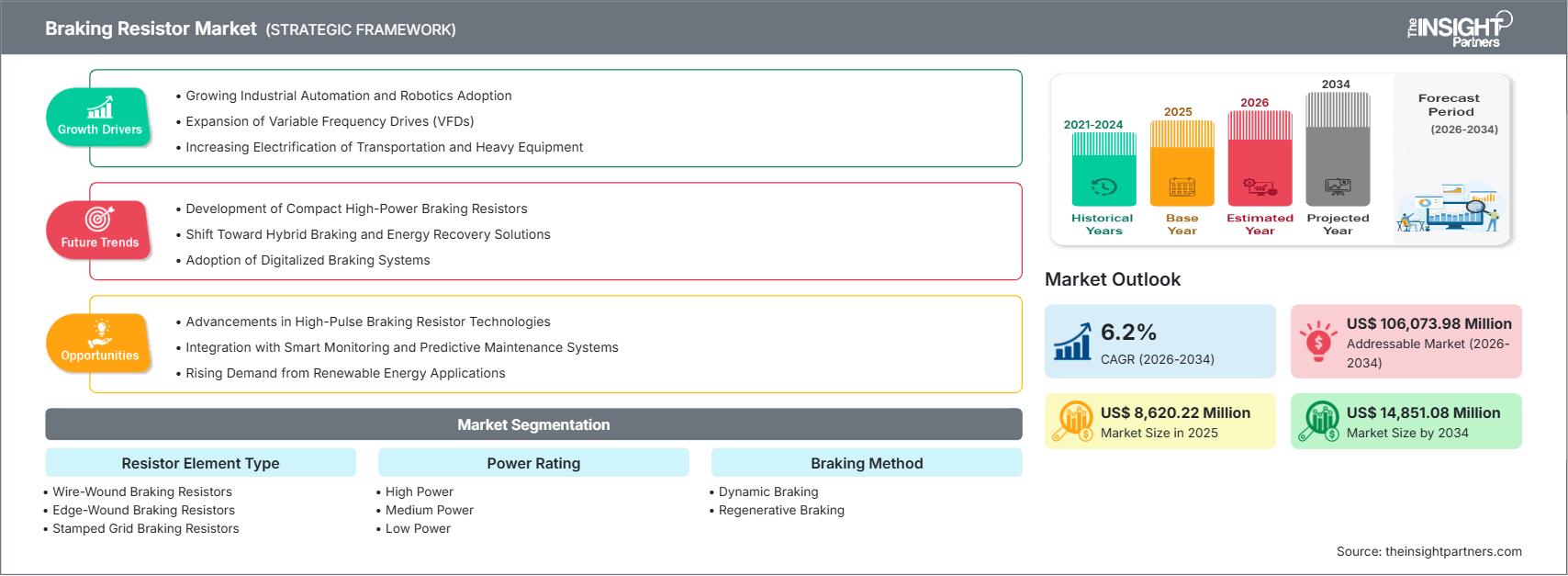
The Braking Resistor Market is expected to reach US$ 14,851.08 million by 2034, up from US$ 8,620.22 million in 2025. The market is anticipated to register a CAGR of 6.2% during 2026–2034. This robust trajectory underscores the critical role of braking resistors in dissipating excess regenerative energy across industrial motor drives and traction systems.
North America accounts for a significant share of the global Braking Resistor market, with a 5.5% CAGR through 2034. Structural growth is propelled by the rapid adoption of automation in manufacturing facilities and substantial investments in railway electrification projects that require advanced dynamic braking solutions.
Braking Resistor Market Assessment and Insights
- North America held a 23.50% market share in 2025 and is projected to grow at a 5.5% CAGR between 2026 and 2034. The region's outlook is supported by extensive integration of factory automation and stringent safety regulations governing motor control systems in industrial facilities.
- US captured 79.42% of the North American market in 2025 and is forecasted to grow at a CAGR of 5.8% through 2034. High capital expenditure on industrial automation and the expansion of railway electrification remain fundamental demand levers.
- Europe accounted for a 38.41% market share in 2025 and is expected to expand at a CAGR of 6.1% from 2026 to 2034. Leading countries include Germany, the United Kingdom, and France, underpinned by renewable energy integration and advanced manufacturing mandates.
- Asia Pacific secured a 29.01% market share in 2025 and is poised to achieve the highest CAGR of 7.5% during the forecast period. China, Japan, South Korea, and India remain pivotal, driven by massive investments in industrial automation and the expansion of metro rail infrastructure.
- Largest Segment in terms of resistor element type, wire-wound braking resistors held a 38.22% market share in 2025 and are anticipated to grow at a CAGR of 5.8%. These resistors remain critical for high-power industrial drive applications requiring reliable thermal performance.
- High Growth Segment identified within the end-use industry is energy, which held a 21.91% share in 2025 and is set to grow at a 7.7% CAGR. The global expansion of renewable capacity and the deployment of wind turbine pitch control systems are accelerating demand significantly.
- Key companies analyzed in detail: ABB Ltd, TE Connectivity Ltd, CRESSALL RESISTORS LTD, Siemens AG, Schneider Electric SE, Eaton Corporation plc, Vishay Intertechnology Inc, TOSHIBA CORPORATION, Yaskawa Electric Corporation, Fuji Electric Co Ltd.
Source: The Insight Partners' analysis based on proprietary research, government publications, company annual reports, investor presentations, industry databases, and expert interviews.
The industry has witnessed tremendous technological advancements, from grid-based traditional models to modular systems with improved thermal management capabilities. Today's wire-wound and edge-wound resistors are housed in high-quality stainless steel and aluminum, improving heat dissipation. Automation has been incorporated into the winding and laser-welding processes to improve consistency and accuracy. Besides, the inclusion of temperature sensors and intelligent monitoring systems in resistor banks aids condition monitoring. It has led to their use in critical industries such as marine propulsion and oil drilling rigs, where system failure can cause catastrophic damage.
Favorable dynamics include increased usage in developing industrial nations in Southeast Asia and the Middle East, driven by rising demand for ride-through braking resistance in renewable grid applications. Harmonic distortion and efficiency guidelines by the International Electrotechnical Commission require component manufacturers to meet stringent standards. Significant investments are being made to develop silicon carbide and other hybrid materials for resistor elements, thereby enabling high-power density. The emergence of electrified public transport and smart factories would provide a long-term order book for manufacturers.
Braking Resistor Market Report Scope
| Report Attribute | Details |
|---|---|
| Market size in 2025 | US$ 8,620.22 Million |
| Market Size by 2034 | US$ 14,851.08 Million |
| Global CAGR (2026 - 2034) | 6.2% |
| Historical Data | 2021-2024 |
| Forecast period | 2026-2034 |
Braking Resistor Market Analysis
The Braking Resistor market's growth is primarily driven by the relentless expansion of variable frequency drive installations across industrial and commercial sectors. Since electric motors account for almost 45% of total electricity use, according to IEA studies, there has been increased demand for energy-efficient motor control systems, and variable frequency drives have become standard components for pumps, fans, and compressors. Every VFD installed in a dynamic braking system requires a corresponding resistor bank to dissipate regenerative energy, in a one-to-one correlation. The supply chain starts with alloy producers and ends with the system integrators. There is current tension in the supply chain due to price swings in nickel chromium alloy and lead times for large-capacity drives exceeding 100 kW.
Competitive intensity in the Braking Resistor market analysis reveals a landscape divided between multinational electrical conglomerates and specialized resistor manufacturers. ABB Ltd and Siemens AG leverage their enormous installed base of industrial drives to secure bundled resistor contracts, while Cressall Resistors Ltd and Vishay Intertechnology Inc use custom-engineered resistors for harsh operating environments such as offshore wind farms and mining haul trucks. The positioning strategy is increasingly focused on resistor modules and braking chopper packs, which makes system design easier for OEMs. Schneider Electric SE and Eaton Corporation plc are focusing on predictive-maintenance-based resistor packs with Internet of Things capabilities for thermal-stress measurement.
● REPORT CUSTOMIZATION
Tailor This Report To Align With Your Specific Business Requirements
This report can be customized to align precisely with your business objectives, scope, and target markets. Customization options include tailored segmentation, geography, competitive analysis, and strategic insights to support informed decision-making.
Customize This Report →WHAT YOU CAN ADJUST
- ● Segmentations
- ● Geography
- ● Competitive Analysis
- ● Language Preferences
Braking Resistor Market: Strategic Insights
Regional Insights
North America Braking Resistor Market
North America accounted for a 23.50% share of the Braking Resistor Market in 2025, with a forecast CAGR of 5.5% through 2034. The level of industrial automation and the upgrading of outdated power systems are important structural factors. This area has a strong demand for high-power wire-wound resistors in heavy industry, especially in steel rolling mills and automobile production lines, because the energy generated by regenerative braking must be absorbed quickly. The United States and Canada have strict regulatory standards in accordance with NFPA 70 and IEEE standards.
U.S. Braking Resistor Market
The US commanded 79.42% of the North American market in 2025 and is expected to grow at a 5.8% CAGR. High demand stems from the increasing automation of auto manufacturing plants and the rapid installation of data center backup power generators that require testing with dynamic braking. There is also an established OEM customer base for material handling equipment.
Europe Braking Resistor Market
Europe captured a 38.41% share of the global Braking Resistor Market in 2025, with the market expanding at a CAGR of 6.1%. Germany is the top player owing to a strong presence of machine tool manufacturers and automakers using servo drives with regenerative braking capabilities. Market trends are governed by the EU Machinery Directive and Ecodesign requirements, which stipulate that there must be means to recover or dissipate energy from newly installed industrial motors exceeding a certain threshold.
APAC Braking Resistor Market
Asia Pacific held a 29.01% share in 2025 and is projected to grow at the highest CAGR of 7.5%. China remains the manufacturing hub, with unmatched capital investment in high-speed rail networks, urban metro systems, and industrial automation. Japan and South Korea, on the other hand, focus on miniature resistors for robots and semiconductor manufacturing equipment.
Middle East & Africa Braking Resistor Market
The Middle East and Africa region is projected to grow at a steady CAGR of 5.0% through 2034. Saudi Arabia and the UAE dominate, owing to the huge projects and industrial cities that require enormous cranes and hoists with fail-safe braking equipment. South Africa’s deep mine industry continues to support the requirement for explosion-proof braking resistors in winders and fans.

Segmentation Analysis
Resistor Element Type
The resistor element type segment is advancing at a CAGR of 5.5–6.0%, as material and design innovations directly correlate with power density and thermal endurance. There has been a trend in which the market is gradually moving away from open-grid design towards closed-module design, which offers better safety features. This Segment identifies the performance criteria of the scope of the Braking Resistor Market.
- Wire-Wound Braking Resistors: Wire-wound designs are mostly favored for high-power applications, where ohmic stability under thermal cycling is essential. The demand comes from manufacturing industries, which use large VFDs in applications such as steel mills and cement manufacturing plants, where reliable braking is needed during deceleration and holding.
- Edge-Wound Braking Resistors: The edge-wound design is suitable for low-resistance, high-current applications. Their robustness and metal construction make them well-suited for traction motor tests and locomotive dynamic braking grids, as they can withstand mechanical vibrations and dissipate heat quickly.
- Stamped Grid Braking Resistors: Stamped grid design is cost-effective and can be used in high-volume production. It is common in applications such as elevator and crane controls, where performance under an intermittent duty cycle can be achieved without incurring the high costs of edge-wound production processes.
- Others: This category includes thick film and liquid-cooled resistor technologies. Liquid-cooled variants are gaining traction in compact marine drive systems and submarine propulsion simulators, where space constraints preclude the use of large air-cooled resistor banks.
Power Rating
The power rating sub-category is fueled by the growing demand for increased power density in contemporary industrial motor drives. The correct power rating is critical for ensuring safety and preventing overheating in the regenerative braking system.
- High Power (Above 10 kW): This Sub-category accounts for most of the income as a result of its wide use in heavy industry and applications involving traction. High-power resistors are mandatory for locomotives’ dynamic braking, mining hoists, and compressor test rigs, where constant energy dissipation requires reliable heat engineering solutions.
- Medium Power (1 to 10 kW): Medium-power resistors are used in the largest number of installed units across commercial HVAC systems, machine tools, and automated conveyor systems. Standardization and modularity of medium-power products provide advantages during implementation in the equipment of original equipment manufacturers (OEM).
- Low Power (Less Than 1 kW): Low-power resistors are applied in mini servo drives, robotics, and laboratory test devices. The trend towards smaller, collaborative robots in electronic assembly lines promotes the development of space-efficient, PC-mountable braking resistors.
Braking Method
The braking method segment reflects the broader industry transition toward energy efficiency and power regeneration. The fundamental distinction between dissipative and regenerative approaches defines system architecture and component selection.
- Dynamic Braking: Dynamic braking remains the dominant method, converting regenerative kinetic energy into heat through resistor banks. It is preferred in applications where the power grid cannot accept regenerated energy, including remote mining operations, marine vessels, and emergency stop systems requiring absolute reliability.
- Regenerative Braking: Regenerative braking is gaining share in grid-connected applications where energy recovery offsets operational costs. Elevators, high-speed trains, and modern crane systems increasingly employ regenerative drives with line reactors, though braking resistors serve as essential backup dissipation pathways during grid faults.
End Use Industry
The end-use industry landscape is evolving, driven by sector-specific safety regulations and electrification mandates. The depth of braking resistor specification varies significantly across verticals.
- Automobile and Railway: This Segment is driven by EV drivetrain test benches and global rail electrification. Locomotive dynamic braking grids require rugged, roof-mounted resistor assemblies that withstand severe environmental exposure and continuous high-temperature operation during long downhill descents.
- Energy: Wind turbine pitch control and solar inverter testing represent key applications. Braking resistors ensure safe turbine blade positioning during grid-loss events, while solar farm commissioning requires load banks to validate inverter performance before grid synchronization.
- Oil and Gas: Drilling rig drawworks and mud pump drives require explosion-proof braking resistors certified for hazardous area operation. Offshore platforms demand corrosion-resistant, compact designs that minimize footprint and maintenance access requirements in space-constrained installations.
- Marine: Ship propulsion test benches and port crane systems utilize water-cooled and air-cooled resistor banks. Naval applications demand MIL-SPEC qualified resistors for electromagnetic compatibility and shock resistance aboard surface vessels and submarines.
- Mining: Conveyor decline braking and winder drives are critical applications. Underground mining mandates flameproof enclosures and intrinsic safety barriers, while surface operations prioritize dust-tight, high-ingress-protection resistor housings for reliable operation in arid environments.
Opportunity Snapshot
| End Use Industry | Revenue Contribution | Trend Tag | Adoption Stage |
| Automobile and Railway | High | EV Testing | Scaling |
| Energy | High | Grid Stabilization | Scaling |
| Oil and Gas | Medium | Hazardous Area | Mature |
| Marine | Medium | Naval Electrification | Emerging |
| Mining | Medium | Automation Retrofit | Scaling |
| Others | Low | Hybrid Drives | Emerging |
Braking Resistor Market Growth Drivers and Impact Analysis
Global Electrification of Railway and Urban Transit Networks
The phenomenal expansion of the network of metros, light rails, and high-speed railways worldwide serves as a powerful catalyst for growth in the braking resistor market. Contemporary electric trains and multiple-unit trains use dynamic braking, in which roof-mounted resistor grids dissipate kinetic energy during braking. The International Union of Railways reports a remarkable increase in the length of electrified railways over the last decade, with the Asia-Pacific region accounting for more than 60% of newly electrified railways. Every newly installed trainset will require several high-power resistor banks capable of operating under repeated thermal cycles in adverse external environments. Transit organizations are simultaneously replacing the existing DC traction mechanisms with the AC traction mechanisms, creating significant demand for retrofits.
Industrial Automation Intensity and VFD Proliferation
Greater adoption of variable frequency drives across global manufacturing processes forms the backbone of demand for the braking resistor market. In their quest to meet energy-efficiency goals in line with ISO 50001 standards, manufacturers are increasingly converting fixed-speed motor installations to VFD-driven setups. Each time a VFD setup is used in a dynamic braking process – as in the case of cranes, centrifugal separators, and conveyors – there needs to be an accompanying braking resistor to handle the regenerative Power produced during the process of slowing down a large mass. According to the International Energy Agency, industrial motors consume about 45 percent of the total electricity produced worldwide, and with VFDs, energy use can be cut by 25-30 percent.
Renewable Energy Integration and Grid Stability Requirements
Rapid globalization of intermittent renewable generation is increasing demand for specialized braking resistors used to stabilize grid power quality. Pitch control of wind turbine generators uses a braking resistor to feather the blades in an emergency shutdown mode or when disconnected from the grid, preventing them from spinning out of control. Inverters for photovoltaic installations require test benches with load banks and resistors to test the installation before it can be connected to the grid. Testing batteries for energy storage involves cycling them between charging and discharging with resistive loads. As noted in the International Renewable Energy Agency's report on record-setting annual capacity additions, there has been an increase in the number of power electronics that require safe energy-dissipation paths.
Braking Resistor Market Future Trends
Integration of IoT-Enabled Predictive Monitoring Systems
The Braking Resistor market trends indicate a decisive shift toward intelligent, sensor-integrated resistor assemblies capable of real-time condition monitoring and predictive failure analytics. Modern resistor packs for braking are shifting from simple passive heat dissipators to more complex sub-assemblies that include thermocouples, insulation-resistance testing equipment, and partial-discharge detectors. The shift is enabling data logging for thermal cycling and giving maintenance engineers a chance to identify potential resistor deterioration, hot spots, and insulation failures before they cause system shutdowns. Cloud-based systems collect data from multiple sites, helping to compare overall performance and optimize spare parts inventory. In addition, this shift in strategy from a maintenance approach to a preventive maintenance approach greatly reduces the risk of unplanned downtime.
Advanced Materials and Compact High-Density Resistor Designs
One significant long-term trend shaping the future of braking resistors is the scientific quest to achieve higher power densities in smaller physical dimensions, enabled by advancements in materials science. While the existing nickel-chromium and iron-chromium-aluminum materials continue to be used, new technologies, such as ceramic matrix composites and silicon carbide substrates, offer higher thermal conductivity and enable sustained operation at higher temperatures. By using new materials, braking resistor manufacturers can create smaller braking modules that dissipate the same amount of energy while occupying up to 40% less area than before, making them very useful on space-constrained offshore platforms, marine vessels, and urban substations. Additive manufacturing is also being employed to prototype resistor grid designs that use airflow paths to enhance thermal dissipation through techniques previously unavailable.
Braking Resistor Market Opportunities
Electric Vehicle Testing and Battery Validation Infrastructure
The rapid expansion of electric vehicle production worldwide has created a high-growth niche market opportunity for the Braking Resistor industry. The testing of EV drive trains involves specialized dynamometer test rigs in which braking resistors mimic road load conditions and dissipate energy during battery pack charge-depletion tests. Every car OEM and Tier-1 manufacturer setting up its battery validation labs needs multi-megawatt-rated, resistor-based load banks that enable precise power profiling. Additionally, battery recycling facilities need controlled-discharge equipment, in which braking resistors are used to drain the traction batteries before disassembly. The process calls for very programmable resistor banks with high integration of data acquisition systems. Those companies that offer turnkey load bank solutions in containers with SCADA connectivity can earn premium margins when supplying their products to automotive engineering customers in accordance with standards such as ISO 12405.
Aftermarket Modernization of Aging Industrial Drive Systems
The substantial global installed base of legacy motor control centers and industrial drives over 15 years old presents a significant retrofit opportunity. Existing facilities often operate with obsolete braking resistor designs that lack modern thermal protection, insulation monitoring, or compliance with updated fire safety codes. The Braking Resistor market Forecasts sustained aftermarket demand as plant engineers prioritize reliability upgrades over complete drive replacement. The process of fitting the latest designs of edge-wound or wire-wound resistor banks into existing enclosure systems, with air-cooling system improvements, prolongs equipment life while ensuring safe operation, all at a much lower cost than installing new systems. The greatest demand for this product would be seen in the developed, industrialized regions of North America and Europe, where older steel mills, paper factories, and mining companies continue to use DC drive systems that have been in use for decades.
Recent Developments
- November 2024: Shenzhen Zenithsun Electronics Tech Co., Ltd., a leader in the manufacturing of high-quality resistors and load banks, is excited to announce the launch of its new line of Variable Resistors designed to meet the diverse needs of various industries. This innovative product line offers enhanced flexibility and precision, making it ideal for applications ranging from testing and calibration to voltage stabilization.
- September 2024: Accelera by Cummins, the zero-emissions business unit of Cummins Inc. [NYSE: CMI], unveiled its new integrated brake chopper resistor (iBCR) at this year’s IAA Transportation in Hannover, Germany. The iBCR includes robust cybersecurity features, improved performance, and reliability.
Frequently Asked Questions

- Comprehensive Market Sizing and Forecast Analysis
- Detailed Segmentation Analysis
- In-Depth Market Dynamics Assessment
- Regional and Country-Level Insights
- Competitive Landscape and Company Benchmarking
- Strategic Business Intelligence
Recent Reports
Testimonials

The Insight Partners provided valuable market intelligence that supported our global go-to-market strategy. Their team was professional, responsive, and attentive to our feedback, providing thoughtful analysis and helpful methodological clarifications throughout the project.
Junmo Kim Chief Financial Officer (CFO), Enertech Co., Ltd.
The Insight Partners' SCADA System Market report is comprehensive, with valuable insights on current trends and future forecasts. The team was highly professional, responsive, and supportive throughout. We are very satisfied and highly recommend their services.
RAN KEDEM Partner, Reali Technologies LTDs
I requested a report on a very specific software market and the team produced the report in a few days. The information was very relevant and well presented. I then requested some changes and additions to the report. The team was again very responsive and I got the final report in less than a week.
JEAN-HERVE JENN Chairman, Future Analytica
We worked with The Insight Partners for an important market study and forecast. They gave us clear insights into opportunities and risks, which helped shape our plans. Their research was easy to use and based on solid data. It helped us make smart, confident decisions. We highly recommend them.
PIYUSH NAGPAL Sr. Vice President, High Beam Global
The Insight Partners delivered insightful, well-structured market research with strong domain expertise. Their team was professional and responsive throughout. The user-friendly website made accessing industry reports seamless. We highly recommend them for reliable, high-quality research services
YUKIHIKO ADACHI CEO, Deep Blue, LLC.
This is the first time I have purchased a market report from The Insight Partners.While I was unsure at first, I visited their web site and felt more comfortable to take the risk and purchase a market report.I am completely satisfied with the quality of the report and customer service. I had several questions and comments with the initial report, but after a couple of dialogs over email with their analyst I believe I have a report that I can use as input to our strategic planning process.Thank you so much for taking the extra time and making this a positive experience.I will definitely recommend your service to others and you will be my first call when we need further market data.
JOHN SUZUKI President and Chief Executive Officer, Board Director, BK Technologies
I wish to appreciate your support and the professionalism you displayed in the course of attending to my request for information regarding to infectious disease IVD market in Nigeria. I appreciate your patience, your guidance, and the fact that you were willing to offer a discount, which eventually made it possible for us to close a deal. I look forward to engaging The Insight Partners in the future, all thanks to the impression you have created in me as a result of this first encounter.
DR CHIJIOKE ONYIA MANAGING DIRECTOR, PineCrest Healthcare Ltd.Reason to Buy
- Informed Decision-Making
- Understanding Market Dynamics
- Competitive Analysis
- Identifying Emerging Markets
- Customer Insights
- Market Forecasts
- Risk Mitigation
- Boosting Operational Efficiency
- Strategic Planning
- Investment Justification
- Tracking Industry Innovations
- Aligning with Regulatory Trends






 Get Free Sample for