
Internet of Vehicle Market Demand, Trends & Forecast by 2034
Coverage: By Components (Hardware, Software, Service); Connectivity (Bluetooth, Wi-Fi, Cellular, Others), and Geography (North America, Europe, Asia Pacific, and South and Central America)
- Status : Data Released
- Report Code : TIPRE00003388
- Category : Electronics and Semiconductor
- No. of Pages : 150
- Available Report Formats :


- Last update date : October 16, 2026


2025 Market Size
US$ 208.36 Bn
Base year value
2034 Forecast
US$ 948.49 Bn
Projected by 2034
CAGR 2026-2034
18.34 %
Growth rate
Addressable Market
US$ 4,775.25 Bn
(2026-2034)
The Internet of Vehicle Market was valued at US$ 208.36 Billion in 2025 and is projected to reach US$ 948.49 Billion by 2034, expanding at a CAGR of 18.34% during 2026–2034. Growth will result from the convergence of embedded connectivity, software-defined architectures, cloud technologies, and data-driven service solutions in passenger and commercial mobility domains. These solutions enable real-time diagnostics, infotainment, safety, fleet management, and over-the-air features deployment.
North America Internet of Vehicle Market Size is forecasted to grow by 16.8%–17.6% CAGR till 2034 driven by large-scale implementation of embedded cellular systems and connected services. The IoT for Vehicles market size growth will be facilitated by developed 5G network, widespread telematics technology usage, and regulatory focus on cybersecurity and software updates management. Fleet owners also stimulate growth via integration of predictive maintenance, route planning, insurance and assets management in the same mobility platform.
Internet of Vehicle Market Assessment and Insights
- North America: Held a 34–36% share in 2025 and is forecast to grow at 16.8–17.6% CAGR between 2026–2034, supported by 5G coverage, embedded telematics, cloud ecosystems, and monetized vehicle services.
- US: Represented 82–85% of North American revenue in 2025 and is expected to expand at 17.0–17.8% CAGR between 2026–2034.
- Europe: Accounted for a 27–29% share in 2025 and should advance at 17.2–18.0% CAGR between 2026–2034, led by Germany, the UK, and France.
- Asia Pacific: Captured a 25–27% share in 2025 and is projected to record 20.2–21.2% CAGR between 2026–2034, led by China, Japan, South Korea, and India.
- Largest Segment: Hardware held a 45–48% market share in 2025 and is expected to progress at 15.8–16.8% CAGR during 2026–2034.
- High Growth Segment: Service represented 23–26% market share in 2025 and is projected to grow at 22.0–23.2% CAGR during 2026–2034.
- Key companies analyzed in detail: Apple Inc., AUDI AG, Cisco Systems, Inc., Ford Motor Company, Google LLC, International Business Machines Corporation, Intel Corporation, NXP Semiconductors N.V., SAP SE, and Texas Instruments Incorporated.
Source: The Insight Partners' analysis based on proprietary research, government publications, company annual reports, investor presentations, industry databases, and expert interviews.
Connectivity in vehicles has shifted from individual infotainment components to centralized architectures using software to connect sensors, gateways, cloud services, and smartphones. Vehicle production is moving towards integration of more advanced processors, secure hardware, Ethernet architecture, and radios as standard rather than offering connectivity as an add-on. In addition, suppliers are increasingly delivering integrated hardware-software solutions, and automobile makers are reducing product refreshes using over-the-air upgrades. Thus, this progression is creating value shift from selling components to lifecycle software and other services.
In the years between 2024 and 2034, investments will go past the normal automotive market because of better cellular connectivity, more electric vehicles, and digital roads in Asian, Middle Eastern, and chosen African nations. Regulations about security and software updates will ensure that there are reliable architectures and processes for software development. Scalable platforms will be developed that are able to serve many different kinds of vehicles, and the government will invest in roadside communication and ITS to enhance V2I use cases and implementation.
Internet of Vehicle Market Report Scope
| Report Attribute | Details |
|---|---|
| Market size in 2025 | US$ 208.36 Billion |
| Market Size by 2034 | US$ 948.49 Billion |
| Global CAGR (2026 - 2034) | 18.34% |
| Historical Data | 2021-2024 |
| Forecast period | 2026-2034 |
Internet of Vehicle Market Analysis
The Internet of Vehicle market is fueled by the need for connected safety, remote diagnostics, usage-based services, and continuously upgraded digital cockpits from customers. The demand is generated from automakers, fleets, insurance companies, telecommunication operators, municipalities, and cloud services providers, thus forming multi-sided eco-system instead of a usual component chain.
Processors, secure communication and gateways come from semiconductor providers, whereas operating system, analytics and applications development environments come from software companies. The telecom providers will take care of lifecycle of cellular connectivity, whereas service integrators will make sure that this connectivity is deployed. Supply will be affected by automotive qualification, cybersecurity, spectrum management and automotive programs. Platform sharing is useful in optimizing costs, whereas multi-radio technology reduces reliance on any particular network.
Internet of Vehicle Market Report review reveals that the competition is between consumer ecosystems, automotive manufacturers, networking companies, cloud services providers, and semiconductor makers. Apple Inc. and Google LLC influence the smartphone part; AUDI AG and Ford Motor Company dominate in the vehicle-level implementations and customer data ownership; Cisco Systems, Inc., International Business Machines Corporation, and SAP SE struggle in managed connectivity, cloud integration, analytics, and enterprise workflow integration.
Intel Corporation, NXP Semiconductors N.V., and Texas Instruments Incorporated concentrate their investments on processing, networking, security, and power-efficient edge systems. Strategic positioning is becoming more and more reliant on reference architectures, standards engagement, tools for developers, and partnerships that lower integration times. Acquisition of high-speed in-car networking and edge AI technologies by the suppliers shows that they are building a stack, not just selling chips.
● REPORT CUSTOMIZATION
Tailor This Report To Align With Your Specific Business Requirements
This report can be customized to align precisely with your business objectives, scope, and target markets. Customization options include tailored segmentation, geography, competitive analysis, and strategic insights to support informed decision-making.
Customize This Report →WHAT YOU CAN ADJUST
- ● Segmentations
- ● Geography
- ● Competitive Analysis
- ● Language Preferences
Internet of Vehicle Market: Strategic Insights
Regional Insights
North America Internet of Vehicle Market
North America accounted for a share of 34-36% in the Internet of Vehicle Market Share in 2025 and is anticipated to expand at a CAGR of 16.8-17.6% from 2024 to 2034. The widespread presence of LTE and 5G networks, telematics initiatives, and robust cloud computing enable connectivity solutions in connected safety, infotainment, remote services, and commercial fleets.
Drivers of regional demand include long-haul logistics, telematics for insurance purposes, software management in electric vehicles, and consumer openness towards services connected to their smartphones. Cybersecurity concerns translate into investment in identity management, secure boot, encryption, and lifecycle management. Cellular coverage in Canada and fleet initiatives in Mexico add to the momentum, along with the automotive industry of Mexico. Maturity of the subscription ecosystem in North America will facilitate the testing of subscription packages in this region before rolling out globally.
U.S. Internet of Vehicle Market
North America accounted for 82–85% of the revenue generated by the U.S. in 2025 and is anticipated to grow at a CAGR of 17.0–17.8% till 2034. The demand for telematics is due to the presence of vast passenger vehicle parc, robust logistic operations, advanced telecom infrastructure, and OEMs' focus on the development of software-based platform. Embedded connectivity will help in crash management, diagnostics, navigation, Wi-Fi hot spots, keyless entry, and over the air updates.
Ford Motor Company, Apple Inc., Google LLC, Cisco Systems, Inc., International Business Machines Corporation, Intel Corporation, and Texas Instruments Incorporated offer telematics solutions in terms of vehicle, interface, networking, cloud computing, processors, and analog segments respectively. Commercial segment is keen on predictive maintenance, workflow of the driver, route optimization, and asset management while passenger telematics solutions are focused on in terms of integrated displays, voice interface, streaming, and subscription services.
Europe Internet of Vehicle Market
The Europe region had a share of 27-29% in 2025 and is expected to grow with a 17.2-18.0% CAGR till 2034. Germany excels in premium vehicle design, Tier-1 relationships, and software-defined architectures initiatives. The UK is a blend of connected insurance services, digital services, and test environments, whereas France matches its automotive connectivity with electrification and smart mobility investments.
The Italian and Spanish regions make contributions in terms of their fleet and rental vehicle requirements, as well as their urban mobility requirements resulting from the upgrading of the cellular infrastructure and the renewal of their vehicles. Regulations on emergency communications, data security, cyber-security, and over-the-air software updates add costs but make procurement needs standardized. The partnership between AUDI AG, SAP SE, and semiconductors & cloud companies make progress in the region possible.
APAC Internet of Vehicle Market
APAC’s 2025 market share was 25–27%, and it will see a 20.2–21.2% compound annual growth rate (CAGR) through 2034, which is the fastest among all regions. China’s leadership position stems from electric vehicles, digital cockpit, telecom infrastructure, and smart road solutions.
The Japanese and South Korean contribution is in automotive electronics and 5G technology. The Indian advantage is in having a huge automobile industry and growing mobile broadband networks. Australia is behind in use cases such as fleets, mining, and long-distance logistics.
Middle East & Africa Internet of Vehicle Market
Middle East & Africa is expected to grow at 18.6–19.6% CAGR through 2034. Saudi Arabia and the UAE lead through smart-city programs, premium vehicle demand, logistics modernization, and investment in 5G-enabled transport infrastructure.
South Africa has the most extensive established automotive and fleet services ecosystem in the region, while the rest of MEA is rather diverse due to variability of coverage, cost, and the age of vehicles. There are many opportunities in energy sector fleets, ports, mining and inter-country logistics which can justify the usage of fleet management solutions.
Segmentation Analysis
Components
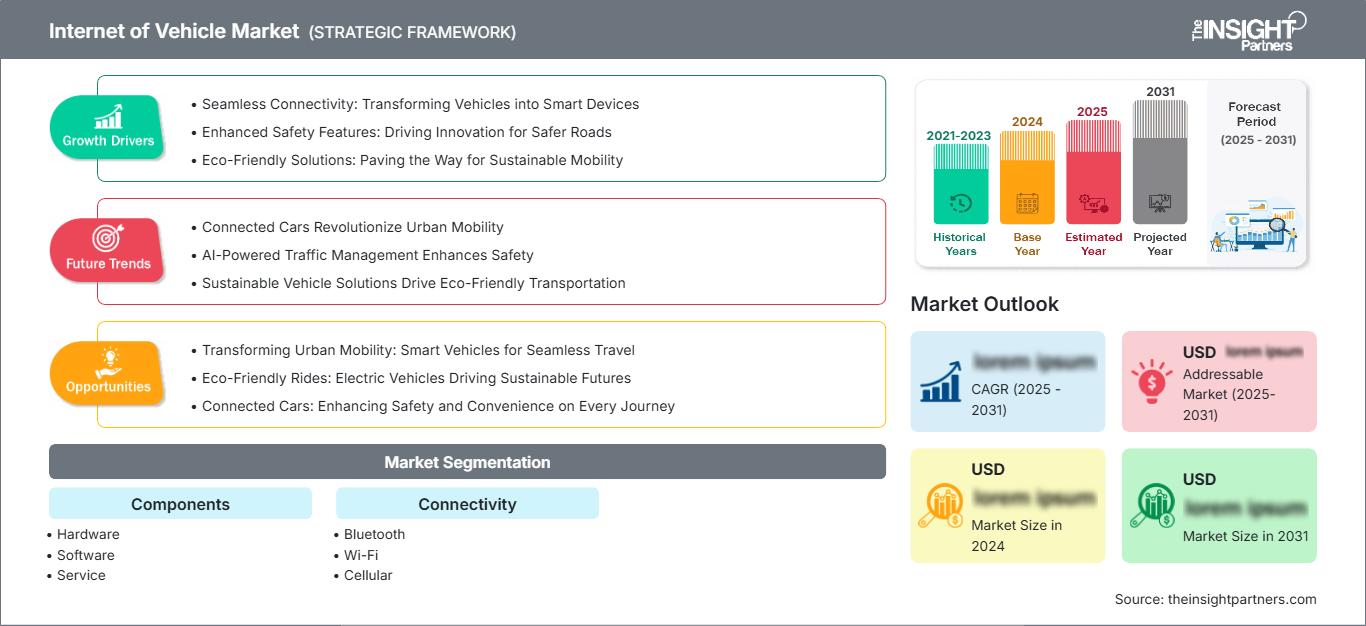
The Internet of Vehicle Market scope across components covers Hardware, Software, and Service, with the category expected to expand at 18.0–19.0% CAGR during 2026–2034. Procurement is shifting from separate electronic control units toward integrated compute, connectivity, security, and cloud stacks. Hardware remains the largest segment, while software and lifecycle services gain strategic weight as automakers monetize features and maintain vehicles after sale.
- Hardware: Automotive processors, telematics control units, gateways, sensors, antennas, and secure elements form the deployment foundation and retain strategic importance because qualification, reliability, and integration requirements create high switching costs.
- Software: Operating platforms, middleware, cybersecurity, analytics, and application layers coordinate vehicle data and enable differentiated services, making software central to feature velocity, interoperability, and post-sale value creation.
- Service: Integration, managed connectivity, maintenance, cybersecurity monitoring, and data services address lifecycle complexity, helping automakers and fleets operate multi-network deployments while converting connected capabilities into recurring operational and customer outcomes.
Connectivity
Connectivity is forecast to grow at 18.4–19.4% CAGR during 2026–2034 as vehicles combine Bluetooth, Wi-Fi, and Cellular links for complementary functions. Architecture selection depends on range, bandwidth, latency, power, security, and service continuity. Multi-radio designs are becoming standard because personal-device pairing, cabin networking, cloud access, emergency communications, and remote updates impose different technical and commercial requirements.
- Bluetooth: Bluetooth supports smartphone pairing, audio, digital keys, and low-energy device discovery, retaining a mature position because it offers broad device compatibility and efficient short-range communication within and around vehicles.
- Wi-Fi: Wi-Fi enables cabin hotspots, high-throughput media, diagnostics, and workshop updates, with strategic value rising as multi-screen experiences and larger software packages require fast local data transfer.
- Cellular: Cellular provides wide-area, always-on access for telematics, emergency response, navigation, fleet control, and cloud services, making it the backbone for subscriptions and remote vehicle management.
Opportunity Snapshot
| Application | Revenue Contribution (High/Medium/Low) | Trend Tag | Adoption Stage |
| Fleet Management | High | Predictive Fleets | Scaling |
| Infotainment | High | Digital Cockpit | Mature |
| Remote Diagnostics | High | OTA Service | Scaling |
| Usage-Based Insurance | Medium | Risk Telematics | Scaling |
| V2X Safety | Medium | Cooperative Safety | Emerging |
Internet of Vehicle Market Growth Drivers and Impact Analysis
Software-Defined Vehicles Reshape Lifecycle Economics
With the help of centralized computing and zonal electric architecture, car manufacturers have an opportunity to decouple features’ development from hardware cycles. That changes the business model and means that manufacturers can offer functions, security updates, improved user interface, and performance optimizations even after the delivery of a vehicle. NXP Semiconductors N.V. offered automotive microcontrollers with zonal architecture and networking capabilities, which demonstrates the alignment of the supplier with the Internet of Vehicle Market trend. The effects of the change affect everything from semiconductors qualification to cloud orchestration, tests, and services. Car manufacturers benefit from faster feature reusability across the range of cars; however, at the same time, they have to be responsible for software and cybersecurity for a longer period of time.
Always-On Cellular Coverage Enables Service Monetization
Embedded cellular connectivity turns the vehicle into a persistent service endpoint rather than an intermittently paired device. Mobile broadband coverage is nearly universal globally, while 5G reaches more than half of the population, strengthening the infrastructure basis for telematics and cloud applications. Automakers can package navigation, hotspot access, remote control, diagnostics, entertainment, and fleet tools through recurring plans. Connectivity-management platforms automate provisioning, policy, charging, roaming, and lifecycle tasks across countries and model years. Market impact appears in higher service attach rates, lower manual support costs, and improved vehicle data continuity. Commercial success nevertheless depends on transparent pricing, reliable coverage, and disciplined consent management.
Fleet Digitization Creates Quantifiable Operating Returns
Fleet operators adopt connected-vehicle systems because vehicle availability, fuel consumption, route adherence, driver safety, and maintenance can be measured directly. Industry evidence indicates strong perceived value for GPS tracking and fleet management, with many operators reporting rapid returns from predictive analytics and asset tracking. These economics accelerate deployment in logistics, rental, field service, public transport, mining, and energy fleets. Unlike consumer applications, fleet purchases can be justified through avoided downtime and improved utilization. Vendors that integrate vehicle data with enterprise resource planning, maintenance, and dispatch workflows can capture larger contracts. The resulting demand favors reliable APIs, configurable dashboards, and service-level commitments over isolated telematics devices.
Internet of Vehicle Market Future Trends
Edge AI Will Prioritize Contextual Vehicle Data
Internet of Vehicle Market trends increasingly point toward selective edge inference rather than continuous cloud transmission. Vehicles will process camera, cabin, powertrain, and network data locally, forwarding only events or compressed insights. This approach reduces latency, bandwidth cost, and privacy exposure while improving resilience when coverage fluctuates. Programmable neural processors and centralized gateways will support predictive maintenance, driver assistance, personalization, and cybersecurity anomaly detection. Over time, procurement will emphasize model-update governance, workload isolation, and energy efficiency alongside raw compute. Partnerships between chipmakers, cloud platforms, and automakers will determine how consistently AI workloads operate across vehicle generations.
Interoperable Digital Identity Will Connect Mobility Services
Digital keys will evolve into broader mobility identity frameworks connecting vehicles, devices, charging, parking, rental, insurance, and fleet authorization. Bluetooth Low Energy, Wi-Fi, cellular links, secure elements, and credential platforms will work together to authenticate users and assign temporary permissions. Standards-based interoperability can reduce proprietary integration and make shared access easier across brands. Security architecture will move toward hardware-rooted credentials, auditable provisioning, revocation, and privacy-preserving data exchange. Commercial opportunities will emerge for credential lifecycle services and cross-platform orchestration. Adoption will depend on consistent user experience, recovery processes, and clear accountability when device, vehicle, or network security fails.
Internet of Vehicle Market Opportunities
Managed Cybersecurity for Long Vehicle Lifecycles
Connected vehicles remain operational far longer than consumer electronics, creating an opportunity for managed cybersecurity services that extend beyond launch. Providers can combine vulnerability monitoring, software-bill-of-materials governance, incident response, certificate management, penetration testing, and secure update operations. Automakers and fleets need evidence that controls remain effective across suppliers, countries, and discontinued platforms. Investment should target reusable compliance tooling, automated risk prioritization, and service models priced by vehicle or active endpoint. Partnerships with insurers and telecom operators can improve threat intelligence and response coordination. Vendors that demonstrate automotive safety integration and measurable remediation times can establish durable, high-margin relationships.
Localized Platforms for High-Growth Mobility Markets
Rapidly motorizing economies require connected platforms adapted to varied network quality, vehicle cost, languages, payment systems, and service capacity. Investors can support lightweight telematics, offline-capable applications, eSIM orchestration, and cloud regions that meet local data requirements. India, Southeast Asia, the Gulf, and selected African markets present opportunities in commercial fleets, two-wheel mobility interfaces, public transport, and logistics rather than only premium passenger cars. Success requires local carrier agreements, repair-network integration, and pricing aligned with operating savings. Modular platforms can begin with tracking and diagnostics, then add insurance, payments, maintenance, and safety services as coverage and customer readiness improve.
Recent Developments
- October 2025: NXP Semiconductors N.V. completed acquisitions of Aviva Links for US$ 243 million and Kinara for US$ 307 million, expanding automotive SerDes connectivity and energy-efficient edge AI capabilities. The transactions strengthen NXP’s portfolio for software-defined vehicle networking, sensor data transport, and programmable inference at the intelligent edge.
- May 2025: Apple Inc. began rolling out CarPlay Ultra with new Aston Martin vehicle orders in the U.S. and Canada, extending iPhone integration across driver displays, instrument-cluster information, gauges, and vehicle controls. Apple also identified Hyundai, Kia, and Genesis among brands working toward future availability.
- March 2025: NXP Semiconductors N.V. introduced the S32K5 automotive microcontroller family for zonal and electrification architectures, combining 16 nm FinFET technology, embedded MRAM, integrated Ethernet switching, hardware-enforced isolation, and an edge neural-processing unit. The launch extends the CoreRide platform for scalable software-defined vehicle designs.
Frequently Asked Questions

- Comprehensive Market Sizing and Forecast Analysis
- Detailed Segmentation Analysis
- In-Depth Market Dynamics Assessment
- Regional and Country-Level Insights
- Competitive Landscape and Company Benchmarking
- Strategic Business Intelligence
Recent Reports
Testimonials

The Insight Partners provided valuable market intelligence that supported our global go-to-market strategy. Their team was professional, responsive, and attentive to our feedback, providing thoughtful analysis and helpful methodological clarifications throughout the project.
Junmo Kim Chief Financial Officer (CFO), Enertech Co., Ltd.
The Insight Partners' SCADA System Market report is comprehensive, with valuable insights on current trends and future forecasts. The team was highly professional, responsive, and supportive throughout. We are very satisfied and highly recommend their services.
RAN KEDEM Partner, Reali Technologies LTDs
I requested a report on a very specific software market and the team produced the report in a few days. The information was very relevant and well presented. I then requested some changes and additions to the report. The team was again very responsive and I got the final report in less than a week.
JEAN-HERVE JENN Chairman, Future Analytica
We worked with The Insight Partners for an important market study and forecast. They gave us clear insights into opportunities and risks, which helped shape our plans. Their research was easy to use and based on solid data. It helped us make smart, confident decisions. We highly recommend them.
PIYUSH NAGPAL Sr. Vice President, High Beam Global
The Insight Partners delivered insightful, well-structured market research with strong domain expertise. Their team was professional and responsive throughout. The user-friendly website made accessing industry reports seamless. We highly recommend them for reliable, high-quality research services
YUKIHIKO ADACHI CEO, Deep Blue, LLC.
This is the first time I have purchased a market report from The Insight Partners.While I was unsure at first, I visited their web site and felt more comfortable to take the risk and purchase a market report.I am completely satisfied with the quality of the report and customer service. I had several questions and comments with the initial report, but after a couple of dialogs over email with their analyst I believe I have a report that I can use as input to our strategic planning process.Thank you so much for taking the extra time and making this a positive experience.I will definitely recommend your service to others and you will be my first call when we need further market data.
JOHN SUZUKI President and Chief Executive Officer, Board Director, BK Technologies
I wish to appreciate your support and the professionalism you displayed in the course of attending to my request for information regarding to infectious disease IVD market in Nigeria. I appreciate your patience, your guidance, and the fact that you were willing to offer a discount, which eventually made it possible for us to close a deal. I look forward to engaging The Insight Partners in the future, all thanks to the impression you have created in me as a result of this first encounter.
DR CHIJIOKE ONYIA MANAGING DIRECTOR, PineCrest Healthcare Ltd.Reason to Buy
- Informed Decision-Making
- Understanding Market Dynamics
- Competitive Analysis
- Identifying Emerging Markets
- Customer Insights
- Market Forecasts
- Risk Mitigation
- Boosting Operational Efficiency
- Strategic Planning
- Investment Justification
- Tracking Industry Innovations
- Aligning with Regulatory Trends





 Get Free Sample for