
Intelligent Lighting Control Market Size, Demand & Growth by 2034
Coverage: by Component (Sensors, Ballasts and LED Drivers, Microcontrollers, Dimmers and Switches Actuators, Transmitters and Receivers, Intelligent Luminaries); Connectivity (Wired, Wireless); End-user (Residential, Commercial, Industrial) , and Geography (North America, Europe, Asia Pacific, and South and Central America)
- Status : Data Released
- Report Code : TIPRE00010117
- Category : Electronics and Semiconductor
- No. of Pages : 150
- Available Report Formats :


- Last update date : October 22, 2026


2025 Market Size
US$ 11.67 Bn
Base year value
2034 Forecast
US$ 32.23 Bn
Projected by 2034
CAGR 2026-2034
11.95 %
Growth rate
Addressable Market
US$ 192.63 Bn
(2026-2034)
The Intelligent Lighting Control Market size is valued at US$ 11.67 Billion in 2025 and is projected to reach US$ 32.23 Billion by 2034, registering a CAGR of 11.95% during 2026–2034. Expansion is supported by increasing adoption of connected building systems, energy-efficiency requirements, LED modernization, occupancy-based automation, and demand for lighting infrastructure that can exchange operational data with broader building-management platforms.
North America is positioned for sustained expansion, with an estimated 10.8–11.6% CAGR through 2034. Commercial building modernization and stricter energy-performance requirements are strengthening demand for connected controls. Growing deployment of wireless sensors, digital building platforms, and retrofit-friendly control architectures is also improving the addressable market across offices, retail properties, hospitality, and institutional facilities.
Intelligent Lighting Control Market Assessment and Insights
- North America: North America represented a 28–31% Intelligent Lighting Control Market share in 2025 and is projected to grow at a 10.8–11.6% CAGR between 2026–2034, supported by commercial retrofits, building automation, wireless controls, and energy-performance requirements.
- US: The US accounted for 78–82% of North American demand in 2025 and is expected to grow at a 10.9–11.7% CAGR during 2026–2034, supported by commercial modernization and connected-building investment.
- Europe: Europe held a 24–27% share in 2025 and is forecast to expand at a 10.2–11.0% CAGR through 2034. Germany, the UK, France, Italy, and Spain benefit from renovation, decarbonization, and building automation.
- Asia Pacific: Asia Pacific represented a 30–33% share in 2025 and is expected to register a 12.6–13.5% CAGR during 2026–2034. China, Japan, South Korea, and India lead through construction, industrial digitization, and smart-building programs.
- Largest Segment: Commercial end-user applications represented a 45–49% market share in 2025 and are projected to grow at a 12.0–12.6% CAGR during 2026–2034, supported by retrofit and automation projects.
- High Growth Segment: Wireless connectivity held a 43–47% market share in 2025 and is expected to expand at a 13.2–14.0% CAGR during 2026–2034, driven by retrofit flexibility.
- Key companies analyzed in detail: Eaton Corporation plc, Enlighted, Inc. (Siemens), Honeywell International Inc., Hubbell Incorporated, Koninklijke Philips N.V., Legrand SA, Lutron Electronics Co., Inc., OSRAM GmbH, Schneider Electric SE, and Wipro Limited.
Source: The Insight Partners' analysis based on proprietary research, government publications, company annual reports, investor presentations, industry databases, and expert interviews.
The market for Intelligent Lighting Control has progressed from single component solutions such as timers, switches, and motion detectors to systems incorporating sensor, dimming, communication, and software components. This progress has been hastened by the advent of LEDs because light fixtures that can be digitally controlled can react to presence, daylight, scheduling, and scene settings. Architectures now incorporate elements such as microcontrollers, wireless communication capabilities, intelligent drivers, and connectivity to clouds or edge environments, transforming lighting from a passive electrical load to an active component of building management.
During the next ten years, adoption will expand among new urban centers and retrofitted building stock. Energy-efficient buildings, smart city, and connected facilities investment is expected to spur adoption, while standardization and building performance policies promote integration with HVAC systems, access control, and energy management systems. Wireless systems will find particular favor where re-wiring is prohibitively expensive, while wired systems will continue to have applicability in large scale new build facilities.
Intelligent Lighting Control Market Report Scope
| Report Attribute | Details |
|---|---|
| Market size in 2025 | US$ 11.67 Billion |
| Market Size by 2034 | US$ 32.23 Billion |
| Global CAGR (2026 - 2034) | 11.95% |
| Historical Data | 2021-2024 |
| Forecast period | 2026-2034 |
Intelligent Lighting Control Market Analysis
The demand for intelligent lighting control systems is driven by the need for energy efficiency and occupancy detection. This market growth is driven by retrofits, smart office spaces, hotel renovations, automation in retail outlets, and improvements in industrial facilities. Value Chain participants include: sensors manufacturers, LED drivers manufacturers, control platform suppliers, luminaire makers, electrical wholesale distributors, system integrators, contractors, and facilities operators.
Factors influencing supply include availability of semiconductors, sensors, wireless communication modules, power electronics, LED components, and software engineering. Component integration helps simplify installations, and the use of open communications protocol enables coexistence of controls by multiple vendors. Manufacturers are beginning to differentiate themselves in terms of easy commissioning, interoperability, cybersecurity, analysis, and life cycle support services. Wireless systems benefit from retrofit applications where disruption to construction is an issue.
Positioning within the Intelligent Lighting Control Market is based on product range, integration capability, installer network, and software capabilities. According to the analysis of the Intelligent Lighting Control Market, Eaton Corporation plc, Honeywell International Inc., Schneider Electric SE, and Legrand SA position their products by means of wide building electrical product range. Enlighted, Inc. (Siemens) positions its products due to sensor-enabled connected environment capabilities, whereas Lutron Electronics Co., Inc. enjoys its competitive positioning through professional residential and commercial control systems.
Philips NV and OSRAM GmbH rely on their vast lighting knowledge base, whereas Hubbell Incorporated and Wipro Limited offer their products both in the field of buildings and connected lighting. More investment will be directed towards wireless commissioning, analytics, platforms that provide for interoperability, tunable lighting, and building controls integration.
● REPORT CUSTOMIZATION
Tailor This Report To Align With Your Specific Business Requirements
This report can be customized to align precisely with your business objectives, scope, and target markets. Customization options include tailored segmentation, geography, competitive analysis, and strategic insights to support informed decision-making.
Customize This Report →WHAT YOU CAN ADJUST
- ● Segmentations
- ● Geography
- ● Competitive Analysis
- ● Language Preferences
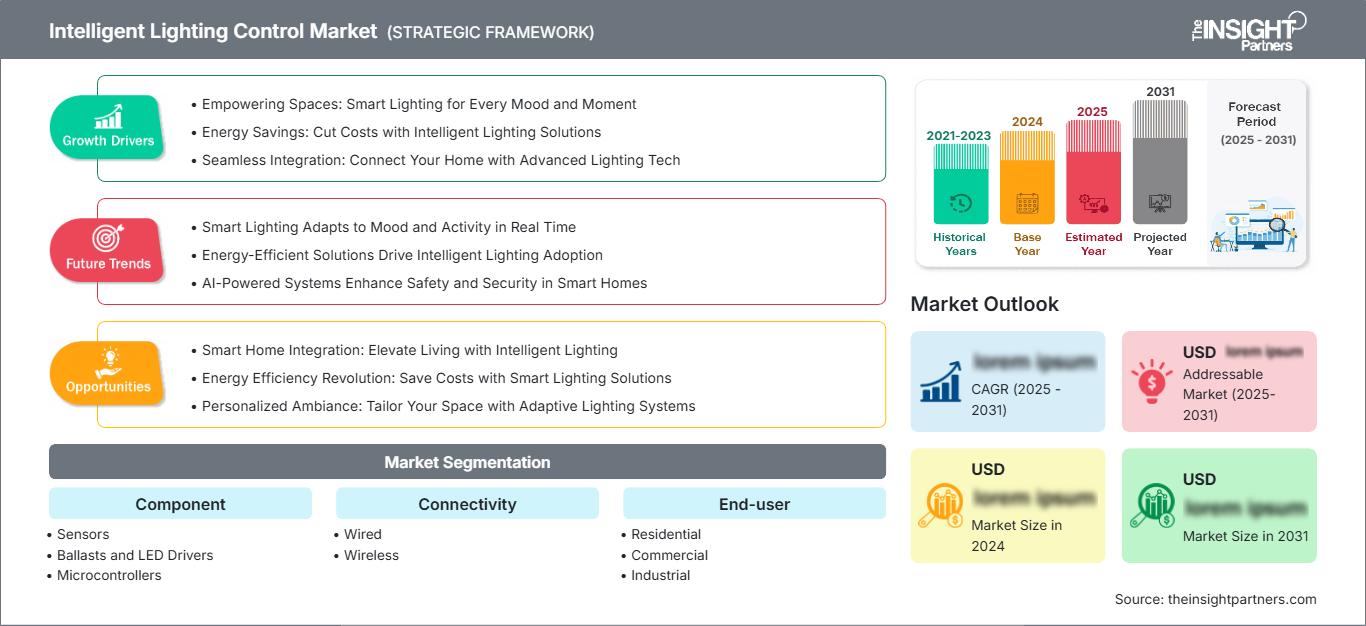
Intelligent Lighting Control Market: Strategic Insights
Regional Insights
North America Intelligent Lighting Control Market
North America represented a 28–31% share in 2025 and is projected to expand at a 10.8–11.6% CAGR through 2034. The US is the dominant source of regional demand, with Canada and Mexico contributing through commercial construction, industrial facilities, retail and institutional renovation. Office buildings and retrofits provide intermittent demand for controls which can be used in improving energy performance without the need for extensive wiring.
The Regional Intelligent Lighting Control Market is also driven by building performance standards and the growing interest in connectivity in facilities management. Wireless sensor implementation, digital commissioning, occupancy sensing and dimming based on day lighting are increasingly relevant in retrofits. The commercial market is looking for controls which can integrate with automation systems whereas the industrial market wants controls which are reliable and scalable for zone management.
U.S. Intelligent Lighting Control Market
The US represented 78–82% of North American demand in 2025 and is projected to grow at a 10.9–11.7% CAGR through 2034. Commercial buildings, hotels, healthcare, education, and retailing create strong demand. Some major players operating in this market include Eaton Corporation plc, Honeywell International Inc., Hubbell Incorporated, Lutron Electronics Co., Inc., and Schneider Electric SE.
Technology adoption in the US focuses on cost considerations for retrofits, wireless installation, presence detection, daylighting, and centralized management capabilities. Building owners will find it easier to justify controls in case the system can deliver operational data in addition to switch capabilities. New buildings will tend to install systems using wires, while older buildings will favor wireless installations to reduce cable installation.
Europe Intelligent Lighting Control Market
Europe held a 24–27% share in 2025 and is forecast to grow at a 10.2–11.0% CAGR through 2034, with Germany leading the region. Germany gets boosted by industrial and commercial automation, whereas the UK has a substantial retrofit market potential in the office, retail, hospitality, and institutional sectors. France is bolstered by building-efficiency measures, while the opportunities for Italy and Spain come from renovation and smart-building trends. The customers in Europe are becoming more aware of factors like interoperability, energy metering, life-cycle cost, and commissioning needs. The wired architecture is critical in new construction, while the wireless approach becomes relevant in retrofit projects.
APAC Intelligent Lighting Control Market
APAC represented a 30–33% share in 2025 and is expected to expand at a 12.6–13.5% CAGR through 2034, making it the fastest-growing major region. China drives the demand, followed by Japan, South Korea, and India. Australia is contributing to the market through commercial building, institutional building, and energy management systems.
Increased industrialization, urbanization, and smart-building projects have made the installable market base bigger. China is getting the benefit of manufacturing and construction, Japan due to its strength in building automation, South Korea due to electronics and commercial infrastructure, and India due to fast urbanization. Australia focuses on making buildings operate efficiently. Policies for energy-efficient infrastructure would facilitate sensor-based technologies.
Middle East & Africa Intelligent Lighting Control Market
Middle East and Africa demand is modeled at a 9.4–10.2% CAGR through 2034, led by Saudi Arabia. The United Arab Emirates represents a key location within the region for hospitality, commercial real estate, and smart city developments, whereas South Africa has commercial, industrial, and institutional property markets. The rest of the MEA market consists of project-specific developments.
Energy efficiency and infrastructure play an important role in driving demands in the market. The big urban developments in Saudi Arabia offer the chance of implementing integrated controls, while the big developments in the United Arab Emirates will be increasingly facilitated by building communications. Commercial and industrial retrofits in South Africa constitute yet another demand base. Suppliers who can provide local technical assistance, wireless communication solutions, and control systems are well placed to meet their demands.
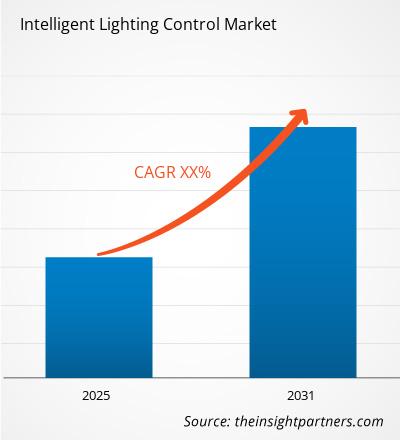
Segmentation Analysis
Component
The Component segment includes Sensors, Ballasts and LED Drivers, Microcontrollers, Dimmers and Switches Actuators, Transmitters and Receivers, and Intelligent Luminaries. It is projected to grow at an 11.4–12.1% CAGR during 2026–2034. The segment benefits from increasing integration of sensing, control electronics, connectivity, and intelligence directly into lighting hardware and infrastructure.
- Sensors: Sensors are fundamental to occupancy, daylight, motion, and environmental responsiveness. Demand is shifting toward multi-function devices that provide richer data while simplifying installation and enabling automated lighting decisions.
- Ballasts and LED Drivers: LED drivers regulate power and increasingly provide dimming and communication functions. Their strategic importance is increasing as connected luminaires require precise control, diagnostics, and compatibility with digital protocols.
- Microcontrollers: Microcontrollers provide local intelligence for sensing, dimming, scheduling, and communication. Their role expands as manufacturers move control functions closer to luminaires and reduce dependence on centralized processing.
- Dimmers and Switches Actuators: These components remain essential interfaces between control logic and electrical loads. Demand favors digitally configurable products supporting multiple lighting technologies, remote operation, and flexible installation.
- Transmitters and Receivers: Connectivity components enable wireless commands, sensing data, commissioning, and system coordination. Their importance rises as retrofit projects prioritize low-disruption installation and scalable control networks.
- Intelligent Luminaries: Intelligent luminaires integrate lighting, drivers, sensing, and communication into unified products. They offer simplified deployment and stronger data capabilities, particularly in new commercial and institutional projects.
Connectivity
Connectivity comprises Wired and Wireless architectures, with the segment expected to register a 12.2–12.9% CAGR during 2026–2034. The balance between the two approaches depends on project age, cabling conditions, reliability requirements, scalability, and installation economics. Wireless solutions are gaining strategic relevance in retrofit-heavy environments where construction disruption must be minimized.
- Wired: Wired systems remain important for large new-build projects requiring predictable communication, centralized control, and robust infrastructure. They are particularly suitable where cabling is incorporated during initial electrical installation.
- Wireless: Wireless systems support faster retrofits and flexible zoning by reducing additional cabling requirements. Their strategic value is strongest in existing buildings, leased spaces, hospitality properties, and projects requiring minimal physical disruption.
End-user
The End-user segment covers Residential, Commercial, and Industrial applications and is projected to expand at an 11.9–12.6% CAGR during 2026–2034. Commercial buildings provide the largest addressable base, while residential adoption benefits from smart-home penetration and industrial facilities increasingly use connected lighting for energy and operational management.
- Residential: Residential systems emphasize convenience, personalization, scheduling, voice interfaces, and energy awareness. Adoption is supported by retrofit-friendly wireless products that can add intelligence without extensive electrical modification.
- Commercial: Commercial buildings represent the strongest demand center because offices, retail, hospitality, healthcare, and education require scalable zoning, occupancy management, and energy optimization across multiple spaces.
- Industrial: Industrial applications prioritize reliability, task lighting, energy management, and automation. Connected systems can support operational visibility while enabling lighting to respond to occupancy, production schedules, and facility conditions.
Opportunity Snapshot
| End-user | Revenue Contribution | Trend Tag | Adoption Stage |
|---|---|---|---|
| Residential | Medium | Smart Homes | Scaling |
| Commercial | High | Building Automation | Mature |
| Industrial | Medium | Factory Controls | Scaling |
Intelligent Lighting Control Market Growth Drivers and Impact Analysis
Building energy optimization strengthens demand for automated controls
Owners of buildings have come to recognize lighting controls as a way of improving the operational efficiency of buildings and not just a tool in the electrical installation category. The occupancy sensors, the daylight harvesting, scheduling, and dimming all help match lighting with real activity levels in a space, resulting in reduced wasteful lighting activities. The benefit of these controls in a commercial context is most notable in large buildings in which several zones have different operating schedules. Lighting controls also generate operational information that can be used for maintenance planning and utilization planning purposes. With energy management systems becoming increasingly integrated, lighting systems now are often linked to HVAC and building management systems. This means that the benefits now move from controlling individual lights to optimizing the entire facility. With interoperable systems, manufacturers are now able to respond to the wider needs of building management systems.
Wireless architecture lowers barriers to retrofit adoption
The wireless connection addresses the challenge of installation of lighting control system by eliminating costs incurred through installation of new cables since wireless sensors, switches, controllers and luminaires require fewer infrastructural modifications. These wireless platforms are able to be installed in fully occupied office space, hotels, shopping centers, and institutions. The market opportunity encompasses leased buildings since the systems will not have to undergo any extensive infrastructural modification for configuration purposes. Additionally, wireless systems allow for flexible zoning in case of any changes on the layout of the floors. Reliability, cybersecurity, commissioning, battery and interoperability should still be considered while choosing the best vendor in the market. The vendors who tackle these issues will make it easier for facility managers to install connected controls that they had seen as very complicated to install before.
Smart-building integration increases the value of lighting data
The networks in question also offer a wealth of information concerning occupancy, energy, environmental, and operational conditions that may facilitate building management purposes. In conjunction with other systems, the lighting network infrastructure will assist in pinpointing underutilized space, harmonizing the environment, and gaining greater insights into the workings of the facility for the benefit of facility managers. This represents another financial motive for intelligent controls since the technology may yield benefits that extend beyond the field of lighting. Information sharing will foster interoperability and application programming capabilities. Building owners will be able to build upon the features already provided rather than swapping out entire systems. The business result is a transition towards platforms that incorporate hardware and software. Suppliers that will enable this transition through their support of open standards and secure data transmission are likely to bid on larger building-related projects.
Intelligent Lighting Control Market Future Trends
Lighting controls evolve toward autonomous building intelligence
The key trends in Future Intelligent Lighting Control Market will focus on the development of fully autonomous solutions which are able to understand the occupancy, sunlight, scheduling, and environmental conditions without human interference. Edge computing can make it possible to implement the decisions regarding lighting locally, thus making the systems less reliant on cloud connectivity. Machine learning algorithms can help recognize repetitive occupancy patterns and scheduling of lights on an automatic basis while allowing users to override their decisions. Moreover, lighting can also collaborate with window shades, HVAC system, and other energy management equipment to achieve smarter environment. All these trends will lead to growing demand for sensors that can generate more comprehensive data and controllers which can process it. The issue of cybersecurity and privacy will become even more relevant due to the increasing amount of data collected by interconnected devices.
Human-centric and adaptive illumination expands functional requirements
The Intelligent Lighting Control Market trends show that lighting solutions will progress from brightness controls to intelligent and adaptive environments that factor in color temperatures, time of day, preference of the occupants, and their activities. Tunable-white solutions may offer different lighting scenes for office, relaxation, shop, hospitality, and health-care settings. Future platforms may include all these features and occupancy as well as information about natural light and build dynamic profiles of lighting without the need for adjustment by hand. Adaptive lighting solutions can help commercial buildings distinguish between different spaces, but keep the control centralized. Home solutions can focus on customization and wider integration into home automation systems. Factories can have lighting profiles depending on the kind of activities that are supposed to be performed and the schedules of their realization. In this case, control architecture should provide more accurate dimming, additional software configuration, and compatibility of different luminaires.
Intelligent Lighting Control Market Opportunities
Retrofit platforms create scalable opportunities across aging buildings
The strongest investment opportunity lies in retrofit platforms that combine wireless connectivity, sensors, intelligent drivers, and simplified commissioning. Large numbers of existing buildings still operate conventional switching or limited automation, creating a broad replacement opportunity. The Intelligent Lighting Control Market Forecasts point toward sustained expansion as owners seek measurable energy and operational improvements without undertaking complete electrical reconstruction. Suppliers should prioritize modular architectures that can start with individual rooms and scale to entire properties. Installer training, remote commissioning, cybersecurity, and compatibility with existing luminaires can provide meaningful differentiation. Partnerships with facility-management companies and electrical contractors can accelerate adoption by embedding control solutions into recurring renovation programs. Investors should favor businesses with recurring software or service revenue because connected lighting increasingly creates opportunities for monitoring, analytics, maintenance, and optimization after the initial hardware installation.
Connected commercial properties offer high-value system integration opportunities
Commercial buildings provide an attractive opportunity in the Intelligent Lighting Control Market because lighting controls can become an entry point into wider building automation. Offices, hotels, hospitals, retail properties, and campuses require coordinated management of lighting, occupancy, HVAC, access, and energy systems. Suppliers can create value by offering open interfaces that allow lighting data to be incorporated into facility-management applications. Strategic partnerships with building-management software providers can expand the addressable project size and reduce dependence on hardware margins. System integrators also represent an important route to market because complex installations require design, commissioning, and lifecycle support. Companies should prioritize solutions that can operate across multiple building vintages and communication environments. The resulting business model can combine equipment sales with software, analytics, maintenance, and professional services, creating a broader revenue base and stronger customer relationships.
Recent Developments
- February 2026: Lutron Electronics unveiled its new Intelligent Lighting portfolio at Integrated Systems Europe (ISE), introducing a fully addressable lighting ecosystem that integrates natural light, electric light and wireless control for luxury residential applications. The portfolio launches with complementary Ketra and Orluna product families, spanning downlights, lamps, linear fixtures, tape, cylinders, uplights and floorwash fixtures.
- August 2026: Energy Efficiency Services Limited (EESL), in partnership with Andhra Pradesh’s Commissioner and Director of Municipal Administration (CDMA), announced plans to roll out an integrated smart LED street-lighting project across all 123 urban local bodies (ULBs) in the state. The project will replace nearly 10.5 lakh conventional streetlights with Individual Light Monitoring (ILM)-enabled smart LEDs connected to a centralised monitoring platform, with 7.5 lakh lights covered in the initial phase and another 3 lakh under the expanded scope.
- October 2025: Casambi partnered with Thea Enterprises, a manufacturer’s representative serving the New York metropolitan area, to expand access to smarter and more flexible lighting control solutions. The partnership combines Casambi’s LightingOS™ wireless lighting-control technology with Thea’s more than 30 years of expertise in commissioning and project delivery, supporting contractors, specifiers and building owners across the region.
Frequently Asked Questions

- Comprehensive Market Sizing and Forecast Analysis
- Detailed Segmentation Analysis
- In-Depth Market Dynamics Assessment
- Regional and Country-Level Insights
- Competitive Landscape and Company Benchmarking
- Strategic Business Intelligence
Recent Reports
Testimonials

The Insight Partners provided valuable market intelligence that supported our global go-to-market strategy. Their team was professional, responsive, and attentive to our feedback, providing thoughtful analysis and helpful methodological clarifications throughout the project.
Junmo Kim Chief Financial Officer (CFO), Enertech Co., Ltd.
The Insight Partners' SCADA System Market report is comprehensive, with valuable insights on current trends and future forecasts. The team was highly professional, responsive, and supportive throughout. We are very satisfied and highly recommend their services.
RAN KEDEM Partner, Reali Technologies LTDs
I requested a report on a very specific software market and the team produced the report in a few days. The information was very relevant and well presented. I then requested some changes and additions to the report. The team was again very responsive and I got the final report in less than a week.
JEAN-HERVE JENN Chairman, Future Analytica
We worked with The Insight Partners for an important market study and forecast. They gave us clear insights into opportunities and risks, which helped shape our plans. Their research was easy to use and based on solid data. It helped us make smart, confident decisions. We highly recommend them.
PIYUSH NAGPAL Sr. Vice President, High Beam Global
The Insight Partners delivered insightful, well-structured market research with strong domain expertise. Their team was professional and responsive throughout. The user-friendly website made accessing industry reports seamless. We highly recommend them for reliable, high-quality research services
YUKIHIKO ADACHI CEO, Deep Blue, LLC.
This is the first time I have purchased a market report from The Insight Partners.While I was unsure at first, I visited their web site and felt more comfortable to take the risk and purchase a market report.I am completely satisfied with the quality of the report and customer service. I had several questions and comments with the initial report, but after a couple of dialogs over email with their analyst I believe I have a report that I can use as input to our strategic planning process.Thank you so much for taking the extra time and making this a positive experience.I will definitely recommend your service to others and you will be my first call when we need further market data.
JOHN SUZUKI President and Chief Executive Officer, Board Director, BK Technologies
I wish to appreciate your support and the professionalism you displayed in the course of attending to my request for information regarding to infectious disease IVD market in Nigeria. I appreciate your patience, your guidance, and the fact that you were willing to offer a discount, which eventually made it possible for us to close a deal. I look forward to engaging The Insight Partners in the future, all thanks to the impression you have created in me as a result of this first encounter.
DR CHIJIOKE ONYIA MANAGING DIRECTOR, PineCrest Healthcare Ltd.Reason to Buy
- Informed Decision-Making
- Understanding Market Dynamics
- Competitive Analysis
- Identifying Emerging Markets
- Customer Insights
- Market Forecasts
- Risk Mitigation
- Boosting Operational Efficiency
- Strategic Planning
- Investment Justification
- Tracking Industry Innovations
- Aligning with Regulatory Trends





 Get Free Sample for