
Ferroelectric Materials Market Size, Growth & Trends by 2034
Coverage: By Product Type (Barium Titanate, Lead Zirconate Titanate (PZT), Lead Titanate (PbTiO3), Lead Lanthanum Zirconate Titanate (PLZT)); Application (Ceramic Capacitors, Thermistor, Piezoelectric, Switches, Light Deflectors, Others), and Geography (North America, Europe, Asia Pacific, and South and Central America)
- Status : Data Released
- Report Code : TIPRE00016423
- Category : Chemicals and Materials
- No. of Pages : 150
- Available Report Formats :


- Last update date : October 22, 2026


2025 Market Size
US$ 3.19 Bn
Base year value
2034 Forecast
US$ 7.02 Bn
Projected by 2034
CAGR 2026-2034
9.16 %
Growth rate
Addressable Market
US$ 45.65 Bn
(2026-2034)
The Ferroelectric Materials Market was valued at US$ 3.19 Billion in 2025 and is projected to reach US$ 7.02 Billion by 2034, registering a CAGR of 9.16% during 2026–2034. Market expansion is supported by rising requirements for high-performance dielectric and piezoelectric materials in electronic components, precision devices, communication equipment, automotive systems, and advanced industrial technologies.
In North America, the ferrolectric materials market size is supported by semiconductor investment, advanced medical-device manufacturing, aerospace electronics, and increasing adoption of high-performance sensing and actuation systems. The region is estimated to expand at a CAGR of 7.5–8.5% during 2026–2034, with demand benefiting from domestic electronics manufacturing initiatives and the need for reliable materials in automotive, industrial, and defense applications.
Ferroelectric Materials Market Assessment and Insights
- North America: North America accounted for an estimated 18–22% Ferroelectric Materials Market share in 2025 and is expected to grow at a CAGR of 7.5–8.5% during 2026–2034. Semiconductor investment, medical electronics, aerospace technologies, and automotive electrification strengthen demand for advanced dielectric and piezoelectric ceramic materials.
- US: The US represented approximately 78–82% of North American demand in 2025 and is projected to expand at a CAGR of 7.8–8.8% during 2026–2034, supported by semiconductor fabrication and advanced electronic systems.
- Europe: Europe held an estimated 20–24% share in 2025 and is expected to grow at 7.0–8.0% CAGR during 2026–2034. Germany, the UK, France, Italy, and Spain support demand through automotive electronics, industrial automation, medical technology, and advanced ceramics manufacturing.
- Asia Pacific: Asia Pacific represented an estimated 48–52% share in 2025 and is projected to register a 10.0–11.0% CAGR during 2026–2034. China, Japan, South Korea, and India remain central to electronics production, ceramic-component manufacturing, semiconductor investment, and electric mobility.
- Largest Segment: Ceramic Capacitors represented an estimated 40–45% market share in 2025 and are expected to expand at 9.0–10.0% CAGR during 2026–2034, supported by component miniaturization and rising electronic circuit density.
- High Growth Segment: Piezoelectric applications accounted for approximately 22–27% market share in 2025 and are projected to grow at a 10.5–11.5% CAGR during 2026–2034, driven by sensors, actuators, ultrasound, precision motion, and industrial automation.
- Key companies analyzed in detail: American Elements; Seiko Epson Corporation; Kyocera Corporation; Molchem; PI Ceramic GmbH; Piezo Kinetics, Inc.; Sparkler Piezo-Ceramics Private Limited; Titanates Limited; TPL, Inc.; Zhonglan Industry Co., Ltd.
Source: The Insight Partners' analysis based on proprietary research, government publications, company annual reports, investor presentations, industry databases, and expert interviews.
There has been a transition in materials development in the Ferroelectric Materials Market from bulk ceramics through conventional methods to controlled powder forms, controlled compositions, grain structures, multilayers, and thinner dielectric layers. Barium titanate is still very significant owing to ferroelectric Class II ceramic materials providing high dielectric constants for small capacitors and PZT material providing support in difficult piezoelectric applications. Therefore, there is now an increased influence of manufacturing quality, compositions, reliability, and compatibility with advanced electronic packaging rather than just quantity of material in the ferroelectric materials market.
In future, the manufacturing facilities located in Asia will continue to be significant whereas more investment in specialty materials, semiconductors-related products, medical technologies and high value-added piezoelectric components will be made in North America and Europe. Increasing environmental requirements will drive more interest in lead-free ceramics. Simultaneously, there will be more public-private investment in electrification and electricity infrastructure that will expand the addressable electronics market.
Ferroelectric Materials Market Report Scope
| Report Attribute | Details |
|---|---|
| Market size in 2025 | US$ 3.19 Billion |
| Market Size by 2034 | US$ 7.02 Billion |
| Global CAGR (2026 - 2034) | 9.16% |
| Historical Data | 2021-2024 |
| Forecast period | 2026-2034 |
Ferroelectric Materials Market Analysis
The demand environment in the Ferroelectric Materials Market is becoming more influenced by the growing demand for ferroelectric materials in compact electronics, high voltage power systems, sensors, and automation equipment. The supply chain starts with chemical precursors and powders with high purity and is then followed by processes like calcination, milling, formulating, ceramics processing, electrodes attachment, testing, and finally assembling. There are several factors to be considered by material suppliers such as dielectric, piezoelectric, thermal, and mechanical properties. The supply situation relies much on consistency as minor changes in the composition and properties of particles will have a huge impact on electricity generation and manufacturing process.
Consumer electronics and machinery continue to be major volume buyers; however, the value of demand from automotive, communication equipment, medical devices, and precision machinery is becoming more intense. Advanced electronics need to be small in size without affecting the capacitance and reliability. Sensors and actuators applications are focused on their responses and long-term stability.
The competition in ferroelectric materials markets is increasingly being driven by formulation skill and engineering for specific applications. American Elements provides materials for specialty applications, whereas PI Ceramic GmbH and Piezo Kinetics, Inc. specialize in high performance piezoelectrics. Kyocera Corporation possesses advanced ceramics knowledge and manufacturing ability of devices and components, while Seiko Epson Corporation offers experience in precision devices and functional materials/actuators for controlled environments.
Geographic scale and customer qualification processes also impact the competition in the Ferroelectric Materials Market. Molchem, Sparkler Piezo-Ceramics Private Limited, Titanates Limited, TPL, Inc., and Zhonglan Industry Co., Ltd. are involved in specialized supply chains with particular material and application needs. Competitive positioning in such an environment increasingly revolves around better powder quality and fewer defects, customer formulations, and meeting environmental requirements. Consequently, investment trends are becoming increasingly focused on process automation, thin ceramics, advanced characterization, and development processes that expedite the transition from laboratory formulation to qualified commercial component development.
● REPORT CUSTOMIZATION
Tailor This Report To Align With Your Specific Business Requirements
This report can be customized to align precisely with your business objectives, scope, and target markets. Customization options include tailored segmentation, geography, competitive analysis, and strategic insights to support informed decision-making.
Customize This Report →WHAT YOU CAN ADJUST
- ● Segmentations
- ● Geography
- ● Competitive Analysis
- ● Language Preferences
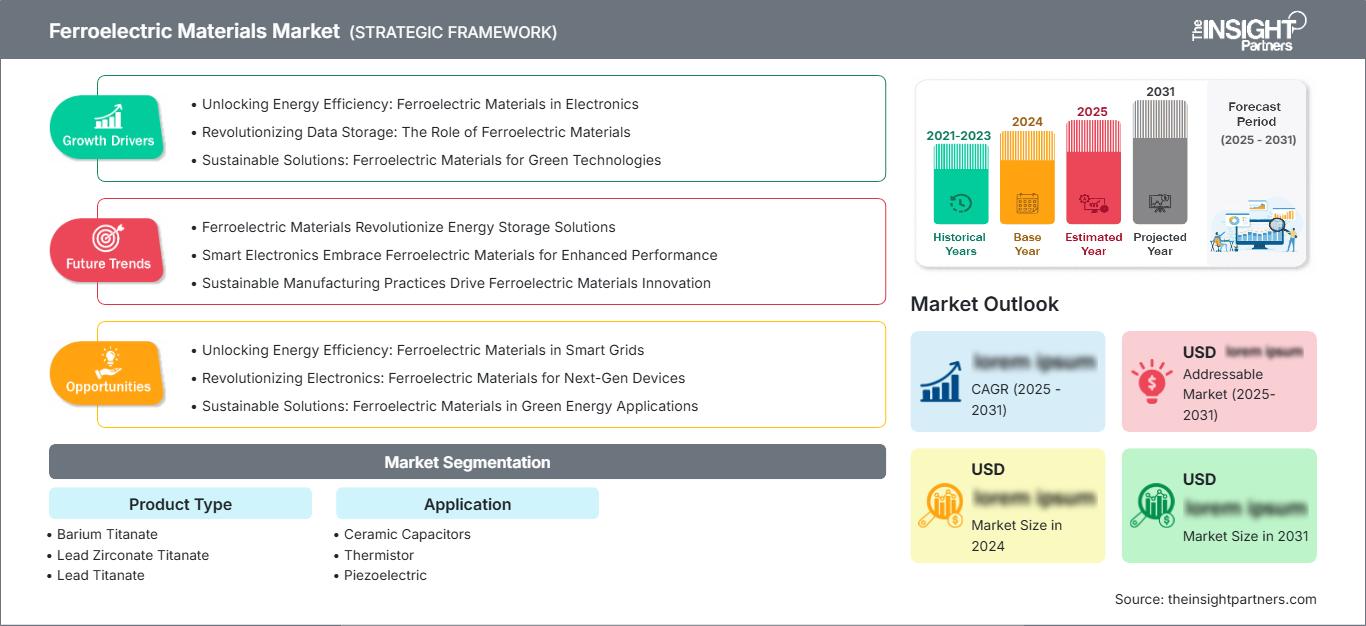
Ferroelectric Materials Market: Strategic Insights
Regional Insights
North America ferrolectric materials market
North America accounted for an estimated 18–22% share in 2025 and is projected to record a 7.5–8.5% CAGR during 2026–2034. This region is favored with semiconductor fabrication processes, medicine technology, aerospace electronics, industrial automation and defense electronics. The demand in the region lies in high value-added products, where consistency, quality, reliability and traceability become more crucial than the quantity produced. Investment in manufacturing in the region promotes the use of specialized electronic materials in the region. The United States leads in terms of demand in the region and Canada through its contribution in aerospace, R&D, communications, and industrial electronics technologies. Increased investments in advanced manufacturing and increased production capacity for high technology products fuel the growth of this market. Ferroelectric materials market in North America is thus strategic despite the larger production in Asia Pacific region.
U.S. ferrolectric materials market Market
The US represented approximately 78–82% of North American Ferroelectric Materials Market in 2025 and is anticipated to expand at a 7.8–8.8% CAGR during 2026–2034. Diversified needs for materials and device technologies arise in semiconductor fabrication plants, medical instruments, aerospace applications, industrial automation, and automotive electronics. Availability of companies like American Elements, TPL, Inc., Piezo Kinetics, Inc., and engineering firms provides local sources for certain materials and device technologies.
Application developments include sensors, ultrasonic transducers, motion control systems, communication components, and embedded electronics. Additionally, manufacturing investments indirectly drive demand through broadening the electronic materials ecosystem. Customers typically expect stable performance over a long qualification period, thereby providing a barrier to entry to companies that lack adequate materials characterization capabilities and quality processes.
Moreover, the US holds importance in the area of alternative ferroelectric systems and semiconducting materials. Such capabilities together with the advanced manufacturing make it suitable for high-value opportunities rather than bulk ceramic material manufacturing. Thus, regional expansion will be associated with technology investment and increasing component complexity.
Europe ferrolectric materials market Market
Europe held an estimated 20–24% share in 2025 and is expected to expand at a 7.0–8.0% CAGR during 2026–2034. Germany leads the region due to its advanced automotive, industrial automation, machinery and technical ceramic technology infrastructure. The growing demand in the region is shifting towards materials used in sensors, precision actuators, medical devices and electromobility technologies.
The contribution of the UK includes the aerospace industry, scientific instruments, advanced manufacturing and ceramics expertise. Piezoelectric technology in Europe is represented by PI Ceramic GmbH, while Kyocera's European business is engaged in technical ceramics and component production. Development of reduced and lead-free functional ceramic systems is also supported by research activities at various universities and industrial organizations.
France, Italy and Spain contribute through automotive industries, industrial equipment, healthcare technologies, renewable energy infrastructures and electronics manufacturing industries. Their combined contribution increases the demand beyond Germany's industrial infrastructure. Sustainability and environmental regulations continue to play a significant role in the region. As conventional lead-based piezoelectric ceramics come under more regulations, the Europe will keep a dominant position in high-end applications.
APAC ferrolectric materials market Market
The Ferroelectric Materials Market forecast shows that Asia Pacific represented an estimated 48–52% share in 2025 and is projected to grow at a 10.0–11.0% CAGR during 2026–2034. China is the largest country owing to its big electronics and ceramic parts manufacturing capabilities, while Japan and South Korea provide their contribution in the form of highly efficient electronic parts, material science, and semiconductors. In addition, India has been developing its electronics manufacturing capabilities, and Australia provides specialization in research and industry applications.
Industrial policies that encourage semiconductors, electronics manufacturing, electric mobility, and digital infrastructure create demand. Volume manufacturing creates cost advantages, but Japan and South Korea are important players in providing high-performance formulations and precision components. Thus, the Asia Pacific region has been combining volumes and innovation.
Middle East & Africa ferrolectric materials market Market
According to the Ferroelectric Materials Market report, Middle East & Africa is expected to register a 6.5–7.5% CAGR during 2026–2034, supported by infrastructure modernization and increasing deployment of advanced electronic systems. The investment in digital technology, industrial diversification, automation, and energy technology by Saudi Arabia and the UAE indirectly leads to the creation of demand for sensors, power electronics, and other components.
South Africa remains important owing to its uses in industry, telecommunication, mining, and research while the Rest of MEA continues to be an important market with some growth potential due to smaller scale but still significant demand. The growth in the region is directly related to the usage of the equipment rather than to the local production of ceramics.
Segmentation Analysis
Product Type
The Product Type segment is projected to grow at a CAGR of 8.8–9.8% during 2026–2034. Material selection depends on dielectric behavior, piezoelectric response, processing compatibility, operating environment, and regulatory requirements. The ferrolectric materials market scope includes established titanate and zirconate systems that continue to serve distinct component architectures, while innovation increasingly focuses on improving performance consistency and reducing environmental constraints.
- Barium Titanate: This material holds strategic importance in high-capacitance ceramic components, particularly multilayer capacitor dielectrics, where compact dimensions and high dielectric response support electronic miniaturization and increasing circuit density.
- Lead Zirconate Titanate: PZT remains important for transducers, actuators, ultrasound devices, and precision systems because of its strong piezoelectric characteristics and established processing knowledge across specialized industrial applications.
- Lead Titanate: Lead titanate serves selected high-temperature and piezoelectric applications where crystal properties and thermal characteristics make it suitable for specialized functional ceramic designs and research programs.
- Lead Lanthanum Zirconate Titanate: PLZT supports optoelectronic and electro-optic functions, including selected light-control and deflection applications, where composition engineering enables tailored dielectric and optical behavior.
Application
The Application segment is anticipated to grow at a CAGR of 9.3–10.3% during 2026–2034. Demand patterns vary significantly because capacitors prioritize dielectric performance, while piezoelectric devices require electromechanical conversion and switches or optical devices depend on controlled polarization behavior. Increasing electronics complexity, automation, and precision-device deployment are broadening application requirements.
- Ceramic Capacitors: This is the largest application, supported by multilayer component production, high circuit density, electronic miniaturization, and the need for high capacitance within increasingly compact electronic devices.
- Thermistor: Ferroelectric and related ceramic formulations support temperature-sensitive electronic functions, creating opportunities in circuit protection, thermal monitoring, consumer appliances, automotive systems, and industrial equipment.
- Piezoelectric: This application is strategically important for actuators, sensors, ultrasound, precision positioning, printing systems, and energy conversion devices requiring controlled electromechanical response.
- Switches: Polarization switching characteristics support specialized memory, control, and electronic switching concepts where low-energy operation and nonvolatile functional behavior provide technical advantages.
- Light Deflectors: Electro-optic material behavior supports specialized optical control, beam steering, instrumentation, and precision photonic systems requiring rapid and controllable modification of optical signals.
Opportunity Snapshot
| Application | Revenue Contribution | Trend Tag | Adoption Stage |
|---|---|---|---|
| Ceramic Capacitors | High | MLCC Density | Mature |
| Thermistor | Medium | Thermal Sensing | Mature |
| Piezoelectric | High | Precision Motion | Scaling |
| Switches | Low | Nonvolatile Switching | Emerging |
| Light Deflectors | Medium | Optical Steering | Scaling |
Ferroelectric Materials Market Growth Drivers and Impact Analysis
Electronic Miniaturization and Higher Component Density
More sophisticated electronic devices include an ever-increasing combination of computing capabilities, communication capabilities, sensor capabilities, and power management in a shrinking amount of space. This creates a need for more dielectric materials with improved performance characteristics for use in compact capacitors and integrated electronic circuits. Barium Titanate becomes crucial since Class II ferroelectric ceramics offer a high dielectric constant for compact capacitors. Material suppliers will have to enhance their capabilities for controlling particle size and composition as well as the manufacturing process. The demand will increase not only in terms of volume but also in terms of higher requirements regarding quality due to thinning of layers and smaller sizes of parts.
Expansion of Electrification and Advanced Power Electronics
Global investment in electrification is enlarging the ecosystem for power conversion, energy storage, electric mobility, industrial automation, and intelligent infrastructure. The IEA expects electricity-sector investment to reach US$ 1.5 trillion in 2025, illustrating the scale of investment supporting electricity-based technologies and related equipment. This environment increases requirements for capacitors, sensors, control systems, and electronic assemblies. Ferroelectric and piezoelectric materials benefit indirectly as equipment becomes more electronically controlled and functionally complex. Automotive electrification is particularly relevant because vehicles require more electronic modules, sensing functions, and high-reliability components. The resulting opportunity favors suppliers able to support demanding qualification standards, stable electrical properties, and application-specific engineering requirements.
Growing Use of Precision Sensors and Actuators
Industrial automation, medical equipment, digital printing, robotics, ultrasound, and precision positioning systems increasingly require compact devices that convert electrical energy into controlled mechanical motion or convert mechanical signals into electrical outputs. Piezoelectric ferroelectric ceramics are well suited to these functions because their electromechanical response can be engineered through composition and processing. Demand is moving toward higher precision, smaller dimensions, and improved repeatability, which increases the importance of advanced ceramic fabrication. This driver supports specialized suppliers more strongly than commodity material producers. It also creates opportunities for co-development with equipment manufacturers because performance depends on the interaction between material properties, component geometry, electrodes, packaging, and operating conditions.
Ferroelectric Materials Market Future Trends
Lead-Free Ferroelectric Development Will Accelerate
The ferroelectric materials market trends increasingly point toward greater investment in lead-free functional ceramics. Environmental expectations and material-regulatory considerations are encouraging research into barium titanate and alternative compositions that can deliver competitive dielectric or piezoelectric performance. The transition will be gradual because PZT has a mature application base and strong functional characteristics. Future commercialization will therefore focus on applications where lead-free formulations can meet performance and reliability requirements without imposing excessive processing costs. Suppliers will increasingly differentiate through composition engineering, dopant control, grain-structure optimization, and application-specific testing. This transition could gradually reshape procurement decisions, particularly among customers developing environmentally differentiated electronics and medical technologies.
Semiconductor-Compatible Ferroelectrics Will Gain Strategic Attention
The Ferroelectric Materials Market report shows that future technology development is expected to expand interest in thin-film and semiconductor-compatible ferroelectric systems. The ability to integrate functional materials into increasingly compact electronic architectures creates opportunities for embedded capacitors, nonvolatile memory concepts, and emerging logic technologies. Hafnium-oxide-based ferroelectrics have attracted attention because modified compositions can be integrated with semiconductor manufacturing processes and scaled to very thin dimensions. Commercial adoption will depend on endurance, uniformity, yield, and integration economics. Traditional bulk ceramics will remain important, but suppliers capable of extending materials expertise toward thin films, advanced deposition, and semiconductor processing could participate in higher-value technology segments as research programs transition toward commercial devices.
Ferroelectric Materials Market Opportunities
Specialized Materials for High-Reliability Industrial Applications
A significant investment opportunity exists in application-specific materials for industrial automation, aerospace, medical technology, and high-reliability electronics. These markets typically involve longer qualification cycles and demanding performance requirements, creating barriers to entry but supporting greater technical differentiation. The ferrolectric materials market Forecasts indicate that suppliers investing in advanced characterization, lot-to-lot consistency, and customer-specific formulation can improve access to these specialized applications. Investment priorities should include controlled powder synthesis, automated quality monitoring, traceability, and technical collaboration with component manufacturers. Rather than competing solely on material cost, suppliers can capture value by solving reliability and integration challenges. This strategy is particularly relevant for precision sensors, actuators, ultrasound components, and harsh-environment electronic systems.
Localized Technical Support for Emerging Electronics Manufacturing
Electronics manufacturing in the Ferroelectric Materials Market is expanding across emerging industrial locations, creating opportunities for suppliers that combine materials availability with local technical support. India and selected Southeast Asian economies are particularly relevant as manufacturing ecosystems broaden across components, devices, and assembly operations. Establishing regional application laboratories, qualification support, and customer engineering capabilities can shorten development cycles and strengthen supplier relationships. Investment should focus on partnerships with ceramic-component producers and electronics manufacturers rather than standalone material distribution. Localized technical services can also help customers optimize sintering, electrode compatibility, and component reliability. Companies that establish application support before markets reach full maturity may secure strategic customer positions as regional manufacturing capacity expands.
Recent Developments
- August 2026: Smartkem, Inc. (Nasdaq: SMTK) ("Smartkem" or the "Company") announced that it has entered into a definitive business combination agreement (the "Agreement") with Ferrox Critical Minerals ("Ferrox"), a critical minerals developer whose principal asset is the Tivani project in Limpopo Province, South Africa. “With this merger we will now have the ability to source critical minerals for Smartkem as well as provide excess material to the global market, making Smartkem one of the few vertically integrated public electronics companies,” comments Terrence Duffy, incoming CEO.
- April 2026: VTT announced that it is developing a new type of low-power memory based on ultra-thin films of ferroelectric hafnium zirconium oxide (HZO). This material can retain its electrical polarisation even when power is switched off. The technology is highly energy efficient, fast to write and read, compact enough for integration in a small footprint, and capable of being reprogrammed more than a trillion times. When co-integrated with a selector, it can also enable analogue computing directly in memory.
Frequently Asked Questions

- Comprehensive Market Sizing and Forecast Analysis
- Detailed Segmentation Analysis
- In-Depth Market Dynamics Assessment
- Regional and Country-Level Insights
- Competitive Landscape and Company Benchmarking
- Strategic Business Intelligence
Recent Reports
Testimonials

The Insight Partners provided valuable market intelligence that supported our global go-to-market strategy. Their team was professional, responsive, and attentive to our feedback, providing thoughtful analysis and helpful methodological clarifications throughout the project.
Junmo Kim Chief Financial Officer (CFO), Enertech Co., Ltd.
The Insight Partners' SCADA System Market report is comprehensive, with valuable insights on current trends and future forecasts. The team was highly professional, responsive, and supportive throughout. We are very satisfied and highly recommend their services.
RAN KEDEM Partner, Reali Technologies LTDs
I requested a report on a very specific software market and the team produced the report in a few days. The information was very relevant and well presented. I then requested some changes and additions to the report. The team was again very responsive and I got the final report in less than a week.
JEAN-HERVE JENN Chairman, Future Analytica
We worked with The Insight Partners for an important market study and forecast. They gave us clear insights into opportunities and risks, which helped shape our plans. Their research was easy to use and based on solid data. It helped us make smart, confident decisions. We highly recommend them.
PIYUSH NAGPAL Sr. Vice President, High Beam Global
The Insight Partners delivered insightful, well-structured market research with strong domain expertise. Their team was professional and responsive throughout. The user-friendly website made accessing industry reports seamless. We highly recommend them for reliable, high-quality research services
YUKIHIKO ADACHI CEO, Deep Blue, LLC.
This is the first time I have purchased a market report from The Insight Partners.While I was unsure at first, I visited their web site and felt more comfortable to take the risk and purchase a market report.I am completely satisfied with the quality of the report and customer service. I had several questions and comments with the initial report, but after a couple of dialogs over email with their analyst I believe I have a report that I can use as input to our strategic planning process.Thank you so much for taking the extra time and making this a positive experience.I will definitely recommend your service to others and you will be my first call when we need further market data.
JOHN SUZUKI President and Chief Executive Officer, Board Director, BK Technologies
I wish to appreciate your support and the professionalism you displayed in the course of attending to my request for information regarding to infectious disease IVD market in Nigeria. I appreciate your patience, your guidance, and the fact that you were willing to offer a discount, which eventually made it possible for us to close a deal. I look forward to engaging The Insight Partners in the future, all thanks to the impression you have created in me as a result of this first encounter.
DR CHIJIOKE ONYIA MANAGING DIRECTOR, PineCrest Healthcare Ltd.Reason to Buy
- Informed Decision-Making
- Understanding Market Dynamics
- Competitive Analysis
- Identifying Emerging Markets
- Customer Insights
- Market Forecasts
- Risk Mitigation
- Boosting Operational Efficiency
- Strategic Planning
- Investment Justification
- Tracking Industry Innovations
- Aligning with Regulatory Trends





 Get Free Sample for