
Electronic Cleaning Solvents Market Trends, Demand & Growth by 2034
Coverage: by Product Type (Glycol and Glycol Ethers, Brominated Solvents, Fluorinated Solvents, Formulated Hydrocarbon Solvents, Others); Application (Equipment Manufacturing, Servicing, Repair) , and Geography (North America, Europe, Asia Pacific, and South and Central America)
- Status : Data Released
- Report Code : TIPRE00008071
- Category : Chemicals and Materials
- No. of Pages : 150
- Available Report Formats :


- Last update date : September 28, 2026


2025 Market Size
US$ 2.84 Bn
Base year value
2034 Forecast
US$ 5.52 Bn
Projected by 2034
CAGR 2026-2034
7.66 %
Growth rate
Addressable Market
US$ 37.64 Bn
(2026-2034)
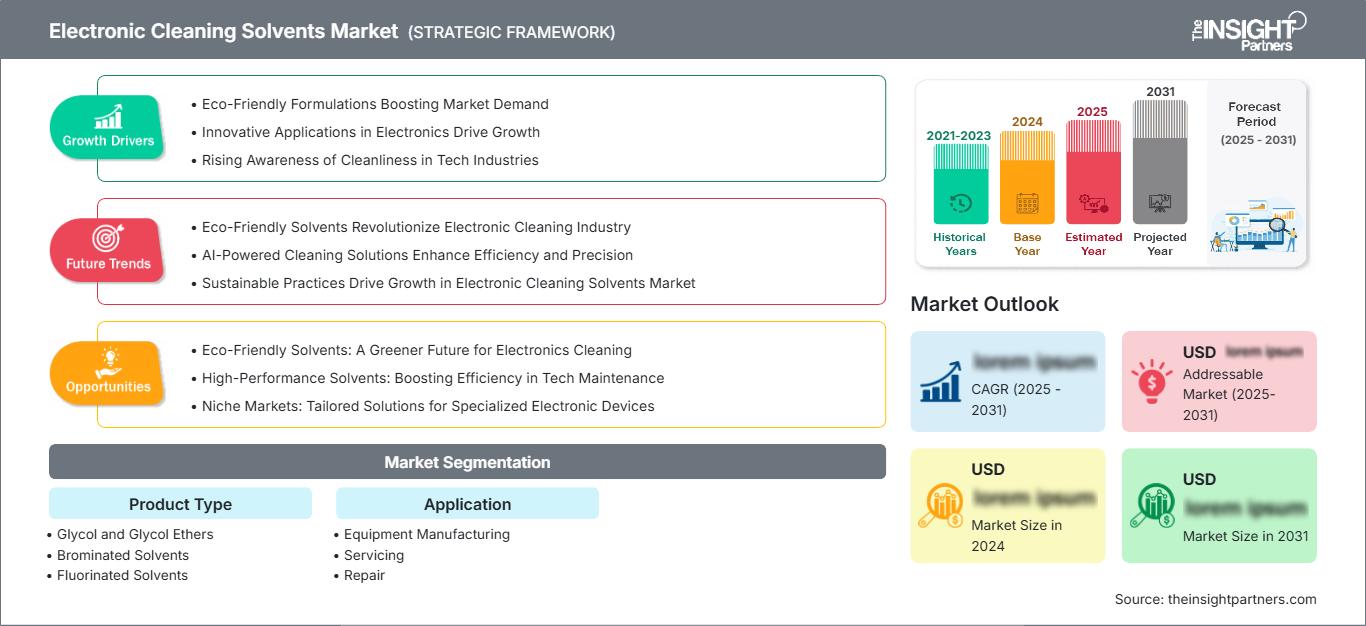
The Electronic Cleaning Solvents market size was valued at US$ 2.84 Billion in 2025 and is projected to reach US$ 5.52 Billion by 2034, registering a CAGR of 7.66% from 2026 to 2034. The market covers specialty chemistries used to remove flux, oils, particulate matter, oxidation, moisture, and other contaminants from electronic assemblies and equipment. It is segmented by Product Type into Glycol and Glycol Ethers, Brominated Solvents, Fluorinated Solvents, and Formulated Hydrocarbon Solvents, and by Application into Equipment Manufacturing, Servicing, and Repair.
North America represents a mature but technically demanding market, supported by semiconductor manufacturing, aerospace electronics, automotive electronics, data-center infrastructure, and industrial equipment maintenance. The region accounted for an estimated ~29% of the global Electronic Cleaning Solvents market in 2025 and is expected to expand at ~6.8% CAGR through 2034. Regulatory pressure on high-toxicity and high-environmental-impact chemistries is encouraging users to qualify lower-GWP, nonflammable, residue-free alternatives. In January 2025, U.S. regulatory guidance on perchloroethylene use in energized electrical cleaning further increased the importance of solvent selection, process controls, and safer alternatives.
Electronic Cleaning Solvents Market Assessment and Insights
- North America: The region held ~29% of the global Electronic Cleaning Solvents market share in 2025 and is projected to grow at ~6.8% CAGR. Its mature electronics, aerospace, industrial controls, and automotive production base support recurring demand, while environmental and occupational requirements are accelerating reformulation. The implication is a gradual shift toward application-specific chemistries rather than commodity cleaning fluids.
- U.S.: The U.S. represented ~84% of North America's market in 2025 and is expected to expand at ~6.7% CAGR. Semiconductor, defense, aerospace, data-center, and automotive electronics applications support demand, while chemical restrictions encourage manufacturers to qualify alternatives to legacy chlorinated and other high-concern solvents.
- Europe: Europe represented ~25% of the global market in 2025 and is projected to grow at ~6.9% CAGR. Germany, the UK, France, and Italy provide substantial electronics, automotive, industrial, and aerospace demand. Regulatory compliance, worker safety, VOC management, and low-GWP chemistry are stronger differentiators than simple cleaning power.
- Asia Pacific: Asia Pacific accounted for ~37% of global demand in 2025 and is expected to grow at ~9.1% CAGR. China, Japan, South Korea, and India combine electronics manufacturing, semiconductor investment, automotive electronics production, and expanding repair ecosystems. The region's supply-chain depth gives solvent suppliers opportunities to develop localized formulations and technical service.
- Largest Segment: Equipment Manufacturing is the largest Application segment and is expected to expand at ~8.0% CAGR. Cleaning is embedded directly into PCB assembly, component manufacturing, precision equipment production, and final inspection workflows, making process reliability and residue control important purchasing criteria.
- High Growth Segment: Formulated Hydrocarbon Solvents are expected to record ~8.8% CAGR. Their growth is supported by demand for fast-drying, residue-free cleaning, compatibility with selected plastics and elastomers, and substitution opportunities where users seek practical alternatives to regulated chemistries.
- Key companies analyzed in detail: 3M Company; A.W. Chesterton Company; Albemarle Corporation; CRC Industries, Inc.; Electrolube, a MacDermid Alpha Electronics Solutions brand; Honeywell International Inc.; LyondellBasell Industries N.V.; Miller-Stephenson, Inc.; Illinois Tool Works Inc.; and ZESTRON.
Source: The Insight Partners' analysis based on proprietary research, government publications, company annual reports, investor presentations, industry databases, and expert interviews.
The electronics cleaning industry has evolved from degreasing to precision cleaning. The modern circuit boards, connectors, sensors, optical interconnects, and miniature assembly parts have become more complex in geometries and more vulnerable to plastics, coatings, rubber-like and metallic materials. As a result, the solvents offered by the manufacturers include solvent selection factors such as level of residue, evaporation rate, material compatibility, flammability, solvency strength, and environmental considerations. These solvent types include the traditional alcohols and hydrocarbon cleaning fluids as well as bromine- and fluorine-based precision cleaning fluids.
Production conditions are changing at the same time. The selection of cleaning chemistry takes place along with equipment selection, processing temperature, agitation, drying, enclosure and recovery methods. Co-solvent systems are becoming more popular where a single solvent fails to dissolve both polar and non-polar contamination effectively. Recent advances in electronics cleaning technology focus on proper selection of solvent chemistry with regard to type of contaminant, substrate material and cleaning process.
From now until 2034, commercialization trends will see the predominance of low-GWP, low-residue, non-flammable, and PFAS-aware formulations wherever possible. Supply chains will trend regionalized as electronic manufacturers desire short qualification processes and reliable chemical supply closer to their manufacturing hubs. The clustering of semiconductor and automotive electronics manufacturing, along with other high-tech manufacturing investments in the Asia Pacific region, will be conducive to local formulation and technical support capability.
The regulatory environment will be a critical factor in product selection. Regulatory constraints on chemicals like PCE as well as increased regulation of fluorinated chemistries are making it harder and more expensive to qualify. Meanwhile, precise cleaning demands make a simple switch-out impossible due to the need for the replacement solvent to maintain cleaning efficacy and material compatibility. This opens up opportunities for suppliers to offer a combination of chemistry, process qualification, equipment compatibility, and solvent recovery.
Electronic Cleaning Solvents Market Report Scope
| Report Attribute | Details |
|---|---|
| Market size in 2025 | US$ 2.84 Billion |
| Market Size by 2034 | US$ 5.52 Billion |
| Global CAGR (2026 - 2034) | 7.66% |
| Historical Data | 2021-2024 |
| Forecast period | 2026-2034 |
Electronic Cleaning Solvents Market Analysis
There is a growing need for demand from a chain of manufacturing processes which are sensitive to contamination rather than from general maintenance. The processes include flux and solder residues due to PCB assembly; oil and particulates from precise component manufacture; oxidation for connectors and switches; and increasingly clean surfaces for semiconductor processing. As such, the growth of Electronic Cleaning Solvents is directly tied to the level of production of electronics as well as increasing functionality densities of the assemblies. An example is CRC Industries which markets electronic cleaning products for contacts, switches, motors, relays, connectors, busbars, sensors and associated equipment.
In terms of the value chain, there is the supply of solvents and intermediates by specialty chemical producers followed by formulators who work on optimizing solvent properties. Equipment manufacturers test formulation performance in different methods like spray, immersion, ultrasonic, vapor degreasing or manual processes. Finally, the electronics producers and maintenance firms qualify formulation based on the material and contamination properties of their components. The switching cost of formulations therefore results from having to validate processes, test compatibilities, train personnel and set new safety policies.
The Electronic Cleaning Solvents market report shows that competition is consequently based on more than product availability. Honeywell positions Solstice PF as a low-GWP precision cleaning chemistry for metal, plastic, and electronics parts and for vapor degreasing, circuit flushing, and aerosol applications. Miller-Stephenson similarly emphasizes electronic cleaning solvents designed around rapid evaporation, residue removal, and compatibility with plastics, elastomers, and metals.
The emerging strategy paradigm will focus on formulation specialization and environmental performance. Companies with established electronic materials product lines can offer cleaning chemistry with technical services and locally available assembly materials. Formulation specialists could compete based on contaminant-specific chemistry, geographic delivery, and application engineering. This is advantageous to companies able to demonstrate consistent cleaning and help their customers cut back on solvent usage under regulation or environmental considerations.
● REPORT CUSTOMIZATION
Tailor This Report To Align With Your Specific Business Requirements
This report can be customized to align precisely with your business objectives, scope, and target markets. Customization options include tailored segmentation, geography, competitive analysis, and strategic insights to support informed decision-making.
Customize This Report →WHAT YOU CAN ADJUST
- ● Segmentations
- ● Geography
- ● Competitive Analysis
- ● Language Preferences
Electronic Cleaning Solvents Market: Strategic Insights
Regional Insights
North America Electronic Cleaning Solvents Market
North America accounted for ~29% of the global market in 2025 and is projected to expand at ~6.8% CAGR. The region's demand is concentrated in the U.S., where semiconductor fabrication, aerospace electronics, defense systems, automotive electronics, industrial controls, and data-center equipment create multiple precision-cleaning requirements. Canada contributes through aerospace, electronics, industrial equipment, and advanced manufacturing.
The U.S. market is characterized by stringent process validation and chemical-management requirements. Regulatory scrutiny of PCE and other substances is encouraging users to assess safer alternatives and document operating controls. At the same time, high-value electronics and aerospace components justify premium cleaning chemistries when failure, residue, or corrosion can create high downstream costs.
U.S. Electronic Cleaning Solvents Market
The U.S. represented ~84% of North America's Electronic Cleaning Solvents demand in 2025 and is expected to grow at ~6.7% CAGR. Demand is supported by semiconductor production, aerospace and defense electronics, automotive electrification, and data-center infrastructure. The market favors products that provide fast drying, low residue, controlled flammability, and compatibility with complex electronic assemblies.
Company activity reinforces the importance of electronics and advanced manufacturing. 3M continues to operate across semiconductor production materials, electronics assembly, chip packaging, and data-center applications, while its 2026 activity around optical connectivity illustrates the expanding contamination-control requirements associated with dense digital infrastructure.
Europe Electronic Cleaning Solvents Market
Europe represented ~25% of the global market in 2025 and is expected to expand at ~6.9% CAGR. Germany provides a strong industrial and automotive electronics base, while France contributes to aerospace and industrial electronics demand. The UK has important aerospace, defense, electronics, and precision-engineering activity, while Italy adds industrial equipment and automotive-related demand.
European buyers place substantial emphasis on chemical safety, VOC management, material compatibility, and environmental attributes. The resulting market structure favors reformulated solvent systems and technically validated alternatives to legacy chemistries. Suppliers that can support compliance documentation alongside process qualification are positioned to capture replacement demand.
APAC Electronic Cleaning Solvents Market
According to the Electronic Cleaning Solvents market forecast, APAC represented ~37% of the global market in 2025 and is projected to expand at ~9.1% CAGR. China is the largest regional demand center because of its extensive electronics manufacturing ecosystem and component supply base. Japan combines precision electronics, automotive systems, industrial equipment, and advanced materials manufacturing. South Korea has strong semiconductor and display manufacturing, while India is expanding electronics assembly and domestic manufacturing capacity.
The regional market benefits from vertical integration and concentrated production clusters. High-volume PCB assembly and component manufacturing create recurring cleaning requirements, while advanced semiconductor and display facilities demand higher purity and tighter contamination controls. Local production and distribution capabilities are increasingly important because electronics manufacturers seek a stable supply and technical support close to manufacturing sites.
MEA Electronic Cleaning Solvents Market
MEA remains a smaller but developing market, with demand centered on industrial maintenance, telecommunications infrastructure, automotive service, power electronics, and electronics assembly. Gulf countries provide opportunities through industrial diversification and infrastructure investment, while South Africa has a broader industrial maintenance base. Demand is more service-oriented than in mature electronics manufacturing centers, although local assembly and repair capabilities can expand the addressable market.
Segmentation Analysis
Glycol and Glycol Ethers
Glycol and Glycol Ethers support cleaning applications requiring controlled solvency and compatibility across selected contaminants and substrates. The segment is expected to grow at ~7.2% CAGR through 2034. Its relevance is strongest where formulators need to balance cleaning strength, evaporation, surface compatibility, and process economics.
Brominated Solvents
Brominated Solvents are used where strong solvency and precision cleaning performance are required. The segment is expected to grow at ~3.1% CAGR as regulatory and environmental considerations constrain some traditional applications. Suppliers are therefore focusing on lower-impact formulations and targeted uses where performance requirements justify specialized chemistry.
Fluorinated Solvents
Fluorinated Solvents are expected to expand at ~6.4% CAGR. They remain relevant for precision cleaning because of low surface tension, material compatibility, nonflammability in selected formulations, and rapid drying. Honeywell's Solstice portfolio illustrates the industry's transition toward lower-GWP fluorinated alternatives for precision cleaning and vapor degreasing.
Formulated Hydrocarbon Solvents
Formulated Hydrocarbon Solvents are projected to record ~8.8% CAGR and represent the fastest-growing Product Type. They benefit from cost-effective cleaning, rapid evaporation in selected formulations, and suitability for electrical contacts, components, and maintenance applications. CRC and Miller-Stephenson demonstrate the continuing role of hydrocarbon-based and blended precision cleaners in electronic equipment maintenance.
Equipment Manufacturing
Equipment Manufacturing is projected to grow at ~8.0% CAGR and remains the largest Application segment. It includes cleaning during the production of PCBs, electronic components, connectors, sensors, precision instruments, and other assemblies. Buyers prioritize repeatability, residue control, compatibility, and integration with automated or semi-automated cleaning equipment.
Servicing
Servicing is expected to expand at ~7.3% CAGR. The application covers maintenance of electrical and electronic systems where contaminants can increase contact resistance, impair switching, or accelerate corrosion. Portable aerosols and fast-drying formulations are particularly relevant where equipment downtime must be minimized.
Repair
Repair is expected to grow at ~7.6% CAGR as electronic equipment becomes more complex and repair technicians encounter tighter component geometries. Demand centers on precision contact cleaning, flux removal, oxidation control, and residue-free maintenance. Product compatibility with plastics, coatings, elastomers, and sensitive components remains a central selection criterion.
Opportunity Snapshot
| Application | Revenue Contribution (High/Medium/Low) | Trend Tag | Adoption Stage |
|---|---|---|---|
| Equipment Manufacturing | High | Process Control | Mature |
| Servicing | Medium | Field Maintenance | Scaling |
| Repair | Medium | Component Recovery | Scaling |
Electronic Cleaning Solvents Market Growth Drivers and Impact Analysis
Expansion of Semiconductor and Advanced Electronics Manufacturing
Semiconductor, advanced packaging, PCB, sensor, and electronic-component production requires progressively tighter contamination control. As component geometries become smaller and process tolerances narrow, residues that were previously acceptable can affect electrical performance, adhesion, corrosion resistance, or reliability. This increases the frequency with which manufacturers specify controlled cleaning stages and validated chemistries.
The implication is a shift from discretionary cleaning toward process-critical cleaning. Suppliers that can document compatibility, residue performance, and repeatability are better positioned to participate in new manufacturing lines and qualification programs.
Regulatory Substitution of Legacy Cleaning Chemistries
Environmental and occupational regulations are changing the economics of solvent selection. Restrictions affecting PCE and increasing scrutiny of fluorinated substances encourage manufacturers to reassess established cleaning processes. EPA compliance guidance issued in 2025 for PCE use in energized electrical cleaning demonstrates how regulation can directly influence operational requirements.
Substitution is not straightforward because replacement solvents must deliver comparable cleaning performance without damaging plastics, coatings, metals, or elastomers. This supports higher-value formulation development and technical validation.
Increasing Complexity of Electronic Assemblies
Modern electronics combine miniaturized components, high-density interconnects, adhesives, coatings, fluxes, and dissimilar materials. These combinations increase the probability that a single cleaning chemistry will be insufficient across all contamination types. Electrolube's portfolio, for example, includes dedicated electronic cleaners, flux removers, solvent cleaners, and water-based systems for different contamination and process requirements.
The market implication is greater demand for application-specific formulations and process engineering rather than one universal cleaner.
Electronic Cleaning Solvents Market Future Trends
Low-GWP Chemistry Becomes a Core Product Requirement
Electronic Cleaning Solvents market trends are increasingly centered on low-GWP formulations that retain fast evaporation, high solvency, and material compatibility. Honeywell's Solstice PF demonstrates this direction by combining precision-cleaning performance with a low-GWP profile and suitability for vapor degreasing and electronics applications.
This trend will influence product qualification, equipment compatibility, procurement specifications, and replacement cycles through 2034.
Co-Solvent and Tailored Formulations Gain Ground
Co-solvent processes are becoming more relevant because complex electronic contamination can contain both polar and nonpolar residues. Combining a solvating agent with a rinsing solvent can improve contaminant removal while controlling material compatibility and drying behavior. This approach allows manufacturers to optimize the cleaning sequence instead of relying on a single chemistry.
Solvent Recovery Becomes More Integrated
Solvent recovery is becoming part of the broader cleaning process design. Recent equipment developments target the recovery and reuse of low-boiling-point engineered solvents used in electronics and precision manufacturing, reflecting growing pressure to manage solvent cost, availability, waste, and regulatory exposure.
Electronic Cleaning Solvents Market Opportunities
PFAS-Conscious Precision Cleaning Alternatives
The Electronic Cleaning Solvents Forecast opportunity is strongest in precision formulations that can replace higher-concern chemistries while preserving cleaning performance. Electronics manufacturers, semiconductor suppliers, aerospace companies, and contract manufacturers require alternatives that can pass material-compatibility and contamination-removal testing without major process redesign. Suppliers that combine low-GWP chemistry with technical validation and equipment compatibility can capture replacement programs across North America and Europe.
Localized Formulation and Recovery Services in APAC
APAC offers an actionable opportunity for suppliers to establish regional formulation, technical service, and solvent-recovery capabilities near electronics production clusters. China, South Korea, Japan, and India have different regulatory environments and manufacturing profiles, creating demand for localized product qualification rather than a single global formulation. Local inventory, recycling support, and process troubleshooting can reduce qualification and supply-continuity barriers for high-volume manufacturers.
Recent Developments
- August 2026: 3M Company - 3M and BOE opened a joint laboratory in China to advance display technologies across LCD, OLED, and MLED applications. The collaboration expands 3M's electronics-materials engagement with a major Asian display manufacturer and reinforces its focus on high-performance materials for dense electronic systems, creating additional opportunities for contamination-control and precision-cleaning technologies across advanced display manufacturing.
Frequently Asked Questions

- Comprehensive Market Sizing and Forecast Analysis
- Detailed Segmentation Analysis
- In-Depth Market Dynamics Assessment
- Regional and Country-Level Insights
- Competitive Landscape and Company Benchmarking
- Strategic Business Intelligence
Recent Reports
Testimonials

The Insight Partners provided valuable market intelligence that supported our global go-to-market strategy. Their team was professional, responsive, and attentive to our feedback, providing thoughtful analysis and helpful methodological clarifications throughout the project.
Junmo Kim Chief Financial Officer (CFO), Enertech Co., Ltd.
The Insight Partners' SCADA System Market report is comprehensive, with valuable insights on current trends and future forecasts. The team was highly professional, responsive, and supportive throughout. We are very satisfied and highly recommend their services.
RAN KEDEM Partner, Reali Technologies LTDs
I requested a report on a very specific software market and the team produced the report in a few days. The information was very relevant and well presented. I then requested some changes and additions to the report. The team was again very responsive and I got the final report in less than a week.
JEAN-HERVE JENN Chairman, Future Analytica
We worked with The Insight Partners for an important market study and forecast. They gave us clear insights into opportunities and risks, which helped shape our plans. Their research was easy to use and based on solid data. It helped us make smart, confident decisions. We highly recommend them.
PIYUSH NAGPAL Sr. Vice President, High Beam Global
The Insight Partners delivered insightful, well-structured market research with strong domain expertise. Their team was professional and responsive throughout. The user-friendly website made accessing industry reports seamless. We highly recommend them for reliable, high-quality research services
YUKIHIKO ADACHI CEO, Deep Blue, LLC.
This is the first time I have purchased a market report from The Insight Partners.While I was unsure at first, I visited their web site and felt more comfortable to take the risk and purchase a market report.I am completely satisfied with the quality of the report and customer service. I had several questions and comments with the initial report, but after a couple of dialogs over email with their analyst I believe I have a report that I can use as input to our strategic planning process.Thank you so much for taking the extra time and making this a positive experience.I will definitely recommend your service to others and you will be my first call when we need further market data.
JOHN SUZUKI President and Chief Executive Officer, Board Director, BK Technologies
I wish to appreciate your support and the professionalism you displayed in the course of attending to my request for information regarding to infectious disease IVD market in Nigeria. I appreciate your patience, your guidance, and the fact that you were willing to offer a discount, which eventually made it possible for us to close a deal. I look forward to engaging The Insight Partners in the future, all thanks to the impression you have created in me as a result of this first encounter.
DR CHIJIOKE ONYIA MANAGING DIRECTOR, PineCrest Healthcare Ltd.Reason to Buy
- Informed Decision-Making
- Understanding Market Dynamics
- Competitive Analysis
- Identifying Emerging Markets
- Customer Insights
- Market Forecasts
- Risk Mitigation
- Boosting Operational Efficiency
- Strategic Planning
- Investment Justification
- Tracking Industry Innovations
- Aligning with Regulatory Trends





 Get Free Sample for