
Diphenylmethane Diisocyanate (MDI) Market Share, Growth & Forecast by 2034
Coverage: By Product (Guaranteed Reagent, Analytical Reagent, Chemically Pure); Application (Construction, Insulation, Refrigeration, Packaging), and Geography (North America, Europe, Asia Pacific, and South and Central America)
- Status : Data Released
- Report Code : TIPRE00015081
- Category : Chemicals and Materials
- No. of Pages : 150
- Available Report Formats :


- Last update date : September 28, 2026


2025 Market Size
US$ 5.54 Bn
Base year value
2034 Forecast
US$ 8.73 Bn
Projected by 2034
CAGR 2026-2034
5.20 %
Growth rate
Addressable Market
US$ 64.80 Bn
(2026-2034)
The Diphenylmethane Diisocyanate market size was valued at US$ 5.54 Billion in 2025 and is projected to reach US$ 8.73 Billion by 2034, expanding at a CAGR of 5.20% from 2026 to 2034. The market covers diphenylmethane diisocyanate products classified by Product into Guaranteed Reagent, Analytical Reagent, and Chemically Pure, and by Application into Construction, Insulation, Refrigeration, and Packaging.
North America is estimated to account for 18.0% of the global Diphenylmethane Diisocyanate market in 2025 and is projected to expand at a 4.60% CAGR from 2026 to 2034, supported by polyurethane insulation, refrigeration equipment, construction applications, and localized isocyanate supply. BASF's Geismar expansion is scheduled to raise its North American MDI capacity from 380,000 metric tons annually to approximately 600,000 metric tons in 2026, strengthening regional supply resilience.
Diphenylmethane Diisocyanate (MDI) Market Assessment and Insights
- North America: North America is estimated to hold an 18.0% global Diphenylmethane Diisocyanate market share in 2025 and grow at a 4.60% CAGR through 2034, supported by established polyurethane manufacturing, construction insulation, refrigeration demand, and new regional capacity.
- U.S.: The U.S. is estimated to represent 68.0% of North America's market in 2025 and grow at a 4.50% CAGR, supported by construction insulation, appliance applications, and domestic MDI capacity investments.
- Europe: Europe is estimated to represent 24.0% of global demand in 2025 and expand at a 4.80% CAGR, led by Germany, Italy, France, Spain, and the UK, where energy efficiency and advanced polyurethane applications differentiate demand.
- Asia Pacific: Asia Pacific is estimated to represent 49.0% of global demand in 2025 and expand at a 5.80% CAGR, led by China, Japan, South Korea, and India through construction, appliances, refrigeration, and expanding polyurethane manufacturing.
- Largest Segment: Application is the largest segment and is projected to grow at a 5.55% CAGR from 2026 to 2034, reflecting the broad use of MDI-based polyurethane systems across insulation, construction, refrigeration, and packaging.
- High-Growth Segment: Application is also the high-growth main segment at a 5.55% CAGR from 2026 to 2034, as energy-efficient insulation and cold-chain equipment increase MDI consumption across developing and industrializing markets.
- Key companies analyzed in detail: BASF SE; Covestro AG; Jilin Connell Chemical Industry Co., Ltd.; Dow Inc.; Wanhua Chemical Group Co., Ltd.; Huntsman Corporation; Tosoh Corporation; Kumho Mitsui Chemicals, Inc.; Mitsui Chemicals, Inc.; OCI Company Ltd.
Source: The Insight Partners' analysis based on proprietary research, government publications, company annual reports, investor presentations, industry databases, and expert interviews.
According to the Diphenylmethane Diisocyanate market report, demand for MDI has moved away from being purely commodity oriented, which was typical of the polyurethane feedstock industry, to a more specialized market of polymeric, monomeric, modified, and application-specific MDIs. The rigid polyurethane foams have become an especially important material for insulation purposes, but other applications include adhesives, elastomers, wood bonding, household appliances, and automotive parts. According to Covestro, in 2024, global MDI demand amounted to about 7.4 million tons and is forecasted to keep growing in the future, whereas industry supply is controlled by a relatively few big producers.
The next stage of the market development will presumably focus on regional supply security, energy-efficient MDI manufacturing, and low-carbon MDI. At the beginning of June 2026, Covestro announced its plans for constructing a new MDI plant of 660 thousand tons per year in Shanghai to be commissioned at the end of the decade, while BASF proceeds with its expansion of Geismar in the United States.
Diphenylmethane Diisocyanate (MDI) Market Report Scope
| Report Attribute | Details |
|---|---|
| Market size in 2025 | US$ 5.54 Billion |
| Market Size by 2034 | US$ 8.73 Billion |
| Global CAGR (2026 - 2034) | 5.20% |
| Historical Data | 2021-2024 |
| Forecast period | 2026-2034 |
Diphenylmethane Diisocyanate (MDI) Market Analysis
The Diphenylmethane Diisocyanate market forecast shows that strongest demand driver includes the growth of applications that call for polyurethane systems of improved thermal performance. There is increased demand for rigid polyurethane systems in the construction industry while there is also increased demand for polyurethanes in refrigeration and cold chain with materials having low thermal conductivity and dimensional stability. MDI goes through a value chain process starting from aniline and other intermediates up to the manufacture of MDI, formulation of polyurethane systems, conversion of foams, and finally into insulation or equipment. BASF describes MDI as a primary isocyanate used in rigid, semi-rigid, and flexible polyurethane plastics in the construction and domestic appliance industries.
On the supply side, structural concentration is due to the capital-intensive nature of commercial MDI manufacture, requirement of integrated chlorine and aniline feedstocks, phosgenation process, process controls, and handling of hazardous materials. Large companies, therefore, compete on the basis of scale, feedstock integration, geographic footprint, and reliability other than commodity pricing. Huntsman has world-scale MDI facilities at Geismar, Rotterdam, and Caojing, while its portfolio contains specialized MDI formulations for polyurethane systems.
The level of competition exists between BASF SE, Covestro AG, Wanhua Chemical Group Co., Ltd., Huntsman Corporation, and Dow Inc. The position of specialist Asian companies is becoming more robust in this market. In particular, the investment of Covestro in Shanghai in 2026 shows that the production capacity and secure supply chain are important issues. The Geismar project by BASF demonstrates its position in North America. Huntsman stands out due to MDI-related products and downstream polyurethane systems. Dow provides polymeric and modified MDI products for foams, elastomers, adhesives, coatings, and sealants.
The Diphenylmethane Diisocyanate market trends show that investments are increasingly focused not only on the increase in the production capacity but also on the sustainable process. For example, Kumho Mitsui Chemicals in 2025 decided to increase the Yeosu MDI capacity up to 710,000 tons a year by adding 100,000 tons of additional capacity. At the same time, recycling facilities are added to the capacity growth.
● REPORT CUSTOMIZATION
Tailor This Report To Align With Your Specific Business Requirements
This report can be customized to align precisely with your business objectives, scope, and target markets. Customization options include tailored segmentation, geography, competitive analysis, and strategic insights to support informed decision-making.
Customize This Report →WHAT YOU CAN ADJUST
- ● Segmentations
- ● Geography
- ● Competitive Analysis
- ● Language Preferences
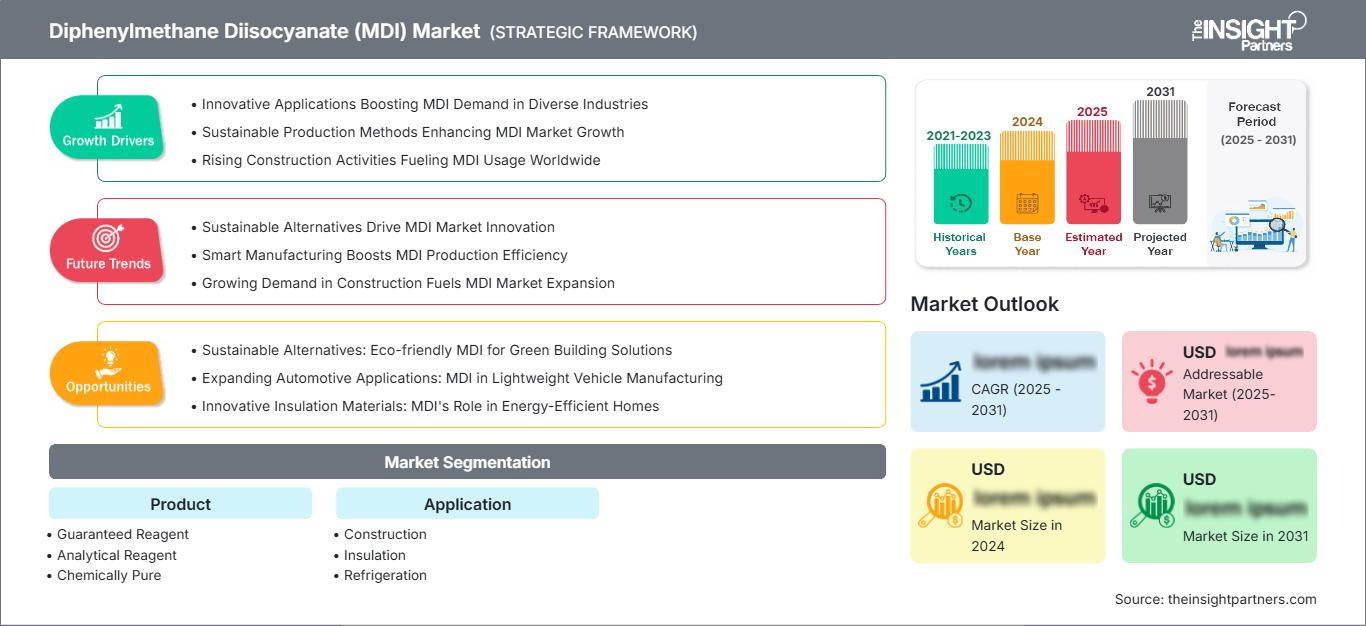
Diphenylmethane Diisocyanate (MDI) Market: Strategic Insights
Regional Insights
North America Diphenylmethane Diisocyanate Market
North America is estimated to account for 18.0% of the global Diphenylmethane Diisocyanate market in 2025 and is projected to grow at a 4.60% CAGR through 2034. The region benefits from established polyurethane production, residential and commercial insulation, refrigeration, automotive components, and industrial adhesives. The U.S. represents the majority of regional demand because of its large construction and appliance industries and its established MDI manufacturing base.
Regional supply chains are becoming increasingly local. The Geismar project by BASF is due to be commissioned commercially in 2026, and this plant will boost the North American MDI capacity from 380,000 tons to 600,000 metric tons annually. Besides BASF, both Huntsman and Dow have MDI production facilities in Geismar, and the latter is present in MDI formulation in the U.S.
U.S. Diphenylmethane Diisocyanate Market
The U.S. is estimated to represent 68.0% of the North American market in 2025 and is projected to expand at a 4.50% CAGR. The demand comes from uses in construction insulation, refrigeration, home appliances, automotive parts, adhesives, and polyurethane systems. This use of MDI favors polyurethane-based systems that offer insulation properties along with dimensional and mechanical properties.
Domestic supplies and technical expertise in downstream processes come from BASF, Huntsman, and Dow. BASF’s Geismar plant expansion becomes very critical because it enhances domestic capacity for MDI along with helping customers who need a reliable domestic supply of MDI. The uniqueness of the U.S. market comes from the combination of large-scale chemical manufacturing, polyurethane formulation expertise, and energy-efficient building materials.
Europe Diphenylmethane Diisocyanate Market
Europe is estimated to hold 24.0% of the global market in 2025 and is projected to grow at a 4.80% CAGR through 2034. Germany is the leading country because of its integrated chemical industry, automotive manufacturing, construction materials base, and concentration of major MDI producers. France and Italy provide significant downstream demand through construction materials, appliances, furniture, and industrial polyurethane applications.
The UK has a mature construction and insulation market, while Spain has an established MDI production presence through Covestro's Tarragona facility. Italy's machinery, appliances, furniture, and industrial manufacturing industries create demand for polyurethane systems. European regulation increasingly emphasizes energy performance and building efficiency, supporting insulation-related polyurethane consumption. The European regulatory environment also requires careful management of diisocyanate exposure, while ECHA maintains MDI within the REACH regulatory framework.
APAC Diphenylmethane Diisocyanate Market
APAC is estimated to account for 49.0% of the global market in 2025 and is projected to grow at a 5.80% CAGR. China is the leading market because of its large construction sector, extensive polyurethane manufacturing base, appliance production, and significant domestic MDI capacity. Wanhua has developed an extensive integrated chemical platform in China, reinforcing regional supply availability.
Japan and South Korea have mature polyurethane industries and technically differentiated MDI production. Kumho Mitsui Chemicals is expanding its Yeosu facility, while Tosoh supplies monomeric and polymeric MDI products for polyurethane applications. India represents an emerging demand center due to construction, appliances, cold-chain infrastructure, and industrialization. Australia remains smaller but has demand linked to construction insulation, refrigeration, and imported polyurethane systems.
Middle East & Africa Diphenylmethane Diisocyanate Market
The Middle East & Africa is estimated to represent 5.0% of global demand in 2025 and is projected to grow at a 5.40% CAGR. Saudi Arabia and the UAE are the principal regional demand centers because of construction investment, industrial development, and growing interest in localized chemical manufacturing. South Africa provides demand through construction, refrigeration, automotive-related applications, and industrial polyurethane products.
The region remains more import-dependent than China, Europe, or North America, creating an opportunity for localized production and logistics infrastructure. New MDI investment discussions involving the Middle East indicate increasing interest in positioning the region closer to downstream demand and global polyurethane supply chains. Covestro's 2026 feasibility study for an MDI train in the UAE reinforces this direction.
South & Central America Diphenylmethane Diisocyanate Market
South & Central America are estimated to represent 4.0% of global demand in 2025 and are projected to grow at a 5.10% CAGR. Brazil is the leading market, supported by construction, appliances, refrigeration, automotive production, and industrial manufacturing. Argentina contributes through construction and appliance-related polyurethane demand.
The region remains more dependent on imported MDI than the major production hubs, making logistics, distributor networks, inventory management, and local formulation capabilities important competitive factors. Brazil's larger industrial base provides greater downstream diversification, while Argentina and other markets are more sensitive to import economics and construction cycles. Regional growth is therefore likely to favor suppliers with reliable delivery and technical support.
Segmentation Analysis
Product
The Product segment covers Guaranteed Reagent, Analytical Reagent, and Chemically Pure classifications within the supplied market taxonomy. This segment is projected to grow at a 4.90% CAGR from 2026 to 2034. Demand is influenced by specification requirements, laboratory use, chemical processing, and applications where controlled purity is important. Suppliers compete through consistency, documentation, quality control, and reliable handling characteristics.
- Guaranteed Reagent: This grade serves applications requiring controlled chemical specifications and dependable purity characteristics. Its adoption is linked to laboratories and technical users who require repeatable analytical or formulation performance.
- Analytical Reagent: Analytical Reagent products support laboratory testing, chemical analysis, and controlled experimental procedures. Buyer selection emphasizes purity documentation, batch consistency, traceability, and dependable analytical performance.
- Chemically Pure: Chemically Pure MDI serves applications where controlled composition is required without necessarily requiring the narrow specifications of specialized analytical grades. Its position depends on purity requirements and downstream process compatibility.
Application
The Application segment includes Construction, Insulation, Refrigeration, and Packaging, and is projected to grow at a 5.55% CAGR from 2026 to 2034. Its leading position reflects the extensive use of MDI in polyurethane systems. Demand is supported by thermal performance requirements, cold-chain development, building efficiency, and durable protective materials.
- Construction: MDI-based polyurethane systems are used in building materials, structural components, adhesives, sealants, and insulation systems. Adoption is supported by thermal efficiency and lightweight construction requirements.
- Insulation: Rigid polyurethane foam provides low thermal conductivity and is widely used in building envelopes, panels, pipes, and equipment. Energy-efficiency requirements make insulation a strategically important MDI-consuming application.
- Refrigeration: MDI-based polyurethane foam is used in refrigerators, freezers, cold rooms, refrigerated transport, and cold-chain infrastructure. Demand depends on thermal insulation performance and the expansion of temperature-controlled food distribution.
- Packaging: MDI-based polyurethane materials support specialized packaging structures and protective systems where cushioning, adhesion, durability, and thermal properties are required. Adoption is more application-specific than construction and insulation.
Opportunity Snapshot
| Application | Revenue Contribution | Trend Tag | Adoption Stage |
|---|---|---|---|
| Construction | High | Energy Efficiency | Mature |
| Insulation | High | Thermal Performance | Mature |
| Refrigeration | Medium | Cold Chain | Scaling |
| Packaging | Low | Material Protection | Emerging |
Diphenylmethane Diisocyanate (MDI) Market Growth Drivers and Impact Analysis
Rising Demand for Energy-Efficient Polyurethane Insulation
Energy-efficiency requirements are strengthening demand for MDI-based rigid polyurethane systems because insulation reduces heat transfer while enabling relatively thin construction components. Building owners, contractors, appliance manufacturers, and panel producers increasingly prioritize materials that improve thermal performance without substantially increasing system thickness. This creates a direct chain from tighter building-efficiency expectations to greater use of high-performance polyurethane formulations and, therefore, higher MDI consumption. European construction policy continues to support advanced insulation materials, while producers such as BASF and Covestro maintain MDI portfolios designed for rigid polyurethane applications. The implication is that insulation remains a structurally resilient demand center even when broader construction activity fluctuates.
Expansion of Cold-Chain and Refrigeration Infrastructure
The expansion of temperature-controlled logistics is increasing the need for high-performance insulation in refrigerators, freezers, cold rooms, refrigerated transport, and food-processing facilities. MDI-based rigid polyurethane foam is well-suited to these systems because its thermal insulation properties help maintain controlled temperatures while supporting compact equipment designs. The mechanism is direct: greater cold-chain penetration increases the number of insulated assets, which expands polyurethane foam consumption and subsequently raises MDI requirements. Huntsman's portfolio specifically identifies MDI-based rigid polyurethane as a material used across refrigerated processing plants, storage warehouses, walk-in freezers, transport vehicles, and domestic refrigerators.
Regionalization of MDI Production and Supply Security
Supply security is becoming a stronger investment driver as producers seek to position MDI capacity closer to major polyurethane-consuming regions. BASF's Geismar expansion, Covestro's planned Shanghai MDI train, and Kumho Mitsui Chemicals' Yeosu expansion demonstrate a shift toward large integrated facilities that can reduce logistics exposure and support long-term customer supply. The mechanism is capacity localization followed by shorter supply routes, stronger customer integration, and improved resilience during outages or trade disruptions. These investments should strengthen regional availability while intensifying competition among established producers. The implication is that future competitive positioning will increasingly depend on production footprint and integrated feedstock economics alongside product performance.
Diphenylmethane Diisocyanate (MDI) Market Future Trends
Low-Carbon and Energy-Efficient MDI Manufacturing
MDI producers are increasingly linking capacity investments with lower-emission production technologies, feedstock integration, and resource efficiency. Covestro's planned Shanghai facility is designed around integrated upstream production and proprietary technology intended to reduce energy consumption, while Kumho Mitsui Chemicals is incorporating recycling infrastructure into its Yeosu expansion. This shift affects producers that must manage energy-intensive chemistry and customers seeking lower-carbon polyurethane materials. The likely implication is greater differentiation between conventional commodity MDI and products supported by lower-carbon manufacturing pathways, recycled process streams, mass-balance approaches, and improved energy efficiency.
Greater Localization of Large-Scale MDI Capacity
The industry is moving toward regional capacity clusters that combine MDI production with upstream intermediates and downstream polyurethane customers. This trend is emerging because long supply chains expose buyers to transportation constraints, plant outages, trade disruptions, and feedstock volatility. China, North America, South Korea, and the Middle East are increasingly important investment locations. Covestro's planned Shanghai expansion and BASF's Geismar project demonstrate how major producers are aligning capacity with regional demand. Buyers benefit from improved supply reliability, while producers gain stronger customer integration and logistical advantages. The competitive implication is a greater emphasis on local production capability rather than purely global product availability.
Diphenylmethane Diisocyanate (MDI) Market Opportunities
Expansion of MDI Supply for Emerging Asian Construction Markets
India and other developing Asian economies offer an investment opportunity because construction activity, appliance manufacturing, cold-chain infrastructure, and demand for energy-efficient materials are expanding from a lower installed base. MDI suppliers can target polyurethane system houses, insulation-panel producers, appliance manufacturers, and construction-material companies that need a reliable regional supply. The principal barrier is dependence on imported material and exposure to freight and price volatility. Establishing local technical service, storage, formulation partnerships, and eventually regional production can reduce these constraints. Producers with integrated feedstock access and differentiated MDI grades are positioned to benefit as Asian polyurethane conversion capacity becomes more localized.
Lower-Carbon MDI for Sustainable Polyurethane Systems
Lower-carbon MDI provides an opportunity for producers serving building materials, refrigeration, appliances, and customers with corporate emissions targets. The opportunity centers on products manufactured through renewable electricity, improved energy efficiency, recycled process streams, or certified alternative feedstocks. Buyers increasingly need measurable environmental improvements without sacrificing foam performance or processing characteristics. BASF, Covestro, and Kumho Mitsui Chemicals are already connecting MDI investments with sustainability-related production improvements. The principal commercial opportunity is therefore to develop credible lower-carbon product portfolios supported by traceability and technical validation, enabling polyurethane manufacturers to reduce product footprints while maintaining established processing conditions.
Frequently Asked Questions

- Comprehensive Market Sizing and Forecast Analysis
- Detailed Segmentation Analysis
- In-Depth Market Dynamics Assessment
- Regional and Country-Level Insights
- Competitive Landscape and Company Benchmarking
- Strategic Business Intelligence
Recent Reports
Testimonials

The Insight Partners provided valuable market intelligence that supported our global go-to-market strategy. Their team was professional, responsive, and attentive to our feedback, providing thoughtful analysis and helpful methodological clarifications throughout the project.
Junmo Kim Chief Financial Officer (CFO), Enertech Co., Ltd.
The Insight Partners' SCADA System Market report is comprehensive, with valuable insights on current trends and future forecasts. The team was highly professional, responsive, and supportive throughout. We are very satisfied and highly recommend their services.
RAN KEDEM Partner, Reali Technologies LTDs
I requested a report on a very specific software market and the team produced the report in a few days. The information was very relevant and well presented. I then requested some changes and additions to the report. The team was again very responsive and I got the final report in less than a week.
JEAN-HERVE JENN Chairman, Future Analytica
We worked with The Insight Partners for an important market study and forecast. They gave us clear insights into opportunities and risks, which helped shape our plans. Their research was easy to use and based on solid data. It helped us make smart, confident decisions. We highly recommend them.
PIYUSH NAGPAL Sr. Vice President, High Beam Global
The Insight Partners delivered insightful, well-structured market research with strong domain expertise. Their team was professional and responsive throughout. The user-friendly website made accessing industry reports seamless. We highly recommend them for reliable, high-quality research services
YUKIHIKO ADACHI CEO, Deep Blue, LLC.
This is the first time I have purchased a market report from The Insight Partners.While I was unsure at first, I visited their web site and felt more comfortable to take the risk and purchase a market report.I am completely satisfied with the quality of the report and customer service. I had several questions and comments with the initial report, but after a couple of dialogs over email with their analyst I believe I have a report that I can use as input to our strategic planning process.Thank you so much for taking the extra time and making this a positive experience.I will definitely recommend your service to others and you will be my first call when we need further market data.
JOHN SUZUKI President and Chief Executive Officer, Board Director, BK Technologies
I wish to appreciate your support and the professionalism you displayed in the course of attending to my request for information regarding to infectious disease IVD market in Nigeria. I appreciate your patience, your guidance, and the fact that you were willing to offer a discount, which eventually made it possible for us to close a deal. I look forward to engaging The Insight Partners in the future, all thanks to the impression you have created in me as a result of this first encounter.
DR CHIJIOKE ONYIA MANAGING DIRECTOR, PineCrest Healthcare Ltd.Reason to Buy
- Informed Decision-Making
- Understanding Market Dynamics
- Competitive Analysis
- Identifying Emerging Markets
- Customer Insights
- Market Forecasts
- Risk Mitigation
- Boosting Operational Efficiency
- Strategic Planning
- Investment Justification
- Tracking Industry Innovations
- Aligning with Regulatory Trends





 Get Free Sample for