
Laser Printer Market Share, Demand & Growth by 2034
Coverage: by Type (Single Function, Multi-Function); End-user (Educational Institutions, Corporate, Personal) , and Geography (North America, Europe, Asia Pacific, and South and Central America)
- Status : Data Released
- Report Code : TIPRE00011134
- Category : Electronics and Semiconductor
- No. of Pages : 150
- Available Report Formats :


- Last update date : October 22, 2026


2025 Market Size
US$ 3.21 Bn
Base year value
2034 Forecast
US$ 7.47 Bn
Projected by 2034
CAGR 2026-2034
9.84 %
Growth rate
Addressable Market
US$ 47.56 Bn
(2026-2034)
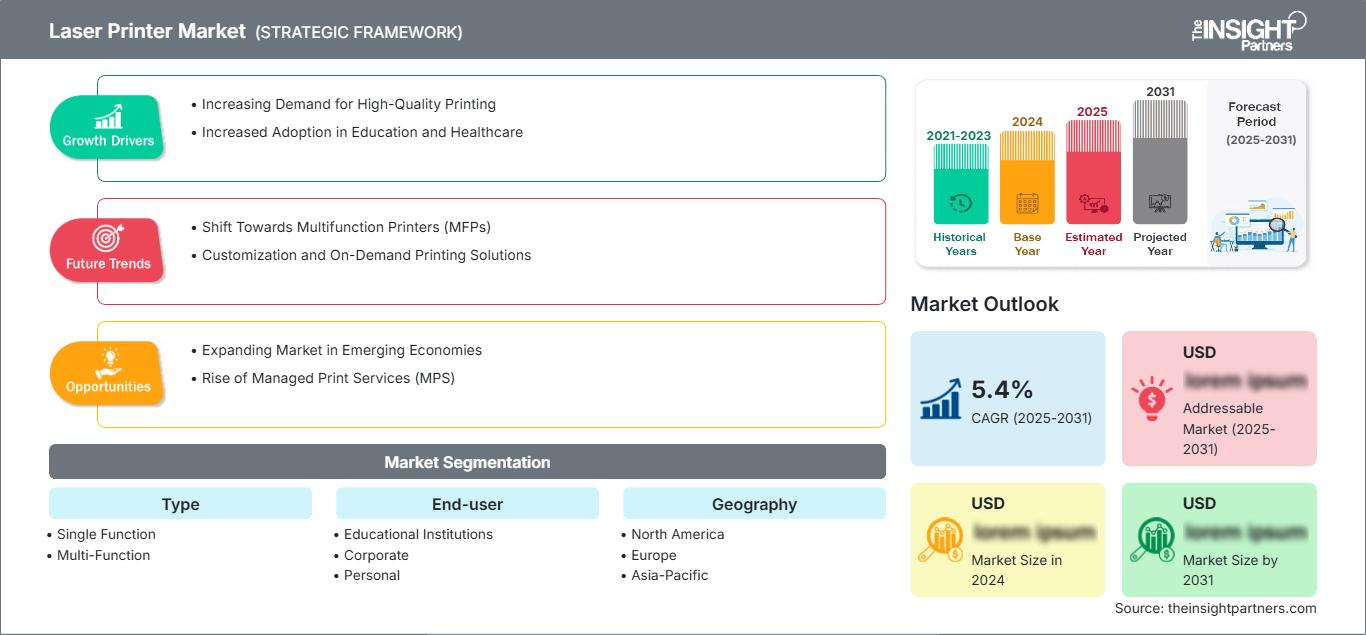
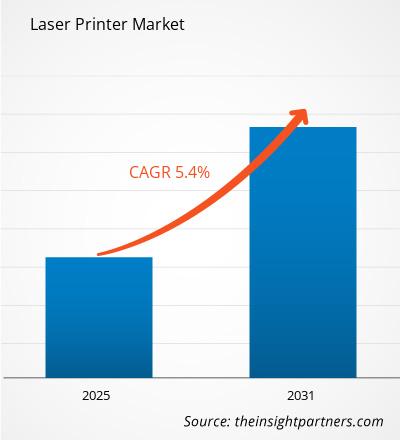
The Laser Printer Market was valued at US$ 3.21 Billion in 2025 and is projected to reach US$ 7.47 Billion by 2034, registering a CAGR of 9.84% during 2026–2034. Expansion is supported by continued demand for high-volume document output, secure office printing, and multifunction workflows across business environments. Technology improvements in print speed, connectivity, energy efficiency, and device management are also supporting replacement activity as organizations modernize distributed printing infrastructure.
The Laser Printer Market size is increasingly influenced by North American demand for secure workplace printing, managed print environments, and multifunction devices. The region is estimated to expand at a CAGR of 8.8–9.4% during 2026–2034, supported by enterprise digitization alongside persistent requirements for physical documentation. Replacement cycles, cybersecurity requirements, and demand for network-enabled equipment are expected to remain important structural drivers.
Laser Printer Market Assessment and Insights
- North America accounted for an estimated 27–31% Laser Printer Market share in 2025 and is projected to grow at a CAGR of 8.8–9.4% between 2026–2034, supported by enterprise replacement, secure printing, and managed workplace infrastructure.
- US represented approximately 76–80% of North American demand in 2025 and is expected to expand at a CAGR of 8.7–9.3% during 2026–2034, supported by corporate and institutional printing requirements.
- Europe held about 25–29% share in 2025 and is projected to register a CAGR of 8.9–9.5% through 2034, with Germany, the UK, France, Italy, and Spain supporting replacement and efficiency-driven purchases.
- Asia Pacific represented approximately 31–35% share in 2025 and is expected to record a CAGR of 10.3–10.9% during 2026–2034, led by China, Japan, South Korea, India, and Australia.
- Largest Segment: Multi-Function accounted for an estimated 58–62% market share in 2025, expanding at a CAGR of 9.5–10.1% during 2026–2034 as organizations consolidate print, scan, copy, and workflow functions.
- High Growth Segment: Educational Institutions represented approximately 16–20% share in 2025, with a projected CAGR of 10.6–11.2% during 2026–2034, supported by digitized administration and recurring physical-document requirements.
- Key companies analyzed in detail: Brother Industries, Ltd.; Canon Inc.; HP Development Company, L.P.; Kyocera Corporation; Lexmark International, Inc.; Oki Electric Industry Co., Ltd.; RICOH; SAMSUNG; Seiko Epson Corporation; Xerox Corporation.
Source: The Insight Partners' analysis based on proprietary research, government publications, company annual reports, investor presentations, industry databases, and expert interviews.
From stand-alone output machines to integrated office systems, the Laser Printer Market has progressed in its development towards integrating print, scan, security, and workflow functionalities. Differentiation in hardware features will rely increasingly on speed, duplex capability, mobility options, energy use, and device management. The increasing importance of multifunction printers has come about due to their capability of integrating multiple document handling tasks on fewer devices, thereby reducing space requirements and enhancing maintenance.
Future demand will increase in emerging Asian countries and institutional segments, where office upgrading still needs to be done. Purchases by governments, construction of educational infrastructure, digitization of small business offices, and renewal of old installed fleets may sustain equipment volumes. In addition, growing interest in energy efficiency, information security, electronic waste, and sustainable consumables is promoting improvement in efficiency and lifecycle management of the device without making obsolete the need for physical documents.
Laser Printer Market Report Scope
| Report Attribute | Details |
|---|---|
| Market size in 2025 | US$ 3.21 Billion |
| Market Size by 2034 | US$ 7.47 Billion |
| Global CAGR (2026 - 2034) | 9.84% |
| Historical Data | 2021-2024 |
| Forecast period | 2026-2034 |
Laser Printer Market Analysis
Demand in the Laser Printer Market is driven by documentation needs, education, government administration, health care documentation, financial services, logistics, and small business. The supply chain is composed of laser printer producers, laser printer components producers, toner and consumables providers, distributors, managed print service providers, software vendors, and maintenance organizations. The economics of printers are tied to the cost of hardware, consumables, services, uptime, and total cost of ownership as opposed to unit price only.
Issues in supply chain for the Laser Printer market include access to semiconductors, imaging parts, toners, drums, controllers, connectors, and local manufacturing capabilities. Companies have become more skilled at platform development in such a way as to produce multiple variants from a single platform, thus enabling quick localization. Distribution will still be required for consumer-based printers, while corporate sales are generally handled through direct channels, managed print, fleet management, and cyber security services.
Competitive advantage lies in quality, speed, reliability, work flow integration, cyber security, low cost of consumables, and service reach. Brother Industries, Ltd. and Canon Inc. offer comprehensive product lines for consumers and businesses, while HP Development Company, L.P. offers solutions for connected work environments and enterprises. Kyocera Corporation, RICOH, and Xerox Corporation are some of the leading competitors in the business document market, where Lexmark International, Inc. offers managed document solutions.
The strategic focus is now moving towards software-driven printing, device security, cloud management, workflow automation, and reduced operational expenses. The companies like Oki Electric Industry Co., Ltd., SAMSUNG, Seiko Epson Corporation, and other mature manufacturers are active within certain customer segments and geographies. In this regard, the competitive environment is evolving from hardware-based positioning to device ecosystem including the supply of consumables, servicing relations, analysis, and workflow automation.
● REPORT CUSTOMIZATION
Tailor This Report To Align With Your Specific Business Requirements
This report can be customized to align precisely with your business objectives, scope, and target markets. Customization options include tailored segmentation, geography, competitive analysis, and strategic insights to support informed decision-making.
Customize This Report →WHAT YOU CAN ADJUST
- ● Segmentations
- ● Geography
- ● Competitive Analysis
- ● Language Preferences
Laser Printer Market: Strategic Insights
Regional Insights
North America Laser Printer Market
North America represented approximately 27–31% of the Laser Printer Market in 2025 and is projected to expand at a CAGR of 8.8–9.4% through 2034. The demand is seen within corporate office environments, government entities, healthcare companies, education institutions, and professional services where producing secure documents remains a vital process. The need to replace the old fleets is underpinned by a desire to produce faster duplex print jobs, wireless connectivity, device authentication, and central administration. Managed print services are likely to drive hardware upgrades as customers are increasingly evaluating products according to their overall lifecycle cost as opposed to standalone product price.
The United States contributes about 76–80% of the regional demand and is still the main driver due to its large installed corporate and institutional base. Canada drives additional demand through small business modernization and government procurement. Increasing security needs, the rise of hybrid workplaces, connected workflows in the cloud, and the need to decrease administrative burden are becoming key factors of purchase decision-making. Customers are increasingly choosing multi-function products that combine scanning and printing with access controls and remote management capabilities.
U.S. Laser Printer Market
The US represented approximately 76–80% of North American demand in 2025 and is projected to grow at a CAGR of 8.7–9.3% through 2034. Large enterprises, government organizations, schools, healthcare providers, and professional services firms support demand through recurring equipment replacement and managed printing arrangements.
The Laser Printer Market report shows that major vendors maintain extensive US distribution and service coverage, while applications increasingly emphasize secure office printing, multifunction workflows, mobile connectivity, and fleet administration. Enterprise customers are also evaluating energy use and consumable costs alongside purchase price, encouraging adoption of efficient networked devices.
Europe Laser Printer Market
Europe held an estimated 25–29% share in 2025 and is expected to grow at a CAGR of 8.9–9.5% through 2034. Germany is seen as an important market in view of the availability of big buyers belonging to industrial, business, and governmental segments, whereas the UK still remains an important market owing to professional services, educational needs, and business presence. France is an important market on account of governmental and business procurement, whereas Italy and Spain generate demand owing to SMEs, educational institutions, and administrative bodies. In the region, energy efficiency, data security, fleet management, and sustainable usage of equipment have emerged as key criteria for procurement. Thus, the regional market is driven by replacement demand.
Germany continues to be an important market for business printing due to manufacturing infrastructure, administration, and many SMEs. The demand for printing becomes driven by networked secure devices, central fleet management, and multifunctional equipment. The customers evaluate the cost-effectiveness of the equipment during the replacement process.
There is significant demand from enterprises and institutions in the UK and France due to professional services, education, health care, and government requirements. The market in Italy and Spain is more sensitive to acquisition economics and the purchasing cycle of SMEs, although there is still demand for replacement.
APAC Laser Printer Market
APAC represented approximately 31–35% Laser Printer Market share in 2025 and is projected to expand at a CAGR of 10.3–10.9% through 2034. China holds the title of the leader due to high demand by large businesses. Japan and South Korea boast advanced office infrastructure, and India provides the scope of growth because of its educational sector, SMEs, and administrative reforms. Mature replacement demand comes from Australia. The equipment needs of the region are catered to through industrial digitalization, government spending, infrastructure of schools, and SME technology usage.
Middle East & Africa Laser Printer Market
The Middle East & Africa region is projected to grow at a CAGR of 7.9–8.6% through 2034. Demand in Saudi Arabia and the UAE comes from modernization, business services, and infrastructure projects, while South Africa is still a significant market through institutional and business services. The rest-of-MEA demand comes from educational and administrative needs.
The strength of the Saudi Arabia market comes from modernization initiatives in the public sector and increasing business infrastructure, while the strength of the UAE market is corporate services and government. Demand in South Africa is driven by education, financial services, and enterprise application systems.
Segmentation Analysis
Type
The Laser Printer Market forecast shows that Type segment is led by Multi-Function equipment and is projected to register a CAGR of 9.5–10.1% during 2026–2034. Organizations increasingly prefer consolidated devices that combine printing, scanning, copying, and workflow functions. Multifunction platforms can reduce equipment duplication and simplify administration, making them particularly relevant to corporate, government, healthcare, and educational environments.
- Single Function: Single Function devices remain important where dedicated high-volume printing, compact deployment, or straightforward document output is prioritized. They are relevant to personal users, departmental workgroups, and applications requiring simple operational configurations.
- Multi-Function: Multi-Function devices occupy a strong position in enterprise and institutional environments because they consolidate document functions, support centralized administration, and enable secure scanning and digital workflow integration.
End-user
The End-user segment in the Laser Printer Market is expected to grow at a CAGR of 10.0–10.6% during 2026–2034 as organizations continue balancing physical documentation with increasingly digitized workflows. Purchasing decisions are becoming more focused on security, connectivity, lifecycle cost, and ease of fleet administration across diverse user environments.
- Educational Institutions: Educational Institutions require reliable printing for examinations, administrative records, learning materials, and student services, creating recurring demand while network management and cost efficiency influence institutional procurement.
- Corporate: Corporate users represent a major demand base because offices require secure document production, scanning, reporting, and workflow support. Fleet consolidation and remote management increasingly shape purchasing decisions.
- Personal: Personal users prioritize compact equipment, affordable operating costs, wireless connectivity, and dependable text output. Replacement demand remains relevant where home offices and individual professionals require regular document production.
Opportunity Snapshot
| End Users | Revenue Contribution | Trend Tag | Adoption Stage |
| Educational Institutions | Medium | Campus Printing | Scaling |
| Corporate | High | Secure Workflows | Mature |
| Personal | Medium | Home Office | Scaling |
Laser Printer Market Growth Drivers and Impact Analysis
Enterprise Security and Managed Device Requirements
More and more often, security becomes an important element of printer purchase due to the function of the printer as an endpoint device within corporate infrastructure. The corporation needs authentication, access control, encryption, activity monitoring, and secure document delivery in order to minimize the risks associated with the unsecured devices. In addition, managed print services provide a continuous supply of new equipment, as it is evaluated on the grounds of performance, security, utilization, and lifespan. This trend does not apply only to big corporations, but impacts the health care, financial, educational, and governmental fields as well, where auditing of printouts is needed.
Replacement of Aging Office Printing Fleets
A large proportion of demand results from replacement rather than new installation. Old printers may lead to increased maintenance needs, slow performance, poor connectivity, inefficient energy usage, and inconsistency in consumables. Firms that upgrade old equipment base their choices on cost of ownership, duty cycles, responsiveness in terms of service, and compatibility with current networks. Such upgrading activities can also be used to move from fragmented individual functionalities to multifunctionality. Such developments have significant meaning among firms that already own a number of printers. It is beneficial for firms that provide managed services in cases where replacements are tied to such services as hardware upgrades form an important part of the purchasing process.
Expansion of Hybrid and Digitally Connected Workflows
Despite the fact that hybrid working has not done away with the need for physical documents, it has had an effect on the deployment of printing equipment. The need to have secure access to printing equipment from laptop computers, smartphones, and cloud-based applications has increased, as well as the need to have control of the equipment centrally located in smaller or dispersed offices. Consequently, network connection capabilities, mobile printing, scan-to-cloud capabilities, and remote monitoring and diagnosis capabilities will factor into the decision-making process. This trend will have the greatest impact on multifunction printers that connect the paper world to the digital world. Institutions of higher learning, professional firms, hospitals and clinics, and government agencies can employ connected printers to capture their paper documents and send them into their digital workflow systems.
Laser Printer Market Future Trends
Intelligent Workflow Integration
The Laser Printer Market trends show that laser printers are expected to evolve further into intelligent document workflow endpoints rather than remaining isolated output devices. Future platforms will increasingly connect printing, scanning, optical character recognition, cloud repositories, authentication systems, and business applications within a unified operating environment. This shift can reduce manual handling by allowing documents to be captured, classified, routed, and stored with fewer user interventions. Device interfaces are also likely to become more contextual, presenting users with application-specific workflows instead of basic print commands. For enterprise customers, integration will matter because the value of a device increasingly depends on how efficiently it supports broader information processes. Vendors capable of combining reliable hardware with software interoperability, analytics, and secure workflow orchestration should be better positioned as organizations redesign document-intensive processes.
Energy-Efficient and Lower-Waste Printing Platforms
Environmental considerations are expected to influence product design, procurement specifications, and fleet management more strongly through 2034. Manufacturers are likely to improve power-management systems, reduce warm-up requirements, optimize toner deposition, extend component life, and increase the proportion of recyclable materials used in equipment and consumables. Customers can support these changes by incorporating energy consumption, consumable yield, serviceability, and end-of-life handling into purchasing evaluations. The trend is especially relevant for large fleets where small efficiency improvements can produce measurable operating and environmental benefits. Product lifecycle transparency may also become more important as enterprises and public institutions establish sustainability criteria for technology procurement. Consequently, efficiency is likely to become a competitive attribute alongside speed, security, reliability, and total cost of ownership.
Laser Printer Market Opportunities
Expansion Across Education and Emerging Business Markets
Education and emerging business markets provide opportunities for suppliers that can offer reliable devices with predictable operating costs and flexible service models. Schools and colleges require printing for examinations, administrative documents, classroom materials, and records, while growing SMEs often need professional document capabilities without the complexity of large enterprise fleets. Vendors can address these segments through compact multifunction platforms, subscription-based consumables, remote support, and simplified fleet administration. Regional distribution partnerships can further improve access in fragmented markets where direct enterprise sales models are less efficient. Tailoring configurations to local paper formats, connectivity standards, service capabilities, and procurement practices can improve adoption. The opportunity is therefore not limited to hardware volume; it also includes recurring consumables, maintenance, software, and managed service relationships.
Secure Printing for Regulated and Document-Intensive Industries
Regulated industries offer an attractive opportunity for vendors that can integrate secure printing with broader information governance. Healthcare providers, financial institutions, government departments, legal organizations, and professional services firms continue to handle documents containing sensitive information, creating requirements for controlled access and traceable workflows. Suppliers can develop differentiated solutions around user authentication, encrypted communication, secure release, audit trails, and centralized policy management. Integration with identity systems and cloud applications can further reduce administrative friction while improving control over document handling. These capabilities allow vendors to compete on workflow value rather than hardware specifications alone. As organizations consolidate technology procurement, suppliers that can combine dependable printing equipment with security, software, service, and lifecycle management may capture larger portions of enterprise document-technology budgets.
Recent Developments
- March 2026: HP launched a new LaserJet portfolio featuring quantum-resistant security, AI-powered tools and 50% faster document processing. The new printers are designed to accelerate document digitization and improve workflows for hybrid workplaces.
- 2026: Canon introduced seven new imageCLASS color laser printers under its “Built for Business” strategy, targeting SMEs and businesses. The range offers speeds of up to 33 ppm, advanced security, connectivity and workflow features.
- June 2024: Brother India launched a new monochrome laser printer series focused on faster, more versatile workplace workflows. The range combines high-speed printing, automatic duplexing and connectivity features for home and office users.
Frequently Asked Questions

- Comprehensive Market Sizing and Forecast Analysis
- Detailed Segmentation Analysis
- In-Depth Market Dynamics Assessment
- Regional and Country-Level Insights
- Competitive Landscape and Company Benchmarking
- Strategic Business Intelligence
Recent Reports
Testimonials

The Insight Partners provided valuable market intelligence that supported our global go-to-market strategy. Their team was professional, responsive, and attentive to our feedback, providing thoughtful analysis and helpful methodological clarifications throughout the project.
Junmo Kim Chief Financial Officer (CFO), Enertech Co., Ltd.
The Insight Partners' SCADA System Market report is comprehensive, with valuable insights on current trends and future forecasts. The team was highly professional, responsive, and supportive throughout. We are very satisfied and highly recommend their services.
RAN KEDEM Partner, Reali Technologies LTDs
I requested a report on a very specific software market and the team produced the report in a few days. The information was very relevant and well presented. I then requested some changes and additions to the report. The team was again very responsive and I got the final report in less than a week.
JEAN-HERVE JENN Chairman, Future Analytica
We worked with The Insight Partners for an important market study and forecast. They gave us clear insights into opportunities and risks, which helped shape our plans. Their research was easy to use and based on solid data. It helped us make smart, confident decisions. We highly recommend them.
PIYUSH NAGPAL Sr. Vice President, High Beam Global
The Insight Partners delivered insightful, well-structured market research with strong domain expertise. Their team was professional and responsive throughout. The user-friendly website made accessing industry reports seamless. We highly recommend them for reliable, high-quality research services
YUKIHIKO ADACHI CEO, Deep Blue, LLC.
This is the first time I have purchased a market report from The Insight Partners.While I was unsure at first, I visited their web site and felt more comfortable to take the risk and purchase a market report.I am completely satisfied with the quality of the report and customer service. I had several questions and comments with the initial report, but after a couple of dialogs over email with their analyst I believe I have a report that I can use as input to our strategic planning process.Thank you so much for taking the extra time and making this a positive experience.I will definitely recommend your service to others and you will be my first call when we need further market data.
JOHN SUZUKI President and Chief Executive Officer, Board Director, BK Technologies
I wish to appreciate your support and the professionalism you displayed in the course of attending to my request for information regarding to infectious disease IVD market in Nigeria. I appreciate your patience, your guidance, and the fact that you were willing to offer a discount, which eventually made it possible for us to close a deal. I look forward to engaging The Insight Partners in the future, all thanks to the impression you have created in me as a result of this first encounter.
DR CHIJIOKE ONYIA MANAGING DIRECTOR, PineCrest Healthcare Ltd.Reason to Buy
- Informed Decision-Making
- Understanding Market Dynamics
- Competitive Analysis
- Identifying Emerging Markets
- Customer Insights
- Market Forecasts
- Risk Mitigation
- Boosting Operational Efficiency
- Strategic Planning
- Investment Justification
- Tracking Industry Innovations
- Aligning with Regulatory Trends





 Get Free Sample for