
Intelligent Power Module Market Demand, Trends & Forecast by 2034
Coverage: by Voltage Rating (Upto 600V, 1200V, Above 1200V); Current Rating (Upto 100A, 101-600A, More Than 600A); Power Device (IGBT, MOSFET); Application (Consumer Durables, Industrial Application) , and Geography (North America, Europe, Asia Pacific, and South and Central America)
- Status : Data Released
- Report Code : TIPRE00003300
- Category : Electronics and Semiconductor
- No. of Pages : 150
- Available Report Formats :


- Last update date : October 16, 2026


2025 Market Size
US$ 3.04 Bn
Base year value
2034 Forecast
US$ 6.58 Bn
Projected by 2034
CAGR 2026-2034
8.96 %
Growth rate
Addressable Market
US$ 43.06 Bn
(2026-2034)
The Intelligent Power Module Market size reached US$ 3.04 Billion in 2025 and is projected to reach US$ 6.58 Billion by 2034, registering a CAGR of 8.96% during 2026–2034. Growth reflects wider adoption of integrated power switching, gate-drive, protection, and thermal-management functions across motor drives, appliances, industrial equipment, and power-conversion systems where compact design and efficient operation increasingly influence system architecture.
North America represents a structurally attractive market, supported by factory automation, data-center power infrastructure, semiconductor manufacturing, and electrification of industrial equipment. The regional outlook is expected to remain within a 9.0–10.0% CAGR range during 2026–2034 as manufacturers prioritize efficient motor control, resilient power conversion, and higher-density electronic systems.
Intelligent Power Module Market Assessment and Insights
- North America: North America is projected to hold a 25–29% Intelligent Power Module Market share in 2025 and expand at a 9.0–10.0% CAGR between 2026–2034, supported by industrial automation, semiconductor manufacturing, data-center electrification, and increasing deployment of efficient motor-control systems.
- US: The US is expected to represent 76–81% of North America share in 2025 and grow at a 9.1–10.1% CAGR between 2026–2034, led by data centers, advanced manufacturing, and electrification.
- Europe: Europe is estimated at a 22–26% share in 2025 and a 8.5–9.5% CAGR between 2026–2034, with Germany, France, Italy, and the UK benefiting from industrial automation, renewable integration, and energy-efficiency requirements.
- Asia Pacific: Asia Pacific is estimated to account for a 40–44% share in 2025 and grow at a 9.4–10.4% CAGR between 2026–2034, with China, Japan, South Korea, and India supported by electronics manufacturing and industrial electrification.
- Largest Segment: IGBT is estimated to command a 76–80% market share in 2025 and expand at a 9.2–10.2% CAGR during 2026–2034, reflecting high-voltage motor and inverter requirements.
- High Growth Segment: Industrial Application is estimated at a 48–53% market share in 2025 and a 9.4–10.4% CAGR during 2026–2034, supported by automation and energy-efficient drives.
- Key companies analyzed in detail: STMicroelectronics, Mitsubishi Electric Corporation, Semiconductor Components Industries, LLC, Infineon Technologies AG, Fuji Electric Co., Ltd., Semikron Elektronik GmbH, Renesas Electronics Corporation, Texas Instruments Incorporated, Sensitron Semiconductor, Inc., and Sanken Electric Co., Ltd.
Source: The Insight Partners' analysis based on proprietary research, government publications, company annual reports, investor presentations, industry databases, and expert interviews.
Advancements in technology evolution have been moving module designs from discrete switching systems to integrated platforms that incorporate all of the following: power semiconductors, gate drives, protection circuitry, sensing and thermal function. Such integration decreases the number of parts used, as well as complexity of the PCB, parasitic elements, and engineering time. Contemporary product ranges consist of compact 600 V class modules and high voltage modules for use in industrial drives, renewable energy converters, as well as traction applications. STMicroelectronics, for instance, characterizes SLLIMM platform as an integrated three-phase inverter solutions for motor control.
Future investments are likely to focus on increased efficiency, smaller packages, better thermal cycling, and semiconductor technology allowing increased power density. Asia Pacific is projected to keep its production leadership role, whereas North America and Europe will develop their semiconductor and power electronics industry. Increased emphasis by regulators on energy efficiency, decarbonization of industries and electrification will drive demand for integrated switching platforms in household appliances, motor drives and power conversion equipment. World demand for electricity continued to grow throughout 2025.
Intelligent Power Module Market Report Scope
| Report Attribute | Details |
|---|---|
| Market size in 2025 | US$ 3.04 Billion |
| Market Size by 2034 | US$ 6.58 Billion |
| Global CAGR (2026 - 2034) | 8.96% |
| Historical Data | 2021-2024 |
| Forecast period | 2026-2034 |
Intelligent Power Module Market Analysis
Growth in the Intelligent Power Module Market is now becoming dependent on industrial electrification, variable speed motor control, appliances, and conversion requirements. The ecosystem for the market includes silicon wafer and semiconductor manufacturing, power device manufacturing, module assembly, gate driver technology, heat sinks, machinery, and systems integrators. Growth prospects will not only depend upon demand for semiconductors but also on investments in motors, inverters, HVAC systems, renewable energy systems, and factory automation.
The demand is being driven by the ability of the integrated power modules to simplify inverter designs while enhancing their reliability and protection. There is a growing preference among manufacturers for standardization of the packages to shorten the design cycle and to minimize external parts. Supply will continue to be affected by the capacity of semiconductor manufacturing, advanced packages, availability of copper and substrates, and qualification requirements.
The Intelligent Power Module Market shows competition between diversified semiconductor vendors and specialized power device vendors. STMicroelectronics and Mitsubishi Electric Corporation have diverse modules, Infineon Technologies AG and Fuji Electric Co., Ltd. offer high-performance power semiconductors technologies, Semiconductor Components Industries, LLC and Renesas Electronics Corporation offer complementary power management solutions, and Texas Instruments Incorporated is actively involved in technologies of power conversion control and drivers.
The Intelligent Power Module Market report shows that investments are shifting from the cost-efficiency of semiconductor to the efficiency of semiconductor, semiconductor packaging, heat dissipation, and application-level integration. Mitsubishi Electric Corporation is developing the technology of IPMs and power modules for appliances and industrial inverters, while Infineon Technologies AG is improving power modules for high-performance applications like automotive and computers. Semikron Elektronik GmbH, Sensitron Semiconductor, Inc., and Sanken Electric Co., Ltd. have special capabilities, while system-oriented players are differentiating themselves via application engineering and reliability.
● REPORT CUSTOMIZATION
Tailor This Report To Align With Your Specific Business Requirements
This report can be customized to align precisely with your business objectives, scope, and target markets. Customization options include tailored segmentation, geography, competitive analysis, and strategic insights to support informed decision-making.
Customize This Report →WHAT YOU CAN ADJUST
- ● Segmentations
- ● Geography
- ● Competitive Analysis
- ● Language Preferences
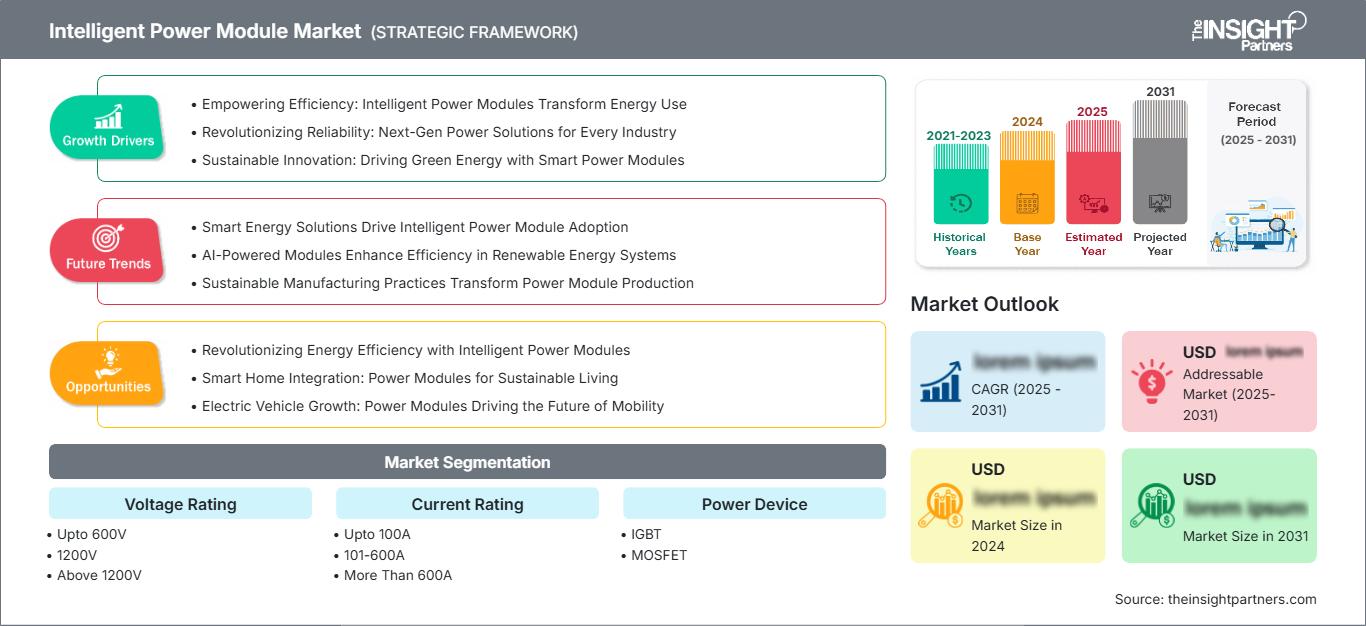
Intelligent Power Module Market: Strategic Insights
Regional Insights
North America Intelligent Power Module Market
North America is estimated to represent 25–29% of the Intelligent Power Module Market in 2025, with regional expansion projected at 9.0–10.0% CAGR through 2034. In this regard, the United States accounts for the majority of regional demand owing to the presence of industrial automation, semiconductor production, expansion of data centers, and electrification of the manufacturing process. Canada’s contribution comes through mining operations, construction of energy infrastructure, and equipment used in industries.
Moreover, increasing consumption of electricity in data centers and industrial loads is driving demand. According to IEA, the US electricity demand is expected to continue growing till 2026 due to the presence of data centers and advanced manufacturing facilities.
U.S. Intelligent Power Module Market
The US accounts for an estimated 76–81% of North America's Intelligent Power Module Market in 2025 and is projected to grow at a 9.1–10.1% CAGR. Demand is concentrated in industrial drives, HVAC systems, power supplies, renewable-energy equipment, semiconductor manufacturing, and data-center infrastructure.
The nation enjoys the advantage of having a well-developed electronics industry and more investment in infrastructure for high-performance computing. Intelligent components become significant where inverter efficiency, small form factors, and protective capabilities minimize system complexity. Industrial automation drives the development of intelligent motor control structures, as increased semiconductor and battery production necessitates efficient variable speed systems and power converters.
Europe Intelligent Power Module Market
Europe is estimated to account for 22–26% of the Intelligent Power Module Market in 2025 and is projected to grow at an 8.5–9.5% CAGR through 2034. Germany leads regional demand, followed by the UK, France, Italy, and Spain, supported by industrial automation, energy efficiency, and electrification.
Positioning of the UK focuses on advanced manufacturing, HVAC optimization, renewable energy utilization, and power management modernization. Germany is the dominant market due to its huge industrial machinery, automotive industry, factory automation, and power electronics industry. The strength of France lies in industrial electrification and energy infrastructure investment, while the strength of Italy is that of appliances and motor drive manufacturing.
APAC Intelligent Power Module Market
APAC is estimated to hold a 40–44% share of the Intelligent Power Module Market in 2025 and grow at a 9.4–10.4% CAGR. China leads, supported by electronics manufacturing, industrial automation, appliances, and electrification. Japan, South Korea, India, and Australia provide additional demand through manufacturing and infrastructure investment.
The size of China in the electronics and heavy industrial machinery sectors provides a good production base for the region. India is developing quickly because of increasing use of electricity in industry and growing appliance ownership, whereas Japan and South Korea are still technologically advanced centers for semiconductors and electronics.
Middle East & Africa Intelligent Power Module Market Market
Middle East and Africa demand is smaller but structurally expanding, with Saudi Arabia leading regional adoption, followed by the UAE and South Africa. The region is supported by industrial diversification, energy infrastructure, HVAC demand, renewable projects, and modernization of motor-driven equipment.
Growth is expected to remain around 7.5–8.5% CAGR through 2034 as infrastructure projects increasingly require efficient drives, pumps, compressors, cooling systems, and power converters. Saudi Arabia benefits from industrial development and energy investment, while the UAE emphasizes smart infrastructure. South Africa provides demand from mining, utilities, and industrial automation, with the rest of MEA developing through infrastructure projects.

Segmentation Analysis
Voltage Rating
The Voltage Rating segment is projected to expand at a 9.0–10.0% CAGR during 2026–2034. Lower-voltage modules remain important in appliances and compact motor drives, while higher ratings gain relevance in industrial inverters, renewable-energy conversion, and heavy-duty equipment. Voltage selection increasingly depends on switching efficiency, insulation requirements, thermal design, and system-level power density.
- Upto 600V: Upto 600V modules remain important for household appliances, HVAC equipment, compact motor drives, and low-to-medium power inverters where compact packaging and cost-efficient switching are priorities.
- 1200V: 1200V modules address industrial drives, renewable-energy converters, and higher-power inverter architectures requiring greater voltage headroom, robust insulation, and reliable switching under demanding operating conditions.
- Above 1200V: Above 1200V modules serve specialized high-power systems where higher blocking voltage, insulation coordination, and ruggedness are strategically important for industrial and infrastructure applications.
Current Rating
The Current Rating segment is expected to register an 8.5–9.5% CAGR from 2026 to 2034. Selection is closely associated with motor capacity, inverter output, thermal limits, and switching frequency. Higher-current configurations benefit from industrial machinery and heavy-duty drives, while lower-current modules remain important for appliances and compact equipment.
- Upto 1A: Upto 1A configurations serve lower-power control requirements where compact dimensions, low standby losses, and economical implementation are more important than high current-handling capability.
- 11-6A: 11-6A modules support mid-range motor drives and inverter applications, balancing output capability with thermal performance and package dimensions across appliances and industrial equipment.
- More Than 6A: More Than 6A modules address higher-load motor systems, industrial machinery, and demanding inverter platforms where current capacity and thermal dissipation directly influence operating reliability.
Power Device
The Power Device segment is forecast to grow at a 9.2–10.2% CAGR through 2034. IGBT remains the dominant technology for medium- and high-power switching because of its voltage and current handling characteristics, while MOSFET adoption remains relevant where high-frequency switching and lower-voltage operation are advantageous.
- IGBT: IGBT maintains the leading position across motor drives, industrial inverters, renewable-energy converters, and higher-power applications where conduction losses, voltage capability, thermal behavior, and rugged switching are important.
- MOSFET: MOSFET demand remains concentrated in lower-voltage and higher-frequency applications, where low on-resistance, rapid switching, and compact power stages provide system-level efficiency benefits.
Application
The Application segment is projected to grow at a 9.1–10.1% CAGR during 2026–2034. Industrial Application is expected to expand faster as factories, pumps, compressors, HVAC systems, and automation equipment adopt variable-speed control. Consumer Durables continue to provide stable volume demand through appliance efficiency requirements and inverter-based architectures.
- Consumer Durables: Consumer Durables represent a substantial volume opportunity through air conditioners, refrigerators, washing machines, heat pumps, and other inverter-based appliances requiring compact and energy-efficient motor control.
- Industrial Application: Industrial Application is strategically important because factory automation, pumps, compressors, servo drives, and general-purpose inverters increasingly require integrated switching, protection, thermal monitoring, and efficient variable-speed operation.
Opportunity Snapshot
| Application | Revenue Contribution (High/Medium/Low) | Trend Tag (MAX 2 words) | Adoption Stage (Emerging/Scaling/Mature) |
|---|---|---|---|
| Consumer Durables | High | Appliance Inverters | Mature |
| Industrial Application | High | Factory Drives | Scaling |
Intelligent Power Module Market Growth Drivers and Impact Analysis
Expansion of Energy-Efficient Motor Control Systems
Industrial motors account for a significant portion of electricity consumption in manufacturing, making variable-speed operation and efficient inverter design important for operating-cost reduction. Integrated modules support this transition by combining switching devices, drivers, and protection functions within compact packages. Their adoption can reduce board complexity and improve thermal management while enabling more standardized inverter architectures. Demand is particularly relevant for pumps, compressors, fans, HVAC systems, conveyors, and servo systems. As factories modernize equipment, module suppliers can capture value through higher-performance packages and application-specific reference designs. The impact extends beyond component volumes because OEMs increasingly evaluate power devices according to total system efficiency, reliability, engineering time, and lifecycle cost rather than semiconductor price alone.
Rising Electrification of Appliances and Heating Equipment
Residential and commercial electrification is increasing the importance of efficient compressor, fan, pump, and heating controls. Heat pumps and inverter-based air-conditioning systems require power-conversion stages that can regulate motor speed according to changing loads. Intelligent modules integrate several functions required for these systems, helping appliance manufacturers reduce board area and simplify protection design. Mitsubishi Electric Corporation's compact DIPIPM development illustrates how module miniaturization is being aligned with air conditioners and heat-pump equipment. The company reduced module footprint substantially while targeting consumer and industrial equipment. As appliance efficiency standards become more stringent, module suppliers should benefit from replacement of fixed-speed architectures by electronically controlled systems.
Growth of Data Centers and High-Density Power Infrastructure
Rapid data-center expansion is creating additional demand for high-efficiency power conversion, thermal management, and compact power-delivery architectures. The IEA reported that data-center electricity demand increased 17% in 2025, while capital expenditure by five large technology companies exceeded US$400 billion. AI-oriented infrastructure is intensifying requirements for higher power density and efficient conversion. Although conventional IPMs are more strongly associated with motor control, the broader power-module ecosystem is increasingly incorporating high-density semiconductor packaging and integrated control concepts. This investment environment can accelerate development of advanced packages, higher-current designs, improved thermal interfaces, and power architectures capable of handling rapidly increasing electrical loads.
Intelligent Power Module Market Future Trends
Greater Integration of Sensing and Protection Functions
The Intelligent Power Module Market trends show that future intelligent modules are likely to incorporate more sensing, diagnostic, and protection capabilities directly into packages. Temperature monitoring, overcurrent detection, undervoltage protection, fault reporting, and condition indicators can reduce dependence on external circuitry and improve predictive maintenance. This direction is particularly relevant for industrial drives and infrastructure equipment where unexpected failures create production losses. Module suppliers are also likely to provide richer design software, simulation models, and reference architectures so engineers can evaluate thermal and electrical behavior before hardware production. Mitsubishi Electric Corporation's participation in the European FLAGCHIP project demonstrates growing attention to monitoring junction temperature and degradation of power modules.
Migration Toward Higher Power Density and Advanced Materials
Power-module development will increasingly emphasize higher power density through improved chip structures, package layouts, thermal interfaces, and semiconductor materials. Silicon remains central to mainstream IPM applications, while SiC and other advanced technologies are gaining relevance where higher efficiency and temperature capability justify additional cost. Infineon Technologies AG introduced a 1300 V SiC module capable of continuous operation at 205°C in 2026, demonstrating the direction of high-temperature power-module development. Over time, these innovations should influence package design, cooling requirements, inverter architecture, and qualification standards across automotive, industrial, renewable-energy, and high-performance computing applications.
Intelligent Power Module Market Opportunities
Localized Manufacturing and Application-Specific Module Platforms
Investors and component suppliers can target localized module manufacturing where governments and OEMs seek more resilient semiconductor supply chains. Opportunities extend beyond wafer fabrication into packaging, substrates, testing, thermal materials, and application engineering. Regionalized production can shorten logistics cycles and support customer qualification requirements while reducing exposure to concentrated supply networks. Vendors can further differentiate by developing modules optimized for HVAC, pumps, compressors, servo systems, and renewable-energy converters rather than relying solely on generic ratings. The strongest opportunities should arise where equipment manufacturers require long product lifecycles and stable component availability. This approach can create recurring design-win pipelines and deeper relationships with industrial customers while improving visibility into application-specific demand.
Advanced Modules for High-Voltage Renewable and Industrial Systems
Intelligent Power Module Market Forecasts point toward opportunities in higher-voltage power conversion as renewable generation, storage, industrial electrification, and infrastructure modernization expand. Suppliers can pursue advanced module platforms that combine higher voltage ratings with improved thermal performance, insulation, fault protection, and compact packaging. Mitsubishi Electric Corporation's 1.2 kV IGBT module for renewable-energy power supplies illustrates the direction of this opportunity. Manufacturers capable of qualifying robust modules for solar inverters, industrial drives, rail systems, and large power-conversion equipment can access applications where reliability and efficiency outweigh component-price considerations. Strategic partnerships with inverter OEMs and system integrators can accelerate adoption.
Recent Developments
- May 2026: Infineon Technologies AG introduced a 1300 V silicon-carbide power module within its HybridPACK Drive family for electric-vehicle inverters, with continuous operation up to 205°C. The development is intended to increase inverter output capability, reduce system complexity, and improve thermal performance for automotive powertrain applications.
- September 2025: Mitsubishi Electric Corporation announced its Compact DIPIPM series for consumer and industrial equipment, including air conditioners and heat-pump systems. The new 600 V modules reduce footprint by approximately 47% compared with conventional products and incorporate RC-IGBT technology and short-circuit protection functions.
- October 2025: STMicroelectronics unveiled a power-delivery prototype supporting 800 VDC architecture for next-generation AI factories. The solution combines silicon, silicon-carbide, and gallium-nitride technologies with advanced chip and package design, reflecting growing requirements for efficient, high-density power delivery in AI data-center infrastructure.
Frequently Asked Questions

- Comprehensive Market Sizing and Forecast Analysis
- Detailed Segmentation Analysis
- In-Depth Market Dynamics Assessment
- Regional and Country-Level Insights
- Competitive Landscape and Company Benchmarking
- Strategic Business Intelligence
Recent Reports
Testimonials

The Insight Partners provided valuable market intelligence that supported our global go-to-market strategy. Their team was professional, responsive, and attentive to our feedback, providing thoughtful analysis and helpful methodological clarifications throughout the project.
Junmo Kim Chief Financial Officer (CFO), Enertech Co., Ltd.
The Insight Partners' SCADA System Market report is comprehensive, with valuable insights on current trends and future forecasts. The team was highly professional, responsive, and supportive throughout. We are very satisfied and highly recommend their services.
RAN KEDEM Partner, Reali Technologies LTDs
I requested a report on a very specific software market and the team produced the report in a few days. The information was very relevant and well presented. I then requested some changes and additions to the report. The team was again very responsive and I got the final report in less than a week.
JEAN-HERVE JENN Chairman, Future Analytica
We worked with The Insight Partners for an important market study and forecast. They gave us clear insights into opportunities and risks, which helped shape our plans. Their research was easy to use and based on solid data. It helped us make smart, confident decisions. We highly recommend them.
PIYUSH NAGPAL Sr. Vice President, High Beam Global
The Insight Partners delivered insightful, well-structured market research with strong domain expertise. Their team was professional and responsive throughout. The user-friendly website made accessing industry reports seamless. We highly recommend them for reliable, high-quality research services
YUKIHIKO ADACHI CEO, Deep Blue, LLC.
This is the first time I have purchased a market report from The Insight Partners.While I was unsure at first, I visited their web site and felt more comfortable to take the risk and purchase a market report.I am completely satisfied with the quality of the report and customer service. I had several questions and comments with the initial report, but after a couple of dialogs over email with their analyst I believe I have a report that I can use as input to our strategic planning process.Thank you so much for taking the extra time and making this a positive experience.I will definitely recommend your service to others and you will be my first call when we need further market data.
JOHN SUZUKI President and Chief Executive Officer, Board Director, BK Technologies
I wish to appreciate your support and the professionalism you displayed in the course of attending to my request for information regarding to infectious disease IVD market in Nigeria. I appreciate your patience, your guidance, and the fact that you were willing to offer a discount, which eventually made it possible for us to close a deal. I look forward to engaging The Insight Partners in the future, all thanks to the impression you have created in me as a result of this first encounter.
DR CHIJIOKE ONYIA MANAGING DIRECTOR, PineCrest Healthcare Ltd.Reason to Buy
- Informed Decision-Making
- Understanding Market Dynamics
- Competitive Analysis
- Identifying Emerging Markets
- Customer Insights
- Market Forecasts
- Risk Mitigation
- Boosting Operational Efficiency
- Strategic Planning
- Investment Justification
- Tracking Industry Innovations
- Aligning with Regulatory Trends





 Get Free Sample for