
Integrated Graphics Processor Market Size, Growth & Trends by 2034
Coverage: by Application (Gaming, Cloud Computing, Workstation, Artificial Intelligence, Driverless Vehicles); End-user (Automotive, Media and Entertainment, Aerospace and Defense, Consumer Electronics, Others) , and Geography (North America, Europe, Asia Pacific, and South and Central America)
- Status : Data Released
- Report Code : TIPRE00011667
- Category : Electronics and Semiconductor
- No. of Pages : 150
- Available Report Formats :


- Last update date : October 16, 2026


2025 Market Size
US$ 28.00 Bn
Base year value
2034 Forecast
US$ 55.57 Bn
Projected by 2034
CAGR 2026-2034
7.91 %
Growth rate
Addressable Market
US$ 375.89 Bn
(2026-2034)
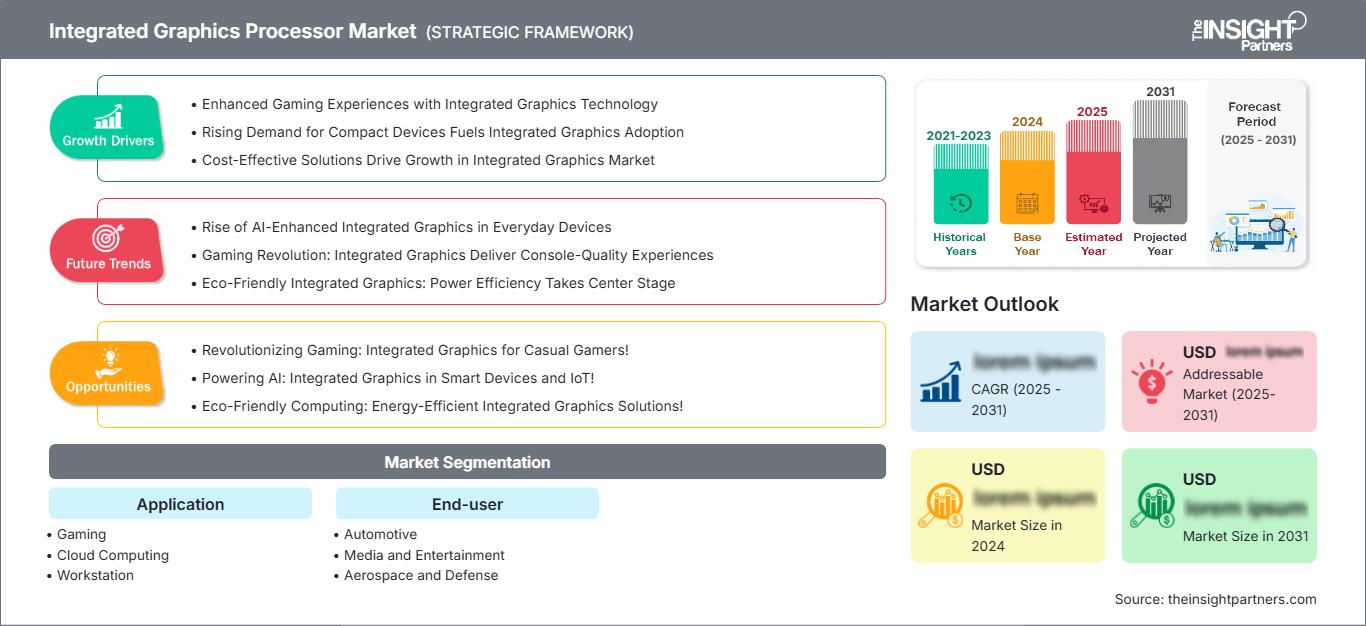
The Integrated Graphics Processor Market size is valued at US$ 28.00 Billion in 2025 and is projected to reach US$ 55.57 Billion by 2034, registering a CAGR of 7.91% during 2026–2034. Expansion reflects increasing demand for graphics acceleration within compact computing platforms, AI-enabled personal devices, automotive systems, and professional workloads where power efficiency, memory bandwidth, and integrated compute capabilities increasingly influence processor architecture and system design decisions.
North America is expected to maintain a strong position, with an estimated 7.5–8.0% CAGR through 2034. Growth is supported by accelerated AI-PC adoption and increasing deployment of graphics-capable processors in automotive computing. Demand from cloud infrastructure, workstation upgrades, gaming systems, and advanced semiconductor design ecosystems should further support regional expansion.
Integrated Graphics Processor Market Assessment and Insights
- North America: North America held a 27–30% Integrated Graphics Processor Market share in 2025 and is projected to expand at a 7.5–8.0% CAGR between 2026–2034, supported by AI PCs, automotive computing, cloud infrastructure, and semiconductor investment.
- US: The US represented 79–83% of North American demand in 2025 and is expected to grow at a 7.6–8.1% CAGR through 2034, led by AI-enabled computing and data-intensive applications.
- Europe: Europe accounted for a 19–22% share in 2025 and is forecast to register a 6.9–7.5% CAGR during 2026–2034. Germany, the UK, France, Italy, and Spain benefit from automotive electronics and industrial digitization.
- Asia Pacific: Asia Pacific represented a 37–40% share in 2025 and is expected to grow at a 8.7–9.3% CAGR through 2034. China, Japan, South Korea, and India lead regional semiconductor, consumer-electronics, and automotive demand.
- Largest Segment: Gaming represented a 28–32% market share in 2025 and is projected to grow at a 7.8–8.4% CAGR during 2026–2034, supported by performance-focused consumer processors.
- High Growth Segment: Artificial Intelligence held a 17–21% market share in 2025 and is expected to expand at a 9.8–10.5% CAGR during 2026–2034, driven by on-device inference.
- Key companies analyzed in detail: Advanced Micro Devices, Inc., ASUSTeK Computer Inc., EVGA Corporation, GIGA-BYTE Technology Co., Ltd., Imagination Technologies Limited, Intel Corporation, NVIDIA Corporation, SAPPHIRE Technology Limited, VIA Technologies, Inc., and ZOTAC.
Source: The Insight Partners' analysis based on proprietary research, government publications, company annual reports, investor presentations, industry databases, and expert interviews.
Integrating processors has moved beyond mere display technology into more advanced graphics and parallel-computing architectures. Modern processor architectures integrate the CPUs, graphics processing units, memory controllers, and AI accelerators into smaller form factors. Architectures such as the Xe architecture from Intel, the Radeon integrated solutions from AMD, and graphics processing unit intellectual property from companies specialized in providing them are part of this trend towards heterogeneous computing.
Future growth of Integrated Graphics Processor Market will be driven by the AI notebooks, automotive cockpits, mini-workstations, and edge-computing devices. Policies that focus on localization of semiconductor technologies, investments in advanced package design, and higher vehicular safety requirements are prompting the suppliers to focus more on performance per watt and reliability. Standards from PCI-SIG and JEDEC also affect the architecture design in terms of inter-operability and memory bandwidths.
Integrated Graphics Processor Market Report Scope
| Report Attribute | Details |
|---|---|
| Market size in 2025 | US$ 28.00 Billion |
| Market Size by 2034 | US$ 55.57 Billion |
| Global CAGR (2026 - 2034) | 7.91% |
| Historical Data | 2021-2024 |
| Forecast period | 2026-2034 |
Integrated Graphics Processor Market Analysis
Demand becomes increasingly oriented towards processors which would be able to carry out tasks related to graphics, media, and AI without the use of an additional graphics card. Such Integrated Graphics Processor Market growth factors include thin-and-light laptops, hand-held gaming devices, small-size desktops, digital displays, as well as automotive infotainment. The market includes CPU/GPU manufacturers, semiconductor foundries, memory vendors, OEMs, OS developers, board vendors, and software tool vendors.
Supply factors in the Integrated Graphics Processor Market are highly dependent on process technology, memory interfaces, packaging capabilities, and software. Integrated products may help in lowering BOM complexities due to the lack of additional graphics cards; however, the use of common memory limits the performance in case of resource-intensive operations. Manufacturers thus differentiate themselves through architectural efficiency, driver maturity, media blocks, thermal performance, and memory management.
Competitive positioning in the Integrated Graphics Processor Market is based on the capability of mixing processors architecture, graphics IP, software ecosystems, and relationships with OEMs. Intel Corporation and Advanced Micro Devices, Inc. have a strong position with processor platforms featuring ever more sophisticated graphics, while Imagination Technologies Limited offers licensable GPU IP for specialized embedded and automotive solutions. NVIDIA Corporation is important due to graphics and AI ecosystems that influence performance expectations in related computing segments.
ASUSTeK Computer Inc., GIGA-BYTE Technology Co., Ltd., SAPPHIRE Technology Limited, and ZOTAC contribute mainly to hardware ecosystem via systems and graphics products, while VIA Technologies, Inc. deals with embedded and specialized computing applications. EVGA Corporation is still kept because of historical importance in graphics hardware market. Priorities of investment shift towards AI-enabled architectures, heterogeneous computing, advanced packaging, software portability, and power-efficient performance.
● REPORT CUSTOMIZATION
Tailor This Report To Align With Your Specific Business Requirements
This report can be customized to align precisely with your business objectives, scope, and target markets. Customization options include tailored segmentation, geography, competitive analysis, and strategic insights to support informed decision-making.
Customize This Report →WHAT YOU CAN ADJUST
- ● Segmentations
- ● Geography
- ● Competitive Analysis
- ● Language Preferences
Integrated Graphics Processor Market: Strategic Insights
Regional Insights
North America Integrated Graphics Processor Market
North America held a 27–30% share in 2025 and is modeled to expand at a 7.5–8.0% CAGR through 2034. The US drives regional consumption, which is enabled by semiconductor design, cloud computing, gaming, workstation development, and automotive technologies. The contributions from Canada are made through technology services and automotive manufacturing, whereas Mexico gets its benefit through electronic and vehicle manufacturing.
The demand in the region is changing to processors which have both graphics and AI accelerators in power-constrained platforms. The AI PC, small workstations, edge devices, and vehicle computing are expanding the application domains of processors beyond the typical desktop graphics application. There are many semiconductor designers, software companies, hyperscalers, and OEMs in the region that enable an ecosystem.
U.S. Integrated Graphics Processor Market
The US represented 79–83% of North American demand in 2025 and is projected to grow at a 7.6–8.1% CAGR during 2026–2034. Demand is driven by AI-capable PCs, gaming, cloud computing, workstations, and automotive software engineering. Companies such as Intel Corporation, Advanced Micro Devices, Inc., NVIDIA Corporation, and other computer manufacturers have very well-developed ecosystems for each application category.
According to the Integrated Graphics Processor Market report, the focus of applications is shifting towards local AI capabilities, high-quality media, gaming, professional visualization, and connected car applications. Cloud providers also have some impact on architectural needs since proper graphics virtualization and heterogeneous computing could help to better utilize infrastructure. Development of semiconductors and computing technologies strengthens the US position, while procurement considerations include software availability, energy efficiency, system lifetime, and compatibility with AI frameworks.
Europe Integrated Graphics Processor Market
Europe represented a 19–22% share in 2025 and is expected to register a 6.9–7.5% CAGR through 2034, with Germany leading regional demand. Germany has advantages in automotive electronics and industrial computing, whereas the UK has expertise in semiconductor design, software, and cloud applications. France, Italy, and Spain have advantages in the field of automotive, aerospace, consumer electronics, and industrial digitalization.
Germany has a high focus on the automotive sector and hence there is growing importance of graphics capable processors due to digital cockpits, driver assistance systems, and centralized vehicle computing. The UK has an edge in chip design and software, France is an expert in aerospace, automotive and technology, and Italy and Spain have advantages in industrial automation, connected mobility, consumer electronics, and multimedia systems.
APAC Integrated Graphics Processor Market
APAC held a 37–40% share in 2025 and is projected to grow at an 8.7–9.3% CAGR through 2034, making it the leading regional market. China is leading the way, with Japan, South Korea, India, and Australia following close behind. The manufacture of consumer electronics, semiconductors, automotive electronics, and gaming devices drives the need.
China possesses a large electronics manufacturing industry as well as growing domestic computing needs. Japan and South Korea focus on their advanced electronics and automotive industries, whereas India is investing heavily in semiconductors and digital infrastructure. Australia brings its contribution via enterprise computing and applications. Policy measures and incentives for integrated computing should be adopted.
Middle East & Africa Integrated Graphics Processor Market
Middle East and Africa demand is modeled at a 7.0–7.7% CAGR through 2034, led by Saudi Arabia. The UAE represents a strategic market for cloud infrastructure, smart-city infrastructure, and high-end electronics, while South Africa offers a contribution through enterprise computing, media, and industrial electronics. The rest of MEA is application-specific.
Opportunities within the region continue to focus on digital infrastructure, entertainment infrastructure, automotive electronics, and localized computing. Saudi Arabia and UAE are spending a lot of money in building technology ecosystems, and therefore there is a need for efficient computing in data centers and in connected environments. South Africa continues to be driven by enterprise and consumer applications. Suppliers who have distribution capabilities, thermally designed products, and long lifecycle products are well positioned.
Segmentation Analysis
Application
The Application segment covers Gaming, Cloud Computing, Workstation, Artificial Intelligence, and Driverless Vehicles. The segment is projected to register an 8.0–8.6% CAGR during 2026–2034. The Integrated Graphics Processor Market scope is broadening as graphics engines increasingly perform parallel compute, media processing, visualization, and selected AI workloads across consumer, professional, and embedded platforms.
- Gaming: Gaming remains a major application because integrated graphics provide increasingly capable performance in notebooks, handheld systems, and compact desktops. Demand favors efficient architectures, faster memory access, improved drivers, and advanced rendering technologies.
- Cloud Computing: Cloud platforms use graphics acceleration for virtual desktops, media services, gaming, visualization, and selected AI workloads. Integrated architectures can support cost-sensitive deployments where graphics capability and general compute must coexist.
- Workstation: Workstation applications require dependable visualization for engineering, design, media production, and technical software. Integrated graphics increasingly serve entry and mobile workstations where efficiency, portability, and system simplicity matter.
- Artificial Intelligence: AI applications are expanding the role of graphics engines in local inference, computer vision, and parallel workloads. Integrated processing can reduce latency and power consumption when workloads remain within device memory constraints.
- Driverless Vehicles: Autonomous and semi-autonomous vehicles require graphics and compute resources for visualization, sensor processing, and human-machine interfaces. Integrated architectures support consolidated vehicle computing while helping manage space, power, and thermal constraints.
End-user
The End-user segment comprises Automotive, Media and Entertainment, Aerospace and Defense, and Consumer Electronics. It is expected to grow at an 8.3–8.9% CAGR during 2026–2034. Adoption depends on graphics intensity, power budgets, safety requirements, device size, and the need to consolidate multiple computing functions within fewer chips.
- Automotive: Automotive applications increasingly require graphics for digital cockpits, infotainment, displays, driver monitoring, and visualization. Functional safety, virtualization, long product lifecycles, and deterministic performance strongly influence supplier qualification.
- Media and Entertainment: Media and entertainment systems require efficient rendering, video decode and encode, content creation, and display processing. Integrated graphics can simplify compact devices while supporting increasingly demanding multimedia experiences.
- Aerospace and Defense: Aerospace and defense systems prioritize reliability, thermal efficiency, lifecycle stability, and deterministic processing. Graphics acceleration supports mission displays, simulation, visualization, training systems, and selected embedded compute workloads.
- Consumer Electronics: Consumer electronics represents a broad installed base spanning notebooks, desktops, tablets, handheld devices, and compact systems. Buyers increasingly value graphics performance, battery efficiency, AI capability, and integrated platform functionality.
Opportunity Snapshot
| Application | Revenue Contribution | Trend Tag | Adoption Stage |
|---|---|---|---|
| Gaming | High | Mobile Gaming | Mature |
| Cloud Computing | Medium | GPU Virtualization | Scaling |
| Workstation | Medium | Local Rendering | Scaling |
| Artificial Intelligence | High | Edge Inference | Emerging |
| Driverless Vehicles | Medium | Vehicle Compute | Emerging |
Integrated Graphics Processor Market Growth Drivers and Impact Analysis
AI PCs increase demand for heterogeneous processor architectures
Personal computers with AI capabilities are leading to a need for coordinated computing capabilities of CPU, GPU, and NPU within a limited power budget. The graphics engine can help in parallel computations for image processing, video processing, inference, and content creation, thus lowering dependence on additional accelerators for specific computations. This impacts purchasing decisions since OEMs now consider performance at the platform level rather than the performance of CPUs alone. This technology has commercial relevance for notebooks, mini PC, business desktop, and mobile workstation segments. In addition, integrated architectures can lead to lower board complexity and more efficient battery power when tasks are allocated efficiently. Since OSs and frameworks will continue to expose heterogeneous compute capabilities, processors with well-developed drivers and development kits are likely to gain more control over the platform.
Automotive computing consolidates graphics and control workloads
The current trend in vehicle electronics is toward centralized and zoned architecture, where several computing tasks are performed by fewer and more powerful systems. Graphics processors participate in cockpit display generation, infotainment, surround view generation, interfaces of the driver monitor, and certain perception applications. Such trends bring about the need for integrated products that ensure deterministic performance within demanding constraints of power, temperature, and functional safety. Another factor for suppliers of automotive solutions is long qualification periods of such programs, making software support and long lifetime of product an important commercial requirement. Functional safety standards like ISO 26262 raise the importance of fault detection, isolation, and reliable operation of computing processes. Providers of graphics, computing, virtualization, and safety capabilities can cover broader range of automotive applications.
Advanced graphics improve compact computing economics
Higher graphics capability within processors can reduce the need for separate entry-level graphics hardware in mainstream notebooks, desktops, handheld devices, and compact systems. This can lower board complexity, simplify cooling arrangements, reduce power requirements, and create more flexible industrial designs. OEMs can redirect saved space toward batteries, storage, connectivity, or additional thermal capacity. The economic impact is strongest for products where discrete graphics would add meaningful cost without being continuously required. At the same time, improved integrated graphics can widen the addressable market for casual gaming, media creation, visualization, and AI-assisted applications. Processor vendors therefore have an incentive to improve performance per watt and memory efficiency. The resulting competition encourages more capable architectures while preserving differentiation between integrated platforms and high-performance discrete accelerators.
Integrated Graphics Processor Market Future Trends
Graphics engines become programmable AI resources
Future processor designs are likely to treat integrated graphics as programmable resources for graphics, media, simulation, and AI workloads rather than isolated rendering engines. This Integrated Graphics Processor Market trends shift should encourage deeper integration between graphics cores, memory controllers, neural accelerators, and software runtimes. Developers will increasingly distribute workloads dynamically according to latency, power, and throughput requirements. Unified programming models and portable APIs can reduce software fragmentation across processor families. Hardware virtualization may also become more important as one graphics engine serves multiple applications or isolated workloads. In automotive and industrial environments, quality-of-service controls will help prioritize safety-critical or latency-sensitive tasks. The commercial implication is a gradual movement toward multipurpose compute architectures where graphics performance remains important, but programmability and workload flexibility become equally significant purchasing criteria.
Memory efficiency becomes a central competitive parameter
Integrated graphics increasingly depend on shared system memory, making bandwidth, latency, cache architecture, and memory-management efficiency critical to real-world performance. Future platforms are likely to emphasize larger caches, improved compression, faster memory standards, and more sophisticated allocation between CPU, GPU, and AI workloads. This can reduce bottlenecks without proportionally increasing system power consumption. Processor designers may also optimize graphics architectures for specific memory footprints, allowing OEMs to balance performance against battery capacity and device cost. In notebooks and compact desktops, efficient memory use can extend the useful range of integrated graphics for gaming and content creation. Automotive systems may similarly benefit because centralized computing platforms must support multiple displays and compute workloads while operating within strict thermal envelopes. Consequently, memory architecture will increasingly shape graphics competitiveness.
Integrated Graphics Processor Market Opportunities
AI-enabled edge devices expand addressable workloads
The strongest strategic opportunities are emerging where graphics and AI workloads must operate locally under strict power and latency constraints. Automotive systems, industrial vision equipment, smart displays, compact workstations, and premium mobile devices can benefit from processors that combine graphics acceleration with AI capabilities. Investors and suppliers should prioritize platforms with scalable architectures, mature software support, and clear paths for workload portability. Partnerships with OEMs can secure design wins before production programs become difficult to displace. The opportunity also extends to developer ecosystems because application compatibility can accelerate adoption across multiple hardware generations. Integrated solutions that reduce board area and cooling requirements may provide additional economic value. Companies should therefore evaluate architectures not only by graphics benchmarks but also by total system efficiency, memory utilization, software ecosystem depth, and suitability for sustained local inference.
Automotive and edge design wins create long-cycle revenue opportunities
The automotive and embedded markets offer attractive opportunities because processor qualification can create multiyear supply relationships and recurring production demand. Suppliers can target digital cockpits, advanced displays, driver assistance, autonomous platforms, robotics, and industrial control systems where graphics and compute functions increasingly converge. The Integrated Graphics Processor Market Forecasts indicate that application diversification should reduce reliance on traditional PC demand over time. Strategic investment should focus on functional safety, virtualization, deterministic behavior, thermal efficiency, and software development support. Licensing models can also provide opportunities for GPU IP specialists that lack large-scale manufacturing capabilities. Collaboration with semiconductor foundries, Tier 1 suppliers, and system integrators can accelerate commercialization. Companies able to demonstrate predictable performance across multiple operating environments should be better positioned to secure long-term embedded design wins.
Recent Developments
- August 2026: Intel is reportedly planning processors featuring NVIDIA integrated GPUs (iGPUs) as part of a future collaboration, with the first products potentially arriving around 2028. The move would mark a significant shift from Intel’s strategy of relying on its own integrated graphics technology and could combine Intel CPU architectures with NVIDIA graphics to deliver substantially stronger integrated graphics performance.
- March 2026: Intel unveiled its next-generation Core Ultra Series 3 with Intel vPro commercial PC platform, built on Intel’s advanced 18A process technology and designed for enterprise, education, government and small-business environments. The platform supports more than 125 commercial PC designs and combines improved performance, power efficiency, integrated graphics and AI acceleration, with Intel claiming over 30% faster single- and multi-thread performance, up to 30% higher productivity, up to 80% better graphics and up to 4× higher AI performance versus four-year-old business PCs.
- September 2025: NVIDIA and Intel announced a strategic collaboration to jointly develop multiple generations of custom data-center and PC products, combining NVIDIA’s AI and accelerated-computing technologies with Intel’s x86 CPU architecture and ecosystem. For data centers, Intel will design and manufacture custom NVIDIA x86 CPUs that NVIDIA will integrate into its AI infrastructure platforms.
Frequently Asked Questions

- Comprehensive Market Sizing and Forecast Analysis
- Detailed Segmentation Analysis
- In-Depth Market Dynamics Assessment
- Regional and Country-Level Insights
- Competitive Landscape and Company Benchmarking
- Strategic Business Intelligence
Recent Reports
Testimonials

The Insight Partners provided valuable market intelligence that supported our global go-to-market strategy. Their team was professional, responsive, and attentive to our feedback, providing thoughtful analysis and helpful methodological clarifications throughout the project.
Junmo Kim Chief Financial Officer (CFO), Enertech Co., Ltd.
The Insight Partners' SCADA System Market report is comprehensive, with valuable insights on current trends and future forecasts. The team was highly professional, responsive, and supportive throughout. We are very satisfied and highly recommend their services.
RAN KEDEM Partner, Reali Technologies LTDs
I requested a report on a very specific software market and the team produced the report in a few days. The information was very relevant and well presented. I then requested some changes and additions to the report. The team was again very responsive and I got the final report in less than a week.
JEAN-HERVE JENN Chairman, Future Analytica
We worked with The Insight Partners for an important market study and forecast. They gave us clear insights into opportunities and risks, which helped shape our plans. Their research was easy to use and based on solid data. It helped us make smart, confident decisions. We highly recommend them.
PIYUSH NAGPAL Sr. Vice President, High Beam Global
The Insight Partners delivered insightful, well-structured market research with strong domain expertise. Their team was professional and responsive throughout. The user-friendly website made accessing industry reports seamless. We highly recommend them for reliable, high-quality research services
YUKIHIKO ADACHI CEO, Deep Blue, LLC.
This is the first time I have purchased a market report from The Insight Partners.While I was unsure at first, I visited their web site and felt more comfortable to take the risk and purchase a market report.I am completely satisfied with the quality of the report and customer service. I had several questions and comments with the initial report, but after a couple of dialogs over email with their analyst I believe I have a report that I can use as input to our strategic planning process.Thank you so much for taking the extra time and making this a positive experience.I will definitely recommend your service to others and you will be my first call when we need further market data.
JOHN SUZUKI President and Chief Executive Officer, Board Director, BK Technologies
I wish to appreciate your support and the professionalism you displayed in the course of attending to my request for information regarding to infectious disease IVD market in Nigeria. I appreciate your patience, your guidance, and the fact that you were willing to offer a discount, which eventually made it possible for us to close a deal. I look forward to engaging The Insight Partners in the future, all thanks to the impression you have created in me as a result of this first encounter.
DR CHIJIOKE ONYIA MANAGING DIRECTOR, PineCrest Healthcare Ltd.Reason to Buy
- Informed Decision-Making
- Understanding Market Dynamics
- Competitive Analysis
- Identifying Emerging Markets
- Customer Insights
- Market Forecasts
- Risk Mitigation
- Boosting Operational Efficiency
- Strategic Planning
- Investment Justification
- Tracking Industry Innovations
- Aligning with Regulatory Trends





 Get Free Sample for