
Infrared Detector Market Size, Demand & Growth by 2034
Coverage: By Wavelength (Short Wave Infrared, Medium Wave Infrared, Long Wave Infrared); Type (Mercury Cadmium Telluride (MCT), Pyroelectric, Microbolometers, Indium gallium arsenide (InGaAs), Others); Vertical (Automotive, Aerospace and Defense, Semiconductor and Electronics, Medical, Residential and Commercial, Other) , and Geography (North America, Europe, Asia Pacific, and South and Central America)
- Status : Data Released
- Report Code : TIPRE00004807
- Category : Electronics and Semiconductor
- No. of Pages : 150
- Available Report Formats :


- Last update date : October 16, 2026


2025 Market Size
US$ 771.31 Mn
Base year value
2034 Forecast
US$ 1,672.89 Mn
Projected by 2034
CAGR 2026-2034
8.98 %
Growth rate
Addressable Market
US$ 10,935.97 Mn
(2026-2034)
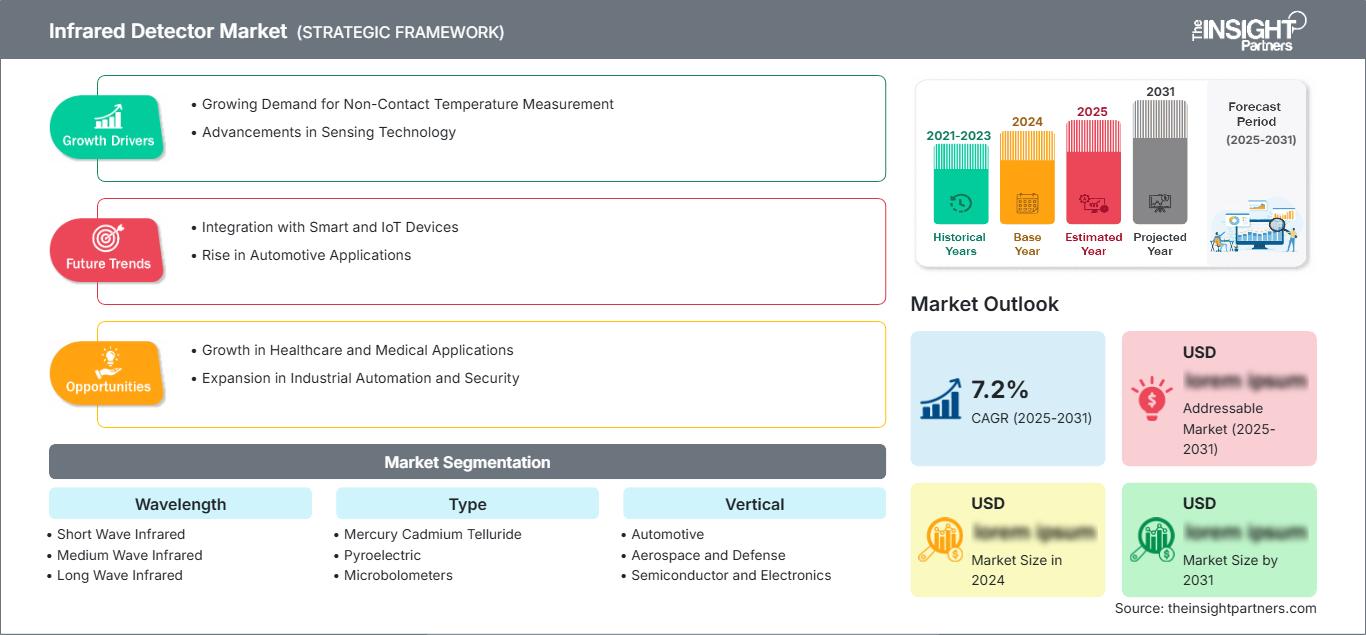
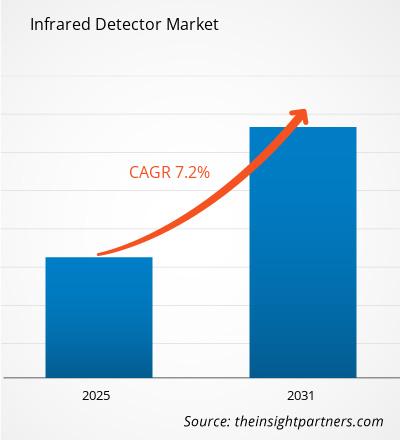
The Infrared Detector Market was valued at US$ 771.31 Million in 2025 and is projected to reach US$ 1,672.89 Million by 2034, expanding at a CAGR of 8.98% during 2026–2034. This outlook reflects the increasing strategic role of infrared sensing across thermal imaging, spectroscopy, machine vision, medical instrumentation, automotive safety, and aerospace and defense platforms requiring reliable detection beyond the visible spectrum.
Across North America, the Infrared Detector Market size is expected to expand at a modeled 8.3–8.9% CAGR through 2034. Defense modernization, semiconductor inspection, and growing deployment of thermal sensing in vehicles and buildings support demand. Buyers increasingly favor smaller-pixel, lower-power detectors that combine higher sensitivity with simplified integration, while domestic manufacturing incentives and secure sourcing requirements strengthen regional investment in photonic components and imaging subsystems.
Infrared Detector Market Assessment and Insights
- North America: Held 36–40% share in 2025 and is modeled to grow at 8.3–8.9% CAGR during 2026–2034, supported by defense procurement, semiconductor inspection, automotive sensing, and established photonics manufacturing.
- US: Represented 79–83% of North American revenue in 2025 and is modeled at 8.4–9.0% CAGR through 2034, reflecting defense, aerospace, industrial, and autonomous-system demand.
- Europe: Accounted for 25–29% share in 2025 and is modeled at 8.0–8.6% CAGR during 2026–2034, led by Germany, France, the UK, Italy, and Spain through automotive, defense, and industrial investment.
- Asia Pacific: Captured 24–28% share in 2025 and is modeled at 9.6–10.3% CAGR during 2026–2034, with China, Japan, South Korea, and India driving electronics, surveillance, and manufacturing demand.
- Largest Segment: Long Wave Infrared held 42–46% market share in 2025 and is modeled to expand at 8.4–9.0% CAGR through 2034 as uncooled thermal imaging scales.
- High Growth Segment: Indium gallium arsenide held 15–18% market share in 2025 and is modeled at 10.4–11.2% CAGR through 2034, benefiting from SWIR inspection and spectroscopy.
- Key companies analyzed in detail: Excelitas Technologies Corp., Teledyne FLIR LLC, Hamamatsu Photonics K.K., InfraTec GmbH, Lynred USA Inc., Murata Manufacturing Co., Ltd., Melexis NV, Nippon Ceramic Co., Ltd., OMRON Corporation, and VIGO Photonics S.A.
Source: The Insight Partners' analysis based on proprietary research, government publications, company annual reports, investor presentations, industry databases, and expert interviews.
Infrared sensing has evolved from large, cryogenic cooled devices to small uncooled arrays, wafer level packaging, and application-specific modules. Cost savings in microbolometer enabled thermal sensing applications, while better performance in MCT and InGaAs enabled sensitive spectroscopy and semiconductor applications. Increasing manufacturing involves more compound semiconductors, pixels uniformity, read-out integrated circuits, vacuum packaging, and calibrated optical elements. The technology trends make the Infrared Detector Market align with scalable electronics manufacturing. However, yield control, specialty materials and supply chain controls for exporting are key manufacturing challenges.
Asia Pacific manufacturing hubs, European automotive initiatives, and Middle Eastern construction programs are some of the regions where the customer base could increase. Investments will flow towards smaller pitch focal plane arrays, multispectral fusion and lower power edge processing. Government support in the form of semiconductor policy, defense resilience, energy efficient buildings, and road safety policies will encourage investments. Suppliers who manage detector materials, packaging yields and reference design will benefit from the emerging demand.
Infrared Detector Market Report Scope
| Report Attribute | Details |
|---|---|
| Market size in 2025 | US$ 771.31 Million |
| Market Size by 2034 | US$ 1,672.89 Million |
| Global CAGR (2026 - 2034) | 8.98% |
| Historical Data | 2021-2024 |
| Forecast period | 2026-2034 |
Infrared Detector Market Analysis
The development of the Infrared Detector market is stimulated by constant needs for all-weather surveillance, predictive maintenance, contactless thermometry, and non-visible light machine vision. The value chain includes companies working with specialty substrates and epitaxial materials, detector makers, circuit designers, packaging experts, optical firms, camera manufacturers, software firms, and end-system manufacturers.
Technologically focused supply is ensured due to the need to regulate composition in MCT, control wafer quality of InGaAs, perform vacuum packaging, and calibrate detectors on pixel level. Dual-sourcing, long lifecycle products, and export-oriented supply are growing demands from customers. Increase in semiconductor sales by 26.2% in 2025 boosts the requirement for inspections; detector manufacturers have to manage foundries and workforce.
According to Infrared Detector Market, competitive landscape is fragmented based on the physics of the infrared detectors and their integration level. Excelitas Technologies Corp., Hamamatsu Photonics K.K., and VIGO Photonics S.A. operate in the realm of photonic detectors, whereas Teledyne FLIR LLC and Lynred USA Inc. operate on both thermal cores and imaging platforms. The companies such as Murata Manufacturing Co., Ltd., Melexis NV, Nippon Ceramic Co., Ltd., and OMRON Corporation focus on scalable sensing solutions.
Competitive advantages are gained through investments in smaller pixel pitches, higher operational temperatures of cooled detectors, hermetic wafer-level packaging, and embedded image processing. InfraTec GmbH distinguishes itself from competitors with its measurement solutions, while platform providers are strategically positioned with respect to calibrated modules and application software. In addition, strategic competitive advantage is gained with detector yield, export licenses, customer qualification capabilities, and component-to-subsystem development.
● REPORT CUSTOMIZATION
Tailor This Report To Align With Your Specific Business Requirements
This report can be customized to align precisely with your business objectives, scope, and target markets. Customization options include tailored segmentation, geography, competitive analysis, and strategic insights to support informed decision-making.
Customize This Report →WHAT YOU CAN ADJUST
- ● Segmentations
- ● Geography
- ● Competitive Analysis
- ● Language Preferences
Infrared Detector Market: Strategic Insights
Regional Insights
North America Infrared Detector Market
North America held a modeled 36–40% Infrared Detector Market share in 2025 and is expected to expand at 8.3–8.9% CAGR during 2026–2034. Defense modernization, border surveillance, firefighting, predictive maintenance, and semiconductor inspections drive continuous demand. The region takes advantage of its well-developed focal plane array technology base, aerospace prime companies, optical component suppliers, and system integration houses that can satisfy qualification, cybersecurity, and export control needs.
There are further growth prospects related to automotive night vision and occupant sensing applications, whereas logistics center automation and intelligent building control solutions use low-power thermal cameras. Semiconductor production incentives stimulate local manufacturing; however, compound semiconductor fabs have a more limited scope. Consumers consider such factors as noise performance, operational temperature, pixel size, calibration precision, and total module power consumption besides the price of the sensor itself.
U.S. Infrared Detector Market
The U.S. represented a modeled 79–83% of North American revenue in 2025 and is projected to grow at 8.4–9.0% CAGR through 2034. Aviation, missile warning, unmanned, industrial thermography, space payload and advanced semiconductor production provide a diversified demand pool. IATA found that passenger demand increased by 5.3% in 2025, which will drive the aircraft usage and maintenance where infrared inspections can detect any thermal defects.
Excelitas Technologies Corp., Teledyne FLIR LLC, Hamamatsu Photonics K.K. and Lynred USA Inc. have the presence either commercially or through manufacturing to serve OEM programs. The adoption trend is towards small uncooled cores, extended-SWIR sensitivity and embedded analytics for perimeter security, maintenance and autonomous operations. Federal purchases and domestic content requirements can favor the local suppliers, but exports regulations may hinder the market opportunities. The end-users prefer customizable modules which can save the integration time without compromising the mission-specific calibration and optics.
Europe Infrared Detector Market
Europe accounted for a modeled 25–29% share in 2025 and is expected to post 8.0–8.6% CAGR through 2034. Germany is a leader in automotive sensing, industrial automation, building diagnostics, and semiconductor equipment. It has an engineering platform that enables microbolometers, pyrolectric sensors, precision optics, and calibrated thermal imaging systems, whereas stricter safety standards for cars and better energy efficiency standards favor incorporation on larger volume platforms.
The UK has contributions in the aerospace sector, defense, research instruments, and fire safety. France has detector manufacturing, defense electronics, space, and industrial imaging, which makes it strategically important in both cooled and uncooled infrared technologies. Italy and Spain contribute to the aerospace, security, automotive, renewable energy inspection, and commercial buildings sectors.
Regional procurement increasingly emphasizes sovereign capability, export resilience, and environmental compliance. Suppliers able to localize calibration, application engineering, and long-term service are positioned to capture defense modernization and industrial decarbonization projects.
APAC Infrared Detector Market
Asia Pacific held a modeled 24–28% share in 2025 and is forecast to grow at 9.6–10.3% CAGR during 2026–2034. China is dominant in electronics production, surveillance, electric vehicles, and inspections. Japan provides detector materials and precise sensing, while South Korea offers semiconductor inspection and military applications.
India extends the application through aerospace, border security, electronics, and smart infrastructure initiatives, while Australia provides mining, firefighting, and asset monitoring needs. Localization policy in semiconductors, automation in factories, and military budgets promote growth, despite restrictions on export, calibration facilities, and lack of compound semiconductor facilities.
Middle East & Africa Infrared Detector Market
The region is modeled to expand at 8.7–9.4% CAGR through 2034. Saudi Arabia leads through defense, oil and gas, smart-city, and industrial diversification programs. The UAE combines border security, aviation, utilities, and premium-building automation with advanced imaging requirements.
South Africa contributes mining, power, security, and wildfire-monitoring demand, while the Rest of MEA remains project-led. Energy infrastructure creates opportunities for leak detection and predictive maintenance, but adoption depends on procurement funding, local integration skills, import controls, and service coverage for calibrated systems.
Segmentation Analysis
Wavelength
Wavelength demand is modeled at 8.7–9.3% CAGR during 2026–2034 as system designers match atmospheric transmission, target temperature, optics, and detector materials to mission requirements. The Infrared Detector Market scope covers reflected-light SWIR inspection, high-temperature MWIR measurement, and broad LWIR thermal imaging. Multiband architectures are gaining relevance where classification accuracy and operation across changing weather conditions justify higher system complexity.
- Short Wave Infrared: SWIR supports semiconductor inspection, moisture analysis, sorting, spectroscopy, and low-light imaging, benefiting from visible-like image detail and compatibility with InGaAs detector arrays.
- Medium Wave Infrared: MWIR remains strategically important for long-range surveillance, missile warning, gas detection, and high-temperature measurement where cooled photonic detectors deliver sensitivity and fast response.
- Long Wave Infrared: LWIR held 42–46% market share in 2025, supported by uncooled thermal cameras used in security, firefighting, buildings, automotive systems, and industrial maintenance.
Type
Type revenue is modeled to rise at 9.0–9.6% CAGR through 2034. Selection depends on sensitivity, spectral response, cooling needs, response speed, pixel scalability, power consumption, and cost. Microbolometers drive volume thermal imaging, MCT supports demanding multi-band performance, pyroelectric devices serve motion and gas sensing, and InGaAs expands with SWIR machine vision and spectroscopy.
- Mercury Cadmium Telluride: MCT provides tunable spectral response and high sensitivity for defense, space, scientific, and gas-analysis systems, although cooling, material uniformity, and manufacturing yield constrain cost.
- Pyroelectric: Pyroelectric detectors serve motion sensing, flame detection, non-dispersive infrared gas analysis, and spectroscopy, offering room-temperature operation, low power, and dependable response to modulated radiation.
- Microbolometers: Microbolometers underpin high-volume uncooled thermal imaging because they eliminate cryogenic cooling, enabling compact cameras for buildings, security, firefighting, industrial inspection, and automotive applications.
- Indium gallium arsenide: InGaAs held 15–18% market share in 2025 and supports fast, sensitive SWIR detection for semiconductor inspection, spectroscopy, laser monitoring, recycling, and agricultural sorting.
Vertical
Vertical demand is modeled at 8.8–9.4% CAGR during 2026–2034, reflecting distinct performance and qualification requirements. Aerospace and defense prioritize range, sensitivity, and ruggedization; semiconductor users emphasize uniformity and defect contrast; automotive programs demand compact, qualified components; medical systems require repeatability; and buildings favor low-cost sensors for occupancy, safety, and energy management.
- Automotive: Night vision, driver monitoring, occupant detection, battery thermal management, and pedestrian sensing create scalable demand, although qualification cycles and cost targets require highly integrated, low-power designs.
- Aerospace and Defense: Surveillance, targeting, missile warning, navigation, and space payloads sustain premium detector demand where sensitivity, ruggedness, range, and secure supply outweigh unit cost.
- Semiconductor and Electronics: SWIR inspection, wafer thermal mapping, laser monitoring, and electronics testing gain strategic importance as advanced packaging and smaller geometries raise defect-detection requirements.
- Medical: Infrared detectors enable thermography, spectroscopy, patient monitoring, diagnostic instrumentation, and laboratory analysis, with adoption governed by calibration, clinical evidence, regulatory approval, and workflow integration.
- Residential and Commercial: Occupancy sensing, intrusion detection, HVAC control, fire safety, electrical inspection, and building diagnostics support broad demand for affordable pyroelectric and uncooled thermal devices.
Opportunity Snapshot
| Industry Vertical | Revenue Contribution | Trend Tag | Adoption Stage |
| Automotive | Medium | Night Vision | Scaling |
| Aerospace and Defense | High | Multispectral ISR | Mature |
| Semiconductor and Electronics | High | Wafer Inspection | Scaling |
| Medical | Medium | Thermal Diagnostics | Emerging |
| Residential and Commercial | Medium | Smart Occupancy | Scaling |
| Other | Low | Specialty Sensing | Emerging |
Infrared Detector Market Growth Drivers and Impact Analysis
Expansion of Thermal Imaging Across Industrial Workflows
Infrared sensing is increasingly adopted by manufacturing industries, utilities, data centers, refineries, and other industrial facilities to detect overheating, insulation failure, friction and process deviation without stopping operations. There are further effects in the economy through the sale of cameras, since every system implemented relies on detector chips that require calibration, lenses, processing components, software and maintenance services. The increase in semiconductor production is a key factor along this line: worldwide semiconductor sales were $ 795.6 billion in 2025, which is a 26.2% increase year over year and satisfies the growing demand for inspections. As owners of assets move towards condition-based maintenance instead of scheduled one, the requirements of the detectors include stability and connectivity.
Defense, Aerospace, and Border-Security Modernization
The constant need for night vision, target acquisition, missile warning, unmanned operations, and perimeter security will continue to drive development of cooled and uncooled detector technology. This technology finds its application in those applications that emphasize performance characteristics, such as sensitivity, range, frame rate, ruggedness, and secure procurement, instead of lowest-cost components. Commercial aviation is another factor driving inspection activities, as demand for 2025 passenger growth increased by 5.3%, and the airlines ensured continued use of their fleets despite capacity shortages. The market implications are characterized by lengthy qualification processes, long-term supply agreements, and a high level of demand for lifecycle support. Suppliers of MCT and microbolometer technologies will be favored when end-users desire higher operational temperatures, smaller pixels, and reduced power consumption.
Scaling Automotive and Smart-Building Sensor Integration
The automotive industry is assessing the use of infrared sensors for such applications as night vision, driver monitoring, occupant classification, detection of thermal runaway, and control of cabin temperature. Building designers use infrared-based technologies for occupancy management, intrusion detection, fire protection, and energy-efficient HVAC control. New markets transform economics by redirecting demand from small volumes of standalone instruments to large quantities of cost-sensitive modules. Achieving success in such markets requires wafer-level packaging, low power consumption, integration with functional safety, and performance in harsh environments in terms of wide operating temperature range. Moreover, sensor makers have to deliver algorithms that detect only meaningful objects without sending out personal images. Changing regulatory and building codes provide an opportunity for the automotive industry to combine increased safety and energy efficiency through the use of infrared sensors.
Infrared Detector Market Future Trends
Multispectral Fusion with Edge Intelligence
Infrared Detector Market trends will increasingly center on combining SWIR, MWIR, or LWIR data with visible imaging, radar, and contextual sensors. Edge processors will execute calibration, target detection, anomaly classification, and compression close to the detector, reducing latency and bandwidth. This architecture is especially relevant for autonomous vehicles, drones, perimeter systems, industrial robots, and portable medical instruments. Suppliers will compete on co-optimized detector, readout, optics, and algorithms rather than isolated responsivity. Adoption will require explainable models, representative training data, cybersecurity, and stable performance across weather and temperature. Modular interfaces and validated reference designs should accelerate OEM integration while preserving application-specific tuning.
Higher-Temperature Operation and Wafer-Level Packaging
Detector roadmaps will prioritize lower cooling burdens, smaller pixels, and packaging processes compatible with scale. Higher-operating-temperature MCT can shrink coolers and reduce power, while wafer-level vacuum packaging can improve microbolometer throughput and module consistency. InGaAs producers will pursue larger arrays, extended spectral response, and lower dark current for inspection and spectroscopy. These advances shift differentiation toward process control, calibration automation, and long-term package integrity. Manufacturers with strong epitaxy, readout integration, and test analytics can improve yield while supporting lower system costs. Customers should expect faster product refreshes, but qualification standards in defense, automotive, and medical applications will continue to moderate adoption speed.
Infrared Detector Market Opportunities
SWIR Inspection for Advanced Manufacturing
Infrared Detector Market Forecasts indicate an actionable opening for InGaAs suppliers in semiconductor packaging, recycling, food sorting, pharmaceuticals, and battery production. SWIR reveals moisture, composition, subsurface defects, and material differences that visible cameras may miss. Vendors can invest in line-scan arrays, standardized interfaces, spectral calibration, and application libraries tailored to production lines. Partnerships with machine-vision integrators and equipment manufacturers can convert detector performance into measurable yield, throughput, and waste-reduction outcomes. Commercial success will depend on lowering total system cost and simplifying illumination, optics, and data interpretation. Suppliers that provide evaluation kits and reference datasets can shorten proof-of-concept cycles and establish design positions before customers standardize inspection architectures.
Localized Detector Packaging and Calibration Capacity
Regional semiconductor and defense policies create investment opportunities in packaging, calibration, and module assembly, even where full detector fabrication is not immediately economical. Companies can establish cleanroom packaging lines, vacuum-seal capability, radiometric calibration laboratories, and reliability testing near high-growth customers. This approach reduces logistics risk, supports domestic-content requirements, and allows application-specific customization without duplicating epitaxy infrastructure. Joint ventures with universities, foundries, and optics suppliers can build technical depth while sharing capital requirements. Investors should prioritize processes serving multiple detector families and assess export-control exposure early. A scalable local module ecosystem can improve lead times, support maintenance, and create defensible customer relationships around qualification data and lifecycle service.
Recent Developments
- September 2025: Murata Manufacturing has launched the IRS-D200ST00R1, a new digital-output SMD pyroelectric infrared sensor designed for low-power applications. The sensor is already in mass production and is aimed at devices that require reliable human-motion detection while operating on limited battery power. The new sensor has been developed in response to the growing use of IoT technology in smart homes and buildings, where motion detection is increasingly used to improve convenience, safety and energy efficiency.
- March 2026: Fujitsu has announced the development of a new high-sensitivity, high-resolution infrared sensor designed to improve monitoring capabilities in defense, disaster prevention and environmental applications. The company says the technology is the world’s first dual-band Type-II superlattice (T2SL) infrared sensor with more than 1 million pixels. The new sensor can simultaneously detect mid-wavelength infrared (MWIR) and long-wavelength infrared (LWIR) radiation.
- August 2026: Comelit-PAC has introduced a new range of linear beam smoke detectors designed to provide reliable fire detection in large, open and high-ceiling environments. The new systems are aimed at warehouses, industrial facilities, atriums, sports halls and other spaces where conventional point smoke detectors can be difficult to deploy effectively. The detectors use reflective infrared beam technology to monitor large areas for smoke over distances of up to 120 metres.
Frequently Asked Questions

- Comprehensive Market Sizing and Forecast Analysis
- Detailed Segmentation Analysis
- In-Depth Market Dynamics Assessment
- Regional and Country-Level Insights
- Competitive Landscape and Company Benchmarking
- Strategic Business Intelligence
Recent Reports
Testimonials

The Insight Partners provided valuable market intelligence that supported our global go-to-market strategy. Their team was professional, responsive, and attentive to our feedback, providing thoughtful analysis and helpful methodological clarifications throughout the project.
Junmo Kim Chief Financial Officer (CFO), Enertech Co., Ltd.
The Insight Partners' SCADA System Market report is comprehensive, with valuable insights on current trends and future forecasts. The team was highly professional, responsive, and supportive throughout. We are very satisfied and highly recommend their services.
RAN KEDEM Partner, Reali Technologies LTDs
I requested a report on a very specific software market and the team produced the report in a few days. The information was very relevant and well presented. I then requested some changes and additions to the report. The team was again very responsive and I got the final report in less than a week.
JEAN-HERVE JENN Chairman, Future Analytica
We worked with The Insight Partners for an important market study and forecast. They gave us clear insights into opportunities and risks, which helped shape our plans. Their research was easy to use and based on solid data. It helped us make smart, confident decisions. We highly recommend them.
PIYUSH NAGPAL Sr. Vice President, High Beam Global
The Insight Partners delivered insightful, well-structured market research with strong domain expertise. Their team was professional and responsive throughout. The user-friendly website made accessing industry reports seamless. We highly recommend them for reliable, high-quality research services
YUKIHIKO ADACHI CEO, Deep Blue, LLC.
This is the first time I have purchased a market report from The Insight Partners.While I was unsure at first, I visited their web site and felt more comfortable to take the risk and purchase a market report.I am completely satisfied with the quality of the report and customer service. I had several questions and comments with the initial report, but after a couple of dialogs over email with their analyst I believe I have a report that I can use as input to our strategic planning process.Thank you so much for taking the extra time and making this a positive experience.I will definitely recommend your service to others and you will be my first call when we need further market data.
JOHN SUZUKI President and Chief Executive Officer, Board Director, BK Technologies
I wish to appreciate your support and the professionalism you displayed in the course of attending to my request for information regarding to infectious disease IVD market in Nigeria. I appreciate your patience, your guidance, and the fact that you were willing to offer a discount, which eventually made it possible for us to close a deal. I look forward to engaging The Insight Partners in the future, all thanks to the impression you have created in me as a result of this first encounter.
DR CHIJIOKE ONYIA MANAGING DIRECTOR, PineCrest Healthcare Ltd.Reason to Buy
- Informed Decision-Making
- Understanding Market Dynamics
- Competitive Analysis
- Identifying Emerging Markets
- Customer Insights
- Market Forecasts
- Risk Mitigation
- Boosting Operational Efficiency
- Strategic Planning
- Investment Justification
- Tracking Industry Innovations
- Aligning with Regulatory Trends





 Get Free Sample for