
Industry 5.0 Market Size, Share & Growth by 2034
Industry 5.0 Market Size and Forecasts (2021 - 2034), Global and Regional Share, Trends, and Growth Opportunity Analysis Report Coverage : By Technology (Digital Twin, Industrial 3D printing, AI in manufacturing, AR/VR, Industrial Sensors, Robots), Application (Manufacturing, Healthcare, Energy, Transportation, Agriculture, Retail & Logistics), Deployment Model (On-Premises, Cloud), End User (Large Enterprises, Small Enterprises, Government Organizations)
- Status : Data Released
- Report Code : TIPRE00039478
- Category : Electronics and Semiconductor
- No. of Pages : 150
- Available Report Formats :


- Last update date : October 16, 2026


2025 Market Size
US$ 84.64 Bn
Base year value
2034 Forecast
US$ 1,013.95 Bn
Projected by 2034
CAGR 2026-2034
31.77 %
Growth rate
Addressable Market
US$ 3,853.54 Bn
(2026-2034)
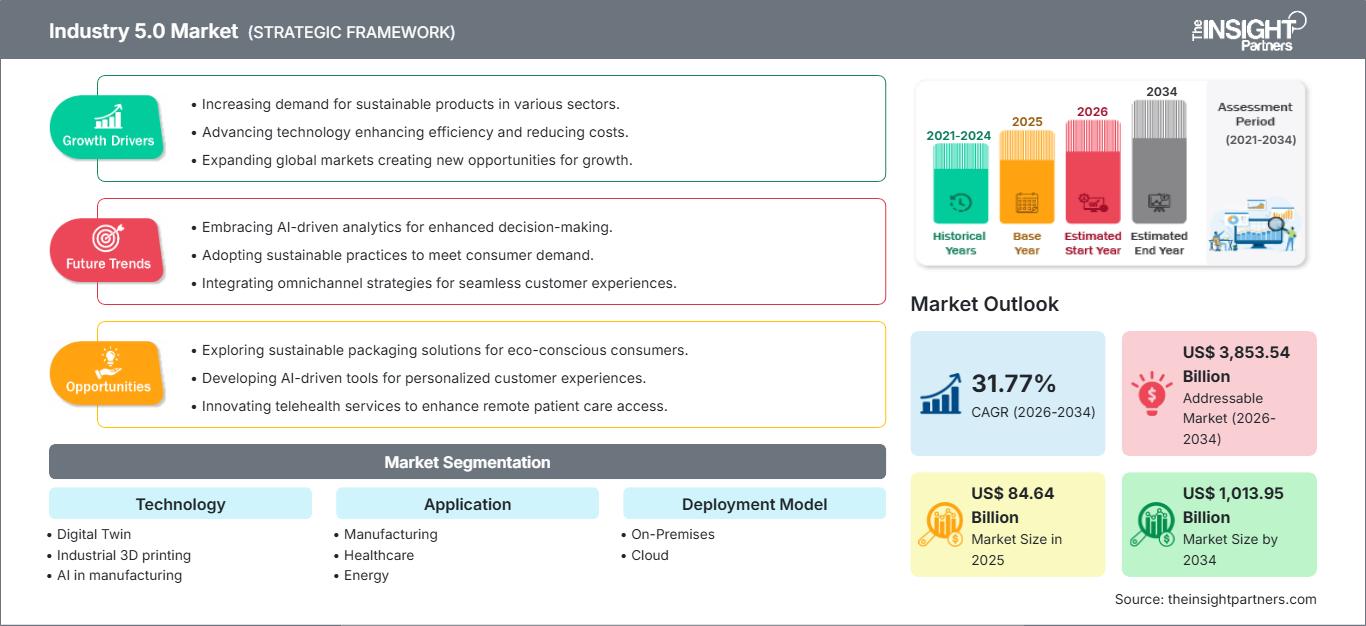
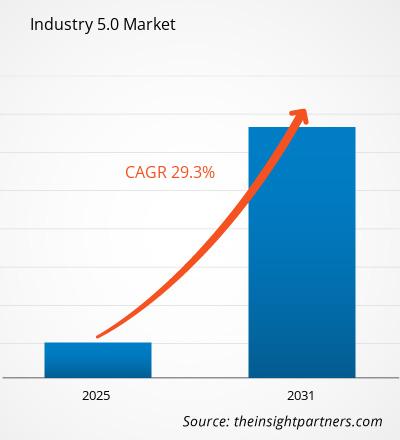
Industry 5.0 Market is valued at US$ 84.64 Billion in 2025 and is projected to reach US$ 1,013.95 Billion by 2034, expanding at a CAGR of 31.77% during 2026–2034. The market reflects the convergence of artificial intelligence, robotics, digital twins, advanced sensing, immersive technologies, and additive manufacturing with human-centric industrial models. Its development is increasingly associated with more adaptive production, sustainable resource use, workforce augmentation, and resilience across interconnected industrial ecosystems.
North America Industry 5.0 Market Size is expected to expand at a 29.5–32.5% CAGR during 2026–2034. Industrial AI investment, advanced robotics adoption, and large-scale cloud infrastructure provide structural support, while manufacturers are increasingly integrating intelligent systems with workforce training, predictive operations, and flexible production architectures. The region's established technology ecosystem also facilitates rapid commercialization of emerging industrial applications.
Industry 5.0 Market Assessment and Insights
- North America is estimated to hold a 28–31% share in 2025 and grow at a 29.5–32.5% CAGR between 2026–2034, supported by industrial AI, robotics, cloud infrastructure, and advanced manufacturing investment.
- US is estimated to account for 84–88% of North America's 2025 market and expand at a 30.0–33.0% CAGR during 2026–2034, supported by AI infrastructure and automation spending.
- Europe is estimated at a 25–28% share in 2025 and projected to grow at a 28.5–31.5% CAGR during 2026–2034, led by Germany, France, the UK, Italy, and the Netherlands.
- Asia Pacific is estimated at a 34–37% share in 2025 and projected to grow at a 33.0–36.0% CAGR during 2026–2034, led by China, Japan, South Korea, and India.
- Largest Segment is AI in manufacturing, estimated at a 30–34% market share in 2025 and projected to grow at a 34.0–37.0% CAGR during 2026–2034.
- High Growth Segment is Cloud deployment, estimated at a 61–65% market share in 2025 and projected to grow at a 33.0–36.0% CAGR during 2026–2034.
- Key companies analyzed in detail: Universal Robots A/S, Rockwell Automation, Inc., Nexus Integra, Schneider Electric SE, Yaskawa Electric Corporation, ABB Ltd, KUKA AG, Cisco Systems, Inc., Siemens AG, FANUC CORPORATION.
Source: The Insight Partners' analysis based on proprietary research, government publications, company annual reports, investor presentations, industry databases, and expert interviews.
The Industry 5.0 Market is shifting away from disjointed automation to an integrated approach whereby artificial intelligence, robotics, simulation, sensing, and human-machine interface work together in a cohesive system. According to the European Commission, the approach will be structured around three priorities that include human-centricity, sustainability, and resilience. In its 2024 roadmap on industrial technologies, the European Commission also lists AI and virtual worlds as technologies that require development and implementation by users.
In the future, the need for demand will expand beyond advanced manufacturing into fields such as healthcare, logistics, agriculture, energy, and transport. Policy issues will become increasingly significant since European initiatives are now linking Industry 5.0 with digital skills, circular economy goals, trustworthy AI, and resilient industrial value chains. The second plenary session of the European Commission's Community of Practice was conducted in March 2026.
Industry 5.0 Market Report Scope
| Report Attribute | Details |
|---|---|
| Market size in 2025 | US$ 84.64 Billion |
| Market Size by 2034 | US$ 1,013.95 Billion |
| Global CAGR (2026 - 2034) | 31.77% |
| Historical Data | 2021-2024 |
| Forecast period | 2026-2034 |
Industry 5.0 Market Analysis
Industry 5.0 Market drivers include manufacturers that aim at maintaining flexibility without compromising productivity, quality, sustainability, or labor involvement. Industrial AI would analyze operational data, digital twins would perform simulations of process changes, robotics would perform repetitive or hazardous tasks while still being linked with human decision making. The whole combination changes the value proposition from the implementation of separate automation initiatives to the creation of an adaptive manufacturing system that can adjust to the demand fluctuations, constraints, and labor needs.
The ecosystem includes automation suppliers, robotics suppliers, industrial software companies, cloud providers, sensors producers, system integrators, engineering companies, and end users. Digital infrastructure becomes one of the essential layers due to the fact that advanced solutions need secure data gathering, computing capabilities, connectivity, and analysis capabilities. Supply of hardware will be driven by the semiconductor industry, sensors, actuators, industrial networking solutions, and special-purpose computing.
Market Analysis for Industry 5.0 shows that there is an intense level of competition between different automation firms and specialists specializing in robots, software, connectivity, or industrial digitalization. For instance, Siemens AG combines technologies such as automation, simulation, digital twin, and AI for industry, while ABB Ltd., FANUC CORPORATION, Yaskawa Electric Corporation, KUKA AG, and Universal Robots A/S specialize in robots. Competition in automation, control, software, and connected industrial architecture is from Rockwell Automation, Inc. and Schneider Electric SE, while Cisco Systems, Inc. specializes in networking and cybersecurity.
Strategic investments tend to be made in engineering based on AI, virtual commissioning, simulation, physical AI, and software-defined automation. Siemens has completed its takeover of Altair Engineering in March 2025, spending approximately US$10 billion and improving its simulation, high-performance computing, data science, and industrial AI capacities. Furthermore, Siemens and NVIDIA have expanded their partnership in June 2025 by connecting accelerated computing to the Siemens Xcelerator platform.
● REPORT CUSTOMIZATION
Tailor This Report To Align With Your Specific Business Requirements
This report can be customized to align precisely with your business objectives, scope, and target markets. Customization options include tailored segmentation, geography, competitive analysis, and strategic insights to support informed decision-making.
Customize This Report →WHAT YOU CAN ADJUST
- ● Segmentations
- ● Geography
- ● Competitive Analysis
- ● Language Preferences
Industry 5.0 Market: Strategic Insights
Regional Insights
North America Industry 5.0 Market
North America is expected to comprise 28-31% of the 2025 Industry 5.0 Market share and grow at a 29.5-32.5% CAGR up to 2034. The area enjoys software know-how, industrial automation, cloud spending, and robotics advancements. In the region, the United States is driving the demand, but Canada and Mexico are also contributing via the manufacturing, energy, logistics, and automotive industries.
The trend is now shifting towards AI-assisted manufacturing, collaborative robotics, digital twins, and connected industrial infrastructure. Larger organizations have opportunities to install complex systems in multiple facilities, but smaller businesses are benefiting through cloud-based software and robotic solutions. Availability of labor, manufacturing reshoring, and need for asset utilization are also pushing investments. Human robot collaboration becomes especially relevant in those cases when automation needs to complement human labor.
U.S. Industry 5.0 Market
North America is represented by the USA, which holds around 84-88% of its market in 2025 and will experience a CAGR of 30.0-33.0% until 2034. Adoption is facilitated by industrial AI solutions, robotics, cloud infrastructure, semiconductor investment, and advanced manufacturing programs. Large technology providers and automation vendors contribute to a comprehensive ecosystem.
Use cases include manufacturing, transportation, healthcare, energy, agriculture, and logistics. Rockwell Automation, Inc., Cisco Systems, Inc., Universal Robots A/S, and FANUC CORPORATION are active participants in automation, networking, robotics, and smart production facilities. The USA's market is positively affected by domestic manufacturing investment, leading to greater flexibility of automation and digital engineering needs. Companies now assess solutions not only in terms of their automation capabilities but productivity, resiliency, worker augmentation, and lifecycle value.
Europe Industry 5.0 Market
The market share in Europe is forecasted to be 25-28% in 2025, and the growth rate is expected to be 28.5-31.5% CAGR until 2034. Germany takes the first position among European countries, while France, UK, Italy, and Netherlands are the next. European policy includes a specific focus on human-centricity, sustainability, and resilience in its Industry 5.0 initiatives, providing the basis for the implementation of technologies.
In the UK, advanced manufacturing, aerospace, healthcare and logistics applications, and increasing interest in productivity improvement through AI can be highlighted. In Germany, machinery, automotive, chemical, and industrial equipment industries allow the wide implementation of robotics, digital twins, and industrial software. France can benefit from the aerospace, energy, and transportation sectors. In Italy, there are opportunities related to machinery and manufacturing sectors. The contribution of Netherlands consists of logistics, semiconductor-related ecosystems, agriculture, and high-tech manufacturing.
APAC Industry 5.0 Market
The APAC region accounts for approximately 34–37% of the 2025 market and is anticipated to grow with a 33.0–36.0% CAGR. China is leading the regional demand for Industry 5.0, followed by Japan, South Korea, and India. Australia provides growth potential through mining, energy, logistics, and infrastructural developments.
Massive manufacturing in China provides a substantial basis for the deployment of robotics, artificial intelligence, sensors, and digital twin. Japan and South Korea focus on precision manufacturing and advanced robotics, whereas India is growing fast through digitalization and industrial development. The APAC region is growing in terms of policies supporting advanced manufacturing and semiconductors.
Middle East & Africa Industry 5.0 Market
Middle East and Africa represent an emerging opportunity, with Saudi Arabia leading regional adoption, followed by the UAE and South Africa. Demand is connected to energy diversification, smart infrastructure, logistics, healthcare, and industrial development. Adoption is projected at a 27.0–30.0% CAGR through 2034.
Diversification schemes within Saudi Arabia generate the need for smart manufacturing and IT infrastructure. Smart logistics, energy, and infrastructure implementations are being made in the UAE, whereas there are opportunities in South Africa in mining, manufacturing, and utilities sectors. Rest of MEA is relatively project-focused, and implementation is impacted by the availability of connected infrastructure and industrial modernization. Deployment through cloud can reduce obstacles due to lack of technical skills and infrastructure in those regions.
Segmentation Analysis
Technology
Technology segment in the Industry 5.0 Market is projected to expand at a 33.0–36.0% CAGR during 2026–2034. AI in manufacturing represents the largest technology category because intelligent decision-making increasingly connects machines, processes, and workforce activities. Digital twins and industrial sensors provide operational context, while robots, AR/VR, and industrial 3D printing extend Industry 5.0 into flexible production, training, simulation, and customized manufacturing.
- Digital Twin: Digital twins enable manufacturers to simulate products, facilities, and processes before physical execution. Their strategic value is increasing as organizations seek virtual commissioning, predictive optimization, lifecycle visibility, and lower engineering risk.
- Industrial 3D printing: Industrial 3D printing supports customized production, rapid prototyping, distributed manufacturing, and complex geometries. Its importance is strongest where shorter development cycles and lower material waste justify alternative production methods.
- AI in manufacturing: AI in manufacturing is the leading technology segment because algorithms can optimize quality, maintenance, scheduling, inspection, and process control. Human oversight remains central to responsible deployment.
- AR/VR: AR/VR technologies support immersive training, remote assistance, engineering visualization, and maintenance guidance. Their strategic importance increases where industrial tasks require complex procedures, specialized knowledge, or geographically distributed expertise.
- Industrial Sensors: Industrial sensors provide the data foundation for intelligent systems by capturing equipment, environmental, process, and worker-related information. Increasing sensor density improves visibility and enables more responsive analytics.
- Robots: Robots provide physical execution for repetitive, hazardous, or precision-intensive tasks. Collaborative and increasingly adaptive platforms expand automation into applications requiring direct interaction with workers and variable production conditions.
Application
Application segment in the industry 5.0 market is expected to grow at a 31.0–34.0% CAGR through 2034. Manufacturing remains the core deployment environment, but healthcare, energy, transportation, agriculture, and retail and logistics are broadening the addressable market. These sectors increasingly combine automation with AI, sensing, cloud infrastructure, and human-machine interfaces to improve adaptability and service continuity.
- Manufacturing: Manufacturing is the principal application because factories can integrate AI, robotics, digital twins, sensors, and additive technologies within one operating environment. Flexible automation supports customization and faster production changeovers.
- Healthcare: Healthcare applications include intelligent laboratories, automated handling, robotics, simulation, and digital workflows. Technology adoption is influenced by accuracy, workforce constraints, patient safety, and the need to improve operational consistency.
- Energy: Energy operators can apply digital twins, AI analytics, sensors, and robotics to generation, transmission, maintenance, and asset inspection. Resilience and predictive capabilities are important in geographically distributed infrastructure.
- Transportation: Transportation applications include intelligent logistics, autonomous systems, predictive maintenance, and digitally simulated infrastructure. Connected technologies can improve fleet utilization, operational safety, and response to changing demand.
- Agriculture: Agriculture can apply robotics, sensing, AI, and autonomous equipment to precision cultivation, crop monitoring, harvesting, and resource optimization. Adoption is supported by labor constraints and the need for more efficient resource use.
- Retail & Logistics: Retail and logistics applications use robotics, AI, digital twins, and sensors for fulfillment, warehouse optimization, inventory management, and personalized operations. Flexible systems support increasingly variable order profiles and delivery requirements.
Deployment Model
Deployment Model segment in the Industry 5.0 Market is projected to grow at a 32.0–35.0% CAGR during 2026–2034. Cloud deployment is gaining strategic importance because organizations can scale AI, analytics, digital twins, and collaboration capabilities without replicating infrastructure at every site. On-premises environments remain important for low-latency, security-sensitive, and operationally critical applications.
- On-Premises: On-premises deployment remains relevant where manufacturers require deterministic response, local processing, strict data governance, or continuous operation despite connectivity constraints. It is particularly suited to mission-critical control environments.
- Cloud: Cloud deployment enables scalable computing, centralized analytics, cross-site benchmarking, and rapid software updates. Its strategic value is increasing as enterprises adopt AI and digital twins across multiple facilities.
End User
End User segment in the Industry 5.0 Market is forecast to grow at a 30.5–33.5% CAGR through 2034. Large enterprises remain the principal adopters because they possess greater technology budgets, multiple facilities, and established digital infrastructure. Small enterprises can increasingly participate through cloud services and modular robotics, while government organizations are adopting technologies for infrastructure, public services, defense, and industrial resilience.
- Large Enterprises: Large enterprises have the strongest deployment capacity because they can fund multi-site transformation programs and integrate technologies across enterprise architecture. Their scale supports broader use of digital twins, AI, robotics, and connected systems.
- Small Enterprises: Small enterprises increasingly gain access through cloud platforms, modular robotics, managed services, and lower-code industrial technologies. These models reduce upfront infrastructure requirements and support incremental automation.
- Government Organizations: Government organizations can apply Industry 5.0 technologies to infrastructure, healthcare, transportation, defense, and public-sector manufacturing. Procurement priorities increasingly include resilience, cybersecurity, workforce capability, and long-term sustainability.
Opportunity Snapshot
| Application | Revenue Contribution (High/Medium/Low) | Trend Tag (MAX 2 words) | Adoption Stage (Emerging/Scaling/Mature) |
|---|---|---|---|
| Manufacturing | High | AI Factories | Scaling |
| Healthcare | Medium | Lab Robotics | Emerging |
| Energy | Medium | Asset Twins | Scaling |
| Transportation | Medium | Autonomous Mobility | Scaling |
| Agriculture | Medium | Precision Robotics | Emerging |
| Retail & Logistics | High | Smart Warehousing | Scaling |
Industry 5.0 Market Growth Drivers and Impact Analysis
Human-Centric Automation and Workforce Augmentation
The shift toward human-centric automation is a defining commercial driver because manufacturers increasingly seek technology that complements worker expertise rather than simply replacing labor. Collaborative robots, AI assistants, augmented-reality interfaces, and intelligent decision-support systems can redistribute repetitive or physically demanding activities while preserving human judgment. The European Commission explicitly places worker wellbeing, skills, and empowerment at the center of the Industry 5.0 concept. This changes procurement priorities by adding usability, safety, training, and worker acceptance to conventional productivity metrics. Organizations under Industry 5.0 Market can justify investments where technology addresses labor shortages, improves ergonomics, or enables experienced employees to supervise more complex operations. Suppliers that combine intuitive interfaces with automation performance are likely to benefit as deployment expands beyond highly standardized factory environments into flexible production and service-oriented settings.
Industrial AI and Real-Time Decision Intelligence
Industrial AI is expanding the value of operational data by turning machine, process, and engineering information into recommendations and automated actions. Manufacturers can use AI for quality inspection, maintenance, scheduling, energy optimization, engineering assistance, and process control. Siemens demonstrated this direction in 2025 through industrial AI capabilities deployed at the edge and through integration of AI, digital twins, and software-defined automation. The market impact is substantial because AI increases the usefulness of existing sensors and automation infrastructure without requiring every asset to be replaced. It also encourages investment in data platforms, edge computing, industrial networking, and cybersecurity. As AI models become more specialized for industrial environments, organizations can move from isolated pilots toward repeatable applications across plants, increasing demand for integrated technology stacks and domain-specific implementation expertise.
Resilience and Sustainable Industrial Transformation
Resilience and sustainability are moving from secondary objectives toward core industrial investment criteria. Industry 5.0 explicitly connects technological development with resource efficiency, environmental responsibility, and the ability of industrial systems to withstand disruption. Digital twins can evaluate production changes before physical implementation, sensors can expose resource consumption, and AI can optimize energy-intensive processes. These capabilities can reduce operational uncertainty while supporting environmental targets. The commercial effect extends across sectors because energy, transportation, healthcare, agriculture, and logistics all face pressure to maintain continuity while controlling resource use. Technology vendors can therefore position Industry 5.0 solutions around measurable resilience, lifecycle efficiency, and adaptability rather than digitalization alone. This expands the addressable customer base beyond factories with advanced automation toward infrastructure operators and public organizations.
Industry 5.0 Market Future Trends
Physical AI and Simulation-to-Real Industrial Systems
Industry 5.0 Market trends are moving toward physical AI systems that can perceive environments, reason about tasks, and adapt actions in real time. Advances in simulation will increasingly allow robots to train against synthetic scenarios before deployment, reducing the engineering effort associated with physical testing. In March 2026, ABB Ltd announced integration of NVIDIA Omniverse libraries into RobotStudio to support physically accurate simulation and physical AI, while FANUC CORPORATION announced collaboration with NVIDIA to combine robotics with AI computing and simulation. These developments point toward production systems where digital models continuously inform physical machines. Future adoption will depend on simulation fidelity, safety validation, compute economics, and the ability to transfer learned behaviors reliably into changing industrial environments.
Autonomous, Adaptive, and Multi-Modal Industrial Workflows
Industrial workflows are likely to become more autonomous as AI combines visual perception, natural-language interaction, sensor fusion, and robotic manipulation. Rather than programming every task through fixed sequences, operators may increasingly specify objectives while intelligent systems determine suitable actions, verify outcomes, and adapt to variations. ABB's 2026 robotics roadmap highlights AI vision, precision, human-robot interaction, mobility, and autonomous versatile robotics as components of this evolution. The trend will extend Industry 5.0 beyond fixed automation toward flexible systems capable of operating across multiple tasks. Safety validation, explainability, workforce training, and interoperability will become essential adoption conditions. Vendors that provide controllable autonomy, clear human oversight, and reliable fallback mechanisms should gain an advantage as customers move from demonstrations toward production-scale deployment.
Industry 5.0 Market Opportunities
AI-Enabled Greenfield Manufacturing Platforms
Industry 5.0 Market Forecasts indicate substantial opportunity in greenfield facilities where digital infrastructure, robotics, AI, simulation, and workforce systems can be designed together from the beginning. New factories can incorporate digital twins before construction, connect equipment through common data architectures, and deploy cloud or edge AI without extensive legacy constraints. Investors and technology providers can target semiconductor, electronics, automotive, battery, aerospace, and advanced machinery projects where production flexibility is strategically important. Partnerships with engineering companies and system integrators can accelerate standardization across multiple sites. Greenfield projects also provide opportunities to embed sustainability measurement, worker-centered interfaces, cybersecurity, and lifecycle monitoring into plant architecture. The strongest commercial propositions will therefore combine automation equipment with simulation, software, data infrastructure, training, and lifecycle services rather than selling individual technologies independently.
Industry 5.0 Solutions for SMEs and Emerging Economies
Small enterprises and emerging industrial economies represent an important opportunity because cloud computing, modular robotics, and subscription software can reduce the capital required for advanced transformation. Technology providers can package AI, digital twins, robotics, and industrial sensing into scalable offerings that begin with one process and expand across facilities. This model can address skills shortages by incorporating guided programming, remote assistance, and automated diagnostics. Emerging economies also offer opportunities in agriculture, logistics, healthcare, energy, and infrastructure, where new systems can be deployed without extensive legacy constraints. Siemens' 2026 work in India illustrates the growing role of regional engineering ecosystems in developing industrial AI, digital twins, and automation capabilities. Providers that localize training, service, financing, and integration capabilities can improve adoption while creating repeatable regional deployment models.
Recent Developments
- May 2026: IQS launched a strategic innovation hub focused on Industry 5.0 and sustainability, backed by a €7 million investment, positioning IQS and Barcelona as a European center for industrial innovation. The hub is designed to accelerate the development and transfer of technologies that combine advanced industrial capabilities with human-centric approaches, sustainability and resilience. It will bring together research, technology development and collaboration with industry to address challenges linked to the green and digital transitions, supporting companies in developing more sustainable, competitive and future-ready industrial processes.
- November 2025: EFFRA highlighted the AI REDGIO 5.0 project, a 43-partner initiative spanning 18 countries that is accelerating the adoption of AI-at-the-Edge technologies for Industry 5.0 manufacturing SMEs. Building on the earlier AI REGIO and I4MS initiatives, the project connects Digital Innovation Hubs, AI providers, regions and manufacturers to develop and validate AI solutions through SME-driven experiments, Didactic Factories and Open Calls.
- May 2025: Siemens unveiled a new industrial agentic AI system designed to autonomously execute complex workflows across industrial design, planning, engineering, operations and maintenance, marking a shift from conventional Industry 4.0 automation toward Industry 5.0. The system uses specialized AI agents coordinated through generative AI-powered industrial copilots, enabling them to reason, collaborate and independently execute tasks across the industrial value chain.
Frequently Asked Questions

- Comprehensive Market Sizing and Forecast Analysis
- Detailed Segmentation Analysis
- In-Depth Market Dynamics Assessment
- Regional and Country-Level Insights
- Competitive Landscape and Company Benchmarking
- Strategic Business Intelligence
Recent Reports
Testimonials

The Insight Partners provided valuable market intelligence that supported our global go-to-market strategy. Their team was professional, responsive, and attentive to our feedback, providing thoughtful analysis and helpful methodological clarifications throughout the project.
Junmo Kim Chief Financial Officer (CFO), Enertech Co., Ltd.
The Insight Partners' SCADA System Market report is comprehensive, with valuable insights on current trends and future forecasts. The team was highly professional, responsive, and supportive throughout. We are very satisfied and highly recommend their services.
RAN KEDEM Partner, Reali Technologies LTDs
I requested a report on a very specific software market and the team produced the report in a few days. The information was very relevant and well presented. I then requested some changes and additions to the report. The team was again very responsive and I got the final report in less than a week.
JEAN-HERVE JENN Chairman, Future Analytica
We worked with The Insight Partners for an important market study and forecast. They gave us clear insights into opportunities and risks, which helped shape our plans. Their research was easy to use and based on solid data. It helped us make smart, confident decisions. We highly recommend them.
PIYUSH NAGPAL Sr. Vice President, High Beam Global
The Insight Partners delivered insightful, well-structured market research with strong domain expertise. Their team was professional and responsive throughout. The user-friendly website made accessing industry reports seamless. We highly recommend them for reliable, high-quality research services
YUKIHIKO ADACHI CEO, Deep Blue, LLC.
This is the first time I have purchased a market report from The Insight Partners.While I was unsure at first, I visited their web site and felt more comfortable to take the risk and purchase a market report.I am completely satisfied with the quality of the report and customer service. I had several questions and comments with the initial report, but after a couple of dialogs over email with their analyst I believe I have a report that I can use as input to our strategic planning process.Thank you so much for taking the extra time and making this a positive experience.I will definitely recommend your service to others and you will be my first call when we need further market data.
JOHN SUZUKI President and Chief Executive Officer, Board Director, BK Technologies
I wish to appreciate your support and the professionalism you displayed in the course of attending to my request for information regarding to infectious disease IVD market in Nigeria. I appreciate your patience, your guidance, and the fact that you were willing to offer a discount, which eventually made it possible for us to close a deal. I look forward to engaging The Insight Partners in the future, all thanks to the impression you have created in me as a result of this first encounter.
DR CHIJIOKE ONYIA MANAGING DIRECTOR, PineCrest Healthcare Ltd.Reason to Buy
- Informed Decision-Making
- Understanding Market Dynamics
- Competitive Analysis
- Identifying Emerging Markets
- Customer Insights
- Market Forecasts
- Risk Mitigation
- Boosting Operational Efficiency
- Strategic Planning
- Investment Justification
- Tracking Industry Innovations
- Aligning with Regulatory Trends





 Get Free Sample for