
Industrial Automation And Control Systems Market Growth, Size & Forecast by 2034
Coverage: by Control System (DCS, PLC, SCADA, Others); Component (HMI, Industrial Robots, Control Valves, Sensors, Others); End Use Industry (Automotive, Chemical, Energy and Utilities, Food and Beverage, Healthcare, Manufacturing, Others) , and Geography (North America, Europe, Asia Pacific, and South and Central America)
- Status : Data Released
- Report Code : TIPRE00011666
- Category : Electronics and Semiconductor
- No. of Pages : 150
- Available Report Formats :


- Last update date : September 22, 2026


2025 Market Size
US$ 232.43 Bn
Base year value
2034 Forecast
US$ 516.99 Bn
Projected by 2034
CAGR 2026-2034
9.29 %
Growth rate
Addressable Market
US$ 3,348.11 Bn
(2026-2034)
The global Industrial Automation And Control Systems market was valued at US$ 232.43 billion in 2025 and is expected to reach US$ 516.99 billion by 2034; it is estimated to record a CAGR of 9.29% during 2026-2034.
Industrial Automation And Control Systems Market Assessment and Insights
- North America: North America represented a 27–31% Industrial Automation and Control Systems Market share in 2025 and is expected to expand at a CAGR of 8.5–9.5% between 2026–2034. Manufacturing reshoring, semiconductor investments, process modernization, and industrial cybersecurity requirements support sustained automation deployment.
- US: The US accounted for 21–24% of global demand in 2025 and is projected to grow at a CAGR of 8.7–9.7% through 2034, supported by advanced manufacturing, robotics, and infrastructure modernization.
- Europe: Europe held a 23–27% share in 2025 and is projected to grow at a CAGR of 8.8–9.8%. Germany, the UK, France, Italy, and Spain remain important markets because of automotive production, process industries, energy transition, and Industry 4.0 adoption.
- Asia Pacific: Asia Pacific commanded a 38–42% share in 2025 and is expected to register a CAGR of 11.0–12.0%. China, Japan, South Korea, and India lead regional deployment through manufacturing expansion, electronics production, robotics, and industrial digitalization.
- Largest Segment: Control System held a 42–46% market share in 2025 and is projected to grow at a CAGR of 9.8–10.8%, supported by PLC, DCS, and SCADA modernization.
- High Growth Segment: Industrial Robots represented a 12–16% market share in 2025 and is projected to expand at a CAGR of 12.0–13.0%, driven by labor optimization and flexible manufacturing.
- Key companies analyzed in detail: ABB Ltd., Delta Electronics, Inc., Honeywell International Inc., Kawasaki Heavy Industries, Ltd., Mitsubishi Electric Corporation, Rockwell Automation, Inc., Rohmann-Automation GmbH, Schneider Electric, Siemens AG, Yokogawa Ltd.
Source: The Insight Partners' analysis based on proprietary research, government publications, company annual reports, investor presentations, industry databases, and expert interviews.
Production facilities in the Industrial Automation and Control Systems Market have evolved from standalone programmable controllers into networks involving PLCs, DCS systems, SCADA, HMIs, sensors, robotics, and industrial networks. The market for Industrial Automation and Control Systems has been moving towards software control, edge computing, machine vision, predictive maintenance, and an integrated data environment. In hardware, companies will increasingly be distinguished by their capacity for interoperability, security, analytics, and lifecycle services, as opposed to just controller performance.
The coming years will see deployment expanding into developing manufacturing hubs, as national policies push for localized manufacturing, efficiency, and infrastructure development. Semiconductor plants, electric vehicle assembly lines, battery plants, pharmaceutical facilities, and food processing plants require additional automation technology. Government regulation concerning workplace safety, energy usage, emissions, and security has also driven the replacement of older control technology with networked architecture.
Industrial Automation And Control Systems Market Report Scope
| Report Attribute | Details |
|---|---|
| Market size in 2025 | US$ 232.43 Billion |
| Market Size by 2034 | US$ 516.99 Billion |
| Global CAGR (2026 - 2034) | 9.29% |
| Historical Data | 2021-2024 |
| Forecast period | 2026-2034 |
Industrial Automation And Control Systems Market Analysis
Demand in the Industrial Automation and Control Systems Market is being shaped more and more by the requirement to increase throughput in a controlled way relative to labor, energy, quality, and downtime. It follows that the growth of the Industrial Automation and Control Systems Market is directly related to the process of manufacturing facilities upgrading and investments in connectivity of manufacturing assets. This value chain includes the players of different categories, such as control systems suppliers, automation components suppliers, system integrators, robotics suppliers, software providers, engineering companies, and industrial end users.
The important change in the value chain is the integration of operational technology and enterprise software. The sensors and controllers provide structured data transmission to edge computing, manufacturing execution system, clouds, and analytics solutions. This creates the opportunities for closed loop optimization, condition monitoring, and production traceability. Another important point is that the suppliers are designing modular systems, which enable their customers to upgrade particular production lines without replacement of whole control environment.
There is competition among the diversified electrical and automation firms and those that are focused on providing specialized solutions in the field of control or robotics technology. As per the report "Industrial Automation and Control Systems Market Analysis," competitive edge in the future will lie in product diversity, compatibility with the existing installed base, engineering knowledge, cybersecurity, and ecosystem collaboration. The major competitors in the field of process and discrete automation include ABB Ltd., Honeywell International Inc., Schneider Electric, Siemens AG, and Yokogawa Ltd., while Mitsubishi Electric Corporation, Rockwell Automation, Inc., and Delta Electronics, Inc. focus on factory automation and control.
The focus of strategy development in the Industrial Automation and Control Systems Market is increasingly shifting towards software and AI-based offerings. Kawasaki Heavy Industries, Ltd. adds the robotics angle to competition, while Rohmann-Automation GmbH concentrates on specialized automation solutions. The areas of investment interest are industrial artificial intelligence, digital twins, edge computing, autonomous robotics, and open control architectures. Cooperation with vendors of cloud, semiconductor, networking, and software solutions is becoming relevant because of increasing customer expectation of seamless integration of automation platform into larger digital infrastructure.
● REPORT CUSTOMIZATION
Tailor This Report To Align With Your Specific Business Requirements
This report can be customized to align precisely with your business objectives, scope, and target markets. Customization options include tailored segmentation, geography, competitive analysis, and strategic insights to support informed decision-making.
Customize This Report →WHAT YOU CAN ADJUST
- ● Segmentations
- ● Geography
- ● Competitive Analysis
- ● Language Preferences
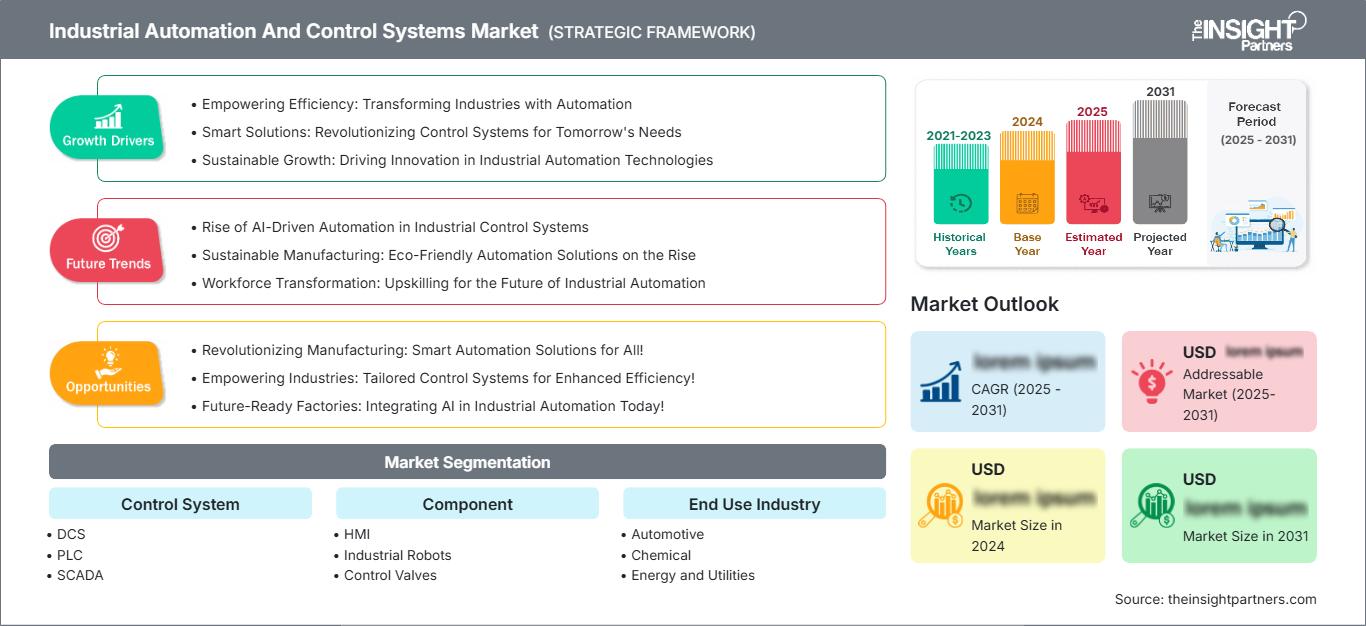
Industrial Automation And Control Systems Market: Strategic Insights
Regional Insights
North America Industrial Automation and Control Systems Market
North America accounted for a 27–31% Industrial Automation and Control Systems Market in 2025 and is projected to expand at a CAGR of 8.5–9.5% through 2034. The drivers of demand in the region are the US, which is helped by the return of manufacturing facilities, semiconductors, EV production, aerospace manufacturing, and control system updates. The demands from Canada include food manufacturing, energy, mining, and use in advanced manufacturing. The current demand growth is in connectivity, controller, robotics, and industrial software.
There are lots of legacy equipment in the region, providing opportunities for both greenfield and replacement projects. The requirements for industrial cybersecurity and labor shortage drive the need to consolidate control architecture and automate repetitive tasks. US manufacturers are integrating robots, vision, PLCs, and analytics. On the other hand, energy and utilities are interested in remote monitoring and predictive maintenance solutions.
U.S. Industrial Automation and Control Systems Market
The US represented 21–24% of global demand in 2025 and is expected to grow at a CAGR of 8.7–9.7%. Its share of North American demand is estimated at 77–81%, reflecting the country's larger manufacturing base and concentration of technology investment. Automotive, electronics, pharmaceuticals, aerospace, food processing, and utilities remain major application areas for automation deployment.
ABB Ltd., Honeywell International Inc., Rockwell Automation Inc., Schneider Electric, and Siemens AG have considerable commercial presence in various US industries. The trend involves the utilization of PLCs, SCADA, robotics, sensors, and networked HMIs; in addition, industrial AI is emerging as an important consideration for maintenance and quality control functions. Reshoring initiatives and heavy investments in manufacturing operations would ensure strong demand throughout the forecast period.
Europe Industrial Automation and Control Systems Market
Europe held a 23–27% share in 2025 and is projected to grow at a CAGR of 8.8–9.8%, with Germany remaining the leading regional market. High industrial energy costs, decarbonization needs, labor limitations, and advanced manufacturing facilities enable automation investments. Customers in the region value energy management, flexibility in production processes, machine connection, and cybersecurity in the industry.
The UK is characterized by demand in the pharmaceuticals, food manufacturing, aerospace, and infrastructure sectors, with automation being increasingly associated with productivity and labor supply. The German market remains the most active because of the presence of automated processes in automobile, machinery, chemical, and electronics producers. France relies on aerospace, automobile, food, and nuclear industries. Italy shows high demands for automation in machinery, packaging, food, and automobile production. Spain is driven by the automotive production, logistics, food processing, and renewable energy industries.
APAC Industrial Automation and Control Systems Market
APAC represented 38–42% of demand in 2025 and is forecast to grow at a CAGR of 11.0–12.0%, making it the fastest-growing major region. China is ahead of other countries in regional deployment, followed by Japan, South Korea, India, and Australia. Electronics, automotive, machinery, semiconductor, and battery production continue to dominate as sources of demand for automation.
Policies on industrial modernization, digitalization of industries, and manufacturing localization are leading to greater intensification of automation. China takes advantage of its massive production capabilities, whereas Japan and South Korea focus on robotics and precision manufacturing.
Middle East & Africa Industrial Automation and Control Systems Market
Middle East and Africa is expected to expand at a CAGR of 7.0–8.0%, with Saudi Arabia leading regional demand. Saudi Arabia and the UAE are investing in automated industrial facilities, energy infrastructure, logistics, and downstream processing, while South Africa maintains demand across mining, manufacturing, and utilities.
The wider MEA region offers opportunities in water infrastructure, oil and gas, power generation, mining, and smart industrial facilities. Automation adoption is increasingly linked with remote operations, safety, energy optimization, and asset monitoring. Large infrastructure programs and industrial diversification initiatives provide a foundation for longer-term control-system modernization.
Segmentation Analysis
Control System
Control System is expected to expand at a CAGR of 9.8–10.8% during 2026–2034. PLCs remain central to discrete manufacturing, while DCS platforms retain importance in continuous processes. SCADA adoption benefits from remote monitoring requirements and distributed infrastructure. The Industrial Automation and Control Systems Market scope is broadening as these systems increasingly integrate analytics, cybersecurity, edge computing, and enterprise applications.
- DCS: DCS platforms remain strategically important for continuous processes requiring coordinated control, alarm management, and high operational availability across chemicals, energy, utilities, and other process-intensive environments.
- PLC: PLCs maintain strong demand in discrete manufacturing because of flexible programming, compact architectures, deterministic control, and compatibility with robotics, drives, sensors, and machine-level automation.
- SCADA: SCADA systems support geographically distributed assets through centralized visualization, remote monitoring, alarm management, and historical data collection, making them important for utilities, energy, infrastructure, and water applications.
Component
Component demand is projected to grow at a CAGR of 10.2–11.2% through 2034. HMI devices, industrial robots, control valves, and sensors are increasingly connected within integrated architectures. Replacement demand is reinforced by aging installed equipment, while greenfield factories require larger combinations of sensing, motion, visualization, and automated control technologies.
- HMI: HMIs increasingly provide operators with contextual production information, diagnostics, alarms, and performance visualization while supporting integration with PLCs, SCADA platforms, edge devices, and manufacturing software.
- Industrial Robots: Industrial robots are expanding across welding, assembly, material handling, packaging, inspection, and machine tending as manufacturers seek repeatable processes, flexible production, and reduced exposure to labor constraints.
- Control Valves: Control valves remain fundamental to process automation because accurate flow, pressure, and temperature regulation directly affects plant stability, energy use, safety, and product consistency.
- Sensors: Sensors provide the measurement layer for automated production, enabling condition monitoring, quality inspection, process optimization, safety functions, and real-time feedback to industrial control systems.
End Use Industry
End Use Industry demand is expected to rise at a CAGR of 10.0–11.0%. Automotive and manufacturing remain major users, while chemical, energy and utilities, food and beverage, and healthcare applications require increasingly precise, traceable, and connected operations. Sector-specific safety, quality, energy, and production requirements shape automation architecture selection.
- Automotive: Automotive plants deploy robotics, PLCs, machine vision, sensors, and connected control systems extensively across body assembly, painting, powertrain, battery production, inspection, and material handling.
- Chemical: Chemical facilities rely on DCS, SCADA, sensors, and control valves for continuous process management, safety monitoring, quality consistency, and precise handling of complex operating conditions.
- Energy and Utilities: Utilities and energy operators use SCADA, sensors, and control systems for remote asset management, grid operations, generation, distribution, water systems, and infrastructure reliability.
- Food and Beverage: Food manufacturers increasingly automate processing, packaging, inspection, and material handling to improve consistency, hygiene, traceability, production speed, and compliance with stringent quality requirements.
- Healthcare: Healthcare manufacturing uses automation for pharmaceuticals, medical devices, laboratory processes, packaging, and sterile production, where repeatability, traceability, validation, and contamination control are critical.
- Manufacturing: General manufacturing remains a broad automation adopter, combining PLCs, HMIs, robotics, sensors, and analytics to improve productivity, flexibility, asset utilization, and quality management.
Opportunity Snapshot
| End Use Industry | Revenue Contribution (High/Medium/Low) | Trend Tag | Adoption Stage |
|---|---|---|---|
| Automotive | High | Smart Assembly | Scaling |
| Chemical | High | Process Control | Mature |
| Energy and Utilities | High | Remote Operations | Scaling |
| Food and Beverage | Medium | Hygienic Automation | Scaling |
| Healthcare | Medium | Validated Production | Scaling |
| Manufacturing | High | Flexible Factories | Mature |
Industrial Automation And Control Systems Market Growth Drivers and Impact Analysis
Factory Modernization and Manufacturing Reshoring
Manufacturers are upgrading production resources in order to boost productivity, minimize downtime, and gain control over domestic supply chains. Both reshoring and localization strategies will positively impact automation as new plants will be able to have connected controllers, robotics, vision systems, and other digital technologies right at the development stage. Moreover, existing plants are updating their outdated PLCs, HMI units, sensors, and SCADA systems due to reliability and cybersecurity issues. The effect of the investment goes beyond the simple equipment replacement since the modernization project requires engineering, networking, software installation, and training of operators. Such measures provide ongoing business for the automation sector as well as expand the number of connected devices installed. The effect is particularly strong for automotive, electronics, pharmaceuticals, machinery, and food processing industries where production flexibility and traceability become important in capital budgeting decision-making process.
Industrial Energy Efficiency and Sustainability Requirements
Higher energy expenses and decarbonization goals have increased the economic case for automation. The need for precise metering of energy like electricity, heat, steam, compressed air, and process efficiency has become critical for industries looking to minimize waste and increase efficiency. The sensors, controllers, HMI, and supervisory systems give the data needed to enable real-time tracking and automation of the processes. Industries that are energy-intensive, like chemicals, metals, utilities, and food processing, can utilize control systems to integrate their machinery and avoid wastage. The need for sustainability reporting also increases the importance of having accurate operating data since companies require the data for setting their internal targets and making reports. The automation companies are now integrating process control with energy management and optimization capabilities.
Labor Constraints and Demand for Flexible Automation
With the continuing problem of a shortage of skilled workers in industry, businesses are turning towards automation to deal with repetitive, dangerous, and highly variable tasks. Robotics, machine vision, autonomous materials handling, and intelligent control systems can help solve problems while making it possible for employees to concentrate on supervision and maintenance work as well as other high-value work. Flexible automation is especially pertinent to companies working with multiple products because of their ability to adjust recipe, process, and machine programming without significant reconfigurations. Small businesses are also becoming more interested in automation due to smaller robotics systems and controllers being more accessible. There is also an effect on the market because of the need for integration between hardware and software solutions.
Industrial Automation And Control Systems Market Future Trends
Software-Defined and AI-Native Industrial Control
The Industrial Automation and Control Systems Market trends indicate that in future, the architecture of automation would become less dependent on hardware and move some control functions into the software-defined realm. Agents using AI might start helping with the engineering, configuration, diagnostics, scheduling, and optimization tasks, rather than being restricted to only dialogue interface. As for the trends in Industrial Automation and Control Systems Market, these changes are possible only with increased validation, cybersecurity, determinism, and human supervision before decisions taken by such systems could be applied for the safety-critical process control. The trend towards open architecture would grow as the need for the integration of automation hardware and unique analytics and AI applications from various vendors grows. Edge computing is expected to stay relevant when the latency, reliability, and data sovereignty do not allow moving everything into the cloud.
Convergence of Robotics, Vision, and Autonomous Operations
Automation in manufacturing is shifting towards fully integrated robot systems that are able to sense their environment, analyze production situations, and adapt themselves accordingly. In the future, there will be more and more integration of robots with vision technology, force sensors, autonomous mobility, and coordinating software. Rather than programming individual machines separately, coordination of whole fleets will be possible via higher-level production targets. Such a system could be beneficial for quick changeovers and higher utilization of production facilities in cases where different products need to be manufactured. Digital twins will play an ever increasing role in providing simulation prior to actual implementation, thus accelerating the commissioning of new technologies and detecting process limitations sooner. Standards for connectivity will become even more relevant since autonomous equipment requires reliable communication of orders, status, and safety information.
Industrial Automation And Control Systems Market Opportunities
Automation Modernization in Emerging Manufacturing Hubs
There is potential in emerging manufacturing markets as much of the construction of plants will not be restricted by legacy architecture that is embedded in the manufacturing process. There are opportunities to invest in automotive, electronic, pharmaceutical, food, and machine-building projects with integrated PLC, SCADA, robotics, sensors, and industrial software in green fields. India, Southeast Asia, Eastern Europe, and some selected economies from the Middle East have relevance as manufacturers look to expand their production capabilities. Industrial Automation and Control Systems Market Forecasts must thus factor replacement budgets in mature economies and automation density in emerging manufacturing centers. Local engineering, training, security, and spare parts availability can make a material difference to adoption. Suppliers who build regional integration ecosystems can accelerate implementation processes and alleviate customer fears of lifecycle support and workforce training.
Lifecycle Services and Brownfield Digital Transformation
Another important opportunity lies in the concept of brownfield modernization as manufacturers do not have the ability to change their entire production environment at once. Suppliers can create migration packages that will retain functional equipment while introducing connected sensors, new HMIs, edge gateways, security elements, analytics, and controllers incrementally. This method minimizes the disruptions to operations and allows for an investment approach to be coordinated with maintenance cycles. The opportunity also exists to sell assessment, engineering, commissioning, remote management, security, and optimization services post-installation of equipment. This opportunity is especially applicable to chemicals, utilities, food processing, metals, and mature manufacturing facilities where continuity of production is essential.
Recent Developments
- April 2026: Siemens AG launched the Eigen Engineering Agent, a purpose-built AI solution for industrial automation engineering. The company stated that the agent had been piloted with more than 100 customers across 19 countries before general availability. The system connects directly with TIA Portal and is designed to execute multi-step engineering tasks with reasoning and self-correction capabilities.
- March 2026: Siemens AG introduced 26 new edge, automation, and control technologies at its RXD Summit in Beijing and expanded its collaboration with Alibaba on industrial simulation software. The announcement also highlighted AI-powered cooling and electrification technologies aimed at high-density data centers and AI infrastructure, demonstrating the widening intersection between automation, industrial AI, and digital infrastructure.
- May 2025: Schneider Electric launched its Open Automation Movement in India, emphasizing interoperable, software-defined automation designed to reduce legacy technology silos. The initiative focuses on vendor-agnostic integration, plug-and-play capabilities, improved engineering efficiency, and scalable industrial architectures. The announcement reflects the industry's shift toward open automation models that allow industrial customers to integrate automation technologies with broader digital systems.
Frequently Asked Questions

- Comprehensive Market Sizing and Forecast Analysis
- Detailed Segmentation Analysis
- In-Depth Market Dynamics Assessment
- Regional and Country-Level Insights
- Competitive Landscape and Company Benchmarking
- Strategic Business Intelligence
Recent Reports
Testimonials

The Insight Partners provided valuable market intelligence that supported our global go-to-market strategy. Their team was professional, responsive, and attentive to our feedback, providing thoughtful analysis and helpful methodological clarifications throughout the project.
Junmo Kim Chief Financial Officer (CFO), Enertech Co., Ltd.
The Insight Partners' SCADA System Market report is comprehensive, with valuable insights on current trends and future forecasts. The team was highly professional, responsive, and supportive throughout. We are very satisfied and highly recommend their services.
RAN KEDEM Partner, Reali Technologies LTDs
I requested a report on a very specific software market and the team produced the report in a few days. The information was very relevant and well presented. I then requested some changes and additions to the report. The team was again very responsive and I got the final report in less than a week.
JEAN-HERVE JENN Chairman, Future Analytica
We worked with The Insight Partners for an important market study and forecast. They gave us clear insights into opportunities and risks, which helped shape our plans. Their research was easy to use and based on solid data. It helped us make smart, confident decisions. We highly recommend them.
PIYUSH NAGPAL Sr. Vice President, High Beam Global
The Insight Partners delivered insightful, well-structured market research with strong domain expertise. Their team was professional and responsive throughout. The user-friendly website made accessing industry reports seamless. We highly recommend them for reliable, high-quality research services
YUKIHIKO ADACHI CEO, Deep Blue, LLC.
This is the first time I have purchased a market report from The Insight Partners.While I was unsure at first, I visited their web site and felt more comfortable to take the risk and purchase a market report.I am completely satisfied with the quality of the report and customer service. I had several questions and comments with the initial report, but after a couple of dialogs over email with their analyst I believe I have a report that I can use as input to our strategic planning process.Thank you so much for taking the extra time and making this a positive experience.I will definitely recommend your service to others and you will be my first call when we need further market data.
JOHN SUZUKI President and Chief Executive Officer, Board Director, BK Technologies
I wish to appreciate your support and the professionalism you displayed in the course of attending to my request for information regarding to infectious disease IVD market in Nigeria. I appreciate your patience, your guidance, and the fact that you were willing to offer a discount, which eventually made it possible for us to close a deal. I look forward to engaging The Insight Partners in the future, all thanks to the impression you have created in me as a result of this first encounter.
DR CHIJIOKE ONYIA MANAGING DIRECTOR, PineCrest Healthcare Ltd.Reason to Buy
- Informed Decision-Making
- Understanding Market Dynamics
- Competitive Analysis
- Identifying Emerging Markets
- Customer Insights
- Market Forecasts
- Risk Mitigation
- Boosting Operational Efficiency
- Strategic Planning
- Investment Justification
- Tracking Industry Innovations
- Aligning with Regulatory Trends





 Get Free Sample for