
CAR-T Cell Therapy Market Size, Trends & Demand 2034
Coverage: By Targeted Antigen (CD19 and BCMA), Indication (Lymphomas, Leukemia and Multiple Myeloma), End User (Hospitals and Specialty Clinics, Ambulatory Surgical Centers and Others), and Geography (North America, Europe, Asia Pacific, Rest of World)
- Status : Published
- Report Code : TIPRE00029935
- Category : Life Sciences
- No. of Pages : 247
- Available Report Formats :


- Last update date : October 07, 2026


2025 Market Size
US$ 4,482.18 Mn
Base year value
2034 Forecast
US$ 19,314.55 Mn
Projected by 2034
CAGR 2026-2034
17.6 %
Growth rate
Addressable Market
US$ 98,890.63 Mn
(2026-2034)
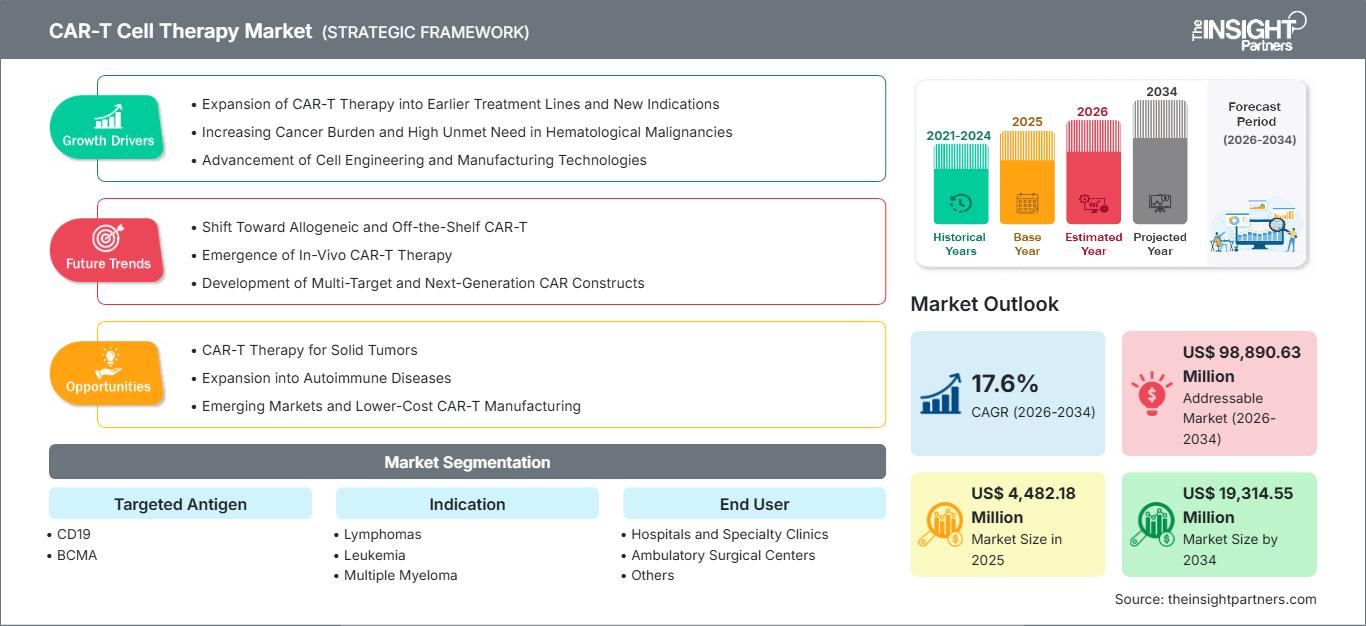
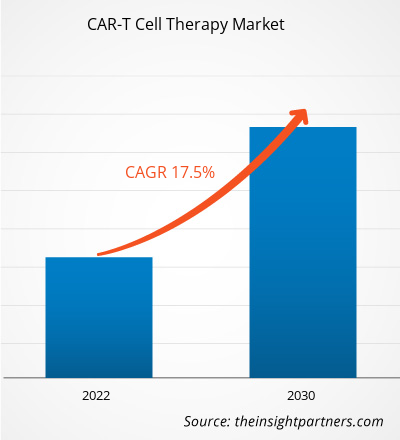
The CAR-T Cell Therapy Market was valued at US$ 4,482.18 Million in 2025 and is projected to reach US$ 19,314.55 Million by 2034, registering a CAGR of 17.6% during 2026–2034. The market is being shaped by expanding clinical adoption, broader treatment-line eligibility, advances in cell engineering, and increasing investment in manufacturing and treatment infrastructure across major oncology markets.
North America is a crucial market, supported by well-developed cancer therapy departments, comprehensive medical coverage, the collaboration of highly experienced hematology and oncology teams, and a wide selection of drugs in the field, some of which are already approved. It is anticipated that North America will grow at an average rate of about 16. 8% -18. 2% for 2026-2034, mainly due to the use of initial therapies and the expansion of cell therapy centers.
CAR-T Cell Therapy Market Assessment and Insights
- North America: The region is estimated to account for 44–48% share in 2025 and is expected to grow at a 16.8–18.2% CAGR between 2026–2034, supported by established treatment infrastructure, reimbursement, and expanding indications.
- US: The US is estimated to represent 82–86% of North American revenue in 2025, with a projected 16.5–18.0% CAGR during 2026–2034, supported by extensive treatment-center networks and regulatory development.
- Europe: Europe is estimated to hold 23–27% share in 2025 and grow at a 17.0–18.5% CAGR during 2026–2034, led by Germany, the UK, France, Italy, and Spain.
- Asia Pacific: Asia Pacific is estimated at 18–22% share in 2025 and is projected to register the fastest 19.0–21.0% CAGR during 2026–2034, led by China, Japan, South Korea, and India.
- Largest Segment: Lymphomas are estimated to hold a 47–51% market share in 2025, with a 16.5–18.0% CAGR during 2026–2034, reflecting the breadth of approved CD19-directed therapies.
- High Growth Segment: Multiple myeloma is estimated at 28–32% share in 2025, with an 18.5–20.5% CAGR during 2026–2034, supported by expanding BCMA-directed treatment use.
- Key companies analyzed in detail: Bristol-Myers Squibb Company, Novartis AG, Gilead Sciences, Inc., Johnson & Johnson, JW (Cayman) Therapeutics Co., Ltd., Innovent Biologics, Inc., Autolus Therapeutics plc, Shanghai Fosun Pharmaceutical (Group) Co., Ltd., Immunoadoptive Cell Therapy Private Limited, and CARsgen Therapeutics Holdings Limited.
Source: The Insight Partners' analysis based on proprietary research, government publications, company annual reports, investor presentations, industry databases, and expert interviews.
The CAR-T cells are a new wave of treatment that started with mainly hematological malignancies as late-line settings and has evolved to an arsenal with various antigens and also the possibility of earlier therapies in combination with production that is more effective. In patients with lymphoma and blood cancer, CD19-directed CAR-T still remains at the center, but BCMA-directed therapies have provided different options for treating patient with multiple myeloma. Manufacturing is also making strides for shorter vein-to-vein time periods, standardized processes, improved release testing, and much larger volume manufacturing.
In the future, there will be an increasing number of markets that are coming up plus the set-up of cancer treatment centers and cell therapies. China will be the one driving the major changes as the biggest clinical development country with manufacturing scale, aside from India, other Asian markets are also providing alternatives and cheaper options for multiple myeloma through the regulatory process simplification and development of decentralized manufacturing through the necessary investments as the way to handle and manage toxicity are expected. Regulatory simplifications, development of decentralized capabilities through investment, and increase experience with handling toxicity that is coming are expected to contribute to the broad adoption of the therapy with improved treatment accessibility.
CAR-T Cell Therapy Market Report Scope
| Report Attribute | Details |
|---|---|
| Market size in 2025 | US$ 4,482.18 Million |
| Market Size by 2034 | US$ 19,314.55 Million |
| Global CAGR (2026 - 2034) | 17.6% |
| Historical Data | 2021-2024 |
| Forecast period | 2026-2034 |
CAR-T Cell Therapy Market Analysis
CAR-T Cell Therapy Market development is stimulated by the medical justification of the patient's request for persistent results when it comes to hematological cancers that have returned after being treated or are not responding to treatment anymore (refractory) as well as by the rise of proof of efficacy in earlier lines. The whole chain includes identification of the patient, leukapheresis - collection of the cells - transportation of the cells, modification by genetic engineering, amplification of the culture, quality assurance, testing of the final product, administering the conditioning drugs, delivery of the treatment, and post-treatment follow-up. There are possibilities at every single point for the introduction of new technologies and the involvement of specialized service providers.
Production is still on the key side of the supply, since the autologous treatments are relying upon the initial material from a patient and strictly regulated production environment in a CAR-T Cell Therapy market. Because of this, firms are focusing on increasing production automation organizing the flow of goods through the distribution chain, carrying out detailed tests, and bringing production processes to standard. A faster turn-around of manufacturing can increase the availability of treatment and also alleviate operational bottlenecks. On top of that, the removal in 2025 of US REMS requirements has also relieved some administrative burdens for approved CD19- and BCMA- targeted therapies.
Competitors in the CAR-T Cell Therapy Market are a mixed bag of international pharmaceutical firms, cell therapy specialists, and innovators operating first and foremost out of China (China). The leading pharma companies with successful and mature commercial product lines include Bristol-Myers Squibb Company, Novartis AG, Gilead Sciences, Inc. and The Johnson & Johnson Company. On the regionally competitive side, there are firms like JW (Cayman) Therapeutics Co. Ltd. Innovent Biologics, Inc. and Shanghai Fosun Pharmaceutical (Group) Co. Ltd. who offer different kinds of products. Meanwhile, Autolus Therapeutics plc and CARsgen Therapeutics Holdings Limited have a different kind of development pipeline than their competitors.
Market leadership is largely a function of new indication development, manufacturing strength, network of treatment centers, distinction of clinical practice, and control of costs. Also, the direction of development investment is also changing toward better versions of T-cells (next-generation constructs) and new ways of cell manufacturing. CARsgen, for example, has demonstrated that T-cell therapies can move from blood cancers to solid cancers, thereby opening up a new battleground of cell therapy developers, through their approval in 2026 of satri-cel for the treatment of gastrin-producing tumors of the stomach or the gastroesophageal junction (CLDN18. 2-positive type).
● REPORT CUSTOMIZATION
Tailor This Report To Align With Your Specific Business Requirements
This report can be customized to align precisely with your business objectives, scope, and target markets. Customization options include tailored segmentation, geography, competitive analysis, and strategic insights to support informed decision-making.
Customize This Report →WHAT YOU CAN ADJUST
- ● Segmentations
- ● Geography
- ● Competitive Analysis
- ● Language Preferences
CAR-T Cell Therapy Market: Strategic Insights
Regional Insights
North America CAR-T Cell Therapy Market
North America is estimated to represent 44–48% share in 2025 and is projected to grow at a 16.8–18.2% CAGR during 2026–2034. The US dominates regional activity because of its broad treatment-center network, established reimbursement mechanisms, extensive clinical-trial infrastructure, and concentration of commercial CAR-T manufacturers. Canada contributes through expanding hematology programs and improving access to cellular therapies.
The regional ecosystem benefits from experienced oncology specialists, established leukapheresis capabilities, specialized manufacturing networks, and intensive-care capacity for managing treatment-related toxicities. Earlier-line treatment adoption is another structural growth factor because approved therapies are increasingly moving beyond heavily pretreated populations. Regulatory experience with CRS and neurological toxicities also supports operational maturation. Expansion into community-linked treatment networks could gradually improve geographic access while preserving specialized monitoring requirements in CAR-T Cell Therapy Market.
U.S. CAR-T Cell Therapy Market
The US is estimated to account for 82–86% of North American revenue in 2025, with a projected 16.5–18.0% CAGR during 2026–2034. Its leadership reflects extensive commercial availability, specialized treatment centers, favorable oncology infrastructure, and strong clinical development activity across CD19- and BCMA-directed therapies.
Mainstream large-scale corporations are strongly involved in various lymphoma leukemia myeloma areas in the US. Drug usage has been a major trend which indicates that treatment lines are being moved earlier than before and patient eligibility requirements have been somewhat enlarged. The 2025 removal of REMS requirement for approved autologous CD19- and BCMA-targeted therapeutics would mean a decrease in certification and availability restrictions from the immediate-to-cilizumab level for the hospitals that are participating, possibly resulting in a broader range of patients benefiting from these drugs. There's an increasing demand from both the market and the patients for drugs that could be administered as early as possible.
Europe CAR-T Cell Therapy Market
Europe is estimated to hold 23–27% share in 2025 and is expected to expand at a 17.0–18.5% CAGR during 2026–2034. Germany is a leading market because of advanced hematology infrastructure, specialist centers, and established reimbursement pathways. The UK has developed centralized cellular therapy expertise through specialist NHS centers, while France combines academic oncology capabilities with national healthcare coordination.
Italy and Spain are expanding access as qualified centers increase their cellular therapy capabilities. Across Europe, demand is influenced by regulatory harmonization, national reimbursement decisions, treatment-center accreditation, and investment in specialized manufacturing logistics. The region is also seeing broader adoption of approved indications. Differences in reimbursement and referral structures, however, continue to affect the pace at which patients can access commercial CAR-T treatments.
APAC CAR-T Cell Therapy Market
APAC is estimated to account for 18–22% share in 2025 and is projected to register a 19.0–21.0% CAGR during 2026–2034, making it the fastest-growing major region. China leads regional development, supported by domestic cell therapy companies, extensive clinical research, and expanding treatment infrastructure. Japan and South Korea provide mature regulatory and oncology ecosystems, while India and Australia are building capacity.
China's regulatory progress is particularly significant because satri-cel became the first globally approved CAR-T therapy for a solid tumor in June 2026. This development expands the addressable therapeutic landscape and encourages further innovation in antigen selection, manufacturing, and solid-tumor targeting across the region.
Rest of World CAR-T Cell Therapy Market
Rest of World is expected to remain a developing with 11.0%-11.6% but increasingly important market, supported by expanding access to advanced oncology treatments, improvements in specialized healthcare infrastructure, and growing interest in cellular therapies. Countries across Latin America and other emerging markets are gradually strengthening capabilities for complex cancer care, creating opportunities for CAR-T therapies as treatment centers develop the required clinical expertise and patient referral networks.
Growth is constrained by high treatment costs, limited availability of specialized cellular therapy centers, regulatory complexities, and manufacturing and logistics requirements. Nevertheless, investments in tertiary oncology infrastructure, international collaborations, and regional referral networks are expected to improve access. Partnerships with global therapy developers, improvements in cell collection and transportation capabilities, and increasing clinical awareness could gradually support CAR-T adoption across Rest of World markets.
Segmentation Analysis
Targeted Antigen
CD19 and BCMA represent the principal targeted-antigen categories, with the segment expected to expand at a 17.0–19.0% CAGR during 2026–2034. CD19 remains strongly established across B-cell malignancies, while BCMA is expanding in multiple myeloma. Future competition will emphasize antigen persistence, response durability, safety, and opportunities for combination or sequential treatment.
- CD19: CD19-directed therapies hold a strong market position because of established use across B-cell lymphomas and acute lymphoblastic leukemia, supported by multiple approved products and extensive clinical experience.
- BCMA: BCMA-directed therapies are strategically important in multiple myeloma, where growing use in earlier treatment settings and continued clinical development support sustained demand.
Indication
Indication demand is projected to increase at a 17.0–19.0% CAGR during 2026–2034, with lymphomas remaining the largest indication category in CAR-T Cell Therapy Market. Broader approvals, increasing physician familiarity, and movement into earlier treatment lines are supporting adoption. Multiple myeloma is expected to record strong momentum as BCMA-directed therapies gain wider utilization.
- Lymphomas: Lymphomas represent the leading indication because multiple CD19-directed products are approved across large B-cell and related lymphoma subtypes, creating the broadest established treatment base.
- Leukemia: Leukemia remains strategically important because CD19-directed therapy has demonstrated durable responses in selected B-cell precursor acute lymphoblastic leukemia populations.
- Multiple Myeloma: Multiple myeloma is increasingly important as BCMA-directed therapies expand treatment options for patients with relapsed or refractory disease and move toward earlier treatment settings.
End Users
End-user demand is projected to rise at a 16.5–18.5% CAGR during 2026–2034, with hospitals and specialty clinics retaining the dominant position in CAR-T Cell Therapy Market. The complexity of cell collection, conditioning, infusion, toxicity monitoring, and emergency management favors facilities with multidisciplinary oncology capabilities and advanced supportive-care infrastructure.
- Hospitals and Specialty Clinics: These facilities represent the principal treatment setting because they provide hematology expertise, cell therapy infrastructure, intensive monitoring, and access to multidisciplinary teams required for complex treatment delivery.
- Ambulatory Surgical Centers: Ambulatory centers may gain selective relevance as monitoring protocols mature, although their adoption remains constrained by requirements for specialist supervision and rapid access to acute-care services.
- Others: Other settings include specialized treatment networks and emerging decentralized models that may support follow-up, patient coordination, or selected components of the broader treatment pathway.
Opportunity Snapshot
| End User | Revenue Contribution | Trend Tag | Adoption Stage |
| Hospitals and Specialty Clinics | High | Specialist Centers | Mature |
| Ambulatory Surgical Centers | Low | Outpatient Shift | Emerging |
| Others | Medium | Care Decentralization | Scaling |
CAR-T Cell Therapy Market Growth Drivers and Impact Analysis
Expansion into Earlier Treatment Lines
Movement into earlier treatment lines is reshaping the commercial opportunity by increasing the eligible patient pool and changing how clinicians position cellular therapy within treatment algorithms in CAR-T Cell Therapy Market. Earlier use can improve the probability that patients reach therapy before extensive disease progression or deterioration in performance status. Regulatory expansion across indications is therefore strategically important because it can increase treatment volumes without relying solely on growth in the underlying cancer population. Johnson & Johnson's CARVYKTI expansion to patients after at least one prior line illustrates how earlier intervention can broaden utilization. For manufacturers, earlier-line adoption also increases the importance of comparative evidence, treatment sequencing, referral pathways, reimbursement negotiations, and capacity planning at authorized treatment centers.
Advances in Cell Engineering and Manufacturing
Advances in cell engineering are improving the ability of developers to modify T cells for stronger antigen recognition, persistence, and controlled activity. Manufacturing innovation is equally important because autologous therapies require individualized production and rigorous quality controls. Improvements in process automation, closed-system processing, analytical testing, and logistics coordination can reduce operational variability and improve throughput. Companies with scalable manufacturing networks can therefore compete not only through clinical efficacy but also through treatment availability and production reliability. Shorter vein-to-vein timelines can be particularly valuable for patients with rapidly progressing disease. As manufacturing platforms mature, opportunities are emerging for specialized suppliers of viral vectors, reagents, analytical assays, cryopreservation systems, and cell-processing equipment to participate in the broader ecosystem in CAR-T Cell Therapy Market.
Increasing Cancer Burden and Unmet Need in Relapsed Disease
The expanding global cancer burden provides a broad clinical backdrop for advanced cellular therapies. The International Agency for Research on Cancer estimated 20.6 million new cancer cases worldwide in 2024, while 9.8 million people died from cancer, highlighting continued demand for more effective treatment strategies. Within hematological malignancies, patients who relapse after multiple systemic therapies may have limited durable treatment options, creating a high-value opportunity for therapies capable of producing deep responses. Continued identification of eligible patients, improved referral pathways, and greater awareness among hematologists can increase treatment utilization. The commercial effect is strongest where diagnosis, reimbursement, specialist expertise, and treatment-center capacity develop simultaneously.
CAR-T Cell Therapy Market Future Trends
Expansion Beyond Hematological Malignancies
Expansion into solid tumors is likely to become one of the most consequential future directions. The June 2026 approval of satri-cel for CLDN18.2-positive, HER2-negative advanced gastric or gastroesophageal junction adenocarcinoma established a new commercial precedent for CAR-T therapy outside hematological cancers. Future development will increasingly focus on tumor-specific antigens, trafficking, persistence, tumor microenvironment resistance, and strategies that limit off-tumor activity. Successful solid-tumor products could materially broaden the addressable population and create new manufacturing and treatment-center requirements in CAR-T Cell Therapy Market.
Greater Focus on Treatment Convenience and Manufacturing Speed
Treatment convenience is expected to become a stronger differentiator as cellular therapy adoption expands. Developers are likely to prioritize manufacturing platforms capable of reducing turnaround times, improving batch consistency, and lowering logistical complexity. Greater automation and digital tracking could support real-time chain-of-identity and chain-of-custody management across collection, production, release, and administration. The longer-term direction may also include greater interest in allogeneic or off-the-shelf approaches, although clinical durability, immune rejection, and safety remain important development considerations. Faster manufacturing and more predictable logistics could improve access for patients whose disease progresses quickly.
CAR-T Cell Therapy Market Opportunities
Development of Regional Manufacturing and Treatment Networks
Regional manufacturing networks represent an important opportunity for companies seeking to expand access beyond established North American and European centers. Building production and logistics capabilities closer to treatment sites can reduce transportation complexity, support faster turnaround, and improve resilience in patient-specific supply chains. Asia Pacific is particularly attractive because China, Japan, South Korea, and India are developing increasingly sophisticated cell therapy ecosystems. Partnerships between pharmaceutical companies, hospitals, contract development and manufacturing organizations, and logistics providers could create integrated regional models. Investment decisions should prioritize locations with strong oncology infrastructure, skilled cell-processing personnel, predictable regulatory pathways, and sufficient patient volumes.
Cost-Optimized CAR-T Delivery Models
Cost optimization offers another strategic opportunity, particularly in emerging markets where conventional autologous manufacturing can limit access. Developers can pursue lower-cost production workflows, regional manufacturing, standardized clinical protocols, and partnerships with public healthcare systems. India and China provide relevant environments for testing economically differentiated models because both markets have large patient populations and growing domestic cell therapy capabilities. Companies can also explore modular manufacturing, shared treatment infrastructure, and technology-transfer arrangements to reduce fixed costs. Successful cost optimization will require maintaining product quality, regulatory compliance, traceability, and patient safety while lowering the total treatment burden. This approach could support wider penetration in markets where reimbursement remains constrained.
Recent Developments
- June 2026: CARsgen Therapeutics Holdings Limited announced that China's National Medical Products Administration approved satricabtagene autoleucel, or satri-cel, for CLDN18.2-positive, HER2-negative advanced gastric or gastroesophageal junction adenocarcinoma after at least two prior lines. The approval represents the first globally approved CAR-T therapy for a solid tumor and materially expands the strategic scope of cellular therapy development.
- February 2026: Gilead Sciences, Inc. announced that the US FDA approved a Yescarta prescribing-information update removing the previous limitation of use for patients with relapsed or refractory primary central nervous system lymphoma. The decision broadened the applicable treatment population for the CD19-directed therapy and strengthened its positioning in aggressive lymphoma.
- June 2025: Bristol-Myers Squibb Company reported that the US FDA approved Breyanzi for adults with relapsed or refractory marginal zone lymphoma after at least two prior systemic treatment lines. The approval expanded Breyanzi's coverage to a fifth cancer type and reinforced competition around broader CD19-directed treatment applications.
Frequently Asked Questions

- Comprehensive Market Sizing and Forecast Analysis
- Detailed Segmentation Analysis
- In-Depth Market Dynamics Assessment
- Regional and Country-Level Insights
- Competitive Landscape and Company Benchmarking
- Strategic Business Intelligence
Recent Reports
Testimonials

The Insight Partners provided valuable market intelligence that supported our global go-to-market strategy. Their team was professional, responsive, and attentive to our feedback, providing thoughtful analysis and helpful methodological clarifications throughout the project.
Junmo Kim Chief Financial Officer (CFO), Enertech Co., Ltd.
The Insight Partners' SCADA System Market report is comprehensive, with valuable insights on current trends and future forecasts. The team was highly professional, responsive, and supportive throughout. We are very satisfied and highly recommend their services.
RAN KEDEM Partner, Reali Technologies LTDs
I requested a report on a very specific software market and the team produced the report in a few days. The information was very relevant and well presented. I then requested some changes and additions to the report. The team was again very responsive and I got the final report in less than a week.
JEAN-HERVE JENN Chairman, Future Analytica
We worked with The Insight Partners for an important market study and forecast. They gave us clear insights into opportunities and risks, which helped shape our plans. Their research was easy to use and based on solid data. It helped us make smart, confident decisions. We highly recommend them.
PIYUSH NAGPAL Sr. Vice President, High Beam Global
The Insight Partners delivered insightful, well-structured market research with strong domain expertise. Their team was professional and responsive throughout. The user-friendly website made accessing industry reports seamless. We highly recommend them for reliable, high-quality research services
YUKIHIKO ADACHI CEO, Deep Blue, LLC.
This is the first time I have purchased a market report from The Insight Partners.While I was unsure at first, I visited their web site and felt more comfortable to take the risk and purchase a market report.I am completely satisfied with the quality of the report and customer service. I had several questions and comments with the initial report, but after a couple of dialogs over email with their analyst I believe I have a report that I can use as input to our strategic planning process.Thank you so much for taking the extra time and making this a positive experience.I will definitely recommend your service to others and you will be my first call when we need further market data.
JOHN SUZUKI President and Chief Executive Officer, Board Director, BK Technologies
I wish to appreciate your support and the professionalism you displayed in the course of attending to my request for information regarding to infectious disease IVD market in Nigeria. I appreciate your patience, your guidance, and the fact that you were willing to offer a discount, which eventually made it possible for us to close a deal. I look forward to engaging The Insight Partners in the future, all thanks to the impression you have created in me as a result of this first encounter.
DR CHIJIOKE ONYIA MANAGING DIRECTOR, PineCrest Healthcare Ltd.Reason to Buy
- Informed Decision-Making
- Understanding Market Dynamics
- Competitive Analysis
- Identifying Emerging Markets
- Customer Insights
- Market Forecasts
- Risk Mitigation
- Boosting Operational Efficiency
- Strategic Planning
- Investment Justification
- Tracking Industry Innovations
- Aligning with Regulatory Trends





 Get Free Sample for