
Artificial Tendons And Ligaments Market Share, Size & Demand by 2034
Coverage: By Application (Foot & Ankle Injuries, Knee Injuries, Shoulder Injuries and Others), End User (Hospitals, Ambulatory Surgical Centers and Others) , and Geography (North America, Europe, Asia Pacific, and South and Central America)
- Status : Data Released
- Report Code : TIPMD00002582
- Category : Life Sciences
- No. of Pages : 150
- Available Report Formats :


- Last update date : September 08, 2026


2025 Market Size
US$ 1.05 Bn
Base year value
2034 Forecast
US$ 2.49 Bn
Projected by 2034
CAGR 2026-2034
10.06 %
Growth rate
Addressable Market
US$ 15.73 Bn
(2026-2034)
The artificial tendons and ligaments market is expanding as orthopedic reconstruction increasingly incorporates synthetic scaffolds, ligament reinforcement systems, and advanced fixation technologies. The market was valued at US$ 1.05 Billion in 2025 and is projected to reach US$ 2.49 Billion by 2034, registering a CAGR of 10.06% from 2026 to 2034. Demand is supported by sports-related injuries, minimally invasive reconstruction, improved biomaterials, and increasing clinical interest in durable soft-tissue repair solutions.
North America represents a strategically important market, supported by established orthopedic surgery infrastructure, high sports medicine utilization, and comparatively rapid adoption of advanced soft-tissue technologies. The artificial tendons and ligaments market size in the region is expected to expand at approximately 9.5–10.0% CAGR between 2026 and 2034, with outpatient orthopedic procedures and technology-led ligament reconstruction supporting sustained demand.
Artificial Tendons And Ligaments Market Assessment and Insights
- North America: North America is expected to account for a 34–38% share in 2025 and grow at a 9.5–10.0% CAGR between 2026–2034, supported by established sports medicine centers, high procedure volumes, reimbursement availability, and early adoption of synthetic soft-tissue reinforcement technologies.
- US: The US is estimated to represent 68–72% of North America in 2025 and grow at a 9.6–10.1% CAGR between 2026–2034, driven by orthopedic specialization and high adoption of minimally invasive reconstruction.
- Europe: Europe is projected to hold a 27–31% share in 2025 and expand at a 9.1–9.6% CAGR between 2026–2034, led by Germany, the UK, France, Italy, and Spain, were established orthopedic networks support adoption.
- Asia Pacific: Asia Pacific is estimated at a 21–25% share in 2025 and is projected to grow at an 11.0–11.7% CAGR between 2026–2034, with China, Japan, India, South Korea, and Australia benefiting from expanding orthopedic capacity.
- Largest Segment: Knee Injuries is estimated to command a 48–52% market share in 2025, with a 10.4–11.0% CAGR from 2026–2034, reflecting substantial ACL reconstruction activity and sports-related trauma.
- High Growth Segment: Ambulatory Surgical Centers are estimated at a 28–32% market share in 2025, with an 11.3–12.0% CAGR from 2026–2034, supported by shifting procedures toward outpatient orthopedic settings.
- Key companies analyzed in detail: Mathys AG Bettlach, Cousin Biotech, OrthoMed, Inc., Neoligaments, Corin Group, FX Solutions, Advanced Orthopaedic Solutions, Arthrex, Inc., Integra LifeSciences Corporation, Stryker Corporation, Shanghai PINE&POWER Biotech, Xiros Ltd. (Neoligaments).
Source: The Insight Partners' analysis based on proprietary research, government publications, company annual reports, investor presentations, industry databases, and expert interviews.
Advancements in Artificial Tendons and Ligaments Market have caused the market to move away from traditional synthetic grafting towards innovative reinforcement devices that utilize a combination of mechanics and biology. The importance of polymer structure, load distribution, ingrowth, fixation, and minimally-invasive delivery has gained prominence. Increasing specialization within production means polymer process control, sterilization, sizing, and increased instrumentation become vital. As a result of this trend, the applications in clinical practice have become wider than just ligament replacement.
The investments during the forecast period will be made in bio-integration material, outpatient friendly systems, and faster surgery technology. Regulation will continue to play a vital role because manufacturers need to prove safety and clinical applicability of material and its performance and sterilization. Asia will become a focal point for emerging markets due to improvement in orthopedics whereas Europe will focus on evidence generation and procurement.
Artificial Tendons And Ligaments Market Report Scope
| Report Attribute | Details |
|---|---|
| Market size in 2025 | US$ 1.05 Billion |
| Market Size by 2034 | US$ 2.49 Billion |
| Global CAGR (2026 - 2034) | 10.06% |
| Historical Data | 2021-2024 |
| Forecast period | 2026-2034 |
Artificial Tendons And Ligaments Market Analysis
Factors driving demand include sports injury, instability of the ligaments, degradation of the tendons, and increasing adoption of reconstruction procedures. Growth in artificial tendons and ligaments market will depend on the existence of an ecosystem that includes biomaterials firms, implant suppliers, fixation devices, orthopedic surgeons, hospitals, ambulatory facilities, distributors, and sterilizers. Synthetic polymers, reinforced scaffold structures, suture materials, anchors, and surgical instruments constitute the value chain elements.
Distinct supply factors result from the variation of products in terms of material construction, surgical procedure, regulation, and indications. Companies that manufacture artificial tendons and ligaments will compete based on training of the surgeons, properties of the implants, clinical trials, and procedure-specific designs. Big orthopedic firms will benefit from distribution networks while small specialist manufacturers will compete through technology.
Competitive intensity is intensifying as existing orthopedic corporations diversify their soft tissue offerings and specialized firms develop innovative synthetic reinforcement technologies. For example, Stryker Corporation consolidated its position through Artelon, whereas Arthrex, Inc. is developing fixation and ligament reconstruction technologies. Zimmer Biomet has a diversified sports medicine product line, whereas Corin Group, Cousin Biotech, Mathys AG Bettlach, Xiros Ltd. (Neoligaments), and Shanghai PINE&POWER Biotech have more specialized competitive offerings.
Positioning becomes increasingly dependent on achieving clinical differentiation as well as manufacturing scalability and regulatory coverage. Orthopedic firms that possess complementary product lines for fixation, sports medicine and orthopedic implants may combine offerings according to procedures rather than particular implants. Priority areas of investment for artificial tendon and ligaments are material science, minimally invasive instrumentation, surgeon training, and evidence generation. This means that companies with integrated implant design, procedure workflow, clinical validation and distribution are favored over price competition in the artificial tendons and ligaments market report.
● REPORT CUSTOMIZATION
Tailor This Report To Align With Your Specific Business Requirements
This report can be customized to align precisely with your business objectives, scope, and target markets. Customization options include tailored segmentation, geography, competitive analysis, and strategic insights to support informed decision-making.
Customize This Report →WHAT YOU CAN ADJUST
- ● Segmentations
- ● Geography
- ● Competitive Analysis
- ● Language Preferences
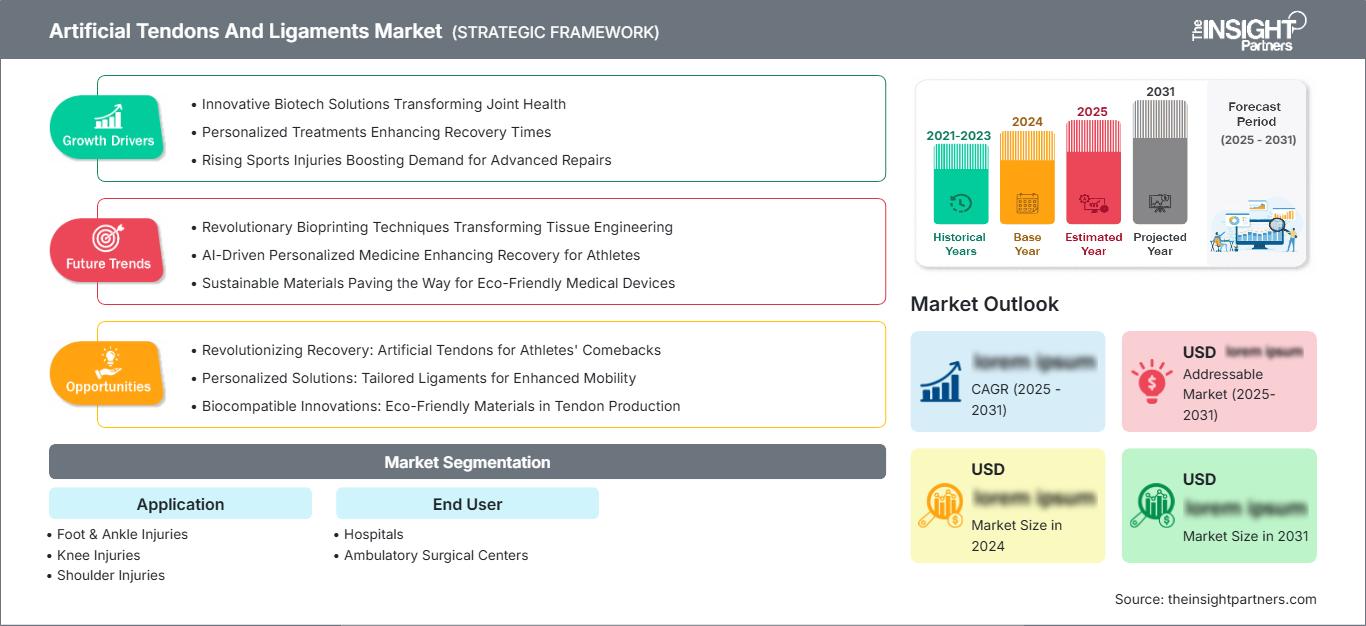
Artificial Tendons And Ligaments Market: Strategic Insights
Regional Insights
North America artificial tendons and ligaments market
North America is estimated to represent a 34–38% of the Artificial Tendons and Ligaments Market share in 2025 and is projected to grow at a 9.5–10.0% CAGR through 2034. The US accounts for most regional activity because of high orthopedic procedure volumes, specialized sports medicine centers, established ambulatory surgery infrastructure, and comparatively strong adoption of advanced soft-tissue technologies.
The participation of Canada is through the use of specialized orthopedic hospitals and sports medicine, while the United States remains the major player in the process of commercialization. Reimbursement issues, knowledge of the surgeons on artificial joints, and the development of minimally invasive procedures contribute to adoption of the technology. The industry enjoys the benefit of good regulatory framework and distribution networks.
U.S. artificial tendons and ligaments market
The USA contributes around 68-72% to the North America market in 2025 and is expected to grow at 9.6-10.1% CAGR till 2034. Arthrex Inc, Stryker Corporation, Zimmer Biomet and Integra LifeSciences Corporation have significant orthopedic and soft-tissue expertise and thus contribute to the accessibility of technologies.
Knee reconstruction continues to be vital, whereas shoulder, Achilles, ankle and many more tendon applications can also be considered. ASCs become increasingly important since some orthopedic procedures can be conducted outside of inpatient facilities. In addition, the US market is facilitated by numerous surgeons' trainings, clinical research collaborations and commercialization. Product differentiation is related to the accuracy of fixation, ease of use of implants and reinforcement of tissues.
Europe artificial tendons and ligaments market
Europe is forecast to occupy a share of 27–31% in 2025 and will exhibit growth at a rate of 9.1–9.6% CAGR from 2025 to 2034, with Germany being the dominant country-level market. The region boasts of well-developed orthopedic infrastructure, specialized manufacturing facilities, and clinical research strength.
Demand in the UK is sustained by sports medicine centers, orthopedic hospitals, and outpatient surgeries. Germany takes advantage of its advanced orthopedic infrastructure and a robust medical device manufacturing sector. France, Italy, and Spain offer further business opportunities through sports medicine, trauma reconstruction, and outpatient surgery pathways. Clinical efficacy, durability, efficiency, and cost-effectiveness are increasingly becoming important factors in the purchase decisions of regional healthcare establishments. European manufacturers are active suppliers of special synthetic ligaments and tendons.
APAC artificial tendons and ligaments market
It is expected that the APAC region will occupy a 21-25% market share in 2025 and will witness a 11.0-11.7% CAGR, being one of the most rapidly growing regions. The main country of regional demand is China, followed by Japan, South Korea, India, and Australia. The reasons for growth include the growing orthopedic infrastructure, sport activity, and investments in healthcare.
China has large numbers of patients and the growth of the capabilities of local medical devices, whereas Japan has a focus on advanced orthopedics. In India and South Korea, there is the growing demand for sport medicine products, and in Australia – the developed orthopedic services.
Middle East & Africa artificial tendons and ligaments market
Middle East and Africa is expected to expand at an 8.6–9.2% CAGR, with Saudi Arabia representing a leading market. Saudi Arabia and the UAE are investing in advanced healthcare infrastructure, while South Africa remains an important orthopedic center. Rest of MEA demand is concentrated in major metropolitan healthcare systems.
The development of infrastructure, investment in healthcare for sports, and medical tourism are driving the development of specialized orthopedic capabilities. The Gulf markets will be able to procure advanced technologies via central purchasing and specialized hospitals, whereas the African markets will still have concerns about cost, accessibility, and education.
Segmentation Analysis
Application
Application segment in the Artificial Tendons and Ligaments Market represents a core segmentation dimension, with knee injuries expected to remain the largest demand center. The segment is supported by ACL reconstruction, sports trauma, ligament instability, and increasing use of reinforcement technologies. The application segment is projected to register a 10.0–10.6% CAGR from 2026–2034. Shoulder and foot and ankle procedures provide additional opportunities as surgeons adopt synthetic reinforcement for complex repairs.
- Foot & Ankle Injuries: Demand is supported by Achilles and ankle ligament reconstruction, particularly where tissue quality is compromised. Synthetic reinforcement can provide additional structural support during healing and complement fixation technologies.
- Knee Injuries: Knee applications maintain the strongest market position because ACL and related ligament procedures represent established reconstruction pathways. Product development focuses on fixation accuracy, graft reinforcement, surgical efficiency, and restoration of functional stability.
- Shoulder Injuries: Shoulder applications address rotator cuff and associated soft-tissue repairs. Demand is strategically important as surgeons seek reinforcement options for challenging tissue quality, revision procedures, and selected high-risk repairs.
End User
End-user dynamics are shifting as orthopedic procedures move toward specialized outpatient environments. The segment is projected to grow at a 10.3–10.9% CAGR from 2026–2034, with hospitals retaining substantial clinical importance while ambulatory surgical centers gain relevance through shorter procedures, improved anesthesia protocols, and pressure to optimize healthcare resource utilization.
- Hospitals: Hospitals remain essential for complex trauma, revision procedures, multidisciplinary orthopedic care, and cases requiring advanced postoperative monitoring. Their purchasing decisions emphasize clinical evidence, product reliability, training, and compatibility with established surgical systems.
- Ambulatory Surgical Centers: Ambulatory centers are increasingly positioned for standardized ligament and tendon procedures with predictable clinical pathways. Their strategic importance stems from shorter stays, operating-room efficiency, and growing demand for cost-conscious orthopedic treatment models.
Opportunity Snapshot
| End User | Revenue Contribution (High/Medium/Low) | Trend Tag | Adoption Stage |
|---|---|---|---|
| Hospitals | High | Complex Repair | Mature |
| Ambulatory Surgical Centers | Medium | Outpatient Shift | Scaling |
Artificial Tendons And Ligaments Market Growth Drivers and Impact Analysis
Rising sports-related ligament and tendon injuries
Sports participation and the increasing clinical recognition of ligament injuries create a broad underlying demand pool for reconstructive technologies. ACL injuries, ankle instability, Achilles injuries, and shoulder soft-tissue damage generate recurring requirements for surgical repair and reinforcement. The market impact is strongest in countries with established sports medicine infrastructure, where specialist centers can adopt differentiated implants and procedural technologies. Growing participation among recreational athletes also broadens demand beyond professional sports. For manufacturers, this driver favors products designed for predictable handling, strong fixation, and rapid integration into established surgical workflows. Clinical education becomes strategically important because surgeon familiarity influences technology selection. The resulting demand environment supports continued development of application-specific synthetic scaffolds and reinforcement systems.
Expansion of minimally invasive orthopedic procedures
Minimally invasive orthopedic surgery is changing the commercial requirements for tendon and ligament technologies. Surgeons increasingly favor implants and instruments that can be delivered through smaller access points while maintaining fixation accuracy and mechanical performance. This trend directly affects implant geometry, instrumentation, packaging, and operating-room workflow. Ambulatory surgical centers can benefit when procedures become more standardized and predictable, creating an additional channel for technology adoption. Manufacturers that reduce preparation time, simplify implantation, or integrate fixation components can improve procedural efficiency. The commercial impact extends across hospitals and outpatient facilities because procurement decisions increasingly consider operating-room utilization alongside clinical outcomes. Consequently, product developers are emphasizing compact instruments, reproducible fixation, and procedure-specific configurations.
Advances in synthetic biomaterials and tissue reinforcement
Material science is creating new possibilities for reinforcement systems designed to provide mechanical support while allowing interaction with native tissue. Modern synthetic scaffolds can be engineered around strength, flexibility, porosity, dimensional stability, and controlled tissue integration. These characteristics can address limitations associated with purely mechanical repair, particularly when native tissue quality is inadequate. The commercial impact is significant because differentiated biomaterials can support premium positioning and create opportunities for specialized indications. Companies are also evaluating combinations of synthetic structures with biologic approaches, although clinical evidence and regulatory requirements remain important constraints. As biomaterial performance improves, competition is likely to shift toward validated functional outcomes rather than simple implant availability, strengthening the role of clinical studies and surgeon-led evidence generation.
Artificial Tendons And Ligaments Market Future Trends
Biointegrative reinforcement will move closer to mainstream reconstruction
Future product development in the Artificial Tendons and Ligaments Market is likely to prioritize reinforcement systems that balance immediate mechanical support with progressive interaction with native tissue. Rather than functioning solely as permanent mechanical substitutes, newer scaffolds may increasingly be designed around controlled load sharing, tissue ingrowth, elasticity, and long-term integration. This approach could expand the role of synthetic technologies in revision procedures and repairs involving poor tissue quality. Product architectures may become more application-specific, with distinct designs for ACL, Achilles, rotator cuff, and ankle reconstruction. Evidence requirements will also become more sophisticated as manufacturers seek to demonstrate durability and functional benefit. The market will therefore increasingly reward technologies capable of demonstrating clinically meaningful integration rather than relying solely on mechanical strength claims.
Procedure-specific systems will reshape product differentiation
Competition is expected to move toward integrated procedure platforms combining implants, fixation components, instrumentation, and surgical guidance. Instead of purchasing individual devices, providers may increasingly evaluate complete solutions that simplify operating-room preparation and improve procedural reproducibility. Such platforms can be particularly attractive in ambulatory settings where operating-room time and inventory efficiency have direct economic importance. Digital planning, standardized instruments, and modular implant configurations may further strengthen this trend. Manufacturers with broad orthopedic portfolios can bundle technologies across knee, shoulder, and foot and ankle procedures, while specialized companies may focus on high-value indications. Over time, product differentiation should increasingly reflect workflow efficiency, surgeon usability, clinical evidence, and supply reliability alongside implant material characteristics.
Artificial Tendons And Ligaments Market Opportunities
Expansion of outpatient orthopedic reconstruction
The transition of selected orthopedic procedures toward ambulatory surgical centers creates a significant commercial opportunity for manufacturers able to develop compact, efficient, and standardized systems. Suppliers can target procedure kits that reduce instrument complexity, simplify implant preparation, and support predictable operating-room workflows. Partnerships with outpatient networks could accelerate surgeon adoption by combining product access with training and procedural education. Manufacturers can also adapt packaging and inventory models to accommodate the requirements of high-throughput centers. The artificial tendons and ligaments market Forecasts indicate that outpatient settings can become increasingly important as healthcare systems seek lower treatment costs without compromising clinical quality. Companies that align product design with ambulatory workflow requirements can therefore build differentiated positions in a rapidly evolving distribution channel.
Localized manufacturing and distribution partnerships in APAC
APAC offers an attractive expansion opportunity because orthopedic capacity is developing at different speeds across China, India, South Korea, Japan, and Australia. Local manufacturing partnerships can address pricing pressure, shorten supply chains, and improve product availability while enabling international companies to navigate country-specific procurement and regulatory requirements. Domestic manufacturers can complement global suppliers through contract production, distribution, or co-development arrangements. Strategic investment should prioritize markets with established orthopedic centers and growing sports medicine activity rather than broad geographic expansion alone. Companies can also localize surgeon education and clinical evidence generation to strengthen adoption. These approaches could improve access to advanced synthetic technologies while reducing the commercial barriers associated with imported specialty implants.
Recent Developments
- February 2026: Arthrex, Inc. released the TightRope SB all-suture implant for ACL fixation. The device provides an all-suture fixation option while retaining adjustable fixation capabilities for ACL reconstruction and repair. Arthrex reported that nearly 2,000 implants had been used in procedures across the US before the broader release, highlighting continued development of less invasive fixation technologies for knee ligament surgery.
- February 2026: Zimmer Biomet reported its fourth-quarter and full-year 2025 financial results, with fourth-quarter sales of US$2.24 billion, representing 10.9% reported growth. Its Sports Medicine, Extremities, Trauma, Craniomaxillofacial and Thoracic category generated US$587.6 million during the quarter, reinforcing the importance of sports medicine and soft-tissue-related technologies within its broader orthopedic portfolio.
- 2025: Stryker Corporation continued commercial development of its Artelon portfolio for tendon and ligament reinforcement. Its current portfolio includes FlexBand, FlexBand Plus, and FlexPatch systems for applications including rotator cuff, Achilles tendon, patellar tendon, collateral ligament, and other soft-tissue repairs. The portfolio reflects Stryker's broader integration of synthetic reinforcement technologies into foot and ankle and sports medicine offerings.
Frequently Asked Questions

- Comprehensive Market Sizing and Forecast Analysis
- Detailed Segmentation Analysis
- In-Depth Market Dynamics Assessment
- Regional and Country-Level Insights
- Competitive Landscape and Company Benchmarking
- Strategic Business Intelligence
Recent Reports
Testimonials

The Insight Partners provided valuable market intelligence that supported our global go-to-market strategy. Their team was professional, responsive, and attentive to our feedback, providing thoughtful analysis and helpful methodological clarifications throughout the project.
Junmo Kim Chief Financial Officer (CFO), Enertech Co., Ltd.
The Insight Partners' SCADA System Market report is comprehensive, with valuable insights on current trends and future forecasts. The team was highly professional, responsive, and supportive throughout. We are very satisfied and highly recommend their services.
RAN KEDEM Partner, Reali Technologies LTDs
I requested a report on a very specific software market and the team produced the report in a few days. The information was very relevant and well presented. I then requested some changes and additions to the report. The team was again very responsive and I got the final report in less than a week.
JEAN-HERVE JENN Chairman, Future Analytica
We worked with The Insight Partners for an important market study and forecast. They gave us clear insights into opportunities and risks, which helped shape our plans. Their research was easy to use and based on solid data. It helped us make smart, confident decisions. We highly recommend them.
PIYUSH NAGPAL Sr. Vice President, High Beam Global
The Insight Partners delivered insightful, well-structured market research with strong domain expertise. Their team was professional and responsive throughout. The user-friendly website made accessing industry reports seamless. We highly recommend them for reliable, high-quality research services
YUKIHIKO ADACHI CEO, Deep Blue, LLC.
This is the first time I have purchased a market report from The Insight Partners.While I was unsure at first, I visited their web site and felt more comfortable to take the risk and purchase a market report.I am completely satisfied with the quality of the report and customer service. I had several questions and comments with the initial report, but after a couple of dialogs over email with their analyst I believe I have a report that I can use as input to our strategic planning process.Thank you so much for taking the extra time and making this a positive experience.I will definitely recommend your service to others and you will be my first call when we need further market data.
JOHN SUZUKI President and Chief Executive Officer, Board Director, BK Technologies
I wish to appreciate your support and the professionalism you displayed in the course of attending to my request for information regarding to infectious disease IVD market in Nigeria. I appreciate your patience, your guidance, and the fact that you were willing to offer a discount, which eventually made it possible for us to close a deal. I look forward to engaging The Insight Partners in the future, all thanks to the impression you have created in me as a result of this first encounter.
DR CHIJIOKE ONYIA MANAGING DIRECTOR, PineCrest Healthcare Ltd.Reason to Buy
- Informed Decision-Making
- Understanding Market Dynamics
- Competitive Analysis
- Identifying Emerging Markets
- Customer Insights
- Market Forecasts
- Risk Mitigation
- Boosting Operational Efficiency
- Strategic Planning
- Investment Justification
- Tracking Industry Innovations
- Aligning with Regulatory Trends





 Get Free Sample for