
Joint Resurfacing Devices Market Size, Share, Demand Analysis, and Forecast to 2031
Coverage: By Type (Knee, Hip, Shoulder, Ankle, and Others), Material (Metal, Ceramic, and Others), End User (Hospitals, Orthopedic Clinics, Ambulatory Surgical Centers, and Others), and Geography (North America, Europe, Asia Pacific, Middle East & Africa, and South and Central America)
- Status : Published
- Report Code : TIPRE00041706
- Category : Life Sciences
- No. of Pages : 212
- Available Report Formats :


- Last update date : December 12, 2025


2024 Market Size
US$ 2.35 Bn
Base year value
2031 Forecast
US$ 3.25 Bn
Projected by 2031
CAGR 2025-2031
4.9 %
Growth rate
Addressable Market
US$ 20.01 Bn
(2025-2031)
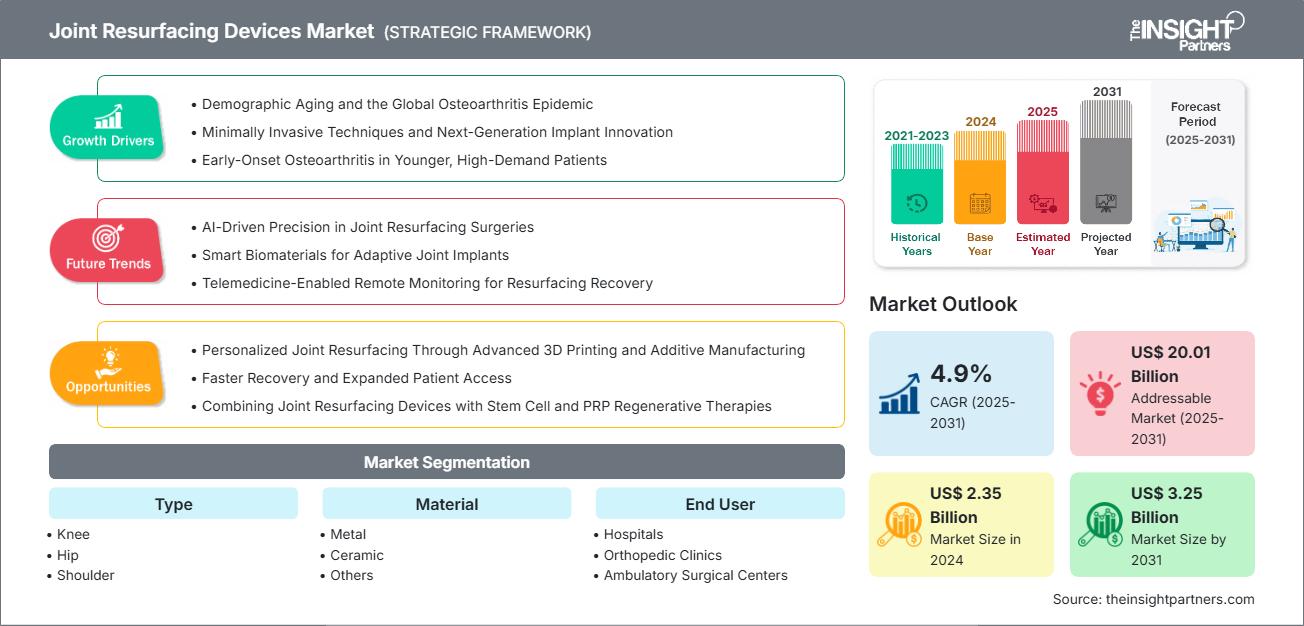
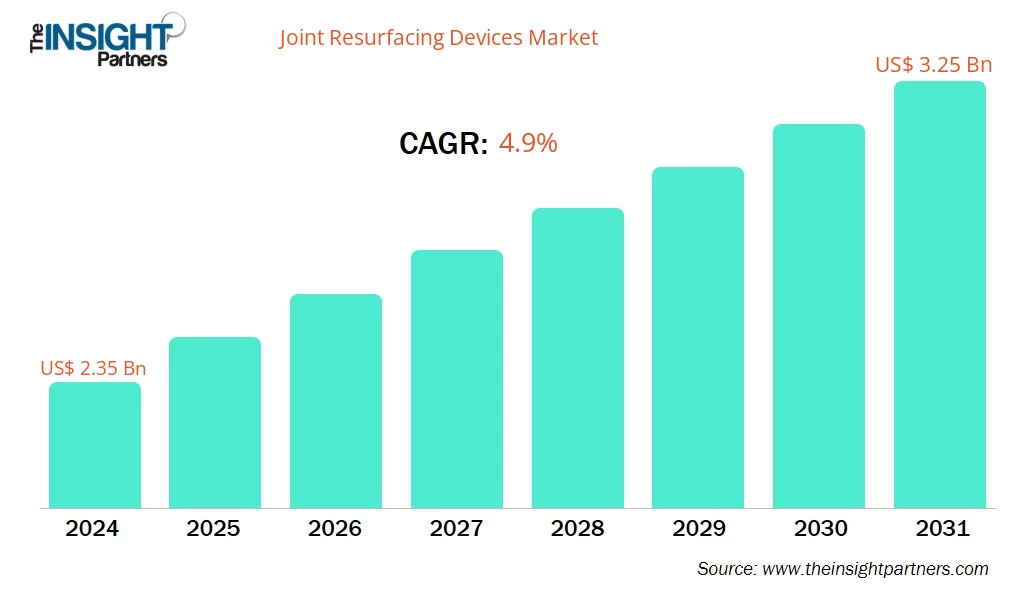
The joint resurfacing devices market size is projected to reach US$ 3.25 billion by 2031 from US$ 2.35 billion in 2024. The market is expected to register a CAGR of 4.9% during 2025–2031.
Joint Resurfacing Devices Market Analysis
Key factors driving market growth include demographic aging, rising prevalence of osteoarthritis, and next-generation implant innovation. Early-onset osteoarthritis in younger patients contributes to market development. Personalized joint resurfacing through advanced 3D printing and additive manufacturing, faster recovery and expanded patient access, and combining joint resurfacing devices with stem cell and PRP regenerative therapies are expected to create ample opportunities in the market.
Joint Resurfacing Devices Market Overview
With an increasing focus on the preservation of bones and patient mobility, joint resurfacing devices—especially hip resurfacing implants—constitute a niche but expanding segment of the overall joint reconstruction market. In contrast to standard total joint replacements, resurfacing keeps more of the patient's own bone by capping instead of replacing the joint's articulating surfaces, which reduces dislocation risks and leads to easier future revisions. The concept of resurfacing attracts the younger patients, as resurfacing allows better functional outcomes and joint stability over time. Resurfacing is being brought back to life by innovations in materials (such as ceramic and hybrid coatings), minimally invasive surgical techniques, and computer-assisted planning. However, challenges such as metal-ion release in metal-on-metal systems and the overall surgical complexity remain major obstacles. The increasing prevalence of hip osteoarthritis, good patient outcomes, and the widespread use of tissue-sparing procedures are some of the factors that are resulting in higher demand for orthopedic centers and hospitals.
Market Research Highlights
- North America dominated the market with 44.5% share in 2024.
- Asia Pacific is poised to grow at a CAGR of 5.3% over the forecast period.
- United States market is projected to grow at a CAGR of 5.2% over the forecast period.
- By Type, the Knee segment accounted for the largest market share of 51% in 2024.
- By Material, the Ceramic segment is anticipated to witness the fastest growth, registering a CAGR of 5.8% over the forecast period
- By End User, the Hospitals segment accounted for the largest market share of 57.5% in 2024.
- The report profiles key industry players such as MicroPort Scientific Corp, Stryker Corp, Zimmer Biomet Holdings Inc, Smith & Nephew Plc, JRI Orthopaedics Limited, Enovis Corp, Medacta Group SA, Corin Group, MatOrtho Limited, JointMedica, while also analyzing key developments in novel ideas, disruptive products, and innovative services that could reshape the future market and reveal emerging themes across the industry.
Source: The Insight Partners' analysis based on proprietary research, government publications, company annual reports, investor presentations, industry databases, and expert interviews.
● REPORT CUSTOMIZATION
Tailor This Report To Align With Your Specific Business Requirements
This report can be customized to align precisely with your business objectives, scope, and target markets. Customization options include tailored segmentation, geography, competitive analysis, and strategic insights to support informed decision-making.
Customize This Report →WHAT YOU CAN ADJUST
- ● Segmentations
- ● Geography
- ● Competitive Analysis
- ● Language Preferences
Joint Resurfacing Devices Market: Strategic Insights
-
Get Top Key Market Trends of this report.This FREE sample will include data analysis, ranging from market trends to estimates and forecasts.
Joint Resurfacing Devices Market Drivers and Opportunities
Market Drivers:
- Demographic Aging and Increased Osteoarthritis Prevalence: Continued demographic aging and increased osteoarthritis prevalence lead to a rise in the demand for bone-preserving joint resurfacing. These approaches can delay the need for total joint replacement and may reduce revision risk, helping improve mobility and functional outcomes in appropriately selected elderly, overweight, or post-menopausal patients.
- Minimally Invasive Techniques and Next-Generation Implant Innovation: Progress in minimally invasive surgery, AI-assisted planning, and next-generation implants results in faster recovery, fewer complications, and lower treatment costs, leading to increased patient satisfaction.
- Early-Onset of Osteoarthritis in Younger, High-Demand Patients: Osteoarthritis is increasingly common among younger, active adults, primarily due to sports injuries, obesity, and high-impact lifestyles. Consequently, bone-preserving joint resurfacing has become a preferred treatment, as it helps maintain mobility, reduce disability, and preserves the option for future total joint arthroplasty if needed.
Market Opportunities:
- Personalized Joint Resurfacing Through Advanced 3D Printing: Patient-specific implants can be produced using 3D printing, improving osseointegration and functional outcomes while reducing complications and revision rates. This approach also enables faster recovery and allows for the adoption of complex hip, knee, and hand resurfacing procedures.
- Faster Recovery and Expanded Patient Access: Use of minimally invasive resurfacing methods leads to shorter hospital stays, less blood loss and pain, and faster recovery. These advantages attract younger or active patients.
- Combining Joint Resurfacing with Stem Cell and PRP Therapies: Use of stem cells and PRP, along with resurfacing implants, results in the regeneration of cartilage, prolongs implant life, reduces inflammation, decreases revision rates, and aligns with biologically driven, patient-centered orthopedic solutions.
Joint Resurfacing Devices Market Report Segmentation Analysis
The joint resurfacing devices market is divided into different segments to give a clearer view of how it works, its growth potential, and the latest trends. Below is the standard segmentation approach used in most industry reports:
By Type:
- Knee: Resurfacing the knee is a procedure that preserves the bone and cartilage in cases of osteoarthritis and post-traumatic situations. It is associated with quick recovery, low revision rates, and excellent function, especially for younger, active, or high-demand patients.
- Hip: By capping the femoral head, hip resurfacing preserves bone, lowers the risk of dislocation, and delays the need for total arthroplasty. These advantages make it an appealing option for physically active adults as well as elderly patients suffering from osteoarthritis or avascular necrosis.
- Shoulder: In shoulder resurfacing, the glenohumeral articulation is restored while the native bone and joint stability are preserved, resulting in fewer complications and enabling early mobilization in patients with osteoarthritis, rotator cuff arthropathy, and post-traumatic shoulder injuries.
- Ankle: By rescuing the tibiotalar joint surfaces, ankle resurfacing helps in pain relief while maintaining mobility in the case of osteoarthritis, trauma, or post-surgical situations. Thus, it serves as a bone-sparing option that offers advantages similar to total ankle replacement.
- Others: In addition to the wrist, resurfacing procedures can also be performed on the elbow and small joints, helping restore function, relieve pain, and preserve bone in cases of trauma, degenerative disorders, or congenital deformities; this highlights the importance of personalized, patient-specific treatment strategies.
By Material:
- Metal
- Ceramic
- Others
By End User:
- Hospitals
- Orthopedic Clinics
- Ambulatory Surgical Centers
- Others
Each end user in the joint resurfacing devices market has distinct handling, safety, and regulatory needs, shaping equipment selection and operational protocols.
By Geography:
- North America
- Europe
- Asia Pacific
- Latin America
- Middle East & Africa
Joint Resurfacing Devices Market Report Scope
| Report Attribute | Details |
|---|---|
| Market size in 2024 | US$ 2.35 Billion |
| Market Size by 2031 | US$ 3.25 Billion |
| Global CAGR (2025 - 2031) | 4.9% |
| Historical Data | 2021-2023 |
| Forecast period | 2025-2031 |
| Segments Covered |
By Type
|
| Regions and Countries Covered |
North America
|
| Market leaders and key company profiles |
|
Joint Resurfacing Devices Market Players Density: Understanding Its Impact on Business Dynamics
The Joint Resurfacing Devices Market is growing rapidly, driven by increasing end-user demand due to factors such as evolving consumer preferences, technological advancements, and greater awareness of the product's benefits. As demand rises, businesses are expanding their offerings, innovating to meet consumer needs, and capitalizing on emerging trends, which further fuels market growth.
Joint Resurfacing Devices Market Share Analysis by Geography
Asia Pacific is expected to grow the fastest in the next few years. Emerging markets in Latin America, the Middle East, and Africa also have many untapped opportunities for joint reconstruction device providers to expand. Market growth factors include the rising prevalence of osteoarthritis and other joint-related disorders and the significantly increasing demand for joint replacement surgeries.
The market grows differently in each region, owing to the economic growth and increasing healthcare expenditure, which have enhanced the affordability of joint resurfacing procedures. Below is a summary of market share and trends by region:
1. North America
- Market Share: Holds a significant portion of the global market
- Key Drivers: The high prevalence of osteoarthritis, established healthcare infrastructure, and quick uptake of minimally invasive and 3D-printed implants are leading the joint resurfacing devices market
- Trends: Strong use of robotic and minimally invasive techniques
2. Europe
- Market Share: Substantial share due to early adoption of joint resurfacing devices
- Key Drivers: The increasing number of patients with osteoarthritis, government-funded healthcare, the preference of the patients for bone-preserving procedures, and innovations in the implant and MIS techniques contribute to the rise in resurface adoption.
- Trends: Focus on regulatory‑approved innovations, strong public health systems, and emphasis on patient safety and long-term implant outcomes
3. Asia Pacific
- Market Share: Fastest-growing region with rising market share every year
- Key Drivers: Geriatric population, increasing number of sports injuries, obesity, better access to healthcare, and the adoption of advanced surgical technologies are the factors contributing to the market growth.
- Trends: Expanding hospital capacity and increasing medical tourism
4. South & Central America
- Market Share: Growing market with steady progress
- Key Drivers: The increasing OA incidence, developing hospital infrastructure, rising surgical awareness, and bone-preserving implant adoption are improving access to resurfacing procedures across emerging markets.
- Trends: Emerging adoption of resurfacing is tied to improving healthcare access
5. Middle East and Africa
- Market Share: Small market share, growing at a rapid pace
- Key Drivers: The rising number of OA cases, increased access to private healthcare, sports-related injuries, and the steady adoption of minimally invasive and regenerative resurfacing techniques contribute to market growth.
- Trends: Rising non-communicable disease burdens are contributing to increased investments in healthcare infrastructure.
Joint Resurfacing Devices Market Players Density: Understanding Its Impact on Business Dynamics
High Market Density and Competition
Competition is strong due to the presence of established players, such as Smith & Nephew, DePuy / Johnson & Johnson, Zimmer / Zimmer Biomet, and Stryker, which are also adding to the competitive landscape across different regions.
This high level of competition urges companies to stand out by offering:
- Advanced security features
- Value-added services such as analytics & predictive maintenance, real‑time operational analytics, and installation
- Competitive pricing models
- Strong customer support and easy integration
Opportunities and Strategic Moves
- Along with the major players, a significant part of the budget will be assigned to the research and development of new third-generation product designs that will solve the clinical challenges that have been left unsolved, such as the reduction of the surgery time, bioabsorbable materials, and patient-specific sizing.
- Partnerships among device companies, research institutions, and healthcare providers are accelerating the introduction of innovations to the market and expanding the global footprint of the industry.
- Technological developments include robotic-assisted surgeries, AI-driven planning, custom implants, and improved biomaterials.
Other companies analysed during the course of research:
- Corin Group / Corin Medical (Cormet resurfacing)
- Finsbury Orthopaedics (ADEPT resurfacing)
- Implantcast (ACCIS resurfacing)
- IO International Orthopaedics (“Icon” resurfacing)
- MatOrtho (ReCerf ceramic resurfacing)
- Lima Corporate
- Meril Life Sciences
- Arthrex
- Globus Medical
- Integra LifeSciences
- Conformis (patient-specific implants)
- Medacta International
- CeramTec (ceramic implants)
- Merete GmbH
- Amplitude Ortho
- Allegra Orthopedic
- Symbios SA (resurfacing heads)
- Waldemar Link GmbH
- JRI (Joint Replacement Instrumentation)
- Stanmore Implants Worldwide
Joint Resurfacing Devices Market News and Recent Developments
- Overture Orthopaedics Announces Full Commercial Launch of the OvertureTi Knee Resurfacing System to Treat Early Osteoarthritis and Cartilage Defects
In July 2025, Overture Orthopaedics—which provides surgeons with innovative joint preservation solutions in sports medicine and orthopaedic surgery—announced the full commercial launch of its OvertureTi Knee Resurfacing System. The system is composed of femoral and tibial implants intended to be used in the partial replacement of the articular surfaces of the knee. These implants were designed with sizing options that allow the surgeon to replace only the diseased or damaged region of the joint while preserving healthy surrounding cartilage and meniscus. The procedure is referred to as Focalplasty - MatOrtho’s ReCerf Hip Resurfacing Arthroplasty Becomes the World's First All-Ceramic Hip Resurfacing Approved by a Regulatory Authority
In December 2024, MatOrtho launched the ReCerf Hip Resurfacing Arthroplasty, which has become the world's first all-ceramic hip resurfacing system to receive regulatory approval. Approval from the Therapeutic Goods Administration (TGA) in Australia marks a transformative moment for joint replacement technology and patient care.
Joint Resurfacing Devices Market Report Coverage and Deliverables
The "Joint Resurfacing Devices Market Size and Forecast (2021–2031)" report provides a detailed analysis of the market covering below areas:
- Joint resurfacing devices market size and forecast at global, regional, and country levels for all the key market segments covered under the scope
- Joint resurfacing devices market trends, as well as market dynamics such as drivers, restraints, and key opportunities
- Detailed PEST and SWOT analysis
- Joint resurfacing devices market analysis covering key market trends, global and regional framework, major players, regulations, and recent market developments
- Industry landscape and competition analysis covering market concentration, heat map analysis, prominent players, and recent developments for the joint resurfacing devices market
- Detailed company profiles
Frequently Asked Questions

- Comprehensive Market Sizing and Forecast Analysis
- Detailed Segmentation Analysis
- In-Depth Market Dynamics Assessment
- Regional and Country-Level Insights
- Competitive Landscape and Company Benchmarking
- Strategic Business Intelligence
Recent Reports
Testimonials

The Insight Partners provided valuable market intelligence that supported our global go-to-market strategy. Their team was professional, responsive, and attentive to our feedback, providing thoughtful analysis and helpful methodological clarifications throughout the project.
Junmo Kim Chief Financial Officer (CFO), Enertech Co., Ltd.
The Insight Partners' SCADA System Market report is comprehensive, with valuable insights on current trends and future forecasts. The team was highly professional, responsive, and supportive throughout. We are very satisfied and highly recommend their services.
RAN KEDEM Partner, Reali Technologies LTDs
I requested a report on a very specific software market and the team produced the report in a few days. The information was very relevant and well presented. I then requested some changes and additions to the report. The team was again very responsive and I got the final report in less than a week.
JEAN-HERVE JENN Chairman, Future Analytica
We worked with The Insight Partners for an important market study and forecast. They gave us clear insights into opportunities and risks, which helped shape our plans. Their research was easy to use and based on solid data. It helped us make smart, confident decisions. We highly recommend them.
PIYUSH NAGPAL Sr. Vice President, High Beam Global
The Insight Partners delivered insightful, well-structured market research with strong domain expertise. Their team was professional and responsive throughout. The user-friendly website made accessing industry reports seamless. We highly recommend them for reliable, high-quality research services
YUKIHIKO ADACHI CEO, Deep Blue, LLC.
This is the first time I have purchased a market report from The Insight Partners.While I was unsure at first, I visited their web site and felt more comfortable to take the risk and purchase a market report.I am completely satisfied with the quality of the report and customer service. I had several questions and comments with the initial report, but after a couple of dialogs over email with their analyst I believe I have a report that I can use as input to our strategic planning process.Thank you so much for taking the extra time and making this a positive experience.I will definitely recommend your service to others and you will be my first call when we need further market data.
JOHN SUZUKI President and Chief Executive Officer, Board Director, BK Technologies
I wish to appreciate your support and the professionalism you displayed in the course of attending to my request for information regarding to infectious disease IVD market in Nigeria. I appreciate your patience, your guidance, and the fact that you were willing to offer a discount, which eventually made it possible for us to close a deal. I look forward to engaging The Insight Partners in the future, all thanks to the impression you have created in me as a result of this first encounter.
DR CHIJIOKE ONYIA MANAGING DIRECTOR, PineCrest Healthcare Ltd.Reason to Buy
- Informed Decision-Making
- Understanding Market Dynamics
- Competitive Analysis
- Identifying Emerging Markets
- Customer Insights
- Market Forecasts
- Risk Mitigation
- Boosting Operational Efficiency
- Strategic Planning
- Investment Justification
- Tracking Industry Innovations
- Aligning with Regulatory Trends




 Get Free Sample for