
Wide-bandgap Semiconductor Market Share, Growth & Demand by 2034
Coverage: by Type (Aluminum nitride, Boron nitride, Silicon Carbide, Gallium nitride) and Application (IT & Telecommunication, Automotive, Defense and aerospace, Consumer electronics, and Others), and Geography (North America, Europe, Asia Pacific, and South and Central America)
- Status : Data Released
- Report Code : TIPRE00003286
- Category : Electronics and Semiconductor
- No. of Pages : 150
- Available Report Formats :


- Last update date : September 28, 2026


2025 Market Size
US$ 2.44 Bn
Base year value
2034 Forecast
US$ 7.58 Bn
Projected by 2034
CAGR 2026-2034
13.43 %
Growth rate
Addressable Market
US$ 43.45 Bn
(2026-2034)
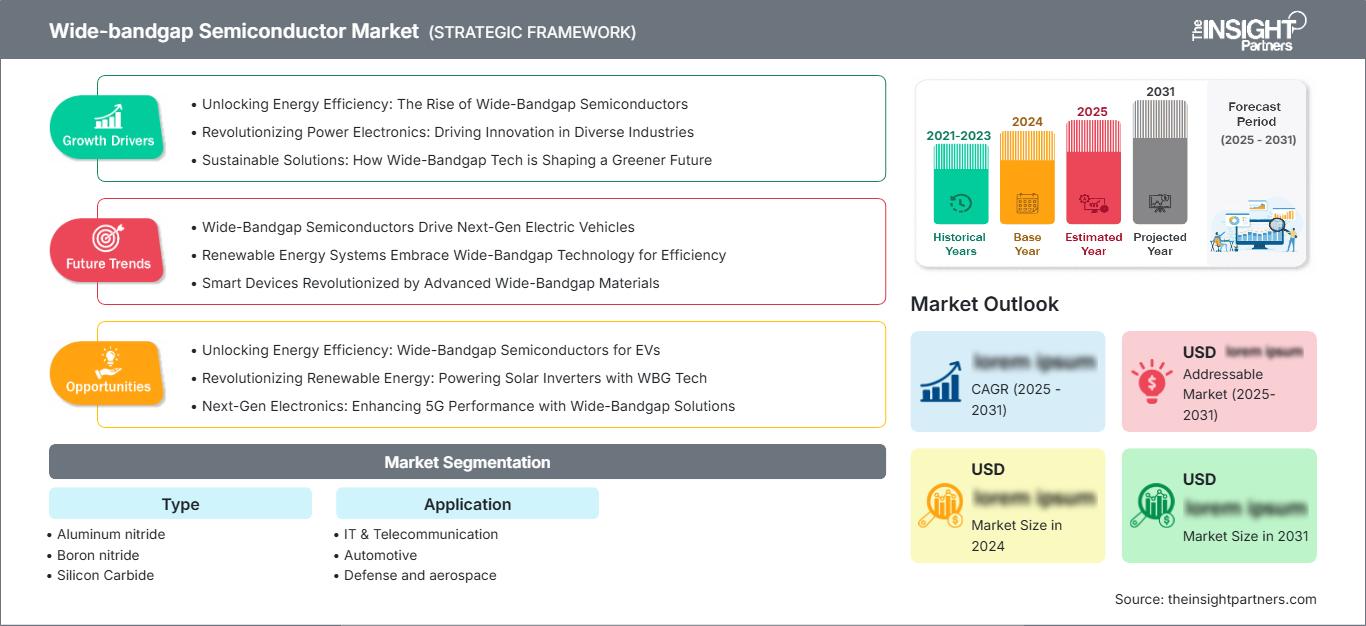
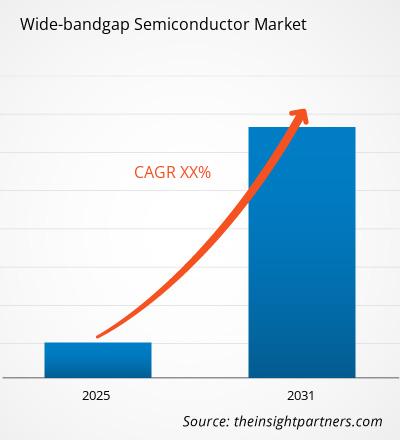
The wide-bandgap semiconductor market is valued at US$ 2.44 Billion in 2025 and is projected to reach US$ 7.58 Billion by 2034, registering a CAGR of 13.43% during 2026–2034. The market encompasses compound semiconductor materials supporting higher switching frequencies, temperature tolerance, voltage handling, and power density across transportation and computing.
North America is expected to maintain a strong position, supported by semiconductor localization, defense procurement, electric mobility, renewable power electronics, and data-center investment. The wide-bandgap semiconductor market size is expected to expand at an estimated 12–14% CAGR during 2026–2034, with the US remaining the principal demand center because of technology development and domestic manufacturing initiatives.
Wide-bandgap Semiconductor Market Assessment and Insights
- North America: North America is estimated to hold a 25–29% regional share in 2025 and grow at a 12–14% CAGR between 2026–2034, supported by electric vehicles, aerospace electronics, AI infrastructure, and semiconductor supply-chain localization.
- US: The US is estimated to represent 69–73% of North American demand in 2025, advancing at a 12–14% CAGR during 2026–2034 through defense, data-center, and automotive power-electronics adoption.
- Europe: Europe is estimated at a 22–26% share in 2025 and a 12–14% CAGR through 2034, led by Germany, the UK, France, Italy, and Spain, where automotive electrification and industrial efficiency programs support adoption.
- Asia Pacific: Asia Pacific is estimated to account for 38–42% in 2025 and expand at a 14–16% CAGR through 2034, with China, Japan, South Korea, and India driving manufacturing scale, EV deployment, and electronics demand.
- Largest Segment: Silicon Carbide is estimated to hold a 42–46% market share in 2025 and grow at a 13–15% CAGR during 2026–2034, reflecting high-voltage mobility and energy applications.
- High Growth Segment: Gallium Nitride is estimated to hold a 28–32% market share in 2025 and grow at a 15–17% CAGR during 2026–2034, supported by compact power conversion and high-frequency systems.
- Key companies analyzed in detail: Cree, Inc.; Efficient Power Conversion Corporation, Inc.; FUJITSU LIMITED; GaN Systems; Infineon Technologies AG; Microchip Technology Incorporated; Mitsubishi Electric Corporation; Qorvo, Inc.; Toshiba Corporation; United Silicon Carbide, Inc.; ROHM Co., Ltd.
Source: The Insight Partners' analysis based on proprietary research, government publications, company annual reports, investor presentations, industry databases, and expert interviews.
Production economics are shifting as SiC wafer diameters increase and GaN manufacturing moves toward larger wafers, improving throughput and cost efficiency. The wide-bandgap semiconductor market is broadening beyond discrete devices into integrated modules, gate drivers, radio-frequency systems, and power architectures for mobility, renewable generation, industrial drives, and computing. Supply chains emphasize substrate quality, epitaxy, packaging, and qualification.
Looking ahead, adoption should deepen where energy losses, thermal constraints, and switching performance affect system economics. Investment is moving toward regional wafer capacity, packaging, reliability qualification, and application-specific design. Regulatory support for vehicle efficiency, grid modernization, renewable integration, and domestic semiconductor production should reinforce demand, while qualification cycles and material costs remain important commercialization considerations.
Wide-bandgap Semiconductor Market Report Scope
| Report Attribute | Details |
|---|---|
| Market size in 2025 | US$ 2.44 Billion |
| Market Size by 2034 | US$ 7.58 Billion |
| Global CAGR (2026 - 2034) | 13.43% |
| Historical Data | 2021-2024 |
| Forecast period | 2026-2034 |
Wide-bandgap Semiconductor Market Analysis
The wide-bandgap semiconductor market growth is being shaped by efficient power conversion, higher operating temperatures, and smaller passive components. While SiC is suited for applications like traction inverters at high voltage, charging systems, solar inverters, and industrial conversion, GaN caters to fast chargers, telecom power supply, consumer electronics, and advanced data center architecture. The eco-system includes substrate, epitaxy, manufacturing, device engineering, packaging, module, and equipment companies.
The dynamics of supply are different for each type of material. For SiC, they include substrate quality, defect management, epitaxial wafers, and wafer scaling; for GaN, they include epitaxial process, transistor design, thermal dissipation, and standardization in packaging. While automotive qualification pushes back commercialization of the devices, large-scale projects can help with factory utilization.
The wide-bandgap semiconductor market analysis shows competition centered on device performance, manufacturing scale, qualification, intellectual property, and application engineering. SiC and GaN production capacities are being increased by Infineon Technologies AG, whereas Mitsubishi Electric Corporation is making progress in SiC MOSFET generations for electrified vehicles. Qorvo, Inc. and Efficient Power Conversion Corporation, Inc. reinforce their GaN strengths in high-frequency and power applications, whereas Toshiba Corporation, Microchip Technology Incorporated, and ROHM Co., Ltd. participate in the competition via diversified power offerings.
Strategic positioning is associated with vertical integration and joint development of products. Cree, Inc., United Silicon Carbide, Inc. and GaN Systems bring their expertise, whereas FUJITSU LIMITED is supporting its presence in the semiconductor and communication industries. Investment activities include expansion of wafer capacity, packages, qualification laboratories and application reference designs. Strategic partnerships may facilitate transfer and qualify products faster, especially in cases of long product lifetimes expected by automotive, aerospace, and industrial customers.
● REPORT CUSTOMIZATION
Tailor This Report To Align With Your Specific Business Requirements
This report can be customized to align precisely with your business objectives, scope, and target markets. Customization options include tailored segmentation, geography, competitive analysis, and strategic insights to support informed decision-making.
Customize This Report →WHAT YOU CAN ADJUST
- ● Segmentations
- ● Geography
- ● Competitive Analysis
- ● Language Preferences
Wide-bandgap Semiconductor Market: Strategic Insights
Regional Insights
North America wide-bandgap semiconductor market
North America is estimated to hold a 25–29% wide-bandgap semiconductor market share in 2025 and expand at a 12–14% CAGR through 2034. The USA drives regional demand with the help of electric vehicles, defense electronics, renewable energy conversion, and hyperscale computing. Incentives for domestic semiconductor investments and supply chain diversification drive substrate, process and package technology investments, whereas aerospace systems drive high-temperature and radiation-hardened devices. Compound semiconductor technology legacy in the region provides an advantage, although high capital cost and qualification hurdles limit the fast expansion of manufacturing capacity.
Applications have expanded to include data center power delivery, industrial drives, photovoltaic conversion and telecommunications. Defense procurement is heavily influenced by reliability, thermal capability and power conversion efficiency, driving the growth of GaN and SiC. Established connections between device suppliers and system integrators are another advantage of the region. Capital cost and qualification remain key factors for companies building regional capacity and application-specific technology.
U.S. wide-bandgap semiconductor Market
The US represents an estimated 69–73% of North American demand in 2025 and is expected to grow at a 12–14% CAGR through 2034. Demand areas include inverters for automobiles, charging equipment, defense electronics, satellite electronics, telecommunications equipment, energy converters for renewables, and data center power supplies. Localization of semiconductor production helps to build up local production capability and to diversify material sources.
Our company has a strong presence in the design of devices, power modules, radio frequency systems, and manufacturing equipment. SiC is becoming increasingly favored in automotive applications owing to high voltage efficiencies, while GaN is expanding in small chargers, communication electronics, and high-frequency converters. Advanced computing is yet another area of demand because the power delivery structures need to be capable of handling higher rack densities.
Europe wide-bandgap semiconductor Market
Europe is estimated to account for 22–26% of 2025 demand and expand at a 12–14% CAGR through 2034. Germany is still the front-runner due to the automotive and industrial automation applications, which form the installed base. The UK favors GaN, RF, aerospace, and research applications. France, on the other hand, integrates defense, automotive, and energy applications. Italy and Spain contribute through their use of industrial machinery, renewable energy, and electrification programs.
Automotive electrification continues to be the key application channel, alongside renewable energy generation, charging infrastructure, industrial drives, and railways. Efficiency and resilience of energy supply are key for European manufacturers, favoring localization of wafer fabrication, module assembly, and packaging. Regulatory pressure around vehicle and industrial energy efficiency encourages more efficient power electronics. Customer qualification, automotive design cycle time, and competition from Asia play into this picture.
APAC wide-bandgap semiconductor Market
APAC is estimated to represent 38–42% of 2025 demand and grow at a 14–16% CAGR through 2034, making it the leading regional market. China combines large-scale EV production, renewable deployment, and semiconductor manufacturing. Japan remains strong in automotive and industrial power devices, while South Korea supports electronics and advanced manufacturing. India is expanding EV and power-electronics adoption, while Australia contributes through renewable systems and mining electrification.
Middle East & Africa wide-bandgap semiconductor Market
The Middle East and Africa demand is developing from a smaller base, with Saudi Arabia, the UAE, and South Africa providing the most visible opportunities. Energy diversification, solar projects, charging infrastructure, telecom networks, and industrial modernization support a 10–12% CAGR through 2034. Saudi Arabia and the UAE emphasize digital infrastructure and renewable generation, while South Africa combines mining, grid needs, and industrial power conversion.
Segmentation Analysis
Type
Type segmentation reflects differences in material properties, manufacturing maturity, and application economics. The type segment is expected to expand at a 13–15% CAGR during 2026–2034 as designers select materials according to voltage, frequency, thermal, and cost requirements. Silicon carbide leads high-power applications, while gallium nitride gains share in high-frequency and compact systems.
- Aluminum nitride supports high thermal conductivity and electrical insulation requirements, making it strategically relevant to advanced packaging, heat-management structures, and demanding electronic assemblies where thermal performance is critical.
- Boron nitride serves specialized thermal-management and electronic-material applications, with demand concentrated in environments requiring electrical insulation, heat spreading, and materials capable of supporting high-performance semiconductor architectures.
- Silicon Carbide holds the strongest position in high-voltage power conversion, especially traction inverters, charging, renewable-energy systems, and industrial drives where lower losses and thermal robustness improve system-level efficiency.
- Gallium nitride is increasingly selected for high-frequency switching, compact chargers, telecom power, RF systems, and data-center architectures where fast switching and high power density can reduce component size.
Application
Application demand is expected to rise at a 13–15% CAGR during 2026–2034 as system designers prioritize efficiency, thermal management, switching speed, and compact power conversion. The application segment benefits from adoption across transportation, communications, computing, and defense.
- IT & Telecommunication demand is supported by high-efficiency power supplies, radio-frequency systems, network equipment, and data-center infrastructure where higher switching performance can reduce conversion losses and improve equipment density.
- Automotive remains strategically important because electrified vehicles require efficient traction inverters, onboard chargers, DC-DC converters, and charging infrastructure, with SiC particularly relevant to high-voltage powertrains.
- Defense and aerospace applications prioritize radiation tolerance, high frequency, thermal stability, compactness, and reliability, creating demand for specialized GaN and SiC devices in radar, communications, aircraft, and space systems.
- Consumer electronics adoption is driven by smaller fast chargers, adapters, power management, and compact devices, where GaN can enable higher switching frequencies and reduced magnetic-component size.
Opportunity Snapshot
| Application | Revenue Contribution (High/Medium/Low) | Trend Tag (MAX 2 words) | Adoption Stage (Emerging/Scaling/Mature) |
| IT & Telecommunication | High | AI Power | Scaling |
| Automotive | High | Fast Charging | Scaling |
| Defense and aerospace | Medium | Radar Systems | Scaling |
| Consumer electronics | Medium | Fast Chargers | Mature |
Wide-bandgap Semiconductor Market Growth Drivers and Impact Analysis
Electric vehicle powertrain efficiency requirements
Electric vehicle architecture is putting continual stress on inverter efficiency, thermal management, charge time, and weight. The use of SiC in these systems can result in lower losses from switching and conduction, leading to a smaller requirement for thermal management and better drive efficiency. According to the International Energy Agency, global electric vehicle sales surpassed 20 million in 2025, where electric vehicles accounted for 25 percent of all car sales. With this growing installed base of equipment, there is an increase in the addressable market for advanced power semiconductors in terms of traction inverters, onboard charging, and charging infrastructure.
AI infrastructure and high-density power delivery
Increased computational density is making changes in electrical design since higher compute density results in greater power per rack and higher significance of conversion efficiency. WBG devices may enable high switching speeds and power density in selected power conversion stages, which will be beneficial in terms of reduction of heat dissipation and smaller system size. As indicated by Infineon, AI data centers' racks are supposed to demand one megawatt or more of power before the end of the decade. This implies that the resultant change in architecture can provide new opportunities for GaN and SiC in power supply applications, intermediate buses, voltage regulation, and high-voltage DC systems.
Renewable energy and grid modernization
For solar inverters, battery energy storage systems, charging stations, and industrial power converters, there is now a need for high-efficiency performance amid varying load profiles and stringent thermal conditions. While SiC helps achieve high-voltage switching and lower losses where efficiencies determine the feasibility of a project, GaN could help overcome fast switching stages and auxiliary power needs. The smart grid would also benefit from compact equipment that can work with high power densities, but not necessarily with cooling system proportions rising in a linear way. In the wake of distributed generation integration by utilities and industries, the need for bidirectional conversion becomes imperative. Device vendors thus have the chance to do better than selling individual components through offering qualified modules, gate drive solutions, and platform-based solutions.
Wide-bandgap Semiconductor Market Future Trends
Advanced packaging will become a larger differentiator
The wide-bandgap semiconductor market trends are moving toward packaging architectures that extract more value from high-frequency and high-temperature device characteristics. Future product designs are expected to incorporate lower inductance interconnects, better thermal pathways, substrate innovations, and smaller module sizes. Package development will take place concurrently with that of the transistor, rather than being an afterthought in manufacturing. This approach will go a long way in reducing parasitic effects and improving switching behavior while satisfying thermal cycling demands in automotive and industrial applications. Standardized footprints will speed up acceptance by making board modifications simpler and easier to qualify. With device characteristics becoming increasingly uniform, packaging reliability, power density, ease of manufacture, and integration with the system are likely to play a key role in purchasing decisions.
Material diversification will broaden application coverage
Future adoption will increasingly reflect application-specific combinations of SiC, GaN, and emerging compound materials. SiC is likely to remain favored where high voltage and harsh thermal conditions dominate, while GaN can expand where high switching frequency and compactness create greater system value. Aluminum nitride and boron nitride can gain relevance through thermal management and advanced packaging ecosystems. Designers will evaluate complete power paths, including switches, drivers, magnetics, substrates, and cooling, rather than selecting devices independently. This systems approach can create new collaboration models between semiconductor vendors and equipment manufacturers. Over time, application-specific optimization should widen the addressable market and reduce the assumption that one wide-bandgap technology must serve every power-conversion requirement.
Wide-bandgap Semiconductor Market Opportunities
Localized manufacturing and secure supply ecosystems
The wide-bandgap semiconductor market scope creates investment opportunities in regional substrates, epitaxy, wafer fabrication, packaging, and testing. Supply-chain concentration has encouraged governments and manufacturers to seek greater resilience for semiconductor technologies. New capacity can be differentiated through larger wafer formats, improved defect control, automation, and application-specific qualification. Investors should assess not only installed capacity but also substrate availability, customer qualification pipelines, process yields, and offtake agreements. Companies able to connect material production with device fabrication and module assembly can reduce dependency across multiple stages and improve responsiveness to customer requirements. Regional ecosystems may also benefit from public incentives, university research, and defense or automotive procurement that supports early-stage qualification and create a pathway toward commercial scale.
Integrated power modules for electrified systems
An attractive opportunity identified by wide-bandgap semiconductor market forecasts lies in integrated modules that combine wide-bandgap switches, drivers, sensing, thermal structures, and protection functions. Such products can simplify system design for automotive inverters, chargers, renewable-energy converters, industrial drives, and data-center power systems. Customers value validated reference architectures because qualification and thermal optimization can consume significant engineering resources. Vendors that provide complete electrical and mechanical integration can move closer to system-level decision points and improve switching performance without requiring customers to redesign every supporting component. Investment priorities should include low-inductance packaging, high-reliability interconnects, advanced cooling, and digital monitoring. The strongest opportunities are where module integration reduces size, losses, engineering time, or maintenance.
Frequently Asked Questions

- Comprehensive Market Sizing and Forecast Analysis
- Detailed Segmentation Analysis
- In-Depth Market Dynamics Assessment
- Regional and Country-Level Insights
- Competitive Landscape and Company Benchmarking
- Strategic Business Intelligence
Recent Reports
Testimonials

The Insight Partners provided valuable market intelligence that supported our global go-to-market strategy. Their team was professional, responsive, and attentive to our feedback, providing thoughtful analysis and helpful methodological clarifications throughout the project.
Junmo Kim Chief Financial Officer (CFO), Enertech Co., Ltd.
The Insight Partners' SCADA System Market report is comprehensive, with valuable insights on current trends and future forecasts. The team was highly professional, responsive, and supportive throughout. We are very satisfied and highly recommend their services.
RAN KEDEM Partner, Reali Technologies LTDs
I requested a report on a very specific software market and the team produced the report in a few days. The information was very relevant and well presented. I then requested some changes and additions to the report. The team was again very responsive and I got the final report in less than a week.
JEAN-HERVE JENN Chairman, Future Analytica
We worked with The Insight Partners for an important market study and forecast. They gave us clear insights into opportunities and risks, which helped shape our plans. Their research was easy to use and based on solid data. It helped us make smart, confident decisions. We highly recommend them.
PIYUSH NAGPAL Sr. Vice President, High Beam Global
The Insight Partners delivered insightful, well-structured market research with strong domain expertise. Their team was professional and responsive throughout. The user-friendly website made accessing industry reports seamless. We highly recommend them for reliable, high-quality research services
YUKIHIKO ADACHI CEO, Deep Blue, LLC.
This is the first time I have purchased a market report from The Insight Partners.While I was unsure at first, I visited their web site and felt more comfortable to take the risk and purchase a market report.I am completely satisfied with the quality of the report and customer service. I had several questions and comments with the initial report, but after a couple of dialogs over email with their analyst I believe I have a report that I can use as input to our strategic planning process.Thank you so much for taking the extra time and making this a positive experience.I will definitely recommend your service to others and you will be my first call when we need further market data.
JOHN SUZUKI President and Chief Executive Officer, Board Director, BK Technologies
I wish to appreciate your support and the professionalism you displayed in the course of attending to my request for information regarding to infectious disease IVD market in Nigeria. I appreciate your patience, your guidance, and the fact that you were willing to offer a discount, which eventually made it possible for us to close a deal. I look forward to engaging The Insight Partners in the future, all thanks to the impression you have created in me as a result of this first encounter.
DR CHIJIOKE ONYIA MANAGING DIRECTOR, PineCrest Healthcare Ltd.Reason to Buy
- Informed Decision-Making
- Understanding Market Dynamics
- Competitive Analysis
- Identifying Emerging Markets
- Customer Insights
- Market Forecasts
- Risk Mitigation
- Boosting Operational Efficiency
- Strategic Planning
- Investment Justification
- Tracking Industry Innovations
- Aligning with Regulatory Trends





 Get Free Sample for