
Organic Acids in Animal Nutrition Market Growth, Demand & Size by 2034
Coverage: By Type (Acetic acid, Citric acid, Formic acid, Lactic acid, Propionic acid, Ascorbic acid, Gluconic acid, Fumaric acid, Malic acid); Application (Poultry, Livestock), and Geography (North America, Europe, Asia Pacific, and South and Central America)
- Status : Data Released
- Report Code : TIPRE00014633
- Category : Chemicals and Materials
- No. of Pages : 150
- Available Report Formats :


- Last update date : September 28, 2026


2025 Market Size
US$ 1.76 Bn
Base year value
2034 Forecast
US$ 3.25 Bn
Projected by 2034
CAGR 2026-2034
7.03 %
Growth rate
Addressable Market
US$ 22.59 Bn
(2026-2034)
The organic acids in animal nutrition market was valued at US$ 1.76 Billion in 2025 and is projected to reach US$ 3.25 Billion by 2034, expanding at a 7.03% CAGR from 2026 to 2034. The market covers formic acid, propionic acid, acetic acid, citric acid, lactic acid, and sorbic acid used across poultry, ruminant, swine, and aquaculture nutrition. These ingredients are incorporated into feed, drinking water, silage, and feed-preservation systems to support feed hygiene, acidification, microbial control, digestive performance, and feed quality.
North America represents a mature but steadily expanding demand center, supported by integrated livestock production, commercial feed manufacturing, and increasing attention to feed hygiene and gut health. The region accounted for ~27% of the global Organic Acids in Animal Nutrition Market Size in 2025 and is expected to register a ~6.4% CAGR through the forecast period. In the US, organic acid solutions are increasingly positioned as part of broader feed-management programs rather than as stand-alone preservatives. Product portfolios from companies such as BASF, Eastman, Kemin, and ADM demonstrate this shift toward species-specific acidification, feed preservation, and water-management applications. Eastman's recent focus on formic-acid-based solutions for feed and drinking-water applications also illustrates the movement toward flexible delivery systems.
Organic Acids in Animal Nutrition Market Assessment and Insights
- North America: North America held ~27% of the organic acids in animal nutrition market in 2025 and is expected to grow at a ~6.4% CAGR. Mature feed manufacturing infrastructure, high commercial livestock integration, and established feed-additive distribution channels support adoption. The implication is a stable premium market where product differentiation increasingly depends on formulation performance, handling characteristics, and technical support rather than basic acid availability.
- U.S.: The US represented ~78% of North American demand in 2025 and is projected to expand at a ~6.2% CAGR. Poultry and swine producers are important users because acidification can be integrated with feed hygiene, pathogen-control, and gut-health programs. Increasing interest in alternatives to routine antimicrobial use also supports demand for multifunctional acidifier systems.
- Europe: Europe represented ~24% of the global market in 2025 and is projected to grow at a ~6.6% CAGR. Germany, France, the Netherlands, Spain, and the UK are relevant demand centers, with the region distinguished by stringent feed-additive authorization, traceability, safety, and sustainability requirements. European buyers therefore place substantial emphasis on documented efficacy, approved applications, handling safety, and formulation consistency.
- Asia Pacific: APAC accounted for ~37% of the global market in 2025 and is expected to register a ~8.1% CAGR. China, India, Japan, South Korea, and Southeast Asian livestock-producing economies provide the principal demand base. Rapid feed-mill modernization, commercial poultry and swine production, aquaculture expansion, and increasing focus on Salmonella and other feedborne risks support stronger growth than in mature markets.
- Largest Segment: Poultry is the largest application segment and is expected to grow at a ~7.2% CAGR. High feed throughput, intensive production systems, pathogen-control requirements, and sensitivity to feed conversion make acidification and feed-hygiene solutions commercially important for poultry integrators.
- High Growth Segment: Aquaculture is the fastest-growing application segment, with a projected ~8.0% CAGR. Intensification of fish and shrimp farming is increasing the need for controlled feed quality, digestive support, and water-management practices, creating opportunities for acid solutions adapted to aquatic production systems.
- Key companies analyzed in detail: dsm-firmenich Animal Nutrition & Health, Nutreco, BASF SE, Kemin Industries Inc., Eastman Chemical Company, ADM, Cargill Incorporated, Dow, Celanese Corporation, and Helan Jindan Lactic Acid.
Source: The Insight Partners' analysis based on proprietary research, government publications, company annual reports, investor presentations, industry databases, and expert interviews.
The organic acids used in animal nutrition have moved beyond being merely feed preservation solutions to becoming multi-functional solutions that take into consideration feed hygiene, digestive health, microbial balance, and production efficiency. Formic and propionic acids are especially important since they can help reduce feed pH levels and control undesirable microorganisms. Blended solutions involve the use of acids alongside salts, buffers, or complementary functional ingredients. Examples from BASF include formic acid products, propionic acid products, and blended products intended to reduce corrosiveness and facilitate handling.
There have also been changes in buyer needs. The need for feed and livestock producers to have solutions that will work in broader health management systems, such as those related to feed, drinking water, and on-farm hygiene. The Eastman Acitra and Protaq platforms are good examples of solutions that emphasize the importance of flexibility in terms of product application. These are acidification products that can be used in both feed and drinking water, which increases the use case of the product.
The future market environment will be impacted increasingly by regulation, antimicrobial resistance management, localization of production of feed additives, and animal performance results. Authorization of any product to be marketed in Europe is a regulatory barrier favoring companies that have already gained experience in compiling technical dossier and obtaining authorization. Moreover, there is an ongoing change in the regulatory environment, where the discussion in Europe focuses on making authorization processes more effective while maintaining feed safety standards.
The emerging market will be impacted by local manufacturing, technical support, and distribution. India and Southeast Asia represent two important areas because of increasing industrialization in feed production and the need of producers of poultry, swine, dairy, and aquatic animals to solve problems related to microbiological issues, feed storage, and digestion. Companies which can offer acid products along with application equipment, formulations, diagnostics, and technical support services at farms will have an advantage.
Organic Acids in Animal Nutrition Market Report Scope
| Report Attribute | Details |
|---|---|
| Market size in 2025 | US$ 1.76 Billion |
| Market Size by 2034 | US$ 3.25 Billion |
| Global CAGR (2026 - 2034) | 7.03% |
| Historical Data | 2021-2024 |
| Forecast period | 2026-2034 |
Organic Acids in Animal Nutrition Market Analysis
Organic Acids in Animal Nutrition Market Growth is enabled through the intersection of feed safety, livestock intensification, antimicrobial management, and the economic significance of feed efficiency. In response to microbial contamination or degradation of feed, acidification may minimize the conditions that enable unwanted bacteria, yeasts, and molds. Improved hygiene of feeds leads to greater feed consistency, while acidification within the gut complements digestion and gut health approaches. There is, therefore, an overall value chain wherein the need for livestock health drives decisions in feed milling, which determine demand for particular acids, buffered formulations, salts, and equipment.
On the supply side, there is production of individual acids, either chemically or through fermentation, followed by processing, formulation, packaging, and distribution through feed additive distributors and technical sales channels. Economics of the product not only depend on price of the acids themselves, but on concentration, formulation robustness, corrosivity, logistics, packaging, and dosing efficiency. Buffered or formulated products offer increased value propositions in terms of minimizing handling issues or performing two functions at once, such as preserving and acidifying feed.
Organic acids in animal nutrition analysis indicates that there will be increasing convergence of feed protection and animal health management practices. The producers of feed are evaluating acidifiers together with probiotics, phytogenics, enzymes, postbiotics, and other functional ingredients. These ingredients may be complementary rather than directly substitutable since they work on different mechanisms. According to FAO, acidifiers are included in the feed-additive strategies that reduce dependence on antimicrobials, but industry activity indicates increasing focus on integrated gut health programs.
The competitive environment mentioned in the Organic Acids in Animal Nutrition Market Report becomes characterized by formulation technology, species knowledge, application expertise, regulation expertise, and geographic supply. BASF develops proprietary product lines of formic and propionic acid, whereas Eastman combines the organic acids with monoglycerides technologies for animal health. Kemin includes the organic acids with antimicrobial and water sanitization solutions, while ADM incorporates acidifiers in its feed additive portfolio. Cargill and Nutreco compete via more comprehensive nutrition platforms combining feed additives and animal health, microbiome and formulation solutions.
Recent corporate strategy also indicates that the sector is becoming more specialized. dsm-firmenich announced the planned divestment of its Animal Nutrition & Health business to CVC Capital Partners, with the transaction expected to create standalone businesses focused on animal-nutrition solutions and essential nutrition ingredients. This illustrates a wider strategic pattern in which large diversified groups are evaluating whether specialized animal-nutrition businesses can generate greater value as focused platforms.
● REPORT CUSTOMIZATION
Tailor This Report To Align With Your Specific Business Requirements
This report can be customized to align precisely with your business objectives, scope, and target markets. Customization options include tailored segmentation, geography, competitive analysis, and strategic insights to support informed decision-making.
Customize This Report →WHAT YOU CAN ADJUST
- ● Segmentations
- ● Geography
- ● Competitive Analysis
- ● Language Preferences
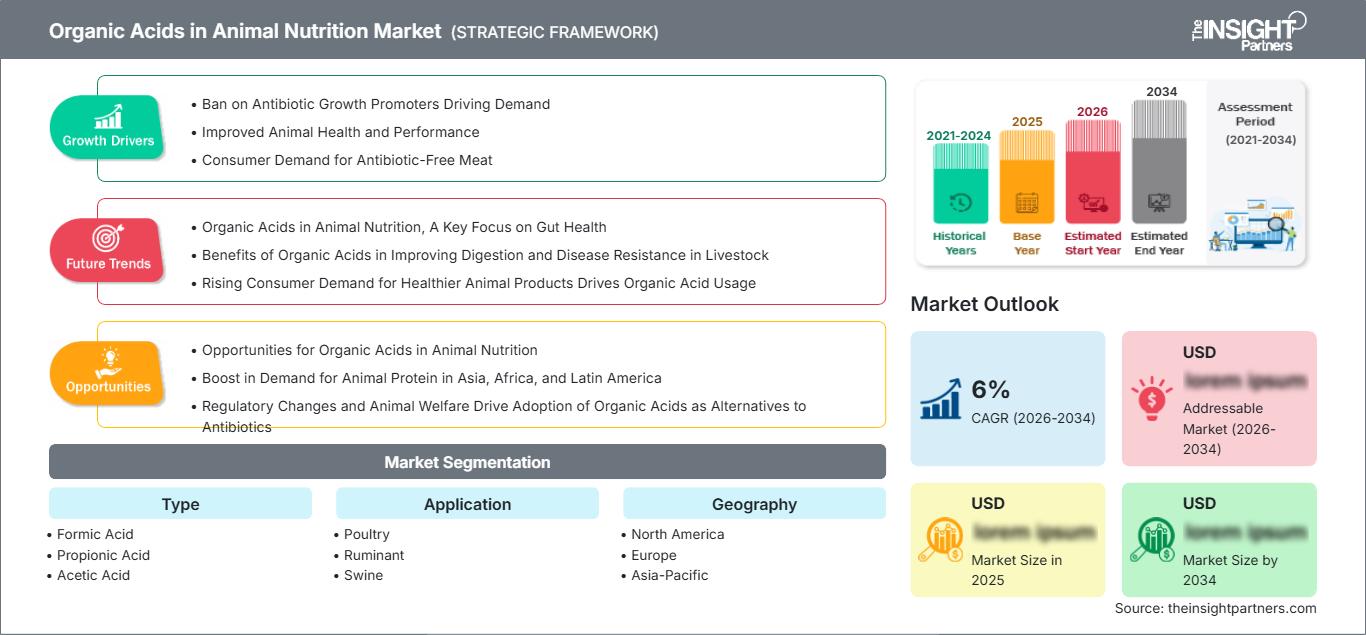
Organic Acids in Animal Nutrition Market: Strategic Insights
Regional Insights
North America Organic Acids in Animal Nutrition Market
North America accounted for ~27% of the global organic acids in animal nutrition market share in 2025 and is expected to expand at a ~6.4% CAGR. The region's established compound-feed sector, vertically integrated poultry and swine operations, and high adoption of feed-safety programs support consistent demand. Organic acids are increasingly incorporated into broader feed-hygiene strategies covering raw materials, finished feed, storage, and drinking water.
The US is the principal regional demand center. Large poultry and swine integrators favor solutions that can be standardized across feed mills and farms, while technical support is important because acid effectiveness depends on feed composition, moisture, buffering capacity, and application conditions. Canada has a smaller but technically mature market, with demand supported by commercial livestock production and feed-quality management.
U.S. Organic Acids in Animal Nutrition Market
The US represented ~78% of North American demand in 2025 and is expected to grow at a ~6.2% CAGR. Poultry and swine are important applications because intensive production systems create strong requirements for feed hygiene and consistent digestive performance. Organic acid products are increasingly delivered through multiple routes, including feed and drinking water, enabling producers to address different stages of animal production.
The US market also benefits from a sophisticated feed-additive distribution structure and strong presence of multinational suppliers. Eastman has developed formic-acid-based Acitra and Protaq solutions, while Kemin supplies acid-based feed and water-management products. This competitive environment shifts purchasing decisions toward efficacy, ease of application, technical service, and integration with broader animal-health programs.
Europe Organic Acids in Animal Nutrition Market
Europe represented ~24% of the global market in 2025 and is forecast to grow at a ~6.6% CAGR. Germany is an important market because of its feed manufacturing base and concentration of specialty feed-ingredient expertise. France has strong livestock and feed-production activity, while Spain's intensive swine and poultry sectors create significant demand for feed-hygiene and gut-health solutions. The Netherlands is strategically important because of its concentration of feed companies, animal nutrition research, and livestock technology.
European regulation is a defining market characteristic. Feed additives require authorization and must meet defined conditions of use, labeling, and safety requirements. This increases compliance costs but also favors suppliers with regulatory dossiers, technical evidence, and established quality systems. Demand is therefore increasingly linked to documented functionality rather than simple acid availability.
APAC Organic Acids in Animal Nutrition Market
APAC held ~37% of the global market in 2025 and is projected to grow at a ~8.1% CAGR. China is the leading demand center because of its large commercial feed and livestock industries. India is becoming increasingly important as poultry and dairy production commercialize and feed mills adopt more sophisticated feed-hygiene practices. Japan and South Korea provide mature markets where quality, consistency, and technical performance are more important than basic volume expansion.
Aquaculture adds a distinctive growth pathway across China, India, Southeast Asia, and other Asian markets. Acidification products can be incorporated into broader digestive-health and feed-management strategies for fish and shrimp. Meanwhile, increasing concern over antimicrobial resistance is encouraging producers to evaluate alternatives and complements to conventional antimicrobial approaches. Pakistan's poultry sector, for example, has identified organic acids alongside probiotics and phytochemicals as important antimicrobial alternatives, demonstrating the relevance of this transition in South Asian production systems.
Segmentation Analysis
Type
The type segment in the Organic Acids in Animal Nutrition Market covers formic acid, propionic acid, acetic acid, citric acid, lactic acid, and sorbic acid. Demand varies according to antimicrobial activity, preservation requirements, acidity profile, palatability, formulation compatibility, and end-use application. Formic and propionic acids are particularly important in feed preservation and acidification, while lactic and citric acids can serve more specialized nutritional and formulation roles. The competitive outlook increasingly favors blends and buffered systems that balance efficacy with handling and corrosion requirements.
Application
The application segment in the Organic Acids in Animal Nutrition Market covers poultry, ruminant, swine, and aquaculture. Poultry remains the largest application, with a ~7.2% CAGR, supported by intensive production, high feed consumption, and persistent requirements for microbial control and gut-health management. Swine demand is closely associated with weaning and digestive-health challenges. Ruminant applications include feed preservation, silage management, and digestive support, while aquaculture is expected to achieve the fastest growth at a ~8.0% CAGR as intensive fish and shrimp production expands.
Type sub-segments
- Formic Acid: Primarily used for feed acidification, preservation, and microbial control; its strong positioning in poultry and swine supports broad adoption.
- Propionic Acid: Particularly relevant to mold inhibition, grain preservation, and silage applications, making it important where moisture and storage conditions create spoilage risk.
- Acetic Acid: Used for acidification and preservation and can contribute to blended formulations targeting feed hygiene and digestive conditions.
- Citric Acid: Supports acidification and palatability-related formulation strategies and can complement broader nutritional programs.
- Lactic Acid: Provides an acidification option with relevance to fermentation-oriented formulations and specialized animal-nutrition applications.
- Sorbic Acid: Primarily valued for preservation and mold-control functionality, particularly where extended feed or raw-material stability is required.
Application sub-segments
- Poultry: Demand is concentrated in intensive broiler, layer, and breeder systems where feed hygiene and digestive consistency directly affect productivity.
- Ruminant: Demand is associated with dairy and beef production, silage quality, feed preservation, and digestive-management requirements.
- Swine: Adoption is closely linked to young-animal nutrition, feed hygiene, weaning stress, and control of undesirable microbial activity.
- Aquaculture: The segment benefits from expanding intensive fish and shrimp farming and the need to manage feed quality and digestive performance under controlled production conditions.
Opportunity Snapshot
| Application | Revenue Contribution | Trend Tag | Adoption Stage |
| Poultry | High | Gut-health | Mature |
| Ruminant | Medium | Silage-control | Mature |
| Swine | High | Weaning-support | Scaling |
| Aquaculture | Medium | Water-delivery | Scaling |
Organic Acids in Animal Nutrition Market Growth Drivers and Impact Analysis
Expansion of antimicrobial-reduction strategies
Antimicrobial-resistance concerns are strengthening interest in feed interventions that can support hygiene and gut health without relying exclusively on conventional antimicrobial approaches. Organic acids can lower pH and create conditions less favorable to selected undesirable microorganisms, making them relevant to integrated antimicrobial-reduction programs. The commercial implication is stronger demand for products supported by species-specific efficacy data and practical application protocols.
Rising importance of feed hygiene and pathogen control
Feed contamination can compromise animal performance and create downstream food-safety risks. Formic and propionic acid solutions are therefore used to preserve feed and raw materials and control microbial deterioration. Suppliers increasingly differentiate products through buffering, combinations of acids, and application technologies that improve safety and ease of use. This creates additional value beyond the underlying commodity acid.
Intensification of livestock and aquaculture production
As production becomes more intensive, feed quality and digestive consistency become increasingly important to operating economics. Commercial poultry, swine, and aquaculture systems have less tolerance for disruptions caused by contaminated feed, poor storage, or digestive instability. Organic acids fit this environment because they can be incorporated into structured feed-management programs and adjusted according to production conditions.
Demand for multifunctional feed-additive formulations
Feed manufacturers increasingly prefer solutions capable of addressing more than one operational problem. Acid blends can combine preservation, microbial control, acidification, and digestive-support functions, while combination products can integrate organic acids with monoglycerides, antimicrobial compounds, or other functional ingredients. This encourages suppliers to compete through formulation architecture rather than through individual acid availability alone.
Organic Acids in Animal Nutrition Market Future Trends
Shift toward precision acidification
Organic Acids in Animal Nutrition Market trends are moving toward more targeted formulation and dosing. Instead of applying a uniform acidifier across all diets, feed manufacturers can increasingly tailor acid type, concentration, buffering, delivery route, and timing to animal species, feed composition, production stage, and microbial challenge. This approach should favor suppliers with formulation expertise and technical data because buyers will increasingly evaluate performance per application rather than simply comparing product price.
Integration with microbiome-focused nutrition
The relationship between organic acids, gut pH, microbial populations, and nutrient utilization is becoming more important in animal nutrition strategies. Organic acids are increasingly considered alongside probiotics, postbiotics, phytogenics, enzymes, and other functional additives. The structural implication is a move from single-function acidifiers toward coordinated gut-health programs in which acids form one component of a broader nutritional intervention.
Greater use of drinking-water delivery
Water-based delivery is becoming strategically important because it can provide an intervention route when animals have reduced feed intake or when producers need rapid application during stress periods. Eastman's Protaq platform demonstrates how organic acids can be formulated for drinking-water and liquid-feed use. Wider adoption of water delivery should create demand for products compatible with farm water systems and supported by clear application protocols.
More emphasis on sustainability and regulatory documentation
Feed producers are under increasing pressure to demonstrate resource efficiency, animal-health outcomes, and responsible ingredient use. European regulatory requirements and broader sustainability programs are encouraging suppliers to document product functionality, safety, sourcing, and environmental implications. This favors established manufacturers with regulatory infrastructure and could raise entry barriers for suppliers competing solely on low-cost commodity acids.
Organic Acids in Animal Nutrition Market Opportunities
Integrated feed-hygiene solutions for emerging Asian markets
A significant opportunity in the Organic Acids in Animal Nutrition Market Forecast exists in India, Southeast Asia, and other fast-growing Asian livestock markets where feed manufacturing is becoming more professionalized but farm-level hygiene practices remain uneven. Suppliers can target poultry and swine integrators with buffered acid blends, dosing equipment, technical audits, and feed-mill support. The opportunity is strongest where customers require a complete microbial-management program rather than a basic acid ingredient. Local manufacturing and regional technical teams can reduce logistics complexity while improving customer confidence.
Species-specific solutions for intensive aquaculture
Aquaculture offers an attractive whitespace for formulations designed around fish and shrimp feed characteristics, water conditions, digestive physiology, and production-stage requirements. Suppliers can develop acid systems that work alongside probiotics, functional feed ingredients, and water-management programs. China, India, and Southeast Asian aquaculture markets provide potential customer bases, while differentiated products that demonstrate feed stability and digestive benefits can reduce direct price competition with commodity acids.
Recent Developments
- May 19, 2026: dsm-firmenich Animal Nutrition & Health - The Animal Nutrition & Health business announced a partnership involving its Sustell environmental-footprinting platform and PoultryPlan to make sustainability measurement more accessible to poultry producers. The development strengthens the market's shift toward integrated nutrition, productivity, and sustainability services and illustrates how feed-additive suppliers are broadening their value proposition beyond individual ingredients.
- March 05, 2026: Eastman Chemical Company - Eastman highlighted formic acid in animal nutrition, emphasizing its production in Oulu, Finland, and its use in feed preservation, silage, feed hygiene, and animal-health solutions. The development reinforces the importance of formic acid within multifunctional nutrition programs and demonstrates how established acid producers are positioning organic acids around feed quality and microbial management rather than commodity supply alone.
Frequently Asked Questions

- Comprehensive Market Sizing and Forecast Analysis
- Detailed Segmentation Analysis
- In-Depth Market Dynamics Assessment
- Regional and Country-Level Insights
- Competitive Landscape and Company Benchmarking
- Strategic Business Intelligence
Recent Reports
Testimonials

The Insight Partners provided valuable market intelligence that supported our global go-to-market strategy. Their team was professional, responsive, and attentive to our feedback, providing thoughtful analysis and helpful methodological clarifications throughout the project.
Junmo Kim Chief Financial Officer (CFO), Enertech Co., Ltd.
The Insight Partners' SCADA System Market report is comprehensive, with valuable insights on current trends and future forecasts. The team was highly professional, responsive, and supportive throughout. We are very satisfied and highly recommend their services.
RAN KEDEM Partner, Reali Technologies LTDs
I requested a report on a very specific software market and the team produced the report in a few days. The information was very relevant and well presented. I then requested some changes and additions to the report. The team was again very responsive and I got the final report in less than a week.
JEAN-HERVE JENN Chairman, Future Analytica
We worked with The Insight Partners for an important market study and forecast. They gave us clear insights into opportunities and risks, which helped shape our plans. Their research was easy to use and based on solid data. It helped us make smart, confident decisions. We highly recommend them.
PIYUSH NAGPAL Sr. Vice President, High Beam Global
The Insight Partners delivered insightful, well-structured market research with strong domain expertise. Their team was professional and responsive throughout. The user-friendly website made accessing industry reports seamless. We highly recommend them for reliable, high-quality research services
YUKIHIKO ADACHI CEO, Deep Blue, LLC.
This is the first time I have purchased a market report from The Insight Partners.While I was unsure at first, I visited their web site and felt more comfortable to take the risk and purchase a market report.I am completely satisfied with the quality of the report and customer service. I had several questions and comments with the initial report, but after a couple of dialogs over email with their analyst I believe I have a report that I can use as input to our strategic planning process.Thank you so much for taking the extra time and making this a positive experience.I will definitely recommend your service to others and you will be my first call when we need further market data.
JOHN SUZUKI President and Chief Executive Officer, Board Director, BK Technologies
I wish to appreciate your support and the professionalism you displayed in the course of attending to my request for information regarding to infectious disease IVD market in Nigeria. I appreciate your patience, your guidance, and the fact that you were willing to offer a discount, which eventually made it possible for us to close a deal. I look forward to engaging The Insight Partners in the future, all thanks to the impression you have created in me as a result of this first encounter.
DR CHIJIOKE ONYIA MANAGING DIRECTOR, PineCrest Healthcare Ltd.Reason to Buy
- Informed Decision-Making
- Understanding Market Dynamics
- Competitive Analysis
- Identifying Emerging Markets
- Customer Insights
- Market Forecasts
- Risk Mitigation
- Boosting Operational Efficiency
- Strategic Planning
- Investment Justification
- Tracking Industry Innovations
- Aligning with Regulatory Trends





 Get Free Sample for