
Optical Ceramics Market Trends, Share & Demand by 2034
Coverage: by Material (Sapphire, Aluminum Oxynitride, Spinel); End-use (Optics and Optoelectronics, Aerospace, Defense and Security, Energy) , and Geography (North America, Europe, Asia Pacific, and South and Central America)
- Status : Data Released
- Report Code : TIPRE00008578
- Category : Chemicals and Materials
- No. of Pages : 150
- Available Report Formats :


- Last update date : September 29, 2026


2025 Market Size
US$ 1.42 Bn
Base year value
2034 Forecast
US$ 2.5 Bn
Projected by 2034
CAGR 2026-2034
6.47 %
Growth rate
Addressable Market
US$ 17.72 Bn
(2026-2034)
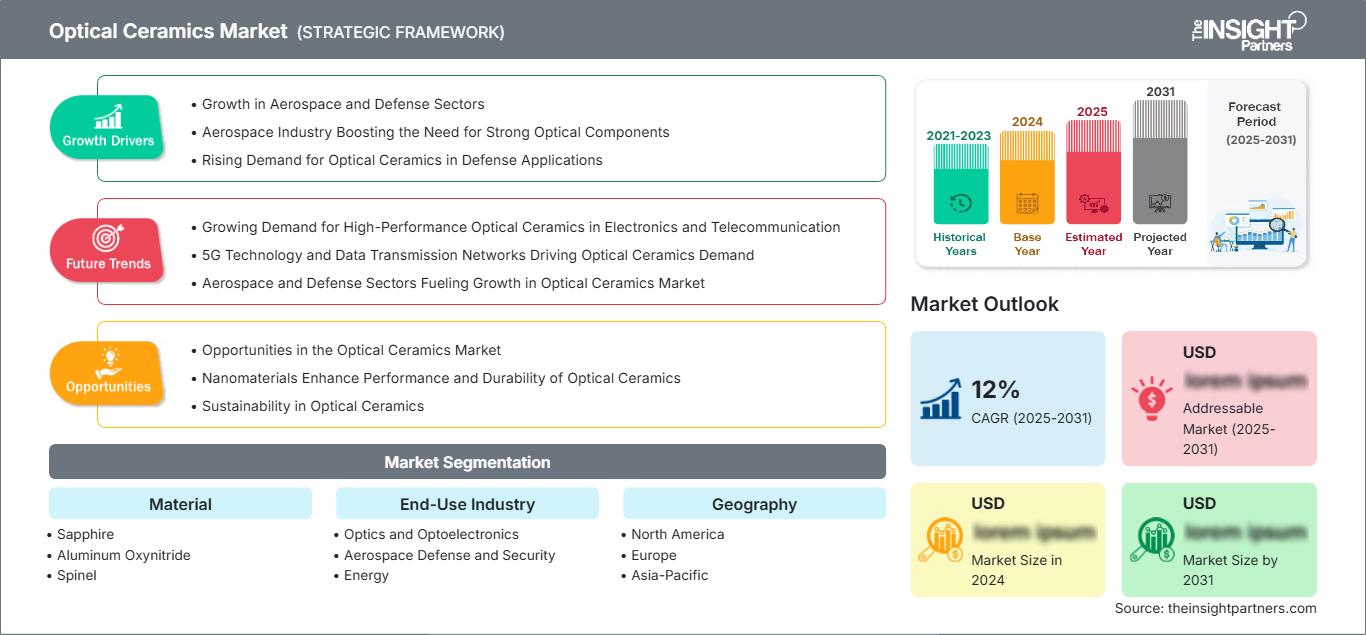
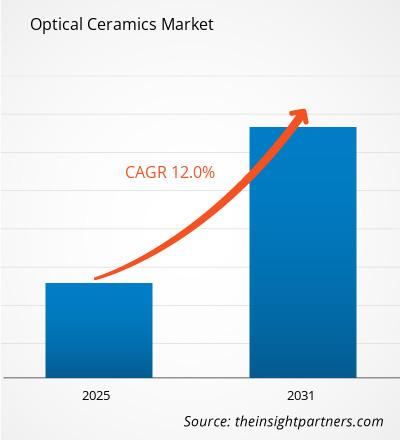
The optical ceramics market was valued at US$ 1.42 Billion in 2025 and is projected to reach US$ 2.5 Billion by 2034, expanding at a 6.47% CAGR during 2026-2034. The market covers transparent and optically functional ceramic materials used to transmit, control, amplify, or protect light across demanding environments. The defined scope includes Sapphire, Aluminum Oxynitride, Spinel, and Yttrium Aluminum Garnet under Material, and Optics and Optoelectronics, Aerospace Defense and Security, and Energy under End-Use Industry. The market is shaped by the combination of optical transmission, hardness, thermal stability, chemical resistance, mechanical strength, and the ability to manufacture complex or large-format components.
North America represents a substantial portion of global demand, supported by aerospace and defense programs, infrared sensing, transparent armor, laser systems, and specialized optoelectronic equipment. North America accounted for an estimated ~34% of the global optical ceramics market size in 2025, with a projected ~5.8% CAGR during 2026-2034. The region benefits from a mature advanced-materials ecosystem linking ceramic producers, defense primes, optical fabricators, research laboratories, and government-funded technology programs. In the US, ALON and spinel are being developed for transparent armor, infrared windows, missile domes, and other electro-optical applications, while sapphire and YAG support sensing, semiconductor processing, and laser systems. Surmet's vertically integrated production of ALON and spinel illustrates the region's emphasis on moving transparent ceramic technologies from materials development into finished optical components.
Optical Ceramics Market Assessment and Insights
- North America: The region held ~34% of global market revenue in 2025 and is expected to register a ~5.8% CAGR during 2026-2034. Its position reflects defense procurement, infrared sensing, transparent armor, and established optical fabrication capabilities. This supports continued demand for high-performance transparent ceramics where weight reduction and survivability justify higher material and processing costs.
- U.S.: The US represented ~82% of North American demand in 2025 and is projected to grow at a ~5.5% CAGR during 2026-2034. Aerospace and defense programs remain important, particularly for ALON and spinel sensor windows, transparent armor, and missile domes. Government-backed development programs also help reduce commercialization risk for advanced ceramic compositions.
- Europe: Europe represented ~27% of global market revenue in 2025, with a projected ~6.1% CAGR during 2026-2034. Germany, France, and the UK are particularly relevant because of advanced ceramics manufacturing, precision optics, aerospace, defense electronics, and industrial laser ecosystems. The principal differentiator is the region's integration of precision engineering with high-performance ceramic manufacturing.
- Asia Pacific: APAC accounted for ~31% of the global market in 2025 and is expected to expand at a ~7.3% CAGR during 2026-2034. China, Japan, South Korea, and India contribute through electronics, semiconductor manufacturing, optical communications, sensing, lasers, and industrial equipment. Expanding electronics and photonics manufacturing provides a broader downstream base than defense applications alone.
- Largest Segment: Optics and Optoelectronics is the largest main end-use segment and is projected to register a ~6.2% CAGR during 2026-2034. Its leading position reflects the broad application of sapphire, spinel, and YAG in optical windows, lenses, laser systems, sensing equipment, semiconductor tools, and precision instruments.
- High Growth Segment: Aerospace Defense and Security is the high-growth main end-use segment, with an estimated ~7.4% CAGR during 2026-2034. Demand is supported by infrared sensing, transparent armor, missile and seeker systems, surveillance platforms, and the need for lighter optical protection capable of operating under severe thermal and mechanical loads.
- Key companies analyzed in detail: Surmet Corporation; CeramTec GmbH; Coherent Corp.; SCHOTT AG; CeraNova Corporation; CoorsTek; Kyocera Corporation; Saint-Gobain; Konoshima Chemical Co., Ltd.; Murata Manufacturing Co., Ltd.
Source: The Insight Partners' analysis based on proprietary research, government publications, company annual reports, investor presentations, industry databases, and expert interviews.
The market for optical ceramics has moved on from relatively specialized optical components into engineered materials that cater for entire system needs. While there is continued interest in sapphire due to its hardness, chemical durability, thermal stability and broadband optical transmission properties, polycrystalline ceramics such as ALON and spinel offer scope for creating isotropic optical material properties, large geometries and customized IR performance. There is growing relevance of YAG ceramics when laser designers demand high optical quality together with manufacturability.
Manufacturing capability is a key distinction. Transparency of ceramic materials demands control over the process parameters of powder purity, particle size, shaping, sintering, porosity, grain growth, polishing and surface finishing since any microscopic defect has a tendency to scatter light, thus impairing optical performance. Transparent ceramic technology by Konoshima Chemical is an illustration of how managing sources of scattering contributes to optical transmission of polycrystalline ceramics. The same is true for CoorsTek's YAG technology.
Industry developments in recent years have demonstrated that the scope of the technology base is expanding past traditional optical windows. In 2025, Kyocera introduced sapphire apertures, optical components, ceramic packages, and technologies designed for sensing, medical, analytical, and advanced mobility applications. This suggests that optical ceramics are becoming used more and more in comprehensive optoelectronic designs rather than just purchased as simple windows.
Between 2025 and 2034, commercialization could expand into applications that would require optical properties to be maintained in more extreme conditions. Aerospace vehicles, hypersonics, autonomous sensing, high-power lasers, semiconductor equipment, and energy-related optical systems might lead to the creation of demand for materials capable of withstanding thermal shock and mechanical stress along with retaining their optical properties.
Localization of the supply chain might become an important factor in the future as well. Processing of ceramics is highly equipment-dependent and involves specialized handling of powders, sintering, grinding, polishing, and metrology. Customers in defense and semiconductor applications find it beneficial to work with regionally qualified suppliers as optical components might become a critical part of the system requiring long qualification process.
Optical Ceramics Market Report Scope
| Report Attribute | Details |
|---|---|
| Market size in 2025 | US$ 1.42 Billion |
| Market Size by 2034 | US$ 2.5 Billion |
| Global CAGR (2026 - 2034) | 6.47% |
| Historical Data | 2021-2024 |
| Forecast period | 2026-2034 |
Optical Ceramics Market Analysis
Increasingly, demand will depend on the relative difference in performance between traditional materials such as glass or single crystals and ceramic materials. Typically, the mechanism by which the optical ceramics market expands starts with the need for a system designer to address constraints related to weight, wear and tear, heat transfer, infrared transparency, or environment resistance. This results in the choice of sapphire, ALON, spinel, or YAG as a material, thereby creating demand for special powder processing, transparent body fabrication, polishing, coatings, and optical metrology.
The aerospace and defense sectors offer an important high-value demand channel because the optical window has the dual purpose of being both an optical and protective layer. For example, ALON can be fabricated into transparent armor and infrared components where light weight and high durability would provide system benefits. On the other hand, spinel could provide wide spectral transparency and isotropy useful for multispectral sensing. Meanwhile, sapphire would be useful where hardness and environmental resistance prevail. This diversity of application rules out commoditization of the market.
The supply side is technologically concentrated in that ensuring the optical quality of ceramics implies precise control over impurities, porosity, grain boundaries, stress, and surface. The larger the size of the component, the more complicated it is to ensure uniformity in its optical characteristics. Consequently, suppliers that are able to integrate powder preparation, formation, thermal processing, machining, polishing, and inspection into their production are better off compared to suppliers producing ceramic blanks only.
The competitive positioning in the Optical Ceramics Market Report is also based on the extent of processing in manufacturing. For example, Surmet uses the combination of ALON and spinel ceramics with precise fabrication processes; CoorsTek produces transparent and translucent ceramics including spinel and polycrystalline YAG; Kyocera integrates the fabrication of sapphire with high-precision lapping, polishing, metallization, and brazing; Konoshima Chemical specializes in transparent YAG, yttria, and magneto-optic ceramics.
The field of investment is also leaning toward ceramic engineering for specific applications. Instead of formulating materials based only on their optical characteristics, producers are now formulating materials based on the power level of the lasers, infrared radiation, thermal shock resistance, chemical stability, geometry of sensors, and manufacturing considerations. The need for cooperative development between these entities becomes critical in such an environment.
● REPORT CUSTOMIZATION
Tailor This Report To Align With Your Specific Business Requirements
This report can be customized to align precisely with your business objectives, scope, and target markets. Customization options include tailored segmentation, geography, competitive analysis, and strategic insights to support informed decision-making.
Customize This Report →WHAT YOU CAN ADJUST
- ● Segmentations
- ● Geography
- ● Competitive Analysis
- ● Language Preferences
Optical Ceramics Market: Strategic Insights
Regional Insights
North America optical ceramics market
North America accounted for ~34% of global optical ceramics market share in 2025 and is expected to expand at a ~5.8% CAGR during 2026-2034. The region's demand profile is strongly influenced by aerospace and defense, where transparent ceramics are used for electro-optical windows, sensor protection, transparent armor, and missile or reconnaissance systems. The US dominates regional demand because it combines defense procurement with domestic advanced-materials research and specialized optical fabrication.
Another factor working in favor of the US is the presence of a well-developed community of defense contractors and governmental research labs that may assist in developing and certifying new compositions for use in products. The ALON production by Surmet Corporation and development of transparent ceramics for defense applications by CeraNova Corporation demonstrate the focus on high temperature and infrared applications.
U.S. optical ceramics Market
The US constituted about 82% of the Optical Ceramics Market revenue in North America in 2025 with forecasted growth at around 5.5% during 2026-2034. The demand varies based on the wide range of aerospace, defense, semiconductor, laser, and sensing applications. The transparent ceramics could be used as optical windows, but also protect environments from ballistics. This feature makes them applicable for aviation, ground vehicles, missile, and infrared sensors.
Government-funded technology development is significant since most high-end optical ceramics need a lot of testing. For example, the US defense research program launched by CeraNova in 2025 aimed at evaluation of conformal infrared window made from a new ceramic composition in comparison with sapphire in hypersonic vehicles.
Europe optical ceramics market
Europe held ~27% of the global market in 2025 and is projected to grow at ~6.1% CAGR during 2026-2034. Germany is a major regional hub because of its advanced ceramics, precision engineering, optics, industrial laser, semiconductor, and automotive technology base. CeramTec's broad advanced-ceramics footprint reinforces the region's ability to manufacture precision components for demanding industrial applications.
Contributions from France are made via aerospace, defense, photonics, and high precision industrial machinery, with optical ceramics capable of providing sensing and optical protection solutions in these areas. In the UK, there is a very strong photonics and defense sector, with optical components and materials playing an important role in this market. There is significant demand across Europe because of the engineering needs for reliability, precision, longevity, and advanced equipment.
APAC optical ceramics market
APAC represented ~31% of global market revenue in 2025 and is forecast to register a ~7.3% CAGR during 2026-2034. Japan is an important technology center because companies such as Kyocera and Konoshima Chemical combine ceramic material development with precision processing and optical applications. Sapphire components are used across sensing, analytical equipment, semiconductor manufacturing, and optical systems.
China's participation is achieved through electronics manufacturing, photonics, defense development, semiconductor machinery, and enhanced capability in advanced materials within the country. The big downstream manufacturing sector within China creates room for sapphire and transparent ceramics in optical sensors and electronic systems. South Korea's relevance arises from semiconductor, display and electronics manufacturing where sapphire and other optical ceramics can be used in precision systems.
India is an emerging market in the region owing to development in semiconductors, electronics, defense and industrial technologies. Local manufacturing of high-tech products can gradually increase the demand for precision ceramic components, although foreign participants are also working on their involvement in the Indian electronics environment.
Segmentation Analysis
Material
The Material segment covers Sapphire, Aluminum Oxynitride, Spinel, and Yttrium Aluminum Garnet. It is projected to expand at a ~6.5% CAGR during 2026-2034, with growth differentiated by optical wavelength, mechanical requirements, processing economics, and application qualification.
- Sapphire: A mature high-performance material used where hardness, thermal resistance, chemical stability, and broadband optical transmission are important. Its established production and polishing ecosystem supports continued adoption in sensing, semiconductor equipment, analytical systems, and optical windows.
- Aluminum Oxynitride: ALON is particularly important for lightweight transparent armor and infrared optical systems. Its isotropic optical behavior and combination of hardness and transparency support applications where conventional glass or birefringent materials have limitations.
- Spinel: Magnesium aluminate spinel provides broad optical transmission and favorable mechanical properties. It is strategically relevant for infrared windows, multispectral sensing, laser applications, and conformal optical designs.
- Yttrium Aluminum Garnet: YAG ceramics are strongly associated with laser gain media and optical systems. Polycrystalline YAG can offer manufacturing and scalability advantages while supporting high-power laser applications.
End-Use Industry
The End-Use Industry segment includes Optics and Optoelectronics, Aerospace Defense and Security, and Energy. It is expected to grow at a ~6.7% CAGR during 2026-2034, reflecting increasing use of optical ceramics in equipment that must maintain optical performance under demanding operating conditions.
- Optics and Optoelectronics: The largest demand base, covering optical windows, lenses, sensing systems, semiconductor equipment, laser components, and analytical instruments. Procurement is driven by transmission quality, precision, environmental durability, and component lifetime.
- Aerospace Defense and Security: The fastest-growing end-use area, supported by infrared seekers, surveillance systems, transparent armor, missile domes, and airborne sensing. Buyers prioritize survivability, low mass, multispectral transmission, and resistance to thermal and mechanical shock.
- Energy: Demand is linked to laser systems, high-temperature viewing windows, specialized optical equipment, and environments where conventional glass can degrade. Material selection is strongly influenced by chemical resistance, thermal stability, and optical performance.
Opportunity Snapshot
| End-Use Industry | Revenue Contribution | Trend Tag | Adoption Stage |
|---|---|---|---|
| Optics and Optoelectronics | High | Precision optics | Mature |
| Aerospace Defense and Security | High | Lightweight protection | Scaling |
| Energy | Medium | Harsh-environment optics | Scaling |
Optical Ceramics Market Growth Drivers and Impact Analysis
Expansion of infrared sensing and protected electro-optics
Infrared sensing creates a direct need for windows and domes that transmit relevant wavelengths while surviving abrasion, thermal loads, pressure, vibration, and environmental exposure. Aerospace and defense system designers therefore increasingly evaluate ceramics as multifunctional components rather than transparent covers. The resulting demand benefits ALON and spinel in particular, while sapphire remains important for applications prioritizing hardness and environmental resistance.
Demand for lighter and more durable optical protection
Weight reduction is becoming a system-level design objective for aircraft, helicopters, unmanned platforms, and armored vehicles. Transparent ceramics can replace thicker glass-based structures in selected applications while maintaining optical transmission and improving resistance to impact or abrasion. The implication for suppliers is a shift toward larger, thinner, precision-finished ceramic components rather than small standardized parts.
Growth of high-power laser and precision photonics systems
Laser systems place stringent requirements on optical homogeneity, thermal behavior, surface quality, and damage resistance. YAG ceramics are positioned for applications where high-output laser operation and scalable manufacturing are important. At the same time, magneto-optic ceramics and specialized transparent compositions create additional demand from laser and optical-isolator architectures.
Increasing ceramic content in semiconductor equipment
Semiconductor manufacturing equipment operates under plasma, chemical, thermal, and vacuum conditions that can degrade conventional materials. Sapphire windows and other advanced ceramics provide optical transparency alongside chemical and thermal resistance. As equipment architectures become more precise, demand shifts toward ceramic components with tightly controlled surfaces, dimensions, contamination characteristics, and joining methods.
Optical Ceramics Market Future Trends
Transition toward application-engineered transparent ceramics
The optical ceramics market trends are increasingly moving from standardized material selection toward application-specific compositions and microstructures. Suppliers are engineering ceramics around wavelength, thermal load, mechanical shock, optical distortion, and surface characteristics. This approach can expand the addressable application space for materials such as spinel, YAG, yttria, and advanced oxide ceramics.
Greater use of conformal and complex optical geometries
Future optical systems are expected to require more curved and aerodynamically integrated windows rather than conventional flat components. Conformal ceramics can reduce aerodynamic disturbances and provide greater sensor fields of view, particularly in aerospace and high-speed systems. Manufacturing methods that approach net shape before final polishing can reduce material removal and enable geometries that are difficult to produce through conventional machining.
Integration of optical ceramics with multifunctional coatings
Optical components are increasingly expected to provide more than transmission. Anti-reflective, conductive, abrasion-resistant, thermal-management, and environmental-protection coatings can add functionality to ceramic windows and lenses. This will encourage closer integration between ceramic processing, surface treatment, coating deposition, and optical metrology.
Localization of qualified ceramic supply
Qualification-intensive applications create incentives to develop regional supply chains. Aerospace, defense, semiconductor, and strategic photonics customers may favor suppliers capable of controlling powder preparation, forming, densification, machining, polishing, coating, and inspection within a coordinated manufacturing network. This favors vertically integrated producers and encourages investment in regional precision-processing capacity.
Optical Ceramics Market Opportunities
Large-format transparent ceramics for aerospace sensing
Large-area windows and domes represent a commercially attractive opportunity because aerospace and defense platforms increasingly require wider fields of view while limiting aerodynamic and weight penalties. Suppliers that can combine high optical homogeneity with near-net-shape forming, low-defect densification, and precision polishing can target aircraft reconnaissance systems, high-speed vehicles, missile seekers, and unmanned platforms. The primary barrier is maintaining uniform optical and mechanical properties as component dimensions increase. Strategic beneficiaries will be producers with vertically integrated processing and strong qualification capabilities.
Precision sapphire and ceramic components for semiconductor equipment
The expansion of semiconductor manufacturing creates an opportunity in the Optical Ceramics Market Forecast for suppliers of sapphire windows, transparent components, sensor apertures, and other optically functional ceramics. Equipment manufacturers need components capable of withstanding plasma, corrosive gases, thermal cycling, and repeated cleaning while maintaining optical performance. Suppliers can differentiate through complex-shape polishing, metallization, hermetic joining, contamination control, and short engineering lead times. Japan, South Korea, China, Taiwan, and emerging semiconductor manufacturing locations such as India offer attractive demand centers.
Recent Developments
- August 11, 2026: CeramTec GmbH - CeramTec announced its participation in SEMICON India 2026, highlighting precision ceramic solutions for semiconductor manufacturing and power electronics. The event demonstrates the company's continued focus on high-precision ceramic components and its engagement with India's expanding semiconductor ecosystem, strengthening the role of advanced ceramics in regional equipment and sensing supply chains.
- January 21, 2025: Kyocera Corporation - Kyocera announced its participation in SPIE Photonics West 2025, presenting optical components, ceramic packages, sapphire-based solutions, and technologies for laser, infrared, visible-light sensing, medical imaging, smart vehicles, and quantum applications. The activity highlights the company's strategy of connecting fine-ceramic and sapphire capabilities with expanding optoelectronic system requirements. -
Frequently Asked Questions

- Comprehensive Market Sizing and Forecast Analysis
- Detailed Segmentation Analysis
- In-Depth Market Dynamics Assessment
- Regional and Country-Level Insights
- Competitive Landscape and Company Benchmarking
- Strategic Business Intelligence
Recent Reports
Testimonials

The Insight Partners provided valuable market intelligence that supported our global go-to-market strategy. Their team was professional, responsive, and attentive to our feedback, providing thoughtful analysis and helpful methodological clarifications throughout the project.
Junmo Kim Chief Financial Officer (CFO), Enertech Co., Ltd.
The Insight Partners' SCADA System Market report is comprehensive, with valuable insights on current trends and future forecasts. The team was highly professional, responsive, and supportive throughout. We are very satisfied and highly recommend their services.
RAN KEDEM Partner, Reali Technologies LTDs
I requested a report on a very specific software market and the team produced the report in a few days. The information was very relevant and well presented. I then requested some changes and additions to the report. The team was again very responsive and I got the final report in less than a week.
JEAN-HERVE JENN Chairman, Future Analytica
We worked with The Insight Partners for an important market study and forecast. They gave us clear insights into opportunities and risks, which helped shape our plans. Their research was easy to use and based on solid data. It helped us make smart, confident decisions. We highly recommend them.
PIYUSH NAGPAL Sr. Vice President, High Beam Global
The Insight Partners delivered insightful, well-structured market research with strong domain expertise. Their team was professional and responsive throughout. The user-friendly website made accessing industry reports seamless. We highly recommend them for reliable, high-quality research services
YUKIHIKO ADACHI CEO, Deep Blue, LLC.
This is the first time I have purchased a market report from The Insight Partners.While I was unsure at first, I visited their web site and felt more comfortable to take the risk and purchase a market report.I am completely satisfied with the quality of the report and customer service. I had several questions and comments with the initial report, but after a couple of dialogs over email with their analyst I believe I have a report that I can use as input to our strategic planning process.Thank you so much for taking the extra time and making this a positive experience.I will definitely recommend your service to others and you will be my first call when we need further market data.
JOHN SUZUKI President and Chief Executive Officer, Board Director, BK Technologies
I wish to appreciate your support and the professionalism you displayed in the course of attending to my request for information regarding to infectious disease IVD market in Nigeria. I appreciate your patience, your guidance, and the fact that you were willing to offer a discount, which eventually made it possible for us to close a deal. I look forward to engaging The Insight Partners in the future, all thanks to the impression you have created in me as a result of this first encounter.
DR CHIJIOKE ONYIA MANAGING DIRECTOR, PineCrest Healthcare Ltd.Reason to Buy
- Informed Decision-Making
- Understanding Market Dynamics
- Competitive Analysis
- Identifying Emerging Markets
- Customer Insights
- Market Forecasts
- Risk Mitigation
- Boosting Operational Efficiency
- Strategic Planning
- Investment Justification
- Tracking Industry Innovations
- Aligning with Regulatory Trends





 Get Free Sample for