
Oil and Gas Automation Market Share, Size & Demand by 2034
Coverage: by Offering (Hardware, Software, Service); Technology (SCADA, PLC, DCS, PLM, HMI, Others); Process (Upstream, Midstream, Downstream) , and Geography (North America, Europe, Asia Pacific, and South and Central America)
- Status : Data Released
- Report Code : TIPRE00010054
- Category : Electronics and Semiconductor
- No. of Pages : 150
- Available Report Formats :


- Last update date : October 16, 2026


2025 Market Size
US$ 84.45 Bn
Base year value
2034 Forecast
US$ 152.89 Bn
Projected by 2034
CAGR 2026-2034
6.82 %
Growth rate
Addressable Market
US$ 1,072.48 Bn
(2026-2034)
The Oil and gas automation market reached US$ 84.45 Billion in 2025 and is projected to reach US$ 152.89 Billion by 2034, registering a CAGR of 6.82% during 2026–2034. The market shows sustained investments in automation in the areas of production, transport, processing, and refining facilities due to operators’ focus on maintaining business continuity, visibility, safety, reliability, and increased efficiency of engineering and maintenance personnel amid the connectivity of energy infrastructures.
North America Oil and gas automation market size constitutes a strategically important demand center due to well-developed upstream infrastructure, vast pipelines, liquefied natural gas plants, refinery upgrades, and adoption of digital controls technology. North America is expected to demonstrate a 6.1–6.6% CAGR through 2034, with increased focus on brownfield upgrades, remote operations, cybersecurity, and asset management through analytics.
Oil and Gas Automation Market Assessment and Insights
- North America: North America is estimated to account for a 31–35% share in 2025 and grow at a 6.1–6.6% CAGR between 2026–2034, supported by shale operations, LNG projects, pipeline digitization, and refinery modernization.
- US: The US represents 74–78% of North American demand in 2025 and is expected to expand at a 6.0–6.5% CAGR between 2026–2034, led by upstream automation and LNG infrastructure.
- Europe: Europe holds a 24–28% share in 2025 and is projected to grow at a 6.2–6.7% CAGR between 2026–2034, with Germany, the UK, France, Italy, and Norway supporting modernization demand.
- Asia Pacific: Asia Pacific represents a 27–31% share in 2025 and is forecast to expand at a 7.2–7.8% CAGR between 2026–2034, led by China, India, Japan, and South Korea.
- Largest Segment: Hardware holds a 46–50% market share in 2025 and is expected to grow at a 6.2–6.7% CAGR through 2034, reflecting extensive installed-control infrastructure.
- High Growth Segment: Software holds a 25–29% market share in 2025 and is expected to grow at an 8.0–8.6% CAGR through 2034, supported by analytics and digital operations.
- Key companies analyzed in detail: ABB Ltd, Emerson Electric Co., Honeywell International Inc., Johnson Controls International plc, Mitsubishi Electric Corporation, Rockwell Automation, Inc., Schneider Electric SE, Siemens AG, Valmet Oyj, and Yokogawa Electric Corporation.
Source: The Insight Partners' analysis based on proprietary research, government publications, company annual reports, investor presentations, industry databases, and expert interviews.
There has been an evolution in the oil and gas automation sector from isolated instrumentation and supervisory control to comprehensive architectures linking field instruments, controllers, historians, enterprise applications, and asset-performance management systems. More and more production operations are incorporating SCADA, PLC, DCS, HMI, and software applications. In the meantime, the engineering teams rely on digital twins for the better commissioning and management of the entire lifecycle. Such trend is particularly obvious in brownfield sites where operators want to achieve modernization without scrapping working control system or having prolonged production downtime.
Futuristic trends will spread over new production centers and LNG routes. According to the International Energy Agency, the upstream oil and gas industry investments in 2025 will total less than US$570 billion, while LNG projects will become stronger in 2026-2028. Focusing on methane management, process safety, emission monitoring, and critical-infrastructure cybersecurity should boost automation investments regardless of unbalanced growth in hydrocarbon demands in different regions.
Oil and Gas Automation Market Report Scope
| Report Attribute | Details |
|---|---|
| Market size in 2025 | US$ 84.45 Billion |
| Market Size by 2034 | US$ 152.89 Billion |
| Global CAGR (2026 - 2034) | 6.82% |
| Historical Data | 2021-2024 |
| Forecast period | 2026-2034 |
Oil and Gas Automation Market Analysis
Demand is determined by the need to keep production reliable amidst growing complexity of assets. Upstream producers need well control, artificial lift, drilling, and gathering, while midstream producers need pipeline management, compressor control, leak detection, and centralized supervision. Refineries and petrochemical plants in turn demand tight coordination of controls during the processes of refining and chemical processing. Value chain includes sensors and controllers, software, engineering, integration, maintenance, and support throughout the product life cycle.
Supply is dominated by suppliers capable of combining hardware control capabilities with engineering and software capabilities. Installed base creates switching costs, especially those which relate to safety systems and process control architectures that should remain in place for decades. On the other hand, open communication standards and software modularity ease entry into specialized segments of control industry. Therefore, the market becomes the one where modernization initiatives increasingly involve legacy control systems supplemented by analytics, edge computing, cybersecurity, and remote monitoring.
Competitive positioning in the Oil and gas automation market report requires the increasing ability to link automation with operational intelligence at an enterprise level. ABB Ltd, Emerson Electric Co., Honeywell International Inc., Siemens AG, Yokogawa Electric Corporation, and Schneider Electric SE are strong in process automation, whereas Rockwell Automation, Inc. and Mitsubishi Electric Corporation excel in controllers and industrial software. Valmet Oyj is another player in process automation, and Johnson Controls International plc offers building and industrial controls for integrated facilities.
The shift in investment strategy is toward software-driven value creation beyond mere equipment. Project Beyond of Emerson exemplifies the approach towards software-defined industrial operations, whereas Honeywell has been focusing on AI-enabled digital solutions and narrower automation portfolio. Suppliers are also relying on acquisitions, installed base offerings, upgrades of lifecycle, cybersecurity, and digital twins for customer retention. The competition is favorable for suppliers able to deliver measurable operational results without replacing existing systems.
● REPORT CUSTOMIZATION
Tailor This Report To Align With Your Specific Business Requirements
This report can be customized to align precisely with your business objectives, scope, and target markets. Customization options include tailored segmentation, geography, competitive analysis, and strategic insights to support informed decision-making.
Customize This Report →WHAT YOU CAN ADJUST
- ● Segmentations
- ● Geography
- ● Competitive Analysis
- ● Language Preferences
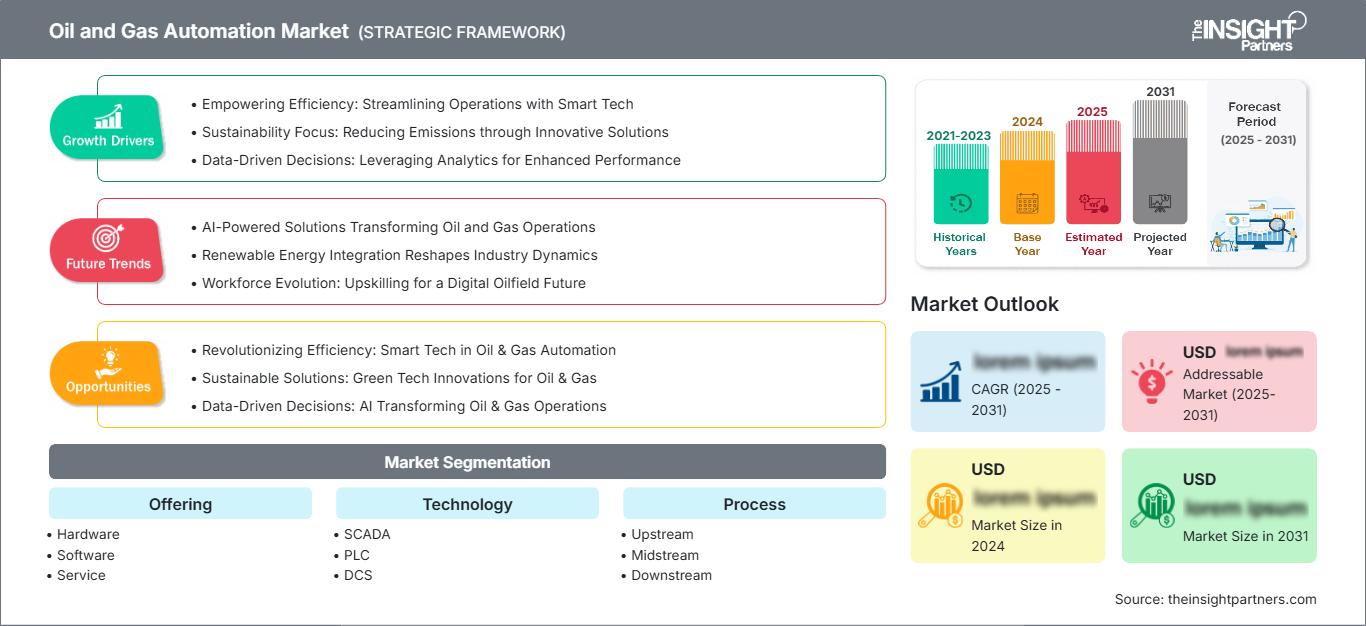
Oil and Gas Automation Market: Strategic Insights
Regional Insights
North America oil and gas automation market
North America is estimated to hold a 31–35% share in 2025 and grow at a 6.1–6.6% CAGR through 2034. The region benefits from extensive shale production, mature pipeline systems, LNG development, offshore operations, and large refining capacity. Automation demand increasingly centers on remote supervision, production optimization, compressor control, condition monitoring, and cybersecurity for distributed operational technology environments.
The US leads in regional demand, and Canada contributes through activities from its oil sands, pipelines, gas, and LNG sectors. The need for brownfield solutions is crucial since the operator has an opportunity to optimize the process of measuring, controlling, and maintaining the system without rebuilding the whole facility. Excellent engineering skills and installed base help generate lifecycle services income.
U.S. oil and gas automation market
The United States represents 74-78% of North American demand in 2025 and is expected to post a CAGR of 6.0-6.5%. Shale production, LNG development, gas gathering systems, refineries, and offshore facilities lead to varied application needs for automation. The presence of vendors extends to process control, PLCs, SCADA, analysis, instrumentation, and lifecycle services in key production locations.
Emerging trends in application include remote monitoring, predictive maintenance, emissions measurements, and central management of assets. The fast investment cycle of US tight oil favors quick adoption of new technologies, whereas LNG developments favor automation for liquefaction, storage, compression, and exports. The installed bases of Emerson Electric Co., Honeywell International Inc., Rockwell Automation, Inc., and ABB Ltd provide for periodic upgrading.
Europe oil and gas automation market
Europe is a share of 24–28% in 2025 and is forecast to grow by a 6.2–6.7% CAGR through 2034. Norway is a top market in Europe in terms of automation demand due to offshore production, high level of digitalization and focus on efficiency and emissions control.
In turn, the UK keeps its automation demand in the North Sea, terminals, refineries and offshore services. There is an increasing demand in remote asset management, integrity management and updating of matured control systems. Germany is still a hub for technologies and engineering with such companies as Siemens AG among others helping in industrial digitalization. France, Italy and Spain make contribution via refineries, petrochemical industry, terminals and energy infrastructure.
APAC oil and gas automation market
The Oil and gas automation market share of APAC in 2025 stands at 27-31%, and it is expected to expand at a CAGR of 7.2-7.8% until 2034, and China remains as its key player. The region has different demand dynamics from China, Japan, South Korea, India, and Australia in refining, LNG, offshore production, pipelines, and petrochemicals.
Growth of industry, upgrading of refineries, developments of LNG, and energy security policies will drive the adoption of the technology. India is focusing more on the exploration of its own resources and offshore development, while Australia still requires advanced control in LNG and remote facilities. China is the combination of high refining and petrochemical capacities and advanced industrial automation technologies.
Middle East & Africa oil and gas automation Market
Middle East and Africa demand is projected to expand at a 6.7–7.3% CAGR through 2034. Saudi Arabia leads regional demand, followed by the UAE, while South Africa and the rest of MEA provide opportunities across refining, terminals, gas processing, and industrial infrastructure.
Automation is driven by energy security, production increases, refinery integration, and mega infrastructure projects. Process control together with asset performance management, digital twin technology, remote control systems, and cybersecurity becomes more common among the Gulf region producers. Saudi Arabia and the United Arab Emirates have advanced pipeline of technology adoption. South Africa relies on refineries and industrial infrastructure to meet its energy needs.
Segmentation Analysis
Offering
Hardware remains the largest offering category, supported by installed-base requirements for controllers, instrumentation, networking, safety equipment, and operator interfaces. The segment is expected to grow at a 6.2–6.7% CAGR from 2026–2034. Service and software demand increasingly attach to hardware modernization, creating integrated procurement models.
- Hardware: Hardware maintains a leading market position because control infrastructure requires durable field devices, controllers, networking equipment, safety systems, and replacement components across long-lived production assets.
- Software: Software demand is strengthening as operators consolidate operational data, deploy analytics, improve visualization, and introduce predictive capabilities without fully replacing established control hardware.
- Service: Services remain strategically important for engineering, commissioning, cybersecurity, lifecycle maintenance, migration, and optimization, particularly where operators modernize brownfield facilities under strict uptime requirements.
Technology
Technology adoption reflects the coexistence of established control architectures and newer digital layers. SCADA, PLC, DCS, PLM, and HMI solutions address different operational requirements, while interoperability is becoming a purchasing priority. The technology segment is expected to grow at a 6.5–7.0% CAGR through 2034 as facilities connect control environments with analytics and enterprise systems.
- SCADA: SCADA remains central to geographically distributed operations, including pipelines, gathering systems, terminals, and remote production assets requiring centralized supervision and event management.
- PLC: PLC adoption remains strong for fast, modular control applications, packaged equipment, compressors, utilities, and discrete subsystems within larger process environments.
- DCS: DCS platforms retain strategic importance in continuous processing, particularly refineries and gas facilities where coordinated control, safety, alarm management, and lifecycle reliability are essential.
- PLM: PLM supports engineering and lifecycle coordination by linking product, equipment, documentation, configuration, and change information across complex capital projects.
- HMI: HMI systems remain fundamental to operator interaction, increasingly incorporating contextualized alarms, richer visualization, mobile access, and integrated operational information.
Process
Process demand varies according to asset complexity, geographic dispersion, and control intensity. Upstream operations require automation for wells, drilling, production, and gathering; midstream depends heavily on distributed monitoring; downstream requires highly coordinated process control. The process segment is expected to grow at a 6.4–6.9% CAGR through 2034.
- Upstream: Upstream adoption centers on production optimization, remote well monitoring, artificial lift, drilling automation, safety systems, and data-driven maintenance across increasingly distributed assets.
- Midstream: Midstream demand emphasizes pipeline integrity, compressor automation, custody measurement, leak detection, centralized SCADA, and secure communications across geographically dispersed networks.
- Downstream: Downstream facilities require tightly integrated control for refining, gas processing, petrochemicals, utilities, and emissions management, making automation essential to process stability and product consistency.
Opportunity Snapshot
| Process | Revenue Contribution | Trend Tag | Adoption Stage |
| Upstream | High | Remote Operations | Scaling |
| Midstream | Medium | Pipeline Intelligence | Scaling |
| Downstream | High | Refinery Optimization | Mature |
Oil and Gas Automation Market Growth Drivers and Impact Analysis
Increasing emphasis on asset reliability and lifecycle efficiency
Operators are placing greater weight on lifecycle economics as mature fields and processing assets require reliable operation despite aging infrastructure. Automation provides continuous condition visibility, faster fault identification, and more consistent operating procedures across distributed facilities. The commercial impact extends beyond production control because improved asset information can reduce unnecessary maintenance interventions and support better spare-parts planning. Brownfield modernization is particularly relevant because operators can upgrade instrumentation, controllers, networks, and software incrementally rather than undertake disruptive plant-wide replacement. As capital discipline remains important in hydrocarbon operations, suppliers that package engineering, migration, cybersecurity, and lifecycle services can capture broader project value. This driver also supports recurring service demand because installed automation assets require periodic upgrades, security patches, calibration, configuration management, and performance optimization throughout their operating lives.
Expansion of connected infrastructure across LNG and gas systems
LNG, gas processing, pipeline, and compression infrastructure requires coordinated control across geographically separated assets and complex process chains. Automation enables operators to connect field measurements with centralized supervision, equipment diagnostics, and production planning, improving operational consistency across networks. New LNG capacity also creates opportunities for standardized automation architectures during project design rather than retrofitting systems after commissioning. The market impact is strongest where projects combine multiple compressor stations, storage facilities, terminals, and processing units, because manual coordination becomes increasingly difficult at scale. Suppliers with integrated control, safety, communications, and analytics capabilities can therefore participate across several project layers. This driver is also strengthening demand for secure remote access and resilient communications, particularly where facilities operate with limited onsite staffing or face challenging environmental conditions.
Stronger operational technology cybersecurity requirements
The convergence of industrial networks with enterprise and cloud environments is increasing the importance of cybersecurity within automation procurement. Oil and gas facilities operate critical infrastructure where a control-system disruption can affect production, safety, environmental performance, and supply continuity. Consequently, buyers are evaluating secure architectures, identity management, network segmentation, monitoring, backup procedures, and incident-response capabilities alongside conventional automation specifications. The impact is changing the competitive basis of projects because cybersecurity is increasingly embedded within modernization programs rather than treated as a separate information-technology purchase. Vendors able to integrate security controls with automation engineering can shorten deployment complexity and improve lifecycle governance. The resulting spending opportunity extends across hardware, software, services, assessments, managed security, and periodic upgrades as threat conditions and regulatory expectations evolve.
Oil and Gas Automation Market Future Trends
AI-assisted operational decision support
AI-assisted decision support in the Oil and gas automation market trends is likely to become more deeply embedded in control-room and asset-management workflows during the forecast period. Rather than replacing core control logic, emerging systems will increasingly interpret alarms, historical operating patterns, equipment conditions, and production constraints to provide prioritized recommendations. This approach can reduce information overload for operators while retaining human authority over critical decisions. Generative AI may also simplify access to engineering documentation, maintenance histories, and operating procedures through natural-language interfaces. The commercial opportunity will depend on trustworthy data, clear governance, cybersecurity, and validation against process-safety requirements. As deployment matures, vendors are likely to differentiate through domain-specific models, explainability, integration with existing DCS and SCADA environments, and measurable improvements in troubleshooting speed and engineering productivity.
Migration toward modular and open automation architectures
Future automation projects are likely to favor architectures that separate control functions from data, applications, and visualization layers. Modular designs can allow operators to introduce new analytics, edge computing, or AI capabilities without replacing the underlying control platform. This reduces technology lock-in and can extend the useful life of installed infrastructure. Open interfaces will become more significant as operators combine equipment from multiple suppliers and seek common data models across facilities. The transition will not eliminate proprietary systems, particularly where safety certification and deterministic control remain critical, but it should increase demand for interoperability layers and lifecycle migration tools. Vendors that demonstrate secure coexistence between legacy and modern systems will have an advantage in large brownfield environments where operational continuity is more important than wholesale technological replacement.
Oil and Gas Automation Market Opportunities
Modernization programs for aging control infrastructure
A substantial opportunity exists in staged modernization of mature production, pipeline, LNG, and refining assets in the Oil and gas automation market forecast. Many operators cannot justify lengthy shutdowns or complete control-system replacement, creating demand for migration approaches that preserve existing equipment while progressively adding modern controllers, networks, visualization, analytics, and cybersecurity. Investment decisions can be prioritized around assets with the highest operational risk or maintenance burden, allowing operators to spread capital expenditure across multiple budget cycles. Suppliers can create differentiated propositions through standardized migration packages, simulation-based testing, engineering reuse, and lifecycle service agreements. The opportunity is particularly attractive where aging systems face component obsolescence, limited technical support, or increasing cybersecurity exposure. Such projects also create follow-on demand for operator training, documentation updates, remote monitoring, and performance optimization.
Digital operating models for emerging production hubs
Emerging production regions provide opportunities to design automation architectures around digital operating models from project inception. New offshore fields, gas-processing facilities, LNG developments, pipelines, and refineries can incorporate centralized operations, remote maintenance, secure connectivity, advanced analytics, and integrated asset information without carrying the same legacy constraints as mature facilities. This creates potential for standardized regional platforms that can be replicated across multiple projects and operating units. Vendors and engineering partners can capture value by combining automation with workforce enablement, cybersecurity, data governance, and lifecycle support. The opportunity is strongest where governments and national energy companies seek domestic production, higher operating efficiency, and technology localization simultaneously. Local engineering partnerships and training programs can improve deployment capacity while reducing dependence on scarce specialized automation personnel.
Frequently Asked Questions

- Comprehensive Market Sizing and Forecast Analysis
- Detailed Segmentation Analysis
- In-Depth Market Dynamics Assessment
- Regional and Country-Level Insights
- Competitive Landscape and Company Benchmarking
- Strategic Business Intelligence
Recent Reports
Testimonials

The Insight Partners provided valuable market intelligence that supported our global go-to-market strategy. Their team was professional, responsive, and attentive to our feedback, providing thoughtful analysis and helpful methodological clarifications throughout the project.
Junmo Kim Chief Financial Officer (CFO), Enertech Co., Ltd.
The Insight Partners' SCADA System Market report is comprehensive, with valuable insights on current trends and future forecasts. The team was highly professional, responsive, and supportive throughout. We are very satisfied and highly recommend their services.
RAN KEDEM Partner, Reali Technologies LTDs
I requested a report on a very specific software market and the team produced the report in a few days. The information was very relevant and well presented. I then requested some changes and additions to the report. The team was again very responsive and I got the final report in less than a week.
JEAN-HERVE JENN Chairman, Future Analytica
We worked with The Insight Partners for an important market study and forecast. They gave us clear insights into opportunities and risks, which helped shape our plans. Their research was easy to use and based on solid data. It helped us make smart, confident decisions. We highly recommend them.
PIYUSH NAGPAL Sr. Vice President, High Beam Global
The Insight Partners delivered insightful, well-structured market research with strong domain expertise. Their team was professional and responsive throughout. The user-friendly website made accessing industry reports seamless. We highly recommend them for reliable, high-quality research services
YUKIHIKO ADACHI CEO, Deep Blue, LLC.
This is the first time I have purchased a market report from The Insight Partners.While I was unsure at first, I visited their web site and felt more comfortable to take the risk and purchase a market report.I am completely satisfied with the quality of the report and customer service. I had several questions and comments with the initial report, but after a couple of dialogs over email with their analyst I believe I have a report that I can use as input to our strategic planning process.Thank you so much for taking the extra time and making this a positive experience.I will definitely recommend your service to others and you will be my first call when we need further market data.
JOHN SUZUKI President and Chief Executive Officer, Board Director, BK Technologies
I wish to appreciate your support and the professionalism you displayed in the course of attending to my request for information regarding to infectious disease IVD market in Nigeria. I appreciate your patience, your guidance, and the fact that you were willing to offer a discount, which eventually made it possible for us to close a deal. I look forward to engaging The Insight Partners in the future, all thanks to the impression you have created in me as a result of this first encounter.
DR CHIJIOKE ONYIA MANAGING DIRECTOR, PineCrest Healthcare Ltd.Reason to Buy
- Informed Decision-Making
- Understanding Market Dynamics
- Competitive Analysis
- Identifying Emerging Markets
- Customer Insights
- Market Forecasts
- Risk Mitigation
- Boosting Operational Efficiency
- Strategic Planning
- Investment Justification
- Tracking Industry Innovations
- Aligning with Regulatory Trends





 Get Free Sample for