
Large Power Transformers Market Share, Growth & Forecast by 2034
Coverage: by Application (Power Transmission, Power Generation); End User (Industrial Sector, Energy and Utility Sector, Infrastructure) , and Geography (North America, Europe, Asia Pacific, and South and Central America)
- Status : Data Released
- Report Code : TIPRE00012253
- Category : Electronics and Semiconductor
- No. of Pages : 150
- Available Report Formats :


- Last update date : October 22, 2026


2025 Market Size
US$ 30.49 Bn
Base year value
2034 Forecast
US$ 62.69 Bn
Projected by 2034
CAGR 2026-2034
8.34 %
Growth rate
Addressable Market
US$ 418.40 Bn
(2026-2034)
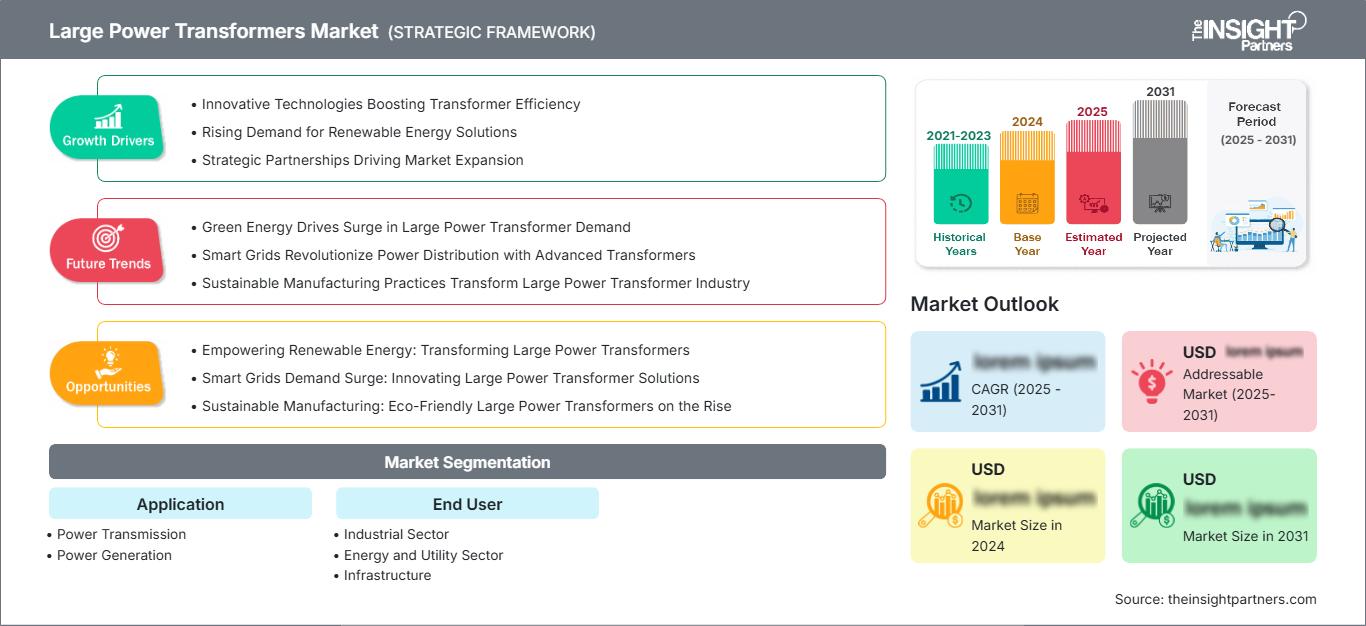
The Large Power Transformers Market size was valued at US$ 30.49 Billion in 2025 and is projected to reach US$ 62.69 Billion by 2034, registering a CAGR of 8.34% during 2026–2034. The market is being shaped by transmission-network expansion, replacement of aging grid assets, renewable-power integration, and rising electricity demand from industrial and infrastructure applications. Increasing requirements for high-voltage and ultra-high-voltage equipment are also influencing manufacturing capacity and procurement strategies globally.
North America is expected to maintain a significant position, supported by grid modernization, replacement of aging transformer fleets, data-center electricity requirements, and increasing transmission investment. The region is estimated to register a CAGR in the 7.2–7.8% range during 2026–2034. Longer procurement cycles, constrained manufacturing capacity, and requirements for resilient domestic supply chains are encouraging utilities and industrial buyers to plan transformer purchases earlier in project-development cycles.
Large Power Transformers Market Assessment and Insights
- North America: The region is estimated to account for a 24–28% Large Power Transformers Market share in 2025 and expand at a CAGR of 7.2–7.8% during 2026–2034, supported by grid replacement, load growth, renewable integration, and transmission reinforcement.
- US: The US is estimated to represent 72–76% of North American demand in 2025 and grow at a CAGR of 7.0–7.6% during 2026–2034, driven by aging infrastructure and large-load connections.
- Europe: Europe is estimated to hold a 20–24% share in 2025 and grow at a CAGR of 6.8–7.4%, with Germany, the UK, France, Italy, and Spain supporting transmission reinforcement and renewable integration.
- Asia Pacific: Asia Pacific is estimated to represent a 42–46% share in 2025 and grow at a CAGR of 8.0–8.6%, led by China, India, Japan, and South Korea as electricity infrastructure expands.
- Largest Segment: Power Transmission is estimated to hold a 58–62% market share in 2025 and grow at a CAGR of 8.0–8.5%, reflecting sustained investment in high-voltage networks.
- High Growth Segment: Industrial Sector is estimated to represent a 24–28% share in 2025 and expand at a CAGR of 8.8–9.4%, supported by electrification and large industrial loads.
- Key companies analyzed in detail: ABB Ltd., Bharat Heavy Electricals Limited, CG Power and Industrial Solutions Limited, GE Vernova Inc., Hyosung Heavy Industries Corporation, Mitsubishi Electric Corporation, Siemens AG, Schneider Electric SE, SPX Transformer Solutions, Inc., Toshiba Corporation.
Source: The Insight Partners' analysis based on proprietary research, government publications, company annual reports, investor presentations, industry databases, and expert interviews.
The Large Power Transformers Market has transitioned from traditional transformer sourcing to the production of high-capacity, application-specific transformers tailored to the increasing intricacy of transmission networks. Manufacturers have responded to increases in voltage specifications, renewable generation corridors, digital condition monitoring, insulation systems, and greater need for resilience. Production continues to be concentrated among existing engineering firms, while specialized production investments increase production in key regions. Additionally, procurement lead times are being extended due to greater needs for certainty about material supply, engineering capacity, testing, and transport.
In terms of the outlook, new power corridors in the Asia Pacific, North America, Middle East, and certain European geographies will generate further transformer requirements. Investment in the grid is increasingly becoming as important as investment in generation, with renewables and big electricity consumers creating interconnection bottlenecks. The focus of regulation on grid reliability, energy security, domestic production, and renewable energy integration should drive capital spending for years to come. The end result is a business environment which benefits suppliers with advanced engineering, unit testing, servicing, and access to electrical steel, copper, insulation and other vital components.
Large Power Transformers Market Report Scope
| Report Attribute | Details |
|---|---|
| Market size in 2025 | US$ 30.49 Billion |
| Market Size by 2034 | US$ 62.69 Billion |
| Global CAGR (2026 - 2034) | 8.34% |
| Historical Data | 2021-2024 |
| Forecast period | 2026-2034 |
Large Power Transformers Market Analysis
Demand in the Large Power Transformers Market is intimately related to electricity transmission capability, capacity expansion in generation, and renewal of existing aging high-voltage equipment. The value chain includes electrical steel and copper suppliers, transformer designers, component makers, core and winding producers, test stations, logistics services, utilities, industrial users, and infrastructure builders. Large transformers need substantial engineering effort and special transport, hence production planning and project management become important competitive criteria. Lifecycle performance is becoming more important criterion in procurement decisions than just the cost of equipment.
The supply side in the Large Power Transformers Market continues being affected by lengthy production cycles, skill availability, testing capacity, and material prices. Large transformers are typically customized for projects, hence there are no fast substitutes in case of lack of production capacity. This aspect makes plant capacity and relationships with customers very important competitive aspects. In particular, utilities and industrial users are increasingly assessing their suppliers by delivery performance, engineering expertise, commissioning capability, spare parts availability, and after-sales services besides technical criteria and cost.
Competitive positioning in the Large Power Transformers Market is based more and more on the company’s ability to integrate transformer production and grid engineering together with digital control systems and power electronics. ABB Ltd., Siemens AG, GE Vernova Inc., Mitsubishi Electric Corporation, and Schneider Electric SE offer competitive advantages in the form of comprehensive electrification portfolios and their global project capabilities. Bharat Heavy Electricals Limited and CG Power and Industrial Solutions Limited are key players in India, whereas Hyosung Heavy Industries Corporation is growing its position in the high voltage segment.
Some other players distinguish themselves with their manufacturing expertise, regional presence, and project management competencies. Thus, for instance, SPX Transformer Solutions, Inc. is strongly oriented towards the North America region, and Toshiba Corporation provides established engineering of transformers in Asia and abroad. The focus of investment is gradually moving to capacity expansion, local manufacturing, digitalization of asset management, and technology innovations for renewable energy sources’ integration. Competitive positioning therefore changes from supplying of individual pieces of equipment to grid infrastructure participation.
● REPORT CUSTOMIZATION
Tailor This Report To Align With Your Specific Business Requirements
This report can be customized to align precisely with your business objectives, scope, and target markets. Customization options include tailored segmentation, geography, competitive analysis, and strategic insights to support informed decision-making.
Customize This Report →WHAT YOU CAN ADJUST
- ● Segmentations
- ● Geography
- ● Competitive Analysis
- ● Language Preferences
Large Power Transformers Market: Strategic Insights
Regional Insights
North America Large Power Transformers Market
North America is estimated to account for 24–28% of the Large Power Transformers Market in 2025 and record a CAGR of 7.2–7.8% during 2026–2034. Grid replacement becomes critical since utilities are dealing with aging infrastructure along with an increase in energy demands due to data centers, industrial reshoring, electrification, and renewables. Transmission upgrade has become important as well as new generation projects require additional capacity for interconnection.
The regional supply chain environment continues to be constrained by the lengthy manufacturing process and engineering needs, as well as limited number of high-capacity production slots. Therefore, the emphasis of utilities is on supplier qualification, domestic manufacturing, lifecycle support, and delivery assurance. Canada makes its contribution through the renewal of its transmission system and renewable energy deployment, while the US will continue to be a primary source of demand. North American sourcing will continue to favor suppliers that provide services related to engineering, testing, transportation, installation, and monitoring.
U.S. Large Power Transformers Market
The US is estimated to represent 72–76% of North American demand in 2025 and grow at a CAGR of 7.0–7.6% during 2026–2034. Demand is driven by replacement, grid expansion, integration of renewables, data center load and industrial electrification needs. Suppliers are placing additional emphasis on supply security and reduction in their exposure to international logistical risks.
The usage trends now feature reinforcement of transmission systems near high growth areas with load centers and renewable energy sites. The suppliers with capabilities in these areas include GE Vernova Inc., Siemens AG, ABB Ltd., Hyosung Heavy Industries Corporation and SPX Transformer Solutions, Inc. Projects with high loads are creating demand for large capacity equipment and the procurement processes are increasingly relying on long-term contracts.
Europe Large Power Transformers Market
Europe is estimated to hold a 20–24% share in 2025 and expand at a CAGR of 6.8–7.4% during 2026–2034. Germany is a key market for power transmission because of the need to reinforce the grid in order to transmit power generated from renewable energy sources to centers of demand. The United Kingdom will also need grid reinforcement due to its need to connect offshore wind energy as well as increased electricity demands.
Other markets include France, Italy, and Spain because of their demand due to the generation of renewable energy, industrial electrification, interconnection, and upgrading of networks. Italy will be helped in terms of transformer manufacturing and investments, while Spain is reinforcing networks linked with growing generation of renewable energy. France has a mixture of nuclear generation and renewable energy generation.
APAC Large Power Transformers Market
APAC is estimated to represent a 42–46% share in 2025 and grow at a CAGR of 8.0–8.6% during 2026–2034. China remains the leading country, supported by large transmission projects and industrial electricity demand. India is expanding transmission infrastructure for renewable evacuation, while Japan and South Korea support technologically advanced transformer manufacturing.
Australia contributes through renewable integration and long-distance transmission requirements. Across the region, industrial expansion, urbanization, renewable-energy targets, and grid modernization are reinforcing demand. Manufacturing depth in China, India, Japan, and South Korea also supports regional supply resilience, although high-capacity transformer projects remain subject to extended engineering, testing, and delivery cycles.
Middle East & Africa Large Power Transformers Market
The Large Power Transformers Market report shows that Middle East and Africa demand is supported by power-generation expansion, industrial development, transmission upgrades, and large infrastructure programs. Saudi Arabia remains a leading market, while the UAE and South Africa contribute through network modernization and major energy projects. The region is estimated to expand at a CAGR of 7.2–7.9% during 2026–2034.
Saudi Arabia is particularly important because industrial diversification and large infrastructure investments require reliable transmission capacity. The UAE continues to develop electricity infrastructure alongside expanding urban and industrial projects. South Africa requires network investment to improve reliability and integrate additional generation. Across the wider region, transformer demand is increasingly linked with renewable projects, interconnections, industrial corridors, and electricity-access initiatives.

Segmentation Analysis
Application
The Large Power Transformers Market forecast shows that Power Transmission is expected to remain the dominant application, with a CAGR of 8.0–8.5% during 2026–2034. Demand is supported by new high-voltage transmission lines, renewable-power evacuation, interregional interconnections, and replacement of aging equipment. Increasing electricity flows across longer distances require high-capacity transformers with strong thermal, insulation, and reliability characteristics.
- Power Transmission: High-voltage network expansion creates sustained procurement requirements, particularly where renewable generation is located far from major consumption centers. Transmission projects also require coordinated transformer, substation, and grid-engineering planning.
- Power Generation: Generation facilities require transformers to connect plants to transmission systems and manage voltage conversion. Growth is supported by renewable projects, conventional generation replacement, and increasing requirements for grid stability.
End User
Industrial Sector is expected to record a CAGR of 8.8–9.4% during 2026–2034, making it the fastest-growing main end-user segment. Electrification of manufacturing, metals, mining, chemicals, data infrastructure, and other energy-intensive activities is increasing demand for reliable high-capacity electrical equipment.
- Industrial Sector: Large industrial facilities require dependable power conversion for continuous operations. Electrification, production expansion, and high-load applications are increasing the importance of transformer reliability and lifecycle performance.
- Energy and Utility Sector: Utilities remain central buyers because transmission modernization, generation integration, and replacement programs require high-capacity transformer fleets across national and regional networks.
- Infrastructure: Airports, railways, urban developments, water systems, and large construction programs create demand where dependable electricity supply and high-capacity substations are required.
Opportunity Snapshot
| Segment Name | Revenue Contribution (High/Medium/Low) | Trend Tag | Adoption Stage |
| Power Transmission | High | Grid Expansion | Scaling |
| Power Generation | Medium | Renewable Evacuation | Scaling |
Large Power Transformers Market Growth Drivers and Impact Analysis
Renewable Integration and Transmission Expansion
With renewables becoming more common in sites other than traditional electricity-consumption areas, there is an increased need for high voltage lines. This means that solar and wind installations need transformers and substations that can transport electricity over greater distances and cope with varying loads. The International Energy Agency has pointed out the growing imbalance between investments in grids versus generation capacity, while worldwide investments in grids are projected to reach US$400 billion by 2025. In such a situation, for transformer manufacturers, the prospects lie in bigger transformers, higher voltage levels, and equipment built for varying load conditions. Moreover, utility companies are now checking transformer specifications in light of their needs for renewables' integration, grid security, and longevity of operation. Thus, renewable energy installation impacts transformer demand in both direct and indirect ways.
Data Centers and Large-Load Electrification
The fast expansion of the number of data centers and other electricity-consuming buildings will affect the load profiles in several developed and developing countries. AI-driven systems could be characterized by a large demand for electricity generation capacities, which would give rise to the need for the construction of substations, transmission lines, and high-capacity transformers. The increasing demand for electrification of industry, which presupposes that electricity-powered devices would replace fuel-burning machinery used in production plants, is another example. Transformer manufacturers with good engineering skills will have an opportunity since large load operations are usually designed according to unique electrical needs and coordinated installation activities. It is not just about one facility as a group of large load applications can lead to network reinforcement needs.
Aging Grid Assets and Replacement Requirements
Replacement of aging transformer fleets is becoming an increasingly significant driver of demand, especially within established electricity systems. Large power transformers are complex and very costly assets with a long service life, thus fleet replacement becomes a multi-year process. There is a need to plan for replacement while also meeting new capacity requirements, outages, logistics constraints, and availability of capable vendors. With age, transformers may become incompatible with evolving conditions of the grid, as more renewables, distributed energy, and large loads create different flow characteristics. Here, the utility companies get a chance to retire old equipment and invest in new equipment with better monitoring, cooling, and maintenance capabilities. For the manufacturers, capturing this opportunity involves integrating new transformer supply with engineering, diagnostics, spare parts, and services along the lifecycle. The market effect will be structural in nature as replacement is constant regardless of the ups and downs of new generation investments.
Large Power Transformers Market Future Trends
Digital Asset Monitoring and Condition-Based Maintenance
The Large Power Transformers Market trends show that digital monitoring is expected to become more deeply integrated into transformer procurement as utilities seek greater visibility into asset condition and remaining useful life. Sensors, dissolved-gas analysis, temperature monitoring, load measurement, and connected maintenance platforms can help operators identify abnormal conditions before failures occur. The future direction is likely to move from standalone monitoring devices toward integrated asset-health systems connected with utility maintenance platforms. This approach can improve maintenance prioritization, reduce unnecessary inspections, and support more informed decisions about loading and replacement. Transformer manufacturers may increasingly differentiate equipment through software compatibility, cybersecurity features, analytics capabilities, and lifecycle service models. As transformer fleets become more valuable and difficult to replace quickly, asset owners are likely to place greater importance on technologies that extend operating visibility and improve risk management.
Higher-Voltage Systems and Grid Flexibility
The increasing scale of renewable generation and long-distance electricity transfer is likely to strengthen demand for higher-voltage transformer technologies. Ultra-high-voltage alternating-current systems and high-voltage direct-current projects can transfer large amounts of electricity efficiently across long distances, creating requirements for specialized transformer engineering and testing. Grid operators are also exploring technologies that improve network flexibility and increase the utilization of existing infrastructure. Transformer designs may therefore increasingly incorporate capabilities suited to variable loading, advanced monitoring, and changing power-flow patterns. Manufacturers with experience in high-voltage insulation, thermal management, large-unit testing, and project logistics are positioned to benefit from this trend. Over time, the competitive emphasis is expected to shift toward integrated solutions capable of supporting high-capacity transmission while maintaining reliability under increasingly dynamic operating conditions.
Large Power Transformers Market Opportunities
Localized Manufacturing and Supply-Chain Resilience
Supply-chain constraints create an opportunity for manufacturers to establish or expand regional transformer production and component sourcing. Large transformer procurement can require several years, making delivery risk a material consideration for utilities and infrastructure developers. Local manufacturing can reduce transportation complexity, strengthen customer responsiveness, and support qualification requirements associated with strategic grid equipment. Opportunities are particularly relevant in North America, India, Southeast Asia, and other markets where grid expansion is occurring alongside policy emphasis on domestic industrial capacity. Manufacturers can strengthen their positions by expanding core, winding, tank, testing, and engineering capabilities while developing local supplier ecosystems. Long-term procurement agreements can further improve capacity visibility and support investment decisions. Companies able to combine regional manufacturing with global engineering standards can potentially secure a larger share of strategically important transmission projects.
Transformer Services and Lifecycle Optimization
Lifecycle services represent an opportunity to generate value beyond the initial transformer sale as utilities manage increasingly complex and constrained equipment fleets. Diagnostic testing, condition monitoring, refurbishment, replacement planning, spare-parts management, emergency response, and technical consulting can help asset owners improve transformer availability and manage replacement risk. Service opportunities are particularly relevant for aging fleets where operators need to prioritize investment across large numbers of assets. Manufacturers with installed bases can use historical operating information to develop maintenance programs tailored to individual equipment conditions. Digital platforms can further connect diagnostics with maintenance planning and fleet-level decision-making. This creates a recurring service opportunity while strengthening customer relationships over the transformer lifecycle. Suppliers that combine equipment engineering with field services can therefore differentiate themselves from competitors focused primarily on initial hardware delivery.
Recent Developments
- June 2026: Hitachi Energy announced an investment of approximately ₹2,000 crore to establish a new Large Power Transformer factory in Karjan, Vadodara. The facility will strengthen India’s transformer manufacturing capacity and support growing grid, HVDC, data-centre and industrial demand.
- September 2026: Waaree Transpower announced a ₹192 crore investment to expand its high-voltage transformer manufacturing capacity. The new facility will manufacture transformers up to 500 MVA and 400 kV, with operations targeted for April 2027.
- August 2026: GameChange Energy broke ground on a major EHV transformer factory expansion in Mumbai. The facility will manufacture high-capacity transformers for critical power infrastructure and is expected to begin production in Q1 2028.
Frequently Asked Questions

- Comprehensive Market Sizing and Forecast Analysis
- Detailed Segmentation Analysis
- In-Depth Market Dynamics Assessment
- Regional and Country-Level Insights
- Competitive Landscape and Company Benchmarking
- Strategic Business Intelligence
Recent Reports
Testimonials

The Insight Partners provided valuable market intelligence that supported our global go-to-market strategy. Their team was professional, responsive, and attentive to our feedback, providing thoughtful analysis and helpful methodological clarifications throughout the project.
Junmo Kim Chief Financial Officer (CFO), Enertech Co., Ltd.
The Insight Partners' SCADA System Market report is comprehensive, with valuable insights on current trends and future forecasts. The team was highly professional, responsive, and supportive throughout. We are very satisfied and highly recommend their services.
RAN KEDEM Partner, Reali Technologies LTDs
I requested a report on a very specific software market and the team produced the report in a few days. The information was very relevant and well presented. I then requested some changes and additions to the report. The team was again very responsive and I got the final report in less than a week.
JEAN-HERVE JENN Chairman, Future Analytica
We worked with The Insight Partners for an important market study and forecast. They gave us clear insights into opportunities and risks, which helped shape our plans. Their research was easy to use and based on solid data. It helped us make smart, confident decisions. We highly recommend them.
PIYUSH NAGPAL Sr. Vice President, High Beam Global
The Insight Partners delivered insightful, well-structured market research with strong domain expertise. Their team was professional and responsive throughout. The user-friendly website made accessing industry reports seamless. We highly recommend them for reliable, high-quality research services
YUKIHIKO ADACHI CEO, Deep Blue, LLC.
This is the first time I have purchased a market report from The Insight Partners.While I was unsure at first, I visited their web site and felt more comfortable to take the risk and purchase a market report.I am completely satisfied with the quality of the report and customer service. I had several questions and comments with the initial report, but after a couple of dialogs over email with their analyst I believe I have a report that I can use as input to our strategic planning process.Thank you so much for taking the extra time and making this a positive experience.I will definitely recommend your service to others and you will be my first call when we need further market data.
JOHN SUZUKI President and Chief Executive Officer, Board Director, BK Technologies
I wish to appreciate your support and the professionalism you displayed in the course of attending to my request for information regarding to infectious disease IVD market in Nigeria. I appreciate your patience, your guidance, and the fact that you were willing to offer a discount, which eventually made it possible for us to close a deal. I look forward to engaging The Insight Partners in the future, all thanks to the impression you have created in me as a result of this first encounter.
DR CHIJIOKE ONYIA MANAGING DIRECTOR, PineCrest Healthcare Ltd.Reason to Buy
- Informed Decision-Making
- Understanding Market Dynamics
- Competitive Analysis
- Identifying Emerging Markets
- Customer Insights
- Market Forecasts
- Risk Mitigation
- Boosting Operational Efficiency
- Strategic Planning
- Investment Justification
- Tracking Industry Innovations
- Aligning with Regulatory Trends





 Get Free Sample for