
Infrared Thermography Market Share, Growth & Demand by 2034
Infrared Thermography Market Size and Forecasts (2021 - 2034), Global and Regional Share, Trends, and Growth Opportunity Analysis Report Coverage : By Product (Cameras, Scopes, Modules), Solution (Handheld Thermal Camera, Fixed Mount Camera, Unmanned Infrared System), Platform (IR lens, Uncooled IR detector)
- Status : Data Released
- Report Code : TIPRE00039481
- Category : Electronics and Semiconductor
- No. of Pages : 150
- Available Report Formats :


- Last update date : October 16, 2026


2025 Market Size
US$ 491.49 Mn
Base year value
2034 Forecast
US$ 801.21 Mn
Projected by 2034
CAGR 2026-2034
5.58 %
Growth rate
Addressable Market
US$ 5,860.37 Mn
(2026-2034)
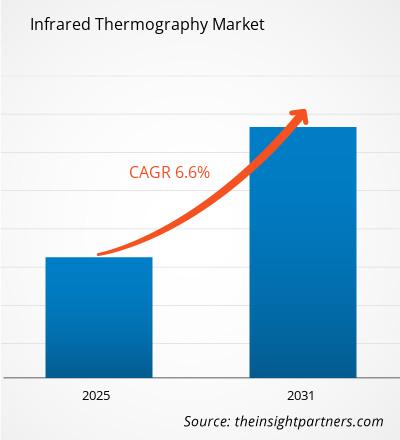
The Infrared Thermography Market was valued at US$ 491.49 Million in 2025 and is projected to reach US$ 801.21 Million by 2034. The market is expected to expand at a CAGR of 5.58% during 2026–2034, reflecting sustained adoption of non-contact temperature measurement across predictive maintenance, electrical inspection, building diagnostics, research, surveillance, and unmanned systems.
North America’s Infrared Thermography Market size is expected to advance at a modelled 5.2–5.8% CAGR, supported by mature condition-monitoring programs and expanding use of thermal analytics in utilities, manufacturing, aerospace, security, and building inspection. Strong distribution channels, technician training, and software-integrated camera fleets reinforce replacement demand, while investment in batteries, data centers, and grid resilience broadens continuous monitoring applications.
Infrared Thermography Market Assessment and Insights
- North America: Held 33–35% Infrared Thermography Market share in 2025 and is modelled to grow at 5.2–5.8% CAGR between 2026–2034, supported by predictive maintenance, grid modernization, defense procurement, and established thermography training ecosystems.
- US: Represented 78–81% of North American revenue in 2025 and is modelled to expand at 5.3–5.9% CAGR between 2026–2034.
- Europe: Captured 26–28% share in 2025 and is modelled at 4.9–5.5% CAGR between 2026–2034, led by Germany, the UK, France, Italy, and Spain.
- Asia Pacific: Accounted for 27–29% share in 2025 and is modelled to register 6.1–6.7% CAGR between 2026–2034, led by China, Japan, South Korea, India, and Australia.
- Largest Segment: Cameras held a modelled 47–50% market share in 2025 and are expected to post 5.2–5.8% CAGR during 2026–2034.
- High Growth Segment: Unmanned Infrared System represented a modelled 18–21% market share in 2025 and is expected to register 6.6–7.2% CAGR during 2026–2034.
- Key companies analyzed in detail: Teledyne FLIR LLC, Fluke Corporation, Axis Communications AB, GE HealthCare Technologies Inc., Hologic, Inc., SEMATECH, Inc., L3Harris Technologies, Inc., Honeywell International Inc., JENOPTIK AG, AB SKF, RTX Corporation, Xenics NV, and Zhejiang Dali Technology Co., Ltd.
Source: The Insight Partners' analysis based on proprietary research, government publications, company annual reports, investor presentations, industry databases, and expert interviews.
The evolution of thermography has moved from manual skilled camera-based systems to a combination of inspection solutions with the utilization of radiometric sensing technology alongside variable optics, image edge processing, workflow guidance, and asset-specific software. Although manufacturing trends are progressively shifting to favor the usage of uncooled microbolometers at scale, the cooled sensors will still be essential for any use case requiring distance, speed, or sensitivity. Suppliers are integrating visible images, acoustic information, and artificial intelligence to increase the accuracy of anomaly detection. This innovation expands the accessibility of the technology beyond the scope of specialized inspection teams and cuts down the reporting period whilst expanding revenue opportunities through software, calibration, training, and application engineering.
Between 2025 and 2034, expenditures will be directed towards Asian electronics producers, North American utility power grids and data centers, European energy efficiency efforts, and Middle East utility and industrial operations. Purchases for batteries, renewables, self-driving cars, and perimeter security solutions will increase the demand for small modules and fixed monitoring. Concerns about electrical safety, building performance, and critical infrastructure reliability will fuel the trend towards inspection process standardization. Suppliers of local service, cybersecurity, application-specific optics, and analytics capabilities will be perfectly positioned.
Infrared Thermography Market Report Scope
| Report Attribute | Details |
|---|---|
| Market size in 2025 | US$ 491.49 Million |
| Market Size by 2034 | US$ 801.21 Million |
| Global CAGR (2026 - 2034) | 5.58% |
| Historical Data | 2021-2024 |
| Forecast period | 2026-2034 |
Infrared Thermography Market Analysis
Growth drivers of Infrared Thermography Market include plant reliability, electrical safety, energy audit, research validation, and surveillance. Market needs are coming from asset owners, maintenance firms, laboratories, systems integrators, and governmental agencies. Infrared Thermography Market encompasses detector wafer fabrication, electronics for signal detection, optics, source calibration, camera electronics, camera enclosure, analysis software, reporting software, and field service.
Supply economics are different for each particular system design. Possibility of developing compact and affordable cameras using uncooled detectors in comparison with cooled detectors that require cryogenic technology and special design is possible. Increasing number of customers apply standardized approaches to emissivity calculations, image format, and testing procedures. Availability of components, export restrictions, calibration quality, and qualifications of users become equally important as the camera resolution.
As per the Infrared Thermography Market forecast, competition in terms of diversified sensing communities, industrial instrument suppliers, security solution providers, and detector manufacturers is prevalent. Teledyne FLIR LLC and Fluke Corporation are competing through professional imaging technology and workflow software, while Axis Communications AB concentrates on thermal surveillance solutions through networks. Honeywell International Inc., JENOPTIK AG, RTX Corporation, L3Harris Technologies, Inc., Xenics NV, and Zhejiang Dali Technology Co., Ltd. have products catering to specific industries or OEM applications.
Investments are being made in edge AI, radiometric video, energy-efficient solutions, and analytical service offerings. Adjacent medical imaging technology is provided by GE HealthCare Technologies Inc. and Hologic, Inc. Adjacency in terms of condition monitoring is represented by AB SKF. SEMATECH, Inc. is the adjacency in terms of semiconductor research industry. Strategic advantage lies in access to detectors, ease of use of software, certification, cybersecurity, distribution channels, and information from thermal data.
● REPORT CUSTOMIZATION
Tailor This Report To Align With Your Specific Business Requirements
This report can be customized to align precisely with your business objectives, scope, and target markets. Customization options include tailored segmentation, geography, competitive analysis, and strategic insights to support informed decision-making.
Customize This Report →WHAT YOU CAN ADJUST
- ● Segmentations
- ● Geography
- ● Competitive Analysis
- ● Language Preferences
Infrared Thermography Market: Strategic Insights

Regional Insights
North America Infrared Thermography Market
North America held a modelled 33–35% Infrared Thermography Market share in 2025 and is expected to expand at 5.2–5.8% CAGR through 2034. There is high demand in the fields of utilities, aerospace, defense, oil & gas, advanced manufacturing, commercial buildings, and data centers. Matured preventive maintenance strategies help in making regular investments in imaging from basic imagers to radiometric, networked and fixed monitoring equipment. Grid hardening and electrification necessitate more inspection in substations, switchgear, transformers, batteries and charging systems.
Purchasing is moving towards an asset-centric, route-based and analytical approach that lessens reliance on rare thermographic experts. Canada provides its contribution in the fields of mining, energy, utilities, and building inspection, whereas Mexico brings in more applications of automotive, electronics and industrial inspection. The buyers are now looking at cybersecurity, calibration traceability, ruggedness, and software integration capabilities. Robust training and support networks make up for the regional dominance, but competition in pricing from Asian camera and detector makers is rising.
U.S. Infrared Thermography Market
The U.S. represented 78–81% of North American revenue in 2025 and is modelled to grow at 5.3–5.9% CAGR during 2026–2034. Electrical reliability, defense modernization, semiconductor investment, battery manufacturing, data center expansion, and commercial energy audits are among diverse applications. Teledyne FLIR LLC, Fluke Corporation, Honeywell International Inc., RTX Corporation, and L3Harris Technologies, Inc. have relevant technologies or capabilities.
Applications consist of cameras that perform route inspection on handheld devices, cameras that continuously monitor, and unmanned cameras for remote inspections. The use of thermography is done by utilities to perform maintenance work while the equipment is in operation, by manufacturers to inspect motors and process equipment, and laboratories to examine fast thermal processes. Selection of products depends on such things as resolution, sensitivity, focusing capability, temperature range, automatic reporting, and capability of integration with existing asset management systems. Shortage of labor adds up to more reasons.
Europe Infrared Thermography Market
Europe accounted for a modelled 26–28% share in 2025 and is projected to register 4.9–5.5% CAGR through 2034. Germany leads in the field of mechanical engineering, automobiles, chemistry, electronics, and building efficiency technologies. The UK specializes in utilities, offshore power generation, aerospace, railways, and inspection of commercial properties using professional thermography for compliance and maintenance management.
France offers nuclear power, transportation, aerospace, and buildings needing renovation. The Italian industrial clusters and electrical grid make possible the application of portable camera technology, while Spain benefits from its renewable energy production and expansion of data center capacity. Regulations related to energy efficiency, safety in industry, and decarbonization in Europe offer many possibilities for repeated thermal imaging. The suppliers have to address GDPR-compliant video installation, cybersecurity, CE marking, multilingual options, and calibrations.
APAC Infrared Thermography Market
Asia Pacific held an estimated 27–29% share in 2025 and is modelled to expand at 6.1–6.7% CAGR, the fastest regional pace. China leads through detector production, electronics, utilities, manufacturing, security, and unmanned platforms. Japan and South Korea emphasize precision electronics, automotive, and semiconductor applications.
India’s grid, rail, refining, and building activity broadens inspection demand, while Australia’s mining, utilities, and solar assets support rugged field systems. Industrial automation, local camera production, and policy support for energy efficiency strengthen adoption, although price sensitivity encourages modular products and tiered software.
Middle East & Africa Infrared Thermography Market
The region is modelled to grow at 5.5–6.1% CAGR through 2034. Saudi Arabia leads through utilities, petrochemicals, giga-projects, data centers, and industrial diversification, while the UAE advances smart infrastructure, aviation, solar, and perimeter-security applications.
South Africa contributes mining, power, and commercial inspection demand. The Rest of MEA offers selective opportunities around grids, hydrocarbons, transport, and large facilities. High ambient temperatures, dust, remote assets, and limited specialist availability increase the value of rugged cameras, suitable optics, remote analytics, and dependable local service.
Segmentation Analysis
Product
The Product segment is modelled to grow at 5.3–5.9% CAGR during 2026–2034. Cameras remain the principal revenue pool because they combine sensing, display, measurement, storage, and reporting. Scopes address constrained or enclosed inspection points, while modules enable OEM integration into drones, fixed systems, scientific instruments, and automation. The Infrared Thermography Market scope increasingly includes hardware-software bundles that reduce inspection variability and improve asset traceability.
- Cameras: Professional handheld and fixed cameras lead demand across electrical, mechanical, building, research, and security applications, with resolution, sensitivity, optics, connectivity, and reporting workflows driving replacement decisions.
- Scopes: Thermal scopes serve defense, public safety, wildlife, perimeter, and field observation, where low-light independence, rugged construction, range, battery endurance, and intuitive controls determine strategic value.
- Modules: Compact radiometric modules support rapid OEM development for drones, robotics, firefighting, industrial automation, and scientific systems, making interfaces, power draw, calibration, and software development kits decisive.
Solution
The Solution segment is modelled to expand at 5.7–6.3% CAGR through 2034. Handheld thermal cameras support flexible route-based inspection and troubleshooting, fixed mount cameras provide continuous surveillance of critical assets, and unmanned infrared systems extend coverage to hazardous or inaccessible locations. Adoption depends on workflow fit, inspection frequency, integration cost, operator skill, communications reliability, and whether customers require radiometric evidence or simple event detection.
- Handheld Thermal Camera: Portable imagers remain essential for maintenance rounds, electrical inspection, HVAC, building diagnostics, and field service, balancing image quality, ergonomics, focus, battery life, and reporting efficiency.
- Fixed Mount Camera: Continuous monitoring suits substations, furnaces, warehouses, battery rooms, and process lines, where automated alarms, edge analytics, network security, and integration with control platforms support scaling.
- Unmanned Infrared System: Drone and robotic platforms provide safer, repeatable inspection of solar farms, transmission corridors, roofs, industrial sites, and remote infrastructure, expanding coverage while reducing access costs.
Platform
The Platform segment is modelled to advance at 5.5–6.1% CAGR during 2026–2034. IR lenses determine field of view, transmission, focus, and measurement geometry, while uncooled IR detectors underpin high-volume portable, fixed, and embedded systems. Growth reflects improving detector sensitivity, pixel density, packaging, and calibration, alongside broader lens portfolios. Supplier differentiation increasingly depends on stable component access, manufacturing yield, export compliance, and application-specific integration support.
- IR lens: Interchangeable wide-angle, standard, telephoto, and macro optics expand camera utility across buildings, utilities, electronics, research, and long-range monitoring, making transmission quality and calibration compatibility strategically important.
- Uncooled IR detector: Microbolometer-based detectors enable compact, lower-power systems without cryogenic cooling, supporting widespread industrial and commercial adoption while ongoing improvements enhance resolution, sensitivity, yield, and affordability.
Opportunity Snapshot
| Solution | Revenue Contribution | Trend Tag | Adoption Stage |
| Handheld Thermal Camera | High | Guided Inspection | Mature |
| Fixed Mount Camera | High | Continuous Monitoring | Scaling |
| Unmanned Infrared System | Medium | Autonomous Inspection | Emerging |
Infrared Thermography Market Growth Drivers and Impact Analysis
Predictive Maintenance Becomes Data-Driven
Industrial users are adopting condition monitoring systems, which will detect heat anomalies before the failures in electricity, mechanics, and processes get out of control. Thermographic cameras can be used to inspect energized equipment without making contact and comparing temperatures in similar patterns during multiple routes. The effect of the market goes further than selling cameras to databases for assets, guided inspection systems, reporting tools, training, and calibration. Both utilities, industrial plants, data centers, and commercial buildings will see value if the pictures have information about the history of the equipment and the priority of its maintenance. Manufacturers who make the process more repeatable, easier emissivity settings, annotation and analysis of trends can broaden adoption past certified operators.
Electrification Expands Thermal Risk Monitoring
Increased electrification leads to more devices and connections which may produce resistive heating, imbalance, insulation problems, or thermal runaway. Network expansion, renewables, battery energy storage systems, electric vehicle charging stations, semiconductor fabrication plants, and data centers all provide inspection opportunities at switchgear, transformers, busbars, connectors, inverters, modules, and battery housings. Thermal imaging technology offers wide-area sensing capabilities which complement point sensors and electrical testing. There is increased market interest in both handheld imagers for commissioning and maintenance, fixed systems for real-time alarms, and drones for monitoring remote assets. Vendors may compete by offering accurate thermometers, appropriate optics, analytical capabilities, and integration with supervisory control systems. With denser assets, automated prioritization and remote analysis become a necessity for translating images into maintenance action.
Lower-Cost Uncooled Detectors Broaden Access
Advances in uncooled detector fabrication, packaging, calibration, and electronics are improving image quality while reducing size, power consumption, and system cost. These changes support wider deployment in entry-level professional cameras, compact fixed devices, mobile accessories, drones, robotics, and original equipment manufacturer modules. Broader access expands the addressable user base from specialist thermographers to electricians, technicians, building inspectors, security teams, and automated systems. The market impact is greater unit volume but sharper price competition, encouraging vendors to differentiate through software, support, optics, and application expertise. Reliable calibration and transparent specifications remain important because lower prices can otherwise increase variability in measurement performance, particularly where users require defensible temperature data rather than qualitative heat detection.
Infrared Thermography Market Future Trends
Edge AI and Multispectral Fusion
Infrared Thermography Market trends will increasingly center on cameras that combine thermal, visible, acoustic, radar, or environmental inputs with edge artificial intelligence. Fusion can improve object verification, localize anomalies, and reduce false alarms in surveillance and industrial monitoring. Models will classify recurring thermal patterns, flag deviations, and prioritize inspections without transmitting every frame to a central server. This approach lowers bandwidth and shortens response time, but buyers will demand explainable outputs, cybersecurity, and validation under real operating conditions. Suppliers that provide open interfaces, updateable models, and human-review workflows can convert cameras from passive imaging devices into decision-support nodes embedded within broader operational technology systems.
App-Guided Thermography at Scale
Guided applications will standardize inspection routes, camera settings, asset identification, image capture, and reporting for less-experienced users. Embedded instructions and remote expert support can address technician shortages while preserving consistent evidence for maintenance decisions. Cameras will increasingly synchronize with mobile devices, cloud platforms, and computerized maintenance systems, allowing results to flow directly into work orders. Training will remain necessary because emissivity, reflections, load, distance, and environmental conditions affect interpretation. The commercial shift favors vendors that combine intuitive hardware with configurable templates, secure collaboration, and fleet administration. Subscription software and support services should gain importance as organizations deploy common thermography practices across multiple sites.
Infrared Thermography Market Opportunities
Continuous Monitoring for Batteries and Data Centers
Battery manufacturing, energy storage, and high-density computing create assets where localized heating can precede performance loss, fire, or service interruption. Suppliers can develop fixed radiometric systems that monitor racks, cells, busways, switchgear, cooling equipment, and charging infrastructure, then integrate alarms with building or plant controls. Investment should focus on calibrated temperature measurement, suitable fields of view, cybersecurity, event recording, and analytics that distinguish operational variation from emerging faults. Partnerships with engineering firms, battery integrators, and data-center operators can embed thermal monitoring during design rather than after incidents. Recurring revenue can follow from commissioning, software, periodic verification, and expansion across standardized facilities.
Unmanned Inspection of Distributed Infrastructure
Drones and ground robots can extend thermography across solar farms, transmission lines, pipelines, roofs, rail assets, industrial yards, and emergency scenes. Infrared Thermography Market opportunities are strongest where manual access is dangerous, slow, or expensive and where repeatable georeferenced surveys improve comparison. Vendors should invest in lightweight modules, radiometric accuracy, stabilized optics, edge processing, and software that converts imagery into asset-level findings. Collaboration with unmanned-platform manufacturers and inspection service providers can accelerate deployment. Commercial success will depend on regulatory compliance, secure data handling, flight endurance, environmental robustness, and integration with maintenance systems rather than camera performance alone.
Recent Developments
- September 2025: Axis Communications has announced the AXIS Q6411-LE Bispectral PTZ Camera, an all-in-one surveillance solution that combines thermal imaging and visual monitoring in a single pan-tilt-zoom (PTZ) camera. The company says the system is designed to provide reliable detection and visual verification across a wide range of lighting and weather conditions.
- September 2025: Teledyne FLIR LLC launched the Boson+ IQ Development Kit, combining thermal reference hardware with Prism software and Qualcomm processing for edge artificial intelligence. The kit targets faster integration of thermal sensing into defense, security, industrial automation, robotics, and autonomous platforms while supporting multisensor interfaces and software development workflows.
- August 2025: Teledyne FLIR LLC announced ACSL as a Thermal by FLIR collaborator for the SAMO dual thermal payload. The integration uses the Hadron 640R module and supports inspection, surveying, public safety, and disaster response applications on ACSL’s SOTEN drone platform, illustrating continued expansion of radiometric thermal modules in secure unmanned systems.
Frequently Asked Questions

- Comprehensive Market Sizing and Forecast Analysis
- Detailed Segmentation Analysis
- In-Depth Market Dynamics Assessment
- Regional and Country-Level Insights
- Competitive Landscape and Company Benchmarking
- Strategic Business Intelligence
Recent Reports
Testimonials

The Insight Partners provided valuable market intelligence that supported our global go-to-market strategy. Their team was professional, responsive, and attentive to our feedback, providing thoughtful analysis and helpful methodological clarifications throughout the project.
Junmo Kim Chief Financial Officer (CFO), Enertech Co., Ltd.
The Insight Partners' SCADA System Market report is comprehensive, with valuable insights on current trends and future forecasts. The team was highly professional, responsive, and supportive throughout. We are very satisfied and highly recommend their services.
RAN KEDEM Partner, Reali Technologies LTDs
I requested a report on a very specific software market and the team produced the report in a few days. The information was very relevant and well presented. I then requested some changes and additions to the report. The team was again very responsive and I got the final report in less than a week.
JEAN-HERVE JENN Chairman, Future Analytica
We worked with The Insight Partners for an important market study and forecast. They gave us clear insights into opportunities and risks, which helped shape our plans. Their research was easy to use and based on solid data. It helped us make smart, confident decisions. We highly recommend them.
PIYUSH NAGPAL Sr. Vice President, High Beam Global
The Insight Partners delivered insightful, well-structured market research with strong domain expertise. Their team was professional and responsive throughout. The user-friendly website made accessing industry reports seamless. We highly recommend them for reliable, high-quality research services
YUKIHIKO ADACHI CEO, Deep Blue, LLC.
This is the first time I have purchased a market report from The Insight Partners.While I was unsure at first, I visited their web site and felt more comfortable to take the risk and purchase a market report.I am completely satisfied with the quality of the report and customer service. I had several questions and comments with the initial report, but after a couple of dialogs over email with their analyst I believe I have a report that I can use as input to our strategic planning process.Thank you so much for taking the extra time and making this a positive experience.I will definitely recommend your service to others and you will be my first call when we need further market data.
JOHN SUZUKI President and Chief Executive Officer, Board Director, BK Technologies
I wish to appreciate your support and the professionalism you displayed in the course of attending to my request for information regarding to infectious disease IVD market in Nigeria. I appreciate your patience, your guidance, and the fact that you were willing to offer a discount, which eventually made it possible for us to close a deal. I look forward to engaging The Insight Partners in the future, all thanks to the impression you have created in me as a result of this first encounter.
DR CHIJIOKE ONYIA MANAGING DIRECTOR, PineCrest Healthcare Ltd.Reason to Buy
- Informed Decision-Making
- Understanding Market Dynamics
- Competitive Analysis
- Identifying Emerging Markets
- Customer Insights
- Market Forecasts
- Risk Mitigation
- Boosting Operational Efficiency
- Strategic Planning
- Investment Justification
- Tracking Industry Innovations
- Aligning with Regulatory Trends





 Get Free Sample for