
Paper Doilies Market Size, Share & Trends by 2034
Coverage: by End Users (Food Service, Household, Others); Sales Channel (B2B, B2C) , and Geography (North America, Europe, Asia Pacific, and South and Central America)
- Status : Data Released
- Report Code : TIPRE00010031
- Category : Chemicals and Materials
- No. of Pages : 150
- Available Report Formats :


- Last update date : September 17, 2026


2025 Market Size
US$ 286.75 Mn
Base year value
2034 Forecast
US$ 386.21 Mn
Projected by 2034
CAGR 2026-2034
3.36 %
Growth rate
Addressable Market
US$ 3,055.54 Mn
(2026-2034)
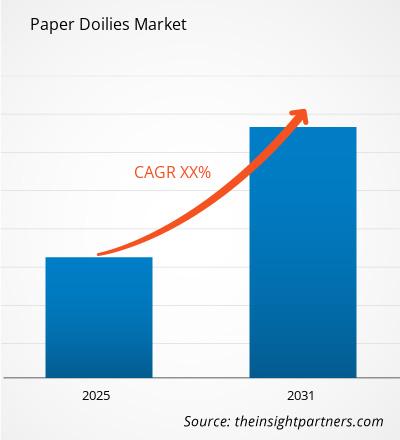
The Paper Doilies market was valued at US$ 286.75 Million in 2025 and is projected to reach US$ 386.21 Million by 2034, registering a CAGR of 3.36% during 2026–2034. Growth comes from repeat food service usage, replacement of reusable tableware, customization of products, and ongoing demand for lighter disposable presentation forms. The Market is a specialist paper converting industry used for food presentation, hospitality, home décor, baking, catering, and events.
North America continues to be a supported market due to foodservice distribution channels, bakery chains, catering firms, and household crafts consumers. The Paper Doilies Market Size is dependent on restaurant and bakery operations, seasons and festivities, and distribution, while demands for sustainability drive improved paper quality and food contact safety.
Paper Doilies Market Assessment and Insights
- North America: North America is expected to account for a 31–35% share in 2025 and expand at a 3.0–3.5% CAGR between 2026 and 2034, supported by established foodservice distribution, bakery presentation, catering demand, and household craft applications.
- U.S.: The U.S. represents approximately 72–76% share of North America in 2025 and is expected to grow at a 2.8–3.3% CAGR between 2026–2034, supported by broad distributor networks and foodservice demand.
- Europe: Europe is estimated at a 25–29% share in 2025 and is projected to grow at a 3.2–3.7% CAGR between 2026 and 2034. Germany, the UK, France, Italy, and Spain support demand through bakery, hospitality, catering, and premium presentation applications.
- Asia Pacific: Asia Pacific is estimated at a 27–31% share in 2025 and is expected to register a 3.7–4.3% CAGR between 2026 and 2034, led by China, India, Japan, South Korea, and Australia as foodservice and organized retail expand.
- Largest Segment: Food Service is the largest segment, representing approximately 68–72% market share in 2025 and growing at a 3.1–3.5% CAGR during 2026–2034, supported by recurring commercial consumption.
- High Growth Segment: B2C represents approximately 34–38% market share in 2025 and is expected to grow at a 4.0–4.4% CAGR during 2026–2034, supported by e-commerce and household purchases.
- Key companies analyzed in detail: AmerCareRoyal, LLC; Flamingo Paper & Food Service Products, Corp.; Geeta Enterprises; Graphic Management Specialty Products, Inc.; Hygloss Products, Inc.; Jinan Guangmei Paper Products Co., Ltd.; Mafcote, Inc.; Paterson Pacific Parchment Company; Royal Paper Products, Inc.; Sonoco Products Company.
Source: The Insight Partners' analysis based on proprietary research, government publications, company annual reports, investor presentations, industry databases, and expert interviews.
Food-service paper packaging materials have progressed from being simple white lace varieties into a larger array that includes color papers, printed graphics, grease resistant constructions, custom designed forms and food-safe specifications. Manufacturing is increasingly moving towards the use of die-cutting, embossing, precision perforation, automatic packaging and digital or flexo printing. This is enabling the manufacturers to cater to both mass foodservice needs as well as small customized orders without making significant modifications in their core conversion facility.
The future looks towards recyclable and sustainably sourced materials, better conversion processes, reduced manufacturing runs and local inventory. The growth in Asian foodservice markets offers volume prospects whereas buyers in Europe prefer to see traceable and environmentally friendly materials. Automated cutting, printing, inspection and packaging equipment will enhance the yield and reduce labor costs for the manufacturers catering to segmented customer bases.
Paper Doilies Market Report Scope
| Report Attribute | Details |
|---|---|
| Market size in 2025 | US$ 286.75 Million |
| Market Size by 2034 | US$ 386.21 Million |
| Global CAGR (2026 - 2034) | 3.36% |
| Historical Data | 2021-2024 |
| Forecast period | 2026-2034 |
Paper Doilies Market Analysis
Presentation of food continues to be the key driver as decorative liners have found applications as affordable accompaniments for food service across restaurants, bakeries, cafés, caterers, hotels, and institutional food preparation kitchens. In that case, the forecast of Paper Doilies Market is highly dependent on the level of food preparation consumption, bakery products sold, catering services rendered and liner replacement rate. The supply chain starts from paper mills and specialty converters, then printing, embossing, die cutting, packaging, distribution, wholesaling and retailing foodservice establishments.
Supply chain dynamics continue to be flexible due to the use of tried and tested technology for converting paper into liners in addition to the different types of food-contact paper being utilized. Manufacturers have the ability to customize dimensions, designs, colors and package designs as per customer needs. Decisions on sourcing are gradually moving towards considering paper grade, basis weight, oil resistance, food contact suitability and packaging effectiveness.
The nature of competition is fragmented, involving the use of direct sales, distribution, private-labeling, and specialized product lines by manufacturers. According to the analysis of the Paper Doilies Market Report, size advantage is gained when the supplier has national foodservice customers, and specialization advantage is gained through customizing, decoration, small batches, and geographic responsiveness. AmerCareRoyal, LLC and Royal Paper Products, Inc. gain from having a wide range of disposable foodservice products, whereas Mafcote, Inc. is proficient at producing lace paper products.
Geographic specialization impacts the level of competition. Geeta Enterprises caters to the requirements of Indian catering and hospitality industry. On the other hand, Jinan Guangmei Paper Products Co., Ltd. specializes in the manufacture of products that are suitable for exports from China. Paterson Pacific Parchment Company specializes in manufacturing foodservice product lines whereas Hygloss Products, Inc. specializes in decoration and craft applications. Sonoco Products Company specializes in paper conversion services.
● REPORT CUSTOMIZATION
Tailor This Report To Align With Your Specific Business Requirements
This report can be customized to align precisely with your business objectives, scope, and target markets. Customization options include tailored segmentation, geography, competitive analysis, and strategic insights to support informed decision-making.
Customize This Report →WHAT YOU CAN ADJUST
- ● Segmentations
- ● Geography
- ● Competitive Analysis
- ● Language Preferences
Paper Doilies Market: Strategic Insights

Regional Insights
North America Paper Doilies Market
North America held an estimated 31–35% Paper Doilies Market share in 2025 and is expected to grow at a 3.0–3.5% CAGR through 2034. The U.S. accounts for approximately 72–76% of regional demand, reflecting its large restaurant, bakery, catering, institutional, and specialty retail base. Canada provides additional demand through hospitality, foodservice distribution, and household celebration products.
The regional market involves the presence of existing distributors as well as the availability of a wide range of products. There is increasing demand for uniform sizing, suitability for food contact, lace design, and easy bulk packaging. The retail sector and the online sector also offer the option to purchase smaller quantities for personal use such as weddings, birthday parties, baking, and crafting.
U.S. Paper Doilies Market
The United States comprises about 72-76% of the North American demand in 2025 and is expected to exhibit a CAGR of 2.8-3.3% until 2034. Applications include restaurants, bakeries, caterers, hotels, supermarkets, party suppliers, craft retailers, and institutions. AmerCareRoyal, LLC, Royal Paper Products, Inc., Mafcote, Inc., and Hygloss Products, Inc. have some product/distribution relevance to the market.
Commercial applications dominate since the consumers need regular supply and standard packaging. Household and craft applications widen the applications in terms of retail/e-commerce sales, while customized offerings cater to branding and special baking requirements. The food contact requirements, quality of paper, packaging efficiencies, and delivery services are some of the factors that drive purchases.
Europe Paper Doilies Market
Europe is expected to have a 25–29% market share in 2025 with 3.2–3.7% CAGR through 2034, with Germany emerging as one of the key markets in the region. The UK, France, Italy, and Spain make significant contributions to the demand via bakery, pastry, hospitality, catering, and celebration applications.
In the United Kingdom, the market is driven by food service distribution and active bakery and catering activities. The requirements include standardized food contact materials, grease resistance, and designs for premium appearance. In Germany, attention is paid to the quality and sustainability of the goods and procurement. Applications in bakeries and confectioneries are also essential. In France, there are used traditions of pastries and catering, in Italy – traditions of baking and hospitality, in Spain – restaurants and tourism. Material procurement and disposal are becoming more important criteria.
APAC Paper Doilies Market
The APAC region is forecast to be in the 27% to 31% range in 2025, growing at a CAGR of 3.7% to 4.3% to 2034, led by China both in production and consumption. India, Japan, South Korea, and Australia represent varied demand from foodservice, household, hospitality, and retail applications.
Drivers include industrialization, development of urban foodservice, bakery development, and organized retailing. For China, large converting capacity and export demand are drivers. Catering and celebratory demand are drivers for India. The Japanese and South Korean markets focus on quality and presentation, while the Australian market features a combination of hospitality demand and sustainability-based procurement.
Middle East & Africa Paper Doilies Market
MEA and Africa will grow at a CAGR of 3.4%-3.9% up to 2034, with Saudi Arabia and UAE contributing to their regional demand. Hospitality investment, tourism, catering, and high-quality presentation of food contribute to the repeated commercial use, and South Africa is considered an important market in Southern Africa.
Hospitality and events investment is an advantage for Saudi Arabia, while hotels, catering, restaurants, and tourism are beneficial for UAE. South Africa has diversified foodservice offerings and developed distribution channels. All other MEA countries have a fragmented market with demand in urban areas. Growth is driven by growing hospitality infrastructure and foodservice development, but high dependence on imports and logistics costs impact procurement economics.
Segmentation Analysis
End Users
End Users are expected to grow at a 3.3–3.6% CAGR during 2026–2034. The Paper Doilies Market scope spans commercial food presentation and household use, with foodservice remaining the principal consumption base. Adoption depends on dining occasions, bakery presentation, catering volumes, disposable convenience, and aesthetic requirements.
- Food Service: Restaurants, cafés, bakeries, hotels, caterers, and institutional kitchens use decorative liners for pastries, desserts, plates, and serving trays. Recurring consumption and bulk procurement support the segment's strong position.
- Household: Household users purchase products for baking, parties, weddings, crafts, gifting, and decorative table settings. Retail packs and e-commerce availability broaden accessibility and support demand for varied shapes and colors.
Sales Channel
Sales Channel is projected to expand at a 3.4–3.8% CAGR during 2026–2034. Procurement remains divided between institutional bulk purchasing and consumer-oriented channels. Digital ordering is improving access to specialized designs, while distributors remain important for restaurants and catering operators requiring dependable, recurring supply.
- B2B: Distributors, wholesalers, foodservice suppliers, bakeries, restaurants, hotels, and event companies purchase larger quantities. Standardized specifications, reliable availability, competitive pricing, and customized printing influence supplier selection.
- B2C: Consumers increasingly access products through supermarkets, specialty stores, craft retailers, and online marketplaces. Smaller packs, seasonal designs, customized aesthetics, and convenient home delivery strengthen the channel's strategic importance.
Opportunity Snapshot
| End Users | Revenue Contribution | Trend Tag | Adoption Stage |
|---|---|---|---|
| Food Service | High | Catering Presentation | Mature |
| Household | Medium | Home Baking | Scaling |
Paper Doilies Market Growth Drivers and Impact Analysis
Expansion of Organized Foodservice and Bakery Presentation
Foodservice modernization is increasing the number of outlets that require standardized serving accessories, particularly restaurants, cafés, bakeries, hotels, and catering operators. Decorative liners remain inexpensive relative to the overall food presentation cost, allowing operators to improve visual presentation without significant operating expenditure. Bakery chains also use standardized presentation materials to maintain a consistent brand appearance across locations. The effect is strongest in urban markets where organized foodservice and delivery-oriented businesses are expanding. Higher outlet density increases recurring purchasing requirements and encourages distributors to maintain broader inventories. Manufacturers able to supply multiple dimensions and pack quantities can capture demand from both national accounts and regional operators. This driver supports stable volume expansion while limiting dependence on individual seasonal events.
Demand for Convenient Disposable Presentation Accessories
Convenience remains a structural reason for continued adoption across commercial and household settings. Disposable serving accessories eliminate washing, storage, and post-event cleaning requirements, which is valuable for catering companies, bakeries, quick-service restaurants, parties, and large gatherings. Lightweight paper formats also simplify transportation and inventory handling compared with reusable textile alternatives. Household consumers use products for celebrations, baking, gifting, and informal entertaining, creating a second demand layer outside professional foodservice. Retailers can stock multiple sizes and designs without substantial space requirements, while online platforms can offer extensive assortments without maintaining large physical displays. This combination of convenience and low unit cost supports recurring purchases and helps preserve demand even when operators face pressure to control discretionary expenses.
Customization and Food-Contact Performance Requirements
Commercial buyers increasingly expect products to combine decorative appeal with functional performance. Grease absorption, dimensional stability, clean die cutting, food-contact suitability, and consistent printing can differentiate products that otherwise appear similar. Bakeries and event businesses may request custom patterns, logos, colors, or dimensions to strengthen presentation and brand identity. Such requirements encourage manufacturers to invest in improved printing, automated die cutting, quality inspection, and flexible production systems. Suppliers that can manage smaller production batches while maintaining consistent quality can serve specialty accounts without relying exclusively on high-volume standardized products. Customization also increases the value of premium formats because buyers are purchasing presentation functionality rather than paper alone. The resulting product differentiation can support stronger margins and deeper customer relationships.
Paper Doilies Market Future Trends
Greater Adoption of Sustainable and Traceable Paper Inputs
Sustainability is expected to move from a supporting attribute toward a procurement criterion for larger foodservice and retail customers. Manufacturers are likely to increase the use of responsibly sourced fiber, recycled content where food-contact requirements permit, and clearer environmental documentation. Paper Doilies Market trends will increasingly reflect retailer requirements for traceability, responsible forestry, recyclable packaging, and reduced material intensity. Product development may also focus on lighter basis weights that preserve rigidity and appearance while lowering material consumption. Suppliers with documented sourcing systems can improve qualification prospects with multinational customers and distributors. At the same time, environmental claims will require stronger substantiation, making certification, supplier documentation, and accurate labeling increasingly important. This shift should favor manufacturers with integrated quality and sourcing controls.
Digital Customization and Short-Run Production
Digital printing and more flexible converting systems are expected to broaden customization opportunities for small and mid-sized customers. Instead of requiring large standardized orders, bakeries, caterers, event organizers, and specialty retailers can increasingly request limited quantities with distinctive patterns, colors, seasonal themes, or branding. Automated cutting and inspection can support these shorter runs while controlling production consistency. The trend is particularly relevant to e-commerce because online sellers can present extensive design assortments without maintaining equivalent physical inventories. Manufacturers may therefore organize production around modular formats and faster changeovers, improving responsiveness to seasonal demand. Over time, customized products could represent a larger share of value creation even where standardized products continue to dominate overall unit volumes.
Paper Doilies Market Opportunities
Expansion of Customized Foodservice and Bakery Solutions
Manufacturers can capture higher-value demand by developing customized products for bakery chains, cafés, caterers, hotels, and event organizers. Paper Doilies Market Forecasts indicate that the strongest commercial opportunity lies in combining standard production efficiency with differentiated designs, dimensions, printing, and packaging. Suppliers can create modular design libraries and digital ordering systems that reduce the complexity of smaller orders. Partnerships with foodservice distributors can extend reach without requiring large direct-sales teams. Investment in automated die cutting and digital printing would allow manufacturers to switch between designs efficiently while maintaining quality. Regional production hubs can further reduce delivery times and import exposure. This strategy creates opportunities to increase customer retention because customized specifications are less easily substituted than generic products.
Building Premium Sustainable Product Portfolios
A second opportunity lies in premium products that combine decorative performance with documented environmental characteristics. Manufacturers can develop responsibly sourced, recyclable, and appropriately certified paper formats for customers with sustainability procurement policies. Differentiated products can target hotels, premium bakeries, event organizers, specialty retailers, and institutional buyers seeking stronger environmental credentials without sacrificing presentation. Suppliers should prioritize transparent material documentation, food-contact compliance, and packaging optimization rather than relying solely on broad sustainability claims. Investments in efficient production can help offset higher input or certification costs. Regional sourcing can also reduce logistics exposure and improve responsiveness. Companies that integrate sustainable materials, quality assurance, and customer-specific design capabilities can establish stronger positions in higher-value applications while maintaining conventional products for price-sensitive customers.
Recent Developments
- In July 2026, Hoffmaster announced a US$65 million expansion of its Clintonville, Wisconsin, manufacturing facility. The project includes an 86,000-square-foot expansion and is expected to create more than 100 manufacturing jobs. Hoffmaster produces single-use tableware and foodservice products, including doilies, making this relevant to paper doily production capacity.
- In January 2025, Duni acquired Poppies Europe, and by 2026, Poppies operated as a wholly owned Duni Group company. The combined business continues to offer tabletop and paper-based foodservice products, including doilies. Duni's 2026 assortment also includes round doilies, indicating continued product availability and assortment development.
Frequently Asked Questions

- Comprehensive Market Sizing and Forecast Analysis
- Detailed Segmentation Analysis
- In-Depth Market Dynamics Assessment
- Regional and Country-Level Insights
- Competitive Landscape and Company Benchmarking
- Strategic Business Intelligence
Recent Reports
Testimonials

The Insight Partners provided valuable market intelligence that supported our global go-to-market strategy. Their team was professional, responsive, and attentive to our feedback, providing thoughtful analysis and helpful methodological clarifications throughout the project.
Junmo Kim Chief Financial Officer (CFO), Enertech Co., Ltd.
The Insight Partners' SCADA System Market report is comprehensive, with valuable insights on current trends and future forecasts. The team was highly professional, responsive, and supportive throughout. We are very satisfied and highly recommend their services.
RAN KEDEM Partner, Reali Technologies LTDs
I requested a report on a very specific software market and the team produced the report in a few days. The information was very relevant and well presented. I then requested some changes and additions to the report. The team was again very responsive and I got the final report in less than a week.
JEAN-HERVE JENN Chairman, Future Analytica
We worked with The Insight Partners for an important market study and forecast. They gave us clear insights into opportunities and risks, which helped shape our plans. Their research was easy to use and based on solid data. It helped us make smart, confident decisions. We highly recommend them.
PIYUSH NAGPAL Sr. Vice President, High Beam Global
The Insight Partners delivered insightful, well-structured market research with strong domain expertise. Their team was professional and responsive throughout. The user-friendly website made accessing industry reports seamless. We highly recommend them for reliable, high-quality research services
YUKIHIKO ADACHI CEO, Deep Blue, LLC.
This is the first time I have purchased a market report from The Insight Partners.While I was unsure at first, I visited their web site and felt more comfortable to take the risk and purchase a market report.I am completely satisfied with the quality of the report and customer service. I had several questions and comments with the initial report, but after a couple of dialogs over email with their analyst I believe I have a report that I can use as input to our strategic planning process.Thank you so much for taking the extra time and making this a positive experience.I will definitely recommend your service to others and you will be my first call when we need further market data.
JOHN SUZUKI President and Chief Executive Officer, Board Director, BK Technologies
I wish to appreciate your support and the professionalism you displayed in the course of attending to my request for information regarding to infectious disease IVD market in Nigeria. I appreciate your patience, your guidance, and the fact that you were willing to offer a discount, which eventually made it possible for us to close a deal. I look forward to engaging The Insight Partners in the future, all thanks to the impression you have created in me as a result of this first encounter.
DR CHIJIOKE ONYIA MANAGING DIRECTOR, PineCrest Healthcare Ltd.Reason to Buy
- Informed Decision-Making
- Understanding Market Dynamics
- Competitive Analysis
- Identifying Emerging Markets
- Customer Insights
- Market Forecasts
- Risk Mitigation
- Boosting Operational Efficiency
- Strategic Planning
- Investment Justification
- Tracking Industry Innovations
- Aligning with Regulatory Trends





 Get Free Sample for