
Paint Remover Market Size, Share & Growth by 2034
Coverage: By Type (Solvent Type, Caustic Type, Acidic Type); Applications (Vehicle Maintenance, Industrial Repair, Building Renovation, Furniture Refinishing, Others) , and Geography (North America, Europe, Asia Pacific, and South and Central America)
- Status : Data Released
- Report Code : TIPRE00022654
- Category : Chemicals and Materials
- No. of Pages : 150
- Available Report Formats :


- Last update date : September 17, 2026


2025 Market Size
US$ 2.01 Bn
Base year value
2034 Forecast
US$ 3.30 Bn
Projected by 2034
CAGR 2026-2034
5.66 %
Growth rate
Addressable Market
US$ 24.06 Bn
(2026-2034)
The Paint Remover Market is positioned as a specialty surface-preparation market spanning solvent, caustic, and acidic formulations used across vehicle maintenance, industrial repair, building renovation, and furniture refinishing. The market is valued at US$ 2.01 Billion in 2025 and is projected to reach US$ 3.30 Billion by 2034, expanding at a CAGR of 5.66% during 2026–2034. Regulatory pressure and formulation innovation are reshaping product selection.
Demand in North America is supported by renovation activity, vehicle refinishing, industrial maintenance, and the transition toward lower-hazard stripping chemistries. The Paint Remover Market size opportunity is expected to advance at an estimated 5.2–5.8% CAGR from 2026–2034, with the replacement of methylene-chloride-based products creating additional formulation opportunities. EPA restrictions on consumer and many commercial uses reinforce the shift toward alternative technologies.
Paint Remover Market Assessment and Insights
- North America: North America accounts for an estimated 31–35% Paint Remover Market share in 2025 and is projected to grow at a 5.1–5.7% CAGR between 2026 and 2034, supported by renovation, automotive refinishing, aerospace maintenance, and regulatory-driven reformulation toward safer stripping systems.
- U.S.: The U.S. represents approximately 82–86% of North America's share in 2025, with a growth of 5.0–5.6% CAGR between 2026 and 2034, led by building rehabilitation, vehicle repair, industrial maintenance, and safer chemical substitution.
- Europe: Europe holds approximately 23–27% share in 2025 and is expected to expand at a 4.7–5.3% CAGR between 2026 and 2034. Germany, the UK, France, Italy, and Spain remain important markets, supported by renovation and environmental compliance.
- Asia Pacific: Asia Pacific represents approximately 35–39% share in 2025 and is projected to register 6.2–7.0% CAGR between 2026 and 2034. China, Japan, South Korea, India, and Australia provide the principal demand base through automotive, construction, marine, and manufacturing activities.
- Largest Segment: Solvent Type remains the largest segment, holding a 45–49% market share in 2025 and advancing at a 5.0–5.6% CAGR from 2026–2034, supported by broad stripping performance.
- High Growth Segment: Caustic Type is the high-growth segment, representing 24–28% market share in 2025 and expanding at 6.0–6.7% CAGR from 2026–2034 as safer industrial alternatives gain acceptance.
- Key companies analyzed in detail: 3M Company, Akzo Nobel N.V., Fiberlock Technologies, Rust-Oleum Corporation, Franmar Chemical, Inc., Green Products Co., GSP Products, Henkel AG & Co. KGaA, PPG Industries, Inc., United Gilsonite Laboratories.
Source: The Insight Partners' analysis based on proprietary research, government publications, company annual reports, investor presentations, industry databases, and expert interviews.
The market is moving away from highly reactive conventional strippers to formulations that are formulated to be less toxic, less exposed to volatile organic compounds, substrate friendly, and with optimized dwell time. Gel formulations have become important as they stay put on vertical surfaces, while the use of abrasives works in tandem with chemicals for metals, wood, plastics, and fiberglass. The regulatory limitations are contributing towards reformulation, especially in the case of methylene chloride and other hazardous solvents.
Focus on investments in the Paint Remover Market is increasing on water-based, bio-based, low odor, and application specific formulations. Growth opportunities can be found in the Asia Pacific region as the regions' industrialization, automobile manufacturing, construction renovations, and maintenance are expanding the market base. In developed markets, compliance, safety, packaging, and efficiency are getting more attention than just volume expansion.
Paint Remover Market Report Scope
| Report Attribute | Details |
|---|---|
| Market size in 2025 | US$ 2.01 Billion |
| Market Size by 2034 | US$ 3.30 Billion |
| Global CAGR (2026 - 2034) | 5.66% |
| Historical Data | 2021-2024 |
| Forecast period | 2026-2034 |
Paint Remover Market Analysis
The demand side of the Paint Remover Market is driven by the fact that the surface needs to be restored prior to repainting, repairing, re-finishing or inspecting. The growth environment encompasses raw material producers, formulation companies, packagers, distributors, contractors, maintenance service providers and industries. Choice of product is based on type of coating, sensitivity of the surface, stripping time, residue control, exposure of the operator and waste treatment.
Supply conditions in the Paint Remover Market are determined by access and cost of solvents, caustics, surfactants, thickeners, corrosion inhibitors and special chemicals. Formulators develop the products with proper rheology which ensures that they do not drip from vertical surfaces. Commercial customers also take into account water requirement after stripping and surface preparation after that. Therefore, formulators with flexibility in their formulation have an advantage over others.
The competition structure of the Paint Remover Market has remained diverse in the case of multinational chemical and coating corporations as well as specialized manufacturers of stripping products. As per the study, the competition among big corporations is in terms of distribution network, technical capabilities, applicability and branding while the differentiation among specialists lies in their formulations based on substrates and environment-friendly chemical compositions. 3M Company has a wide range of stripping and abrasives. Henkel AG & Co. KGaA and PPG Industries, Inc. are dominant players in industrial surface treatment and refinishing ecosystems.
There has been an increase in the use of formulation substitution and application specialization as the positioning strategy. Akzo Nobel N.V. caters to coating ecosystems of industries and aerospace while Rust-Oleum Corporation caters to renovation and maintenance for the users. Fiberlock Technologies and Franmar Chemical, Inc. have focused on specialized removal solutions while Green Products Co., GSP Products, and United Gilsonite Laboratories have increased focus in professional and restoration solutions niche.
● REPORT CUSTOMIZATION
Tailor This Report To Align With Your Specific Business Requirements
This report can be customized to align precisely with your business objectives, scope, and target markets. Customization options include tailored segmentation, geography, competitive analysis, and strategic insights to support informed decision-making.
Customize This Report →WHAT YOU CAN ADJUST
- ● Segmentations
- ● Geography
- ● Competitive Analysis
- ● Language Preferences
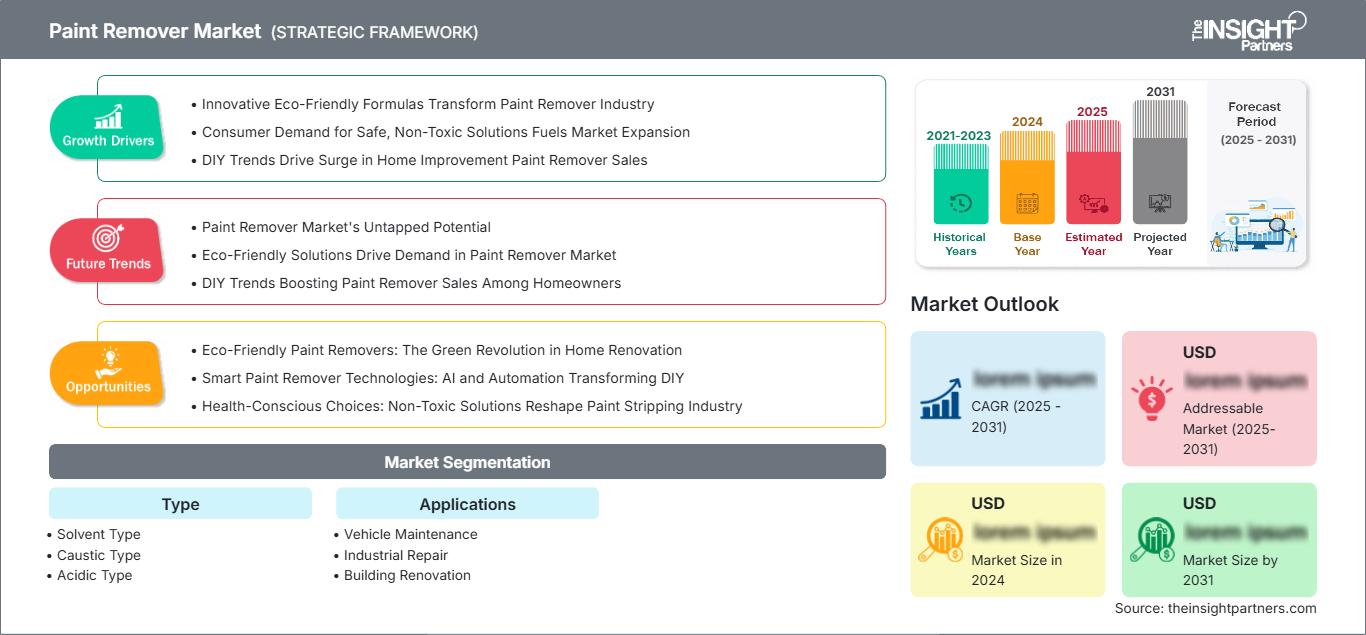
Paint Remover Market: Strategic Insights
Regional Insights
North America Paint Remover Market
North America represents a 31–35% Paint Remover Market in 2025 and is projected to grow at a 5.1–5.7% CAGR from 2026–2034. The USA leads consumption in the region, which is driven by residential remodeling, commercial building renovations, automobile refinishing, industrial maintenance, and aerospace MRO services. Canadian activities include construction rehabilitation, transportation maintenance, and industrial asset refinishes. Regulations will be a key driver, as their role has been to drive a shift in chemistries away from more risky options. The EPA regulations restrict consumer use of methylene chloride for paint and coating removal purposes, followed by broader regulation of almost all consumer applications and many industrial applications.
Demand for products in the Paint Remover Market is shifting towards odorless gel coatings, aqueous products, stripping with mechanical assistance, and specific applications. Productivity is important to professionals, whereas ease of use is critical to consumers. There is also an established distribution network comprising hardware stores, industrial distributors, automotive supplies and online. Formulated with technical documentation is key for manufacturers looking to capitalize on replacement demand for products.
U.S. Paint Remover Market
The U.S. contributes approximately 82–86% of North America's 2025 share and is expected to grow at a 5.0–5.6% CAGR from 2026–2034. Recurring needs arise from renovation work, automobile restoration, industrial repairs, and aerospace maintenance. The replacement of regulatory requirements continues to be a vital factor of demand as EPA restrictions change compositions and delivery.
The 3M Company, PPG Industries, Inc., Henkel AG & Co. KGaA, Rust-Oleum Corporation, Fiberlock Technologies, and Franmar Chemical, Inc. cater to various applications. There is a growing trend of chemical strippers being used alongside abrasive and mechanical methods in cases where efficiency and substrate safety are important considerations. For building renovation and furniture stripping, it is more desirable for the products to have controlled action.
Europe Paint Remover Market
Europe holds approximately 23–27% share in 2025 and is forecast to expand at a 4.7–5.3% CAGR through 2034, with Germany representing the leading national market. Together, the UK, Germany, France, Italy, and Spain offer a diversified base ranging from renovation to industrial maintenance, car repair, and furniture restoration.
The UK sustains its demand due to the need for residential refurbishment and restoration, while Germany receives an added benefit from the maintenance of industrial machinery and manufacturing. France needs construction renovation and automotive products, while Italy is in need of furniture and wood restoration. On the other hand, Spain enjoys construction rehabilitation and automotive service and commercial property maintenance. Europe is demanding more environmentally friendly chemicals, pushing producers to redevelop their products without compromising on the stripping power.
APAC Paint Remover Market
APAC represents approximately 35–39% share in 2025 and is expected to grow at a 6.2–7.0% CAGR, making it the fastest-growing major region. China leads regional demand, followed by Japan, South Korea, India, and Australia. Automotive manufacturing, shipbuilding, industrial production, and construction renovation support consumption.
China combines manufacturing scale with infrastructure refurbishment, while India benefits from expanding vehicle maintenance and construction activity. Japan and South Korea provide specialized industrial and marine applications. Australia contributes through building maintenance and restoration. Policy emphasis on industrial safety and environmental management is encouraging suppliers to improve formulation quality, packaging, and handling practices while maintaining productivity.
Middle East & Africa Paint Remover Market
The Middle East & Africa is projected to expand at a 4.2–5.0% CAGR from 2026–2034. Saudi Arabia spearheads regional demand by way of infrastructure developments, industrial facilities, and asset maintenance. UAE capitalizes on construction projects, commercial renovations, aviation and marine operations, whereas South Africa assists with automotive, mining, and industrial maintenance needs.
The remaining MEA represents a smaller market, yet provides opportunities for infrastructure renewal and industrial upgrading. Energy infrastructure brings about repeatable demands for maintenance coatings of tanks, machinery, pipelines, and facilities. Formulations have to be capable of withstanding high temperatures, controlled application, and easy residue removal. Distribution networks and technical assistance are significant due to uneven availability of specialist chemicals compared to developed markets.
Segmentation Analysis
Type
Type segmentation reflects differences in stripping mechanism, substrate compatibility, operating conditions, and regulatory exposure. The segment is expected to grow at a 5.4–6.0% CAGR from 2026 to 2034. Solvent systems remain important because of their broad coating compatibility, while caustic and acidic technologies serve applications requiring stronger or chemically selective removal.
- Solvent Type: Solvent formulations provide broad compatibility across coatings and substrates. Demand remains concentrated in professional maintenance, vehicle repair, and renovation, where stripping speed, penetration, and controlled residue removal are important purchasing criteria.
- Caustic Type: Caustic formulations are used where alkaline chemistry can efficiently break down coatings. Their strategic role is increasing in industrial cleaning and selected renovation applications requiring strong removal performance and controlled chemical handling.
- Acidic Type: Acidic formulations address specialized removal requirements, particularly where mineral deposits, corrosion products, or chemically resistant coatings accompany surface contamination. Their use depends strongly on substrate compatibility and post-treatment neutralization requirements.
Applications
Applications determine formulation requirements according to coating thickness, substrate, operating environment, and acceptable processing time. This segment is projected to grow at a 5.7–6.3% CAGR from 2026–2034 as professional maintenance and refurbishment activities expand across transportation, buildings, industrial equipment, and furniture.
- Vehicle Maintenance: Vehicle maintenance uses removers for refinishing preparation, coating correction, restoration, and localized repair. Products must minimize substrate damage while delivering predictable removal across multiple automotive coating systems.
- Industrial Repair: Industrial repair requires high-performance formulations for machinery, fabricated metal, equipment, and production assets. Users prioritize stripping efficiency, compatibility, worker protection, and integration with established maintenance procedures.
- Building Renovation: Building renovation creates demand across walls, floors, woodwork, masonry, and architectural elements. Gel and low-odor technologies are particularly useful where controlled application and reduced migration are required.
- Furniture Refinishing: Furniture refinishing emphasizes controlled removal from wood and decorative surfaces without excessive substrate damage. Demand favors formulations with manageable dwell times, low residue, and suitability for detailed restoration work.
Opportunity Snapshot
| Applications | Revenue Contribution | Trend Tag | Adoption Stage |
|---|---|---|---|
| Vehicle Maintenance | High | Fleet Refinishing | Mature |
| Industrial Repair | High | Asset Restoration | Mature |
| Building Renovation | High | Renovation Cycle | Scaling |
| Furniture Refinishing | Medium | Heritage Restoration | Scaling |
Paint Remover Market Growth Drivers and Impact Analysis
Regulatory substitution of high-risk stripping chemicals
Restrictions on hazardous paint-stripping chemicals are forcing manufacturers and users to reconsider established formulations. In the U.S., EPA restrictions cover consumer methylene chloride paint and coating removal and, following the 2024 risk-management rule, extend to most industrial and commercial uses, with defined exceptions and compliance pathways. This regulatory environment increases demand for alternative solvent blends, caustic systems, bio-based products, and mechanical-assisted processes. Manufacturers that reformulate early can preserve distribution access and reduce compliance disruption. Buyers also gain a greater incentive to standardize approved product lists across maintenance sites. The resulting substitution cycle supports premium pricing for compliant products when performance remains comparable. Over time, formulation portfolios are likely to become more diversified, reducing dependence on individual restricted chemicals and encouraging innovation in safer surface-treatment technologies.
Expansion of renovation and asset refurbishment activities
The Paint Remover Market report shows that renovation creates recurring stripping requirements because repainting and recoating often require the removal of incompatible, damaged, or deteriorated layers. Residential refurbishment supports furniture, doors, trim, floors, and architectural surfaces, while commercial renovation increases demand across offices, hospitality properties, retail buildings, and public infrastructure. Industrial operators also use stripping products during maintenance shutdowns to prepare equipment for new protective coatings. The market impact is strongest where surface restoration extends asset life rather than requiring full replacement. Contractors increasingly value products that reduce labor time, minimize scraping, and maintain substrate integrity. Manufacturers can therefore gain share by improving dwell-time consistency, vertical cling, residue management, and compatibility with subsequent coatings. Demand is also strengthened when refurbishment budgets rise during periods when owners prioritize extending existing asset service lives.
Increasing need for efficient industrial surface preparation
Industrial maintenance requires predictable removal of coatings before inspection, welding, repair, corrosion treatment, or recoating. As equipment becomes more expensive and downtime becomes more costly, users increasingly evaluate stripping solutions according to total process time rather than product price alone. Chemical removers can reduce manual abrasion requirements on complex geometries and difficult-to-access surfaces. Aerospace, automotive, marine, and machinery maintenance applications, therefore, provide attractive opportunities for specialized formulations. Product developers are responding with gels, low-residue systems, and combinations designed for specific coating families. The competitive effect is a gradual shift from generic stripping products toward technically differentiated solutions supported by application guidance. Suppliers able to demonstrate substrate compatibility, controlled removal, and predictable processing conditions can secure repeat industrial demand through maintenance specifications and approved-product programs.
Paint Remover Market Future Trends
Bio-based and low-VOC formulation development
The Paint Remover Market trends show that the next stage of formulation development will increasingly focus on bio-based feedstocks, lower-VOC systems, reduced odor, and improved biodegradability without sacrificing removal performance. Product developers are testing renewable solvents, ester-based chemistry, water-compatible systems, and specialty surfactants to replace conventional high-risk ingredients. This trend is likely to be strongest in Europe and North America, where environmental expectations and chemical restrictions influence purchasing decisions. Professional users are also becoming more receptive when safer products provide comparable dwell times and stripping effectiveness. Packaging will evolve alongside chemistry, with clearer hazard communication and application guidance. The strategic implication is that formulation performance will be assessed through a broader matrix covering worker exposure, disposal, substrate protection, and lifecycle considerations. Suppliers that integrate these factors early can develop differentiated products suitable for both professional and increasingly sustainability-conscious customers.
Application-specific stripping technologies
Future product portfolios are likely to become more specialized according to coating family, substrate, and operating environment. Instead of one general-purpose remover, suppliers can increasingly offer systems optimized for automotive finishes, architectural coatings, industrial epoxies, furniture finishes, or aerospace applications. Such specialization allows manufacturers to tune penetration, dwell time, viscosity, corrosion inhibition, and residue characteristics for defined use cases. Digital technical support can reinforce this trend by helping users select products according to coating type and substrate. The resulting model reduces trial-and-error consumption and improves process consistency. Specialist formulations may also command stronger customer retention because maintenance teams prefer validated products once compatibility has been demonstrated. Over the forecast period, application-specific chemistry should therefore become an important competitive tool, particularly in industrial environments where coating complexity and downtime costs justify higher-value solutions.
Paint Remover Market Opportunities
Premium compliant formulations for regulated markets
Manufacturers can capture incremental value by developing premium formulations designed specifically for markets with stringent restrictions on hazardous solvents and VOC emissions. The opportunity extends beyond simple substitution because customers require comparable stripping speed, substrate safety, storage stability, and ease of application. Companies should prioritize formulations that can be documented through clear technical specifications, safety data, and application protocols. Paint Remover Market Forecasts indicate that replacement demand can remain structurally attractive even when overall consumption grows moderately, because regulatory changes force product turnover independently of renovation cycles. Suppliers can target professional contractors, industrial distributors, and maintenance organizations with product conversion programs. Partnerships with distributors can accelerate adoption by providing application demonstrations and approved alternatives. The strongest commercial propositions will combine safer chemistry with measurable productivity benefits rather than positioning environmental performance as the only purchasing criterion.
Specialized solutions for industrial and restoration applications
Industrial equipment, historic buildings, aircraft components, furniture, and complex fabricated structures require different stripping characteristics. This creates an opportunity for suppliers to develop targeted products with controlled dwell times, substrate-specific compatibility, and minimal residue. Restoration projects can support premium products because preserving the underlying material is often more important than minimizing chemical cost. Industrial customers similarly value predictable performance when downtime and rework carry substantial economic consequences. Manufacturers should invest in application laboratories, coating compatibility databases, and technical service teams capable of recommending appropriate systems. Smaller specialists can compete effectively by focusing on narrow use cases where large-volume general-purpose products are less suitable. Expansion through specialist distributors and contractor networks can provide efficient market access. This strategy also supports customer loyalty because successful formulation selection becomes embedded in maintenance procedures and project specifications.
Recent Developments
- June 2025: Akzo Nobel N.V. — JSW Paints agreed to acquire a 74.76% stake in Akzo Nobel India for approximately US$1.05 billion, with the overall transaction valued at about US$1.6 billion including debt. The acquisition is expected to strengthen JSW Paints' position in India and make it the country's fourth-largest paint company by market share. Akzo Nobel will retain its Indian R&D center and powder coatings business.
- November 2025: Akzo Nobel N.V. — AkzoNobel announced plans to merge with Axalta Coating Systems in a transaction creating a combined coatings group with an enterprise value of approximately US$25 billion. The proposed company expects annual cost savings of US$600 million, revenues of about US$17 billion, and a 20% core profit margin, with completion targeted for late 2026 to early 2027.
Frequently Asked Questions

- Comprehensive Market Sizing and Forecast Analysis
- Detailed Segmentation Analysis
- In-Depth Market Dynamics Assessment
- Regional and Country-Level Insights
- Competitive Landscape and Company Benchmarking
- Strategic Business Intelligence
Recent Reports
Testimonials

The Insight Partners provided valuable market intelligence that supported our global go-to-market strategy. Their team was professional, responsive, and attentive to our feedback, providing thoughtful analysis and helpful methodological clarifications throughout the project.
Junmo Kim Chief Financial Officer (CFO), Enertech Co., Ltd.
The Insight Partners' SCADA System Market report is comprehensive, with valuable insights on current trends and future forecasts. The team was highly professional, responsive, and supportive throughout. We are very satisfied and highly recommend their services.
RAN KEDEM Partner, Reali Technologies LTDs
I requested a report on a very specific software market and the team produced the report in a few days. The information was very relevant and well presented. I then requested some changes and additions to the report. The team was again very responsive and I got the final report in less than a week.
JEAN-HERVE JENN Chairman, Future Analytica
We worked with The Insight Partners for an important market study and forecast. They gave us clear insights into opportunities and risks, which helped shape our plans. Their research was easy to use and based on solid data. It helped us make smart, confident decisions. We highly recommend them.
PIYUSH NAGPAL Sr. Vice President, High Beam Global
The Insight Partners delivered insightful, well-structured market research with strong domain expertise. Their team was professional and responsive throughout. The user-friendly website made accessing industry reports seamless. We highly recommend them for reliable, high-quality research services
YUKIHIKO ADACHI CEO, Deep Blue, LLC.
This is the first time I have purchased a market report from The Insight Partners.While I was unsure at first, I visited their web site and felt more comfortable to take the risk and purchase a market report.I am completely satisfied with the quality of the report and customer service. I had several questions and comments with the initial report, but after a couple of dialogs over email with their analyst I believe I have a report that I can use as input to our strategic planning process.Thank you so much for taking the extra time and making this a positive experience.I will definitely recommend your service to others and you will be my first call when we need further market data.
JOHN SUZUKI President and Chief Executive Officer, Board Director, BK Technologies
I wish to appreciate your support and the professionalism you displayed in the course of attending to my request for information regarding to infectious disease IVD market in Nigeria. I appreciate your patience, your guidance, and the fact that you were willing to offer a discount, which eventually made it possible for us to close a deal. I look forward to engaging The Insight Partners in the future, all thanks to the impression you have created in me as a result of this first encounter.
DR CHIJIOKE ONYIA MANAGING DIRECTOR, PineCrest Healthcare Ltd.Reason to Buy
- Informed Decision-Making
- Understanding Market Dynamics
- Competitive Analysis
- Identifying Emerging Markets
- Customer Insights
- Market Forecasts
- Risk Mitigation
- Boosting Operational Efficiency
- Strategic Planning
- Investment Justification
- Tracking Industry Innovations
- Aligning with Regulatory Trends





 Get Free Sample for