
Optical Fingerprint Sensor Market Growth, Demand & Size by 2034
Coverage: by Component (Photo Diode, Charged Coupled Device (CCD), Others); Application (Telecom, Government, Healthcare, Smart Homes, Others), and Geography (North America, Europe, Asia Pacific, and South and Central America)
- Status : Data Released
- Report Code : TIPRE00013155
- Category : Electronics and Semiconductor
- No. of Pages : 150
- Available Report Formats :


- Last update date : October 13, 2026


2025 Market Size
US$ 1.65 Bn
Base year value
2034 Forecast
US$ 4.71 Bn
Projected by 2034
CAGR 2026-2034
12.35 %
Growth rate
Addressable Market
US$ 27.80 Bn
(2026-2034)
The optical fingerprint sensor market recorded a valuation of US$ 1.65 Billion in 2025 and is projected to reach US$ 4.71 Billion by 2034, expanding at a CAGR of 12.35% between 2026 and 2034. Rising integration of biometric authentication across consumer electronics, government identity systems, and access-control infrastructure continues to reinforce demand across diverse end-use verticals worldwide, supported by falling sensor manufacturing costs.
North America's optical fingerprint sensor market size is estimated to expand at a CAGR ranging between 11% and 12.5% through 2034, propelled by widespread adoption of biometric access control in enterprise security, financial services digitization, and stringent identity-verification mandates. Continued government investment in border-control modernization and smart-device penetration further strengthens the region's structural growth trajectory, positioning it among the more mature yet steadily expanding regional markets globally.
Optical Fingerprint Sensor Market Assessment and Insights
- North America: The region maintains a commanding presence, holding an estimated 32-35% share in 2025, and is anticipated to grow at a CAGR of 11-12.5% between 2026 and 2034, driven by enterprise security and identity-verification adoption.
- US: The United States dominates regional demand, contributing roughly 85-88% of North America's revenue in 2025, growing at a CAGR of 11-12% from 2026 to 2034 on strong device integration.
- Europe: Europe held around 24-27% share in 2025 and is projected to expand at a CAGR of 11.5-13% through 2034, with Germany, the UK, and France leading regional deployment across banking and government identity programs.
- Asia Pacific: APAC accounted for approximately 30-33% share in 2025, forecast to grow at a CAGR of 13.5-15% between 2026 and 2034, led by China, Japan, South Korea, and India through smartphone and smart-city expansion.
- Largest Segment: Photo Diode-based sensors, under Component, held an estimated 55-60% share in 2025 and are projected to grow at a CAGR of 11-12% between 2026 and 2034, owing to their cost efficiency and reliability.
- High Growth Segment: Smart Homes, under Application, held roughly 15-18% share in 2025 and is expected to expand at a CAGR of 15-17% between 2026 and 2034, driven by rising residential biometric-lock installations.
- Key companies analyzed in detail: BioEnable, BIO-key International, Inc., Fingerprint Cards AB, Mantra Softech (India) Pvt. Ltd., SECURLINX Corporation, Shenzhen CAMA Biometrics Co., Ltd., Shenzhen Goodix Technology Co., Ltd., Synaptics Incorporated, VKANSEE Technology Company Limited, VocalZoom Ltd.
Source: The Insight Partners' analysis based on proprietary research, government publications, company annual reports, investor presentations, industry databases, and expert interviews.
Optical sensing module production has progressed from larger assembly-based designs relying on prisms to smaller under-display designs integrated directly underneath smartphone screens. Manufacturing processes have changed from low-volume assembly into higher volume processes of wafer-level packaging and CMOS image sensor production, lowering costs per unit significantly. As a result, these developments have expanded accessibility to include mid-tier handsets, POS terminals, and access control devices among other applications. In this manner, the strategy for sourcing components among OEMs producing devices featuring biometrics has been altered.
Going forward, developing economies of South East Asia, Latin America, and the Middle East are expected to draw more manufacturing investments as governments develop national identification programs that rely on biometrics. Favorable regulatory trends like data-protection regimes that require secure authentication, coupled with growing amounts allocated to semiconductor localization, will lead to an expansion of geographical manufacturing of sensors in the next decade.
Optical Fingerprint Sensor Market Report Scope
| Report Attribute | Details |
|---|---|
| Market size in 2025 | US$ 1.65 Billion |
| Market Size by 2034 | US$ 4.71 Billion |
| Global CAGR (2026 - 2034) | 12.35% |
| Historical Data | 2021-2024 |
| Forecast period | 2026-2034 |
Optical Fingerprint Sensor Market Analysis
Optical fingerprint sensor market growth is fundamentally anchored in escalating demand for secure, low-cost biometric authentication across smartphones, banking terminals, and government identification systems. Value chain participants include photodiode and CCD chip makers, module assemblers, and original equipment manufacturers, all playing their parts within an integrated ecosystem. The growing use of digital payment methods and e-KYC across developing countries has led to a wider pool of prospects for the adoption of optical sensing technology.
There is a consolidation risk, along with efficiencies of scale, given the limited number of makers of components located in Asia. Wafer assembly is being localized by manufacturers in order to safeguard against geopolitical tensions and the associated tariffs. In addition, new incremental sources of demand for the components are evolving in the form of healthcare and smart home solutions.
This optical fingerprint sensor market analysis reveals a moderately consolidated competitive landscape shaped by continuous technology differentiation. Synaptics Incorporated and Shenzhen Goodix Technology Co., Ltd. maintain leadership through proprietary under-display sensing architectures, while Fingerprint Cards AB and BIO-key International, Inc. compete through software-integrated authentication platforms serving enterprise and government clients. Smaller specialists such as VKANSEE Technology Company Limited and VocalZoom Ltd. differentiate via niche optical imaging innovations targeting high-security applications.
Optical Fingerprint Sensor Market forecast indicates sustained growth through 2034, supported by increasing demand for secure biometric authentication across smartphones, government identity programs, enterprise access control, healthcare, and smart-home applications. Investment in this space will likely continue to revolve around next-generation sensing precision, anti-spoofing features, and miniature sensor technology. Regional manufacturers like Shenzhen CAMA Biometrics Co., Ltd. and Mantra Softech (India) Pvt. Ltd. are improving their manufacturing capabilities, whereas BioEnable and SECURLINX Corporation are developing biometric products for enterprises. In the future, competitive differentiation will be more about miniaturized modules, cost savings, higher authentication accuracy, and the transition from smartphones to other connected device applications.
● REPORT CUSTOMIZATION
Tailor This Report To Align With Your Specific Business Requirements
This report can be customized to align precisely with your business objectives, scope, and target markets. Customization options include tailored segmentation, geography, competitive analysis, and strategic insights to support informed decision-making.
Customize This Report →WHAT YOU CAN ADJUST
- ● Segmentations
- ● Geography
- ● Competitive Analysis
- ● Language Preferences
Optical Fingerprint Sensor Market: Strategic Insights
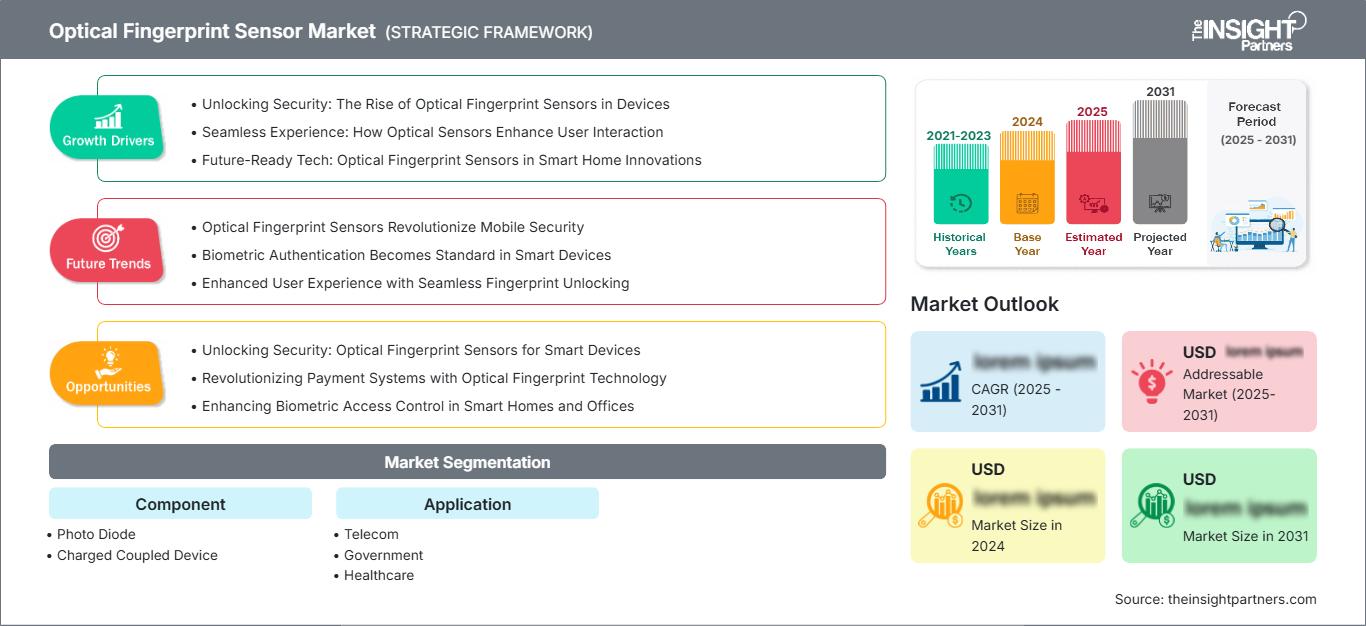
Regional Insights
North America Optical Fingerprint Sensor Market
North America's optical fingerprint sensor market share stood at an estimated 32-35% in 2025, supported by mature adoption across banking, healthcare, and government identity verification. The region is forecast to expand at a CAGR of 11-12.5% between 2026 and 2034. Enterprise security modernization and continued smartphone refresh cycles sustain steady demand for embedded optical modules across commercial and residential access-control deployments throughout the forecast period.
Structural drivers include stringent identity-verification regulations across financial institutions, rising border-security modernization spending, and expanding smart-home biometric-lock adoption among residential consumers. Canada contributes a smaller yet steadily growing share, supported by government digital-identity initiatives. Overall, the region's growth trajectory remains anchored in replacement demand and incremental penetration into healthcare access-management systems rather than first-time technology adoption, distinguishing it from faster-growing emerging markets.
U.S. Optical Fingerprint Sensor Market
The United States commands approximately 85-88% of North America's total revenue in 2025, growing at a CAGR of 11-12% through 2034. A wide presence of major players in the integration of technology, such as Synaptics Incorporated and BIO-key International, Inc., ensures domestic sourcing and innovation capabilities, whereas identity-verification initiatives of the federal government keep expanding their purchasing power in agencies responsible for law enforcement and border controls all over the country.
Application trends include device integration in telecommunication systems and identity verification initiatives of the government, as well as healthcare implementation for patient data protection. Multi-factor authentication involving optical sensors and mobile identity cards is gaining popularity among corporations, whereas smart-home locks that use biometric verification are gaining traction among consumers due to their increasing investments in security and knowledge about device unlocking through fingerprints.
Europe Optical Fingerprint Sensor Market
Europe accounted for an estimated 24-27% share of the global optical fingerprint sensor market in 2025, expanding at a CAGR of 11.5-13% between 2026 and 2034. Germany leads regional demand through strong automotive and industrial access-control integration, supported by advanced manufacturing capabilities and robust enterprise security spending across financial and government institutions throughout the country's technology sector.
The United Kingdom follows closely, driven by banking-sector biometric authentication rollouts and expanding government digital-identity credentialing programs supporting border and immigration verification systems nationwide. Germany's growth stems from automotive-grade sensor integration and industrial access-control deployment across manufacturing facilities. France, Italy, and Spain collectively contribute steady incremental demand, led by government identification modernization, banking security upgrades, and gradually rising smart-home biometric-lock adoption among urban residential consumers across major metropolitan centers.
APAC Optical Fingerprint Sensor Market
Asia Pacific held an estimated 30-33% share in 2025 and is projected to expand at a CAGR of 13.5-15% through 2034, the fastest among all regions. China leads regional demand, supported by dense smartphone manufacturing ecosystems and domestic component fabrication led by Shenzhen Goodix Technology Co., Ltd. and Shenzhen CAMA Biometrics Co., Ltd.
Japan and South Korea contribute through advanced consumer-electronics integration, while India's growth is fueled by government digital-identity initiatives and expanding domestic manufacturing led by Mantra Softech (India) Pvt. Ltd. Australia shows steady enterprise-security adoption. Policy support for semiconductor localization and smart-city infrastructure continues to reinforce regional industrial and manufacturing momentum.
Middle East & Africa Optical Fingerprint Sensor Market
The Middle East and Africa region is forecast to grow at a CAGR of 12.5-14% between 2026 and 2034, led by Saudi Arabia and the United Arab Emirates through national digital-identity and smart-city infrastructure programs. Government-backed biometric border-control modernization continues driving component procurement across major metropolitan development projects.
South Africa contributes through banking-sector authentication adoption, while the Rest of MEA shows gradual uptake tied to telecom-driven mobile device penetration. Infrastructure investment linked to energy-sector diversification programs across Gulf economies is increasingly incorporating biometric access control within smart-building and industrial-facility security frameworks regionwide.
Segmentation Analysis
Component
The Component segment is projected to grow at a CAGR of 11.5-12.5% between 2026 and 2034. This optical fingerprint sensor market scope reflects continuous cost reduction in photodiode fabrication alongside rising precision demand from charge-coupled device imaging in high-security applications. Component selection increasingly balances manufacturing cost against imaging accuracy requirements across telecom, government, and healthcare deployment environments, shaping supplier procurement strategies industrywide.
- Photo Diode: This dominant component type offers cost-efficient light detection suited for high-volume smartphone and consumer-device integration, favored by manufacturers balancing performance with affordable large-scale production economics.
- Charged Coupled Device: This precision-imaging component serves high-security applications requiring superior image clarity, favored across government identification and healthcare authentication systems demanding stringent accuracy standards.
Application
The Application segment is estimated to expand at a CAGR of 12-13.5% between 2026 and 2034. Telecom remains the largest contributor given smartphone integration volumes, while healthcare and smart-home applications are emerging as incremental growth pools. Government identity programs continue to reinforce steady procurement, collectively diversifying demand beyond consumer electronics into institutional and residential deployment environments across developed and emerging economies alike.
- Telecom: This segment leads application demand through smartphone and mobile-device fingerprint integration, supported by continuous device refresh cycles and expanding mid-range smartphone biometric adoption across global consumer markets.
- Government: This segment reflects steady demand from national identity credentialing, border control, and law-enforcement biometric databases, supported by sustained public-sector digital-identity modernization investment worldwide.
- Healthcare: This segment is gaining traction through patient-record access control and medication-dispensing authentication, supported by rising institutional cybersecurity and regulatory compliance requirements across hospital networks.
- Smart Homes: This segment is expanding rapidly through residential biometric-lock adoption, supported by rising consumer security awareness and growing integration with connected home-automation ecosystems.
Opportunity Snapshot
| Application | Revenue Contribution | Trend Tag | Adoption Stage |
| Telecom | High | Under-Display Sensing | Mature |
| Government | High | Identity Credentialing | Scaling |
| Healthcare | Medium | Patient Authentication | Emerging |
| Smart Homes | Medium | Biometric Locks | Emerging |
Optical Fingerprint Sensor Market Growth Drivers and Impact Analysis
Expanding Smartphone Biometric Integration Across Mid-Range Devices
The trend of integrating optical fingerprint sensors into mid-tier and budget devices is catching up as the smartphone companies integrate optical fingerprint sensors not only in their premium flagship devices. In fact, the wider scope of usage will drive the procurement volumes of component companies because the smartphone companies need to differentiate themselves in terms of security features, but in a more cost-effective way. With the lowering costs of wafer-level packaging, the under-display optical sensors have now become cost-effective enough to be used at scale. The telecommunication application requirement is continuing to consume a significant proportion of the worldwide component production. The regional centers of device assembly in China, India, and Southeast Asia will continue contributing towards increasing procurement volumes, with the local smartphone companies competing with foreign companies in terms of biometric features.
Government Digital Identity Programs Driving Institutional Procurement
Governments in Asia, the Middle East, and some regions in Africa continue to roll out digital-identification credential systems that mandate biometric enrollment capabilities and drive institutional procurement of optical-sensing devices. Modernization of border controls, national ID systems, and law enforcement biometric systems forms a non-cyclical demand base that is relatively unaffected by consumer electronics spending. More regulatory mandates call for multi-factor authentication systems using fingerprinting technology in addition to facial recognition, thus strengthening specifications towards higher resolution sensors. This institutional demand offers manufacturers a more stable purchasing cycle with increased order size as opposed to consumer electronics demand. Identity management investment will be resilient despite overall economic conditions due to the need for a solid foundation in governmental and social services delivery systems.
Rising Enterprise Access Control Adoption Across Commercial Facilities
Companies operating in finance, health care, and industrial markets are now utilizing optical fingerprint sensors in physical access control systems in place of older card-based credentials that could be duplicated and shared. This is due to the growing need for cybersecurity compliance among companies and also because of the audit trails required for facility access in sensitive and regulated industries. In addition, commercial real estate firms are using biometric access as part of smart building technology to better protect tenants' security and offer a value-added feature to upscale real estate. Such an enterprise stream offers more stability to the company's sales cycle as compared to that of consumer electronics, which is quite volatile. The trend towards hybrid working continues to drive the adoption of touchless secure access control systems.
Optical Fingerprint Sensor Market Future Trends
Convergence of Optical and Multi-Modal Biometric Authentication
Optical fingerprint sensor market trends increasingly point toward convergence with complementary biometric modalities, including facial recognition and vein-pattern imaging, to enhance authentication accuracy and reduce spoofing vulnerabilities. Hybrid systems using optical sensors alongside capacitive or ultrasonic sensing technology are currently being explored by device manufacturers for dual security levels. The emerging trend will force a rethink on module design requirements and necessitate a tighter relationship between sensor manufacturers and those developing software algorithms. Procurement criteria within corporate and governmental sectors will increasingly favor multi-modal solutions, thus placing optical sensors in the ecosystem of authentication methods.
Miniaturization Enabling Expansion into Wearable and IoT Devices
Miniaturization of the optical sensors is anticipated to lead to the incorporation of the sensing module in wearable gadgets, smart cards, and Internet of Things endpoints other than smartphones and access-control systems. With decreasing sensor thickness and lower power requirements, optical fingerprint sensing technology becomes applicable in small devices with limited battery capacity that used to be powered by capacitive counterparts. This growth vector will result in the appearance of new application segments like payment-enabled wearables and health-monitoring gadgets that require integrated identity verification capabilities. The players in the components segment developing ultra-thin sensors will benefit from emerging opportunities.
Optical Fingerprint Sensor Market Opportunities
Healthcare Authentication Infrastructure Expansion
There is a significant opportunity for the adoption of optical fingerprint sensors in healthcare institutions through patient record access, medication dispensing cabinets, and employee credential management applications. Increased focus on data security regulations, as well as increasing data breaches in the healthcare industry, is driving healthcare institutions toward adopting biometric authentication over the current password-based system. Suppliers that provide durable, easy-to-clean optical fingerprint sensors to meet the unique demands of clinical settings can win additional business through institutional sales opportunities. The combination of optical fingerprint sensor suppliers and healthcare IT integration partners presents a potential route of market entry due to the unique needs of the healthcare purchasing process relative to consumer electronics. This opportunity is underdeveloped compared to the telecommunications and government sectors.
Localized Manufacturing Investment Across Emerging Economies
A strong opportunity for investment arises out of the local development of component fabrication and assembly capabilities in Southeast Asia, India, and selected locations in Latin America, since the respective national governments have developed a policy framework that supports the domestic fabrication of semiconductors and electronics. Fabricators relocating or adding additional capabilities to operate closer to where the devices will be assembled could lower logistics expenses and avoid exposure to possible trade disruptions on the border that would impact the shipment of components. Such localization strategies would also place the fabricators in a position to provide equipment to the respective governments that are working on their national identity programs by using domestically produced components.
Frequently Asked Questions

- Comprehensive Market Sizing and Forecast Analysis
- Detailed Segmentation Analysis
- In-Depth Market Dynamics Assessment
- Regional and Country-Level Insights
- Competitive Landscape and Company Benchmarking
- Strategic Business Intelligence
Recent Reports
Testimonials

The Insight Partners provided valuable market intelligence that supported our global go-to-market strategy. Their team was professional, responsive, and attentive to our feedback, providing thoughtful analysis and helpful methodological clarifications throughout the project.
Junmo Kim Chief Financial Officer (CFO), Enertech Co., Ltd.
The Insight Partners' SCADA System Market report is comprehensive, with valuable insights on current trends and future forecasts. The team was highly professional, responsive, and supportive throughout. We are very satisfied and highly recommend their services.
RAN KEDEM Partner, Reali Technologies LTDs
I requested a report on a very specific software market and the team produced the report in a few days. The information was very relevant and well presented. I then requested some changes and additions to the report. The team was again very responsive and I got the final report in less than a week.
JEAN-HERVE JENN Chairman, Future Analytica
We worked with The Insight Partners for an important market study and forecast. They gave us clear insights into opportunities and risks, which helped shape our plans. Their research was easy to use and based on solid data. It helped us make smart, confident decisions. We highly recommend them.
PIYUSH NAGPAL Sr. Vice President, High Beam Global
The Insight Partners delivered insightful, well-structured market research with strong domain expertise. Their team was professional and responsive throughout. The user-friendly website made accessing industry reports seamless. We highly recommend them for reliable, high-quality research services
YUKIHIKO ADACHI CEO, Deep Blue, LLC.
This is the first time I have purchased a market report from The Insight Partners.While I was unsure at first, I visited their web site and felt more comfortable to take the risk and purchase a market report.I am completely satisfied with the quality of the report and customer service. I had several questions and comments with the initial report, but after a couple of dialogs over email with their analyst I believe I have a report that I can use as input to our strategic planning process.Thank you so much for taking the extra time and making this a positive experience.I will definitely recommend your service to others and you will be my first call when we need further market data.
JOHN SUZUKI President and Chief Executive Officer, Board Director, BK Technologies
I wish to appreciate your support and the professionalism you displayed in the course of attending to my request for information regarding to infectious disease IVD market in Nigeria. I appreciate your patience, your guidance, and the fact that you were willing to offer a discount, which eventually made it possible for us to close a deal. I look forward to engaging The Insight Partners in the future, all thanks to the impression you have created in me as a result of this first encounter.
DR CHIJIOKE ONYIA MANAGING DIRECTOR, PineCrest Healthcare Ltd.Reason to Buy
- Informed Decision-Making
- Understanding Market Dynamics
- Competitive Analysis
- Identifying Emerging Markets
- Customer Insights
- Market Forecasts
- Risk Mitigation
- Boosting Operational Efficiency
- Strategic Planning
- Investment Justification
- Tracking Industry Innovations
- Aligning with Regulatory Trends





 Get Free Sample for