
Offgrid Power System for Remote Sensing Market Growth, Trends & Forecast by 2034
Coverage: By Technology Type (Battery Backup, Fuel Cells); End User (Oil and Gas, Wind, Weather Monitoring Stations) , and Geography (North America, Europe, Asia Pacific, and South and Central America)
- Status : Data Released
- Report Code : TIPRE00029435
- Category : Electronics and Semiconductor
- No. of Pages : 150
- Available Report Formats :


- Last update date : October 15, 2026


2025 Market Size
US$ 642.36 Mn
Base year value
2034 Forecast
US$ 1,699.41 Mn
Projected by 2034
CAGR 2026-2034
11.42 %
Growth rate
Addressable Market
US$ 10,318.86 Mn
(2026-2034)
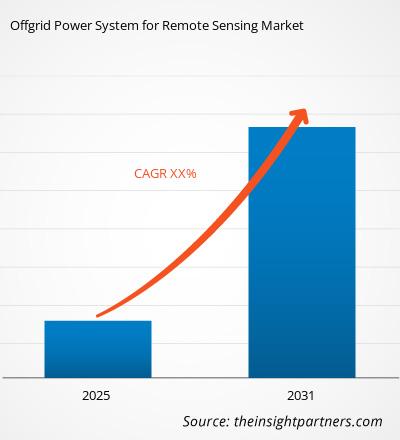
Offgrid Power System for Remote Sensing Market is positioned for sustained expansion as remote monitoring infrastructure increasingly requires dependable autonomous electricity. The market is valued at US$ 642.36 Million in 2025 and is projected to reach US$ 1,699.41 Million by 2034, advancing at a CAGR of 11.42% during 2026–2034. Demand is supported by sensing deployments that must operate continuously where grid access, maintenance access, and conventional power infrastructure remain constrained.
The Offgrid Power System for Remote Sensing Market size in North America is supported by oil and gas monitoring, distributed weather infrastructure, and renewable-energy installations requiring resilient power at isolated sites. Regional expansion is further shaped by methane monitoring programs, increasing deployment of autonomous sensors, and demand for lower-maintenance alternatives to diesel-based generation across remote industrial assets.
Offgrid Power System for Remote Sensing Market Assessment and Insights
- North America: North America is expected to command a 34–38% share in 2025, with a CAGR of 10.8–11.7% during 2026–2034, supported by remote oil and gas assets, methane monitoring, weather stations, and distributed renewable-energy infrastructure.
- US: The US is estimated to represent 76–81% of North America in 2025, expanding at a CAGR of 10.9–11.8% as remote sensing becomes increasingly important for energy infrastructure and environmental compliance.
- Europe: Europe is projected to hold a 24–28% share in 2025 and grow at 10.4–11.3% CAGR through 2034, led by Germany, the UK, France, Italy, and Spain through offshore wind, environmental monitoring, and energy-transition investments.
- Asia Pacific: Asia Pacific is estimated at a 20–24% share in 2025, growing at 12.1–13.1% CAGR, led by China, Japan, South Korea, India, and Australia as remote weather, wind, and energy assets expand.
- Largest Segment: Battery Backup is estimated to hold a 54–58% market share in 2025, with a 10.3–11.2% CAGR through 2034, reflecting established reliability and easy integration.
- High Growth Segment: Fuel Cells are estimated at a 42–46% market share in 2025, expanding at 12.4–13.4% CAGR as long-duration autonomous operation gains importance.
- Key companies analyzed in detail: Acumentrics Holding Corporation; Azuri Technologies Ltd.; Energy Solutions (UK) Limited; Ensol Systems Inc.; Evergreen Energy Technologies Inc.; HES Energy Systems Pte. Ltd.; Koninklijke Philips N.V.; Omnivoltaic Power Co. Ltd.; SFC Energy AG; Solar Energy Company.
Source: The Insight Partners' analysis based on proprietary research, government publications, company annual reports, investor presentations, industry databases, and expert interviews.
The Offgrid Power System for Remote Sensing market has moved from rudimentary battery-powered instruments to advanced autonomous systems that integrate storage, power conditioning, renewable power generation, and fuel cell power back up. Networks of sensors now require uninterrupted energy for SCADA operations, weather station operations, wind measurement, and environmental sensing. The World Meteorological Organization coordinates data collection from about 16,300 surface land-based meteorological stations, giving an indication of the extent and geographic spread of monitoring infrastructure requiring reliable field power.
Investment is increasingly shifting to modular systems that can be deployed without heavy infrastructure work and maintenance remotely. According to the International Energy Agency, off-grid projects will continue to form part of the growth in distributed solar power installations in the future, whereas wind capacity additions will be strong through 2030. This reinforces the relevance of hybrid power systems in developing countries, remote industrial areas, and renewable energy systems.
Offgrid Power System for Remote Sensing Market Report Scope
| Report Attribute | Details |
|---|---|
| Market size in 2025 | US$ 642.36 Million |
| Market Size by 2034 | US$ 1,699.41 Million |
| Global CAGR (2026 - 2034) | 11.42% |
| Historical Data | 2021-2024 |
| Forecast period | 2026-2034 |
Offgrid Power System for Remote Sensing Market Analysis
Growth of the Offgrid Power System for Remote Sensing Market is being driven by the requirement for continuous operation of sensors within locations where grid expansion is economically unfeasible. Demand starts from the specification of the sensing capabilities, communication needs, and uptime by the operators, followed by the integration of batteries, fuel cells, controllers, solar power interfaces, enclosures, and remote management capabilities by the system integrators.
The market is vulnerable to the availability of the batteries, logistics of fuel, semiconductors, and enclosures. Systems based on batteries have reliable supply chains and easy installation capabilities, and fuel cells can reduce service frequency if more autonomy is required. The capability of integration affects the economics of the systems, especially when extreme temperatures, dust, corrosion, or poor access make maintenance and replacement even more expensive.
Offgrid Power System for Remote Sensing Market Report shows market fragmentation of fuel cell companies, solar power systems providers, battery systems providers, and other diversified technology companies. Market development is happening because of increased activity of methanol fuel cells from SFC Energy AG, while Acumentrics Holding Corporation concentrates on the development of rugged power systems. HES Energy Systems Pte. Ltd. specializes in lightweight hydrogen technologies that distinguish them by weight, energy density, and autonomy.
Current trends in investments include hybridization, monitoring, and local service capability. Azuri Technologies Ltd., Omnivoltaic Power Co. Ltd., Energy Solutions (UK) Limited, Ensol Systems Inc., Evergreen Energy Technologies Inc., Koninklijke Philips N.V., and Solar Energy Company provide their products for different segments of the distributed power market. Increasingly, strategic competitive advantage in the industry is based on integration of power generation, storage, control, communication, and services into standard architecture.
● REPORT CUSTOMIZATION
Tailor This Report To Align With Your Specific Business Requirements
This report can be customized to align precisely with your business objectives, scope, and target markets. Customization options include tailored segmentation, geography, competitive analysis, and strategic insights to support informed decision-making.
Customize This Report →WHAT YOU CAN ADJUST
- ● Segmentations
- ● Geography
- ● Competitive Analysis
- ● Language Preferences
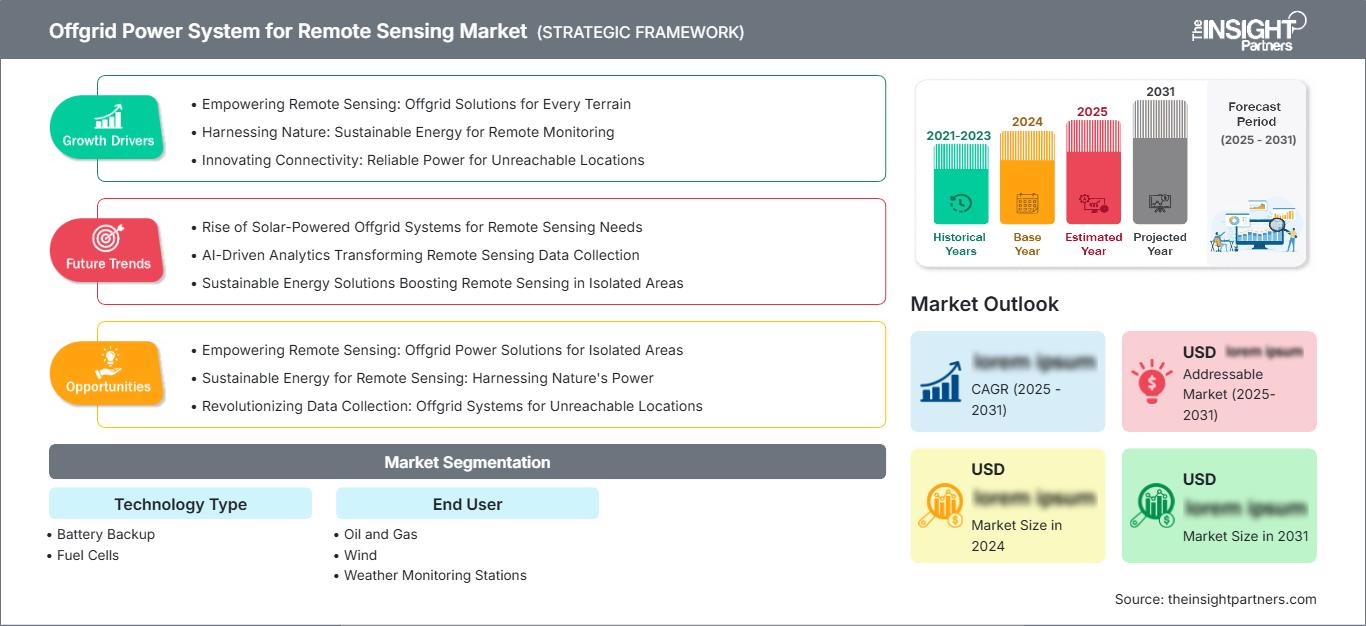
Offgrid Power System for Remote Sensing Market: Strategic Insights
Regional Insights
North America Offgrid Power System for Remote Sensing Market
North America is estimated to represent 34–38% of the global market in 2025 and is expected to expand at a 10.8–11.7% CAGR through 2034. The region benefits from extensive oil and gas infrastructure, remote production sites, wind farms, weather monitoring networks, and environmental sensing programs. US federal methane-monitoring initiatives also encourage operators to deploy autonomous sensing equipment where grid access is limited.
The regional supply base consists of battery back-up, fuel cells, solar, and remote power electronics. The Canadian market includes demand for pipelines, mining, energy services, and remote communications, but the United States is still the key business market. More attention is being paid to total cost of ownership, minimal maintenance, cold weather, and remote monitoring. These conditions require modular systems to sustain sensing continuously with minimum technician intervention.
US Offgrid Power System for Remote Sensing Market
The US accounts for an estimated 76–81% of North America in 2025 and is projected to grow at a 10.9–11.8% CAGR through 2034. Federal initiatives supporting methane measurement and mitigation are increasing the value of continuous monitoring across dispersed oil and gas assets. Remote sensing also supports pipeline integrity, weather observation, wind assessment, and infrastructure surveillance.
Among the corporations operating within the United States, there are SFC Energy AG, Acumentrics Holding Corporation, and technology companies providing services to telecommunication, utility, and industrial monitoring sectors. There is a growing trend in the market that prefers fuel cell backup for applications requiring continuous operation and battery backup for applications requiring shorter autonomy and ease of replacement.
Europe Offgrid Power System for Remote Sensing Market
Europe is expected to hold a 24–28% share in 2025 and expand at a 10.4–11.3% CAGR. Germany is the leading market, supported by industrial monitoring and renewable-energy assets, while the UK, France, Italy, and Spain contribute through distributed weather, wind, environmental, and energy infrastructure.
The UK stands to gain from the expansion of offshore and onshore renewables coupled with advanced environmental monitoring systems. These remote sensing systems have to function effectively despite the maintenance challenges at wind energy plants and coast infrastructures. The demand is thus moving towards power systems that feature high autonomy and remote diagnostics. Germany has an advanced industry and energy integration and, as such, requires reliable power generation for both energy and environment monitoring applications.
For France, Italy, and Spain, there is a unique chance presented. There is an inherent advantage for France because of the monitoring of its meteorology and infrastructure, while Italy's diverse landscape and energy presents an environment where autonomous sensing can be applied. For Spain, there is a favorable environment with abundant solar energy and wind energy installations. The emphasis on emission and energy efficiency monitoring in Europe makes the application of autonomous power systems with low emissions advantageous.
APAC Offgrid Power System for Remote Sensing Market
APAC is estimated to account for 20–24% of the Offgrid Power System for Remote Sensing market share in 2025 and is projected to grow at 12.1–13.1% CAGR. China leads the region, followed by Japan, South Korea, India, and Australia. Industrial expansion, wind development, weather monitoring, and remote infrastructure investment support demand.
The manufacturing capacity of China provides an edge in equipment competitiveness, whereas Japan focuses on reliability and resilience to disasters. South Korea is enabled by industrial and renewable infrastructure, India by expanding weather and energy sensing, and Australia by geographically distributed mining, wind and environment sites. The support by policy makers of renewables and distributed electricity increases the need for autonomous sensing power.
Middle East and Africa Offgrid Power System for Remote Sensing Market
The Middle East and Africa market is expected to expand at a 9.8–10.8% CAGR, supported by remote energy infrastructure and limited grid access. Saudi Arabia leads regional investment, followed by the UAE and South Africa, while other markets offer opportunities around isolated industrial and environmental monitoring.
Investment in infrastructure where stable autonomous power generation would enable power and security surveillance is seen in Saudi Arabia and the United Arab Emirates. South Africa profits from its use of off-grid solar power and renewables. In the remaining MEA region, the use of solar-battery combination power plants is favorable due to abundant sunshine and infrastructural challenges, while fuel cells are applicable for longer autonomy.
Segmentation Analysis
Technology Type
The Technology Type segment covers Battery Backup and Fuel Cells, with the overall technology segment expected to expand at a 11.1–12.0% CAGR during 2026–2034. System selection depends on autonomy, maintenance frequency, operating temperature, fuel availability, sensor load, and the consequences of power interruption.
- Battery Backup: Battery Backup remains the established choice for weather stations, wind monitoring equipment, and low-power remote sensors because installation is simple and charging can be paired with solar generation. Its strategic importance is reinforced by mature components and straightforward replacement procedures.
- Fuel Cells: Fuel Cells provide extended autonomous operation where servicing is difficult or continuous availability is essential. Their role is expanding in critical monitoring, telecommunications, infrastructure surveillance, and industrial locations where longer runtime can offset higher system complexity.
End User
The End User segment is expected to advance at a 11.6–12.5% CAGR through 2034 as remote monitoring expands across energy and environmental applications. Operators increasingly evaluate autonomous power as an essential component of sensing reliability rather than a peripheral equipment choice.
- Oil and Gas: Oil and Gas remains strategically important because dispersed wells, pipelines, processing assets, and methane-monitoring points require dependable sensing without extensive grid infrastructure. Autonomous power supports continuous measurement while reducing repeated site visits.
- Wind: Wind applications require reliable power for meteorological, structural, communications, and condition-monitoring equipment around geographically dispersed turbines. Hybrid power systems can improve availability at sites where grid connections are costly or maintenance access is difficult.
- Weather Monitoring Stations: Weather Monitoring Stations depend on continuous sensor operation for temperature, pressure, rainfall, humidity, and wind observations. Battery-solar architectures remain attractive because they support unattended operation across remote and environmentally exposed locations.
Opportunity Snapshot
| End Users | Revenue Contribution (High/Medium/Low) | Trend Tag (MAX 2 words) | Adoption Stage (Emerging/Scaling/Mature) |
|---|---|---|---|
| Oil and Gas | High | Methane Monitoring | Scaling |
| Wind | High | Turbine Sensing | Scaling |
| Weather Monitoring Stations | Medium | Climate Observation | Mature |
Offgrid Power System for Remote Sensing Market Growth Drivers and Impact Analysis
Autonomous monitoring requirements across dispersed energy assets
The expansion of dispersed energy infrastructure is increasing the number of sensing points that must operate independently from conventional electrical networks. Oil and gas operators monitor wells, pipelines, compressors, and processing assets across large geographic areas, while wind developers require power for meteorological and condition-monitoring equipment. DOE programs supporting methane measurement reinforce the economic relevance of continuous remote sensing. Autonomous power reduces dependency on grid extension and limits technician visits to distant assets. Battery systems remain effective for modest loads, while fuel cells can address longer-duration requirements. The resulting demand is shifting purchasing criteria toward uptime, remote diagnostics, service intervals, and lifecycle cost. Suppliers able to package power generation, storage, controls, and communications into standardized systems are consequently better positioned to capture recurring deployments across distributed monitoring networks.
Greater emphasis on methane measurement and environmental compliance
Environmental monitoring requirements are increasing the operational value of persistent sensing across energy infrastructure. The IEA identifies the energy sector as responsible for more than 35% of human-caused methane emissions, while US federal programs have allocated substantial resources toward monitoring, measurement, and mitigation. These requirements create demand for sensors capable of collecting data continuously or at frequent intervals from locations without reliable grid electricity. Autonomous power systems directly address that infrastructure gap. Operators can install monitoring points at wells, gathering systems, pipelines, and other assets without constructing dedicated electrical connections. Fuel cells can provide long-duration backup where service visits are expensive, while batteries can support lower-power equipment. As regulatory frameworks increasingly require verifiable measurements, reliable power becomes an enabling infrastructure layer for compliance rather than merely a convenience.
Renewable-energy expansion increases demand for independent field power
Rapid renewable deployment is creating a wider installed base of remote assets that require sensing and communications infrastructure. The IEA expects cumulative onshore wind capacity additions during 2025–2030 to increase 45% compared with 2019–2024, reaching 732 GW. Each expansion creates requirements for weather measurement, asset monitoring, communications, and control equipment. Remote sites often face difficult terrain, limited grid access, and high maintenance costs, making autonomous power attractive. Solar-battery architectures can provide routine electricity for low-power sensors, while fuel cells offer additional resilience during prolonged low-generation periods. As renewable projects become geographically dispersed, system integrators increasingly prioritize standardized, modular power packages. This trend supports suppliers capable of delivering compact systems that combine generation, storage, controls, communications, and environmental protection without requiring extensive site construction.
Offgrid Power System for Remote Sensing Market Future Trends
Intelligent hybrid power management for sensor networks
The Offgrid Power System for Remote Sensing Market trends are moving toward intelligent hybrid architectures that dynamically coordinate batteries, renewable inputs, fuel cells, and sensing loads. Rather than sizing systems only for peak demand, operators are increasingly evaluating energy availability, forecast conditions, battery state, sensor duty cycles, and communications requirements together. Advanced controllers can prioritize solar charging, preserve battery reserves, and activate fuel-cell backup only when required. Remote diagnostics can also identify abnormal energy consumption, battery degradation, or charging failures before service interruptions occur. Over time, predictive algorithms may connect weather forecasts with power-management decisions, particularly for meteorological and wind installations. This approach can reduce fuel consumption, improve battery utilization, and increase autonomy without proportionally increasing installed capacity. Standardized software interfaces will further enable operators to manage geographically distributed sensing assets from centralized control environments.
Hydrogen-ready architectures expand beyond conventional backup applications
Fuel-cell deployments are likely to broaden as hydrogen storage, logistics, and low-power stationary systems mature. The most relevant shift is not simply replacing batteries, but creating hybrid architectures where batteries handle short-duration fluctuations while fuel cells provide extended autonomy. Such configurations can reduce the required battery capacity and support continuous operation during prolonged periods of weak solar availability or extreme weather. Remote infrastructure operators may increasingly value systems that accept different hydrogen supply models, including delivered fuel and potentially locally produced hydrogen where renewable resources permit. Standardized interfaces, compact balance-of-plant components, and simplified maintenance will be important for wider adoption. The trend is particularly relevant to isolated energy, environmental, and infrastructure monitoring locations where downtime can compromise datasets, regulatory reporting, asset protection, or operational decision-making.
Offgrid Power System for Remote Sensing Market Opportunities
Integrated power packages for methane and pipeline monitoring
Offgrid Power System for Remote Sensing Market Forecasts point to opportunities in integrated packages designed specifically for methane, pipeline, and distributed asset monitoring. Suppliers can combine sensing power, solar generation, batteries, fuel cells, communications, telemetry, and enclosure protection into standardized field units. This reduces engineering effort for operators deploying hundreds or thousands of monitoring points and creates opportunities for recurring service revenue. The strongest commercial proposition is likely to center on measurable uptime, maintenance intervals, remote diagnostics, and total cost of ownership rather than equipment price alone. Partnerships between power-system manufacturers, sensor companies, communications providers, and oil and gas integrators could accelerate deployments. Vendors that demonstrate interoperability with existing SCADA and environmental-management platforms may gain an advantage because operators increasingly seek centralized visibility across distributed assets rather than isolated monitoring hardware.
Localized manufacturing and service ecosystems in emerging markets
A second opportunity lies in regionalizing assembly, maintenance, and distribution for autonomous sensing power systems in Asia Pacific, the Middle East, and Africa. Remote projects often incur high logistics costs, making local service capability a meaningful purchasing criterion. Manufacturers can develop modular designs using regionally available batteries, photovoltaic components, power electronics, and enclosure systems while retaining standardized control architectures. Local partnerships can shorten replacement cycles and support technical training, particularly for weather stations, wind farms, and energy infrastructure located far from major cities. Financing models that combine equipment, maintenance, monitoring, and replacement services could further reduce adoption barriers. As distributed renewable and environmental-monitoring programs expand, suppliers with localized support networks can improve project economics while reducing dependence on specialized field teams traveling across large territories.
Frequently Asked Questions

- Comprehensive Market Sizing and Forecast Analysis
- Detailed Segmentation Analysis
- In-Depth Market Dynamics Assessment
- Regional and Country-Level Insights
- Competitive Landscape and Company Benchmarking
- Strategic Business Intelligence
Recent Reports
Testimonials

The Insight Partners provided valuable market intelligence that supported our global go-to-market strategy. Their team was professional, responsive, and attentive to our feedback, providing thoughtful analysis and helpful methodological clarifications throughout the project.
Junmo Kim Chief Financial Officer (CFO), Enertech Co., Ltd.
The Insight Partners' SCADA System Market report is comprehensive, with valuable insights on current trends and future forecasts. The team was highly professional, responsive, and supportive throughout. We are very satisfied and highly recommend their services.
RAN KEDEM Partner, Reali Technologies LTDs
I requested a report on a very specific software market and the team produced the report in a few days. The information was very relevant and well presented. I then requested some changes and additions to the report. The team was again very responsive and I got the final report in less than a week.
JEAN-HERVE JENN Chairman, Future Analytica
We worked with The Insight Partners for an important market study and forecast. They gave us clear insights into opportunities and risks, which helped shape our plans. Their research was easy to use and based on solid data. It helped us make smart, confident decisions. We highly recommend them.
PIYUSH NAGPAL Sr. Vice President, High Beam Global
The Insight Partners delivered insightful, well-structured market research with strong domain expertise. Their team was professional and responsive throughout. The user-friendly website made accessing industry reports seamless. We highly recommend them for reliable, high-quality research services
YUKIHIKO ADACHI CEO, Deep Blue, LLC.
This is the first time I have purchased a market report from The Insight Partners.While I was unsure at first, I visited their web site and felt more comfortable to take the risk and purchase a market report.I am completely satisfied with the quality of the report and customer service. I had several questions and comments with the initial report, but after a couple of dialogs over email with their analyst I believe I have a report that I can use as input to our strategic planning process.Thank you so much for taking the extra time and making this a positive experience.I will definitely recommend your service to others and you will be my first call when we need further market data.
JOHN SUZUKI President and Chief Executive Officer, Board Director, BK Technologies
I wish to appreciate your support and the professionalism you displayed in the course of attending to my request for information regarding to infectious disease IVD market in Nigeria. I appreciate your patience, your guidance, and the fact that you were willing to offer a discount, which eventually made it possible for us to close a deal. I look forward to engaging The Insight Partners in the future, all thanks to the impression you have created in me as a result of this first encounter.
DR CHIJIOKE ONYIA MANAGING DIRECTOR, PineCrest Healthcare Ltd.Reason to Buy
- Informed Decision-Making
- Understanding Market Dynamics
- Competitive Analysis
- Identifying Emerging Markets
- Customer Insights
- Market Forecasts
- Risk Mitigation
- Boosting Operational Efficiency
- Strategic Planning
- Investment Justification
- Tracking Industry Innovations
- Aligning with Regulatory Trends





 Get Free Sample for