
Metal Detecting Sensor Market Size, Growth & Trends by 2034
Coverage: By Type (General Type, Nonferrous Metal Type); Application (Food and Beverage, Industrial, Security, Other) , and Geography (North America, Europe, Asia Pacific, and South and Central America)
- Status : Data Released
- Report Code : TIPRE00024845
- Category : Electronics and Semiconductor
- No. of Pages : 150
- Available Report Formats :


- Last update date : October 13, 2026


2025 Market Size
US$ 1.65 Bn
Base year value
2034 Forecast
US$ 2.94 Bn
Projected by 2034
CAGR 2026-2034
7.49 %
Growth rate
Addressable Market
US$ 21.68 Bn
(2026-2034)
The Metal Detecting Sensor Market was valued at US$ 1.65 Billion in 2025 and is projected to reach US$ 2.94 Billion by 2034, registering a CAGR of 7.49% during 2026–2034. Growing emphasis on industrial quality assurance, food safety compliance, security screening, and advanced inspection technologies continues to support steady market expansion. Manufacturers are investing in improved sensing accuracy, digital signal processing, and compact detection systems to meet evolving operational requirements across multiple industries.
Across North America, technological modernization and stringent product quality regulations continue to strengthen industry demand. The metal detecting sensor market size is supported by increasing automation in manufacturing, widespread deployment across food processing facilities, and expanding security infrastructure at transportation hubs. The regional market is estimated to expand at a CAGR of 6.8–7.4% during 2026–2034, supported by sustained investments in industrial automation and regulatory compliance initiatives.
Metal Detecting Sensor Market Assessment and Insights
- North America: North America accounted for an estimated 34–38% share in 2025 and is projected to expand at a CAGR of 6.8–7.4% during 2026–2034. Stable manufacturing output, strong food safety regulations, and continued investment in airport and public security screening systems support long-term regional demand.
- US: The United States represented approximately 78–82% of the North American market in 2025 and is expected to grow at a CAGR of 6.9–7.5% during 2026–2034, supported by industrial automation, food inspection modernization, and homeland security investments.
- Europe: Europe held an estimated 26–30% share in 2025 and is anticipated to register a CAGR of 6.7–7.3% during 2026–2034. Germany, the United Kingdom, France, Italy, and Spain continue to lead regional adoption through advanced manufacturing, food processing, and industrial quality control initiatives.
- Asia Pacific: Asia Pacific accounted for approximately 24–28% share in 2025 and is projected to record the fastest regional expansion with a CAGR of 8.2–8.8% during 2026–2034. China, Japan, South Korea, and India are increasing investments in industrial automation, electronics manufacturing, and modern inspection technologies.
- Largest Segment: Food and Beverage represented the largest application, contributing an estimated 42–46% market share in 2025 and expected to expand at a CAGR of 7.2–7.8% during 2026–2034, driven by stringent food safety regulations and quality assurance requirements across processing facilities.
- High Growth Segment: Security is projected to be the fastest-growing application, accounting for an estimated 24–28% market share in 2025 while advancing at a CAGR of 8.5–9.1% during 2026–2034, supported by increasing investments in transportation security, public infrastructure, and critical facility protection.
- Key companies analyzed in detail: Minelab Electronics Pty Ltd., Bounty Hunter, Fisher Research Laboratory, Garrett Electronics Inc., Teknetics, White’s Electronics, Titan Detectors, Tesoro Electronics, Makro Detector, and Nokta Detection Technologies.
Source: The Insight Partners' analysis based on proprietary research, government publications, company annual reports, investor presentations, industry databases, and expert interviews.
Modern manufacturing firms are increasingly using intelligent inspection systems in their production processes to enhance the quality of products produced, cut down wastage, and meet safety requirements that are being put into place. The recent progress made in terms of signal processing and artificial intelligence filtering has greatly increased the accuracy in the detection process while at the same time lowering the number of false rejections. The portable systems have become smaller and more energy efficient, while the stationary industrial systems have been integrated into the automated manufacturing processes.
The future growth will be driven by manufacturing projects in Southeast Asia, the Middle East, and Latin America as the industrial automation process gains momentum. Requirements from regulatory bodies for safety in food, infrastructure, and the work environment have promoted the use of the intelligent sensing platform. The metal detecting sensor market growth will also benefit from digital factory initiatives, predictive maintenance solutions, and increasing integration of connected inspection equipment capable of supporting real-time production monitoring and data-driven quality management.
Metal Detecting Sensor Market Report Scope
| Report Attribute | Details |
|---|---|
| Market size in 2025 | US$ 1.65 Billion |
| Market Size by 2034 | US$ 2.94 Billion |
| Global CAGR (2026 - 2034) | 7.49% |
| Historical Data | 2021-2024 |
| Forecast period | 2026-2034 |
Metal Detecting Sensor Market Analysis
The demand is still on the rise as companies consider issues such as contamination, automation, and efficiency. According to the metal detecting sensor market analysis, food processors are the largest customers since regulations require the identification of metal particles before reaching consumers. Meanwhile, industrial manufacturers are making more use of the sensors in conveyors, recycling plants, mining processes, and packaging to eliminate production interruptions and achieve uniformity in their products.
Supply chain evolution has encouraged manufacturers to integrate advanced sensors with programmable logic controllers, industrial Internet of Things platforms, and cloud-enabled monitoring software. Component suppliers are emphasizing higher sensitivity, electromagnetic interference resistance, and modular system architecture that reduces maintenance requirements. Improvements in semiconductor technologies and embedded processors have also enabled faster signal interpretation, supporting higher inspection throughput without compromising detection precision across demanding operating environments.
There continues to be competition in terms of continuous innovations in the products offered, customization of their applications, and their ability to distribute globally. Some of these competitors include Minelab Electronics Pty Ltd., Garrett Electronics Inc., Fisher Research Laboratory, Teknetics, Nokta Detection Technologies, Makro Detector, Bounty Hunter, Titan Detectors, Tesoro Electronics, and White’s Electronics. They use competitive technology innovations, software upgrades, ergonomics in product designs, and expansion of service networks as their competitive strategies.
Investor interest is more and more oriented toward R&D of small-sized multi-frequency detectors, AI-driven discrimination methods, and integrated systems for inspection purposes that will be compatible with automated manufacturing operations. Agencies, manufacturers of food products, and industry representatives keep investing in inspection technologies that can help meet regulations and increase effectiveness. With further global expansion of digital manufacturing, the market environment should experience growth in terms of replacement demand, technology modernization, and implementation within new industries.
● REPORT CUSTOMIZATION
Tailor This Report To Align With Your Specific Business Requirements
This report can be customized to align precisely with your business objectives, scope, and target markets. Customization options include tailored segmentation, geography, competitive analysis, and strategic insights to support informed decision-making.
Customize This Report →WHAT YOU CAN ADJUST
- ● Segmentations
- ● Geography
- ● Competitive Analysis
- ● Language Preferences
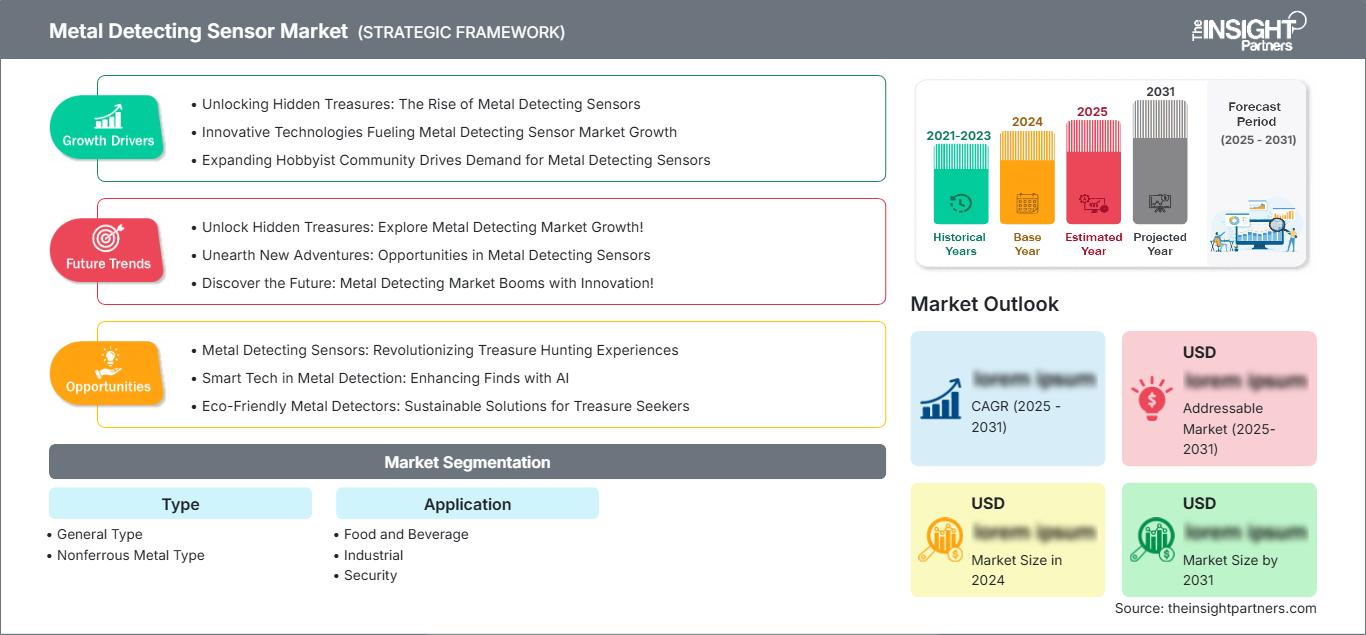
Metal Detecting Sensor Market: Strategic Insights
Regional Insights
North America Metal Detecting Sensor Market
North America accounted for an estimated 34–38% of the metal detecting sensor market share in 2025 and is projected to expand at a CAGR of 6.8–7.4% through 2034. Increased use of automated inspection technology in food processing, pharmaceuticals, logistics, and manufacturing has continued to drive regional demand. Airport and security infrastructure development has contributed to greater installation of the equipment, while strict safety requirements for products have promoted constant improvement in advanced inspection systems.
Industrial companies across the region continue to combine the use of metal detection with industrial automation and quality control systems. In terms of contribution, the U.S. stands out owing to its well-developed industry and research capabilities, while Canada has an advantage owing to its mining operations and exports of food products. Replacement of traditional inspection systems with multi-frequency intelligent detectors is likely to contribute to regional growth.
U.S. Metal Detecting Sensor Market
The United States represented approximately 78–82% of the North American Metal Detecting Sensor Market during 2025 and is anticipated to register a CAGR of 6.9–7.5% through the forecast period. Strong domestic manufacturing capabilities, high regulatory compliance standards, and increasing investments in industrial automation continue to support market expansion. Food manufacturers remain among the largest adopters because contamination prevention and traceability requirements have become increasingly stringent across processing facilities.
The country also demonstrates significant adoption across airports, government facilities, logistics centers, and industrial production plants. Leading technology providers maintain research, engineering, and distribution operations throughout the United States, enabling rapid commercialization of new sensing technologies. Increasing integration with artificial intelligence-based inspection software, predictive maintenance platforms, and industrial Internet of Things infrastructure further strengthens the country's competitive position within the global market.
Europe Metal Detecting Sensor Market
Europe accounted for approximately 26–30% of the global Metal Detecting Sensor Market demand during 2025 and is projected to expand at a CAGR of 6.7–7.3% through 2034. Germany continues to lead regional adoption through advanced manufacturing, industrial automation, and engineering excellence. The United Kingdom demonstrates strong demand from food processing, pharmaceutical manufacturing, and transportation security, supported by ongoing investments in modern inspection infrastructure and digital quality assurance systems.
France, Italy, and Spain collectively contribute substantial regional demand through expanding packaged food production, industrial modernization, and export-oriented manufacturing activities. Regulatory requirements related to product safety, contamination control, and workplace quality standards continue to encourage investments in advanced inspection technologies. European manufacturers increasingly prioritize energy-efficient equipment, connected production environments, and intelligent sensing platforms capable of supporting Industry 4.0 initiatives across multiple industrial sectors.
APAC Metal Detecting Sensor Market
Asia Pacific represented an estimated 24–28% of the global Metal Detecting Sensor Market in 2025 and is forecast to register the highest regional CAGR of 8.2–8.8% through 2034. China leads regional demand owing to its extensive manufacturing ecosystem, while Japan and South Korea continue investing in precision industrial inspection technologies and advanced automation solutions.
India and Australia are witnessing increased deployment across food processing, mining, and industrial manufacturing facilities. Government initiatives supporting domestic manufacturing, digital industrial transformation, and export competitiveness continue to accelerate the adoption of intelligent metal detection systems throughout the region.
Middle East & Africa Metal Detecting Sensor Market
The Middle East and Africa market is anticipated to expand at a CAGR of 6.4–7.0% during 2026–2034. Saudi Arabia and the United Arab Emirates continue investing in industrial diversification, logistics infrastructure, and airport modernization projects, supporting demand for advanced inspection technologies. South Africa remains an important market due to mining activities and industrial manufacturing expansion.
Energy infrastructure development, food processing investments, and modernization of transportation facilities continue creating new opportunities across the Rest of the Middle East and Africa. Increasing focus on industrial safety, quality assurance, and infrastructure resilience is expected to support gradual market expansion throughout the forecast period.
Segmentation Analysis
Type
The Type segment is projected to expand at a CAGR of 7.1–7.7% during 2026–2034. The metal detecting sensor market scope continues to broaden as industries demand higher detection sensitivity, improved discrimination capabilities, and reliable operation across diverse production environments. Continuous technological advancements in electromagnetic sensing, digital filtering, and multi-frequency processing are encouraging adoption across industrial manufacturing, security, and food inspection applications.
- General Type – Widely deployed across industrial production, mining, construction, and security operations due to dependable performance, operational simplicity, and cost-effective inspection capabilities suitable for routine metallic object detection.
- Nonferrous Metal Type – Increasingly adopted where precise identification of aluminum, copper, brass, and other nonferrous materials is essential, particularly within advanced manufacturing, recycling, electronics production, and specialized industrial quality control environments.
Application
The Application segment is expected to register a CAGR of 7.4–8.0% during the forecast period. Demand is driven by expanding industrial automation, stricter product safety regulations, and growing investments in public security infrastructure. Food safety compliance, operational efficiency, and infrastructure protection continue to encourage broader deployment of advanced sensing technologies across both mature and developing economies.
- Food and Beverage – Represents the largest application owing to stringent contamination control regulations, automated processing lines, and increasing investment in quality assurance systems that improve consumer safety and regulatory compliance.
- Industrial – Strong demand originates from manufacturing, mining, recycling, packaging, and material handling operations where reliable metal detection minimizes equipment damage, production downtime, and maintenance costs while improving operational efficiency.
- Security – Growing adoption across airports, transportation hubs, public venues, government facilities, educational institutions, and critical infrastructure reflects increasing investments in advanced screening technologies designed to strengthen public safety and threat detection capabilities.
Opportunity Snapshot
| Application | Revenue Contribution | Trend Tag | Adoption Stage |
|---|---|---|---|
| Food and Beverage | High | Contamination Detection | Mature |
| Industrial | High | Factory Automation | Scaling |
| Security | Medium | Smart Screening | Scaling |
Metal Detecting Sensor Market Growth Drivers and Impact Analysis
Expansion of Automated Manufacturing and Quality Inspection Systems
Introduction of Industry 4.0 technology is leading to the transformation of manufacturing plants for food processing, electronics, automotive, pharmaceuticals and consumer goods industries. Manufacturing plants with automated production lines must have a continuous inspection system that can detect metals without hindering the flow of work and thus metal detecting sensors are a crucial part of manufacturing plants today. Manufacturers are increasingly adopting inspection systems that work with PLC, machine vision systems and an industrial IoT platform in order to increase visibility of the process and minimize loss of production. It helps to detect contamination at an early stage, hence reducing product recall and any other losses like damaging of machinery and downtime of the plant. It encourages the replacement of old inspection systems with intelligent multi-frequency sensors.
Increasing Global Focus on Food Safety and Regulatory Compliance
Food producers are continuing their efforts to use sophisticated inspection systems due to increasing quality standards being set by regulatory authorities and international frameworks for food safety. International food supply chains are growing in complexity, and manufacturers need to introduce efficient contamination detection systems at all stages of the manufacturing process and packaging. Metal detection sensors can assist in preventing contamination, protecting consumers' well-being, and avoiding economic risks of product recalls and penalties. Higher demands of consumers towards food quality products also make it possible for food manufacturers to invest in intelligent inspection systems that can help keep the same level of production efficiency but improve traceability.
Growing Investments in Security Infrastructure and Critical Facilities
There is a continued growth in the number of investments made by governments and other private sectors in infrastructure such as transport, places, facilities, and border security, resulting in increased demand for better metal detectors. There is an increased need for efficient screening systems at airports, railway stations, institutions of learning, government buildings, and even during events that will be able to detect any metallic materials efficiently without causing any delays. The modern systems of security will be equipped with artificial intelligence and digital signal processing to enhance efficiency in detecting and minimizing false alarms.
Metal Detecting Sensor Market Future Trends
Artificial Intelligence Enhancing Detection Accuracy
Artificial intelligence is expected to reshape the metal detecting sensor market trends by enabling adaptive signal processing, automated calibration, and intelligent discrimination between contaminants and acceptable metallic materials. In future inspection systems, machine learning algorithms will be extensively used to minimize the occurrence of false positives while increasing efficiency. The use of analytics in the cloud, predictive maintenance software, and digital production systems will help optimize the performance of inspection systems. As manufacturers adopt the concept of smart factories, intelligent sensors are expected to become an integral part of industrial connected ecosystems that increase productivity and traceability.
Expansion of Connected Multi-Frequency Inspection Platforms
The next generation of metal detectors is predicted to include multi-frequency sensing, wireless communication, and diagnostic features in their design, which are portable enough for use in automated manufacturing settings. There has been a steady trend towards the development of modular metal detectors, whose functionalities can be modified by software, thus allowing integration with robotic technology, IoT industrial systems, and enterprise resource planning systems. This trend will help achieve greater versatility in operations, minimize maintenance and prolong the lifetime of the equipment. The widespread adoption of digital manufacturing processes in emerging markets will further fuel the adoption of such technologies.
Metal Detecting Sensor Market Opportunities
Expansion Across Emerging Industrial Manufacturing Hubs
Rapid industrialization throughout Southeast Asia, Latin America, the Middle East, and selected African economies presents substantial investment opportunities for sensor manufacturers and technology providers. Expanding food processing capacity, electronics manufacturing, automotive production, and mining operations continue to increase demand for reliable inspection equipment capable of supporting international quality standards. Metal detecting sensor market forecasts indicate that localized manufacturing, regional distribution partnerships, and application-specific product development will become increasingly important competitive strategies. Companies investing in regional technical support, customized industrial solutions, and cost-efficient manufacturing capabilities will be well-positioned to capture demand generated by expanding industrial infrastructure and modernization initiatives across emerging economies.
Development of Compact Smart Detection Solutions for Diverse Applications
There is much scope available in terms of marketing of detection devices that are smart, mobile, and energy-efficient. Remote diagnostics, wireless capabilities, calibration through artificial intelligence, and predictive maintenance can help meet the needs of changing customers and keep costs down. Development in semiconductors, embedded software, and cloud-based monitoring would distinguish future products. Companies that can combine high sensitivity of detection and seamless incorporation into manufacturing lines can expect better positioning in the future because of growing replacement needs.
Frequently Asked Questions

- Comprehensive Market Sizing and Forecast Analysis
- Detailed Segmentation Analysis
- In-Depth Market Dynamics Assessment
- Regional and Country-Level Insights
- Competitive Landscape and Company Benchmarking
- Strategic Business Intelligence
Recent Reports
Testimonials

The Insight Partners provided valuable market intelligence that supported our global go-to-market strategy. Their team was professional, responsive, and attentive to our feedback, providing thoughtful analysis and helpful methodological clarifications throughout the project.
Junmo Kim Chief Financial Officer (CFO), Enertech Co., Ltd.
The Insight Partners' SCADA System Market report is comprehensive, with valuable insights on current trends and future forecasts. The team was highly professional, responsive, and supportive throughout. We are very satisfied and highly recommend their services.
RAN KEDEM Partner, Reali Technologies LTDs
I requested a report on a very specific software market and the team produced the report in a few days. The information was very relevant and well presented. I then requested some changes and additions to the report. The team was again very responsive and I got the final report in less than a week.
JEAN-HERVE JENN Chairman, Future Analytica
We worked with The Insight Partners for an important market study and forecast. They gave us clear insights into opportunities and risks, which helped shape our plans. Their research was easy to use and based on solid data. It helped us make smart, confident decisions. We highly recommend them.
PIYUSH NAGPAL Sr. Vice President, High Beam Global
The Insight Partners delivered insightful, well-structured market research with strong domain expertise. Their team was professional and responsive throughout. The user-friendly website made accessing industry reports seamless. We highly recommend them for reliable, high-quality research services
YUKIHIKO ADACHI CEO, Deep Blue, LLC.
This is the first time I have purchased a market report from The Insight Partners.While I was unsure at first, I visited their web site and felt more comfortable to take the risk and purchase a market report.I am completely satisfied with the quality of the report and customer service. I had several questions and comments with the initial report, but after a couple of dialogs over email with their analyst I believe I have a report that I can use as input to our strategic planning process.Thank you so much for taking the extra time and making this a positive experience.I will definitely recommend your service to others and you will be my first call when we need further market data.
JOHN SUZUKI President and Chief Executive Officer, Board Director, BK Technologies
I wish to appreciate your support and the professionalism you displayed in the course of attending to my request for information regarding to infectious disease IVD market in Nigeria. I appreciate your patience, your guidance, and the fact that you were willing to offer a discount, which eventually made it possible for us to close a deal. I look forward to engaging The Insight Partners in the future, all thanks to the impression you have created in me as a result of this first encounter.
DR CHIJIOKE ONYIA MANAGING DIRECTOR, PineCrest Healthcare Ltd.Reason to Buy
- Informed Decision-Making
- Understanding Market Dynamics
- Competitive Analysis
- Identifying Emerging Markets
- Customer Insights
- Market Forecasts
- Risk Mitigation
- Boosting Operational Efficiency
- Strategic Planning
- Investment Justification
- Tracking Industry Innovations
- Aligning with Regulatory Trends





 Get Free Sample for