
IoT-based Asset Tracking and Monitoring Market Size, Share & Trends by 2034
IoT-based Asset Tracking and Monitoring Market Size and Forecasts (2021 - 2034), Global and Regional Share, Trends, and Growth Opportunity Analysis Report Coverage : By Connectivity Type (Wi-Fi, Bluetooth, Cellular, NB-IoT, LoRa, SigFox, UWB, GNSS, ZigBee, Thread), Monitoring Type (Indoor, Outdoor), Application (Manufacturing, Automotive)
- Status : Data Released
- Report Code : TIPRE00039496
- Category : Electronics and Semiconductor
- No. of Pages : 150
- Available Report Formats :


- Last update date : October 16, 2026


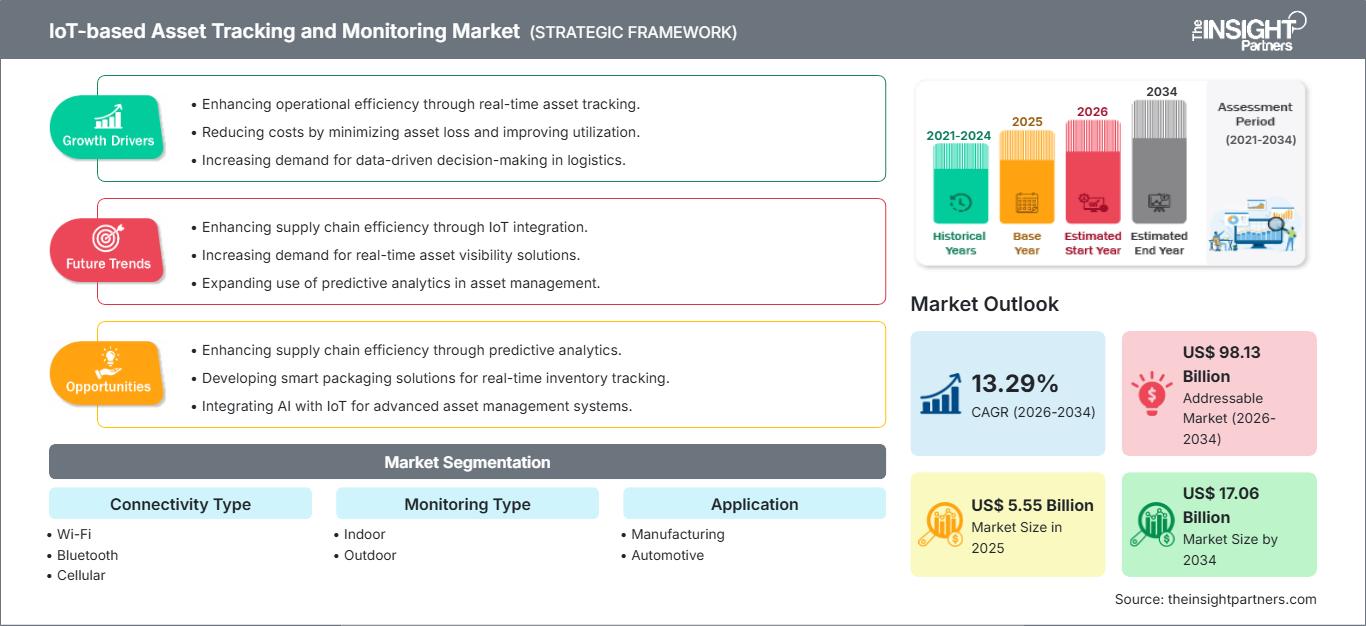
2025 Market Size
US$ 5.55 Bn
Base year value
2034 Forecast
US$ 17.06 Bn
Projected by 2034
CAGR 2026-2034
13.29 %
Growth rate
Addressable Market
US$ 98.13 Bn
(2026-2034)
IoT-based Asset Tracking and Monitoring Market is expanding from US$ 5.55 Billion in 2025 to US$ 17.06 Billion by 2034, registering a CAGR of 13.29% during 2026–2034. The market encompasses connected hardware, wireless networks, positioning technologies, sensors, and monitoring platforms used to identify, locate, and assess physical assets across operational environments. Adoption is increasingly shaped by demand for continuous visibility, lower asset losses, automated workflows, and condition-aware decision-making across industrial ecosystems.
North America IoT-based Asset Tracking and Monitoring Market Size presents a mature demand environment, supported by established cellular infrastructure, extensive logistics networks, and high enterprise adoption of connected operations. The region is estimated to expand at a 11–14% CAGR through 2034. Manufacturing modernization and fleet digitization remain structural drivers, while broader use of edge analytics strengthens the business case for location and condition monitoring.
IoT-based Asset Tracking and Monitoring Market Assessment and Insights
- North America commands a leading position, with a 2025 share of 32–36% and a 2026–2034 CAGR of 11–14%, supported by mature connectivity, industrial automation, and enterprise logistics digitization.
- US represents 70–75% of North America's 2025 market, expanding at a 2026–2034 CAGR of 11–14%, with fleet, manufacturing, and warehouse applications sustaining demand.
- Europe accounts for a 2025 share of 25–29% and a 2026–2034 CAGR of 12–14%, led by Germany, the UK, France, Italy, and Spain as traceability requirements deepen.
- Asia Pacific represents 30–33% of 2025 demand and is expected to register a 2026–2034 CAGR of 14–16%, led by China, Japan, South Korea, India, and Australia.
- Largest Segment: Cellular holds a 22–25% market share in 2025, with a 2026–2034 CAGR of 13–15%, reflecting wide-area coverage and mobility requirements.
- High Growth Segment: UWB represents a 7–10% market share in 2025 and is projected at a 2026–2034 CAGR of 17–20%, driven by precision indoor positioning.
- Key companies analyzed in detail: Quectel Wireless Solutions Co., Ltd.; Fibocom Wireless Inc.; u-blox AG; Telit Cinterion; Semtech Corporation; Ezurio LLC; Nordic Semiconductor ASA; Samsara Inc.; Sequans Communications S.A.; Solera Holdings, Inc.
Source: The Insight Partners' analysis based on proprietary research, government publications, company annual reports, investor presentations, industry databases, and expert interviews.
The Connected Tracking concept has been shifting from basic location tracking toward multi-sensor visibility that combines positioning, connectivity, telemetry, and analytics. Modules based on cell communication technology have already begun utilizing GNSS, while Bluetooth, UWB, Wi-Fi, and LPWA technologies will address indoor location requirements and low power aspects. The manufacturing process has begun transitioning toward smaller low power consumption devices, standardized modules, remote provisioning, and software-defined monitoring solutions, which help reduce the complexities of deploying them within global asset fleets.
Increasingly, the future looks promising for new industrial economies where high density logistics, high-scale manufacturing operations, and infrastructure investments converge. Traceability projects in Europe, connected fleet projects in North America, and industrial automation in the Asia Pacific region should inspire investments in connected tracking architectures. Satellite communications and hybrid positioning are helping widen the target market by enabling tracking of assets operating out of reach of terrestrial networks.
IoT-based Asset Tracking and Monitoring Market Report Scope
| Report Attribute | Details |
|---|---|
| Market size in 2025 | US$ 5.55 Billion |
| Market Size by 2034 | US$ 17.06 Billion |
| Global CAGR (2026 - 2034) | 13.29% |
| Historical Data | 2021-2024 |
| Forecast period | 2026-2034 |
IoT-based Asset Tracking and Monitoring Market Analysis
IoT-based Asset Tracking and Monitoring Market growth is further fueled by companies’ need for quantifiable asset optimization, loss reduction, accuracy of the inventory, and maintenance planning. IoT-enabled Asset Tracking and Monitoring Market growth is becoming increasingly dependent on the combination of device telemetry with cloud platforms, analysis, and enterprise software. The value chain includes semiconductor producers, connectivity modules producers, tracking devices designers, network operators, cloud vendors, system integrators, and vertical solutions providers.
Changes in the supply dynamics are driven by increasing demand for multimode connectivity and global deployment capabilities of connectivity modules. The portfolio of products features LTE-M, NB-IoT, LTE Cat 1 bis, GNSS, Bluetooth Low Energy, and Wi-Fi. It results in competition of suppliers for power efficiency, certification, antenna efficiency, lifecycle, and software compatibility of products, not only the hardware specifications, in particular for industrial and automotive applications requiring long operating cycles.
According to the IoT-based Asset Tracking and Monitoring Market Report, there is a fragmented competitive landscape consisting of semiconductor manufacturers, connectivity vendors, telematics players, and platform integrators. Quectel Wireless Solutions Co., Ltd. and Fibocom Wireless Inc. rely heavily on module offerings, u-blox AG and Telit Cinterion have positioning and cellular offerings, while Semtech Corporation and Sequans Communications S.A. specialize in low-power and cellular connectivity architectures.
The strategic investments in this market segment are now shifting from standalone tracking devices towards integrated solutions. Nordic Semiconductor ASA specializes in low-power wireless offerings, while Samsara Inc. and Solera Holdings, Inc. add fleet management and workflow integration to the tracking functionality. Ezurio LLC adds the value to the ecosystem with wireless modules and embedded connectivity. Differentiation in the market is achieved by device management, analytics, interoperability, security, and multi-environment connectivity.
● REPORT CUSTOMIZATION
Tailor This Report To Align With Your Specific Business Requirements
This report can be customized to align precisely with your business objectives, scope, and target markets. Customization options include tailored segmentation, geography, competitive analysis, and strategic insights to support informed decision-making.
Customize This Report →WHAT YOU CAN ADJUST
- ● Segmentations
- ● Geography
- ● Competitive Analysis
- ● Language Preferences
IoT-based Asset Tracking and Monitoring Market: Strategic Insights
Regional Insights
North America IoT-based Asset Tracking and Monitoring Market
North America will have a 32-36% IoT-based Asset Tracking and Monitoring Market share in 2025 and register 11-14% CAGR in 2026-2034. The US will be the driving force in the region, owing to connected fleets, sophisticated warehousing facilities, automation in manufacturing, and ubiquitous cellular connectivity. Canada will contribute through logistics and industrial applications.
This regional opportunity is further validated by the need of businesses for real-time visibility in both mobile and fixed assets. Increasing connectivity of automotive fleets, industrial equipment, containers, and production assets with cloud-based systems. Buying decisions factor-in life cycle economics, cybersecurity, remote device management, and interoperability. Customers in North America also seek solutions that link tracking information with maintenance, route planning, inventories, and operations.
U.S. IoT-based Asset Tracking and Monitoring Market
The US represents 70–75% of North America's 2025 share and is projected to expand at a 11–14% CAGR through 2034. Demand is supported by sophisticated logistics, manufacturing modernization, fleet digitization, and enterprise adoption of cloud-connected operational technologies.
The company's presence is widespread across the modules, telematics, and software platform, including Samsara Inc., Semtech Corporation, and others. Increasingly, the applications are incorporating vehicle location along with the use, maintenance, safety, and visibility of cargo. The larger companies look for scalable implementations, whereas the mid-sized companies are moving towards using the subscription-based tracking platforms. The automotive and manufacturing sectors are considering indoor location technology for their requirements.
Europe IoT-based Asset Tracking and Monitoring Market
Europe is expected to command a market size of 25% – 29%, with anticipated growth at 12%-14% CAGR until 2034; Germany leads in regional demand, while the United Kingdom, France, Italy, and Spain create growth opportunities as traceability and connectivity of industrial infrastructure develops.
In the UK, growth is spurred by modern logistics, and digitalization of the fleet, while Germany is an essential factor due to automotive and industrial manufacturing. In France, transport and industry create growth potential, while in Italy and Spain, connectivity of logistics and production control is growing. Increasing importance of data management, interoperability, energy efficiency, and traceability in European procurement create strong demand for the integration of physical assets and validated digital data.
APAC IoT-based Asset Tracking and Monitoring Market
In 2025, APAC constitutes 30-33% market share and grows at a CAGR of 14-16%. This makes APAC one of the most important regions of expansion in LPWANs. Leading countries in the region include China, Japan, South Korea, India, and Australia, whose main drivers include manufacturing and logistics.
Automation technologies, electronics manufacturing, automobile industry, and increasing digital infrastructures encourage the adoption of the technologies. The factors that favor China include manufacturing, Japan – precision industrial technologies, South Korea – electronics and automobiles, India – logistics, and Australia – geographical dispersion of assets. Digitalization and connectivity programs of governments facilitate investments in the LPWANs.
Middle East & Africa IoT-based Asset Tracking and Monitoring Market
The Middle East and Africa region is expected to witness a 11%–14% CAGR between 2022 and 2034 with Saudi Arabia and the UAE being the main regions. South Africa will continue to be significant, while the Rest of MEA is the new growth segment.
Energy infrastructure projects, logistics modernization, construction, port operations, and industrial operations will all require solutions for locating assets and monitoring their condition. Saudi Arabia and the UAE are developing digital infrastructure, while South Africa will have strong industrial and logistics operations. Remote operation of equipment is an environment that needs cellular, LPWA, and GNSS connectivity solutions among others.
Segmentation Analysis
Connectivity Type
Connectivity Type segment in the IoT-based Asset Tracking and Monitoring Market is expected to expand at a 12–14% CAGR during 2026–2034. Enterprises increasingly combine wide-area cellular connectivity with short-range positioning technologies according to asset mobility, power constraints, indoor accuracy, and network availability. Cellular remains strategically important for mobile assets, while Bluetooth, UWB, Wi-Fi, and LPWA technologies broaden deployment options.
- Wi-Fi supports connected assets within established enterprise networks, particularly warehouses and manufacturing facilities where infrastructure availability enables rapid integration with existing digital systems.
- Bluetooth remains important for low-power tags and proximity applications, with expanding precision capabilities supporting indoor location, inventory visibility, and equipment identification.
- Cellular provides broad-area connectivity for mobile and geographically dispersed assets, supporting fleets, containers, equipment, and shipments that require continuous remote visibility.
- NB-IoT addresses low-power deployments requiring extended battery life and dependable network availability, particularly for stationary or slowly moving industrial assets.
- LoRa supports long-range, low-power monitoring across industrial campuses and remote environments where sensor density and battery efficiency are key deployment considerations.
- SigFox serves lightweight telemetry applications where limited data transmission, simple devices, and low operating costs are more important than high bandwidth.
- UWB enables high-precision indoor positioning, making it strategically relevant for factories, warehouses, automotive facilities, and environments containing valuable mobile equipment.
- GNSS remains fundamental to outdoor tracking by providing location intelligence for vehicles, containers, field equipment, and other geographically distributed assets.
- ZigBee supports local wireless sensor networks where low-power communications and mesh connectivity are useful for facility-level monitoring and industrial automation.
- Thread provides low-power mesh networking and strengthens interoperability opportunities for connected assets operating within modern building and industrial environments.
Monitoring Type
Monitoring Type segment in the IoT-based Asset Tracking and Monitoring Market is forecast to register a 12–14% CAGR during 2026–2034. Demand is shifting from simple location tracking toward continuous visibility of asset status, operating conditions, and utilization. Indoor deployments emphasize precision and proximity, whereas outdoor systems prioritize coverage, durability, and long-range connectivity.
- Indoor monitoring is strategically important for factories, warehouses, hospitals, and distribution centers, where precise location data can improve asset utilization and reduce search time.
- Outdoor monitoring addresses mobile and exposed assets such as vehicles, containers, construction equipment, and field machinery, requiring durable devices and dependable wide-area connectivity.
Application
Application segment in the IoT-based Asset Tracking and Monitoring Market is projected to grow at a 13–15% CAGR during 2026–2034. Manufacturing and automotive users increasingly connect physical assets to production, maintenance, logistics, and operational software. Adoption is strongest where asset downtime, loss, idle capacity, or poor visibility creates measurable financial consequences.
- Manufacturing demand centers on work-in-process assets, tools, components, machinery, and material movement, with tracking increasingly integrated into production planning and maintenance workflows.
- Automotive applications span vehicles, components, tooling, production assets, and fleet operations, supporting traceability, utilization management, location intelligence, and connected mobility services.
Opportunity Snapshot
| Application | Revenue Contribution (High/Medium/Low) | Trend Tag (MAX 2 words) | Adoption Stage (Emerging/Scaling/Mature) |
|---|---|---|---|
| Manufacturing | High | Factory Visibility | Scaling |
| Automotive | High | Fleet Intelligence | Scaling |
IoT-based Asset Tracking and Monitoring Market Growth Drivers and Impact Analysis
Rising requirement for real-time supply chain visibility
Supply chain operators increasingly require asset-level information because delays, misrouting, theft, and idle inventory can propagate across multiple operational stages. IATA’s baggage-tracking framework illustrates the value of event-level visibility, with Resolution 753 requiring tracking at four core custody points. The broader lesson applies to industrial assets: organizations increasingly expect verifiable location histories rather than periodic status updates. This changes procurement priorities toward connected devices that capture location, movement, and condition data continuously. For solution providers, the commercial impact is greater demand for scalable device management, analytics, and integration capabilities. For users, the economic impact comes from faster exception handling, better utilization, and more defensible operational decisions across complex asset networks.
Expansion of low-power cellular and hybrid connectivity
Connectivity economics are improving as enterprises adopt LTE-M, NB-IoT, Cat 1 bis, Bluetooth Low Energy, and hybrid architectures according to asset requirements. GSMA projections indicate that total IoT connections could reach 37.4 billion by 2030, highlighting the scale of the connected-device ecosystem. Asset tracking benefits particularly when modules combine connectivity, positioning, and power management within compact designs. The market impact is a broader addressable base covering assets that previously could not justify continuous monitoring. Suppliers increasingly differentiate through certification, global band support, remote provisioning, antenna performance, and device lifecycle management. Buyers consequently gain greater flexibility to standardize tracker designs across regions while maintaining appropriate connectivity for specific operating conditions.
Industrial digitization and connected asset management
Industrial organizations are moving asset information closer to production, maintenance, and operational decision-making. Connected tracking can link physical equipment with manufacturing execution systems, warehouse platforms, fleet applications, and enterprise analytics. This convergence changes the value proposition from locating an asset to understanding how, when, and where it is used. The market impact is particularly significant for high-value tools, mobile equipment, components, and production resources where utilization directly affects throughput. Manufacturers can prioritize interventions using actual movement and usage patterns, while logistics operators can improve allocation decisions. As digital transformation budgets increasingly emphasize measurable operational outcomes, integrated asset intelligence becomes more relevant than isolated hardware purchases, encouraging vendors to develop application-ready platforms and ecosystem partnerships.
IoT-based Asset Tracking and Monitoring Market Future Trends
Precision positioning will move deeper into mainstream industrial tracking
Precision positioning is likely to become a more visible layer of industrial asset intelligence as Bluetooth Channel Sounding, UWB, GNSS corrections, and sensor fusion mature. Bluetooth Channel Sounding is designed to provide fine-ranging capabilities using established Bluetooth infrastructure, potentially reducing the need for dedicated positioning hardware in selected environments. Future systems will increasingly combine coarse location with precision ranging, activating higher accuracy only when operationally necessary. This architecture can improve power efficiency while supporting automated geofencing, workflow verification, tool location, and proximity-based safety. As positioning becomes more software-defined, buyers may evaluate accuracy, latency, security, and interoperability as a combined performance metric rather than selecting connectivity technologies independently.
Satellite-enabled continuity will extend asset visibility beyond terrestrial networks
Non-terrestrial connectivity in the IoT-based Asset Tracking and Monitoring Market Trend is positioned to complement cellular IoT where assets operate in remote, rural, maritime, mining, energy, and cross-border environments. Future trackers will increasingly use hybrid architectures that select terrestrial cellular, LPWA, or satellite paths according to availability and power conditions. This approach can reduce connectivity gaps without requiring separate device designs for remote deployments. The strategic implication is a larger addressable environment for continuous monitoring, particularly where the cost of losing visibility exceeds additional connectivity expense. Device suppliers are therefore likely to emphasize integrated satellite support, compact antennas, intelligent network selection, and remote provisioning. Over time, connectivity resilience should become a procurement criterion alongside battery life and location accuracy.
IoT-based Asset Tracking and Monitoring Market Opportunities
Integrated platforms for industrial asset intelligence
Investment opportunities are emerging in platforms that combine tracker hardware, connectivity management, location intelligence, sensor telemetry, and workflow software. Buyers increasingly prefer architectures that reduce integration effort and provide actionable information through existing enterprise systems. Vendors can capture greater value by supporting APIs, device orchestration, analytics, and role-based dashboards rather than limiting offerings to hardware sales. Manufacturing represents an especially relevant opportunity because production assets can generate operational information across procurement, assembly, maintenance, and distribution stages. Strategic investors should prioritize platforms capable of supporting multiple connectivity technologies and asset classes. Partnerships between module suppliers, cloud providers, system integrators, and industrial software companies can accelerate deployment while lowering customer implementation barriers.
Connected automotive ecosystems and fleet asset intelligence
Automotive applications offer opportunities beyond basic vehicle location by connecting components, tools, trailers, service equipment, and mobile assets across production and field operations. Investment should focus on solutions that integrate positioning with diagnostics, utilization, maintenance, and workflow data. High-volume automotive environments can support repeatable deployments, while commercial fleets create recurring demand for connected operational services. The opportunity in the IoT-based Asset Tracking and Monitoring Market Forecast is strongest for vendors that can provide global connectivity, secure device lifecycle management, and flexible positioning technologies within compact hardware. Precision indoor tracking also creates potential within plants and logistics yards, where movement of vehicles, parts, and production equipment can be coordinated through shared digital visibility. Such capabilities can support more efficient scheduling and resource allocation.
Recent Developments
- August 2026: Kingwo IoT highlighted the shift toward a hybrid global asset-tracking ecosystem that combines cellular networks with satellite IoT, GNSS, BLE, Wi-Fi positioning and intelligent data platforms to maintain asset visibility beyond conventional cellular coverage. The company pointed to recent developments including Geotab’s satellite-enabled GO Anywhere trackers and a Rogers Communications–Geotab solution for tracking trailers, containers and equipment in areas without mobile coverage.
- November 2025: Arviem AG and Tech Mahindra partnered to develop and deploy intelligent IoT architectures and analytics-driven supply chain visibility solutions, combining Arviem’s IoT-enabled cargo monitoring and logistics expertise with Tech Mahindra’s global technology capabilities and customer network. The partnership will provide integrated IoT, asset tracking and real-time cargo monitoring, supported by advanced analytics, to improve supply-chain transparency, operational efficiency, cargo integrity and resilience. The solutions are aimed at high-value, quality-sensitive and mission-critical cargo, while also supporting risk management, sustainability, delivery reliability and reduction of cargo waste.
Frequently Asked Questions

- Comprehensive Market Sizing and Forecast Analysis
- Detailed Segmentation Analysis
- In-Depth Market Dynamics Assessment
- Regional and Country-Level Insights
- Competitive Landscape and Company Benchmarking
- Strategic Business Intelligence
Recent Reports
Testimonials

The Insight Partners provided valuable market intelligence that supported our global go-to-market strategy. Their team was professional, responsive, and attentive to our feedback, providing thoughtful analysis and helpful methodological clarifications throughout the project.
Junmo Kim Chief Financial Officer (CFO), Enertech Co., Ltd.
The Insight Partners' SCADA System Market report is comprehensive, with valuable insights on current trends and future forecasts. The team was highly professional, responsive, and supportive throughout. We are very satisfied and highly recommend their services.
RAN KEDEM Partner, Reali Technologies LTDs
I requested a report on a very specific software market and the team produced the report in a few days. The information was very relevant and well presented. I then requested some changes and additions to the report. The team was again very responsive and I got the final report in less than a week.
JEAN-HERVE JENN Chairman, Future Analytica
We worked with The Insight Partners for an important market study and forecast. They gave us clear insights into opportunities and risks, which helped shape our plans. Their research was easy to use and based on solid data. It helped us make smart, confident decisions. We highly recommend them.
PIYUSH NAGPAL Sr. Vice President, High Beam Global
The Insight Partners delivered insightful, well-structured market research with strong domain expertise. Their team was professional and responsive throughout. The user-friendly website made accessing industry reports seamless. We highly recommend them for reliable, high-quality research services
YUKIHIKO ADACHI CEO, Deep Blue, LLC.
This is the first time I have purchased a market report from The Insight Partners.While I was unsure at first, I visited their web site and felt more comfortable to take the risk and purchase a market report.I am completely satisfied with the quality of the report and customer service. I had several questions and comments with the initial report, but after a couple of dialogs over email with their analyst I believe I have a report that I can use as input to our strategic planning process.Thank you so much for taking the extra time and making this a positive experience.I will definitely recommend your service to others and you will be my first call when we need further market data.
JOHN SUZUKI President and Chief Executive Officer, Board Director, BK Technologies
I wish to appreciate your support and the professionalism you displayed in the course of attending to my request for information regarding to infectious disease IVD market in Nigeria. I appreciate your patience, your guidance, and the fact that you were willing to offer a discount, which eventually made it possible for us to close a deal. I look forward to engaging The Insight Partners in the future, all thanks to the impression you have created in me as a result of this first encounter.
DR CHIJIOKE ONYIA MANAGING DIRECTOR, PineCrest Healthcare Ltd.Reason to Buy
- Informed Decision-Making
- Understanding Market Dynamics
- Competitive Analysis
- Identifying Emerging Markets
- Customer Insights
- Market Forecasts
- Risk Mitigation
- Boosting Operational Efficiency
- Strategic Planning
- Investment Justification
- Tracking Industry Innovations
- Aligning with Regulatory Trends





 Get Free Sample for