
Inventory Robots Market Share, Size & Demand by 2034
Coverage: by Component (Hardware, Software, Services); End-User (Automotive, Metal and Machinery, Retail and E-Commerce, Food and Beverages, Pharmaceuticals, Others) , and Geography (North America, Europe, Asia Pacific, and South and Central America)
- Status : Data Released
- Report Code : TIPRE00007099
- Category : Electronics and Semiconductor
- No. of Pages : 150
- Available Report Formats :


- Last update date : October 16, 2026


2025 Market Size
US$ 5.34 Bn
Base year value
2034 Forecast
US$ 18.50 Bn
Projected by 2034
CAGR 2026-2034
14.80 %
Growth rate
Addressable Market
US$ 102.03 Bn
(2026-2034)
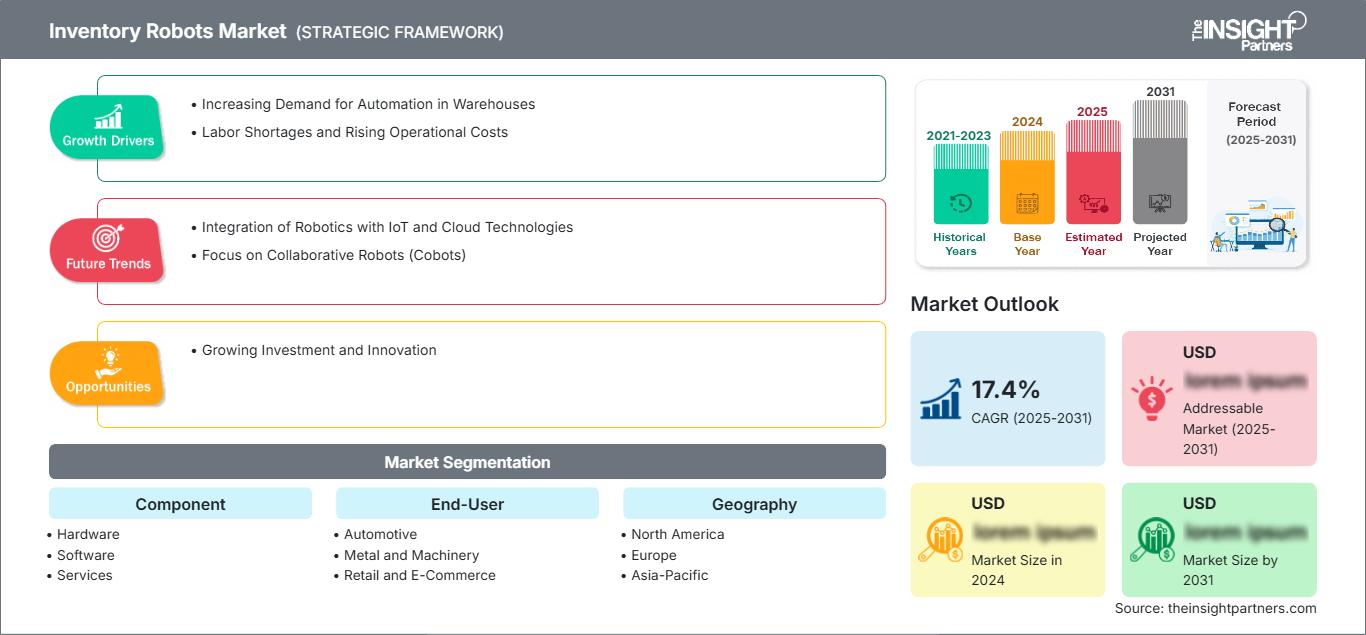
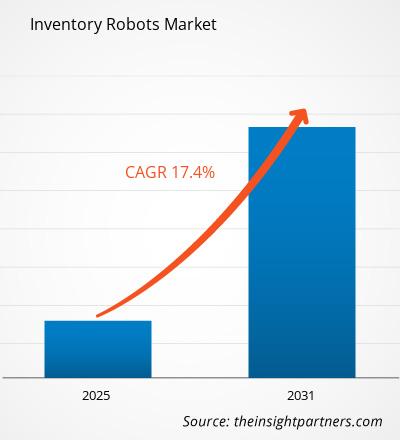
The Inventory Robots Market is positioned for substantial expansion, reaching US$ 5.34 Billion in 2025 and projected to attain US$ 18.50 Billion by 2034, reflecting a CAGR of 14.08% during 2026–2034. Autonomous mobile robots, machine vision, RFID, artificial intelligence, and warehouse execution software are contributing to the adoption of this technology as firms aim for increased visibility of their inventories, quick replenishment, and less reliance on repetitive manual movements.
North America Inventory Robots Market Size is anticipated to be a significant market for this technology on the back of high labor costs, well-established warehouse automation, and consistent investment in omnichannel fulfillment. The forecast suggests a CAGR of 12.5–14.0% from 2024 to 2034 for North America with an increasing integration of mobile robots into warehouse management and enterprise systems.
Inventory Robots Market Assessment and Insights
- North America: North America is expected to account for 29–33% share in 2025, supported by warehouse automation maturity, labor constraints, and strong retail and logistics investment, with a CAGR of 12.5–14.0% between 2026–2034.
- US: The US is estimated to represent 78–82% of North America’s 2025 market, with broad deployment across fulfillment, retail, and manufacturing and a CAGR of 12.8–14.2% between 2026–2034.
- Europe: Europe is estimated at 23–27% share in 2025, led by Germany, the UK, France, Italy, and Spain, with manufacturing automation, labor availability, and warehouse modernization supporting a CAGR of 13.0–14.5% between 2026–2034.
- Asia Pacific: Asia Pacific is expected to hold 31–35% share in 2025, led by China, Japan, South Korea, and India, with dense manufacturing ecosystems and logistics automation supporting a CAGR of 15.0–16.5% between 2026–2034.
- Largest Segment: Retail and E-Commerce is estimated to hold a 31–35% market share in 2025, supported by high SKU volumes and omnichannel operations, with a CAGR of 14.0–15.0%.
- High Growth Segment: Software is modeled at a 19–23% market share in 2025, benefiting from orchestration and analytics requirements, with a CAGR of 15.0–16.0%.
- Key companies analyzed in detail: Bossa Nova Robotics, Fellow Inc., Fetch Robotics, Inc., GEEK+ INC., GreyOrange pte ltd., IAM Robotics, Locus Robotics, MetraLabs, PAL Robotics, Simbe Robotics.
Source: The Insight Partners' analysis based on proprietary research, government publications, company annual reports, investor presentations, industry databases, and expert interviews.
The sector has evolved from fixed material-handling automation toward mobile, sensor-rich systems capable of navigating dynamic facilities and collecting inventory data continuously. Machine vision, RFID, simultaneous localization and mapping, edge computing, and fleet-management software increasingly operate as integrated layers. Warehouse designs are consequently shifting toward flexible automation that can be introduced without extensive structural modification, while robotic picking, counting, transport, and shelf scanning become increasingly coordinated across workflows.
Progress will probably spill over from existing logistics nodes as countries like India, Southeast Asia, the Middle East, and certain parts of Europe upgrade their logistics infrastructure. There are signs of increasing investment in areas such as software-defined robots, robotics-as-a-service, integration, and artificial intelligence-powered decision support systems. Issues related to machine safety, cooperation with humans, cybersecurity, and data management will increasingly become important in procurement requirements for robotic equipment.
Inventory Robots Market Report Scope
| Report Attribute | Details |
|---|---|
| Market size in 2025 | US$ 5.34 Billion |
| Market Size by 2034 | US$ 18.50 Billion |
| Global CAGR (2026 - 2034) | 14.80% |
| Historical Data | 2021-2024 |
| Forecast period | 2026-2034 |
Inventory Robots Market Analysis
In terms of Competitive Analysis of Inventory Robots Market Report, it is noted that there is an exceptionally fragmented market with warehousing robotics veterans competing with retail-oriented autonomous scanning robots as well as industrial automation vendors. In particular, GEEK+ INC. focuses on warehousing fulfillment and mobility robotics, whereas GreyOrange pte ltd. offers both robotics and orchestration. Locus Robotics concentrates on autonomous fulfillment, while PAL Robotics is specialized in RFID retail inventory visibility. Simbe Robotics and MetraLabs specialize in store-level autonomous data acquisition and inventory intelligence.
Furthermore, more often than not, strategic positioning starts to take into account economics of implementation, software compatibility, scope of applications and ability to solve multi-national customers' needs. Robotic manipulation, artificial intelligence, perception, fleet orchestration, as well as service-oriented recurrent solutions get investments. It could be helpful to cooperate with logistics companies, retailers, system integrators and technology partners for faster implementation and broadening scope of application. Thus, the competitive advantage starts to shift from robotic solutions themselves to operational ecosystems able to deliver inventory and throughput gains.
● REPORT CUSTOMIZATION
Tailor This Report To Align With Your Specific Business Requirements
This report can be customized to align precisely with your business objectives, scope, and target markets. Customization options include tailored segmentation, geography, competitive analysis, and strategic insights to support informed decision-making.
Customize This Report →WHAT YOU CAN ADJUST
- ● Segmentations
- ● Geography
- ● Competitive Analysis
- ● Language Preferences
Inventory Robots Market: Strategic Insights
Regional Insights
North America Inventory Robots Market
North America is depicted at a 29-33% Inventory Robots Market share in 2025 and 12.5-14.0% CAGR between 2025 and 2034. The area enjoys the advantage of developed warehouse facilities, higher labor costs, e-commerce penetration, and automation integrator experience. Autonomous solutions for transportation, counting, picking assistance, and replenishment are increasingly being used by American retailers and third-party logistics firms. The contribution of Canada will come from its grocery, distribution, and manufacturing automation, whereas Mexico can be added due to growing nearshoring of industrial warehouses and logistics operations.
The driver of demand is shifting from pure economic factors of complete automation to those for flexible deployment. Companies want robots that would be compatible with human workers, WMS, and multiple facilities. Robots are being used not only in distribution centers but also in stores and backrooms, where the precision of inventory affects replenishment and availability of the product for customers. The regional conditions are favorable for providers of software integration, data analytics, and fleet management in addition to robots themselves.
U.S. Inventory Robots Market
It is expected that the U.S. represents 78–82% of North America’s market share in 2025, growing at a CAGR of 12.8–14.2% up to 2034. The key customers include major retailers, parcels shippers, manufacturers, and third-party logistics. Adoption takes place in fulfillment centers and distribution networks, where productivity and accuracy of the workforce directly affect economics of operations. Modern applications of robots often include transportation, picking support, scanning, and analysis capabilities rather than just independent machines.
In addition to that, the adoption of the technology in the U.S. will be driven by sophisticated warehouse management software infrastructure and extensive deployment of automated warehouses. Firms like Locus Robotics and Simbe Robotics provide examples of various directions of development in the industry – fulfillment automation and intelligent inventory in retail stores respectively. Autonomous robotic systems allow retailers to integrate information regarding their stock into replenishment and merchandising systems. Flexible robotic solutions may ensure consistency of operations in large multi-site networks, given the regional differences in labor availability.
Europe Inventory Robots Market
Europe’s Inventory Robots Market share is forecast to be 23–27% by 2025, with a modelled CAGR of 13.0–14.5% up to 2034. Germany has the largest market share due to developed manufacturing, logistics engineering, and high intensity of industrial automation. The second-largest market is the UK, which has a large demand in the fields of e-commerce and retail automation, while France, Italy, and Spain have further demand owing to logistics modernization, grocery automation, and labour optimization in warehouses.
The UK market is driven by extensive retail network, advanced fulfillment technology, and constant need for precise stock visibility. Germany has high-level automotive and machinery manufacturing, where processes of inventory transfer from warehouses to the process of production become automated. France focuses on applications for retail, groceries, and logistics, while Italy and Spain are growing markets owing to logistics modernization and omnichannel logistics. Safety standards, collaboration of workers, and integration with automation infrastructure continue to be relevant procurement criteria.
APAC Inventory Robots Market
The APAC region is assumed to represent 31–35% market share in 2025 and grow with a 15.0–16.5% CAGR up to 2034, becoming the leader in terms of regional growth. The Chinese region is leading in robotics deployment, followed by Japan, South Korea, India, and Australia. Manufacturing density, development of e-commerce, and state-sponsored initiatives on robotics implementation in factories and warehouses drive the adoption process.
China can leverage its well-developed robotics ecosystem and logistics capabilities, Japan and South Korea benefit from their developed automation sector along with aging workforces, India is heading to increased digitization of warehouses with development of organized retail and e-commerce, and Australia can offer large-scale distribution opportunities and limited labor capabilities in logistics.
Middle East & Africa Inventory Robots Market
Middle East & Africa is forecast to adopt the model based on a 10.0-12.0% CAGR by 2034, with UAE driving the region’s adoption. The development of automation in logistics of Saudi Arabia depends on the diversification of its industry and huge distribution initiatives, whereas UAE will be able to benefit from the highly developed logistics infrastructure and international business flow. South Africa stays the main sub-Saharan country that needs warehouses’ renovation.
The opportunity in the region depends on the logistics infrastructure, the diversification of industries, and the investments in automation solutions. The transformation of Saudi Arabian industry and the aspirations of UAE concerning the logistics can serve as a platform for development of the highly technological facilities. In South Africa, the need for automation will arise from retail, food distribution, and production.
Segmentation Analysis
Component
Component segment in the Inventory Robots Market demand is divided among hardware, software, and services, with software representing the fastest-growing component as customers require centralized fleet management, analytics, and interoperability. The segment is modeled to expand at a 13.5–15.0% CAGR between 2026–2034. Hardware remains essential for physical deployment, while services support installation, maintenance, integration, and lifecycle optimization.
- Hardware: Hardware remains the physical foundation of deployments, covering autonomous platforms, sensors, RFID readers, cameras, navigation systems, batteries, and computing components. Demand is shaped by payload requirements, operating environments, safety specifications, and fleet scalability.
- Software: Software increasingly determines system intelligence through fleet orchestration, mapping, analytics, workflow management, and enterprise integration. Its strategic importance rises as customers operate heterogeneous robotic fleets and seek centralized operational visibility.
- Services: Services encompass deployment, integration, maintenance, training, optimization, and technical support. Their importance increases as customers prioritize uptime, rapid commissioning, predictable lifecycle costs, and consistent performance across geographically distributed facilities.
End-User
End-User segment in the Inventory Robots Market demand is led by Retail and E-Commerce, where high SKU counts, omnichannel fulfillment, and frequent inventory movements create strong automation requirements. The segment is modeled to grow at a 14.0–15.0% CAGR between 2026–2034. Automotive and machinery applications remain important because of structured material flows and repetitive replenishment requirements.
- Automotive: Automotive facilities require precise material availability across production, storage, and sequencing areas. Robots can support repetitive transport and inventory verification while reducing manual travel and improving synchronization between warehouse and manufacturing systems.
- Metal and Machinery: Metal and machinery operations involve varied components, heavy materials, and complex storage locations. Autonomous systems can improve material visibility and movement where production schedules require dependable replenishment and traceability.
- Retail and E-Commerce: Retail and e-commerce require continuous stock visibility across stores, backrooms, fulfillment centers, and returns operations. Inventory robots support shelf scanning, order preparation, replenishment, and discrepancy identification within increasingly dynamic distribution models.
- Food and Beverages: Food and beverage operations benefit from automated inventory checks and movement where product turnover is high and storage conditions can complicate manual processes. Robotics can support traceability, replenishment, and repetitive internal logistics.
- Pharmaceuticals: Pharmaceutical facilities prioritize accuracy, traceability, controlled access, and reliable material handling. Robotics can support inventory verification and movement while integrating with regulated warehouse workflows and digital records.
Opportunity Snapshot
| End-User | Revenue Contribution | Trend Tag | Adoption Stage |
| Automotive | Medium | Line Replenishment | Scaling |
| Metal and Machinery | Medium | Heavy Handling | Scaling |
| Retail and E-Commerce | High | Shelf Visibility | Mature |
| Food and Beverages | Medium | Cold Logistics | Scaling |
| Pharmaceuticals | Medium | Traceable Stock | Scaling |
| Others | Low | Flexible Automation | Emerging |
Inventory Robots Market Growth Drivers and Impact Analysis
Labor productivity pressure is increasing automation economics
The continuous demand for productivity in the workforce is making the business case for autonomous inventory systems stronger in warehouses and retail establishments. Robotic devices may perform repeatable functions like scanning, transporting, and counting, allowing the workers to focus on exceptions, customer interaction, decisions about restocking, or other more valuable tasks within the warehouse. The effect will be more pronounced in the facilities that work long hours and have challenges with maintaining adequate staffing levels. Autonomics may also decrease travel and searching, optimizing the utilization of current staffing without needing facility modifications. As the operational costs increase, buyers are looking at the robots’ performance in terms of capacity, accuracy, uptime, and labor repurposing instead of just the device’s unit price.
Omnichannel fulfillment is raising inventory visibility requirements
The convergence of stores, fulfillment centers, marketplaces, and direct-to-consumer channels is increasing the value of accurate inventory information. A product shown as available digitally must also be physically locatable and accessible within the promised fulfillment window. Autonomous inventory robots can repeatedly scan shelves, aisles, backrooms, and storage areas, helping identify discrepancies between system records and physical conditions. This capability becomes particularly valuable when retailers manage large assortments and rapid product turnover. The commercial impact extends beyond counting because inventory data can inform replenishment, merchandising, loss prevention, order validation, and fulfillment prioritization. Vendors that connect robotic observations with enterprise inventory platforms can therefore move from task automation toward decision support. This creates a stronger business case for software-enabled robotics and supports wider deployment across interconnected retail and logistics operations.
Warehouse modernization is favoring flexible automation architectures
Warehouse operators increasingly require automation that can adapt to changing product mixes, facility layouts, seasonal volumes, and expansion plans. Fixed systems can deliver high throughput but may require significant engineering and capital expenditure when workflows change. Autonomous mobile robots offer an alternative by enabling incremental deployment, fleet expansion, and software-based workflow modification. This flexibility is particularly relevant for third-party logistics providers serving multiple customers with different requirements. The market impact is a shift toward modular architectures in which robots, sensors, orchestration software, and existing warehouse systems operate together. Customers can begin with transport or inventory verification and later introduce picking, sorting, or manipulation capabilities. This approach can lower adoption barriers and improve capital allocation while encouraging vendors to build interoperable platforms rather than application-specific machines.
Inventory Robots Market Future Trends
AI-enabled inventory intelligence will move beyond simple counting
Inventory robots are expected to evolve from data-collection devices into autonomous decision-support platforms. Advances in computer vision, multimodal artificial intelligence, and edge processing should allow robots to recognize products, interpret shelf conditions, identify anomalies, and prioritize tasks without constant human direction. Future systems may combine inventory observations with sales velocity, replenishment schedules, promotions, and warehouse constraints to determine where scanning or intervention is most valuable. This will increase the importance of software architecture, model governance, data quality, and integration with enterprise systems. Vendors able to provide explainable analytics and reliable exception management should gain an advantage as customers seek actionable information rather than additional raw data. The resulting market structure is likely to place greater economic value on intelligence layers than on standalone robotic mobility.
Robotic fleets will become increasingly interoperable
Future facilities are likely to operate multiple robot types rather than relying on a single platform. Inventory scanning robots, transport AMRs, robotic arms, automated storage systems, and conventional material-handling equipment can each address different workflow requirements. Fleet orchestration should therefore evolve toward technology-neutral control layers capable of coordinating heterogeneous equipment, software, and human tasks. Open APIs, standardized interfaces, simulation tools, and cloud-based monitoring will become more important during procurement. This Inventory Robots Market trend can reduce vendor lock-in and allow customers to expand automation as requirements change. It also increases competitive pressure on robotics companies to provide integration capabilities, cybersecurity controls, and service continuity. Over time, customers may evaluate suppliers less by individual robot specifications and more by their ability to manage complete automated operating environments.
Inventory Robots Market Opportunities
Expansion of autonomous inventory systems in emerging logistics hubs
Inventory Robots Market Forecasts point to significant opportunity in emerging logistics hubs where modern fulfillment infrastructure is being developed without extensive legacy automation. India, Southeast Asia, the Middle East, and selected Latin American markets are investing in distribution centers that increasingly require digital inventory control from inception. Vendors can capture this opportunity by offering modular systems with rapid installation, localized service, multilingual interfaces, and integration with commonly deployed enterprise platforms. Financing models and robotic-as-a-service contracts can further reduce upfront capital barriers for mid-sized operators. Strategic partnerships with warehouse developers, logistics providers, systems integrators, and technology distributors can accelerate market access. The most attractive projects are likely to combine inventory visibility with transport or fulfillment functions, allowing customers to justify automation through several operational outcomes rather than a single use case.
Software-led recurring revenue and fleet optimization
Software presents an attractive investment opportunity because robotic fleets generate continuous operational data that can support recurring analytics, optimization, and orchestration services. Suppliers can develop subscription models around fleet monitoring, predictive maintenance, inventory intelligence, simulation, workflow optimization, and performance benchmarking. These offerings can improve revenue visibility while increasing customer retention after hardware deployment. Integrating robotic data with warehouse management, enterprise resource planning, merchandising, and supply-chain planning systems can create additional value by connecting physical observations to commercial decisions. Investors and strategic buyers should therefore assess software architecture, installed fleet size, integration capabilities, and recurring revenue potential alongside robot shipments. Companies that successfully transition from equipment suppliers to platform providers may achieve stronger customer lifetime economics and create defensible positions across increasingly automated logistics ecosystems.
Recent Developments
- June 2026: Amazon introduced the next-generation Proteus autonomous robot to move heavy carts in fulfillment centers. It is designed to support employees by taking on physically demanding tasks. The initiative is part of Amazon’s €10 billion European fulfillment investment.
- June 2026: B&R Stores introduced Simbe’s Tally inventory robot across stores in Nebraska. Tally autonomously scans shelves to identify stock availability, pricing, and placement issues. The technology helps reduce manual inventory checks and frees employees for customer service.
- March 2026: Dexory launched a new generation of autonomous inventory robots for warehouses. The robots provide continuous inventory scanning and can operate alongside employees and forklifts. Data is integrated into DexoryView to create a real-time digital view of warehouse inventory.
Frequently Asked Questions

- Comprehensive Market Sizing and Forecast Analysis
- Detailed Segmentation Analysis
- In-Depth Market Dynamics Assessment
- Regional and Country-Level Insights
- Competitive Landscape and Company Benchmarking
- Strategic Business Intelligence
Recent Reports
Testimonials

The Insight Partners provided valuable market intelligence that supported our global go-to-market strategy. Their team was professional, responsive, and attentive to our feedback, providing thoughtful analysis and helpful methodological clarifications throughout the project.
Junmo Kim Chief Financial Officer (CFO), Enertech Co., Ltd.
The Insight Partners' SCADA System Market report is comprehensive, with valuable insights on current trends and future forecasts. The team was highly professional, responsive, and supportive throughout. We are very satisfied and highly recommend their services.
RAN KEDEM Partner, Reali Technologies LTDs
I requested a report on a very specific software market and the team produced the report in a few days. The information was very relevant and well presented. I then requested some changes and additions to the report. The team was again very responsive and I got the final report in less than a week.
JEAN-HERVE JENN Chairman, Future Analytica
We worked with The Insight Partners for an important market study and forecast. They gave us clear insights into opportunities and risks, which helped shape our plans. Their research was easy to use and based on solid data. It helped us make smart, confident decisions. We highly recommend them.
PIYUSH NAGPAL Sr. Vice President, High Beam Global
The Insight Partners delivered insightful, well-structured market research with strong domain expertise. Their team was professional and responsive throughout. The user-friendly website made accessing industry reports seamless. We highly recommend them for reliable, high-quality research services
YUKIHIKO ADACHI CEO, Deep Blue, LLC.
This is the first time I have purchased a market report from The Insight Partners.While I was unsure at first, I visited their web site and felt more comfortable to take the risk and purchase a market report.I am completely satisfied with the quality of the report and customer service. I had several questions and comments with the initial report, but after a couple of dialogs over email with their analyst I believe I have a report that I can use as input to our strategic planning process.Thank you so much for taking the extra time and making this a positive experience.I will definitely recommend your service to others and you will be my first call when we need further market data.
JOHN SUZUKI President and Chief Executive Officer, Board Director, BK Technologies
I wish to appreciate your support and the professionalism you displayed in the course of attending to my request for information regarding to infectious disease IVD market in Nigeria. I appreciate your patience, your guidance, and the fact that you were willing to offer a discount, which eventually made it possible for us to close a deal. I look forward to engaging The Insight Partners in the future, all thanks to the impression you have created in me as a result of this first encounter.
DR CHIJIOKE ONYIA MANAGING DIRECTOR, PineCrest Healthcare Ltd.Reason to Buy
- Informed Decision-Making
- Understanding Market Dynamics
- Competitive Analysis
- Identifying Emerging Markets
- Customer Insights
- Market Forecasts
- Risk Mitigation
- Boosting Operational Efficiency
- Strategic Planning
- Investment Justification
- Tracking Industry Innovations
- Aligning with Regulatory Trends





 Get Free Sample for