
Infrared Thermometer Market Share, Growth & Forecast by 2034
Coverage: By Product Type (Contact Thermometers, Non-contact Thermometers); End User Industry (Electronics, Food and Beverage, Healthcare, Others) , and Geography (North America, Europe, Asia Pacific, and South and Central America)
- Status : Data Released
- Report Code : TIPRE00011494
- Category : Electronics and Semiconductor
- No. of Pages : 150
- Available Report Formats :


- Last update date : October 22, 2026


2025 Market Size
US$ 3.19 Bn
Base year value
2034 Forecast
US$ 6.74 Bn
Projected by 2034
CAGR 2026-2034
8.67 %
Growth rate
Addressable Market
US$ 44.52 Bn
(2026-2034)
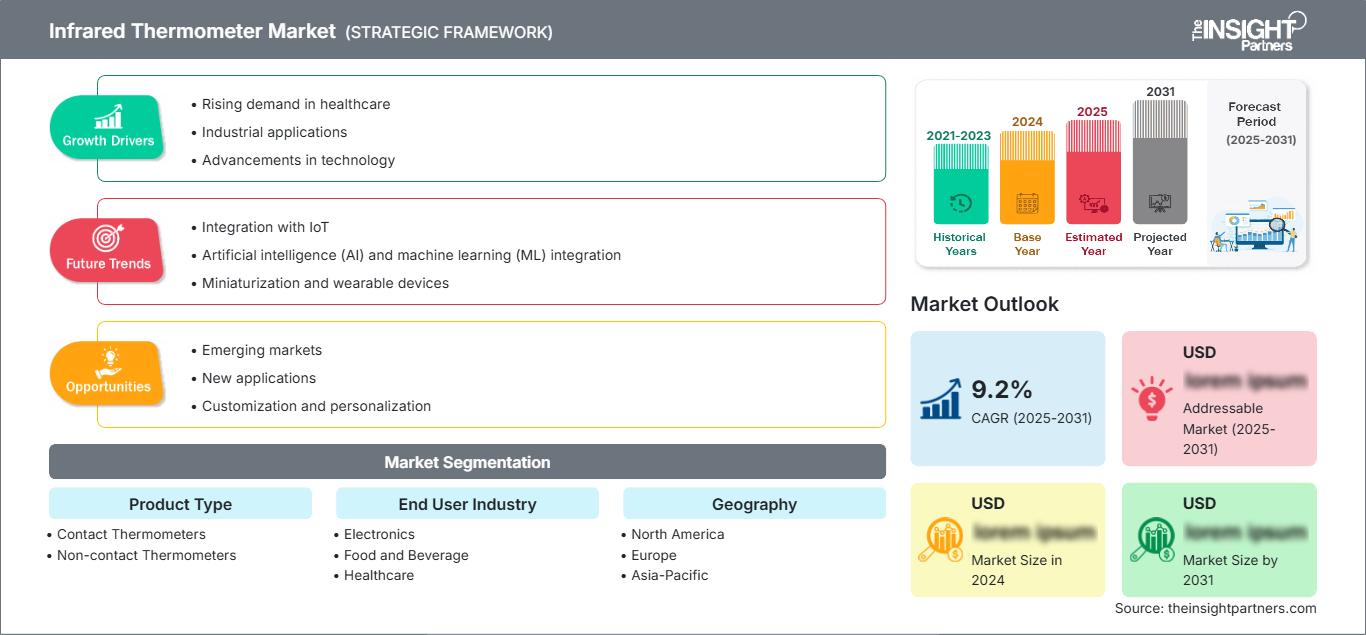
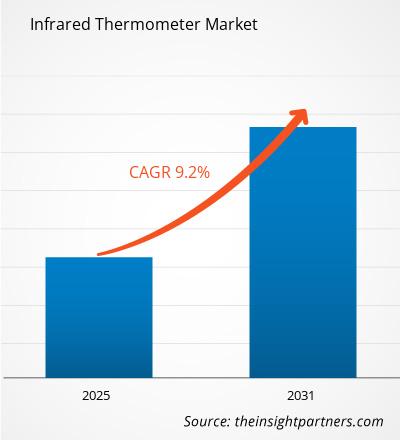
The Infrared Thermometer Market size was valued at US$ 3.19 Billion in 2025 and is projected to reach US$ 6.74 Billion by 2034, expanding at a CAGR of 8.67% during 2026–2034. The market encompasses contact and non-contact thermometers used across electronics, food and beverage, and healthcare industries. Demand is being shaped by faster temperature measurement, hygiene requirements, industrial process monitoring, and increasing integration of sensing technologies into connected equipment.
North America represents a mature but steadily expanding demand center, supported by established healthcare infrastructure, industrial automation, food safety requirements, and broad availability of professional diagnostic equipment. The region is estimated to register a CAGR of 7.8–8.4% through 2034, with replacement demand and connected monitoring supporting sustained adoption.
Infrared Thermometer Market Assessment and Insights
- North America: North America is estimated to hold a 30–34% Infrared Thermometer Market share in 2025 and expand at a 7.8–8.4% CAGR between 2026–2034, supported by healthcare procurement, industrial inspection, and food safety applications.
- US: The US is estimated to represent 88–92% of North America's 2025 market and grow at a 7.6–8.3% CAGR between 2026–2034, reflecting strong clinical and industrial utilization.
- Europe: Europe is estimated at a 25–29% share in 2025 and a 7.9–8.6% CAGR during 2026–2034, led by Germany, the UK, France, Italy, and Spain, where healthcare and regulated food processing sustain demand.
- Asia Pacific: Asia Pacific is estimated at a 29–33% share in 2025 and a 9.0–9.8% CAGR through 2034, led by China, Japan, South Korea, and India, with manufacturing expansion accelerating industrial applications.
- Largest Segment: Non-contact thermometers hold an estimated 78–83% market share in 2025 and are projected to grow at a 7.5–8.2% CAGR through 2034, reflecting hygiene and speed advantages.
- High Growth Segment: Electronics is estimated to account for 15–19% share in 2025 and expand at an 8.2–9.0% CAGR through 2034, supported by semiconductor and equipment inspection requirements.
- Key companies analyzed in detail: American Diagnostic Corporation, CONTEC MEDICAL SYSTEMS CO.,LTD., Electronic Temperature Instruments Ltd, Geratherm Medical AG, Microlife Corporation, Omron Healthcare Co., Thermoval, PCE Deutschland GmbH, THERMOMEDICS, INC., Welch Allyn.
Source: The Insight Partners' analysis based on proprietary research, government publications, company annual reports, investor presentations, industry databases, and expert interviews.
The market has developed from simple thermometers to small and fast devices with an increasing focus on applications. Non-contact designs have become popular as they minimize the measurement errors and allow for fast screening, whereas industrial designs incorporate variable emissivity, dual laser, alarm system, data memory, USB interface, and thermocouple input. Differentiation will, therefore, be based not only on measurement but also on accuracy, usability, calibration capabilities, and integration.
Further growth can be expected where healthcare reform meets digital industry revolution. The manufacturers will concentrate their efforts on high precision sensors, connected diagnostics, durable instruments, and application-specific software. The regulatory focus on precise measurements, quality of devices, and traceability will benefit well-established companies, whereas the expanding production capacities in the Asia Pacific region create possibilities for local manufacture and sales.
Infrared Thermometer Market Report Scope
| Report Attribute | Details |
|---|---|
| Market size in 2025 | US$ 3.19 Billion |
| Market Size by 2034 | US$ 6.74 Billion |
| Global CAGR (2026 - 2034) | 8.67% |
| Historical Data | 2021-2024 |
| Forecast period | 2026-2034 |
Infrared Thermometer Market Analysis
The demand side in the Infrared Thermometer Market is underpinned by three interrelated ecosystems: clinical diagnostics, industrial process control, and food quality monitoring. The healthcare sector values fast and hygienic readings, while electronics producers need non-destructive testing of their components and equipment. Food processors apply infrared sensors to monitor surface temperature without disrupting the process of manufacturing. In all cases, the supply chain includes infrared sensors, optical modules, processing units, display panels, batteries, enclosures, calibration services, distribution, and institutional procurement. Increasingly, suppliers will be valued for their ability to assure sensor availability while keeping their components prices down and delivering calibrated and application-oriented products.
The Infrared Thermometer Market report shows that competitive environment will become more and more dependent on the variety of products apart from selling thermometers. American Diagnostic Corporation, CONTEC MEDICAL SYSTEMS CO., LTD., Microlife Corporation, and Omron Healthcare Co. concentrate their activities on clinical and consumer application, while PCE Deutschland GmbH shows good understanding of industrial measurements. Electronic Temperature Instruments Ltd and Geratherm Medical AG specialize in temperature measuring. Welch Allyn uses temperature measurements within patient monitoring systems, while Thermoval, THERMOMEDICS, INC. and other companies run portfolio of niche products. Investment topics will be connectivity, ergonomics, calibration, and channeling.
● REPORT CUSTOMIZATION
Tailor This Report To Align With Your Specific Business Requirements
This report can be customized to align precisely with your business objectives, scope, and target markets. Customization options include tailored segmentation, geography, competitive analysis, and strategic insights to support informed decision-making.
Customize This Report →WHAT YOU CAN ADJUST
- ● Segmentations
- ● Geography
- ● Competitive Analysis
- ● Language Preferences
Infrared Thermometer Market: Strategic Insights
Regional Insights
North America Infrared Thermometer Market
The Infrared Thermometer Market forecast shows that North America is estimated to account for 30–34% of the global market in 2025 and expand at a 7.8–8.4% CAGR through 2034. The region enjoys advanced hospital purchasing, high penetration of diagnostic devices, sound industrial maintenance procedures, and high food handling standards. Non-contact measurement is especially useful in scenarios that require reduced contact with patients and shortened inspection time.
The US is the most influential Infrared Thermometer Market in the region since healthcare providers, manufacturers, laboratories, and food processing firms buy thermometers in several application areas. The demand is also driven by replacement schedules of professional devices, increased awareness on vital signs management, and installation of rapid testing equipment.
U.S. Infrared Thermometer Market
The US is estimated to represent 88–92% of North America's 2025 market and is projected to grow at a 7.6–8.3% CAGR through 2034. This size is due to its large network of hospitals, outpatient services, home care, food processing, electronics manufacturing, and industrial maintenance.
The company's presence can be seen in both the clinical and the industrial categories where American Diagnostic Corporation and Welch Allyn cater to the needs of healthcare measurements while PCE Deutschland GmbH caters to the needs of industrial inspections. The application trend is moving towards speed, distance control, calibration, and integration into other vital signs measurement devices.
Europe Infrared Thermometer Market
Europe is estimated to hold a 25–29% share in 2025 and grow at a 7.9–8.6% CAGR through 2034. The domination of Germany in the region is brought about by its industrial manufacturing, laboratory measurements, and healthcare procurement. Other nations such as UK, France, Italy, and Spain are responsible for demand in the industry because of their clinical treatment, food manufacturing, and workplace regulations.
There is the advantage of healthcare procurement in the UK, along with professional diagnostics. There is also industrial manufacturing of Germany, which facilitates surface temperature measurement. France, Italy, and Spain are responsible for healthcare demand and food/beverages manufacturing and hospitality industries. The regional growth is facilitated by the trend of hygiene measurement and quality control measures and certified products. Germany is the dominating nation because of its healthcare and industrial demand base.
APAC Infrared Thermometer Market
APAC is estimated to represent 29–33% of the global market in 2025 and expand at a 9.0–9.8% CAGR through 2034. China is ahead, followed by Japan, South Korea, India, and Australia. Industrial automation, electronics manufacturing, healthcare expansion, and local manufacturing of medical devices are some factors that encourage adoption.
The manufacturing base in China results in large-scale industrial needs, whereas the contribution of Japan and South Korea comes in the form of electronics manufacturing and precision manufacturing. The expansion of healthcare infrastructure in India along with manufacturing efforts adds to the demand for the technology, and Australia makes contributions in the field of healthcare and food sectors.
Middle East & Africa Infrared Thermometer Market
Middle East and Africa demand is developing from a smaller base, with the region expected to expand at a 7.0–8.0% CAGR through 2034. Saudi Arabia leads, supported by healthcare investment and industrial diversification, while the UAE benefits from advanced healthcare and infrastructure projects.
South Africa remains a major African market because of established healthcare and industrial capabilities. Rest of MEA demand is supported by hospital expansion, food processing, energy infrastructure, and industrial maintenance. Oil, gas, utilities, construction, and large-scale infrastructure projects create applications where non-contact measurement improves operator safety around hot or inaccessible surfaces.
Segmentation Analysis
Product Type
Product Type segment in the Infrared Thermometer Market is divided between contact and non-contact thermometers, with non-contact instruments maintaining the stronger position because of rapid measurement, hygiene, and operational convenience. The segment is expected to expand at a 8.0–8.7% CAGR during 2026–2034. Industrial and clinical requirements increasingly reward instruments that reduce measurement interruption while maintaining repeatable readings.
- Contact Thermometers: Contact Thermometers retain demand where direct measurement is preferred for specific clinical, laboratory, and controlled applications. Their strategic role centers on affordability, established workflows, and situations requiring direct sensing.
- Non-contact Thermometers: Non-contact Thermometers represent the dominant product category, supported by rapid screening, reduced cross-contact, and suitability for moving, hot, distant, or difficult-to-access surfaces.
End User Industry
End User Industry comprises electronics, food and beverage, and healthcare applications, with healthcare maintaining the largest demand base. The segment is projected to grow at a 8.3–9.0% CAGR during 2026–2034 as temperature measurement becomes increasingly embedded in clinical workflows, manufacturing quality control, and food safety procedures.
- Electronics: Electronics demand is supported by semiconductor manufacturing, printed circuit assembly, battery systems, and equipment inspection, where surface-temperature monitoring helps identify abnormal heat patterns without interrupting production.
- Food and Beverage: Food and Beverage users employ infrared measurement for rapid surface checks, receiving inspections, storage monitoring, and process verification, making portability and repeatability important purchasing criteria.
- Healthcare: Healthcare remains the principal end-user environment, supported by hospitals, clinics, homecare, and diagnostic workflows that prioritize rapid, hygienic, and easy-to-operate temperature measurement.
Opportunity Snapshot
| End User Industry | Revenue Contribution | Trend Tag | Adoption Stage |
| Electronics | Medium | Thermal Inspection | Scaling |
| Food and Beverage | Medium | Process Checking | Scaling |
| Healthcare | High | Rapid Screening | Mature |
Infrared Thermometer Market Growth Drivers and Impact Analysis
Expansion of Automated Industrial Temperature Monitoring
Industrial automation is extending the scope of temperature measurement beyond physical checks. Plant electronics manufacturing, mechanical operations, utilities, and maintenance departments require quick detection of unusual heat without stopping machines. These needs can be met by infrared tools as the operator may perform a check-up of energized and moving surfaces without getting close to them. High-end models featuring adjustable emissivity, laser pointer, alarm signals, data storage capacity, and computer connectivity become more relevant under such conditions. The driver boosts the average number of applications and prompts the vendors to provide differentiation through precision, durability, calibration, and connection capabilities rather than through cheap hand-held instruments.
Moreover, the increasing popularity of predictive maintenance programs leads to adding temperature measurements to the list of routine checks of the equipment's health condition that allows recognizing problems like overheating of bearing, electrical connection, motor, transformer, etc. before breakdowns happen. Finally, the rise of interconnected production facilities gives opportunities for measurement tools to transfer collected data to maintenance software, enterprise-level information systems, and cloud monitoring platforms. As the factories focus on uptime, efficiency, and visibility of operations, the use of automated temperature measurement becomes one of the supportive technologies within the strategy of industrial digitization.
Stronger Hygiene Requirements in Clinical Temperature Measurement
Healthcare procurement increasingly assesses temperature measurement devices based on their efficiency, patient comfort, infection control considerations, and consistency of readings. Non-contact instruments decrease direct contact, providing fast reading, especially when it comes to pediatric, outpatient, screening, and fast-paced care settings. This will ensure continuous replacement of basic models with devices that have distance sensing, fever indicators, memory functions, and ergonomics. The commercial value of temperature measurement equipment is not limited to a single instrument, as hospitals could want to have the same method for measuring body temperature across various connected vital signs measuring system, leading to recurring purchases of devices, accessories, services, calibrations, and replacements.
Healthcare institutions are being pressed to reduce patient throughput time and maintain accurate clinical measurements, which means speed and convenience become purchasing factors for them. In busy wards and outpatient care settings, the devices that will not require extensive preparation before usage and cleaning after it will be preferred. In addition, battery power, visibility of the display, measurement consistency, and interface will affect the decision of the purchaser. Moreover, healthcare institutions increasingly prefer to purchase devices that help implement standardized clinical practice in different units and departments.
Electronics Manufacturing Raises Precision Measurement Requirements
The production of electronics forms a highly technical application field because electronic components, sub-assemblies, batteries, and machinery can form local hot spots indicating issues in production process or defects. The ability to perform infrared measurements without physical contact helps avoid the disturbance of small components and disruption of automated production processes. As the manufacture of electronics becomes denser and more complicated in terms of power supply, the demand from buyers for advanced optical targeting, temperature ranges, emissivity, and repeatability grows. It helps drive premiumization of product lines in the field of industrial thermometers, as well as offer additional services such as thermal imaging and data management.
There is an increasing demand for temperature monitoring for semiconductor fabrication, printed circuit boards fabrication, battery manufacturing and consumer electronics assembly. Even small changes in temperatures have the ability to influence reliability of the components, quality of soldering, performance of the batteries as well as the efficiency of the equipment, which highlights the need for measuring devices that work reliably. Moreover, there is a possibility that the companies will apply infrared cameras during quality testing, commissioning of the equipment, troubleshooting and preventive maintenance. With the development of electric cars, energy storage systems and electronics, there are more applications where thermal inspection is needed.
Infrared Thermometer Market Future Trends
Connected Thermometers Become Data-Enabled Diagnostic Instruments
Connected temperature devices are likely to move from standalone measurement toward participation in broader digital-health and maintenance ecosystems. Bluetooth, USB, wireless synchronization, mobile applications, and cloud-compatible workflows can allow readings to be stored, compared, and shared rather than manually transcribed. In healthcare, this can support longitudinal home monitoring and easier documentation, while industrial users can combine temperature records with maintenance histories. Future products are likely to emphasize interoperability, user guidance, automated quality checks, and software-enabled interpretation, increasing the importance of cybersecurity, data governance, and device compatibility.
Application-Specific Infrared Platforms Gain Share
The Infrared Thermometer Market trends show that future product development is expected to favor specialized instruments designed around distinct operating environments rather than one universal thermometer architecture. Clinical devices will increasingly prioritize patient comfort, measurement-distance control, and simplified interfaces, while industrial products will emphasize high temperature ranges, optical resolution, emissivity adjustment, alarms, and calibration. Food applications are likely to prioritize hygienic handling, rapid scanning, and operational simplicity. Such specialization can support differentiated pricing and improve customer retention through application-specific product families, particularly as buyers increasingly evaluate total workflow efficiency alongside basic temperature-measurement performance.
Infrared Thermometer Market Opportunities
Localized Manufacturing and Distribution in Emerging Asia
Manufacturers in the Infrared Thermometer Market can capture incremental demand by strengthening localized assembly, certification, distribution, and after-sales capabilities across India, Southeast Asia, and other emerging Asian markets. Healthcare infrastructure expansion is increasing the addressable base for diagnostic equipment, while electronics manufacturing creates additional industrial applications. Local channel partnerships can reduce procurement friction and improve availability of calibrated products. Suppliers that combine competitively priced handheld models with professional instruments can address multiple customer tiers without fragmenting their portfolios. The opportunity is strongest where distributors can provide technical training, calibration support, and replacement availability alongside hardware. Such capabilities can improve customer retention and help international manufacturers compete against lower-cost regional suppliers while maintaining differentiated performance specifications.
Integrated Temperature Monitoring for Industrial Customers
Industrial suppliers in the Infrared Thermometer Market have an opportunity to package infrared thermometers with calibration services, data connectivity, maintenance software, and complementary sensors. Instead of treating the instrument as a standalone purchase, vendors can position temperature measurement within preventive-maintenance and quality-control workflows. High-temperature manufacturing, electrical inspection, food processing, and battery production offer particularly relevant applications because measurement frequency and traceability can justify professional equipment. Expanding these capabilities into service-oriented offerings could create recurring revenue through calibration, software updates, accessories, training, and replacement programs.
Recent Developments
- December 2025: Smart Meter launched iDigiTemp, a handheld, fully cellular-connected thermometer designed for remote patient monitoring. It transmits temperature readings in real time without Wi-Fi, Bluetooth, a hub, or smartphone pairing, enabling faster clinical monitoring.
- July 2026: Gentherm acquired Innovative Medical Equipment (IME), a Cleveland-area provider of the ThermaZone thermal therapy device. The acquisition expands Gentherm’s medical product portfolio and customer channels, adding a non-opioid hot-and-cold therapy platform for pain management and recovery.
Frequently Asked Questions

- Comprehensive Market Sizing and Forecast Analysis
- Detailed Segmentation Analysis
- In-Depth Market Dynamics Assessment
- Regional and Country-Level Insights
- Competitive Landscape and Company Benchmarking
- Strategic Business Intelligence
Recent Reports
Testimonials

The Insight Partners provided valuable market intelligence that supported our global go-to-market strategy. Their team was professional, responsive, and attentive to our feedback, providing thoughtful analysis and helpful methodological clarifications throughout the project.
Junmo Kim Chief Financial Officer (CFO), Enertech Co., Ltd.
The Insight Partners' SCADA System Market report is comprehensive, with valuable insights on current trends and future forecasts. The team was highly professional, responsive, and supportive throughout. We are very satisfied and highly recommend their services.
RAN KEDEM Partner, Reali Technologies LTDs
I requested a report on a very specific software market and the team produced the report in a few days. The information was very relevant and well presented. I then requested some changes and additions to the report. The team was again very responsive and I got the final report in less than a week.
JEAN-HERVE JENN Chairman, Future Analytica
We worked with The Insight Partners for an important market study and forecast. They gave us clear insights into opportunities and risks, which helped shape our plans. Their research was easy to use and based on solid data. It helped us make smart, confident decisions. We highly recommend them.
PIYUSH NAGPAL Sr. Vice President, High Beam Global
The Insight Partners delivered insightful, well-structured market research with strong domain expertise. Their team was professional and responsive throughout. The user-friendly website made accessing industry reports seamless. We highly recommend them for reliable, high-quality research services
YUKIHIKO ADACHI CEO, Deep Blue, LLC.
This is the first time I have purchased a market report from The Insight Partners.While I was unsure at first, I visited their web site and felt more comfortable to take the risk and purchase a market report.I am completely satisfied with the quality of the report and customer service. I had several questions and comments with the initial report, but after a couple of dialogs over email with their analyst I believe I have a report that I can use as input to our strategic planning process.Thank you so much for taking the extra time and making this a positive experience.I will definitely recommend your service to others and you will be my first call when we need further market data.
JOHN SUZUKI President and Chief Executive Officer, Board Director, BK Technologies
I wish to appreciate your support and the professionalism you displayed in the course of attending to my request for information regarding to infectious disease IVD market in Nigeria. I appreciate your patience, your guidance, and the fact that you were willing to offer a discount, which eventually made it possible for us to close a deal. I look forward to engaging The Insight Partners in the future, all thanks to the impression you have created in me as a result of this first encounter.
DR CHIJIOKE ONYIA MANAGING DIRECTOR, PineCrest Healthcare Ltd.Reason to Buy
- Informed Decision-Making
- Understanding Market Dynamics
- Competitive Analysis
- Identifying Emerging Markets
- Customer Insights
- Market Forecasts
- Risk Mitigation
- Boosting Operational Efficiency
- Strategic Planning
- Investment Justification
- Tracking Industry Innovations
- Aligning with Regulatory Trends





 Get Free Sample for