
Infrared LED Market Size, Growth & Trends by 2034
Coverage: by Spectral Range (700nm-1500nm, 1500nm-1750nm, and Above 1750 nm); Application (Imaging, Lighting, Surveillance, Biometrics, and Optical Sensing); and End-Use (Aerospace & Defense, Automotive, General Lighting Industry, Consumer Electronics, BFSI, Healthcare, Retail, and Others), and Geography (North America, Europe, Asia Pacific, and South and Central America)
- Status : Data Released
- Report Code : TIPEL00002038
- Category : Electronics and Semiconductor
- No. of Pages : 150
- Available Report Formats :


- Last update date : October 16, 2026


2025 Market Size
US$ 809.91 Mn
Base year value
2034 Forecast
US$ 2,035.33 Mn
Projected by 2034
CAGR 2026-2034
10.78 %
Growth rate
Addressable Market
US$ 12,590.75 Mn
(2026-2034)
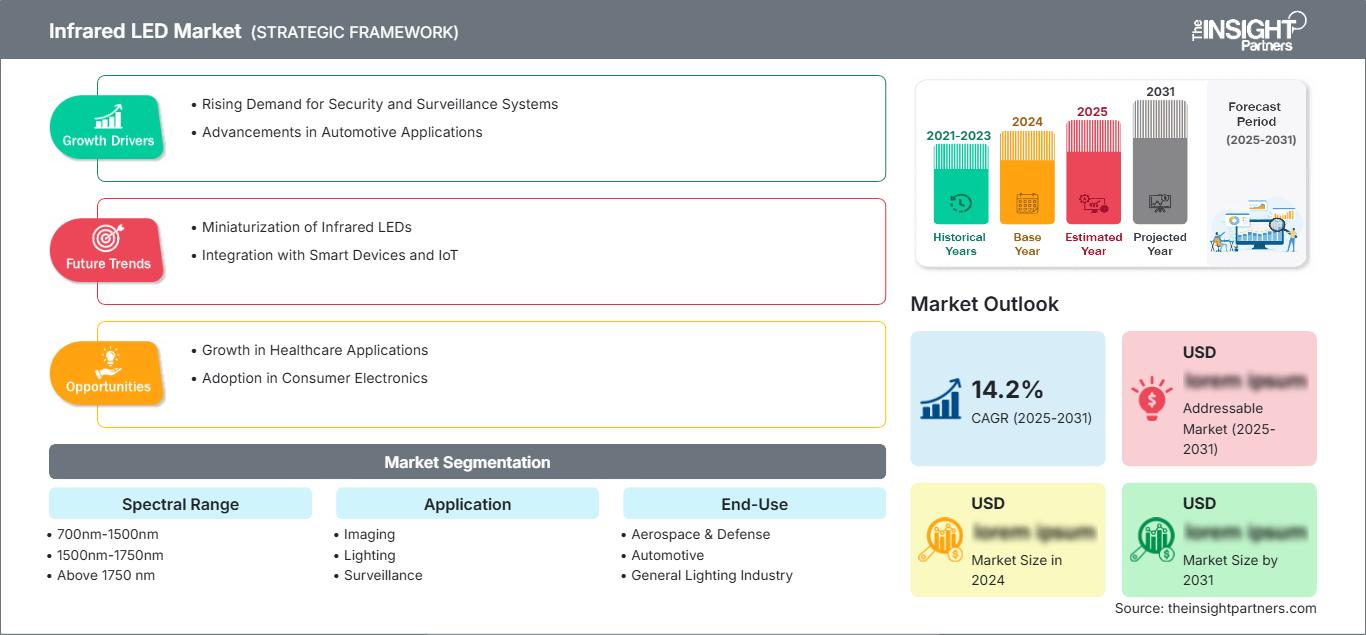
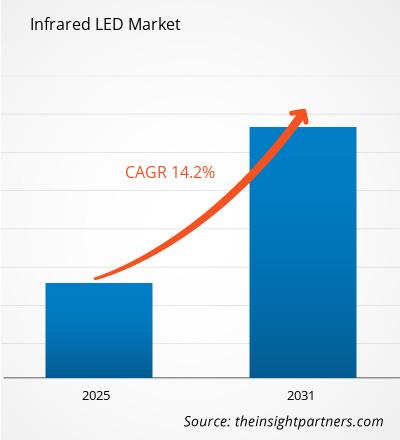
The Infrared LED Market is valued at US$ 809.91 Million in 2025 and is projected to reach US$ 2,035.33 Million by 2034, registering a CAGR of 10.78% during 2026–2034. The market reflects expanding deployment of infrared emitters across sensing, imaging, surveillance, biometrics, automotive monitoring, and healthcare equipment, with advances in optical efficiency, thermal management, packaging, and wavelength control strengthening adoption across high-volume and high-performance applications.
North America is positioned for an estimated 9.6–10.4% CAGR through 2034, supported by automotive sensing, biometric authentication, healthcare monitoring, and security infrastructure. The region benefits from established semiconductor design capabilities and high-value system integration. Its Infrared LED Market size is also influenced by regulatory attention to medical sensing accuracy and increasing deployment of camera-based monitoring technologies in vehicles, buildings, and industrial environments.
Infrared LED Market Assessment and Insights
- North America: North America is expected to hold a 21–25% Infrared LED Market share in 2025 and expand at a 9.6–10.4% CAGR between 2026–2034, supported by automotive sensing, healthcare devices, security systems, and advanced imaging infrastructure.
- US: The US is estimated to represent 74–78% of North American revenue in 2025 and grow at a 9.6–10.4% CAGR, driven by healthcare, defense, automotive, and biometric applications.
- Europe: Europe is projected to account for a 17–21% share in 2025 and advance at an 8.9–9.7% CAGR between 2026–2034, with Germany, the UK, France, Italy, and Spain supporting automotive sensing, industrial imaging, and healthcare demand.
- Asia Pacific: Asia Pacific is estimated at a 47–51% share in 2025 and is expected to register a 10.9–11.7% CAGR, led by China, Japan, South Korea, Taiwan, and India through electronics manufacturing and automotive technology.
- Largest Segment: Consumer Electronics is estimated at a 43–47% market share in 2025, with a 9.8–10.6% CAGR during 2026–2034, supported by high-volume sensing and authentication devices.
- High Growth Segment: Automotive is estimated at a 13–17% market share in 2025 and is expected to grow at an 11.8–12.8% CAGR through 2034, reflecting ADAS and cabin sensing adoption.
- Key companies analyzed in detail: Epileds, Epistar, Everlight Electronics, Nichia, Vishay Intertechnology, OSRAM Opto Semiconductors, Kinbright Electronics, High Power Lighting, Lextar Electronics, and Excelitas Technologies.
Source: The Insight Partners' analysis based on proprietary research, government publications, company annual reports, investor presentations, industry databases, and expert interviews.
The Infrared LED market has seen its application expand beyond traditional remote-control and lighting uses to more advanced sensing applications. Modern thin-film devices, better epitaxial layers, miniaturized form factors, and enhanced thermal management have all helped increase output intensities despite shrinking form factors. Precision in wavelength, eye safety properties, stable pulsing, and temperature stability are becoming important criteria as automotive cabin sensing, biometric cameras, machine vision, and medical wearables proliferate.
Future demand is expected to become broader as developing markets increase their numbers of connected devices, car electronics, surveillance technology, and medical services. Automotive certification will drive demand for more reliable emitters, while medical device certification will drive preference towards those vendors that can demonstrate reliability of their optical output. Increasing regional manufacturing of electronics is driving more localization in packaging, testing, and application engineering of infrared LEDs. All of this points towards a more specialized supplier base.
Infrared LED Market Report Scope
| Report Attribute | Details |
|---|---|
| Market size in 2025 | US$ 809.91 Million |
| Market Size by 2034 | US$ 2,035.33 Million |
| Global CAGR (2026 - 2034) | 10.78% |
| Historical Data | 2021-2024 |
| Forecast period | 2026-2034 |
Infrared LED Market Analysis
The Infrared LED market is becoming more associated with sensing intensity, and not just illumination volume. Automotive OEMs deploy infrared light sources along with cameras for driver and passenger sensing, whereas phones, access control devices, and wearables use light sources for identity authentication and physiology measurement purposes. The value chain involves epitaxy, wafer, chip, packaging, optics, driver, module, and system integration. As a result, the demand for the components depends not only on the specifications of the components but also on their wins among downstream designs.
As a matter of fact, supply continues to be defined by Asian semiconductor capacities and availability of materials, in particular gallium based compounds which are widely used in infrared optoelectronics. Wafer costs, packaging, qualification cycles impact the cost of components and delivery schedules. The availability of components with various wavelengths and packages will allow addressing the different needs of the customers, while automotive and medical device projects require long qualification cycles.
Infrared LED Market report shows that the market has a competitive structure, which involves major optoelectronic companies alongside specialist LED and photonic components suppliers. Nichia and OSRAM Opto Semiconductors stress on performance LEDs and application-oriented optics; Vishay Intertechnology and Everlight Electronics offer comprehensive line-ups of infrared components. Epistar, Epileds, and Lextar Electronics bring semiconductor and packaging expertise, while Excelitas Technologies has a strong photonic and sensing focus.
Development priorities include higher radiant efficiency, smaller form factors, car qualifications, and diversification of wavelengths. The trend is towards positioning components according to the whole set of application needs instead of mere LEDs. These include matching with optics, thermal considerations, reliability tests, and supporting cameras or sensors architectures. Competitiveness shifts to systems engineering, intellectual property rights, manufacturing scale, and customer support from prototyping through manufacturing volume stages.
● REPORT CUSTOMIZATION
Tailor This Report To Align With Your Specific Business Requirements
This report can be customized to align precisely with your business objectives, scope, and target markets. Customization options include tailored segmentation, geography, competitive analysis, and strategic insights to support informed decision-making.
Customize This Report →WHAT YOU CAN ADJUST
- ● Segmentations
- ● Geography
- ● Competitive Analysis
- ● Language Preferences
Infrared LED Market: Strategic Insights
Regional Insights
North America Infrared LED Market
North America is estimated to represent 21–25% of global revenue in 2025 and is projected to expand at a 9.6–10.4% CAGR through 2034. The US accounts for regional demand, backed up by automotive electronics, imaging for military use, access control using biometrics, healthcare applications, and industrial machine vision. Canada makes its contribution via aerospace, mining, and sensing systems.
Automotive cabin monitoring is acquiring growing significance, owing to the fact that safety systems use infrared illumination together with cameras for assessing the alertness of the driver and the occupancy of passengers. Another major application area is healthcare, where there is a need for technically challenging applications due to the predictability of the performance of optical devices.
U.S. Infrared LED Market
The US is estimated to account for 74–78% of North American Infrared LED Market in 2025, with growth of 9.6–10.4% through 2034. The market is driven by requirements in defense imaging, biometric identification, healthcare monitoring, automotive sensors, and security devices. Companies such as Vishay Intertechnology and Excelitas Technologies cater to the domestic requirements for application development.
There is a growing trend in automotive and healthcare applications in terms of the need for small-size infrared emitters in combination with detectors. Pulse oximetry in healthcare demonstrates the relevance of controlled optical performance and verification, whereas reliability at varying temperatures and vibrations is a key requirement in automotive projects.
Europe Infrared LED Market
Europe is estimated to hold a 17–21% Infrared LED Market in 2025 and is expected to grow at an 8.9–9.7% CAGR. Germany is leading in the region, followed by the UK, France, Italy, and Spain. Demand is supported by automotive engineering, industrial automation, security, and healthcare applications, whereas vehicle safety regulations encourage integration of infrared sensors.
The UK has growing demand in the aerospace, defense, healthcare, and security sectors. Germany sees good potential in automotive engineering, industrial machinery, and machine vision applications. France's demand comes from aerospace, defense, and medical industries, while Italy and Spain present prospects for automotive parts, industrial automation, retail security, and healthcare equipment. The preference for energy-efficient emitters with a constant spectrum is increasing.
APAC Infrared LED Market
APAC is estimated at a 47–51% Infrared LED Market in 2025 and is projected to grow at a 10.9–11.7% CAGR, making it the leading region. China is in the lead, followed by Japan, South Korea, India, and Australia, which have electronics assembly and automobile manufacturing as primary sources of demand.
China profits from the development of optoelectronic manufacturing, while Japan and South Korea provide support in terms of sensing and consumer electronics. India is growing its electronics assembly and automobile manufacturing capacity, whereas Australia helps with mining, security, and sensing.
Middle East & Africa Infrared LED Market
Middle East and Africa Infrared LED Market is smaller but expanding, supported by energy infrastructure, security systems, healthcare modernization, and smart-building investment. Saudi Arabia leads regional activity, followed by the UAE and South Africa, while the Rest of MEA remains fragmented across industrial and public-sector applications.
The region is expected to record an 8.1–9.0% CAGR through 2034. Saudi Arabia and the UAE emphasize smart infrastructure and security, whereas South Africa has stronger industrial and mining applications. Energy-sector monitoring, perimeter surveillance, and healthcare equipment create opportunities for rugged infrared emitters capable of reliable operation in demanding environmental conditions.
Segmentation Analysis
Spectral Range
The Spectral Range segment is expected to expand at a 10.2–11.1% CAGR during 2026–2034. Near-infrared wavelengths remain central to cameras, biometric systems, and sensing platforms, while longer wavelengths gain relevance in specialized imaging and material-analysis applications. The Infrared LED Market scope is therefore broadening from standardized emitters toward application-specific spectral solutions.
- 700nm-1500nm: This range remains the principal commercial band because silicon-based detectors, cameras, biometric modules, and automotive sensors offer strong compatibility. Demand emphasizes high radiant intensity, compact packages, and efficient thermal performance.
- 1500nm-1750nm: Adoption is concentrated in specialized sensing and imaging systems where longer wavelengths can reveal information unavailable in conventional visible or near-infrared imaging. Strategic importance is increasing as SWIR-related applications diversify.
- Above 1750 nm: This band serves specialized industrial, scientific, and sensing requirements. Demand is more application-specific, with procurement decisions influenced by detector compatibility, optical losses, thermal requirements, and system-level performance.
Application
The Application segment is projected to register a 10.6–11.5% CAGR during 2026–2034. Imaging, surveillance, biometrics, and optical sensing increasingly require controlled infrared illumination, while lighting remains important in established camera and security architectures. The segment is benefiting from greater sensor intelligence and integration of emitters directly into compact electronic modules.
- Imaging: Infrared illumination improves image capture in low-light conditions and supports machine vision, medical imaging, and specialized inspection. Demand increasingly favors compact high-output emitters with carefully controlled beam profiles.
- Lighting: Infrared lighting remains important for camera illumination, night vision, and controlled environments. Buyers prioritize reliability, efficiency, and compatibility with image sensors while maintaining acceptable thermal characteristics.
- Surveillance: Security cameras and access systems use infrared emitters to maintain visibility without visible illumination. Growth is supported by wider deployment of connected cameras, perimeter monitoring, and intelligent video analytics.
- Biometrics: Facial, iris, and vein-recognition systems require stable illumination and consistent wavelength performance. Component suppliers gain strategic value by supporting miniature designs and high-volume authentication platforms.
- Optical Sensing: Optical sensing uses infrared sources for distance, physiological, environmental, and industrial measurements. Adoption is supported by improved detector sensitivity and increasing integration of sensing functions into connected equipment.
End-Use
The End-Use segment is expected to grow at a 10.9–11.8% CAGR during 2026–2034. Consumer electronics provides scale, while automotive and healthcare applications increasingly demand qualified, high-performance emitters. The segment structure reflects a transition from standardized components toward application-specific designs, reliability requirements, and integrated sensing architectures.
- Aerospace & Defense: Infrared emitters support surveillance, targeting, night vision, and sensing equipment where reliability and environmental robustness are critical. Procurement tends to emphasize qualified components and long product lifecycles.
- Automotive: Automotive systems use infrared sources for driver monitoring, occupant detection, gesture recognition, and advanced sensing. Rising electronic content and safety-system integration are strengthening component requirements.
- General Lighting Industry: Infrared emitters complement conventional lighting where cameras or sensors require invisible illumination. Demand is concentrated in specialized systems rather than mainstream visible-light applications.
- Consumer Electronics: Smartphones, wearables, cameras, authentication devices, and smart-home equipment provide large-volume applications. Miniaturization, power efficiency, and integration are major purchasing considerations.
- BFSI: Banks and financial institutions use infrared-enabled biometric and surveillance systems to strengthen identity verification and physical security. Demand is linked to authentication modernization and fraud-control infrastructure.
- Healthcare: Medical monitoring and diagnostic equipment use infrared light for physiological measurements and imaging. Component selection increasingly emphasizes repeatability, validated performance, compactness, and patient-safety considerations.
- Retail: Retailers deploy infrared-enabled surveillance, access control, people monitoring, and automated systems. Adoption depends on camera infrastructure, analytics integration, and requirements for discreet illumination.
- Others: Other applications include industrial sensing, smart infrastructure, laboratory equipment, and specialized instrumentation. These niches support product diversification and create demand for unusual wavelengths, power levels, and package configurations.
Opportunity Snapshot
| End-Use | Revenue Contribution | Trend Tag | Adoption Stage |
| Aerospace & Defense | Medium | Night Vision | Scaling |
| Automotive | High | Cabin Sensing | Scaling |
| General Lighting Industry | Medium | Camera Illumination | Mature |
| Consumer Electronics | High | Biometric Sensing | Mature |
| BFSI | Medium | Secure Access | Scaling |
| Healthcare | Medium | Vital Monitoring | Scaling |
| Retail | Low | Smart Surveillance | Scaling |
| Others | Low | Industrial Sensing | Emerging |
Infrared LED Market Growth Drivers and Impact Analysis
Automotive sensing expands infrared content per vehicle
In automotive sensing, infrared illumination is becoming an emerging demand driver as infrared technology expands from traditional night vision into driver, occupant, and gesture sensing, along with child presence detection. Increased use of camera-based safety features means more illumination needed per car, along with increased demand for wide beams, high radiant intensity, and robustness. EVs add further electronics and generate additional opportunities for cabin intelligence. This affects not only emitters, optics, and drivers, but also camera modules. It gives suppliers with application engineering expertise the ability to add more value through the product life cycle, even if the design cycle is long, while successful qualification leads to steady production demand.
Biometric authentication increases demand for compact optical emitters
In biometric verification applications, there is growing demand for LEDs with near-infrared wavelengths in mobile handsets, access control systems, ATMs, and networked appliances. For face and iris recognition solutions, lighting control becomes an important consideration to preserve image integrity in different environments, making it vital to choose a suitable wavelength and ensure lighting uniformity. Smaller form factors enable the use of LEDs in smaller camera assemblies, while more efficient radiance will help cut down on energy usage. Market penetration is achieved by suppliers who embed sensors in end products, rather than relying on dedicated light sources. In addition to security upgrades at banks, airports, offices, and residential properties, there is opportunity for growth through access control.
Healthcare monitoring raises requirements for validated infrared performance
Infrared component suppliers must prepare themselves for an increasingly stringent procurement environment due to healthcare applications. There is a need for consistent emitters in pulse oximetry, wearable monitors, and optical diagnostics due to the requirement of light transmission and detection under control. It is also becoming necessary for manufacturers to consider various operating conditions and diverse end users for their products due to regulatory considerations. This will create a situation where the suppliers that are able to offer their products with consistent optical properties, processes, and supply chain capabilities gain a competitive advantage. Qualification requirements in healthcare programs are more stringent compared to consumer applications and take time but are more profitable once approved.
Infrared LED Market Future Trends
Higher-efficiency emitters enable denser sensing architectures
Infrared LED market trends include the move towards radiant efficiency, reduced thermal burden, and optical footprint reduction. The future Infrared LEDs will incorporate advanced thin film chip designs along with improved packaging optics to enable high useful intensities without increasing power consumption proportionally. Such an evolution could mean reduced number of emitters in camera modules and thinner consumer gadgets as well as make thermal design easier. Such evolutions could be more useful for automotive applications since cabin monitoring needs broader coverage in small interiors. At the same time, the industry is expected to provide more wavelength options based on current infrared wavelengths for better detector sensitivity and reduced visible red radiation.
Application-specific wavelengths broaden sensing capabilities
Product development moving forward should focus on wavelength customization in products which demand more than simply lighting up. Long-wavelength infrared could enable imaging and identification, whereas near-infrared wavelength optimization can enhance the capabilities of biometric and automotive cameras. In addition, sensor providers need to work towards the design of the emitter and detector as an integrated system which will ensure optimal performance and reduce excess optical power. High density emission means advanced packaging is still needed to address mechanical challenges and heat dissipation. Given the advancements made in machine vision systems, health monitoring systems, and industrial sensing applications, product providers that have configurable wavelength capabilities and provide engineering solutions should be well-suited to participate in high value-added projects.
Infrared LED Market Opportunities
Localize packaging and application engineering near emerging electronics hubs
The Infrared LED Market Forecasts point to opportunities for suppliers that establish packaging, testing, and application-engineering capabilities close to expanding electronics clusters. India, Southeast Asia, and selected Central European locations can provide access to growing automotive, consumer electronics, and industrial customers while reducing dependence on long international supply chains. Investment should prioritize flexible assembly lines capable of supporting multiple package geometries and wavelength combinations rather than only high-volume standardized products. Local technical support can shorten qualification cycles and improve customer retention. Strategic partnerships with camera, sensor, and module manufacturers may also provide earlier visibility into design requirements. Such localization can complement existing Asian wafer capacity while improving resilience, responsiveness, and regional customer coverage.
Build integrated emitter solutions for regulated sensing applications
A second opportunity lies in integrated infrared solutions designed for automotive, healthcare, and security applications where qualification requirements create barriers to entry. Suppliers can combine emitters with optics, thermal structures, drivers, or detector-matching guidance to simplify system design for customers. Healthcare applications offer potential for specialized packages optimized for wearable monitoring, while automotive programs can benefit from broad-beam and high-intensity products qualified for demanding environments. Investment should focus on reliability testing, optical characterization, and application-specific reference designs. Partnerships with module makers can accelerate adoption by embedding component performance into validated architectures. This approach can increase switching costs and reduce exposure to commoditized pricing, especially where customers value long-term availability and documented component behavior.
Recent Developments
- June 2026: THEON International entered an exclusivity agreement with Carlyle to acquire HGH Systèmes Infrarouges (HGH Infrared) for an enterprise value of approximately €300 million. The acquisition would expand THEON into multi-domain intelligence, surveillance and reconnaissance (ISR) and counter-UAS solutions.
- March 2026: VIGO Photonics completed the $8.4 million acquisition of InfraRed Associates’ assets, strengthening its U.S. presence and adding infrared detector capabilities. The deal expands VIGO’s reach across defense, industrial, medical and scientific markets.
- June 2026: Carlyle entered exclusive discussions with THEON International for the sale of its stake in HGH Infrared Systems, a provider of electro-optical and infrared technologies for defense, security and industrial applications. The proposed transaction is the same HGH deal announced by THEON and remains subject to definitive agreements.
Frequently Asked Questions

- Comprehensive Market Sizing and Forecast Analysis
- Detailed Segmentation Analysis
- In-Depth Market Dynamics Assessment
- Regional and Country-Level Insights
- Competitive Landscape and Company Benchmarking
- Strategic Business Intelligence
Recent Reports
Testimonials

The Insight Partners provided valuable market intelligence that supported our global go-to-market strategy. Their team was professional, responsive, and attentive to our feedback, providing thoughtful analysis and helpful methodological clarifications throughout the project.
Junmo Kim Chief Financial Officer (CFO), Enertech Co., Ltd.
The Insight Partners' SCADA System Market report is comprehensive, with valuable insights on current trends and future forecasts. The team was highly professional, responsive, and supportive throughout. We are very satisfied and highly recommend their services.
RAN KEDEM Partner, Reali Technologies LTDs
I requested a report on a very specific software market and the team produced the report in a few days. The information was very relevant and well presented. I then requested some changes and additions to the report. The team was again very responsive and I got the final report in less than a week.
JEAN-HERVE JENN Chairman, Future Analytica
We worked with The Insight Partners for an important market study and forecast. They gave us clear insights into opportunities and risks, which helped shape our plans. Their research was easy to use and based on solid data. It helped us make smart, confident decisions. We highly recommend them.
PIYUSH NAGPAL Sr. Vice President, High Beam Global
The Insight Partners delivered insightful, well-structured market research with strong domain expertise. Their team was professional and responsive throughout. The user-friendly website made accessing industry reports seamless. We highly recommend them for reliable, high-quality research services
YUKIHIKO ADACHI CEO, Deep Blue, LLC.
This is the first time I have purchased a market report from The Insight Partners.While I was unsure at first, I visited their web site and felt more comfortable to take the risk and purchase a market report.I am completely satisfied with the quality of the report and customer service. I had several questions and comments with the initial report, but after a couple of dialogs over email with their analyst I believe I have a report that I can use as input to our strategic planning process.Thank you so much for taking the extra time and making this a positive experience.I will definitely recommend your service to others and you will be my first call when we need further market data.
JOHN SUZUKI President and Chief Executive Officer, Board Director, BK Technologies
I wish to appreciate your support and the professionalism you displayed in the course of attending to my request for information regarding to infectious disease IVD market in Nigeria. I appreciate your patience, your guidance, and the fact that you were willing to offer a discount, which eventually made it possible for us to close a deal. I look forward to engaging The Insight Partners in the future, all thanks to the impression you have created in me as a result of this first encounter.
DR CHIJIOKE ONYIA MANAGING DIRECTOR, PineCrest Healthcare Ltd.Reason to Buy
- Informed Decision-Making
- Understanding Market Dynamics
- Competitive Analysis
- Identifying Emerging Markets
- Customer Insights
- Market Forecasts
- Risk Mitigation
- Boosting Operational Efficiency
- Strategic Planning
- Investment Justification
- Tracking Industry Innovations
- Aligning with Regulatory Trends





 Get Free Sample for