
Hydrogen Generation Market Share, Trends & Demand Outlook 2034
Coverage: By Type (Green Hydrogen, Blue Hydrogen, Gray and Black Hydrogen, and Others), Delivery Mode (Merchant and Captive), Technology (Steam Methane Reforming (SMR), Partial Oxidation (POX), Coal Gasification, Electrolysis, and Others), Application (Petroleum Refinery, Ammonia Production, Methanol Production, Transportation, Power Generation, and Others), and Geography
- Status : Published
- Report Code : TIPTE100001037
- Category : Energy and Power
- No. of Pages : 288
- Available Report Formats :


- Last update date : October 07, 2026


2025 Market Size
US$ 210.37 Bn
Base year value
2034 Forecast
US$ 401.38 Bn
Projected by 2034
CAGR 2026-2034
7.44 %
Growth rate
Addressable Market
US$ 2,757.31 Bn
(2026-2034)
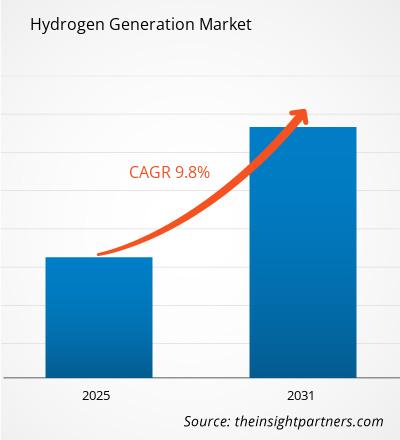
Global Hydrogen Generation Market is entering a measured expansion phase as established industrial demand converges with lower-emission production investment. The market was valued at US$ 210.37 billion in 2025 and is projected to reach US$ 401.38 billion by 2034, expanding at a CAGR of 7.44% during 2026–2034. Growth reflects continuing hydrogen consumption in refining and chemicals alongside gradual commercialization of electrolysis, carbon capture-enabled production, and new mobility and power applications.
North America is expected to expand at an estimated 6.84% CAGR through 2034. The Global Hydrogen Generation Market size in the region is supported by large refinery and ammonia requirements, extensive natural gas and industrial gas infrastructure, and policy mechanisms that improve project economics for lower-carbon hydrogen. Hub development, carbon storage availability, and long-term offtake structures are helping projects progress, although electricity costs, permitting, and demand certainty remain decisive investment filters.
Hydrogen Generation Market Assessment and Insights
Regional Outlook
- North America: 28.1% of the global market in 2025 | 6.84% CAGR through 2034. Market position: The region ranks second, supported by refinery demand, abundant gas, carbon storage resources, industrial hubs, and incentives for lower-emission production.
- US: 92% of North American market revenue in 2025 | 6.78% CAGR through 2034. Market position: The country leads North America through integrated industrial-gas networks, refining and ammonia consumption, project development expertise, and emerging transport and power applications.
- Europe: 23% of the global market in 2025 | 6.53% CAGR through 2034. Market position: Mature industrial demand combines with strong decarbonization rules; Germany leads Europe, while France, the UK, Italy, and Spain develop complementary production and import pathways.
- Asia Pacific: 43% of the global market in 2025 | 8.24% CAGR through 2034. Market position: Asia Pacific is both the largest and fastest-growing region, anchored by China and supported by expanding projects in Japan, South Korea, India, and Australia.
Segment Outlook
- Gray and Black Hydrogen: 92.36% Share in 2025 | 5.57% CAGR through 2034. Market position: Installed coal- and gas-based production serving refining, ammonia, and methanol sustains leadership, although carbon costs and replacement investment gradually reduce its relative contribution.
- Green Hydrogen: 6.6% Share in 2025 | 20.9% CAGR through 2034. Market position: Renewable power procurement, electrolyzer scale-up, industrial decarbonization mandates, and export-derivative projects support the strongest growth from a small commercial base.
Competitive Coverage
China Petroleum & Chemical Corporation (Sinopec), Linde plc, Air Liquide S.A., ENGIE SA, Shell plc, Plug Power Inc., Enapter AG, Ørsted A/S, Siemens Energy AG, Bloom Energy Corporation, Iwatani Corporation, Messer SE & Co. KGaA, Adani Group, Reliance Industries Limited
Methodology
The Insight Partners follows Data Collection & Secondary Research, Primary Research, Data Analysis, and Data Triangulation & Final Review to validate market estimates and insights.
Source: The Insight Partners' analysis based on proprietary research, government publications, company annual reports, investor presentations, industry databases, and expert interviews.
Hydrogen production is shifting from a largely captive, fossil-fed industrial utility toward a portfolio of merchant supply, renewable electrolysis, and natural-gas pathways paired with carbon capture. Steam methane reforming remains commercially entrenched because existing refineries, ammonia plants, pipelines, and operating expertise lower delivered cost. At the same time, electrolyzer manufacturing is industrializing, project sizes are increasing, and developers are integrating renewable power more closely with hydrogen plants. The Global Hydrogen Generation Market therefore reflects two simultaneous systems: dependable conventional supply serving current demand and a capital-intensive transition toward lower-emission molecules.
Through 2034, investable growth will concentrate in locations where inexpensive electricity or gas, water access, storage, transport infrastructure, and bankable offtake overlap. China, India, the Gulf, Australia, and selected industrial corridors in Europe and North America offer distinct production advantages. Regulatory standards for carbon intensity, contracts for difference, tax support, and public procurement can narrow cost gaps, but execution will remain selective. Projects tied to refineries, fertilizer plants, steelmaking, ports, and export derivatives are more likely to advance than speculative capacity without committed buyers.
Hydrogen Generation Market Report Scope
| Report Attribute | Details |
|---|---|
| Market size in 2025 | US$ 210.37 Billion |
| Market Size by 2034 | US$ 401.38 Billion |
| Global CAGR (2026 - 2034) | 7.44% |
| Historical Data | 2021-2024 |
| Forecast period | 2026-2034 |
Hydrogen Generation Market Analysis
The Hydrogen Generation Market is mainly driven by the long term feedstock need of petroleum refining, ammonia, and methanol industry and not by mass adoption of Hydrogen in new applications. Given participants in each new application, producers arrange the provision of NG/coal/renewable electricity/water/equipment to produce the hydrogen they deliver to the customer via captive plants, pipelines, trailers, or liquefaction net; with carbon intensities rising as a factor in selection. Power source, methane mitigation, capture rate and certification are of increasing importance to the customer.
Supply is heavily concentrated near industrial clusters due to the high cost of transportation relative to the high energy content of hydrogen. Integrated sites, which use existing utilities, storage, and off takers, ease commercialization risk. More and more electric-4hylene producer. Engineering contractor. Renewable developer. Industrial-gas company, and offtaker are forming project consortia. This approach shares technology and financing risk while limiting capacity additions to credible demand.
Analysis of world Hydrogen Generation Market: competition is split between incumbents who have the pipeline and customer relationships and specialists who have modular electrolysis or distributed generation. Linde plc, Air Liquide S. A. Messer SE&Co. KGaA are using the existing operating networks and Plug Power Inc. Enapter AG, Siemens Energy AG, Bloom Energy Corporation are competing using equipment platforms. Sinopec, Shell plc, ENGIE SA, rsted A/S, Iwatani corporation, Adani group, Reliance Industries Limited link production to energy portfolio, or captive demand;
The capital is shifting away from lights on and instead targeting projects with permitting subsidies confirmed power supply and binding offtakes. Developers are focusing on modular expansion, a berth on technology guarantees, and co-location with ammonia, refining, or steel assets. Key positioning factors are now less headline capacity and more delivered hydrogen costs, utilization rate, emissions verification and the ability to finance new infrastructure pre scale.
● REPORT CUSTOMIZATION
Tailor This Report To Align With Your Specific Business Requirements
This report can be customized to align precisely with your business objectives, scope, and target markets. Customization options include tailored segmentation, geography, competitive analysis, and strategic insights to support informed decision-making.
Customize This Report →WHAT YOU CAN ADJUST
- ● Segmentations
- ● Geography
- ● Competitive Analysis
- ● Language Preferences
Hydrogen Generation Market: Strategic Insights
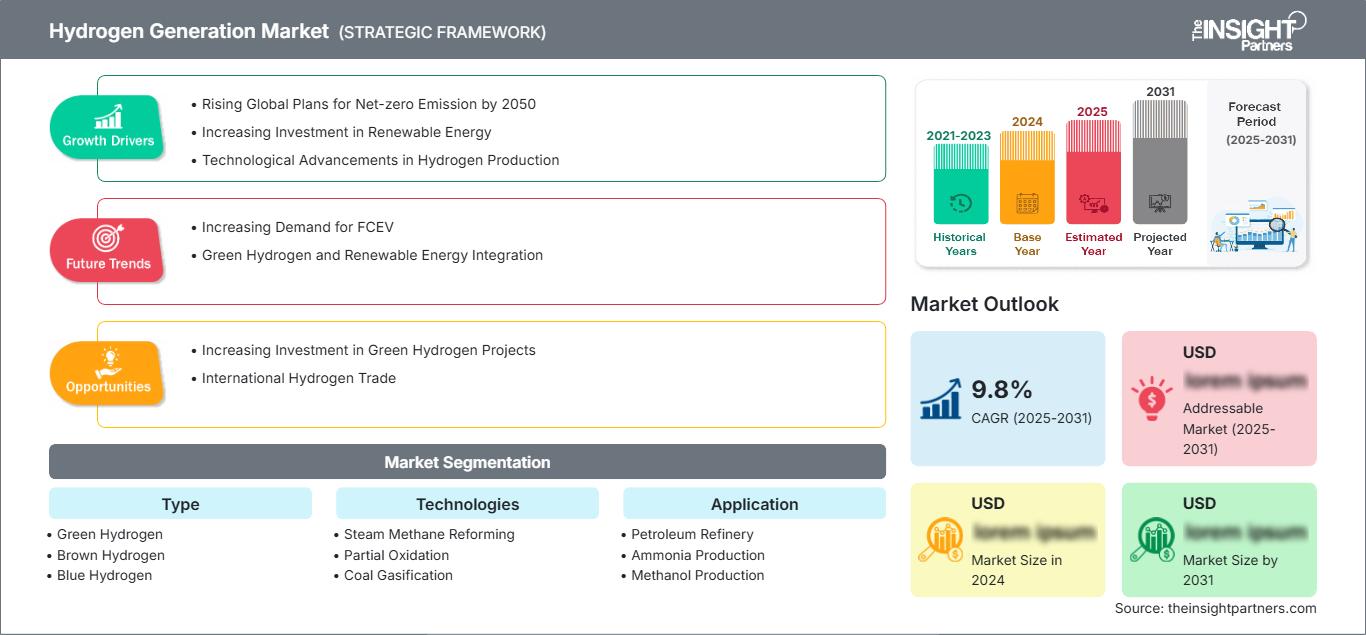
Regional Insights
North America Global Hydrogen Generation Market
North America will likely average 6.84% from present to 2034 due to early adoption of hydrogen in refining, chemicals, and fertilizer. US Gulf Coast and Canadian Industrial growth corridors provide pipeline, port, and experienced engineering contractors that together combine all necessary energy needs, carge storage geology, and infrastructure to foster carbon emission ready blue hydrogen as a reliable bridge for customers to blend renewable into.
Selection of regional projects is more methodical. Tax breaks and green-hydrogen standards will boost economics, but criteria like eligibility, life-cycle emissions, electricity mix and offtake credit will continue to matter. Merchant suppliers can combine demand among users, while captive plants are appropriate for refineries and ammonia producers with a need for energy security. The North American share of the total global Hydrogen Generation Market can be maintained through displacement of incumbent production and targeted growth in heavy-duty transportation, sustainable fuels and dispatchable electricity.
U.S. Global Hydrogen Generation Market
The US accounts for 92.1% of NA revenue in 2025 and is forecasted to grow at a 6.78% CAGR through 2034. US leadership in NA is driven by refinery concentration, significant ammonia production, large natural gas infrastructure and multiple carbon-management regions. Gulf Coast clusters provide the strongest near-term integration as hydrogen production customers pipelines, export terminals and the largest exploration and production carbon sequestration opportunities are collocated.
Linde plc, Air Liquide S.A. Plug Power Inc. Bloom Energy Corporation, and Shell plc each contribute distinct strengths in the provision of industrial gases electrolyzers onsite systems, and energy logistics. Petroleum refining and ammonia still hold the volumes, with projects for e-fuels HDM data-center resiliency, and grid support expanding the addressable population. Investment returns will hinge on utilization and long duration contracts more than the installed nameplate capacity..
Europe Global Hydrogen Generation Market
Europe is estimated to contribute 23.9% of worldwide revenue in 2025 then grow at 6.53% CAGR up to 2034. Europe represents the combination of mature refinery and chemical demand: binding decarbonisation policies; renewable-energy expansion; infrastructure planning on a cross-border basis; public finance. Germany will be the dominating country within Europe because of the industrial foundation, electrolyzer network, backbone network planning and demand from chemical, refining, and potential steel industry.
France has low-carbon electricity and synchronized industrial clusters, the UK has cluster-based blue and green hydrogen in origin with carbon storage and offshore wind, Italy is around gas-network conversion, refining, and Mediterranean imports, and Spain is strong solar and wind complements ammonia, derivatives, and export. The routes are complementary not all the same in each country, so certification and infrastructure interoperability will drive trade.
The regional problem is offtake makes policy targets bankable... Air Liquide S. A. Linde plc, ENGIE S. A. Shell plc, rsted A. S. Siemens Energy A. G. Enapter A. G. and Messer S. E. & Co. K G a have players across production, equipment, and delivery. A project with existing users in the supply chain can achieve higher ratio of utilization through time but greenfield export continues to be exposed to power price, permit, and buyer willingness to pay.
APAC Global Hydrogen Generation Market
Asia pacific Although Asia pacific accounts for a larger percentage of global share, almost 43.1% in 2025, this region is predicted to grow at the highest CAGR of 8.24% from 2015-2034. China represents the leading country in the Asia pacific market supported by theworld's largest conventional hydrogen production base, growing electrolyzer manufacturing and industrial demonstration projects backed by the government.
Japan and South Korea focus on dispersed imported clean fuels, power generation and mobility ecosystems. India is focusing on linking renewable hydrogen with refineries, fertilizer, and export derivatives. Australia is planning for resource led projects supporting renewable power, ports, and export logistics. These different approaches are exemplified by Sinopec, Iwatani Corporation, Adani Group and Reliance Industries Limited. Cost reduction, grid integration, water management and firm industrial offtake would shape the speed of commercialization.
Rest of World Global Hydrogen Generation Market
The Rest of World market is forecast to record a 7.85% CAGR through 2034. Middle East and Africa is the key region where large renewable endowments, hydrocarbons experience, ports, and export focused ammonia developments are aligned. In Rest of MEA regions project economics depend on power cost, water availability, political risk and market access. Large integrated projects can develop export scales, while smaller, captive systems may serve local fertiliser, refining, and power markets.
Segmentation Analysis
Type
The Type segment is forecast to expand at 7.44% CAGR over 20262034. The Global Hydrogen Generation Market encompasses low and conventional routes allowing customers to optimize cost, reliability, and CO2 targets. Gray and black routes will keep their installed base while green and blue ones will draw investments where policies are friendly: access to renewable power, natural gas availability, capture infrastructure and certified demand.
- Green Hydrogen: Electrolysis linked to renewable electricity is scaling from demonstrations toward industrial projects. Adoption is strongest where low-cost power, high utilization, and contracted demand offset equipment and financing costs.
- Blue Hydrogen: Natural-gas production paired with carbon capture suits industrial clusters with storage access. Its strategic value depends on high capture performance, controlled upstream methane emissions, and transparent certification.
- Gray and Black Hydrogen: These pathways continue supplying most established refinery, ammonia, and methanol demand. Their cost advantage is increasingly weighed against carbon exposure and replacement requirements.
Delivery Mode
Delivery Mode is forecast to expand at 7.44% CAGR during 2026–2034. Captive supply dominates energy-intensive sites requiring continuous volumes, while merchant networks aggregate demand across customers and reduce individual capital commitments. Selection depends on consumption scale, distance, purity, reliability, pipeline access, storage, and contract duration. Cluster development is narrowing the boundary as shared infrastructure connects anchored captive users with merchant distribution.
- Merchant: Centralized plants, pipelines, tube trailers, and liquid hydrogen serve multiple customers. Merchant models gain relevance where aggregated demand improves asset utilization and supports specialized logistics.
- Captive: Onsite production remains strategically important for refineries, ammonia, and methanol facilities. Buyers prioritize uninterrupted supply, process integration, feedstock control, and avoided transport costs.
Technology
Technology is expected to expand at a growth rate of 7.44 % CAGR in 20262034. Steam methane reforming acts as the installed base, while electrolysis traces the strongest transition momentum. Partial oxidation and coal gasification maintain relevance in feedstock-specific industrial contexts. Technology option is established by delivered cost, carbon intensity, plant capacity, feedstock availabilities, operational flexibility, and integration with capture or renewable power.
- Steam Methane Reforming (SMR): SMR remains the commercial benchmark for large industrial users because of mature engineering and gas integration. Carbon capture additions can lower emissions where transport and storage exist.
- Partial Oxidation (POX): POX supports heavy hydrocarbon and residue conversion, particularly at integrated refining and chemical sites. Its value lies in feedstock flexibility and syngas integration.
- Coal Gasification: Coal-based production remains concentrated where domestic coal and established chemical complexes support economics. Carbon intensity and policy pressure limit expansion without effective capture.
- Electrolysis: Electrolysis enables renewable and low-carbon electricity to become hydrogen. Modular deployment, falling manufacturing costs, and flexible operation support adoption, although power cost and utilization remain decisive.
Application
Application is forecast to expand at 7.44% CAGR during 2026–2034. Refining and ammonia provide the deepest existing demand, creating practical entry points for lower-emission substitution. Methanol adds chemical and fuel potential, while transportation and power remain earlier-stage. Commercial growth depends on whether new uses can secure infrastructure, equipment availability, safety standards, and long-term price visibility.
- Petroleum Refinery: Refineries consume hydrogen for hydrotreating and desulfurization, making them anchor customers. Replacement of conventional supply offers near-term decarbonization without requiring a new end-use process.
- Ammonia Production: Ammonia creates concentrated, continuous demand and supports fertilizer security. Low-emission hydrogen can reduce production footprints and enable exportable ammonia as an energy carrier.
- Methanol Production: Methanol links hydrogen with chemicals, marine fuels, and synthetic products. Growth requires compatible carbon sources, competitive electricity, and buyers accepting low-emission premiums.
- Transportation: Adoption centers on heavy-duty fleets, buses, logistics corridors, and selected rail or marine uses where fast refueling and high utilization can justify infrastructure.
- Power Generation: Hydrogen and ammonia can support long-duration storage, turbine fuel, and grid balancing. Economics depend on low-cost supply, conversion efficiency, and capacity-value recognition.
Opportunity Snapshot
| Application | Revenue Contribution | Trend Tag | Adoption Stage |
| Petroleum Refinery | High | Feedstock Shift | Mature |
| Ammonia Production | High | Clean Fertilizer | Scaling |
| Methanol Production | Medium | Marine Fuels | Scaling |
| Transportation | Low | Freight Corridors | Emerging |
| Power Generation | Low | Seasonal Storage | Emerging |
| Others | Low | Industrial Heat | Emerging |
Hydrogen Generation Market Growth Drivers and Impact Analysis
Industrial decarbonization of established hydrogen demand
Refineries, ammonia, and methanol plants already use hydrogen on continuous production basis, enabling suppliers to use less polluting source. They do not have to wait for new end-user markets. This gives a credible anchoring demand for electrolysers, carbon capture units, pipelines, and storage needed. The cycle is greatest in clusters of industries, which have bundles of common infrastructure, lowering unit costs and enabling large numbers of buyers to support a payment mechanism by co-ordinated use. Dominant factors like carbon intensity ceilings and customer emissions targets will incentivize procurement, but facilities will have to meet purity standards and supplied reliability. Because of this, most of the Global Hydrogen Generation Market transition is forecast to move from existing consumption, towards less mature usages.
Falling equipment costs and scaled manufacturing
Electrolyzer factories, standard modules, automated stack manufacture, multiple competition in the alkaline, PEM, and solid-oxide platforms all will improve procurement options. Scale can also lower capital cost, speed up lead times and help standardize project design. Even so, low-cost equipment in itself does not lead to economic hydrogen if access to low-cost power is not also available. Other factors impact delivered cost, including the cost of electricity, the capacity factor, project financing, water treatment and balance-of-plant performance. Meanwhile, equipment suppliers able to offer performance guarantees and service rights will reduce risk and avoid execution problems. This particular driver here increases the class of projects one should target, mainly where excess renewable generation would otherwise be cut off, or where low-carbon electricity is available via long-term contracts.
Policy support linked to measurable carbon intensity
Production incentives auctions contracts for difference, mandates, and public procurement can close the cost difference of conventional and low-emission hydrogen. Market effects are strongest when they have durable, technologically neutral eligibility rules aligned with lifecycle emissions measurement, with verifiable certification allowing buyers to compare sources and enabling hydrogen derivative trade across borders. However, rules changes can suspend final investment decisions. From 2034 onwards, policy will favor location and pathway choice over time, with projects that demonstrate at least 80 per cent of electricity origin, methane baseline as well as capture rate and end-use additionality rather than just production labels.
Hydrogen Generation Market Future Trends
Hydrogen hubs become integrated industrial platforms
Trends in the global Hydrogen Generation Market seem to support shared generation storage pipelines, ports, and carbon-management infrastructure instead of one plant each. Hubs can optimize multiple supply routes with multiple end markers, increasing efficiency and reducing infrastructure costs. Next, integration with ammonia methanol sustainable fuels and low carbon steel projects will turn hydrogen into a sector-infrastructure component of a multi-part low-carbon manufacturing system. Digital dispatch and accounting platforms could improve scheduling and tracking. Commercially, success will be achieved by front end loading anchor users ahead of speculative expansion, because technical interconnection is not enough to finance a hub, which still needs contracted demand.
Trade shifts toward hydrogen derivatives
Long-haul movement seems more likely to evolve towards ammonia, methanol, and synthetic fuels where the relative conversion losses can be balanced by more-flexible handling and well-used shipping networks. Gas- and solar-abundant producing economies will convert competitively-priced renewables or gas-derived low-carbon hydrogen into export molecules, while import markets' competitive advantage will be increased supply breadth. This outcome will intensify port competition and generate demand for cracking, storage, certification, and terminal assets. Within contiguous industrial areas, future routes for dedicated hydrogen pipelines will continue to be relevant. By 2034 it will be contracting relationships, carbon standards and shipping economics that should determine, which announced export corridors become operating supply chains.
Hydrogen Generation Market Opportunities
Convert captive refinery and fertilizer supply
Developers can target existing captive hydrogen units with phased retrofits, carbon capture, or adjacent electrolysis. These locations offer known demand, utilities, trained operators, and established product specifications, reducing market-creation risk. Global Hydrogen Generation Market Forecasts support prioritizing projects where replacement capacity coincides with refinery upgrades, fertilizer expansion, or emissions-compliance investment. Action plans should begin with site-specific energy balances, storage access, power contracts, and measurable carbon baselines. Modular additions allow buyers to test performance before full conversion, while long-term supply agreements can allocate electricity, feedstock, and availability risk.
Build modular supply for underserved industrial clusters
Less large scale dispersed industries may not be connected by dedicated hydrogen pipelines even if the demand for (metals glass electronics, food processing, mobility fleets) exists. Modular electrolysis or smaller gas based systems could meet such users either on site and on a short range basis. Investors may need to assemble buyers, customize plants and pair them with storage for maximum utilization. Leasing equipment and offering hydrogen-as-a-service at fixed prices can reduce barriers to end customers owning the capital. The combinations of clean electricity access, expensive trucked hydrogen and value for customers in resilient supply are where these dispersed distributed assets will be most attractive instead of larger centralized networks.
Recent Developments
- April 2026: Air Liquide S.A. – Air Liquide outlined the scale-up of its European electrolysis portfolio, including the 200 MW Normand’Hy PEM electrolyzer under construction near Port-Jérôme-sur-Seine, France. Commissioning is planned for 2026, with designed output of around 28,000 tonnes of renewable and low-carbon hydrogen annually for the Seine Valley industrial basin.
- September 2025: Plug Power Inc. – Plug Power reported that its Woodbine, Georgia, green hydrogen plant delivered 324 metric tons during August 2025, with 97% uptime and 99.7% availability excluding a utility outage. The milestone provided operating evidence for commercial-scale PEM electrolysis and integrated liquid-hydrogen supply serving US customers.
- July 2025: Siemens Energy AG – Siemens Energy announced an electrolyzer award for a renewable-powered hydrogen project in Tamura, Fukushima Prefecture, Japan. The PEM system is designed to produce up to 1,900 metric tons annually for quartz-glass manufacturing, with surplus supply intended for nearby users, linking industrial decarbonization with development of a regional hydrogen ecosystem.
Frequently Asked Questions

- Comprehensive Market Sizing and Forecast Analysis
- Detailed Segmentation Analysis
- In-Depth Market Dynamics Assessment
- Regional and Country-Level Insights
- Competitive Landscape and Company Benchmarking
- Strategic Business Intelligence
Recent Reports
Testimonials

The Insight Partners provided valuable market intelligence that supported our global go-to-market strategy. Their team was professional, responsive, and attentive to our feedback, providing thoughtful analysis and helpful methodological clarifications throughout the project.
Junmo Kim Chief Financial Officer (CFO), Enertech Co., Ltd.
The Insight Partners' SCADA System Market report is comprehensive, with valuable insights on current trends and future forecasts. The team was highly professional, responsive, and supportive throughout. We are very satisfied and highly recommend their services.
RAN KEDEM Partner, Reali Technologies LTDs
I requested a report on a very specific software market and the team produced the report in a few days. The information was very relevant and well presented. I then requested some changes and additions to the report. The team was again very responsive and I got the final report in less than a week.
JEAN-HERVE JENN Chairman, Future Analytica
We worked with The Insight Partners for an important market study and forecast. They gave us clear insights into opportunities and risks, which helped shape our plans. Their research was easy to use and based on solid data. It helped us make smart, confident decisions. We highly recommend them.
PIYUSH NAGPAL Sr. Vice President, High Beam Global
The Insight Partners delivered insightful, well-structured market research with strong domain expertise. Their team was professional and responsive throughout. The user-friendly website made accessing industry reports seamless. We highly recommend them for reliable, high-quality research services
YUKIHIKO ADACHI CEO, Deep Blue, LLC.
This is the first time I have purchased a market report from The Insight Partners.While I was unsure at first, I visited their web site and felt more comfortable to take the risk and purchase a market report.I am completely satisfied with the quality of the report and customer service. I had several questions and comments with the initial report, but after a couple of dialogs over email with their analyst I believe I have a report that I can use as input to our strategic planning process.Thank you so much for taking the extra time and making this a positive experience.I will definitely recommend your service to others and you will be my first call when we need further market data.
JOHN SUZUKI President and Chief Executive Officer, Board Director, BK Technologies
I wish to appreciate your support and the professionalism you displayed in the course of attending to my request for information regarding to infectious disease IVD market in Nigeria. I appreciate your patience, your guidance, and the fact that you were willing to offer a discount, which eventually made it possible for us to close a deal. I look forward to engaging The Insight Partners in the future, all thanks to the impression you have created in me as a result of this first encounter.
DR CHIJIOKE ONYIA MANAGING DIRECTOR, PineCrest Healthcare Ltd.Reason to Buy
- Informed Decision-Making
- Understanding Market Dynamics
- Competitive Analysis
- Identifying Emerging Markets
- Customer Insights
- Market Forecasts
- Risk Mitigation
- Boosting Operational Efficiency
- Strategic Planning
- Investment Justification
- Tracking Industry Innovations
- Aligning with Regulatory Trends





 Get Free Sample for