
Flexible Magnet Market Size, Share & Growth by 2034
Coverage: by Type (Isotropic, Anisotropic, Hybrid); End-User Industries (Electrical and Electronics, Packaging, Automotive, Others) , and Geography (North America, Europe, Asia Pacific, and South and Central America)
- Status : Data Released
- Report Code : TIPRE00005984
- Category : Chemicals and Materials
- No. of Pages : 150
- Available Report Formats :


- Last update date : September 28, 2026


2025 Market Size
US$ 389.20 Mn
Base year value
2034 Forecast
US$ 632.43 Mn
Projected by 2034
CAGR 2026-2034
5.54 %
Growth rate
Addressable Market
US$ 4,631.28 Mn
(2026-2034)
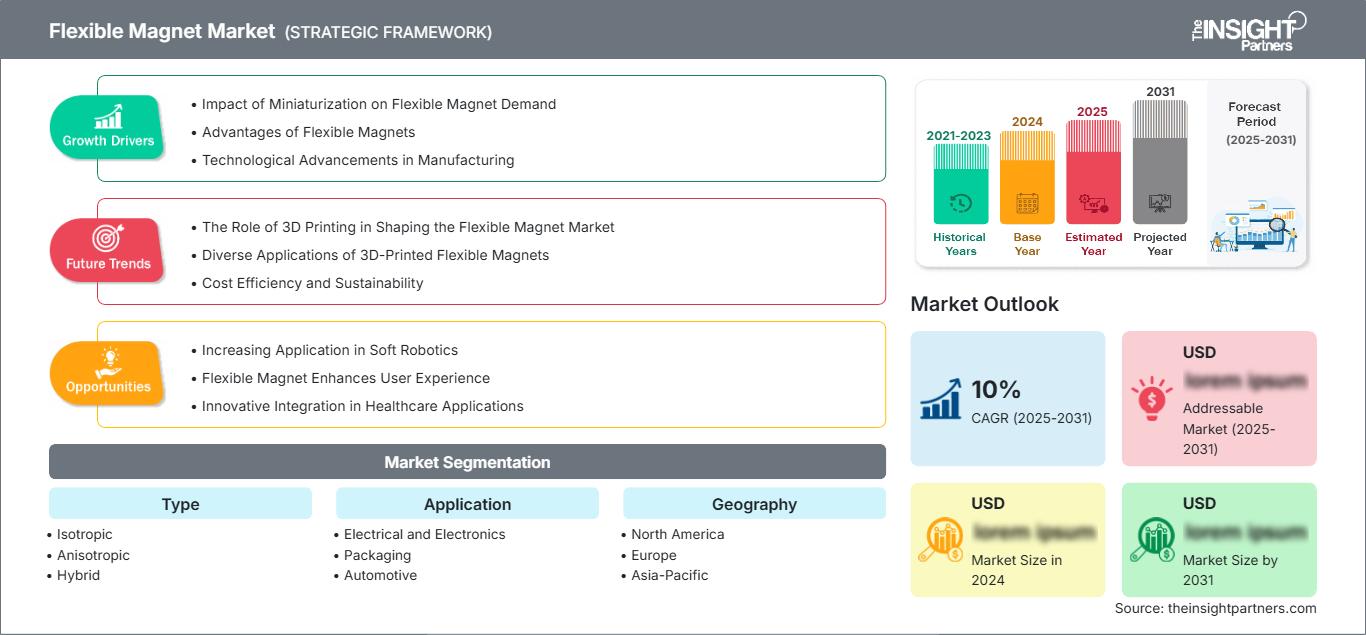
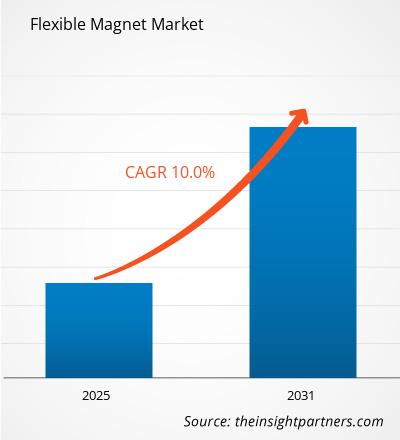
The Flexible Magnet Market was valued at US$ 389.20 Million in 2025 and is projected to reach US$ 632.43 Million by 2034, registering a CAGR of 5.54% during 2026–2034. The market encompasses polymer-bonded magnetic materials that combine permanent magnetic performance with flexibility, enabling products to conform to curved surfaces, be die-cut, laminated, extruded, or supplied in customized shapes for electrical and electronics, packaging, and automotive applications.
North America is expected to maintain a significant position, supported by established magnetic-component manufacturing, automotive production, electronics integration, and demand for customized fastening and shielding solutions. The regional Flexible Magnet Market Size is estimated to expand at a 5.0–5.7% CAGR during 2026–2034. Growth is structurally supported by miniaturized electronic assemblies and increasing use of lightweight magnetic components in vehicle interiors and auxiliary systems.
Flexible Magnet Market Assessment and Insights
- North America: North America is estimated to represent a 21–24% share in 2025 and expand at a 5.0–5.7% CAGR between 2026–2034, supported by automotive components, electronics, custom magnetic assemblies, and established industrial manufacturing capabilities.
- US: The US is projected to account for 74–78% of North American revenue in 2025 and grow at a 4.9–5.6% CAGR between 2026–2034, supported by electronics, automotive, packaging, and industrial applications.
- Europe: Europe is estimated to hold a 20–23% share in 2025 and grow at a 4.7–5.4% CAGR between 2026–2034, with Germany, the UK, France, Italy, and Spain supporting demand through automotive, electronics, industrial, and packaging applications.
- Asia Pacific: Asia Pacific is estimated to command a 39–42% share in 2025 and grow at a 6.0–6.7% CAGR between 2026–2034, led by China, Japan, South Korea, India, and Australia through electronics manufacturing and automotive production.
- Largest Segment: Isotropic magnets are estimated to hold a 53–57% market share in 2025, with an 5.2–5.8% CAGR from 2026–2034, supported by cost-effective, high-volume applications.
- High Growth Segment: Anisotropic magnets are estimated at a 27–31% market share in 2025, with a 6.0–6.7% CAGR from 2026–2034, benefiting from higher magnetic performance requirements.
- Key companies analyzed in detail: 3M Company, Arnold Magnetic Technologies Corporation, TDK Corporation, Master Magnetics, Inc., Adams Magnetic Products Co., Bunting Magnetics Co., Integrated Magnetics, Magnaplast Technologies (India) Private Limited, JASDI Magnet, Flexmag Industries.
Source: The Insight Partners' analysis based on proprietary research, government publications, company annual reports, investor presentations, industry databases, and expert interviews.
The Flexible Magnet Market has moved away from traditional ferrite and polymer sheets and strips to composites with magnetic orientation control, better adhesion, thin layers, and specific geometries. Today's manufacturers are making magnetic powders combined with a polymer matrix and later calendering, extruding, laminating, magnetizing, slitting, and die-cutting such products. Flexible sheets, strips, tapes, and extrusions offered by Arnold Magnetic Technologies through Flexmag include high energy anisotropic types that are meant for stronger magnetic applications.
The future developments will be centered around miniaturization, increased magnetic energy content, special surface treatment, and recyclable products. Asia Pacific will continue to dominate production and consumption of flexible magnets due to large volumes of electronics and automotive industry. North America and Europe will be more into engineering components, specialty applications, and higher performance materials. Innovations in automated processing, customized magnetization, precise cutting, and eco-friendly polymer formulations will help create competitive advantages.
Flexible Magnet Market Report Scope
| Report Attribute | Details |
|---|---|
| Market size in 2025 | US$ 389.20 Million |
| Market Size by 2034 | US$ 632.43 Million |
| Global CAGR (2026 - 2034) | 5.54% |
| Historical Data | 2021-2024 |
| Forecast period | 2026-2034 |
Flexible Magnet Market Analysis
Flexible Magnet Market include the need for compact magnetic parts which allow for odd shaped geometries while minimizing the complexities in assembly process. The electronics industry applies the flexible magnetic material in shielding, sensors, miniature motors, closures, cables management and other associated components. Packaging industry uses magnetic closures and re-usable fastening systems, automotive industry uses flexible magnets in labels, fixtures, seals, sensors and interior components. The flexible magnet value chain involves suppliers of magnetic powders, polymer suppliers, compounders, magnet makers, converters, adhesive suppliers, component assembly makers and OEMs. Thus economics of supply will be driven by cost of ferrite and rare earth powder, polymers available, energy requirements, magnetization process and efficiency in converting process.
The application determines the material in the Flexible Magnet Market Report. Isotropic material offers a relatively simple and cost effective way of making magnets, while anisotropic grade gives a stronger direction when there is a need for a more powerful and compact magnetic product. Combination of different magnetic and polymer features in a single flexible magnet allows for unique applications. The makers distinguish themselves through thickness, pole pattern, adhesive system, lamination, dimensions and converting processes.
Diversified technology firms and dedicated magnet producers form the competitive environment. 3M Company is represented by flexible magnetic tapes and adhesives, whereas the flexible composite portfolio of Arnold Magnetic Technologies Corporation is represented by Flexmag Industries. TDK Corporation’s focus is thin magnetic materials and electromagnetic products with flexible magnetic shielding included. Adams Magnetic Products Co. and Master Magnetics, Inc. offer stock and customized flexible magnetic products for business use.
Competitive advantages of Integrated Magnetics, Bunting Magnetics Co., Magnaplast Technologies (India) Private Limited, and JASDI Magnet rely on specialized magnetic products, customization, regional presence, and application assistance. Investment areas are increasingly becoming focused on automated fabrication, high energy flexible magnetic materials, custom pole arrangements, recyclable printable magnetic products, and regional presence. Competitive positioning accordingly becomes more oriented towards engineering assistance, consistent magnetic characteristics, fast customization, and component integration.
● REPORT CUSTOMIZATION
Tailor This Report To Align With Your Specific Business Requirements
This report can be customized to align precisely with your business objectives, scope, and target markets. Customization options include tailored segmentation, geography, competitive analysis, and strategic insights to support informed decision-making.
Customize This Report →WHAT YOU CAN ADJUST
- ● Segmentations
- ● Geography
- ● Competitive Analysis
- ● Language Preferences
Flexible Magnet Market: Strategic Insights
Regional Insights
North America Flexible Magnet Market
North America is projected to account for a 21–24% Flexible Magnet Market share in 2025 and register a 5.0–5.7% CAGR between 2025 and 2034. Demand is driven largely by the United States, which is powered by automotive manufacturing, electronics, industrial equipment, packaging, and commercial displays. Demand is complemented by Canada in terms of industrial manufacturing and specialized magnetic components and Mexico in terms of expansion in automotive and electronics supply chains. North America boasts a well-established ecosystem of magnetic material suppliers, converters, adhesives providers, and engineering distributors.
The increased demand in the area is shifting from the provision of regular product to customized magnetic strips, sheets, tapes, and assemblies. The automotive industry demands light weight products which can be molded to create curved surfaces, while electronics companies require thin magnetic products. Customizable products can be offered through die cutting, slitting, laminating, and custom magnetization processes. Shorter lead times are possible due to proximity to key industrial buyers, while sustainable requirements call for recyclable substrates and low material products.
U.S. Flexible Magnet Market
The US is expected to represent 74–78% of North American revenue in 2025 and grow at a 4.9–5.6% CAGR through 2034. Automotive, electronics, packaging, industrial equipment, and commercial applications provide a diversified demand base. The country also has a strong concentration of specialist manufacturers and magnetic-component distributors serving customized requirements.
Competitors in the domestic market are 3M Company, Arnold Magnetic Technologies Corporation, Adams Magnetic Products Co., Master Magnetics, Inc., Integrated Magnetics, and Bunting Magnetics Co. Application trends involve attachment, closure magnets, car advertising graphics, sensors, industrial fixtures, and thin shielding for magnetic protection. The need for dimensional accuracy, adhesion properties, custom pole shapes, and consistent magnetic performance means that engineering services and conversion services make for a more successful competitor than just having magnetic sheet stock.
Europe Flexible Magnet Market
The region will hold 20–23% Flexible Magnet Market share in 2025 and grow with 4.7–5.4% CAGR during 2025-2034. Germany will be the leading country due to manufacturing of automobiles, industrial automation, electronics, and engineering-driven supply chains. The UK will be contributing to the market via automobiles, industrial, electronics, and commercial applications. In addition, France will be driving demand for the material in transportation and engineered machinery. In turn, Italy will benefit from machinery, consumer goods, and manufacturing applications. Finally, Spain will drive demand via automobiles manufacturing, packaging, and industrial conversion. Increasing attention to sustainability and durability of manufactured products, environmental requirements, and recyclability will characterize the region. The competitive landscape in Europe will be more favorable for companies capable of offering engineered components with materials specifications.
APAC Flexible Magnet Market
The APAC region is expected to account for 39-42% in 2025 and grow at a CAGR of 6.0-6.7% during the forecast period till 2034. China is the dominant nation due to strong manufacturing operations of electronics and automotive. Japan and South Korea are contributing with their high-end electronics and automotive technologies. The importance of India is increasing with manufacturing operations and appliance development.
There will be a growing regional demand due to industrial policy, electronics localization, EV production, and manufacturing capacity. China has an integrated supply chain of magnetic material and downstream manufacturing, while India has the potential for localized production of components. The regional manufacturers are focusing on automated conversion, thin magnetic sheets, customization, and specialized product development.
Middle East & Africa Flexible Magnet Market
Middle East and Africa is expected to grow at a 4.8–5.6% CAGR through 2034. Saudi Arabia and the UAE provide demand through industrial diversification, packaging, construction-related products, and automotive distribution, while South Africa has the most developed manufacturing and converting base. Rest of MEA contributes through commercial, consumer, industrial, and packaging applications.
Development of infrastructure and diversification of industries can help in creating greater demand for lightweight fasteners, markers, and components. The regional supply chain relies on imports of magnetic materials and finished goods. Potential exists in specialized packaging closures, fixtures, signs, and electronic devices where flexibility is an asset to installation and design.
Segmentation Analysis
Type
The Type segment is projected to expand at an 5.4–6.0% CAGR from 2026–2034. Material orientation and magnetic performance determine suitability across applications. Isotropic products remain important for high-volume and cost-sensitive uses, while anisotropic materials address stronger directional requirements. Hybrid materials provide manufacturers with additional design flexibility where conventional formulations cannot simultaneously satisfy magnetic, mechanical, and processing requirements.
- Isotropic: Isotropic products maintain a broad position because they offer balanced magnetic properties, simpler processing, and economical production for sheets, strips, labels, closures, displays, and general industrial applications.
- Anisotropic: Anisotropic magnets provide stronger directional magnetic performance, making them strategically important where higher holding force, reduced thickness, or more controlled magnetic orientation is required.
- Hybrid: Hybrid materials support specialized product development by combining complementary magnetic or polymer characteristics, enabling manufacturers to address demanding geometries, performance requirements, and application-specific assembly conditions.
Application
The Application segment is expected to grow at an 5.5–6.1% CAGR from 2026–2034. Electrical and electronics applications benefit from miniaturization and flexible component integration, packaging uses magnetic attachment and closure functionality, and automotive applications increasingly value lightweight, conformable components. Demand is therefore distributed across both high-volume products and specialized engineered applications.
- Electrical and Electronics: Electrical and electronics applications benefit from thin profiles, conformability, controlled magnetic fields, and ease of integration, supporting uses in sensors, shielding, closures, small components, and cable-management systems.
- Packaging: Packaging applications use flexible magnetic materials for reusable closures, labels, displays, folders, promotional packaging, and specialized fastening, with customization and ease of opening supporting adoption.
- Automotive: Automotive applications benefit from low weight, vibration tolerance, conformability, and easy installation, supporting vehicle graphics, sensors, seals, interior fixtures, labels, and auxiliary magnetic assemblies.
Opportunity Snapshot
| Application | Revenue Contribution | Trend Tag | Adoption Stage |
| Electrical and Electronics | High | Thin Shielding | Scaling |
| Packaging | Medium | Magnetic Closures | Scaling |
| Automotive | High | Lightweight Fixtures | Scaling |
Flexible Magnet Market Growth Drivers and Impact Analysis
Miniaturization of Electronic and Electromechanical Assemblies
The continuing reduction in device dimensions is increasing demand for magnetic materials that can occupy limited spaces while maintaining reliable performance. Flexible magnetic sheets and films can be supplied in thin profiles, customized dimensions, and application-specific shapes, allowing designers to integrate magnetic functions without introducing bulky rigid components. TDK’s flexible magnetic shielding portfolio illustrates how thin magnetic materials can address electromagnetic interference requirements in compact electronics. As electronics become more densely integrated, magnetic materials can support shielding, sensing, alignment, and attachment functions within constrained assemblies. The market impact is a gradual shift toward higher-value products requiring tighter dimensional control, custom cutting, and technical qualification. Suppliers that combine magnetic formulation with precision converting are positioned to capture greater value from miniaturized electronic designs.
Growing Automotive Use of Lightweight Magnetic Components
Automotive manufacturing provides an expanding opportunity for flexible magnetic components because vehicles contain increasing numbers of sensors, electronic systems, labels, fixtures, seals, and interior assemblies. Flexible materials can conform to curved surfaces and reduce the need for mechanical fasteners in selected low-load applications. Electrification further increases the number of electronic subsystems within vehicles, although flexible magnets remain concentrated in auxiliary rather than high-load powertrain functions. Manufacturers can benefit from components that simplify installation, accommodate vibration, and reduce assembly complexity. Automotive qualification requirements also create barriers to entry because suppliers must demonstrate dimensional stability, magnetic consistency, temperature resistance, and durability. Consequently, successful penetration can create recurring business with vehicle manufacturers and tier suppliers. This driver should support demand for customized, engineered magnetic products.
Expansion of Customized Magnetic Packaging and Closures
Packaging manufacturers increasingly seek reusable and convenient closure mechanisms that provide differentiation without adding substantial structural weight. Flexible magnets can be incorporated into folders, boxes, promotional packages, displays, and reusable containers because they can be cut into narrow strips or custom shapes and laminated with paper, polymer, or adhesive layers. Magnetic closure systems can improve user convenience while enabling repeated opening and closing. For manufacturers, the value proposition extends beyond magnetic holding force because flexible materials can be processed using established converting equipment and supplied in continuous rolls. Demand is therefore likely to favor suppliers that provide integrated lamination, slitting, die cutting, and adhesive solutions. The driver can broaden the addressable customer base from traditional magnet users to packaging converters and brand-oriented product designers seeking functional magnetic integration.
Flexible Magnet Market Future Trends
Higher-Energy Flexible Magnetic Composites
Future development will increasingly emphasize higher-energy flexible composites that deliver greater magnetic performance without losing bendability or processability. Manufacturers are expected to optimize magnetic-powder loading, particle orientation, binder chemistry, and magnetization patterns to increase holding force within thinner geometries. High-energy anisotropic products can address applications where conventional flexible ferrite materials require excessive thickness or surface area. This Flexible Magnet Market trend may expand adoption in sensors, compact assemblies, automotive auxiliaries, and specialized industrial fixtures. Material development will also focus on balancing magnetic performance against density, cost, temperature resistance, and manufacturing yield. Suppliers able to provide predictable performance across narrow thickness ranges could gain an advantage as customers move toward smaller components. Product qualification and application engineering will become increasingly important as higher-performance materials enter technically demanding applications.
Recyclable and Lower-Impact Flexible Magnetic Products
Environmental considerations are expected to influence future flexible magnet design, particularly for printable magnetic media, packaging products, and high-volume commercial applications. Manufacturers can reduce environmental impact through recyclable substrates, lower-material constructions, improved polymer selection, and designs that simplify separation of magnetic and non-magnetic layers. Arnold’s Flexmag portfolio already includes recyclable printable magnetic media, demonstrating the direction of product development. Future solutions may also incorporate improved adhesive systems and reduced use of difficult-to-recycle laminates. Packaging customers are likely to place greater emphasis on end-of-life characteristics as sustainability requirements become integrated into procurement decisions. The resulting opportunity is not limited to recycling itself; manufacturers can differentiate through material documentation, simplified constructions, reduced waste during converting, and products designed to maintain performance while using fewer resources.
Flexible Magnet Market Opportunities
Localized Production in High-Growth Asian Manufacturing Hubs
Investors and manufacturers in the Flexible Magnet Market Forecast can pursue localized production in India, Southeast Asia, and selected Chinese industrial clusters where electronics, automotive, appliance, and packaging manufacturing is expanding. Regional facilities can reduce logistics costs, improve delivery responsiveness, and provide application engineering closer to customers. Flexible magnet production can be integrated with slitting, die cutting, lamination, adhesive coating, and custom magnetization to create a broader value proposition than basic material supply. Joint ventures with regional converters can reduce market-entry risk while providing access to established customer networks. India is particularly attractive for suppliers seeking diversification because domestic manufacturing initiatives and growing electronics production can support downstream magnetic-component demand. Capital allocation should prioritize flexible equipment capable of producing multiple thicknesses, widths, energy grades, and pole configurations to maximize utilization across customer segments.
Advanced Magnetic Components for Emerging Flexible Electronics
Flexible electronics, wearable devices, soft robotics, medical interfaces, and compact sensing systems create longer-term opportunities for specialized magnetic materials. Research into flexible magnetoelectronic devices is expanding across sensors, magnetic tunnel junctions, magnetoresistive systems, and magnetostrictive components, demonstrating a broader technology pathway for mechanically adaptable magnetic functions. Commercial opportunities may emerge for suppliers capable of producing ultra-thin magnetic films, patterned magnetic layers, flexible shielding, and custom magnetic elements. Development partnerships with electronics manufacturers, universities, and component designers can accelerate qualification while reducing the risk associated with entering unfamiliar applications. Companies should prioritize materials that combine flexibility, magnetic stability, controlled thickness, and compatibility with established electronic manufacturing processes. Early participation in design programs can provide valuable intellectual-property and application-development advantages.
Recent Developments
- December 2025: JL MAG established a dedicated Rubber Soft Magnetic Division to enter the flexible magnet market. The company began construction and trial production of an intelligent production line in Ganzhou, China, integrating ferrite and rare-earth technologies. It plans to expand capacity and target applications including automotive seals, sensor brackets, electronics, shielding, and industrial products.
- August 2026: Larsen & Toubro is preparing to enter India’s rare-earth permanent magnet manufacturing sector and is reportedly considering a bid under the government’s ₹7,280 crore incentive scheme. The company is seeking a technology partner and intends to align the initiative with its planned electric-vehicle motor activities, supporting India’s efforts to reduce dependence on Chinese magnet supplies.
Frequently Asked Questions

- Comprehensive Market Sizing and Forecast Analysis
- Detailed Segmentation Analysis
- In-Depth Market Dynamics Assessment
- Regional and Country-Level Insights
- Competitive Landscape and Company Benchmarking
- Strategic Business Intelligence
Recent Reports
Testimonials

The Insight Partners provided valuable market intelligence that supported our global go-to-market strategy. Their team was professional, responsive, and attentive to our feedback, providing thoughtful analysis and helpful methodological clarifications throughout the project.
Junmo Kim Chief Financial Officer (CFO), Enertech Co., Ltd.
The Insight Partners' SCADA System Market report is comprehensive, with valuable insights on current trends and future forecasts. The team was highly professional, responsive, and supportive throughout. We are very satisfied and highly recommend their services.
RAN KEDEM Partner, Reali Technologies LTDs
I requested a report on a very specific software market and the team produced the report in a few days. The information was very relevant and well presented. I then requested some changes and additions to the report. The team was again very responsive and I got the final report in less than a week.
JEAN-HERVE JENN Chairman, Future Analytica
We worked with The Insight Partners for an important market study and forecast. They gave us clear insights into opportunities and risks, which helped shape our plans. Their research was easy to use and based on solid data. It helped us make smart, confident decisions. We highly recommend them.
PIYUSH NAGPAL Sr. Vice President, High Beam Global
The Insight Partners delivered insightful, well-structured market research with strong domain expertise. Their team was professional and responsive throughout. The user-friendly website made accessing industry reports seamless. We highly recommend them for reliable, high-quality research services
YUKIHIKO ADACHI CEO, Deep Blue, LLC.
This is the first time I have purchased a market report from The Insight Partners.While I was unsure at first, I visited their web site and felt more comfortable to take the risk and purchase a market report.I am completely satisfied with the quality of the report and customer service. I had several questions and comments with the initial report, but after a couple of dialogs over email with their analyst I believe I have a report that I can use as input to our strategic planning process.Thank you so much for taking the extra time and making this a positive experience.I will definitely recommend your service to others and you will be my first call when we need further market data.
JOHN SUZUKI President and Chief Executive Officer, Board Director, BK Technologies
I wish to appreciate your support and the professionalism you displayed in the course of attending to my request for information regarding to infectious disease IVD market in Nigeria. I appreciate your patience, your guidance, and the fact that you were willing to offer a discount, which eventually made it possible for us to close a deal. I look forward to engaging The Insight Partners in the future, all thanks to the impression you have created in me as a result of this first encounter.
DR CHIJIOKE ONYIA MANAGING DIRECTOR, PineCrest Healthcare Ltd.Reason to Buy
- Informed Decision-Making
- Understanding Market Dynamics
- Competitive Analysis
- Identifying Emerging Markets
- Customer Insights
- Market Forecasts
- Risk Mitigation
- Boosting Operational Efficiency
- Strategic Planning
- Investment Justification
- Tracking Industry Innovations
- Aligning with Regulatory Trends





 Get Free Sample for