
Feldspar Market Size, Trends & Growth by 2034
Coverage: by Type (Plagioclase Feldspar, K-Feldspar); End Use (Glass, Ceramics, Fillers, Others) , and Geography (North America, Europe, Asia Pacific, and South and Central America)
- Status : Data Released
- Report Code : TIPRE00008072
- Category : Chemicals and Materials
- No. of Pages : 150
- Available Report Formats :


- Last update date : October 22, 2026


2025 Market Size
US$ 6.18 Bn
Base year value
2034 Forecast
US$ 18.27 Bn
Projected by 2034
CAGR 2026-2034
12.80 %
Growth rate
Addressable Market
US$ 106.55 Bn
(2026-2034)
The Feldspar Market size was valued at US$ 6.18 Billion in 2025 and is projected to reach US$ 18.27 Billion by 2034, expanding at a 12.80% CAGR during 2026–2034. Growth is supported by rising consumption of feldspar as a fluxing agent in glass and ceramics, alongside increasing use of processed grades in filler applications. Demand is increasingly influenced by purity, particle-size consistency, iron content, beneficiation efficiency, and proximity to major ceramic and glass manufacturing clusters.
Across North America, the Feldspar Market is developing around glass manufacturing, ceramic products, engineered materials, and specification-driven fillers. The region is expected to expand at approximately 10.2–11.2% CAGR through 2034. Replacement of higher-cost or less suitable mineral inputs, investment in domestic processing, and demand for consistent low-impurity grades are strengthening regional procurement strategies and supporting greater emphasis on reliable mineral supply.
Feldspar Market Assessment and Insights
- North America: North America accounted for approximately 18–22% Feldspar Market share in 2025 and is projected to grow at a 10.2–11.2% CAGR during 2026–2034, supported by glass production, ceramics, domestic mineral processing, and demand for specification-controlled fillers.
- US: The US represented approximately 58–62% of North America in 2025 and is expected to expand at a 9.8–10.8% CAGR during 2026–2034, driven by glass, ceramics, and processed industrial minerals.
- Europe: Europe held approximately 24–28% share in 2025 and is forecast to grow at a 10.8–11.8% CAGR during 2026–2034, with Germany, Italy, Spain, France, and the UK providing important ceramic and glass demand centers.
- Asia Pacific: Asia Pacific represented approximately 38–42% share in 2025 and is projected to register a 14.0–15.0% CAGR during 2026–2034, led by China, India, Japan, South Korea, and Australia through expanding ceramics and glass manufacturing.
- Largest Segment: Glass represented approximately 42–46% market share in 2025 and is expected to grow at a 11.5–12.5% CAGR during 2026–2034, supported by fluxing and melting-efficiency requirements.
- High Growth Segment: K-Feldspar accounted for approximately 52–56% market share in 2025 and is forecast to grow at a 13.5–14.5% CAGR during 2026–2034, supported by ceramic-grade applications.
- Key companies analyzed in detail: Eczacıbaşı Holding Anonim Şirketi; Micronized Group; Imerys Ceramics; Sibelco; The Quartz Corporation; Asia Mineral Processing Co., Ltd.; Gimpex Ltd.; iMinerals Inc.; i-ecam Chemicals Group; Polat Maden Sanayi ve Ticaret A.Ş.; Kaltun Maden San. ve Tic. A.Ş.; Quarzwerke GmbH.
Source: The Insight Partners' analysis based on proprietary research, government publications, company annual reports, investor presentations, industry databases, and expert interviews.
Feldspar Market has shifted from a supply-dominated mineral resource market to specification-grade products manufactured using crushing, screening, grinding, magnetic separation, flotation, and blending. This makes it possible for suppliers to control iron levels, particle size, whiteness, and chemistry. While Turkey continues to be a major source of supply, both India and China offer significant capacity for production and processing. USGS indicated a total of 450,000 metric tons of US marketable feldspar production as well as Turkey as the world’s leading producer in its 2025 commodity summary.
Investments are likely to be directed towards beneficiation, logistics, mine-life extension, and less impactful processing over the forecast period. The growth of demand centers in India, Southeast Asia, and the Middle East will prompt suppliers to invest in export-focused processing capacity near the ceramics industry centers. Environmental requirements concerning land rehabilitation, water use, energy efficiency, and responsible mineral extraction are expected to become more relevant.
Feldspar Market Report Scope
| Report Attribute | Details |
|---|---|
| Market size in 2025 | US$ 6.18 Billion |
| Market Size by 2034 | US$ 18.27 Billion |
| Global CAGR (2026 - 2034) | 12.80% |
| Historical Data | 2021-2024 |
| Forecast period | 2026-2034 |
Feldspar Market Analysis
The Feldspar Market growth is dependent upon the production economics of glass and ceramic items. Feldspar is a fluxing agent and aids in reducing the melting temperature and helps in controlling the viscosity and vitrification. The process begins from the stage of mining, processing, micronizing, mixing and packaging, and goes on further to distribution and technical services. Companies having access to consistent sources can increase customer loyalty through offering formulations suited to their specific mixes and not mere raw material.
The Feldspar Market report shows that the supply chain is influenced by factors like the quality of ore, need for beneficiation, transportation economics, and distance from the port facilities. Some of the important sources of supply come from Turkey, India, China, and selective European producers while North American consumers also import some quantity depending on their specifications. Energy usage and environmental impact associated with the grinding and processing of minerals has made it imperative for the companies to invest in efficient grinding, water treatment, and mine management.
Competition in the Feldspar Market is characterized by fragmentation in terms of international industrial-minerals firms, local mining firms and specialist processors. Sibelco blends its feldspathic minerals into a wider range of industrial-minerals, whereas Imerys Ceramics focuses on ceramic mineral raw materials and their processing products. Eczacıbaşı Holding Anonim Şirketi, Gimpex Ltd., Polat Maden Sanayi ve Ticaret A.Ş. and Kaltun Maden San. ve Tic. A.Ş. bolster the Turkish and Indian-based supply sources through resource possession and processing facilities.
Strategic positioning in the Feldspar Market now relies more heavily on product consistency, geographical diversification, and downstream technical capability. Quartz Corporation, Quarzwerke GmbH, Micronized Group, Asia Mineral Processing Co., Ltd., i-ecam Chemicals Group, and iMinerals Inc. are examples of other specialist or diversified suppliers. New investments are shifting to upgrading the product to value-added grades rather than increasing mining volume because ceramics and glass end-users are increasingly demanding chemical consistency, low iron content, control over particle size and delivery reliability.
● REPORT CUSTOMIZATION
Tailor This Report To Align With Your Specific Business Requirements
This report can be customized to align precisely with your business objectives, scope, and target markets. Customization options include tailored segmentation, geography, competitive analysis, and strategic insights to support informed decision-making.
Customize This Report →WHAT YOU CAN ADJUST
- ● Segmentations
- ● Geography
- ● Competitive Analysis
- ● Language Preferences
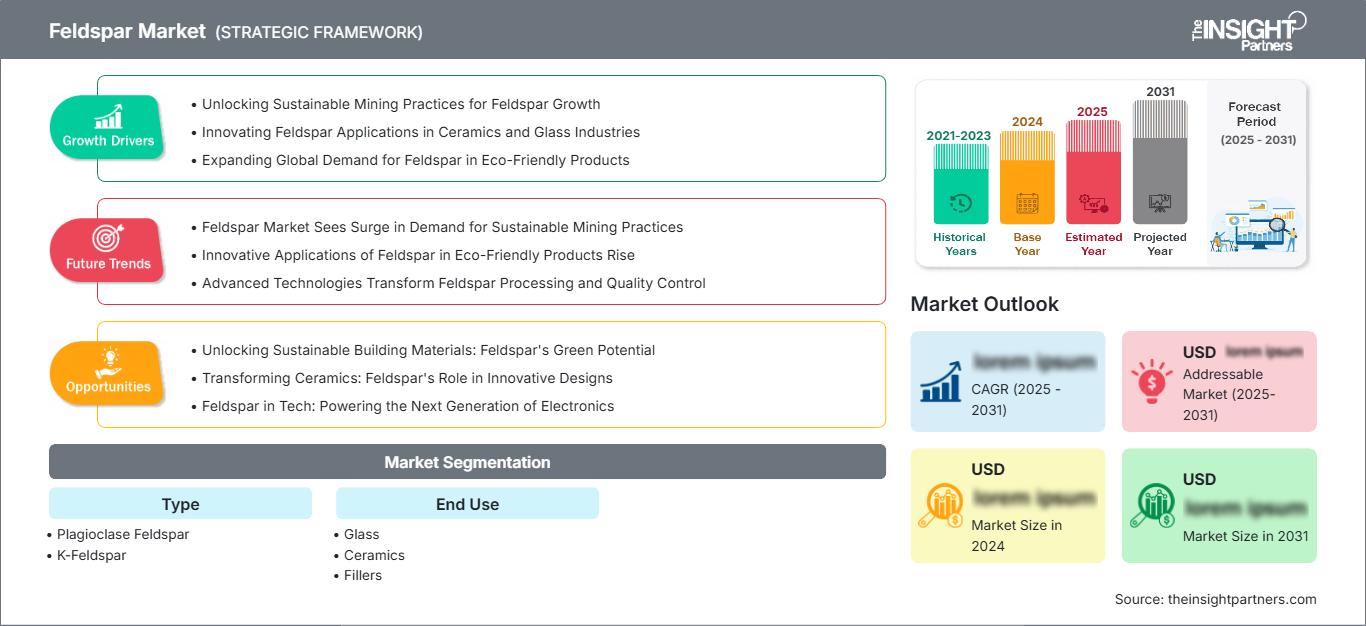
Feldspar Market: Strategic Insights
Regional Insights
North America Feldspar Market
North America accounted for approximately 18–22% Feldspar Market in 2025 and is expected to register a 10.2–11.2% CAGR during 2026–2034. The US continues to be the major regional market, due to the availability of glass containers, flat glass, ceramics, and mineral fillers with specific properties. The country produces the necessary materials on its territory; in addition, some supplies are made from outside. It is crucial to take into account industrial electricity, natural gas, transportation, and mining expenses when producing these materials.
Whereas concerning the US manufacturing industry, the need for materials with constant composition and particle sizes is high. In the manufacturing of glass, feldspar is used since it assists in melting and fluxing owing to the presence of alkali in this mineral while in ceramics, feldspar contributes to vitrification and firing. Mineral resources together with specific industrial purposes can be obtained from Canada, whereas Mexico serves as a place for manufacturing ceramics and glass.
U.S. Feldspar Market
The US represented approximately 58–62% of North American Feldspar Market in 2025 and is projected to grow at a 9.8–10.8% CAGR during 2026–2034. Demands for the material are made in glass, ceramic products, and certain fillers. The latest USGS commodity summary recorded domestic marketable production of 450,000 metric tons, with net import dependence of about 33%.
The glass industry continues to be one of the primary applications for feldspar due to its ability to lower batch melting temperatures and assist with viscosity. In the ceramic industry as well, potassium and sodium feldspar types with low iron content are preferred. Mineral deposits for domestic customers as well as imported mineral deposits help supply different grades. Technical processing of products will be required in most cases.
Europe Feldspar Market
Europe held approximately 24–28% share in 2025 and is forecast to grow at a 10.8–11.8% CAGR during 2026–2034. Germany, Italy, Spain, France, and the UK represent vital consumption centers. Germany draws its strength from having an efficient industrial and mineral processing system, whereas Italy and Spain are significant ceramic producers that require reliable fluxing minerals. The European logistics have been giving increasing importance to environmental credentials, traceability, and efficiency of raw material utilization.
The UK continues to demand glass, ceramics, and special minerals use, with imports meeting certain requirements. Germany utilizes a combination of mineral sources in the country with advanced mineral processing and technical applications. France satisfies the needs for ceramics and glass production along with industrial minerals exploitation, whereas Italy and Spain continue being associated with tile, sanitaryware, tableware, and frit production.
APAC Feldspar Market
APAC represented approximately 38–42% share in 2025 and is projected to grow at a 14.0–15.0% CAGR during 2026–2034. China represents the main regional market, while India, Japan, South Korea, and Australia follow next. The large production capacities of ceramics, glass, infrastructure development, and growing domestic processing contribute to consumption.
The Chinese and Indian markets are notable in terms of their contribution to production and processing, while Japanese and Korean countries are involved in developing technically challenging applications of ceramics and glass. The Australian country is still significant due to its mineral resource development. The focus of the regional policies on industrial modernization, clean mining and beneficiation, and efficient manufacturing encourages valuable mineral processing.
Middle East & Africa Feldspar Market
Middle East and Africa is expected to expand at a 11.5–12.5% CAGR during 2026–2034. Construction-related demand for glass and ceramic material drives growth in Saudi Arabia and the UAE. South Africa provides growth through its minerals and manufacturing sectors. Rest of MEA countries have smaller markets but could provide additional growth potential as industrial capacity is expanded.
Saudi Arabia is aided by its construction sector, diversification of its manufacturing, and investments in downstream construction materials. The UAE is aided by the construction and infrastructure-related demand for glass, ceramics, and engineered materials. South Africa is a country with both mineral assets and manufacturing demands. Energy, transport networks, mine development, and industrial diversification in the region will be important to feldspar sourcing.
Segmentation Analysis
Type
Type segmentation distinguishes Plagioclase Feldspar and K-Feldspar, with the overall type segment expected to expand alongside glass and ceramic manufacturing. The type segment is projected to grow at approximately 12.8–13.8% CAGR during 2026–2034. Product selection depends on alkali composition, iron content, melting behavior, whiteness, and the formulation requirements of downstream manufacturers.
- Plagioclase Feldspar: Plagioclase grades are important sodium- and calcium-bearing mineral inputs used across glass and ceramic formulations. Their commercial position depends on chemical consistency, processing quality, and compatibility with specific firing or melting conditions.
- K-Feldspar: K-Feldspar has a strong position in ceramic formulations because potassium-rich chemistry supports vitrification and firing behavior. Demand is particularly relevant to tiles, sanitaryware, tableware, frits, and selected technical ceramic products.
End Use
End Use comprises Glass, Ceramics, and Fillers, with the segment expected to grow at approximately 12.9–13.9% CAGR during 2026–2034. Consumption patterns are influenced by industrial production, raw-material formulation, energy efficiency, and demand for mineral grades with controlled chemistry and particle size.
- Glass: Glass is the largest application because feldspar functions as a flux and contributes alumina and alkali content. Demand spans container, flat, fiberglass, and specialty glass manufacturing where controlled melting behavior is commercially important.
- Ceramics: Ceramics represents a major value-consuming application across tiles, sanitaryware, tableware, and technical products. Feldspar supports vitrification, firing efficiency, strength, and surface characteristics, making consistent mineral chemistry important to high-volume ceramic production.
- Fillers: Filler applications use processed feldspar where hardness, chemical resistance, brightness, and controlled particle size provide functional advantages. Demand includes coatings, polymers, plastics, adhesives, and selected specialty formulations requiring mineral reinforcement.
Opportunity Snapshot
| End Use | Revenue Contribution | Trend Tag | Adoption Stage |
|---|---|---|---|
| Glass | High | Melting Efficiency | Mature |
| Ceramics | High | Vitrification Control | Mature |
| Fillers | Medium | Functional Mineral | Scaling |
Feldspar Market Growth Drivers and Impact Analysis
Expansion of Ceramic Tile and Sanitaryware Manufacturing
Increasing capacity for ceramics and sanitary ware manufacture is a clear demand factor since feldspar is a part of the formulation to help achieve proper vitrification and firing characteristics. Countries with key ecosystems in the ceramics manufacturing industry include India, China, Southeast Asia, Turkey, Italy, and Spain, thereby developing geographic hubs with needs for reliable mineral feedstocks. Increased size of tiles and higher quality of ceramic surfaces may also make it more relevant to have reliable chemistry and particle size distribution, making formulation tolerances narrow. Companies serving these regions are thus able to extract more value from their products by performing beneficiation and blending as well as technical service rather than just selling mineral raw material. The effect is especially relevant for K-feldspar grades which are often used in ceramic formulations.
Growing Demand for Energy-Efficient Glass Manufacturing
Furnace efficiency, batch efficiency, and melting efficiency are some of the key areas of improvement for glass manufacturers due to rising energy costs. Feldspars add alkalis and alumina to the batches of glass, and they can reduce melting demands, making them useful in container glass, flat glass, fiberglass, and specialty glasses manufacture. However, the commercial effect is not just driven by demand for feldspars but by glassmakers' growing need for consistency in their mineral chemistry in order to ensure furnace efficiency and high-quality products. Feldspar suppliers that will be able to produce low iron content material and predictable grain size distribution have an advantage in providing higher specification products. Moreover, recycling will affect raw materials needs, since increased utilization of cullet will change the chemistry of batches and minerals needed for balancing.
Industrial Preference for Processed Mineral Fillers
Industrial users increasingly evaluate mineral fillers according to functional performance rather than simple cost per tonne. Feldspar can provide hardness, chemical resistance, inertness, brightness, and controlled particle characteristics in selected coatings, polymers, plastics, adhesives, and specialty formulations. This creates a pathway for producers to diversify beyond traditional glass and ceramic customers. Micronization, classification, surface treatment, and impurity removal can expand the range of formulations that accept feldspar-based fillers. The commercial effect is greater value realization from existing mineral resources because processing can convert standard material into application-specific grades. Manufacturers also benefit from supply diversification when feldspar can partially replace or complement alternative mineral fillers. Over time, this driver should encourage suppliers to develop technical laboratories, application testing, and customer-specific formulations, particularly in Europe, North America, and advanced Asian manufacturing clusters where performance specifications are relatively stringent.
Feldspar Market Future Trends
Greater Adoption of Low-Iron and High-Purity Grades
The Feldspar Market trends are increasingly centered on mineral purity, controlled chemistry, and low-iron grades as downstream manufacturers seek greater control over color, transparency, and firing behavior. Premium ceramic tiles, sanitaryware, specialty glass, and technical ceramics place stronger emphasis on raw-material consistency than conventional bulk applications. Producers are consequently investing in beneficiation, flotation, magnetic separation, micronization, and laboratory testing. This trend should increase differentiation between commodity feldspar and application-specific grades. Turkey, India, Europe, and selected North American suppliers are positioned to benefit where deposits can support low-impurity products and processing infrastructure. Digital quality monitoring is also likely to become more important as customers request tighter specifications and traceable batches. Over time, supplier competitiveness should increasingly depend on the ability to combine resource quality with repeatable processing performance and reliable logistics.
Resource Efficiency and Lower-Impact Mineral Processing
Mineral producers are expected to place greater emphasis on water recycling, energy-efficient grinding, mine rehabilitation, waste minimization, and optimized logistics. These practices are becoming commercially relevant because environmental permitting and operating costs increasingly affect the economics of industrial-mineral projects. Feldspar beneficiation can involve crushing, screening, magnetic separation, flotation, and grinding, creating opportunities to reduce energy and water intensity through improved process design. Companies with longer mine lives and integrated processing infrastructure can spread sustainability investments across larger production volumes. European regulatory expectations are likely to accelerate adoption, while Asian producers are increasingly responding to customer requirements for responsible sourcing. The trend also supports resource efficiency through recovery of usable mineral fractions from deposits that previously generated greater waste. This can improve deposit utilization while reducing pressure to develop new extraction areas.
Feldspar Market Opportunities
Development of Regional Beneficiation and Processing Hubs
Feldspar Market Forecasts indicate that regional processing hubs can create attractive opportunities where ceramic and glass manufacturing is expanding faster than local high-quality mineral supply. India, Southeast Asia, the Middle East, and selected African markets offer potential for crushing, grinding, classification, magnetic separation, and blending facilities located close to downstream customers. Such hubs can reduce freight costs, shorten delivery cycles, and enable customized grades for individual ceramic or glass formulations. Investment should prioritize deposits with favorable chemistry and sufficient mine life, followed by modular processing capacity that can scale with customer commitments. Partnerships between mineral producers, equipment suppliers, and ceramic manufacturers can reduce market-entry risk by aligning product specifications with actual production requirements. This approach also allows suppliers to convert locally available resources into higher-value products rather than competing solely on bulk mineral pricing.
Expansion into Specialty Filler and Technical Applications
Processed feldspar can provide an opportunity to diversify revenue beyond conventional glass and ceramics by targeting specialty filler applications. High-purity and micronized grades can serve formulations where hardness, chemical resistance, brightness, optical behavior, and particle-size control are valuable. Potential applications include polymers, coatings, adhesives, technical composites, and selected dental or engineered-material formulations. Suppliers can improve commercial prospects by establishing application laboratories and developing grades around customer performance requirements rather than marketing mineral chemistry alone. This strategy is particularly relevant for producers with existing grinding and classification infrastructure because incremental processing can extend the addressable application base. Technical partnerships with compounders, coating formulators, and plastics manufacturers can accelerate qualification. Over the longer term, specialty applications can also reduce exposure to cyclical construction-linked demand by increasing participation in performance-driven industrial markets.
Recent Developments
- March 2025: Imerys — The EMILI project was added to the European list of Strategic Projects. Imerys stated that the project would continue with environmental and community commitments; the company had also decided to abandon feldspar production at the Beauvoir site to reduce chemical use associated with the project.
- January 2025: Atlantic Lithium Limited, the African-focused lithium exploration and development company targeting to deliver Ghana's first lithium mine, announced an updated JORC (2012) compliant Mineral Resource Estimate of 36.8Mt at 41.9% feldspar ("Feldspar MRE") for the Company's flagship Ewoyaa Lithium Project ("Ewoyaa" or the "Project") in Ghana, West Africa.
Frequently Asked Questions

- Comprehensive Market Sizing and Forecast Analysis
- Detailed Segmentation Analysis
- In-Depth Market Dynamics Assessment
- Regional and Country-Level Insights
- Competitive Landscape and Company Benchmarking
- Strategic Business Intelligence
Recent Reports
Testimonials

The Insight Partners provided valuable market intelligence that supported our global go-to-market strategy. Their team was professional, responsive, and attentive to our feedback, providing thoughtful analysis and helpful methodological clarifications throughout the project.
Junmo Kim Chief Financial Officer (CFO), Enertech Co., Ltd.
The Insight Partners' SCADA System Market report is comprehensive, with valuable insights on current trends and future forecasts. The team was highly professional, responsive, and supportive throughout. We are very satisfied and highly recommend their services.
RAN KEDEM Partner, Reali Technologies LTDs
I requested a report on a very specific software market and the team produced the report in a few days. The information was very relevant and well presented. I then requested some changes and additions to the report. The team was again very responsive and I got the final report in less than a week.
JEAN-HERVE JENN Chairman, Future Analytica
We worked with The Insight Partners for an important market study and forecast. They gave us clear insights into opportunities and risks, which helped shape our plans. Their research was easy to use and based on solid data. It helped us make smart, confident decisions. We highly recommend them.
PIYUSH NAGPAL Sr. Vice President, High Beam Global
The Insight Partners delivered insightful, well-structured market research with strong domain expertise. Their team was professional and responsive throughout. The user-friendly website made accessing industry reports seamless. We highly recommend them for reliable, high-quality research services
YUKIHIKO ADACHI CEO, Deep Blue, LLC.
This is the first time I have purchased a market report from The Insight Partners.While I was unsure at first, I visited their web site and felt more comfortable to take the risk and purchase a market report.I am completely satisfied with the quality of the report and customer service. I had several questions and comments with the initial report, but after a couple of dialogs over email with their analyst I believe I have a report that I can use as input to our strategic planning process.Thank you so much for taking the extra time and making this a positive experience.I will definitely recommend your service to others and you will be my first call when we need further market data.
JOHN SUZUKI President and Chief Executive Officer, Board Director, BK Technologies
I wish to appreciate your support and the professionalism you displayed in the course of attending to my request for information regarding to infectious disease IVD market in Nigeria. I appreciate your patience, your guidance, and the fact that you were willing to offer a discount, which eventually made it possible for us to close a deal. I look forward to engaging The Insight Partners in the future, all thanks to the impression you have created in me as a result of this first encounter.
DR CHIJIOKE ONYIA MANAGING DIRECTOR, PineCrest Healthcare Ltd.Reason to Buy
- Informed Decision-Making
- Understanding Market Dynamics
- Competitive Analysis
- Identifying Emerging Markets
- Customer Insights
- Market Forecasts
- Risk Mitigation
- Boosting Operational Efficiency
- Strategic Planning
- Investment Justification
- Tracking Industry Innovations
- Aligning with Regulatory Trends





 Get Free Sample for