$3450
$2760
The Asia Pacific cell and gene therapy market is projected to reach US$ 8.98 billion by 2031 from US$ 1.51 bllion in 2024 at a CAGR of 29.1% during 2025–2031.
Asia Pacific Cell and Gene Therapy Market AnalysisThe primary factors driving market growth include the increasing prevalence of chronic and genetic diseases, supportive government initiatives, and the rapid popularity of outsourcing cell and gene therapy manufacturing. Expansion of local manufacturing capabilities is expected to create ample opportunities for the Asia Pacific cell and gene therapy market in the coming years.
Asia Pacific Cell and Gene Therapy Market OverviewChina, Japan, South Korea, India, and Australia are among the major investors in biomanufacturing, clinical trials, and the establishment of quality control laboratories. The countries are actively promoting the use of innovative technologies, including advanced gene editing, cell-sheet therapies, automation, and AI-enabled quality control. These advancements accelerate the development of therapies and enhance manufacturing stability. The need for treatments for cancer, rare diseases, and genetic disorders drives the demand for these therapies. Additionally, there is an increasing awareness and acceptance of regenerative and precision medicine approaches in the region.
Customize Research To Suit Your Requirement
We can optimize and tailor the analysis and scope which is unmet through our standard offerings. This flexibility will help you gain the exact information needed for your business planning and decision making.
Asia Pacific Cell and Gene Therapy Market: Strategic Insights


Mrinal
Have a question?
Mrinal will walk you through a 15-minute call to present the report’s content and answer all queries if you have any.
 Speak to Analyst
Asia Pacific Cell and Gene Therapy Market Drivers and OpportunitiesCustomize Research To Suit Your Requirement
We can optimize and tailor the analysis and scope which is unmet through our standard offerings. This flexibility will help you gain the exact information needed for your business planning and decision making.
Asia Pacific Cell and Gene Therapy Market: Strategic Insights
Mrinal
Have a question?
Mrinal will walk you through a 15-minute call to present the report’s content and answer all queries if you have any.
Speak to Analyst
Market Drivers:
- Rising Prevalence of Genetic Diseases: The increasing prevalence of inherited disorders is leading to the widespread use of carrier testing to inform reproductive decisions and reduce the risk of future health problems.
- Increasing Personalized/Preventive Healthcare Focus: The growth of personalized medicine and preventive care is a positive sign that patients and doctors will utilize carrier testing to identify genetic risks beforehand and plan for reproduction.
- Favorable Government & Regulatory Support: Encouraging policies, screening recommendations, and investments in genetic services are enabling more people to access carrier testing, whether due to the healthcare system's standardization or integration of routine healthcare.
Market Opportunities:
- Strategic Initiatives by Companies: Companies involved in the cell and gene therapy market focus on collaborations, expansions, agreements, partnerships, new launches, and other strategic developments. These strategic initiatives help them improve sales, expand geographic reach, and enhance their capacity to cater to a large customer base.
- Expansion of Local Manufacturing Capabilities: The region is witnessing a transformative surge in CGT manufacturing, fueled by strategic investments and technology transfers that localize production and accelerate access to innovative treatments. This expansion addresses global supply chain vulnerabilities while fostering indigenous innovation, particularly in oncology and rare diseases.
- Rising Investments in R&D and Clinical Trials: The region is emerging as a powerhouse in CGT, fueled by robust investments in research and development and a proliferation of clinical trials.
The Asia Pacific cell and gene therapy market is segmented into various categories to provide a clearer understanding of its operations, growth potential, and current trends. Below is the standard segmentation approach used in industry reports:
By Type:
- Cell Therapy: Cell therapy demand is driven by substantial research investment, expanding manufacturing capacity, and increasing adoption of regenerative and oncology treatments across the region.
- Gene Therapy: Gene therapy advances are supported by improved regulations, rising clinical trial activity, and a growing focus on treating rare genetic and inherited diseases in the region.
By Service:
- Process?????? Development: Process development is about finding the most effective ways to scale up production that are of high quality and can be implemented in a factory to support the expanding clinical pipelines in the region and the commercialization of advanced therapies.
- cGMP Manufacturing: cGMP manufacturing involves producing cell and gene therapies in a compliant and reliable manner, supported by regional facilities that are growing, and the investment being made in a high-standard biomanufacturing infrastructure.
- Regulatory Services: Regulatory services are the means by which companies are guided through Asia Pacific approval routes by staff assisting in the preparation of documentation, ensuring compliance, and facilitating the rapid development of advanced therapeutic products.
- Bioassay Services: Bioassay services are the means by which analytical testing is conducted for potency, safety, and functionality, thereby ensuring consistent quality and regulatory compliance for cell and gene therapies produced locally.
By Scale:
- Pre-commercial/R and D Manufacturing: R&D manufacturing is a means of development that is supported by the early stages, and it involves small-batch production, which is flexible and rapid prototyping, and optimization of emerging therapies in the region is enabled.
- Commercial Scale Manufacturing: The emphasis in commercial manufacturing is on producing large-scale, compliant products that the expanding regional facilities support. Thus, a reliable supply can be maintained for approved therapies throughout APAC.
By Service Providers:
- CDMOs: CDMOs offer the integration of development and the provision of manufacturing support that results in a faster scale-up, alignment with regulations, and end-to-end services being available for regional therapy innovators.
- CMOs: CMOs provide the specialized manufacturing capacity that allows companies to release themselves from infrastructure burdens while meeting the rising demand for clinical and commercial-grade therapies in the region.
By Transfection Reagents:
- Polymer-based Transfection Reagents: Polymer-based reagents can support efficient gene delivery if the processes are scalable and cost-effective. Such methods are suitable for high-throughput research and early-stage therapy development.
- Lipid-based Transfection Reagents: Lipid-based reagents are an efficient way to deliver nucleic acids, and that is why they are heavily used in the development of therapeutics, since there is strong compatibility with cell and gene engineering.
- Viral Transduction Enhancers: The use of viral transduction enhancers results in the improvement of vector uptake and expression, which makes manufacturing more productive and consistent for complex cell and gene therapy workflows.
- Other Transfection Reagents: This category comprises the support given by the novel materials, emerging delivery tools, and enabling technologies to innovation and process efficiency throughout the therapy development ??????spectrum.
By End User:
- Contract Research Organizations
- Pharmaceutical and Biopharmaceutical Companies
- Academic and Research Institutes
By Geography:
- Asia Pacific
Market Report Scope
Asia Pacific Cell and Gene Therapy Market Share Analysis by GeographyThe increasing prevalence of chronic and genetic diseases, supportive government initiatives, and the rapid popularity of outsourcing cell and gene therapy manufacturing drive the market growth.
Below is a summary of market share and trends by region:
1. Asia Pacific
- Market Share: Fastest-growing region with rising market shares every year
- Key Drivers: The adoption of cell and gene therapy is progressing rapidly due to continuous healthcare investment, growing awareness among the middle class, and increasing accessibility of genomic technologies.
- Trends: Improvements in access to genomics and increased consumer awareness
High Market Density and Competition
Competition is intense due to established players such as WuXi AppTec Co Ltd and Lonza Group AG. Regional and niche providers, including CellVec Pte Ltd and Avance Clinical Pty Ltd, add to the competitive landscape across different regions.
This high level of competition urges companies to stand out by offering:
- Advanced products
- Value-added services such as customization and sustainable solutions
- Competitive pricing models
- Compliance with regulatory guidelines
Opportunities and Strategic Moves
- Companies are investing in research and development, driving innovation in detection technologies. These investments improve the sensitivity and specificity, addressing specific genetic health issues in different countries.
- Manufacturers will likely focus on local production to cut costs and strengthen supply chains, especially in high-volume markets such as India.
- OBiO Technology
- Genepeutic Bio
- Jubilant Biosys Ltd
- Cyto?Facto Inc.
- BioCell Innovations Pte Ltd
- Taiwan Cell Manufacturing Company (TCMC)
- Aragen Life Sciences
- Hetero Labs
- BioXcellence
- Catalent, Inc.
- New Australian Collaboration to Advance Gene and Cell Therapy Sector: Viral Vector Manufacturing Facility (VVMF) and Cell Therapies co-signed a Memorandum of Understanding (MoU) to explore strategic collaboration opportunities aimed at strengthening the onshore development and manufacture of Advanced Therapy Medicinal Products (ATMPs).
The "Asia Pacific cell and gene therapy Market Size and Forecast (2021–2031)" report provides a detailed analysis of the market covering below areas:
- Asia Pacific cell and gene therapy market size and forecast at the regional and country levels for all the key market segments covered under the scope
- Asia Pacific cell and gene therapy market trends, and market dynamics such as drivers, restraints, and key opportunities
- Detailed PEST and SWOT analysis
- Asia Pacific cell and gene therapy market analysis covering key market trends, regional and country framework, major players, regulations, and recent market developments
- Industry landscape and competition analysis covering market concentration, heat map analysis, prominent players, and recent developments for the Asia Pacific cell and gene therapy market
- Detailed company profiles

Report Coverage
Revenue forecast, Company Analysis, Industry landscape, Growth factors, and Trends

Segment Covered
This text is related
to segments covered.

Regional Scope
North America, Europe, Asia Pacific, Middle East & Africa, South & Central America

Country Scope
This text is related
to country scope.
Frequently Asked Questions
The market is estimated to register a CAGR of 29.1% during the forecast period.
The Asia Pacific cell and gene therapy market is projected to reach a value of US$ 8.98 billion by 2031.
WuXi AppTec (WuXi Advanced Therapies), Lonza, Samsung Biologics, AGC Biologics, GenScript Biotech, Syngene International Ltd, Novotech, SK pharmteco Inc, CMIC Group, Porton Pharma Solutions Ltd are among the key players operating in the market.
The increasing prevalence of chronic and genetic diseases, supportive government initiatives, and the rapid popularity of outsourcing cell and gene therapy manufacturing drive market growth.
China dominated the market in 2024.
The List of Companies - Asia Pacific Cell and Gene Therapy Market
- WuXi AppTec (WuXi Advanced Therapies)
- Lonza
- Samsung Biologics
- AGC Biologics
- GenScript Biotech
- Syngene International Ltd
- Novotech
- SK pharmteco Inc
- CMIC Group
- Porton Pharma Solutions Ltd
The Insight Partners performs research in 4 major stages: Data Collection & Secondary Research, Primary Research, Data Analysis and Data Triangulation & Final Review.
- Data Collection and Secondary Research:
As a market research and consulting firm operating from a decade, we have published many reports and advised several clients across the globe. First step for any study will start with an assessment of currently available data and insights from existing reports. Further, historical and current market information is collected from Investor Presentations, Annual Reports, SEC Filings, etc., and other information related to company’s performance and market positioning are gathered from Paid Databases (Factiva, Hoovers, and Reuters) and various other publications available in public domain.
Several associations trade associates, technical forums, institutes, societies and organizations are accessed to gain technical as well as market related insights through their publications such as research papers, blogs and press releases related to the studies are referred to get cues about the market. Further, white papers, journals, magazines, and other news articles published in the last 3 years are scrutinized and analyzed to understand the current market trends.
- Primary Research:
The primarily interview analysis comprise of data obtained from industry participants interview and answers to survey questions gathered by in-house primary team.
For primary research, interviews are conducted with industry experts/CEOs/Marketing Managers/Sales Managers/VPs/Subject Matter Experts from both demand and supply side to get a 360-degree view of the market. The primary team conducts several interviews based on the complexity of the markets to understand the various market trends and dynamics which makes research more credible and precise.
A typical research interview fulfils the following functions:
- Provides first-hand information on the market size, market trends, growth trends, competitive landscape, and outlook
- Validates and strengthens in-house secondary research findings
- Develops the analysis team’s expertise and market understanding
Primary research involves email interactions and telephone interviews for each market, category, segment, and sub-segment across geographies. The participants who typically take part in such a process include, but are not limited to:
- Industry participants: VPs, business development managers, market intelligence managers and national sales managers
- Outside experts: Valuation experts, research analysts and key opinion leaders specializing in the electronics and semiconductor industry.
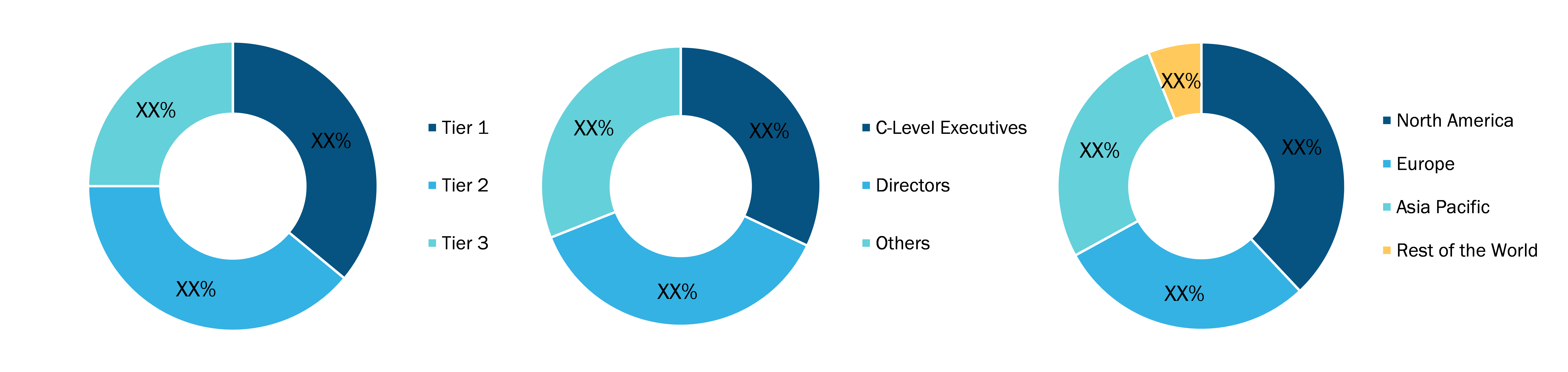
Below is the breakup of our primary respondents by company, designation, and region:
Once we receive the confirmation from primary research sources or primary respondents, we finalize the base year market estimation and forecast the data as per the macroeconomic and microeconomic factors assessed during data collection.
- Data Analysis:
Once data is validated through both secondary as well as primary respondents, we finalize the market estimations by hypothesis formulation and factor analysis at regional and country level.
- 3.1 Macro-Economic Factor Analysis:
We analyse macroeconomic indicators such the gross domestic product (GDP), increase in the demand for goods and services across industries, technological advancement, regional economic growth, governmental policies, the influence of COVID-19, PEST analysis, and other aspects. This analysis aids in setting benchmarks for various nations/regions and approximating market splits. Additionally, the general trend of the aforementioned components aid in determining the market's development possibilities.
- 3.2 Country Level Data:
Various factors that are especially aligned to the country are taken into account to determine the market size for a certain area and country, including the presence of vendors, such as headquarters and offices, the country's GDP, demand patterns, and industry growth. To comprehend the market dynamics for the nation, a number of growth variables, inhibitors, application areas, and current market trends are researched. The aforementioned elements aid in determining the country's overall market's growth potential.
- 3.3 Company Profile:
The “Table of Contents” is formulated by listing and analyzing more than 25 - 30 companies operating in the market ecosystem across geographies. However, we profile only 10 companies as a standard practice in our syndicate reports. These 10 companies comprise leading, emerging, and regional players. Nonetheless, our analysis is not restricted to the 10 listed companies, we also analyze other companies present in the market to develop a holistic view and understand the prevailing trends. The “Company Profiles” section in the report covers key facts, business description, products & services, financial information, SWOT analysis, and key developments. The financial information presented is extracted from the annual reports and official documents of the publicly listed companies. Upon collecting the information for the sections of respective companies, we verify them via various primary sources and then compile the data in respective company profiles. The company level information helps us in deriving the base number as well as in forecasting the market size.
- 3.4 Developing Base Number:
Aggregation of sales statistics (2020-2022) and macro-economic factor, and other secondary and primary research insights are utilized to arrive at base number and related market shares for 2022. The data gaps are identified in this step and relevant market data is analyzed, collected from paid primary interviews or databases. On finalizing the base year market size, forecasts are developed on the basis of macro-economic, industry and market growth factors and company level analysis.
- Data Triangulation and Final Review:
The market findings and base year market size calculations are validated from supply as well as demand side. Demand side validations are based on macro-economic factor analysis and benchmarks for respective regions and countries. In case of supply side validations, revenues of major companies are estimated (in case not available) based on industry benchmark, approximate number of employees, product portfolio, and primary interviews revenues are gathered. Further revenue from target product/service segment is assessed to avoid overshooting of market statistics. In case of heavy deviations between supply and demand side values, all thes steps are repeated to achieve synchronization.
We follow an iterative model, wherein we share our research findings with Subject Matter Experts (SME’s) and Key Opinion Leaders (KOLs) until consensus view of the market is not formulated – this model negates any drastic deviation in the opinions of experts. Only validated and universally acceptable research findings are quoted in our reports.
We have important check points that we use to validate our research findings – which we call – data triangulation, where we validate the information, we generate from secondary sources with primary interviews and then we re-validate with our internal data bases and Subject matter experts. This comprehensive model enables us to deliver high quality, reliable data in shortest possible time.
Trends and growth analysis reports related to Asia Pacific Cell and Gene Therapy Market

Dec 2025
Prenatal Testing Services Market
Size and Forecast (2021 - 2031), Global and Regional Share, Trend, and Growth Opportunity Analysis Report Coverage: By Diagnostic Type (Noninvasive and Invasive), Disease (Aneuploidy, Microdeletions, Structural Chromosomal Abnormalities, and Others), End User (Hospitals, Diagnostic Laboratories, Specialty Clinics, and Other End Users), and Geography (North America, Europe, Asia Pacific, Middle East and Africa, and South and Central America)
Dec 2025
Joint Resurfacing Devices Market
Size and Forecast (2021 - 2031), Global and Regional Share, Trend, and Growth Opportunity Analysis Report Coverage: By Type (Knee, Hip, Shoulder, Ankle, and Others), Material (Metal, Ceramic, and Others), End User (Hospitals, Orthopedic Clinics, Ambulatory Surgical Centers, and Others), and Geography (North America, Europe, Asia Pacific, Middle East & Africa, and South and Central America)
Dec 2025
Embolization Plugs Market
Size and Forecast (2021 - 2031), Global and Regional Share, Trend, and Growth Opportunity Analysis Report Coverage: By Application (Neurology, Peripheral Vascular Disease, Oncology, Urology, and Others), End User (Hospital, Ambulatory Centers, and Others), and Geography (North America, Europe, Asia Pacific, Middle East and Africa, and South and Central America)
Dec 2025
Carrier Testing Services Market
Size and Forecast (2021 - 2031), Global and Regional Share, Trend, and Growth Opportunity Analysis Report Coverage: By Type (Expanded Carrier Screening and Targeted Disease Carrier Screening), Medical Condition (Pulmonary Conditions, Hematological Conditions, Neurological Conditions, and Other Medical Conditions), End User (Hospital-Based Laboratories, Diagnostic Laboratories, and Other End Users), and Geography (North America, Europe, Asia Pacific, Middle East and Africa, and South and Central America)
Dec 2025
Recombinant Albumin Market
Size and Forecast (2021 - 2031), Global and Regional Share, Trend, and Growth Opportunity Analysis Report Coverage: By Source (Human Recombinant Albumin, Bovine Recombinant Albumin, and Others), Application (Excipient in Biotherapeutics And Vaccines, Cell Culture, Drug Delivery, Diagnostics, and Others), and End User (Pharmaceutical and Biotechnology Companies, Research Institutes, Hospitals and Diagnostic Laboratories, and Others)
Dec 2025
Predictive Genetic Testing Market
Size and Forecast (2021 - 2031), Global and Regional Share, Trend, and Growth Opportunity Analysis Report Coverage: By Type (Predispositional Testing and Presymptomatic Testing), Disease (Cancer, Cardiovascular Diseases, Metabolic Diseases, and Other Diseases), End User (Hospital-Based Laboratories, Diagnostic Laboratories, and Other End Users), and Geography (North America, Europe, Asia Pacific, Middle East and Africa, and South and Central America)
Dec 2025
Medical Contract Manufacturing Market
Size and Forecast (2021 - 2031), Global and Regional Share, Trend, and Growth Opportunity Analysis Report Coverage: By Service Type (Full-device Manufacturing, Sub-assembly and Components, and Materials-specific Services), Device Type (IVD Devices, Diagnostic Imaging Devices, Cardiovascular Devices, Drug Delivery Devices, Orthopedic Devices, Respiratory Care Devices, Ophthalmology Devices, Surgical Devices, Diabetes Care Devices, Dental Devices, Endoscopy and Laparoscopy Devices, Gynecology and Urology Devices, Neurology Devices, Patient Assistive Devices, and Others), and Geography (North America, Europe, Asia Pacific, Middle East and Africa, and South and Central America)
Dec 2025
Bulk Lyophilization Services Market
Size and Forecast (2021 - 2031), Global and Regional Share, Trend, and Growth Opportunity Analysis Report Coverage: By Lyophilization Format (Bulk Tray Lyophilization, Drum Lyophilization, Shelf Freeze-Drying, Tunnel or Conveyer Based Freeze Drying, and Hybrid Methods), Scale (Small Scale or Lab Scale, Pilot Scale, and Commercial and Industrial Scale), Service Type (Custom Process Development and Optimization, Pilot Scale and R and D Lyophilization, and Full Scale Commercial Bulk Lyophilization), and End User (Pharmaceutical and Biotechnology Companies, Research and Academic Institutes, and Others), and Geography (North America, Europe, Asia Pacific, Middle East and Africa, and South and Central America)