
Recombinant Albumin Market Trends & Forecast 2031
Coverage: By Source (Human Recombinant Albumin, Bovine Recombinant Albumin, and Others), Application (Excipient in Biotherapeutics And Vaccines, Cell Culture, Drug Delivery, Diagnostics, and Others), and End User (Pharmaceutical and Biotechnology Companies, Research Institutes, Hospitals and Diagnostic Laboratories, and Others)
- Status : Published
- Report Code : TIPRE00041695
- Category : Life Sciences
- No. of Pages : 237
- Available Report Formats :


- Last update date : December 09, 2025


2024 Market Size
US$ 392.50 Mn
Base year value
2031 Forecast
US$ 767.54 Mn
Projected by 2031
CAGR 2025-2031
10.1 %
Growth rate
Addressable Market
US$ 4,112.42 Mn
(2025-2031)
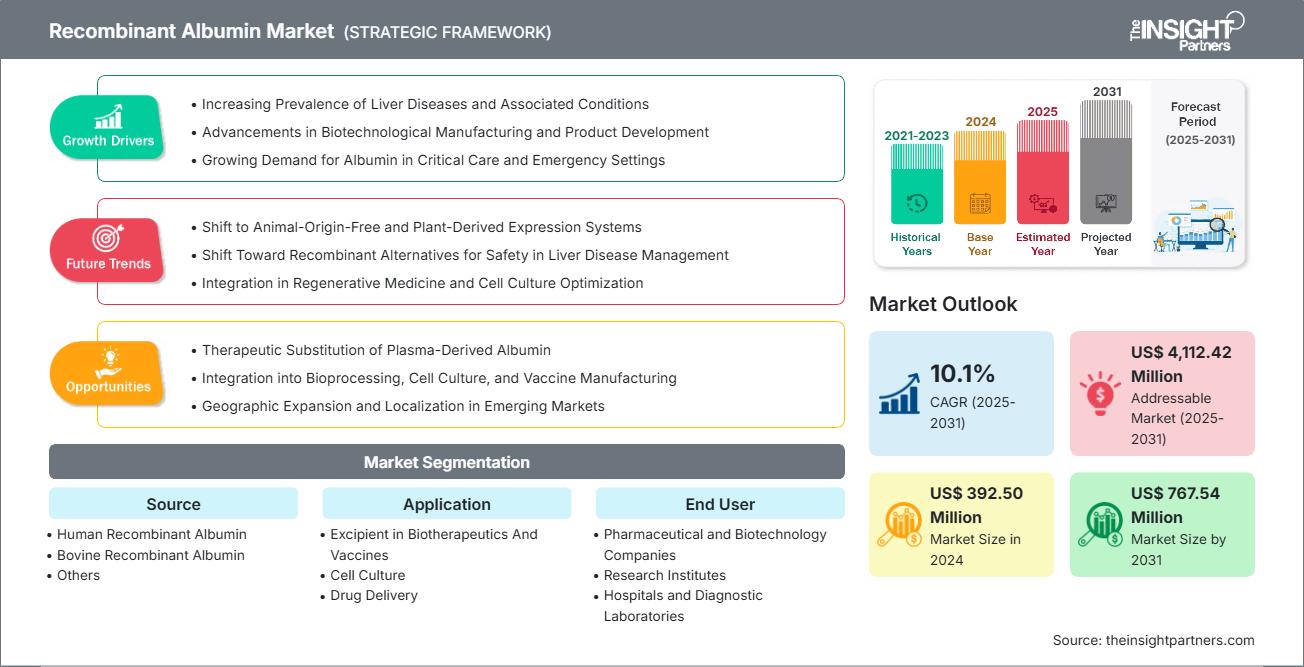
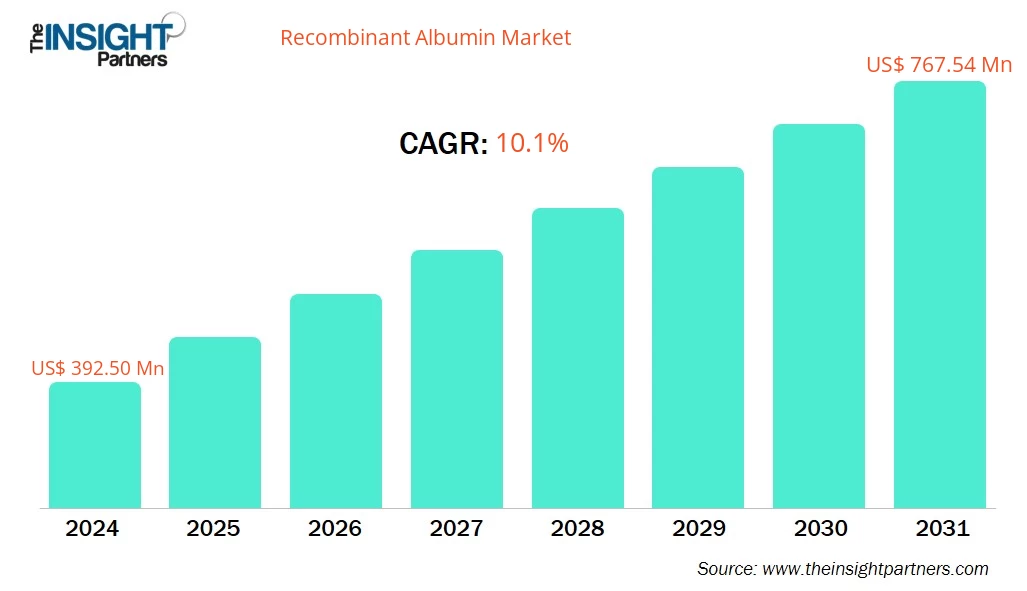
The recombinant albumin market size is projected to reach US$ 767.54 million by 2031 from US$ 392.50 million in 2024. The market is expected to register a CAGR of 10.1% during 2025–2031.
Recombinant Albumin Market Analysis
There is a high demand for non-plasma-derived, consistent, and pathogen-free alternatives to natural albumin. Advancements in biotechnology and manufacturing are improving scalability and reducing the costs of producing recombinant albumin. Its applications are expanding, particularly in biopharmaceutical formulations, cell culture media, and as a drug delivery vehicle, offering enhanced safety and purity. However, production complexities and regulatory hurdles limit its widespread clinical adoption compared to plasma-derived albumin.
Recombinant Albumin Market Overview
Recombinant albumin is expected to replace plasma-derived albumin due to the growing demand for a product that is consistent, pathogen-free, and ethically sourced. The market is niche and small-sized; however, the advancements in biotechnology are increasing the production of recombinant albumin and lowering its costs. Recombinant albumin is expected to be widely used for biopharmaceutical formulations, where it is used as a stabilizer and excipient. In cell culture media, it provides an animal-component-free environment. Additionally, recombinant albumin has good pharmacokinetic properties, making it an attractive carrier for drug delivery applications. High costs of production limit the recombinant albumin market growth, and strict regulatory compliance makes it difficult to be adopted widely in clinics.
Market Assessment and Insights
- North America dominated the market with 47.9% share in 2024.
- Asia Pacific is poised to grow at a CAGR of 12.2% over the forecast period.
- United States market is projected to grow at a CAGR of 9.6% over the forecast period.
- By Source, the Human Recombinant Albumin segment accounted for the largest market share of 82.8% in 2024.
- By Application, the Cell Culture segment is anticipated to witness the fastest growth, registering a CAGR of 10.5% over the forecast period
- By End User, the Pharmaceutical and Biotechnology Companies segment accounted for the largest market share of 68.6% in 2024.
- The report profiles key industry players such as Thermo Fisher Scientific Inc, CSL Ltd, Merck KGaA, Sartorius AG, Akron Biotech, HiMedia Laboratories Pvt Ltd, InVitria, Medxbio Pte Ltd, Lazuline Biotech Private Limited, Cyagen Biosciences, while also analyzing key developments in novel ideas, disruptive products, and innovative services that could reshape the future market and reveal emerging themes across the industry.
Source: The Insight Partners' analysis based on proprietary research, government publications, company annual reports, investor presentations, industry databases, and expert interviews.
● REPORT CUSTOMIZATION
Tailor This Report To Align With Your Specific Business Requirements
This report can be customized to align precisely with your business objectives, scope, and target markets. Customization options include tailored segmentation, geography, competitive analysis, and strategic insights to support informed decision-making.
Customize This Report →WHAT YOU CAN ADJUST
- ● Segmentations
- ● Geography
- ● Competitive Analysis
- ● Language Preferences
Recombinant Albumin Market: Strategic Insights
-
Get Top Key Market Trends of this report.This FREE sample will include data analysis, ranging from market trends to estimates and forecasts.
Recombinant Albumin Market Drivers and Opportunities
Market Drivers:
- Growing Demand for Safe, Serum-Free Plasma Substitutes: Rising demand for serum-free, pathogen-free plasma substitutes in critical care and surgical applications is driven by safety concerns and regulatory approvals.
- Rising Prevalence of Liver Diseases and Albumin Deficiency: Liver diseases and albumin deficiency are becoming increasingly prevalent in the aging population, and the rise of advanced medical interventions is driving greater use of recombinant albumin over plasma-derived products.
Market Opportunities:
- Expansion into Emerging Markets: Expansion into emerging markets offers significant growth potential as increasing healthcare infrastructure and awareness drive demand for advanced, safe albumin therapies globally.
- Development of Novel Formulations: Development of novel recombinant albumin formulations for targeted drug delivery and specialized medical applications opens new avenues for market expansion and innovation.
Recombinant Albumin Market Report Segmentation Analysis
The recombinant albumin market is divided into different segments to give a clearer view of its growth potential and the latest recombinant albumin market trends. Below is the standard segmentation approach used in industry reports:
By Product Type:
- Human Recombinant Albumin: Human recombinant albumin is highly biocompatible and has minimal immunogenicity, which makes it ideal for therapeutic uses, drug delivery, and making cell cultures. Its human origin largely eliminates undesirable effects, which is why it is preferred in clinical and biopharmaceutical settings.
- Bovine Recombinant Albumin: Bovine recombinant albumin is used in research and industrial applications, especially in the production of cell culture media and as a reagent. It is not suitable for direct human therapeutic use, but its lower cost and functional similarity to native bovine albumin make it valuable in non-clinical settings.
- Others: This segment comprises novel recombinant albumin variants or those obtained from other sources of the same species (e.g., rice and yeast). It also encompasses emerging applications in diagnostics, vaccine stabilization, and advanced materials science, all driven by innovation and specific functional requirements.
Application:
- Excipient in Biotherapeutics and Vaccines: As an excipient, recombinant albumin acts as a stabilizer that prevents sensitive biologics and vaccines from degradation. The non-animal-derived status of its source ensures product safety, purity, and consistency, making it preferred in pharmaceutical formulations and extending the drug's shelf-life.
- Cell Culture: In cell culture, recombinant albumin supplies the necessary nutrients and growth factors, encouraging cell multiplication and survival. It replaces animal-origin serum components, thus decreasing variability and eliminating the risk of animal-borne contamination, which is vital for both biomanufacturing and research.
- Drug Delivery: Recombinant albumin has an excellent biocompatibility and a long half-life, which makes it a versatile drug delivery carrier. It improves the solubility, stability, and pharmacokinetics of the therapeutic agents and allows for targeted delivery and reduced drug toxicity.
- Diagnostics: Recombinant albumin is used in diagnostic assays as a blocking agent, stabilizer for reagents, or a component in calibrators and controls. Its high purity and consistent quality reduce non-specific binding and eventually enhance assay sensitivity.
- Others: This segment includes diverse emerging applications such as regenerative medicine, medical devices (e.g., coating materials), and advanced material science. Its unique properties—such as biocompatibility and binding capacity—are being explored for novel uses beyond traditional biopharmaceutical and diagnostic fields.
By End User:
- Pharmaceutical and Biotechnology Companies
- Research Institutes
- Hospitals and Diagnostic Laboratories
- Others
By Geography:
- North America
- Europe
- Asia Pacific
- Latin America
- Middle East & Africa
Recombinant Albumin Market Report Scope
| Report Attribute | Details |
|---|---|
| Market size in 2024 | US$ 392.50 Million |
| Market Size by 2031 | US$ 767.54 Million |
| Global CAGR (2025 - 2031) | 10.1% |
| Historical Data | 2021-2023 |
| Forecast period | 2025-2031 |
| Segments Covered |
By Source
|
| Regions and Countries Covered |
North America
|
| Market leaders and key company profiles |
|
Recombinant Albumin Market Players Density: Understanding Its Impact on Business Dynamics
The Recombinant Albumin Market is growing rapidly, driven by increasing end-user demand due to factors such as evolving consumer preferences, technological advancements, and greater awareness of the product's benefits. As demand rises, businesses are expanding their offerings, innovating to meet consumer needs, and capitalizing on emerging trends, which further fuels market growth.
Recombinant Albumin Market Share Analysis by Geography
North America holds the largest market share, driven by robust biopharmaceutical research and development, advanced healthcare infrastructure, and high adoption of animal-component-free solutions in drug manufacturing and cell culture.
Europe follows closely, propelled by stringent regulatory standards favoring recombinant products and significant investments in biotech and regenerative medicine.
Asia Pacific is projected to experience the fastest growth, fueled by expanding biomanufacturing capabilities, increasing demand for affordable biologics, and rising awareness of recombinant alternatives in emerging economies such as China and India. South & Central America and Middle East & Africa represent nascent but growing markets.
The recombinant albumin growth varies across regions due to factors such as an aging population and the increasing prevalence of mobility-related disorders. Below is a summary of recombinant albumin market share and trends by region:
1. North America
- Market Share: Holds a significant portion of the global market.
- Key Drivers:
- Robust research and development in biopharmaceuticals.
- Advanced healthcare infrastructure.
- Trends: Shift to animal-free solutions.
2. Europe
- Market Share: Holds a substantial market share.
- Key Drivers:
- Growing biopharmaceutical demand.
- Strict regulatory guidelines and safety concerns.
- Trends: Shift toward plant- and yeast-based expression systems.
3. Asia Pacific
- Market Share: Fastest-growing region with an annually rising market share.
- Key Drivers:
- Rapid biopharmaceutical and cell-culture expansion
- Safety and regulatory preference for animal-free proteins
- Trends: Shift toward localized rHSA production and expression platforms.
4. South & Central America
- Market Share: Growing market with steady progress.
- Key Drivers:
- Growing biopharmaceutical manufacturing and research in the region.
- Need for safe, contamination-free stabilizers for therapeutic and vaccine formulations.
- Trends: Increasing adoption of recombinant albumin in cell culture media.
5. Middle East & Africa
- Market Share: Holds a small share, growing at a rapid pace.
- Key Drivers:
- Growth in biopharma/cell-culture infrastructure
- Desire for safe, animal-free excipients
- Trends: Expanding use of recombinant albumin in blood plasma substitutes and biopharmaceuticals.
Recombinant Albumin Market Players Density: Understanding Its Impact on Business Dynamics
High Market Density and Competition
Competition is strong due to the presence of established players such as CSL Ltd and Grifols SA. Niche providers contribute to the competitive landscape across regions.
This high level of competition urges companies to stand out by offering:
- Advanced products
- Value-added services such as customization and sustainable solutions
- Competitive pricing models
- Compliance with regulatory guidelines
Opportunities and Strategic Moves
- Growing demand for recombinant albumin in biologics, cell therapies, vaccines, and regenerative medicine creates a powerful opportunity for manufacturers to expand into high-value pharmaceutical segments. Increasing regulatory preference for animal-free, chemically defined components further accelerates adoption across global bioprocessing workflows.
- Rising investment in biomanufacturing infrastructure across Asia Pacific, Middle East, and Latin America creates strong potential for regional market expansion.
- Emerging use of recombinant albumin in stem-cell cryopreservation, gene therapy platforms, and mRNA technology presents long-term growth potential as advanced therapies scale toward commercialization.
Major Companies operating in the Recombinant Albumin Market are:
- Albumedix (Sartorius)
- InVitria (LevitasBio)
- Merck KGaA/Sigma-Aldrich
- ScienCell Research Labs
- Cyagen Biosciences
- Wuhan Healthgen Biotechnology
- Ventria Bioscience
- Lazuline Bio
- Laurus Bio
- ProSpec
Disclaimer: The companies listed above are not ranked in any particular order.
Other companies analyzed during the course of research:
- HiMedia Laboratories
- Lee Biosolutions
- Aspira Scientific
- Phenotypeca
- Basic Pharma
- Aadi Bioscience
- ARTES Biotechnology
- Novozymes
- Mitsubishi Tanabe Pharma
- CSL Behring
- Grifols
- Octapharma
- Takeda
- Kedrion Biopharma
- Biotest AG
- RayBiotech
- Medxbio Pte Ltd
- Thermo Fisher Scientific
- Abcam
- New England Biolabs (NEB)
Recombinant Albumin Market News and Recent Developments
- China approves rice-derived recombinant human albumin injection in July 2025. In July 2025, The National Medical Products Administration approved the marketing of a rice-derived recombinant human albumin injection after the priority review and approval process, according to a statement released on its website.
- Shilpa Medicare completes Phase 1 Trial for Recombinant Human Albumin (rHA) 20 per cent in August 2024. Shilpa Medicare announced the successful completion of its Phase 1 clinical trial for its flagship product—sRbumin, recombinant human albumin 20 per cent (rHA)—becoming the first Indian company to achieve this milestone. The positive results underscore rHA's potential as a viable alternative to plasma-derived human serum albumin, addressing a critical gap in global healthcare.
Recombinant Albumin Market Report Coverage and Deliverables
The "Recombinant Albumin Market Size and Forecast (2021–2031)" report provides a detailed analysis of the market covering below areas:
- Recombinant Albumin Market size and forecast at global, regional, and country levels for all the key market segments covered under the scope
- Recombinant Albumin Market trends, as well as market dynamics such as drivers, restraints, and key opportunities
- Detailed PEST and SWOT analysis
- Recombinant Albumin Market analysis covering key market trends, global and regional framework, major players, regulations, and recent market developments
- Industry landscape and competition analysis covering market concentration, heat map analysis, prominent players, and recent developments for the Recombinant Albumin Market
- Detailed company profiles
Frequently Asked Questions

- Comprehensive Market Sizing and Forecast Analysis
- Detailed Segmentation Analysis
- In-Depth Market Dynamics Assessment
- Regional and Country-Level Insights
- Competitive Landscape and Company Benchmarking
- Strategic Business Intelligence
Recent Reports
Testimonials

The Insight Partners provided valuable market intelligence that supported our global go-to-market strategy. Their team was professional, responsive, and attentive to our feedback, providing thoughtful analysis and helpful methodological clarifications throughout the project.
Junmo Kim Chief Financial Officer (CFO), Enertech Co., Ltd.
The Insight Partners' SCADA System Market report is comprehensive, with valuable insights on current trends and future forecasts. The team was highly professional, responsive, and supportive throughout. We are very satisfied and highly recommend their services.
RAN KEDEM Partner, Reali Technologies LTDs
I requested a report on a very specific software market and the team produced the report in a few days. The information was very relevant and well presented. I then requested some changes and additions to the report. The team was again very responsive and I got the final report in less than a week.
JEAN-HERVE JENN Chairman, Future Analytica
We worked with The Insight Partners for an important market study and forecast. They gave us clear insights into opportunities and risks, which helped shape our plans. Their research was easy to use and based on solid data. It helped us make smart, confident decisions. We highly recommend them.
PIYUSH NAGPAL Sr. Vice President, High Beam Global
The Insight Partners delivered insightful, well-structured market research with strong domain expertise. Their team was professional and responsive throughout. The user-friendly website made accessing industry reports seamless. We highly recommend them for reliable, high-quality research services
YUKIHIKO ADACHI CEO, Deep Blue, LLC.
This is the first time I have purchased a market report from The Insight Partners.While I was unsure at first, I visited their web site and felt more comfortable to take the risk and purchase a market report.I am completely satisfied with the quality of the report and customer service. I had several questions and comments with the initial report, but after a couple of dialogs over email with their analyst I believe I have a report that I can use as input to our strategic planning process.Thank you so much for taking the extra time and making this a positive experience.I will definitely recommend your service to others and you will be my first call when we need further market data.
JOHN SUZUKI President and Chief Executive Officer, Board Director, BK Technologies
I wish to appreciate your support and the professionalism you displayed in the course of attending to my request for information regarding to infectious disease IVD market in Nigeria. I appreciate your patience, your guidance, and the fact that you were willing to offer a discount, which eventually made it possible for us to close a deal. I look forward to engaging The Insight Partners in the future, all thanks to the impression you have created in me as a result of this first encounter.
DR CHIJIOKE ONYIA MANAGING DIRECTOR, PineCrest Healthcare Ltd.Reason to Buy
- Informed Decision-Making
- Understanding Market Dynamics
- Competitive Analysis
- Identifying Emerging Markets
- Customer Insights
- Market Forecasts
- Risk Mitigation
- Boosting Operational Efficiency
- Strategic Planning
- Investment Justification
- Tracking Industry Innovations
- Aligning with Regulatory Trends



 Get Free Sample for