
Arteriovenous Fistula Devices Market Growth, Size, Share, Key Players, and Forecast by 2034
Arteriovenous Fistula Devices Market Size and Forecasts (2021 - 2034), Global and Regional Share, Trends, and Growth Opportunity Analysis Report Coverage : by Type (AVF Creation Devices, AVF Monitoring Devices, AVF Maintenance Devices); End User (Hospitals, Ambulatory Surgical Centers); and Geography (North America, Europe, Asia Pacific, and South and Central America)
- Status : Data Released
- Report Code : TIPRE00040599
- Category : Life Sciences
- No. of Pages : 150
- Available Report Formats :


- Last update date : September 09, 2026


2025 Market Size
US$ 373.59 Mn
Base year value
2034 Forecast
US$ 694.7 Mn
Projected by 2034
CAGR 2026-2034
7.14 %
Growth rate
Addressable Market
US$ 4,822.36 Mn
(2026-2034)
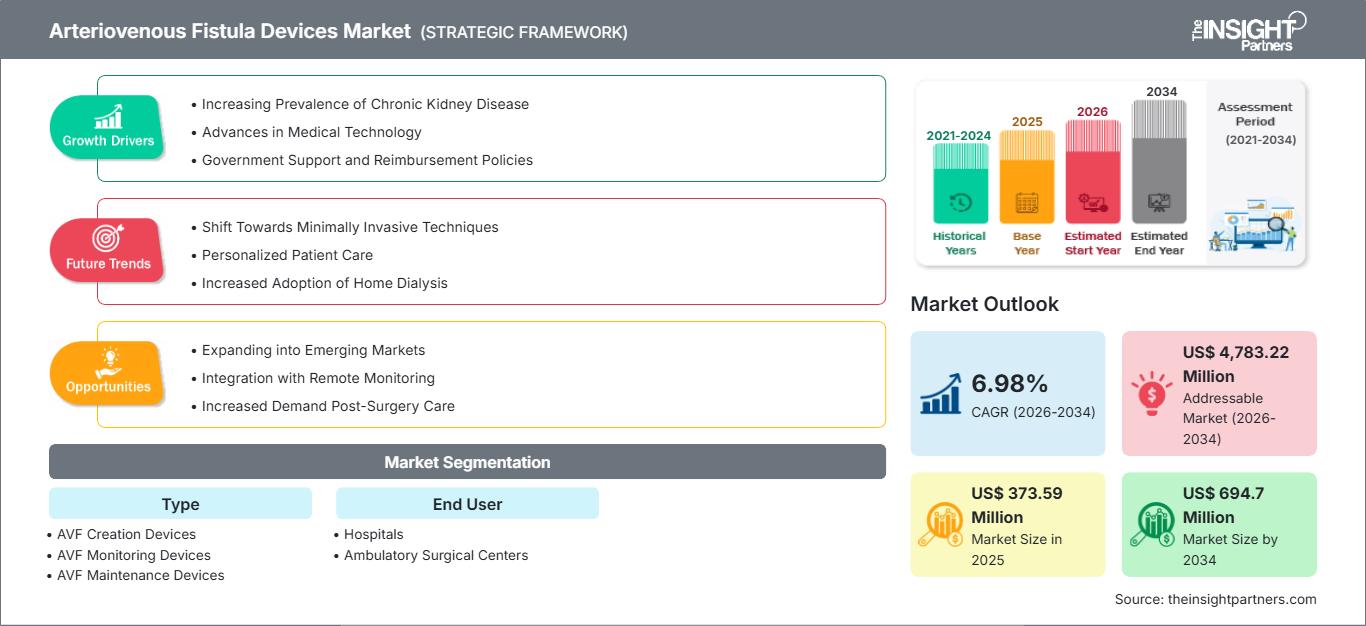
The global Arteriovenous Fistula Devices market was valued at US$ 373.59 million in 2025 and is expected to reach US$ 694.7 million by 2034; it is estimated to record a CAGR of 7.14% during 2026-2034.
Arteriovenous Fistula Devices Market Assessment and Insights
- North America: North America held a 34–38% arteriovenous fistula devices market share in 2025 and is expected to grow at a CAGR of 6.7–7.2% between 2026–2034, supported by mature dialysis networks, reimbursement, and established interventional vascular access capabilities.
- US: The US represented 70–74% of North America's 2025 share, with a 6.6–7.1% CAGR between 2026–2034, supported by high procedure volumes and adoption of percutaneous AVF creation.
- Europe: Europe accounted for a 27–31% share in 2025 and is projected to expand at a 6.3–6.9% CAGR through 2034. Germany, the UK, France, Italy, and Spain provide the principal demand base.
- Asia Pacific: Asia Pacific represented 24–28% in 2025 and is forecast to grow at a 7.5–8.3% CAGR between 2026–2034. China, Japan, South Korea, India, and Australia are the principal markets, supported by expanding dialysis capacity.
- Largest Segment: AVF Creation Devices represented a 48–52% market share in 2025 and is expected to register a 7.1–7.6% CAGR through 2034, reflecting procedural demand and technology adoption.
- High Growth Segment: AVF Monitoring Devices are estimated at a 21–25% share in 2025 and are projected to grow at 7.2–7.8% through 2034 as surveillance becomes more data-driven.
- Key companies analyzed in detail: Becton, Dickinson and Company, Abbott Laboratories, Medtronic plc, Terumo Corporation, Fresenius Medical Care AG, B. Braun Melsungen AG, Cook Medical LLC, Teleflex Incorporated, Vascular Pathways, Inc., W. L. Gore & Associates, Inc.
Source: The Insight Partners' analysis based on proprietary research, government publications, company annual reports, investor presentations, industry databases, and expert interviews.
The arteriovenous fistula devices market size has expanded from being an industry involving surgical creation to an ecosystem of endovascular creation, balloon angioplasty, covered stents, monitoring technology, and access-maintenance therapies. In response, manufacturing efforts have moved towards catheter-based systems, delivery system, imaging-friendly devices, and single-use procedure kits. Increasing differentiations will revolve around anatomical versatility, procedural efficiency, patency, and compatibility with established interventional methods.
Going forward, growth in the industry will be driven increasingly by emerging dialysis markets that involve growing vascular access infrastructure. The focus will be on minimally invasive creation systems, digital surveillance, and technology that can detect signs of maturation and stenosis sooner. Ease of use and safety of percutaneous procedures and their integration with outpatient settings will encourage companies to accumulate evidence for efficient shorter procedures and total lifecycle of access.
Arteriovenous Fistula Devices Market Report Scope
| Report Attribute | Details |
|---|---|
| Market size in 2025 | US$ 373.59 Million |
| Market Size by 2034 | US$ 694.7 Million |
| Global CAGR (2026 - 2034) | 7.14% |
| Historical Data | 2021-2024 |
| Forecast period | 2026-2034 |
Arteriovenous Fistula Devices Market Analysis
Demand growth for arteriovenous fistula devices will be primarily driven by the growth in population undergoing maintenance hemodialysis and clinical preference for durable vascular access. Thus, arteriovenous fistula devices market growth will be driven by the number of accesses created, maturation interventions, surveillance and repeated maintenance treatments. Value chain includes device vendors, vascular surgeons, interventional radiologists, nephrologists, dialysis providers, hospitals, and ambulatory surgical centers.
Supply side factors include increasingly favorable environment for catheter platforms and related devices for stenosis, thrombosis, and maturation failure. Clinical guidelines emphasize personalized vascular access planning and ongoing monitoring of the access through the access lifecycle, thus creating demand that is not once off but recurrent. Device vendors have opportunities to serve creation, monitoring and maintenance processes, whereas dialysis vendors drive purchasing decisions via protocols and procedure volumes.
Replacement and intervention-based demand is the source of revenue resilience in mature markets, whereas access creation is the key opportunity in developing markets. Competitive positioning is based on vascular access product line breadth, clinical evidence, physician familiarity, reimbursement capability and ability to provide solutions for both surgical and endovascular approaches. Becton, Dickinson and Company has a wide range of AV access solutions including creation and maintenance products. Medtronic plc competes through Ellipsys system and related vascular technology. Teleflex Incorporated, Terumo Corporation, and B. Braun Melsungen AG have interventional and vascular access offerings.
Abbott Laboratories, Cook Medical LLC, W. L. Gore & Associates, Inc. and Fresenius Medical Care AG have complementary solutions including vascular intervention, grafts, dialysis and access management. Innovation efforts will increasingly focus on less invasive creation, increased patency and monitoring of access patency. Consequently, competitive positioning will become less about individual product and more about patient access solution.
● REPORT CUSTOMIZATION
Tailor This Report To Align With Your Specific Business Requirements
This report can be customized to align precisely with your business objectives, scope, and target markets. Customization options include tailored segmentation, geography, competitive analysis, and strategic insights to support informed decision-making.
Customize This Report →WHAT YOU CAN ADJUST
- ● Segmentations
- ● Geography
- ● Competitive Analysis
- ● Language Preferences
Arteriovenous Fistula Devices Market: Strategic Insights
Regional Insights
North America arteriovenous fistula devices market
North America accounted for 34–38% of the global market in 2025 and is expected to expand at a 6.7–7.2% CAGR through 2034. The US is the lead regional market owing to its well-developed infrastructure of dialysis, well-versed vascular access programs, and the widespread use of interventional nephrology services. Canada provides a smaller but well-developed clinical opportunity especially due to the implementation of access planning and maintenance within hospitals.
The region enjoys the presence of reimbursement systems favoring the creation and follow-ups of AVFs, whereas outpatient vascular interventions become increasingly relevant. Endovascular creation systems can increase the number of physicians who take part in the process and minimize the role of open surgery. The need for devices is also driven by stenosis and maturation repeat procedures.
U.S. arteriovenous fistula devices market
The US represented 70–74% of North America's 2025 market and is forecast to grow at a 6.6–7.1% CAGR through 2034. High dialysis utilization established vascular access standards, and reimbursement for percutaneous creation and duplex surveillance underpin demand. Hospitals remain important, while ambulatory settings are gaining relevance for suitable interventions.
Becton, Dickinson and Company and Medtronic plc have prominent AVF technology positions, complemented by other vascular intervention suppliers. The US is also an important adoption market for endovascular creation, balloon angioplasty, covered stents, and monitoring technologies. Reimbursement schedules for percutaneous AVF creation and duplex follow-up provide a structured commercial framework for manufacturers and providers.
Europe arteriovenous fistula devices market
Europe represented 27–31% of the global market in 2025 and is projected to grow at a 6.3–6.9% CAGR through 2034. Germany is the leading country, while the UK, France, Italy, and Spain form the principal secondary markets. Mature dialysis services and established vascular access protocols support sustained replacement and intervention demand.
The UK and Germany emphasize structured dialysis access planning and specialist vascular services, while France, Italy, and Spain provide significant procedure volumes through hospital-centered renal care. Adoption differs by reimbursement, provider organization, and physician preference, creating a fragmented competitive environment. Manufacturers with broad portfolios can address both surgical and endovascular pathways, supporting regional penetration.
APAC arteriovenous fistula devices market
APAC held 24–28% of the market in 2025 and is expected to expand at a 7.5–8.3% CAGR through 2034. China is the leading market, followed by Japan, South Korea, India, and Australia. Expanding dialysis capacity and improving specialist infrastructure support device adoption.
China and India provide substantial long-term expansion potential as renal replacement services increase, while Japan and South Korea offer technologically mature demand. Australia benefits from established dialysis networks and clinical protocols. Government investment in renal care, hospital modernization, and specialist training should encourage adoption of advanced creation and monitoring technologies.
Middle East & Africa arteriovenous fistula devices market
Middle East and Africa represent a smaller opportunity but should maintain steady expansion as dialysis infrastructure develops. Saudi Arabia and the UAE lead regional adoption, supported by modern hospitals and specialist capacity, while South Africa remains an important African market for established dialysis services.
The region is expected to grow at approximately 5.8–6.5% through 2034. Energy-supported public investment in Gulf healthcare infrastructure and expanding private hospital networks create opportunities for advanced vascular access technologies. In Africa, affordability, trained specialists, and reliable supply remain key determinants of adoption.
Segmentation Analysis
Type
The Type segment encompasses AVF Creation Devices, AVF Monitoring Devices, and AVF Maintenance Devices. It is expected to expand at a 6.8–7.4% CAGR during 2026–2034. Creation remains commercially significant, while monitoring and maintenance benefit from the recurring nature of access surveillance and intervention. The arteriovenous fistula devices market scope increasingly covers the complete access lifecycle rather than creation alone.
- AVF Creation Devices: These devices support establishment of durable dialysis access through surgical or endovascular approaches. Demand is shaped by new dialysis starts, vascular anatomy, maturation requirements, and growing interest in less invasive procedures.
- AVF Monitoring Devices: Surveillance technologies identify changes in access flow, stenosis, maturation, or dysfunction. Their strategic importance is increasing as providers seek earlier intervention and more systematic management of access performance.
- AVF Maintenance Devices: Maintenance technologies address stenosis, thrombosis, and access dysfunction after creation. Their recurring procedural use makes them important for extending access usability and reducing premature access failure.
End User
The End User segment is projected to grow at a 6.7–7.3% CAGR through 2034. Hospitals retain the largest purchasing base because complex creation and maintenance procedures require multidisciplinary infrastructure. However, ambulatory surgical centers are gaining strategic importance as selected vascular interventions move toward shorter, lower-intensity procedural pathways.
- Hospitals: Hospitals remain the principal setting for complex AVF creation, revision, imaging, and intervention. Their multidisciplinary nephrology, vascular surgery, and interventional radiology capabilities support comprehensive access management.
- Ambulatory Surgical Centers: ASCs are increasingly relevant for suitable access procedures requiring shorter stays. Their value proposition centers on procedural efficiency, lower facility intensity, and improved utilization of specialized outpatient infrastructure.
Opportunity Snapshot
| End User | Revenue Contribution (High/Medium/Low) | Trend Tag | Adoption Stage |
|---|---|---|---|
| Hospitals | High | Complex Access | Mature |
| Ambulatory Surgical Centers | Medium | Outpatient AVF | Scaling |
Arteriovenous Fistula Devices Market Growth Drivers and Impact Analysis
Increasing Hemodialysis Population and Access Requirements
The expanding population requiring maintenance hemodialysis creates a direct need for reliable vascular access. The importance of AV fistulas still stands because of their ability to create reliable access once formed. With aging of dialysis patients and growing comorbid conditions, clinicians have to have access to more tools that will help them map, create, mature, monitor, and revise these accesses. This allows creating the business case not only of initial creation but also repeated interventions. The providers are thus looking at access technology from the perspective of the lifecycle costs of the product – procedure rate, patency, hospital avoidance, and resource usage. For the manufacturers, the increase in the dialysis population will mean more access patients and thus more repeat procedures.
Shift Toward Minimally Invasive AVF Creation
Endovascular fistula creation is changing the competitive structure by providing alternatives to conventional open surgery. Devices such as WavelinQ and Ellipsys demonstrate how catheter-based approaches can create AV fistulas through less invasive procedures and potentially expand the pool of physicians able to perform access creation. Influence spans hospitals, interventional radiology, and ambulatory centers since the procedural process is adaptable to the current endovascular equipment infrastructure. Further adoption of the system also generates second order effects for assistance, angioplasty, embolization, imaging, and surveillance. Those manufacturers who incorporate creation technology alongside maintenance technology would be able to increase their share of the procedure's economics. In the future, it will be clinical evidence and training that would decide the pace at which minimally invasive techniques make their way into traditional surgery.
Greater Emphasis on Access Surveillance and Patency
In the light of these consequences of access failure, healthcare providers will pay increased attention to early detection of stenosis, thrombosis, risks of aneurysm and maturation issues. Surveillance may help ensure timely intervention to prevent access from becoming non-functional, thus forming the repeated need for diagnostics and maintenance solutions. The commercial aspect is especially important for vendors who create integrated devices using physiological data, imaging results, data of dialysis machines and EHRs. Predictive analysis may eventually allow moving the vascular access management from reactive intervention to risk-based surveillance. For example, the strategy called "Access360" that involves artificial intelligence in different aspects of vascular access – from planning, through maturation surveillance and functioning to life cycle – was officially announced by Fresenius Medical Care AG.
Arteriovenous Fistula Devices Market Future Trends
Predictive Monitoring Across the AVF Lifecycle
The arteriovenous fistula devices market trends are likely to increasingly reflect predictive rather than purely reactive access management. Future monitoring platforms may combine ultrasound, flow measurements, dialysis-machine parameters, patient records, and acoustic or imaging signals to identify elevated failure risk. Artificial intelligence could prioritize patients requiring clinical review while reducing unnecessary routine interventions. Manufacturers are likely to develop software-enabled ecosystems that connect creation history with maturation and maintenance records, producing a longitudinal access profile. Such platforms may also support standardized decision-making across dialysis networks, allowing clinicians to compare access performance and intervention timing. Commercial opportunities will emerge for companies capable of integrating hardware, analytics, clinical workflows, and cybersecurity into scalable platforms suitable for hospital and outpatient environments.
Expansion of Endovascular Creation Pathways
Endovascular creation is expected to progress from a specialist alternative toward a more established option within appropriate patient populations. Greater procedural familiarity, anatomical mapping, operator training, and evidence generation should support broader utilization. Future development is likely to focus on improving patient selection, simplifying catheter systems, shortening procedure time, and reducing the number of subsequent maturation interventions. Integration with ultrasound and other image-guided technologies could further improve procedural planning. The trend may also support ambulatory adoption because selected procedures can be performed without conventional surgical infrastructure. Competition will increasingly center on clinical outcomes, reproducibility, anatomical versatility, and total cost of access creation rather than simply the technical novelty of the device.
Arteriovenous Fistula Devices Market Opportunities
Building Integrated Access-Lifecycle Portfolios
Manufacturers can pursue greater value capture by combining creation, monitoring, and maintenance technologies into integrated access-lifecycle portfolios. The arteriovenous fistula devices market Forecasts indicate that recurring intervention requirements can provide a more resilient commercial opportunity than dependence on initial creation procedures alone. Companies with complementary catheter, balloon, stent, imaging, and monitoring capabilities can establish stronger relationships with dialysis networks and hospital systems. Strategic partnerships with nephrology providers could generate clinical evidence while helping manufacturers optimize protocols around patient selection, maturation, and surveillance. Integration also creates opportunities for bundled procurement and standardized access pathways. The most attractive strategies will prioritize measurable improvements in patency, procedure efficiency, and intervention timing rather than simply expanding product breadth.
Expanding Access Technologies in Emerging Dialysis Systems
Emerging dialysis markets provide an opportunity to adapt established AVF technologies to different reimbursement, infrastructure, and training environments. Manufacturers can develop tiered product configurations that balance clinical functionality with affordability while supporting local physician education and procedural training. Partnerships with regional distributors, dialysis networks, and tertiary hospitals could improve market access without requiring immediate large-scale infrastructure investment. China and India are particularly relevant because expanding renal care capacity can increase demand for both new fistula creation and subsequent maintenance. Local regulatory strategies, supply-chain resilience, and clinician training should be considered alongside pricing. Companies that tailor products and service models to local procedural capabilities may establish stronger positions than suppliers relying solely on premium-market commercialization approaches.
Recent Developments
- June 2025: Fresenius Medical Care AG presented its Access360 artificial intelligence approach at its Capital Markets Day, describing applications across AVF pre-placement, maturation monitoring, long-term function, and end-of-life assessment. The company highlighted models intended to support intervention-free survival assessment, maturation prediction, aneurysm and thrombosis risk evaluation, and timely cannulation decisions.
- 2025: Becton, Dickinson and Company continued commercialization and clinical development surrounding its WavelinQ EndoAVF platform, which provides an endovascular alternative for AV fistula creation. The system uses magnetic catheters and radiofrequency energy, while the company's clinical program includes post-market surveillance for endovascular AVF creation and studies of AV access interventions.
- 2025: Medtronic plc continued offering the Ellipsys Vascular Access System for percutaneous AVF creation. The single-catheter system creates a proximal radial artery to perforating-vein anastomosis in appropriately selected dialysis patients, with labeling emphasizing vessel anatomy, ultrasound-guided expertise, and potential maturation procedures following creation.
Frequently Asked Questions

- Comprehensive Market Sizing and Forecast Analysis
- Detailed Segmentation Analysis
- In-Depth Market Dynamics Assessment
- Regional and Country-Level Insights
- Competitive Landscape and Company Benchmarking
- Strategic Business Intelligence
Recent Reports
Testimonials

The Insight Partners provided valuable market intelligence that supported our global go-to-market strategy. Their team was professional, responsive, and attentive to our feedback, providing thoughtful analysis and helpful methodological clarifications throughout the project.
Junmo Kim Chief Financial Officer (CFO), Enertech Co., Ltd.
The Insight Partners' SCADA System Market report is comprehensive, with valuable insights on current trends and future forecasts. The team was highly professional, responsive, and supportive throughout. We are very satisfied and highly recommend their services.
RAN KEDEM Partner, Reali Technologies LTDs
I requested a report on a very specific software market and the team produced the report in a few days. The information was very relevant and well presented. I then requested some changes and additions to the report. The team was again very responsive and I got the final report in less than a week.
JEAN-HERVE JENN Chairman, Future Analytica
We worked with The Insight Partners for an important market study and forecast. They gave us clear insights into opportunities and risks, which helped shape our plans. Their research was easy to use and based on solid data. It helped us make smart, confident decisions. We highly recommend them.
PIYUSH NAGPAL Sr. Vice President, High Beam Global
The Insight Partners delivered insightful, well-structured market research with strong domain expertise. Their team was professional and responsive throughout. The user-friendly website made accessing industry reports seamless. We highly recommend them for reliable, high-quality research services
YUKIHIKO ADACHI CEO, Deep Blue, LLC.
This is the first time I have purchased a market report from The Insight Partners.While I was unsure at first, I visited their web site and felt more comfortable to take the risk and purchase a market report.I am completely satisfied with the quality of the report and customer service. I had several questions and comments with the initial report, but after a couple of dialogs over email with their analyst I believe I have a report that I can use as input to our strategic planning process.Thank you so much for taking the extra time and making this a positive experience.I will definitely recommend your service to others and you will be my first call when we need further market data.
JOHN SUZUKI President and Chief Executive Officer, Board Director, BK Technologies
I wish to appreciate your support and the professionalism you displayed in the course of attending to my request for information regarding to infectious disease IVD market in Nigeria. I appreciate your patience, your guidance, and the fact that you were willing to offer a discount, which eventually made it possible for us to close a deal. I look forward to engaging The Insight Partners in the future, all thanks to the impression you have created in me as a result of this first encounter.
DR CHIJIOKE ONYIA MANAGING DIRECTOR, PineCrest Healthcare Ltd.Reason to Buy
- Informed Decision-Making
- Understanding Market Dynamics
- Competitive Analysis
- Identifying Emerging Markets
- Customer Insights
- Market Forecasts
- Risk Mitigation
- Boosting Operational Efficiency
- Strategic Planning
- Investment Justification
- Tracking Industry Innovations
- Aligning with Regulatory Trends





 Get Free Sample for